
Someday Farm · SomedayFarm.org Stephen Watson
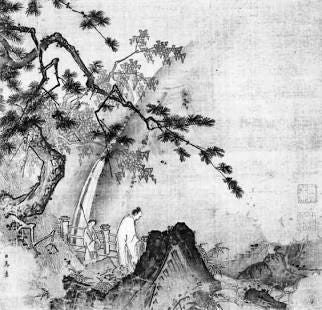
The Substance of Absence: a Path of Guided Meditation When the dark tip of a brush first touches a pale expanse of silk, a world is born. We naturally lean forward to follow the heavy track of the ink, watching the mountain peaks rise or the plum branches bend. Yet, the true life of the work breathes in the silent field surrounding those dark strokes. This is the ancient aesthetic principle of: 留白, Liúbái (to Leave empty space in a work of Art.) It is not a passive background, nor is it a mere failure to finish the canvas. We find this beautifully illustrated in the classic landscape painting by the Southern Song Dynasty Sage: Mǎ, Yuǎn (馬遠.) In his masterpiece, “A Scholar Looking at a Waterfall,” the entire right side of the scroll is left completely untouched. This vast blankness is not empty nothingness; it is the mist rising from the valley, the cool mountain air, and the quiet movement of a river. The painted figure of the scholar is placed carefully in the corner, and his tiny presence generates the grand scale of the entire mountain. The ink stroke is applied not to draw our eyes to itself, but to show us what has not been painted. A Scholar Looking at a Waterfall by Mǎ, Yuǎn Source: Chinasage To grasp this generative quality, we must distinguish it from the Western artistic concept of negative space. In the Western tradition, negative space is typically privative: it is space left empty in support of shaping, outlining, or emphasizing what is painted. Negative space allows the viewer of the Artwork, with the help of what has not been painted, to see what has been painted. In stark contrast, Liúbái is generative: it allows the viewer of the Artwork to see what has not been painted. The brushstroke is a boundary that makes the surrounding void a tangible, breathing reality. It invites the life force of the universe to flow through the open paper: 氣, Qì (Life’s Everflowing Energy.) When this aesthetic sensibility traveled East from China, it was embraced by the Artists and Zen monks of Japan. They adopted the practice of leaving the paper bare, translating the concept into their own artistic vocabulary as: 余白, Yōhaku (Remaining white space.) While the two terms appear nearly identical on the surface, this transition across the sea brought a subtle but important shift in meaning. First, Chinese Liúbái is deeply tied to the flow of vital energy: 氣, Qì. The empty space is treated as a dynamic, moving medium through which the life force of nature circulates. Second, Japanese Yōhaku shifts the focus toward rustic simplicity and contemplative stillness. It is closely aligned with the aesthetic of finding beauty in impermanence and imperfection: 侘寂, Wabi Sabi (The beauty of the imperfect and impermanent.) By moving from the dynamic circulation of energy in China to the quiet stillness of Japan, we find a perfect bridge to the temporal world. This aesthetic of remaining space is not limited to the canvas. In Japanese culture, the physical space...
0:01SPEAKER_00Hello, I'm Stephen Watson of SomedayFarm.org.
0:09SPEAKER_00This is The Breathing Canvas,
0:14SPEAKER_00a guided meditation on the nature of space and self.
0:24SPEAKER_00Let us begin this guided meditation by settling into a posture of quiet comfort,
0:35SPEAKER_00Whether you are sitting on a cushion or a chair, feel your body release.
0:43SPEAKER_00Feel the weight of your body settling down.
0:47SPEAKER_00Feel the weight of your body received by all that is beneath.
1:15SPEAKER_00We begin with the practice of quiet sitting, Ching Tzuo.
1:25SPEAKER_00Let your hands rest on your thighs or join them together to form a traditional gesture of focus.
1:42SPEAKER_00Close your eyes or let your gaze rest softly on the floor.
2:23SPEAKER_00Take a deep breath in, feeling the cool air enter your nose.
2:29SPEAKER_00And then, after appreciating the in-breath, let it out with a slow sigh.
2:47SPEAKER_00This breath is the movement of your vital life force.
2:59SPEAKER_00As you breathe, feel your shoulders drop away from your ears.
3:05SPEAKER_00Feel your shoulders releasing the accumulated tension of the day,