
Someday Farm · SomedayFarm.org Stephen Watson
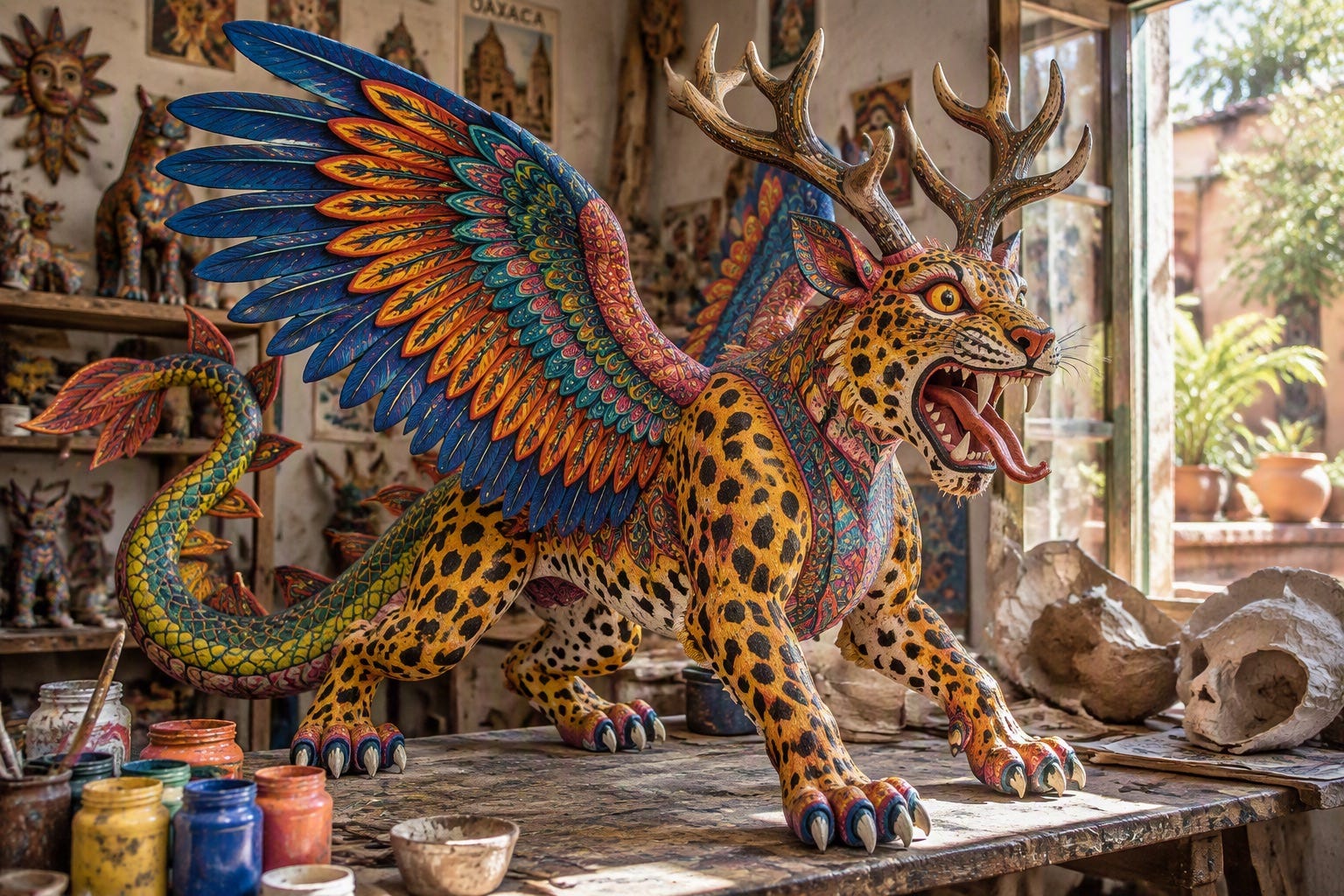
Living Dreams: Alebrijes as Cultural History and Psychological Canvas The vibrant Mexican folk-art forms known as the Alebrije represent one of the most remarkable artistic evolutions of the twentieth century. Combining vivid coloration, intricate pattern work, and impossible anatomical amalgamations, these figures bridge the boundary between physical craftsmanship and the unfettered subconscious. Understanding the origins, evolution, and contemplative resonance of the Alebrije reveals an art form that is simultaneously a cultural treasure and a profound canvas for inner exploration. Historical Origins and Cartonería The tradition of the Alebrije began in Mexico City during the 1930s through the work of Pedro Linares López, a skilled artisan specializing in Cartonería, Cartonería (Traditional Mexican papier-mâché crafting technique.) In 1936, Linares contracted a severe illness that left him bedridden and feverish. During this period of delirium, he experienced a vivid dream in which he walked through a strange, quiet forest. The landscape was populated by extraordinary hybrid beasts, a jaguar bearing eagle wings, a serpent with a deer antlers, and creatures blending domestic and wild forms. These entities repeatedly cried out a single nonsensical word: “Alebrijes.” Upon recovering his health, Linares sought to render these visions tangible using his familiar medium of papier-mâché. Constructing wire frameworks and layering paper treated with paste, he sculpted the feverish chimeras of his dreamscape and painted them with bold, contrasting colors. These original creations captured the attention of prominent Mexican artists, including Diego Rivera and Frida Kahlo, who recognized the distinct inventiveness of the medium. The resulting patronage propelled Linares’ work into national and international recognition. The Oaxacan Evolution As the concept gained fame across Mexico, artisans in the Valley of Oaxaca adapted the vision to their regional traditions of woodcarving. Working primarily with the soft, workable wood of the Copal, Copal (A native tree species whose resinous wood is traditionally carved in Oaxaca.) tree, Oaxacan carvers such as Manuel Jiménez Ramírez began shaping hybrid beasts from single or joined branches. While retaining the whimsical hybrid nature of Linares’ papier-mâché originals, Oaxacan Alebrijes developed a distinct visual language. Craftsmen and their families began decorating the carved wooden surfaces with ultra-fine, highly structured brushwork. These patterns incorporate ancient Zapotec iconography, intricate geometric motifs, micro-dots, and radiant color gradients. Today, Oaxacan Alebrijes are celebrated globally as a primary symbol of regional artistic identity, blending indigenous carving heritage with modern fantastical imagination. Contemplative Symbolism and the Inner Landscape Unlike mythological figures such as dragons, phoenixes, or chimeras, which carry fixed cultural or moral symbolism, an Alebrije has...
0:01SPEAKER_00Hello, I'm Stephen Watson of SomedayFarm.org,
0:07SPEAKER_00and this is Alebrije Art from Dreamland,
0:11SPEAKER_00a Oaxacan guided meditation for a troubled subconscious.
0:19SPEAKER_00Sit comfortably, allowing your posture to be both grounded and spacious.
0:32SPEAKER_00Close your eyes and bring your gentle,
0:35SPEAKER_00unhurried attention to the natural rhythms of your breath.
0:40[music]
1:02SPEAKER_00Inhale slowly through your nose, feeling the expansion in your ribs
1:10SPEAKER_00and in your belly.
1:14SPEAKER_00And exhale fully, allowing your shoulders to soften away from your ears.
1:23SPEAKER_00With each breath, feel the support of the earth beneath you.
1:32SPEAKER_00You are completely safe here in this moment.
1:37SPEAKER_00This sanctuary of your mind is entirely secure, protected, and fully under your stewardship.
1:48SPEAKER_00Nothing here can harm you.
1:52SPEAKER_00You are the conscious observer held in safety.