
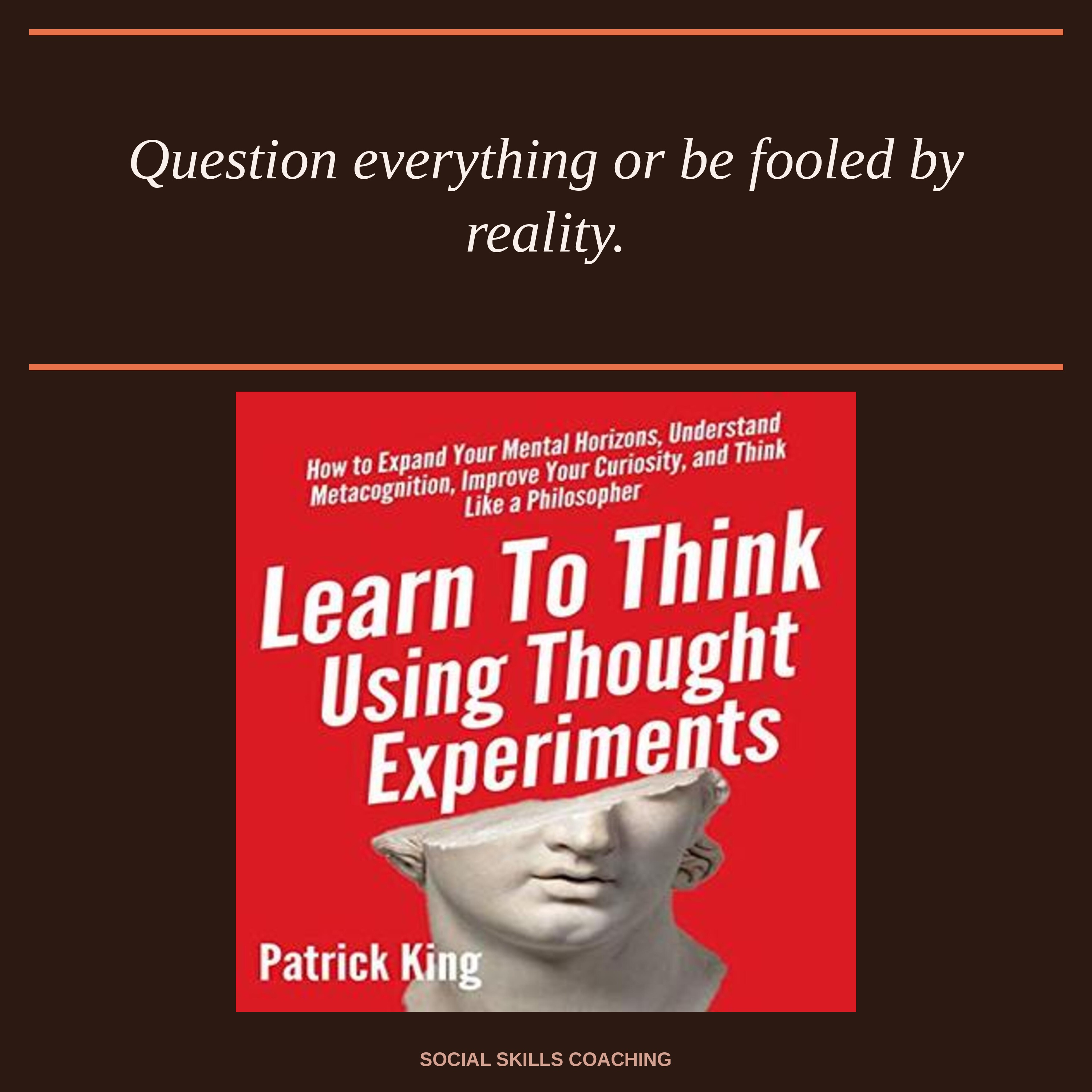
Social Skills Coaching · Patrick King
Patrick King explores how thought experiments, like Schrödinger's cat, challenge our beliefs and assumptions. Learn to question your own knowledge and open the door to new ideas and perspectives. Discover the power of systematic thinking in understanding complex issues. ⏱ CHAPTERS 0:00 Intro 1:39 The Struggle for Knowledge 3:12 Thought Experiments Overview 5:49 Virtues and Drawbacks of Thought Experiments 7:22 Types of Thought Experiments 9:57 Philosophical Implications of Thought Experiments 12:04 Historical Examples of Thought Experiments 15:12 Schrödinger's Cat Explanation 18:21 Critical Thinking Through Thought Experiments 21:29 Newton's Cannon Example 23:33 Practical Applications and Benefits Learn To Think Using Thought Experiments: How to Expand Your Mental Horizons, Understand Metacognition, Improve Your Curiosity, and Think Like a Philosopher (Clear Thinking and Fast Action Book 5) By Patrick King Hear it Here - https://bit.ly/ThoughtExpKing Use the mental tools that the world's greatest thinkers used to generate epiphanies, explore the world, and hone their reasoning. In traditional education, you're taught to recite and regurgitate. Going a step farther, you might learn some critical thinking skills. But what about applying them in the most audacious, fascinating, and inquisitive ways possible with thought experiments? Philosophical and exploratory thinking pushes your boundaries and opens new worlds. Learn to Think Using Thought Experiments is about how to analyze, perceive, and interact with information and situations - all in your mind and imagination. It poses a hypothetical and forces you to engage it and answer questions and reason through arguments you've never known. This book will confuse, frustrate, and ultimately improve your thinking prowess like nothing else, on account of being thrown into the mental deep end. Challenge yourself and you will grow. Improve critical thinking by applying it in innovative and novel ways. Patrick King is an internationally bestselling author and social skills coach. His writing draws of a variety of sources, from scientific research, academic experience, coaching, and real life experience. Become more naturally curious, inquisitive, and Sherlock Holmes-like. - The curious case of two cats and what they teach us about uncertainty. - What choosing between 1 and 5 people says about you. - Why this entire world might just be a dream or simulation. - What a javelin has to do with infinite. - How Zeno's tortoise represents the point where reality and numbers diverge. - How Chinese logicians, beetles, fish, and monkeys demonstrate different angles of reality and perception. Learn to thrive in uncertain situations and contemplate more thoroughly and deeply. Thought experiments are a classic tool that everyone can use, and they enable us to explore more abstract situations and reason through them. Master thought experiments and you can master simply dealing with difficult, uncertain, impossible, or...
0:00Did you know that your thinking about hypothetical scenarios could actually change the way you view reality?
0:14Hello listeners, welcome to Social Skills Coaching, where you become more likeable, more charismatic, and more productive.
0:23Today from Patrick King's book, Learn to Think Using Thought Experiments, we're going to explore the boundaries of thought.
0:31We're going to take a look at some thought experiments that will stretch your mind to its limits and making you question everything and everyone from the trolley problem to Schrodinger's cat.
0:45Each scenario forces new perspectives and deepens your cognitive flexibility, expanding how you see the world.
0:53Let's get into it.
0:54Chapter 1.
0:59Thinking About Thinking
0:59There was a time when mankind knew so much less about the world.
1:03We take so much of what’s around us as a given, forgetting where it came from.
1:08Look around you and you’ll see that almost everything was, at some point, discovered or created by some enterprising or curious human being.
1:17The devices you use daily, the symbols making up the language you’re reading right now, the mechanics of the electricity powering your home, all the medical marvels that went into keeping you alive and well in this moment… (Ignore the fact that someone once had to look at a cow and decide “I will try to drink whatever comes out of these pink things.”)
1:38Each of these accomplishments had to be fought for and won, one tiny step at a time.
1:44Much of what our modern world is made of comes directly from the diligent effort of people working to understand the universe—and create their own inventions.
1:54All this scientific and technological progress was made not simply by sheer force of will or strength, but by using the scientific method, and seeing the world in a way that prioritizes rational argument founded on sound empirical or logical data.