
SMB Tech & Cyber Newsletter | CPF Coaching · CPF Coaching | Christophe Foulon
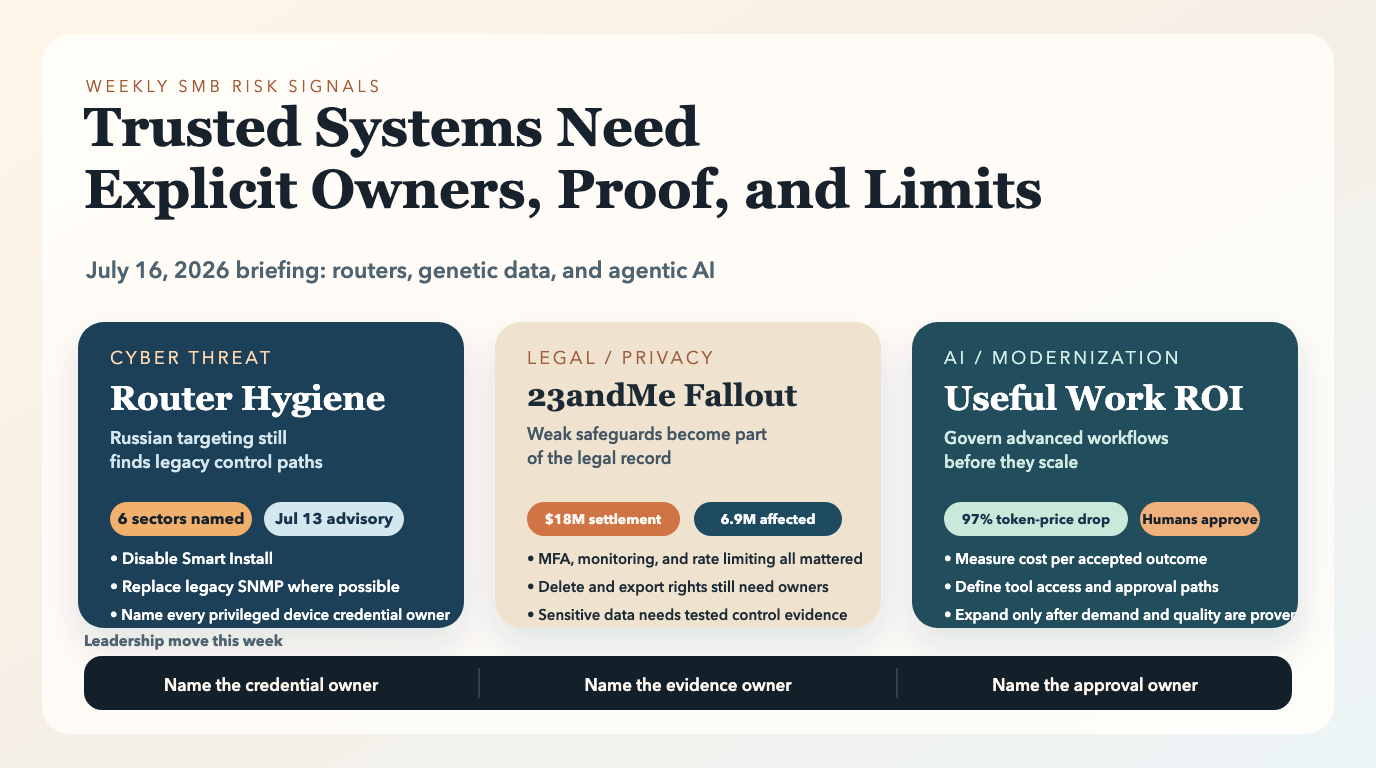
On July 13, 2026, CISA and a broad coalition of U.S. and allied agencies warned that Russian state-sponsored actors continue to exploit poorly configured routers across six critical sectors, often by abusing legacy SNMP settings and exposed management paths. On July 14, 2026, a 42-state coalition secured an $18 million settlement from 23andMe after a breach that affected 6.9 million consumers and exposed how weak multifactor authentication, weak monitoring, and vague deletion controls fail under pressure. Also on July 14, 2026, OpenAI argued that agentic AI investments should be measured by useful work per dollar and governed before advanced workflows scale. These are not three unrelated headlines. They are one operating problem. The systems you trust most now need explicit credentials, evidence, and approval paths. If a router can quietly hand over configuration data, if a sensitive-data platform cannot prove its basic safeguards were reasonable, or if an AI workflow scales before you can define who approves risky actions, the business is still running on trust it has not recently re-earned 1. Router Hygiene Still Decides Whether an Adversary Gets a Shortcut The July 13 advisory matters because it is not about exotic zero-days. It is about weak operational hygiene on devices that sit close to identity, routing, and network control. CISA said the actors primarily scan for poorly configured networking devices, especially routers, and use SNMP weaknesses, Cisco Smart Install, and exposed management portals to get what they need. Why You Should Be Concerned: * Six sectors were named: Communications, defense industrial base, energy, financial services, government services, and healthcare were identified as the highest-risk sectors, which is a reminder that routers stay business-critical even when they feel invisible. * Legacy settings are still the entry point: The advisory says the actors look for SNMP agents that accept common or default community strings, then use those settings to copy device configurations and send them off-network. * Credential quality is part of network defense: The mitigation guidance specifically calls for strong, unique passwords, secure storage, and local accounts used only for emergencies. Strategic Action: Treat routers, firewalls, and network-device management paths as privileged systems, not background plumbing. If you cannot name who owns their credentials, firmware cadence, and emergency access path, you do not yet control the trust boundary they create. This Week’s Leadership Move: * Confirm which routers, switches, and firewalls still allow SNMPv1, SNMPv2, or broad management access from outside your management network. * Require a named owner for every privileged network-device credential and rotate any password that is shared in tickets, notes, or chat history. * Ask your MSP or network partner to show whether Cisco Smart Install is disabled and which management ports remain externally reachable by...
0:00SPEAKER_00This week's SMB Risk Signals, Reuter Hygiene, Genetic Data, and Agentic AI.
0:05SPEAKER_00The systems you trust most need explicit credentials, evidence, and approval paths.
0:10SPEAKER_00This is the SMB Tech & Cybersecurity Leadership Newsletter.
0:14SPEAKER_00On July 13th,
0:15SPEAKER_00On June 13, 2026,
0:16SPEAKER_00CISA and a coalition of US and allied agencies warned
0:22SPEAKER_00that Russian state-sponsored actors are still exploiting poorly configured routers
0:27SPEAKER_00across six critical sectors,
0:30SPEAKER_00On July 14,
0:30SPEAKER_002026, a 42-state coalition secured an $18 million settlement from 23andMe.
0:45SPEAKER_00Also on July 14th, 2026, Open A.
1:03SPEAKER_00I argued that agentic AI investments should be measured by useful work per dollar
1:10SPEAKER_00and governed before advanced workflow scale.
1:13SPEAKER_00These are not three unrelated headlines.
1:16SPEAKER_00They are one operating problem.