
Small Team Big Scale · Ron Schmelzer, Scalebrate
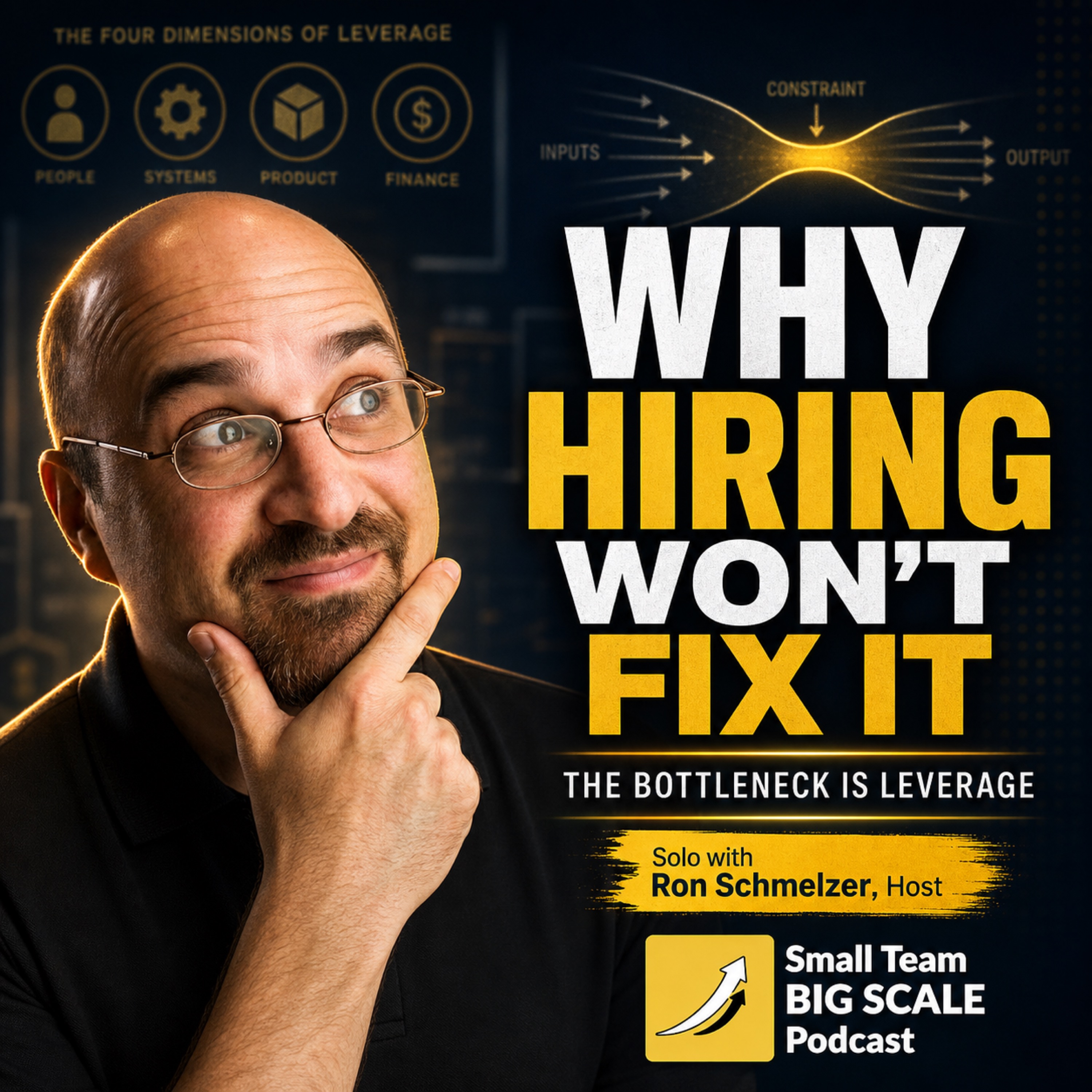
You hired the team. 5, 10, 15 people. Revenue grew. But every meaningful decision still lands on your desk. The team runs the business, but you drive it, and that's the bottleneck hiring was supposed to fix. In this episode, Ron Schmelzer reframes the founder-bottleneck as a leverage problem, not a hiring problem. Hiring solved execution drag but created decision drag. The bottleneck moved from "you doing the work" to "you deciding what work gets done." Using the Scalebrate Leverage Framework: Systems, Team Output, Revenue Architecture, and Time Autonomy, Ron walks through why adding headcount doesn't create output multiplication, and what leverage-first scaling actually looks like. This is Episode 2 in a 4-part solo discovery series. No experts with all the answers, just operators living it. If you're a $2-10M founder still making every call, this one's for you. What you'll learn: Why revenue per employee goes down after your first hires — and what that signal means How hiring solves execution drag but creates decision drag The Leverage Framework: four dimensions that multiply output without multiplying headcount Why systematizing decisions matters more than systematizing tasks How revenue architecture determines whether growth is linear or leveraged Time autonomy: recovering hours isn't enough — you need systems that run without you The discovery ask: what operational fire do you re-fight every month? Links: Scalebrate: https://scalebrate.com Small Team Big Scale Podcast: https://scalebrate.com/podcast
0:02Now, the thing that differentiates the grinders
0:05from the scalers is the grinders continue to
0:07do those activities that got them to their first
0:10million to try to get them to the second million.
0:12And if you're working so hard to get that first
0:15million, you're going to work twice as hard to
0:17get to that second million. That's not scaling.
0:19That's just throwing more work, more labor, more
0:23effort against a problem. A smart way to do it
0:25is to realize that, hey, You figured out the
0:28core of what your business is, the core of what
0:31you're offering, to get you to a million. But
0:34now you need to really work on those processes,
0:36those systems, the leverage aspects, so that
0:40you can not only get to 2 million, but to 3,