
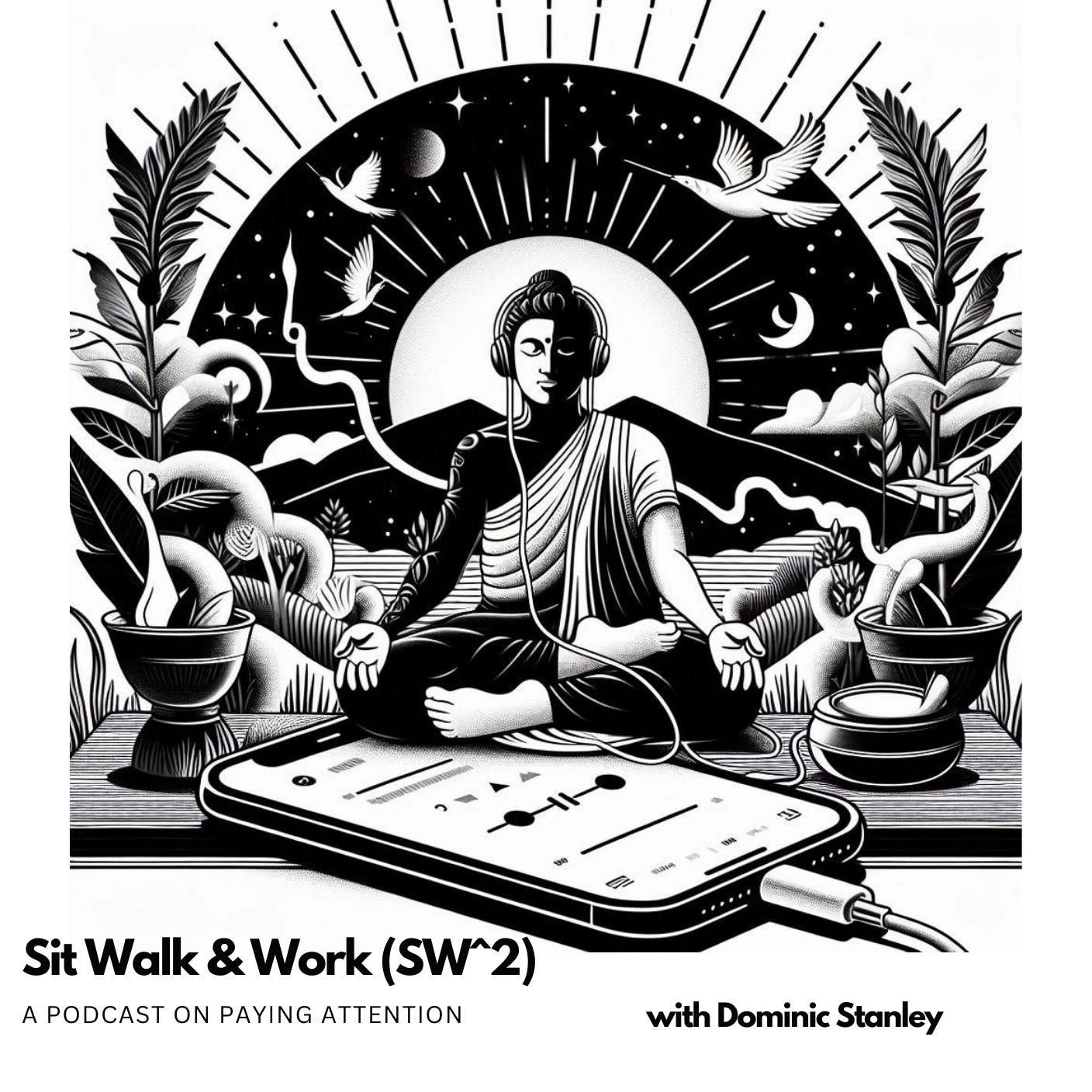
Sit,Walk,Work (SW^2) · Dominic Stanley
Introduction: More Than Just Sitting Still For many of us—especially if you’re just beginning a meditation journey or if you’re convinced you have “no time” for this—meditation can feel like an impossible ask. The challenge isn’t just about finding a quiet corner or managing a packed schedule. It’s what happens the moment you stop: the onslaught of thoughts, the subtle worries about doing it right, and the constant debate about what you “should” be doing next, instead of sitting here trying to calm your mind. I’m Dominic, your host on the Sit Walk Work podcast, and in this post, I want to talk about the subtle power of paying attention—a skill that, when infused with friendliness, balance, and compassion, can transform not just your meditation practice, but your experience of daily life. Arriving and Checking In: Your Starting Line Every Time Before we actually sit down and “do” meditation, there’s an important step that most of us overlook: arriving. I’m not talking about getting to the mat or finding a cushion—it’s the process of really noticing what you’re bringing into each moment. This could be tiredness, residual tension from a tough Zoom call, or even anticipation about what’s for dinner. Just by pausing and checking in with yourself—feeling your breath, the weight of your body, where your feet land—you set a foundation for your practice 03:14. You give yourself permission to let go of the idea that you’re supposed to be somewhere else, or someone else. This is your authentic starting point, every single time you practice. The Breath as Home Base: Letting Nature Do the Work One of the simplest yet profound instructions we revisit is to rest your attention on your natural breathing. Not forcing it, not striving for some ideal state—just noticing, with curiosity, how the breath moves through your body right now 05:49. It might be shallow, deep, smooth, or ragged—none of that is wrong. The practice becomes an invitation to feel an inhalation from beginning to end, and then an exhalation in the same way, observing the natural cycle—receiving, releasing, beginning again. This focus, steady yet soft, gives our busy mind something gentle to anchor to, while teaching us that it’s okay to let go, even of the breath itself 07:25. Meeting Reactivity with Friendliness and Balance It’s natural for discomfort, distraction, or even difficult memories to arise. Maybe your jaw tightens as you think about a tense conversation, or your breath feels stuck after recalling a challenging situation 10:00. Here’s where the real work (and the magic) begins. Instead of running from discomfort or trying to reason it away, you offer it friendliness—a sense of okayness. This doesn’t mean approval; it means not making things worse and refusing to pile on with judgment or self-criticism 14:09. By simply noticing how your mind reacts to pleasant, unpleasant, or neutral sensations, and greeting those reactions with a little bit of kindness and balance, you give yourself...
0:07SPEAKER_01As we begin to arrive for practice.
0:15SPEAKER_01Notice the bracing of your breathing.
0:21SPEAKER_01Feel the weight of your body kind of settling in to the practice.
0:34SPEAKER_01Let yourself arrive to the spaces and places that kind of feel supported.
0:44SPEAKER_01The feet resting on the ground or your sits bones resting on the mat.
1:00SPEAKER_01Remembering that we're here to notice.
1:02SPEAKER_01We're here to understand.
1:05SPEAKER_01And more important, we're here not to make things worse.
1:07SPEAKER_01We're trying to keep things a little more balanced, a little more equanimous.
1:24SPEAKER_01Last week,
1:25SPEAKER_01I talked a little bit about having a bit of a friendly attitude
1:28SPEAKER_01towards what comes up in practice.
1:30SPEAKER_01And I want us to stay with that idea, but I also want to add to it the balance.
1:38SPEAKER_01That's the not making it worse piece.
1:42SPEAKER_01Because those two work hand in hand really in conjunction to what we're doing.