
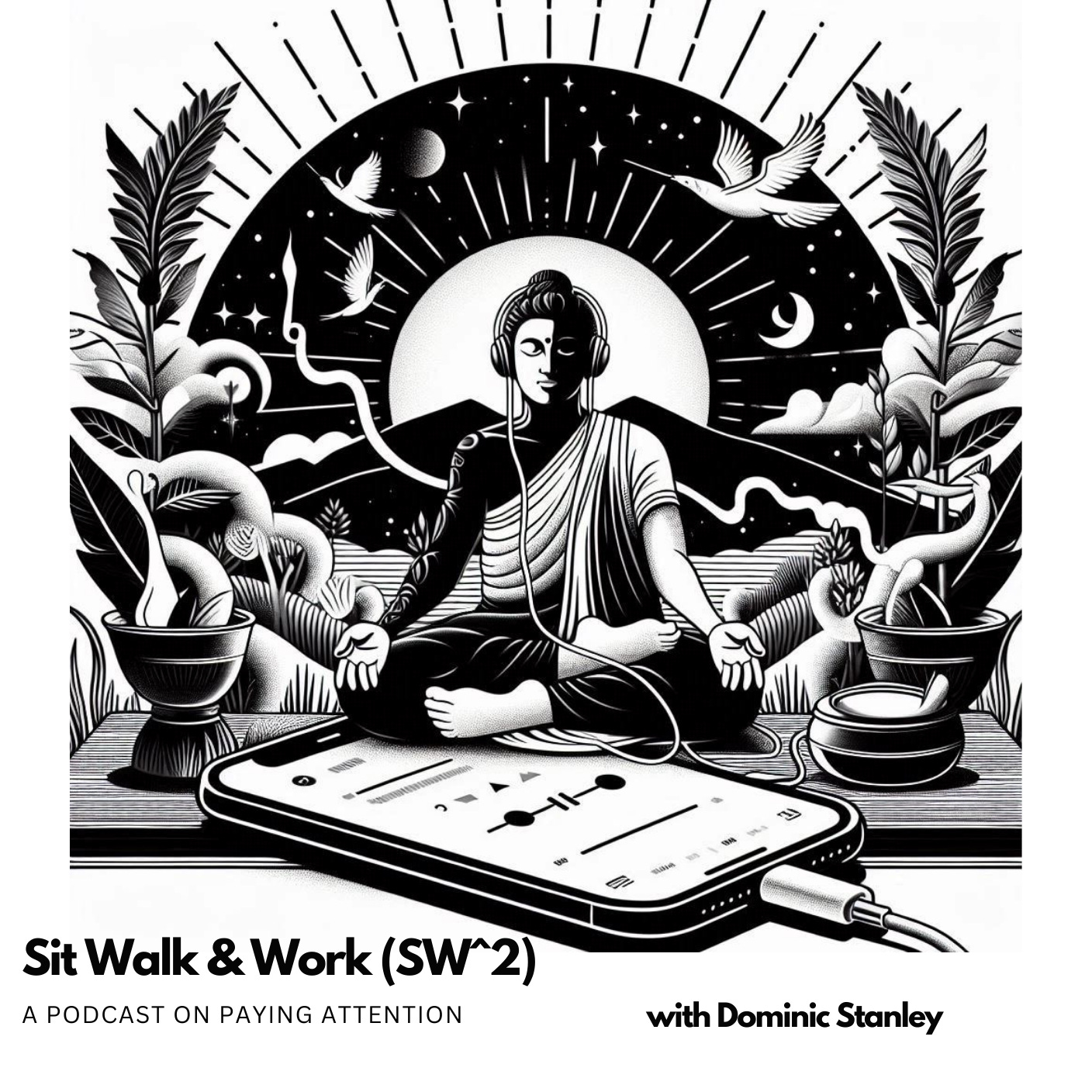
Sit,Walk,Work (SW^2) · Dominic Stanley
Introduction: The Art of Paying Attention In today’s episode of the Sit Walk Work podcast, I guided listeners through a meditation centered on the concept of flourishing—how growth happens not just in nature but within our lives, bodies, and moment-to-moment experiences. Through this practice, we explored the intricate relationships between breath, body, and mind, and how mindful attention can become the soil in which personal growth takes root. Grounding the Mind: Anchoring In Breath and Body We began our journey by grounding ourselves in the present moment. I emphasized the importance of comfort—inviting gentle adjustments, unlocking tension in the hands, shoulders, jaw, and face—so we could settle into our practice with greater ease. Relaxation is not just a nicety; it creates space for awareness to arise and deepens our ability to observe what’s truly happening within us. The breath became our anchor. As we noticed its natural rhythm, inhaling and exhaling, I encouraged everyone to observe its growth—a metaphor for the flourishing process. Each inhale is an expansion; each exhale, a soft return. This rhythmic flow mirrors growth in life: a constant, organic unfolding that isn’t forced but simply happens. Body Scan: Uncovering Sensations and Stories From there, we moved into a gentle body scan—from the toes up to the crown of the head—carried by the breath. I asked everyone to notice sensations as they are, reminding us that flourishing is not always about abundance or comfort. Sometimes it’s about witnessing subtle shifts, tingling warmth, heaviness, or release. The challenge is to stay with these sensations neutrally, resisting the pull of internal narratives about how things should be. That’s where true mindfulness lies: not in fixing or escaping, but in meeting reality as it is. Emotional Tone: Meeting Ourselves Where We Are An important part of our practice involved bringing mindful curiosity to our emotional or feeling state. Are we coming into practice feeling energized, tired, anxious, or calm? I shared my own truth—that I felt tired—modeling how to accept whatever is present. Emotions, like breath and bodily sensations, are in constant flux. Recognizing their changing nature allows us to be less reactive and more compassionate with ourselves. When prompts or questions arise and nothing comes up, that absence is important too. Instead of judging ourselves, we simply notice, let go of expectations, and remain open to what is actually happening. Even if flourishing doesn’t feel obvious, the act of honest attention is itself a form of quiet growth. Contemplating Flourishing: Gratitude and Compassion We deepened the meditation by contemplating what is flourishing in our lives at this very moment. I invited everyone to let that question linger, noticing how the body and mind respond. Sometimes, the answers that arise are difficult—we might not like what we find. In those moments, compassion is essential. Meeting ourselves with...
0:07SPEAKER_00Focusing on getting our posture set up.
0:09SPEAKER_00So if you're lying down, great.
0:11SPEAKER_00If you're seated,
0:11SPEAKER_00that's cool to just kind of check in with yourself and make sure you're
0:16SPEAKER_00as comfortable as you can be.
0:17SPEAKER_00And if you need to make any adjustments to be more comfortable,
0:20SPEAKER_00now's a really good time to do that.
0:27SPEAKER_00The other thing I like to do when I'm kind of gauging my level of comfort
0:32SPEAKER_00for practice, make sure I'm not over tensing anything.
0:36SPEAKER_00So pay attention to what your hands are doing.
0:39SPEAKER_00Maybe soften and relax those a little bit.
0:41SPEAKER_00If you can drop the shoulders and soften them a little bit, that'll help too.
0:45SPEAKER_00And then the other place where tension tends to creep in is also in our jaw and in our face.
0:50SPEAKER_00So try not to clench or hold the jaw too tight.
0:54SPEAKER_00All those places can kind of build up tension that you might not notice.