
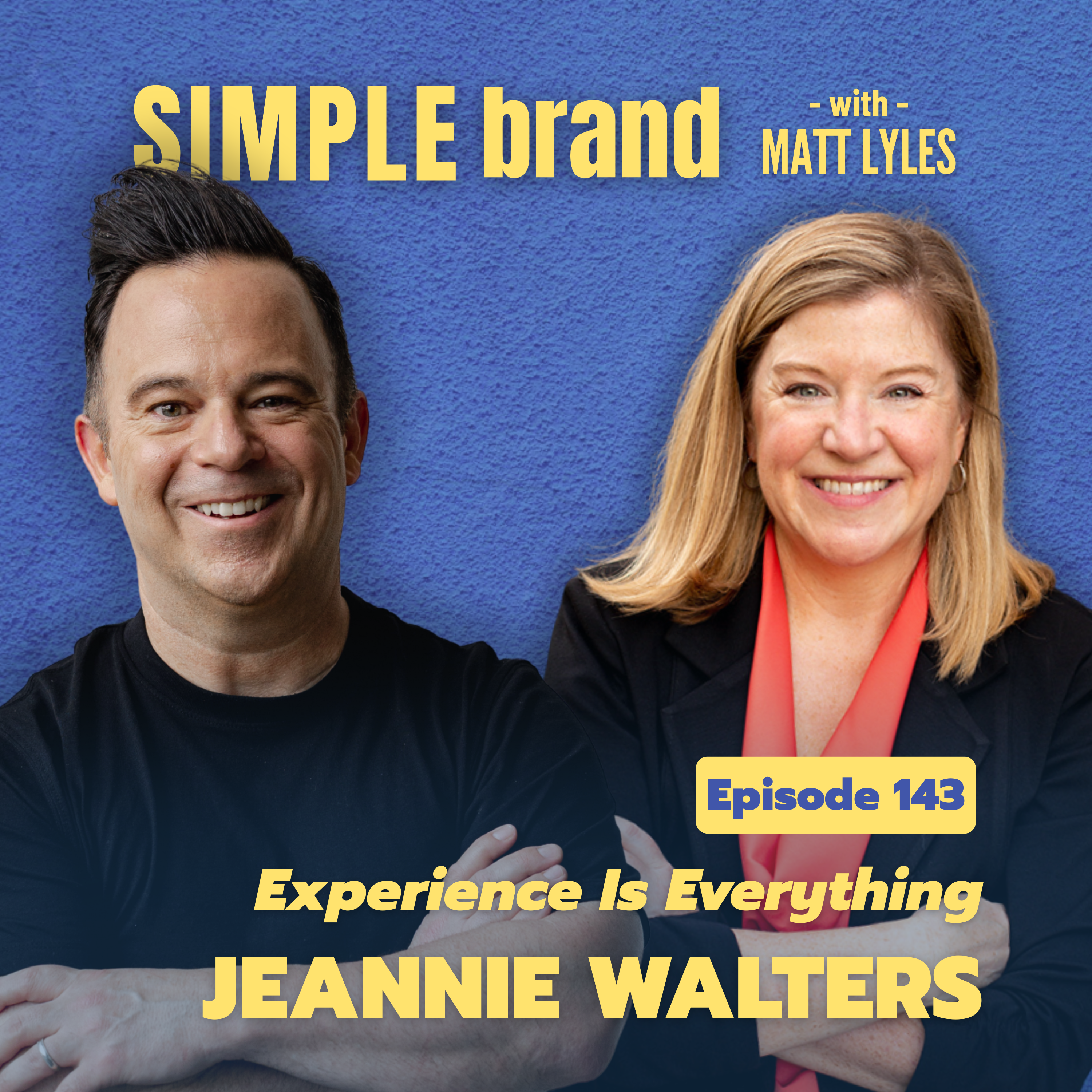
SIMPLE brand With Matt Lyles · Matt Lyles
Why does customer loyalty seem harder to earn than ever before? Customers have more choices, higher expectations, and less patience than ever. At the same time, many organizations are struggling to understand why customers aren't as loyal as they once were. In this episode, I sit down with customer experience expert, keynote speaker, and author Jeannie Walters to discuss her new book, Experience Is Everything: Making Every Moment Count in the Age of Customer Expectations, and why customer loyalty has become so fragile. What You'll Learn in This Episode Why customer loyalty is becoming more fragile than ever before The exercise that helps align an entire organization around customer experience The difference between reactive customer service and proactive customer experience Why emotions play a bigger role in customer loyalty than many organizations realize Why small moments often have a bigger impact than big moments The role intentional leadership plays in creating a better customer experience Chapters 00:00 Introduction to Experience Is Everything 05:10 Creating a Customer Experience Mission Statement 11:13 The Importance of Internal Alignment 15:03 Bridging the Gap in Customer Loyalty and Customer Expectations 18:57 Proactive vs. Reactive Customer Experience 21:03 Managing Negative Emotions in Customer Experience 25:25 The Power of Small Moments 32:23 Jeannie's Experience Is Everything 5-Song Playlist About Jeannie Walters Jeannie Walters is an award-winning customer experience expert, keynote speaker, founder of Experience Investigators, and author of Experience Is Everything: Making Every Moment Count in the Age of Customer Expectations. Through her consulting and speaking, she helps organizations improve customer loyalty, increase retention, and create more customer-centric experiences. Connect with Jeannie Walters Jeannie’s Website Experience Investigators Jeannie’s Book - Experience Is Everything: Making Every Moment Count in the Age of Customer Expectations Jeannie on LinkedIn Connect with Matt Lyles Check Matt's speaking availability Subscribe on YouTube Matt on LinkedIn Matt on Instagram Subscribe to Matt's newsletter Subscribe and listen on Apple Podcasts Subscribe and listen on Spotify
Matt Lyles: Helping you create loyal customers and loyal employees all through the power of simplicity. This is the Simple Brand Podcast, now heard around the world, including Barinas Venezuela. I'm Matt Lyles, and this week, well, before we get to this week's guest, I need you to know the Simple Brand Podcast is now on YouTube. That's right. The podcast is available in both audio and in video formats. So Hey, Jeannie, welcome back to the show. Jeannie Walters: I'm so happy to be here, Matt. So nice to see you. Thanks for having me. Matt Lyles: Yeah, great seeing you again. we're recording today on the day that the book comes out. Congratulations on Experience is Everything. There it is. Jeannie Walters: Yeah, it's actually here. It's in the wild. Matt Lyles: If you're listening to this episode right now and and you're not driving, you can go watch the conversation and you can subscribe at youtube.com slash at MattLyles. Now, on to this week's guest. This week, I'm talking with Jeannie Walters. That's right, Jeannie is returning to the Simple Brand Podcast. She previously joined me in episode 111, where we discuss the importance of creating a customer experience mission. So if you haven't listened to that episode yet, it took a while for the book to come out or for you to get to the point where you said, ⁓ you know what? ⁓ I need put this in a book. So What drove you to releasing experiences everything in 2026? Jeannie Walters: you know, it's one of those things that some people have been like, well, why didn't you write this a long time ago? ⁓ like, ⁓ question. I have been doing this work. This is very hands on for me. I work directly with customer experience leaders and teams and organizations. And what started realizing was I was seeing the same kind of barriers to success ⁓ over and and over again. ⁓ And then started really thinking about, you know, Matt Lyles: Yeah. Be sure to check it out. Jeannie is a customer experience speaker, she's a CEO of Experienced Investigators, and she's the author of her latest book, Experience is Everything: Making Every Moment Count in the Age of Customer Expectations. Listen, I don't know if you know this, but customer loyalty isn't quite what it used to be. Customers have more choices than ever before. Jeannie Walters: Part of this is we just haven't been taught this, right? Like I wasn't taught this, we had to figure this out. We all have to just get in there and figure it out. And wanted to put something together that a leader who had the right heart, who had the right ⁓ who wanted to do more, but didn't know where to start, didn't know how to actually execute on this idea of what if we could use customer experience to really drive business results? Matt Lyles: Well, there you have it. Thanks again to Jeannie Walters for joining me on the show. And thank you for joining me. You know, one thing that really stuck with me from our conversation is the final line from Jeannie's book, where she says, experience isn't everything all at once. It's everything built one moment at a time. That's a powerful reminder to me, and I think it should be to you too. Their expectations are higher than ever before, and it takes far less for them to switch brands than it did just a few years ago. So, how do you earn loyalty in an environment where customers are less patient, they're less forgiving, and they're constantly being presented with new alternatives? That's exactly what Jeannie and I discuss. We talk about why customer loyalty has become so fragile. We talk about Right? Jeannie Walters: in a way that is still kind of mission driven. And so that's what I tried to do in the book by approaching it with that mindset strategy and discipline approach. Matt Lyles: Because sometimes when we think about our customer experience, we think about large initiatives, major transformations, or even creating those big wow moments. But customer loyalty is often built, or it's lost, in the small moments, those everyday moments, those moments where customers are really just trying to accomplish something and simply need us to make life a little bit easier for them. So here's my question for you. The role that trust plays in building long-term relationships. We talk about why organizations should focus less on creating wow moments and more on consistently delivering the fundamentals. And we talk about how leaders can more simply ensure that all their teams are aligned around one customer experience mission. Well, and based on that, probably got some leaders that are looking at their customer experience and saying, ⁓ we need to completely rebuild it. And then you may have some that say, wow, we have nothing really. We need to build this from the ground up. ⁓ so I think for both of those perspectives, it can probably be pretty daunting. So where's the right place for them to start? What's one moment in your customer experience that deserves a little more attention? So go and fix that moment and then go find another one to fix. Thanks for listening, thanks for watching, and until next time, keep it simple. This conversation is gonna help you better understand what today's customers expect and what it takes to earn their loyalty. So here it is. Here's my interview with Jeannie Walters. Jeannie Walters: Yeah, I think you're absolutely right, Matt, that we all have felt that sense of overwhelm sometimes in this work because there's always more to do and everything can feel like a priority. And I think when you get down to it, when you have that feeling, a lot of times it's because you haven't clearly defined and articulated what is the sense of that we're going after? What does that really mean? And so ⁓ Matt Lyles: Yeah. Jeannie Walters: I always encourage people, if you can, with really getting explicit and articulate about that mission that you have because that North Star can make everything else easier. ⁓ so when I talk about mindset, what I'm really talking about is an aligned mindset around who are we to our customers no matter what. And we use something called a CX mission statement. I walk through it in the book. ⁓ One of the early readers called it mad libs, which I absolutely love. She was like, I love the mad libs. ⁓ that tells me you're using it. Right. So you can actually build a mission statement that then drives every decision forward and it makes everything else easier around that prioritization. So that's in an ideal world. That's where I would start. Not everybody can start there, but that's where I love to start. Matt Lyles: Yes. And that mission statement, that's not so much the overall corporate mission statement. This is the customer experience mission statement, the CX mission statement. Jeannie Walters: That's right. That's right. And there are a few corporate mission statements that can serve in this way, but many of our corporate mission statements say things like shareholders or talk about being best in class, but we don't really talk about what is the experience we want to deliver for our customers. And that's what I wanted to get at with that Aligned Mindset strategy. Matt Lyles: Yeah. Okay, so if we're creating that customer experience mission statement, is it as simple as we want to make customers happy? We want to be the most customer centric? Jeannie Walters: I love that you're asking this question. You know me because you know this is going to like send me off because yes, this is what we see all the time, right? Like we see leaders say, ⁓ my gosh, I just came back from Disney ⁓ do everything so well and it's all because they just believe in customer experience. So now we're going to believe in customer experience, everyone go forth and. We hear a lot about we're going to be customer centric, ⁓ when we don't define what that means, then everybody in the organization could have a different perception of what that means. ⁓ that's not necessarily wrong. I don't want people to feel like, my ⁓ is right. You can't say that until you have explicitly defined it. And I think the other part of that is making sure that people have access ⁓ so that they understand it's not just words on a poster. This is something we're using as a tool. This is something that we're going to ask, okay, here's our defined mission statement. Did we live up to that or not? And if we did, great. Is that something we can do more often or throughout more parts of the journey? if we didn't, ⁓ can we do next time to make sure we do? What are those root causes that caused the points of friction? So it really is a powerful way. Matt Lyles: Right. Jeannie Walters: to just universally get everybody at least starting on the same page. Matt Lyles: Yeah, but if I hear somebody thinking, okay, we need a customer experience mission statement and it needs to be explicit, it needs to be really well defined, then I can see where there'd be some leaders that would create a mission statement that is really more of a manifesto, I guess. You know, something that's pages long and once you do that, like once you add too many details, Jeannie Walters: Yes. Matt Lyles: It's hard for any team to actually recall it and to know it. Jeannie Walters: That's right. bring up a really important point. Something I talk about is that we need ⁓ statement that can be internalized because it's really something people have to tuck into their heart and make decisions around. I kind of joke about we don't need 17 paragraphs and ⁓ bullet points under everyone. In fact, we're not going to talk about a lot of detail because some of this is helping in your organization make better judgment calls. because that's going to happen. So what we're trying to do is help everybody make similar aligned judgment calls when it comes to customer experience, because then that creates a consistent customer experience, which actually creates more trust with the customer. So all of this fits together. And I think I have been in so many, we usually develop this with clients through a series of three workshops. And for such a short statement, people have asked me, why do you need that much time? I'm like, ⁓ just wait, just wait. Because we have to make sure it aligns with your overall corporate mission, vision, values. We always start there. And then we want to make sure that it's close enough to something that everybody Matt Lyles: Yeah. Jeannie Walters: say. Even if we're not there exactly today, we know we're going there. It's realistic. And it's also something that people can say, yes, this is us. And it's not everyone in our industry. It's we are. And that takes some time. You really have to sift through things. Matt Lyles: and then with that, especially the larger ⁓ an enterprise have with different functional areas, ⁓ different teams, you might some teams that look at it and say, okay, but then how does that apply to me? What does that mean to me in my role? So ⁓ I think takes a lot of work ⁓ to be able to, ⁓ one, chisel down to just the right Jeannie Walters: Mm-hmm. Matt Lyles: words and the right size. But then beyond that, being able to explain it to different organizations, different functions, different teams. Jeannie Walters: And I think that when it's done well and it always, you know, there's an element of change management here. There's an element of, you know, just getting socializing it and getting it out so people know it's not just a poster and all those things. But I think that if you do it well, what tends to happen is teams who are maybe one or two or three degrees away from the customer experience, they don't interact with customers. They don't really see their role in it. they still understand, ⁓ this is what we're doing. So like supply chain understands, ⁓ we have an impact on this, right? And the other way that I really stress to use this whatever you say about how you show up for your customers, you have to make sure you're showing up for one another that way too. You have to have that alignment. ⁓ so that way you can say to even your internal teams or the collaborators that you have, Matt Lyles: absolute. Jeannie Walters: You can talk about the mission and say, you know what, by you being on time and getting me that information, you're helping us deliver this mission. And so it all connects and people can really start seeing their role in that pretty quickly when it's done well. Matt Lyles: Yeah, absolutely. it helps in knowing that if I'm collaborating with another team that's customer facing or has a impact on the customer, ⁓ then I'm making it easier them to deliver on that customer experience mission. And then you used a good word, impact. ⁓ I to say that even if your team is not customer you're still customer impacting. Jeannie Walters: That's right. That's right. That's a great way to say it. And I think that I don't know why we kind of lost the plot on that, but a lot of organizations have. think that one of my favorite moments, especially when I'm giving like a keynote at an corporation, like the whole group, one of my favorite moments is afterwards when somebody comes up to me and they say, I didn't know why they wanted me to be here, right? But now I understand. They might be from finance, or they might be from product, or they might be from HR. they start connecting the dots in really powerful ways. And then on the flip side of that, I think the other thing that I love about the work we do is customer is not well-defined in most org charts, in most structures. So we get hired by all sorts of fun people who are those CX change agents, right? They see this and they understand it and they might not be in the right quote unquote role or title, but they know the power of it. So we've been hired by chief HR officers. We've been hired by chief data officers. We've been, you know, all these different kinds of executive levels who see this could have a great impact on our organizational results. And so I'm going to lead the charge. And then it's really fun to see that momentum build and you see the team build and everything else. I think going back to your question about like some organizations are starting from scratch. Absolutely. Some are starting with something, but they don't quite know what it is. Matt Lyles: Yeah, ⁓ so I go back to something. We keep seeing research from like or from SAP talking about how like today customer loyalty ⁓ at its lowest point ever. And ⁓ the same time, customer expectations are continuing to rise. So there's a big gap between customer loyalty and customer expectations. And then to add on to that, there's research that shows that executives ⁓ ⁓ company's customer experience ⁓ differently than the way that their customer is. So it's another significant gap. ⁓ are we seeing these gaps here today? Jeannie Walters: Mm-hmm. I think the simplest to that is you can't read the label of the jar you're in, right? And so I think a lot of organizations focus on things like process success, and they say, well, look, all our customer ⁓ service tickets getting answered, so we must be doing well. And they don't take that leap or that next kind of intellectual step to say, well, why are we getting all these tickets? What's happening? Matt Lyles: Yeah. Jeannie Walters: And what could we do about that? And how could we prevent that? So I think that's one very significant gap. The other that I sometimes highlight in my workshops is the further up you get in an organization, the further away you get from the customer typically. So when start my workshops with the executive level or if I'm doing an executive briefing, depending on the crowd, ⁓ I sometimes start with a worksheet. And I just pass it out as people are settling in. I say, the worksheet basically says, tell me about your last interaction with a customer. I can see them ⁓ becoming uncomfortable. And they start shifting in their chairs, and they look around, and then they start asking, ⁓ how are you defining customer? What about internal customers? ⁓ about this? And my whole point of that is to highlight, you know what? It's not their fault. They're doing exactly what they've been asked to do. ⁓ Matt Lyles: Right. Yeah. Jeannie Walters: That's kind of what we need to scale. We need people up at the highest ranks, focused on what they're focused on. But at the same time, we have to acknowledge that sometimes we don't know our customers. We aren't connected to them as much as we could be. And so we have to rely on what are these tools in our customer experience toolkit to really make sure we're tapping into that again and again. that's... The data that we collect is super important, but so are the customer stories. So are the recordings. So are all those things, because that's what really connects us to the humanity of the people that we serve. Matt Lyles: In my previous career, I was ⁓ happy to see in that every ⁓ officer from VP all the to the ⁓ was assigned a particular customer account with that customer's sales AE. And so that VP had go and visit with those customer accounts ⁓ like once a quarter. Jeannie Walters: I love it. Matt Lyles: you know, So that way, they were regularly staying in touch with ⁓ actual customers and hearing these stories. Jeannie Walters: I love that, Matt. And I think part of that that I really love is that it's not performative because a lot of the programs that I've seen have been like, okay, executive of a retail go spend a day in the store for once a year. And the problem with that is the people in the store don't love it because like, we don't know what to do with this person. He's getting in the way. ⁓ So do, they... find like little jobs for them to do so they don't really always get the experience that we hope they get. So I think it's really important to connect with not only, ⁓ what's a day in the life, but really like, ⁓ ⁓ I thinking about if I'm accountable for this customer? How do I change my behavior? What am I looking for? I think that will really get the wheels turning. So I love that example. Matt Lyles: Right. and then to be able to ⁓ actually to and even ⁓ observe in their own setting too. Well, and so ⁓ kind related to that, ⁓ I've you say ⁓ that service ⁓ is Customer experience is proactive. So how can we make sure that we're taking the right approach to ensure everyone in organization is taking the right Jeannie Walters: Yep. Absolutely. Matt Lyles: proactive customer experience focus. Jeannie Walters: Yeah, I think this is really important because sometimes we equate customer service with customer experience. is when I always want to put a big asterisk and say customer service is super important. ⁓ people are super important and good at their jobs and we love them. So I'm not, you I just want to underscore that first. ⁓ But customer is really part of the bigger customer experience. And so we have to make sure that when we are in our jobs, we have to make sure that we are proactively looking at how will this affect the customer and what can I do to make sure it's as seamless as possible, that I'm making it easy to take the next step in the journey, that I'm helping customers feel a certain way. because part of defining the customer experience mission statement is thinking about how do we want our customers to feel. And if we can be proactive about we are proactively looking at how will this affect the customer and what can I do to make sure it's as seamless as possible, that I'm making it easy to take the next step in the journey, that I'm helping customers feel a certain way. And I think that's my favorite part of that proactive distinction because part of defining the customer experience mission statement is thinking about how do we want our customers to feel. And if we can be proactive about eliciting those emotions, then that opens up a whole new world. eliciting those emotions, that opens up a whole new world. People get very creative. They get very innovative about what can we do to help them feel valued and cared for and connected to us. And so ⁓ that's how I think of proactive customer experience. It's looking at the entire end-to-end journey, of course, and it's being holistic, but it's really thinking about what can we proactively do ⁓ to create those moments that really matter and help our customers move through to that next step, stay with us forever, all those things. Matt Lyles: ⁓ yeah, that helps. And I really appreciate how you shared, like you focus on how do we want the customer to feel? So on one side, it's what's our goal for the customer's feelings? And usually there's an opposite to those goals. Like we want them to feel valued, cared for. The opposite is, you know, like maybe customers feel frustrated. ⁓ So ⁓ Jeannie Walters: Hmm. Mm-hmm. Right. Matt Lyles: what are some of the, I guess, biggest negative emotions that you see from customers? Jeannie Walters: Well, this kind of goes back to that question about expectations, right? Because when people are telling us they're not loyal, they're telling us, I don't feel like you care enough. And really, comes down to expectations. So if we are setting the right expectations and delivering for the customer, they will at least feel like, OK, this is a fair deal, right? It's when we don't deliver on those promises that you hear words like disappointed. The word disappointed is literally this. It's you did not meet my expectations. You made me a promise that you didn't keep. So always encourage our clients to really look for certain words. Disappointed is definitely one of them. The other one is frustrated. And my definition of frustrated is anger without control. And you can zero in on that and think about what are the ways that they lost control, that they feel like they're out of control, ⁓ Matt Lyles: Right. Jeannie Walters: What can we do to empower them and give them control? That can make a world of difference because then of, know, things are still going to go wrong, but we need to make sure that when we are getting those negative emotions, we're thinking about how can we turn those around and help them feel better certain things. ⁓ So really important to define those negative emotions. and understand what they really mean. So those two are some of the ones that I always look for. Matt Lyles: Yeah, and it's a look at what are some of those things that are the biggest frustrations that our customers face. ⁓ part of it is being able to react to those and solve those issues, but it's really being proactive and solving that before it ever happens to ⁓ prevent a customer from being frustrated. Jeannie Walters: Okay. That's right. Right, right. And I think sometimes we well, this is just the way it is. And if you actually look at it in a careful way, and I mean, ⁓ named my company Experience Investigators because I believe so much of our job is investigation. ⁓ if you can really dig into it, you can uncover some amazing things. And if you ask the right questions and observe and just look for what are people really telling you when ⁓ using these words, Matt Lyles: Right. Jeannie Walters: you can start discovering like, oh, you know what they're telling us is they didn't know what to expect. That's an uncomfortable feeling, right? So how can we reassure them throughout the journey so that they feel like they understand what's going to happen next? That's a very proactive thing to do and it helps a ton. So it's really, it's looking for those types of situations and helping our customers feel empowered, in control, and just, you know, in the know, I think. We have to help people with uncertainty that creates a lot of anxiety. Matt Lyles: Yeah, and when I think of uncertainty, a lot of it comes from just simply, like you said, ⁓ knowing, not being in the know. And I don't think that it's just the fact that they're not in the know. So what understanding is, like what happens is when there is a void of information, we tend to make up our own information and that information we make up is usually negative. Jeannie Walters: Mm-hmm. That's right. Yep. Matt Lyles: So if we're not getting the information, then we think in our head, ⁓ here's what's happening and it's bad, not good. Jeannie Walters: Mm-hmm. Yes, exactly. mean, I think this is why when we are like texting a friend and then they leave us on read, you know, that's the phrase that we use. We're like, ⁓ my gosh, what happened? What happened? What are they doing? ⁓ my goodness. So, right. So I literally, this happened to me once. I got off a plane after not having connectivity and my friend was like, where are you? ⁓ my gosh, did I say something? Blah, blah, blah, blah, blah. And I was like, ⁓ no, I was just on a plane. Matt Lyles: What did I do? Jeannie Walters: So we do this, we fill in the blanks and our customers do that too. And so we need to be really proactive about reassurance, about letting them know everything's working, everything's as expected, we got you. Matt Lyles: a of times I see ⁓ leaders having the to want to design ⁓ like really big moments like we want to create ⁓ wow moments for customers, we want to create magic moments, we want to create unreasonable hospitality. So is it really as simple as just focusing on creating a few ⁓ major moments for customers? Jeannie Walters: Mm-hmm. Well, I do love Will's book, so let's give Will credit for unreasonable hospitality. He did a great job with that. I think ⁓ challenge that I see is that when we focus on the big moments only, when we say we want to deliver wow moments, what we're kind of saying is we're not going to focus as much on those everyday little moments and delivering the basics. whenever... ⁓ Matt Lyles: I do too, it's right there. Jeannie Walters: I get asked about, do we start? I always say, start with the basics. You're probably not delivering those in the way that you expect. There are probably places, just like we just talked about, you could be more proactive about reassurance, about setting expectations, about care. And if you could focus on those and turn up the volume a little bit on those moments that maybe I call the meh moments, like the moments that we go, ⁓ they don't really matter, right? You can neglect them. If you can look at those moments and Matt Lyles: Yeah. Jeannie Walters: help them be more positive, delightful, understanding, whatever, and aligned with your mission, then you're going to have a more consistent experience. I think sometimes we confuse big PR moments ⁓ big customer experience moments. we've seen, they're great stories, right? Like when the kid leaves the stuffed animal behind and they have a spa day and they send all the pictures like. I love as a parent, of course, I love that. Right. But can we do that for everybody? Maybe not. And does that really do? It's a great moment publicly. But what we have to think about is what if that family had an OK experience at the hotel? Like that would have been a very different story. So it's just important. And I think I've had a few of these where I'll get some random like swag thing from ⁓ brand. Matt Lyles: Yeah, yes. Yeah. Jeannie Walters: And I always wonder, why did they think I would really enjoy a mouse pad with their logo on it as a gift? And they say, we've got this gift for you. it's like, they're trying, but they're almost focused on the wrong thing. Because what I want is an easier invoice to pay. I want a better way to test out new features or whatever. So I think we really have to get into, what are people really doing? ⁓ Nobody. I hate to break this to you, but nobody is waking up thinking about your brand. Nobody is waking up thinking, I can't wait to call about this thing. I'm so excited to get that marketing email, right? Like, Customers don't live in our world, we live in theirs. And so we have to respect that. And I think sometimes we think everything is a linear journey, but really they're just living their lives. And so we have to figure out ways to really respect that. And one way is just to... get really good at delivering exactly what we promised to them. Matt Lyles: Oh yeah, like getting your foundation right first. And you talked about those meh moments, some of those things that are like, take it or leave it, but on its own, changing one of those moments for the better may or may not be noticed. But if you take, if you collect like a whole lot of those moments together, five, 10, 12 of those meh moments, Jeannie Walters: Mm-hmm. Yep. Matt Lyles: and really change them for the better, then customers do start to notice. Jeannie Walters: ⁓ yeah. Well, and honestly, even if they don't notice on like a conscious level, ⁓ those moments, and I sometimes call them micro moments, those are either building or eroding trust. It's one of the two. And so if we are looking at moments in that way, then the ones where customers have to call and say, wait, is this package arriving? And then we say, yeah, it's arriving. Matt Lyles: Yeah, they feel it. Right. Jeannie Walters: So we think, ⁓ we did our job. But the fact that they had to call means that there's an erosion of trust. So we really do have to look at those carefully. And I think part of that is understanding, again, that we are not only in this for customers. We have organizations to and ⁓ for and everything. So we have to make sure the investments in those moments are leading to. ⁓ results for the organization. So that's why it's this, you got to get the mindset right. You've got to serve customers in a way, but then you've got to make sure you know ⁓ are those things that really mean success at your organization. So you know how to prioritize because like, I mean, just in this conversation, how many priorities have we identified, right? ⁓ really easy to get into overwhelm that way. And so I just want to circle back to, we can't always address all of those moments all at once, but we can certainly tie it together with the priorities of the organization and the customers. Matt Lyles: I ⁓ that ties to of last things that you actually write in your book at the very end. And to me, it kind of helps take some of that ⁓ overwhelm off our shoulders. And ⁓ I think got this right. Were you right? ⁓ One last ⁓ because experience isn't all at once, it's everything built ⁓ one ⁓ moment a Jeannie Walters: Mm-hmm. Yeah. Yeah. That's one of my favorite lines in the book. So thank you for asking me about that because I think that whatever we say and whatever we do, it can still feel overwhelming because every person I know who cares about this work is a caring person. And so we want to do the best. We want to serve as many people as possible. We want to deliver. I think if we can all just take that collective breath and realize Matt Lyles: Right. Yeah. Jeannie Walters: everything we do that improves things for our customers, everything that we do that helps our organization succeed by serving our customers the right way. That's all really meaningful. And so even if it's one moment today and it's two moments tomorrow, it is a compounding feature and we will see the benefits of that. And so I just want, you know, CX leaders like you and others to just celebrate. the that you do because it is really important we can't boil the ocean. We can't change an organization overnight. It's not a light switch, but it's a really important journey that we're all on. Matt Lyles: ⁓ think that to something else that you talk about as well is yes, like I think most every customer experience leader, ⁓ every executive has good cares about customer, has good intentions for their customer. But ⁓ when you look at this here, you look at this reminder, it's a good reminder that helps us to be more intentional about every moment that we create and every moment that we deliver. Jeannie Walters: That's right. I sometimes say good intentions don't get results, but intentional leadership does. Matt Lyles: ⁓ All well, Jeannie, one last question for you. ⁓ If were to create a five song playlist for experiences everything, what songs would you include? Jeannie Walters: Mm-hmm. You know I love this question and I had to take notes here. So, okay. So the first one, and I think this aligns with what I told you last time I was on your show way back when, because experienced investigators, you know I'm passionate about that. So Private Eyes by Hall and Oates, throwback. Yes, exactly. Matt Lyles: ⁓ yeah. Jeannie Walters: ⁓ but that one is, you know, we're really investigating. We're looking for things. We're constantly curious. And I love that about us as a collective. every little thing she does magic by the police, of course, because again, it's the moments, it's those little things. And then when I started thinking specifically more about the book, I was like, well, we talk about mindset and what that means. So, I picked believer. by Imagine Dragons because we have to get people on board, right? We have to make everybody a believer. ⁓ That's right. That's right. then this next one is a little bit different, but ⁓ started from the bottom by Drake, because I think it's really about sometimes we are starting from a place where it's been tough, right? Like we have to get aligned around things. I often think about the work I do with leaders as a reset. Matt Lyles: Yeah. Yeah. Get their mind right. Jeannie Walters: because they may have been doing a lot of the activities for a while, but not seeing those results. And so I think it's a matter of, you know, kind of a reset of, we're starting wherever we're starting, but we're going up. So the fifth one, which I also love. ⁓ So this is because I everybody to lead differently. I think CX leaders to show up as business leaders first. And sometimes that means a little bit getting over imposter syndrome, a little bit of trying things out. So Confident by Selena Gomez. That's a great song. Before you have your next meeting with your boss, listen to that one. ⁓ Matt Lyles: ⁓ nice. There you go. Yeah, get pumped up. Jeannie Walters: There you go. Matt Lyles: I think that's a good collection that with that internal mindset, ⁓ the internal focus as a leadership, but then the reminders of all the things that are for ⁓ every moment ⁓ and the fact that, yeah, is everything. Well, Jeannie, where can people go to learn more from you and to learn more from experiences everything? Jeannie Walters: Thank you, Matt. Yeah, I'm all over LinkedIn. That's always a great place to connect. And then you can also find the book at experienceiseverythingbook.com, as well as wherever you buy books. And of course, experienceinvestigators.com is where my business lives. Matt Lyles: ⁓ Jeannie, so ⁓ seeing you, so great talking. ⁓ you so much for being here. Jeannie Walters: Thank you so much. ⁓ this been great.