
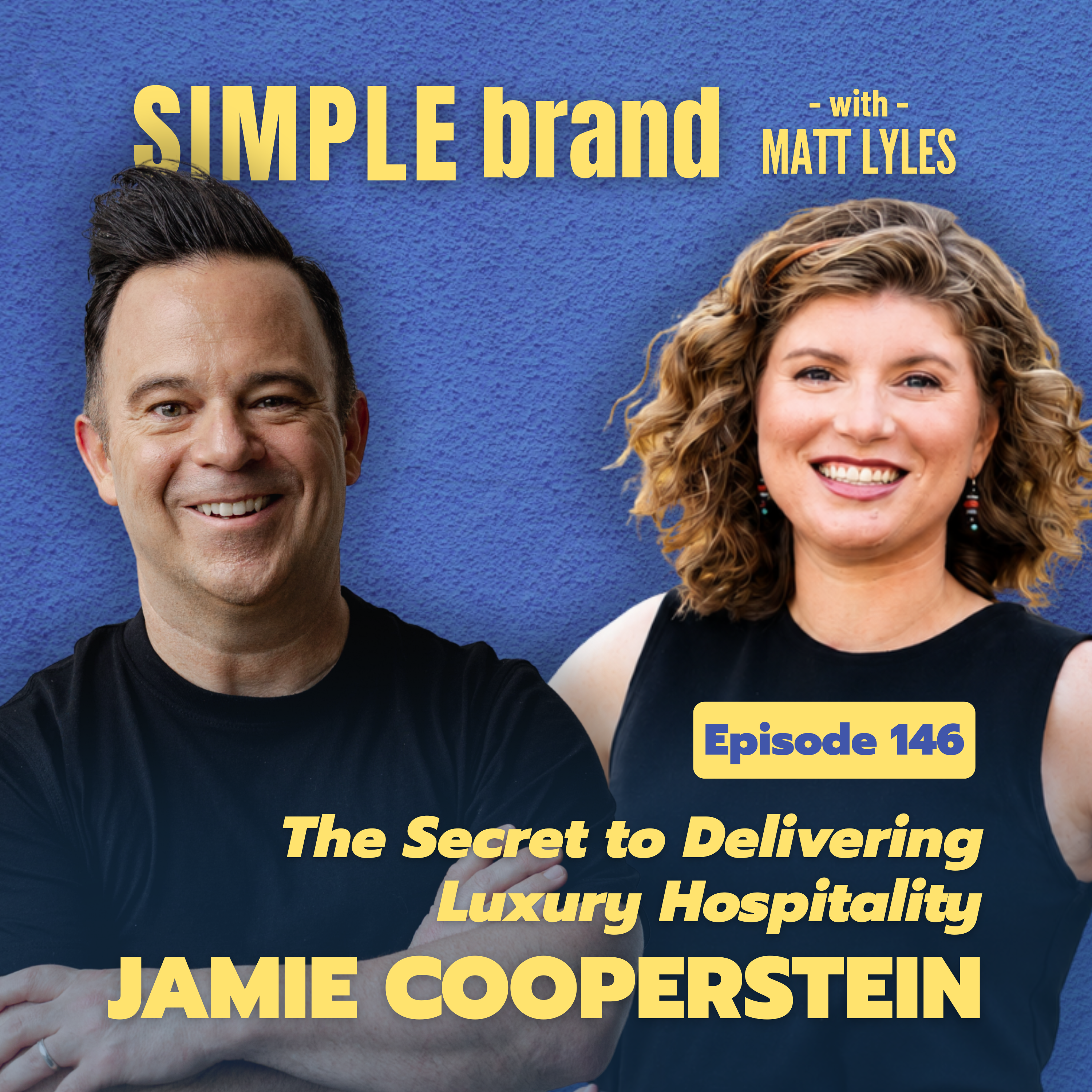
SIMPLE brand With Matt Lyles · Matt Lyles
What makes luxury hospitality feel different? Most people assume it's the beautiful hotels, premium amenities, and five-star service. But the real secret is much simpler. It's making customers feel like they're the only customer. In this episode, I sit down with customer experience strategist, former Five Diamond concierge, and author Jamie Cooperstein to discuss her book, True Hospitality: Lessons Learned from Behind the Concierge Desk. Drawing from more than a decade serving luxury guests face-to-face, Jamie shares the lessons she learned about creating emotional connections, anticipating customer needs, empowering employees, and delivering experiences people never forget. Whether you work in hospitality or not, the principles Jamie shares can help you create more personalized, memorable customer experiences. What You'll Learn The difference between service and hospitality - and why hospitality creates emotional connections How luxury brands make customers feel like they're the only customer The five keys to service excellence How to anticipate customer needs before they ask The right way to handle service recovery Why supportive leadership creates better customer experiences How to empower employees to make decisions in gray areas Chapters 00:00 Introduction to True Hospitality 00:42 The Unique Perspective of a Concierge 04:19 Defining True Hospitality 10:34 The 5 Keys to Service Excellence 21:47 How to Ensure Effective Service Recovery 23:43 Navigating High Customer Emotions 26:50 The Power of Supportive Leadership 32:05 How to Empower Employees in Gray Areas 39:26 Jamie's 5-Song Playlist About Jamie Cooperstein Jamie Cooperstein is a customer experience strategist, speaker, and former Five Diamond concierge. Drawing on more than a decade of experience serving luxury hotel guests, she helps organizations create exceptional customer experiences through hospitality, personalized service, employee empowerment, and leadership. Jamie is the author of True Hospitality: Lessons Learned from Behind the Concierge Desk, a memoir that shares the stories and lessons she learned while serving guests at some of Philadelphia's most prestigious properties. Connect with Jamie Cooperstein Jamie’s Website Jamie on LinkedIn Jamie’s Book - True Hospitality: Lessons Learned from Behind the Concierge Desk Connect with Matt Lyles Check Matt's speaking availability Subscribe on YouTube Matt on LinkedIn Matt on Instagram Subscribe to the SIMPLE brand newsletter Subscribe to the SIMPLE brand show
Matt Lyles: Helping you create loyal customers and loyal employees all through the power of simplicity. This is the Simple Brand Podcast, now heard around the world, including Rome. Rome, Georgia. I'm Matt Lyles, and before we get to this week's guest, you need to know this: the Simple Brand Podcast, it's now on YouTube. That's right, it's now available in both audio and in video formats. So head on over. Thanks again to Jamie Cooperstein for joining me on the show. And thank you for joining me too. You know, one thing from the conversation that really stuck with me was Jamie's story about her manager having her back. So Jamie made a decision, the customer didn't like it, and then the situation escalated. And Jamie was certain that her manager was going to reverse her decision. Instead, her manager stood beside her. Watch the conversation and subscribe at youtube.com/slash at MattLyles. And now on to today's guest. Today I'm talking with Jamie Cooperstein. Jamie is a customer experienced strategist. She's a former Five Diamond Concierge, and she's the author of the book True Hospitality: Lessons Learned from Behind the Concierge Desk. And here's the thing that I really love about Jamie's perspective. He's the one that took the heat. He supported her decision. And then he later used the situation as a teachable moment. And what struck me is that Jamie said her manager could have chosen to be the customer's hero. Instead, he chose to be Jamie's hero. And that made all the difference. Not just in Jamie's loyalty to him, but likely in the loyalty of every other employee who saw how he led. So It's she didn't learn these lessons in a corporate conference room or from case studies. She learned them through over a decade of serving luxury guests face to face and solving real customer problems in real time. Hi Jamie, welcome to the show. Here's my question for you. When your employees face a difficult situation, do they know that you'll have their back? Do they know that you'll support them, you'll coach them, you'll help them grow in that situation? Because when your employees know that they're trusted, they're more likely to use good judgment. They're more likely to take ownership, and they're more likely to create those personalized, memorable experiences for your customers. Jamie Cooperstein: Hi, Matt, I've been looking forward to connecting with you all day. Matt Lyles: Yeah, me too. Man, I have really enjoyed getting to know you online. I think we were connected on LinkedIn. So I get to see a lot of your lessons and a lot of your content and your stories ⁓ your career, from your book. But I'm excited to talk about your book, True Hospitality, ⁓ Learned from Behind the Concierge Desk. You know, sometimes the best way to serve your customers is to serve your employees first. Thanks for listening. Thanks for watching. Until next time, keep it simple. Jamie Cooperstein: Thanks, I'm excited to talk about and just talk about all things related to customer experience in general. We've got a lot to unpack. Matt Lyles: Hooray, yeah. so just first off, when it comes to the book, because book's written a little bit differently than most of ⁓ customer experience that I've gotten to read, ⁓ who is intended ⁓ audience for book? Jamie Cooperstein: So because I decided to ⁓ discover kind of what makes me in the customer service world, and I realized it was my story and the fact that I wore a uniform ⁓ and served other people ⁓ over course of 10 years, led me to write a memoir. And by writing a memoir, and especially fact that the story starts out at when I was age 22, which feels a lifetime ago, ⁓ Matt Lyles: You know, when most people think about luxury hospitality, they tend to think about fancy hotels, beautiful properties, high-end amenities. But the real secret to luxury hospitality isn't making everything look special. It's making people feel special. It's making customers feel like they're the only customer that you have. And that's exactly what Jamie and I discussed today. Jamie Cooperstein: And really takes a look at a career and a career transition in an unexpected journey into a new career The book really ⁓ is served by many, different people, certainly folks that already work in the customer experience field. But it fabulous for somebody like a college student or a high school student, somebody that is possibly considering a career or journey in hospitality and wants to more about what the possibilities ⁓ then the other really fun audience ⁓ the person that is a traveler themselves, ⁓ was always excited to learn about all things luxury hospitality, or maybe has never stayed at a luxury hotel and wants to know more. ⁓ it's kind of a peek behind the lens for that leisure reader that wants to just sit up by the pool or sit by the beach and just kind of dig into all of the gossip and chaos that happens ⁓ the Matt Lyles: We talk about the difference between service and hospitality, how to create emotional connections with the customer, the importance of personalized attention, how to anticipate customers' needs, and what you can do to empower your employees to create that personalized, memorable experience every single time. So if you've ever wondered how you can instill more hospitality into your customer experience, this episode is for you. Yeah. Jamie Cooperstein: but told from the perspective of somebody wearing a uniform. Matt Lyles: ⁓ hearing you say ⁓ makes a lot of sense now because it's a really cool look at the behind the scenes ⁓ what it takes to ⁓ make things happen. Sometimes we're from ⁓ guest perspective, some things seem like it's just so easy to be done, but a lot of times there's a lot of work and a lot of even hoping and praying that something works out. So here's my interview with Jamie Cooperstein. to actually make things happen. Jamie Cooperstein: Absolutely. And the other thing that's really unique about the genre of a memoir is this is not present day. My story starts in 2004 and chronicles the decade that follows. So again, from when I was age 22 to 32, it's not talking about present day Jamie, the consultant and speaker. It's literally following my 10 years spent as a concierge. So again, it's kind of a unique look at what I do now, but bringing credibility Matt Lyles: Right. Jamie Cooperstein: from where I came from. Matt Lyles: Yeah, credibility and then sometimes some of the stories, it allows people to almost learn those in the moment, like as you were learning the lessons. Jamie Cooperstein: Absolutely, was it was a big goal of mine not to Just tell the reader what to do My writing coach said it best is you want to show the reader what to do So yes, there's a lot of wild and crazy stories and I'm happy to share some today But yeah these wild and crazy stories inside the pages of the book That's where the reader gleams the lesson because they see exactly what I was going through in some cases literally learning a very difficult lesson in the moment being yelled at by a guest. So no, I think it was really fun to kind of intentionally write in a way where I wasn't telling I was showing. Matt Lyles: when talk about hospitality, a lot of times that gets reduced to an actual industry, like whether it's ⁓ food, ⁓ travel, tourism, but how do you define true hospitality? Jamie Cooperstein: ⁓ So I define hospitality is being able to forge an emotional connection ⁓ with whoever it you're serving, whoever it is you're actually having a conversation with ⁓ and making sure eliminating any type of transaction and only letting them remember how you made them feel. Matt Lyles: what does that look like? What are the behaviors? What are the interactions that can take that experience ⁓ transform it from ⁓ into having an emotional impact? Jamie Cooperstein: one of the first things for sure that you need to do is try to personalize the experience for whoever you're communicating with and really giving them personalized attention. It should not be a one size fits all approach. ⁓ Anybody you're communicating with or serving, that's your paying customer, they are unique. Matt Lyles: Yeah. Jamie Cooperstein: You should think of them, know, if it's a hotel as an example, you might have 300 rooms, but you should actually pretend that it's a one room hotel. And how can you best serve that one customer in that actual moment? course, that starts with things like using their name. But in the concierge profession, I feel like we perfected this, which is really getting to know ⁓ things like likes, their dislikes, their interests, even things such as their personality quirks Matt Lyles: I have never even thought about that, like thought about that mindset of acting as if it's just a one room hotel for one person. So what does that look like as far as like the design of the experience, the process, and even the mindset of a concierge and every other frontline team member? What does that look like to be able to treat someone like they're the only one. Jamie Cooperstein: So it certainly takes intention. And I'll use the example of somebody approaching the concierge desk and asking for an Italian restaurant. It would be very easy for a concierge to give the same answer to every single person that approaches the desk and just name, let's say, the closest Italian restaurant to the particular hotel that you're working at. But that's not giving personalized attention. Matt Lyles: Yeah. Jamie Cooperstein: So really have to dig and get a sense of is this person looking for a romantic dinner? Are they going out to dinner with a business colleague? Do they need a quick meal because they're seeing the orchestra after or catching a movie? Are they looking for a prefix ⁓ and they love wine and they're looking for wine pairings? Or ⁓ importantly, is it a family with young kids ⁓ maybe they also want some ⁓ and buttered noodles and a quick meal? So the answer ⁓ exponentially more unique and personalized, but it takes the concierge to really dig into that. Matt Lyles: and lot of that just comes down to just starting a relationship and asking questions and then ⁓ paying to those answers, listening to them. Jamie Cooperstein: Absolutely. have to, and this is not a novel idea that I'm going to mention right now, but I feel like in order to be an expert concierge, you have to be innately curious, ⁓ that extends well beyond the concierge profession. I feel like in order to provide personalized service in any capacity for any customer facing business, you really should be curious. You have to want to know more about the people you're serving. Matt Lyles: Well, know, and then just kind of a similar situation. I was in New Orleans, I guess, a couple of months ago, and I was staying at a fairly nice hotel, I was ⁓ out for lunch one day, and I had already created a relationship with the concierge because he knew why I was there. ⁓ was there for a speaking engagement for a conference there, whenever I passed by, like we would always, you know, chat a bit and talk about customer experience. But one day I was heading out for lunch and I was trying to find a really good po-boy place. And so a normal person would have said, ⁓ three places you can go. But he started asking me questions about what I was looking for. And ⁓ was looking for ⁓ place where maybe ⁓ it's locals that go there. the place that is not so much for tourists, like the place where here's the kind of bread I was looking for and the kind of experience I was looking for. And once he understood that, he said, okay, I'm gonna send you somewhere. Now, you know, don't get turned off when you see it because it's a pretty dirty place. And in the back of my mind, I was thinking, that is exactly the place for me. That's it. Yeah, yeah. And when I got there, Jamie Cooperstein: Yeah, so I want to know where you go once your shift is over. Matt Lyles: I it was kind of a hole in the wall place. It was so dirty. Like none of the signage had been changed in decades. ⁓ had some autographed photos of celebrities on the walls, but like nothing passed like 1983 or so. ⁓ it was cash only. And got the Po Boy and it looked really good. And the bread was the exact bread I was looking for. Jamie Cooperstein: You Matt Lyles: And it was so messy that even the napkins that I used couldn't clean my hands. I actually had to go to the restroom to clean my hands. And I was so excited. was like, this was probably the best meal that I've had my entire visit there. All because he knew, okay, this is exactly what Matt is looking for. Jamie Cooperstein: Did the concierge also anticipate your needs by reminding you that it was cash only out of curiosity or did you find that out the hard way? ⁓ Matt Lyles: found it out the hard way. I don't know if he actually knew that or not, but that would have been good. That would have been like a 10 out of 10 concierge, but good point. Jamie Cooperstein: you Matt Lyles: personalized attention, we can actually go ahead and jump into it. ⁓ That's one of your five keys to service excellence, Jamie Cooperstein: Absolutely. Should I jump into the other keys, Matt, since we talked a little bit about personalized attention? Matt Lyles: Let's do that. Yeah, let's let's list those out. Jamie Cooperstein: Cool, so the others that are all lessons that I learned from my tenure spent as a concierge and are kind of woven throughout my memoir. So number two is anticipating needs. three is a personal favorite. It's the art of under promising ⁓ over delivering. So always, you know, being the hero in the eyes of your customer. First person resolution and remembering to take ownership and take And then lastly, timely service recovery. can't always predict when somebody is going to be upset, but it's how you swiftly act when somebody does and remembering to really express empathy and treating and focusing on their emotional needs and ⁓ not necessarily problem at hand. Matt Lyles: talk anticipating needs. ⁓ what are the right to make sure that we're anticipating people's needs? Jamie Cooperstein: So anticipating needs is all about really thinking proactively what somebody might need or hope for before they even think to ask it. There is something referred to as an unexpressed wish. And kind of the easiest way I can paint the picture for that is picture a tourist. You're from Nashville, right, Matt? Picture a tourist in downtown Nashville. They have a map in their hands. And yes, maps still do exist. Or let's they have a phone out and they're looking Matt Lyles: Yes. Jamie Cooperstein: at a map on their phone and they're scratching their head and they just have this look about them that they are lost. An expressed wish would be that tourists coming up to you, Matt, and saying, sir, sir, I'm lost. Can you help me get to XYZ? But an unexpressed wish and the hallmark of really being customer focused is that we can predict and see that that person is lost. So we proactively approach them and say, can I assist you? It looks like you might need some help. I'd love to, you know, I'm from Nashville. I'd love to show you. it is that you're looking for. So that ability to predict, that is the hallmark of excellent companies that really get it when it comes to ⁓ customer. hotel example of that is the checking into a hotel and your room isn't ready, right? Nobody wants to told your room isn't ready, but hotels can anticipate, and excuse me, front desk folks at a hotel can anticipate ⁓ what a guest need or hope for when their room isn't ready and how to take what is a disappointing situation into one that can be a victory, right? Offering a bottle of water, offering a map, offering a place to temporarily rest or change your outfit, et cetera, et cetera. So they're taking your bag, putting it in the storage room, and most importantly, calling you on your cell phone the second your room is ready proactively. Matt Lyles: ⁓ absolutely. And to me, that speaks to at a customer and trying to understand in the moment, what are their ⁓ goals? Because if you can't meet something tactically, how are there other ways that you can meet what their overall goal is? And in that kind of situation where a guest arrives and the room's not ready, ⁓ of their overall goal is to just kind of be able to just... relax or at least feel like they can shed any burden of their luggage or whatever else. Just being able to transition into the hotel. And so it's being able to say, here's what we can offer you right now. Jamie Cooperstein: And I would also say just being fluid, using again the example of a front desk agent. A front desk agent, yes there might be a quote unquote script, but there needs to be depending on who's checking in as well as time of day. Let's use the example of somebody checking into a hotel at. midnight who just got off a long haul international flight, right? You better believe that they're not looking for a hotel tour at midnight. They're not looking for a whole spiel. Okay, so you're going to get down to the point as quickly as you can and efficiently send them up to the room so they can crash into that bed and get some needed needed rest. So no, there you have to be able to be fluid regardless of what your role is. Matt Lyles: Well, I do wanna talk about under promise ⁓ and deliver. So I completely the intent behind that. And there are customer experience experts ⁓ who have been the game much longer than I have who also talk about promise and over deliver. ⁓ But I tend to push back on that concept because belief is that you should promise and to over deliver. And maybe it's semantics because there are times where I know someone ⁓ says we're under promise by little bit, like knowing that we're promise toward the range and then over deliver on that. There are some that are in the practice of saying we're going to under promise, like knowing that it only takes this interaction to take ⁓ two or so, we're gonna promise four hours, ⁓ knowing we'll always come in. ⁓ But if customer ever finds out what the reality is, ⁓ then think they can have some negative feelings around the way that they were under promise too. ⁓ your thoughts that? Jamie Cooperstein: So I love how you're pushing back. So I feel pretty firm on this one when it involves scenarios that have a time associated with them. So things like you're waiting for your car at a valet or telling somebody I'll get back to you with an email by noon. Or most importantly, at a concierge desk saying, absolutely, Mr. Mrs. Wilson, I can get you a dinner reservation tonight at 8 p.m. at the state Matt Lyles: Yeah. Jamie Cooperstein: house that you desire. All those things you have to be very, very careful because if you tell Mrs. Wilson that you can get them that reservation at 8 p.m. tonight at the best steakhouse in Philadelphia where I'm from and then you can't do it, you have a big problem, right? So pretty firm on all of those areas where I think it's absolutely best to kind of finesse it and fudge a little bit. So for Valet, ⁓ would much rather the Valet say Matt Lyles: get that. Jamie Cooperstein: Jamie, we're a little bit backed up. Thank you so much for your patience. know, I anticipate that your car will be around in about 20 minutes or so. ⁓ the next thing I know, five minutes later, ⁓ car comes around. ⁓ my goodness, this is the most efficient valet operation I've ever seen. So, so much better than ⁓ your car will be right around in five minutes and now six minutes, seven minutes, eight minutes, nine minutes. I'm furious, right? You've over promised. So, I do think it's specific to time, should always err on being conservative. That's I found that that works very well. And frankly, all of these things serve you very well in your personal life as well. It just, it actually just happened on Mother's Day. If I can share this story really quickly, I was set to meet my mom and my grandmother out at a restaurant in the Philadelphia suburbs, and I live in Center City, Philadelphia. And my Matt Lyles: ⁓ Yeah, please! Jamie Cooperstein: My daughter was just having a little bit of, I'll call it a temper tantrum, and we just were having trouble getting out the door. So I under promised to my mom and grandmom, and I let them know, I'm so sorry, we're having trouble getting out the door. I think we're gonna end up being about 30 minutes late to the restaurant, but we'll do our best. Thanks for your patience. We ended up only being 10 minutes late, and I was a hero. Matt Lyles: It happens. Jamie Cooperstein: when we walked in the door because thought they were gonna be waiting so much longer and lo and behold, we made it with just 10 minutes of a delay. Matt Lyles: ⁓ makes sense. I understand that. ⁓ And also understand ⁓ that never want to, over-promise or when you're not 100 % sure that you can deliver on that promise. I think when I tend push back, it's more around ⁓ maybe those that are in the of ⁓ completely manipulating the promise every time. Jamie Cooperstein: you need to be authentic in whatever you're doing. So I feel like in those scenarios, ⁓ assuming ⁓ customer would be able to see ⁓ through that in authenticity. Matt Lyles: Yeah. Yeah. Yeah, sometimes they do. And when they do, it them feel, pretty negatively ⁓ about the situation. But also understand ⁓ about the need to able to make sure that your promise does include that buffer or that margin for whatever it is that you can't control. And ⁓ then you work to to make sure that you come in under that promise. Yeah. Jamie Cooperstein: sleep. And Matt, you're correct in that the scenarios that I use were all things where the customer facing employee was in control of themselves. But there are so many examples in organizations where you're relying on a team member, where you might be the one promising something to a customer, but you're relying on a team member to ultimately deliver. And that's where it I think can actually get really sticky. I mean, I'll just give the simplest of examples. Matt Lyles: Yeah. Jamie Cooperstein: will use a example again. Let's say Mr. Mrs. Wilson come down and they ask for extra towels to be sent out by housekeeping later in the day. Front desk agent says absolutely Mr. and Mrs. Wilson will make that happen. They'll be there by the time you return back from your tour and your lunch. But it's not the front desk agent that's putting extra towels in the room. They're relying on a different department, in this case housekeeping. So that's where it really can get sticky because is anybody really following back up with housekeeping to make sure it's in the timeframe that was promised? Probably not. Matt Lyles: I see at ⁓ a ⁓ of across ⁓ all types organizations. Sometimes you may have the situation where ⁓ you've got sales working with a potential client ⁓ making a ⁓ that they have come back to operations and say, ⁓ we just promised to the client, can we actually get this done? And operation says, ⁓ We can't really do that. It's going to take a Herculean effort in order for us to build something to be able to deliver on that promise. And maybe they will, maybe they will be able to build that. But then you've got that internal frustration between those teams because someone promised something that somebody else controlled. Well, let's talk about ⁓ service recovery. So I know like the goal is to always ensure that we're getting the experience right in the first place, but we know that that doesn't always happen. Sometimes things go wrong, but when it goes wrong, we need to ⁓ able to effectively ⁓ it right. So what do we need to do to make sure that we're effective in that service recovery? Jamie Cooperstein: So a lot of folks are trained to take action and immediately figure out a solution. And that's what I did for much of my career. And it did not work. And I learned this the hard way many times because the customer, similar to a child that's acting out and is having big feelings like my daughter did on Mother's Day, you need to absolutely treat their emotion first before you can be the hero, right? So absolutely. Absolutely treating the emotion, not the problem that starts with empathy and really leaning into how somebody is feeling and putting yourself in their shoes. Again, I would skip over this step completely when I was younger. I did not understand the ramifications back then. And now I do. And it's one of the first things that I, when I'm teaching customer, customer facing teams to make sure this is like the number one thing to talk about is absolutely leaning in ⁓ to treating the emotion of their customer. And frankly, that... really first starts with not saying anything, zipping your lips and just active listening, nodding along, making eye contact and kind of playing the role of the therapist, so to speak. And only when you feel like things are starting to kind of diffuse slightly, that's when you can start taking ownership and really becoming the hero with a good actionable option. Matt Lyles: ⁓ yeah. So you mentioned that that was a lesson that you didn't early on that you actually had to learn through that. Do you have a story around that where you ⁓ eventually learned that lesson? Jamie Cooperstein: an example that I can give is at both places I worked, the Rittenhouse Hotel, as well as the residences at Two Liberty Place, we had a chauffeur-driven house car as an amenity at locations. And it free. service, so was quite popular, as you can imagine. And it was ⁓ and not fun as the concierge staff member to have to say no ⁓ somebody when the car wasn't available. And there often would be big feelings on behalf of the customer who really, really wanted the car, especially when it maybe was raining or inclement weather. And I had to be the messenger saying no, but I can help you with the taxi or I can Matt Lyles: Yeah. Jamie Cooperstein: help you in another way get to your destination. And there are numerous times when once I no, I would jump then to the solution which was Mrs. Smith, let me get a taxi for you. That was too soon. was forgetting to first say, I understand it's raining outside. This is so disappointing to you. Don't worry, we're going to make sure we keep you dry. ⁓ The doorman's outside with the golf size will get you safe. right into the taxi, how does that sound? All of those things led up to treating the emotion of Mrs. Smith, but no, I would just jump right to, well, let's a taxi for you instead. Forgetting, I was a total misstep. Matt Lyles: and ⁓ to that goes back to what you were saying earlier around when you're trying to move so fast to be ⁓ solution ⁓ that it into more of a transactional experience than having the emotional impact. Jamie Cooperstein: Thank you. And I think some of it was like when somebody is frustrated or upset at you or upset at the situation, ⁓ wanna get them away from your podium as quickly as you possibly can, right? I don't want this person that is fuming in front of me any longer, let's push them out to Bernard at the front door, right? So I think some of it was just, let's ⁓ them away from me, and you're right, that absolutely makes it then become a transaction. Matt Lyles: Yeah. Worse. one of the that I teach to others is, you know, ⁓ throughout every interaction, especially if it's in a service recovery interaction, ⁓ your goal is have that customer feeling better after this interaction than they felt before. And if you're just pushing along to the next step, there's really no change in their feelings Jamie Cooperstein: and I think that ⁓ can really cement customer loyalty ⁓ on situations that don't go right? If the plan A falls through, ⁓ I actually the opportunities for you to be the hero and win back somebody's trust, those are unbelievable moments where you can forge an emotional connection. You can't shy away from it. You really need to embrace it. Matt Lyles: Well, in thinking back to those stories at that location, getting that car service, I think you've got one of those stories in your book where this was before you learned the lesson, I think, and made the wrong decision, but then in that moment, management actually had your back when they were interacting with their customer. ⁓ Talk to about that and how can we ensure that our employees feel ⁓ like we always have their backs. Jamie Cooperstein: ⁓ my goodness. I'm so glad we're going to be talking about this, Matt. Yeah. So this story was that I'm about to share. This was a pivotal moment for me as a hourly customer facing employee. And it's an act. Matt Lyles: Yeah, I like. Jamie Cooperstein: that every single manager or anybody that has direct reports should really embrace for the success of their teams. So the quick story is this is also another house car story. I basically had to give a resident the bad news that I was taking the car out of service on a day when they really were hoping to use the car to get their son's ⁓ from college. And of course I was providing alternatives. wasn't just saying no and not giving another solution, but the resident was furious at me. And in hindsight, I missed an opportunity to embrace a gray situation and I could have allowed them to use the car and figured it out, but I didn't. I was a rule follower and the residents screamed at me. They then decided to go scream at my boss and I was certain, 100 % certain that my boss was going to overturn my decision and allow the resident to use the car as they really had hoped. to my absolute shock, they took the brunt, the wrath of this resident and stood firm my decision, apologized profusely, empathized to the resident, but stood firm on my decision. ⁓ ⁓ showed me such trust and it gave me this important lesson that, wow, my voice ⁓ does weight and that I now have the confidence to use my voice in the future. Matt Lyles: Yeah. Jamie Cooperstein: The other thing that the manager did that was critical was it was a opportunity for a teachable moment because I did make the wrong decision. So there was a conversation we had to talk about what other opportunities there were in this scenario to have done something to. you know, be memorable with the resident as opposed to be kind of, I was being a tyrant, so to speak. I was being buried by the book. But yeah, unbelievable. It was a moment I will never forget. Matt Lyles: and that ⁓ help ⁓ ⁓ when an employee knows their manager is going to support them and is going to have their back for them. I've had opportunity to work for different leaders throughout my career ⁓ and it like, you know, ⁓ it was split 50-50 where I knew ⁓ like, through my career, half the people that I worked for always had my back. And then there were the other half that I worked for where there were times where, either I made a mistake or where I was holding firm on something and it escalated to them and they, completely went against what it was I was saying. And so like my thought was, well, then why did I waste all that time dealing with this when it could have just sent it to you in the first place? Jamie Cooperstein: Absolutely. And in the example with my manager, he could have chosen to be the hero with that resident, the customer, but instead he became my hero. And he realized that there was much more weight and much more impact in helping me and growing my confidence. Telling, blew me away really was a pivotal moment in my journey. Matt Lyles: Yeah. That's a really strategic and long-term mindset to have as a leader because yeah, as a he could have been the hero to the customer in that moment and that would have been pretty good, ⁓ but to instead make choice to be your hero instead, that says a and if you shared that with anybody else, ⁓ then I imagine that any of other there felt more loyal to him just because of that. Jamie Cooperstein: Absolutely. No, he's one ⁓ a few people that are named in the acknowledgments in the back of my book and for ⁓ good Matt Lyles: Oh, yeah, oh, that's fantastic. I love that story. Well, one of the things you mentioned that story was talking about making sure that you're doing things by the book. And it can be really easy for employees when there are clear rules, clear policies, clear procedures. But in much of customer service, especially in the hospitality industry, there are times where There's gray areas, gray areas where the answer isn't always clear. So how can we help our people more effectively make decisions in those gray areas? Jamie Cooperstein: Yeah, so the gray areas, Matt, that's what's terrifying, honestly, about hospitality, because it's really comforting when there's an easy answer, right? It's really comforting when it's a scenario you're familiar with. But when you have to make a judgment call, both professionally, but also in your personal life, judgment calls are scary. you have to kind of fake your confidence, because it may not be something you've ever experienced before. know, fake it till you make it, right? Matt Lyles: Yeah! Right. Jamie Cooperstein: And companies spend so much money every year teaching their employees to follow these rules, following policies, know, read the procedure manual, sign on the dotted line on page 18, et cetera, right? But what if instead we gave every employee a magic wand and that we gave them the autonomy to wave that magic wand and make a judgment call on their own? spend ⁓ so money every year teaching their employees to follow these rules, following policies, know, read the procedure manual, sign on the dotted line on page 18, et cetera, right? But what if instead we gave every employee a magic wand and we gave them the autonomy to wave that magic wand and make a judgment call on their own? That's pretty powerful That's pretty powerful because I believe that the moments that customers actually remember are often the ones where the employee does go off script, does break protocol, etc. Those are the moments. And I'm sure you have some from your personal life. I have some, we all have some where we remember those examples where an employee did something that technically broke a rule, but it ultimately was in the best interest of the customer. Matt Lyles: ⁓ that speaks to going back to what we talking about earlier ⁓ offering that personalized service to that customer, ⁓ understanding what it they're really looking for, what their goals are, then based on that, how can you meet their goals personally? ⁓ And it may break some rules in the customer's eyes. Like they're thinking, wow, like they really did that for me. the employees may know, yeah, this is the great area that we do get to operate in. It's guardrails, guidelines, where we know that we can bend things a little bit, so long as we don't go ⁓ way the line. But when that happens with customers, like customers ⁓ actually that and feel like, wow, they looked at me as... an individual and gave me an individualized experience based on what I needed. It helps them feel special. Yeah. Jamie Cooperstein: And I think one of the hesitations for ⁓ ⁓ and allow and encourage their employees to go off script so freely is fun say yes, ⁓ right? But are consequences if we say yes to ⁓ everything, right? we have to be thoughtful of when we do embrace the gray and go off script. So I've created five questions that employees should always kind of ask themselves before they determine if it's a good time to go off script. So you should always ask yourself, am I saying yes because of monetary gain? Meaning, somebody put money in my hand and that's why I'm now apt to say yes. If that's the case, you should not proceed, right? Second question is, by saying yes, is this an inconvenience to anyone else? is somebody else going to have to be told no, or perhaps wait longer as a result of this yes to somebody else? ⁓ Matt Lyles: ⁓ you mean an inconvenience to another customer? Jamie Cooperstein: Another customer, yes. Matt Lyles: What about an inconvenience to another employee or another team that now has to clean something up because of this? Jamie Cooperstein: Yeah, that would absolutely apply, absolutely would apply as well. ⁓ Third question is on the topic of favoritism. So am I saying yes because of this person's status or appearance? like that. know, they a celebrity? And that's why I'm giving them preferential treatment. The fourth question has to do with harm's way. ⁓ And saying yes, is somebody being put in harm's way? Is an injury more likely, et cetera, as a result of Matt Lyles: Yeah. Jamie Cooperstein: And then lastly, and probably my favorite of these five questions is by saying yes, am I setting up a precedent a future ask, either by that same customer or another customer who might catch of it. And I think when you go through those five questions, and it's not exactly down to a science, but generally speaking, when you go through those five questions, if you use those as kind of a checkbox, Matt Lyles: ⁓ Yeah. Yeah. Yeah. Right. Jamie Cooperstein: and balance system and you feel like, okay, these five things, I can proceed now because I've asked myself these questions, then you know you're good to go to really embrace the gray. Matt Lyles: And with each of those questions, maybe not even the money question though, with at least four out of those questions, do the answers of those questions ⁓ operate a gray area as well? Jamie Cooperstein: I don't like to make it easy. You still have to think on your toes. absolutely. There is a bit of a sliding scale. Yeah, and there's a fun activity that I've created that kind of looks at all of these potential gray scenarios in spanning so many different industries. And it gives the team, whoever is in attendance at a workshop or training, the opportunity to discuss and figure out, well, Matt Lyles: Okay. Okay. Okay, that's good. Jamie Cooperstein: Should we say yes in the following scenario or is it a no and if so, why? Matt Lyles: No, that helps out. And then just for employees to know that, like to know once you get to answering these questions, here's what that looks like. think that helps them out even more. That gives them even a bit more autonomy, more empowerment to understand all the right ways to kind of think through this situation. Jamie Cooperstein: Absolutely. And again, remembering every customer is unique. So you could have the exact same scenario, but now just swap out who the customer is, right? There are now a dad with a young child versus somebody in a wheelchair versus somebody that is a celebrity versus, you know, et cetera, et cetera. And this, and the yes or no might change depending on. who it is and also time of day, circumstance, et cetera. Matt Lyles: And then I think taking that, that exercise, those questions, and combining it with a manager leadership that always has your back is gonna be able to help out employees that much more, knowing that ⁓ they go the process, answer all the questions, and still end up making what leadership says is the wrong decision, the manager's still gonna have their back. But then it. kind of walk them through those teachable moments around here's when you should and should not do this. Jamie Cooperstein: absolutely critically critically important. Matt Lyles: ⁓ right, Jamie, ⁓ last question for you. If you were to create a five song playlist for True Hospitality, what songs would you include? Jamie Cooperstein: I love, love, this question so much. All right, so my answers are a little quirky, but I'm gonna give some context. So song number one by Sarah McLaughlin is Angel. Matt Lyles: Nice. Jamie Cooperstein: And I selected this song because Sarah is one of many celebrities that I actually got to meet she stayed at the Rittenhouse Hotel. And was shortly after she wrote this song and I had already loved the song and then getting to meet her was pretty amazing. Matt Lyles: Nice. Jamie Cooperstein: Okay, song number two is Waka Waka This Time for Africa by Shakira. And it's a song I'm obsessed with. And when I first started out as a concierge, I took a lot of Zumba classes as my way like at the end of a, do you know what Zumba is, Matt? Matt Lyles: I yeah. I've never taken it, but I have witnessed. Jamie Cooperstein: Okay, so Zumba is like the best way to clear your head and just get out some extra energy. And I would take a lot of Zumba classes after a long day as a concierge to kind of just like decompress. anyway, I played a lot of Waka Waka by Shakira back in the day. The next song on my playlist would be Pretty Woman by Roy Orbison. And selected this because... Matt Lyles: Okay. Jamie Cooperstein: seeing Julia Roberts in Pretty Woman, that was like my first real look at luxury hospitality and a luxury hotel before my unexpected career path as a concierge. And really before I started working in a hotel, both that movie Pretty Woman, as well as Home Alone 2 and the Plaza Hotel in New York City, that was really my, what I thought of when I thought of a luxury ⁓ hotel. Matt Lyles: Right. Right. Jamie Cooperstein: Okay, fourth song Cheek to Cheek, which is a classic old school song by Irvin Berlin and dancing cheek to cheek. And this was my wedding song, my first dance with my husband, Josh. ⁓ And were set up by residents that lived at the at Two Liberty Place. The second place I was a concierge. So, Matt Lyles: ⁓ okay. Yeah. Nice. Jamie Cooperstein: of a again wouldn't have met my husband had I not been a concierge. And then my final song is If I Had a Million Dollars by Bare Naked Ladies. And chose this for a few reasons. But the main one being I up in a middle class ⁓ family. I really experience wealth ⁓ or lavishness I became a concierge and was kind of thrown into this world of luxury. Matt Lyles: Yes. Jamie Cooperstein: And all 10 of my years serving as a concierge and serving demanding customers, many of those customers had a million dollars. So it was quite the education, but it also left me yearning to have some of the things that they had. So this is kind of my homage to if I had a million dollars, what would I do with it? Matt Lyles: Well, yeah. that's a great playlist and ⁓ that to your journey and some the things that you've ⁓ been able to do just ⁓ based on positions throughout your career. I that. ⁓ and I know that there's more of your journey too. Well, Jamie, I've learned a lot from you through your book. I've learned a lot from you today. Where can we go to learn more from you? Jamie Cooperstein: So few different choices, Matt. And of course, thank you for having me. I absolutely loved our conversation today. You can go to my website, which is jcoopconsulting.com. can also follow me on LinkedIn, as Matt had shared at the top of our session today. I'm quite active on LinkedIn. I love to share good customer service content. And I also love to follow along with folks like Matt and everyone else who also shares great customer service Matt Lyles: Yeah! Jamie Cooperstein: content. Those are probably the two best ways and my website will also be a good source if you're interested in buying a copy of True Hospitality. There's links right there on the site. Matt Lyles: Well, Jamie, thank you so much for being here today. Jamie Cooperstein: Thank you for having me. was a joy. I'm sad we're done. Matt Lyles: then we have to do it again sometime in the future too. Jamie Cooperstein: I would love that.