
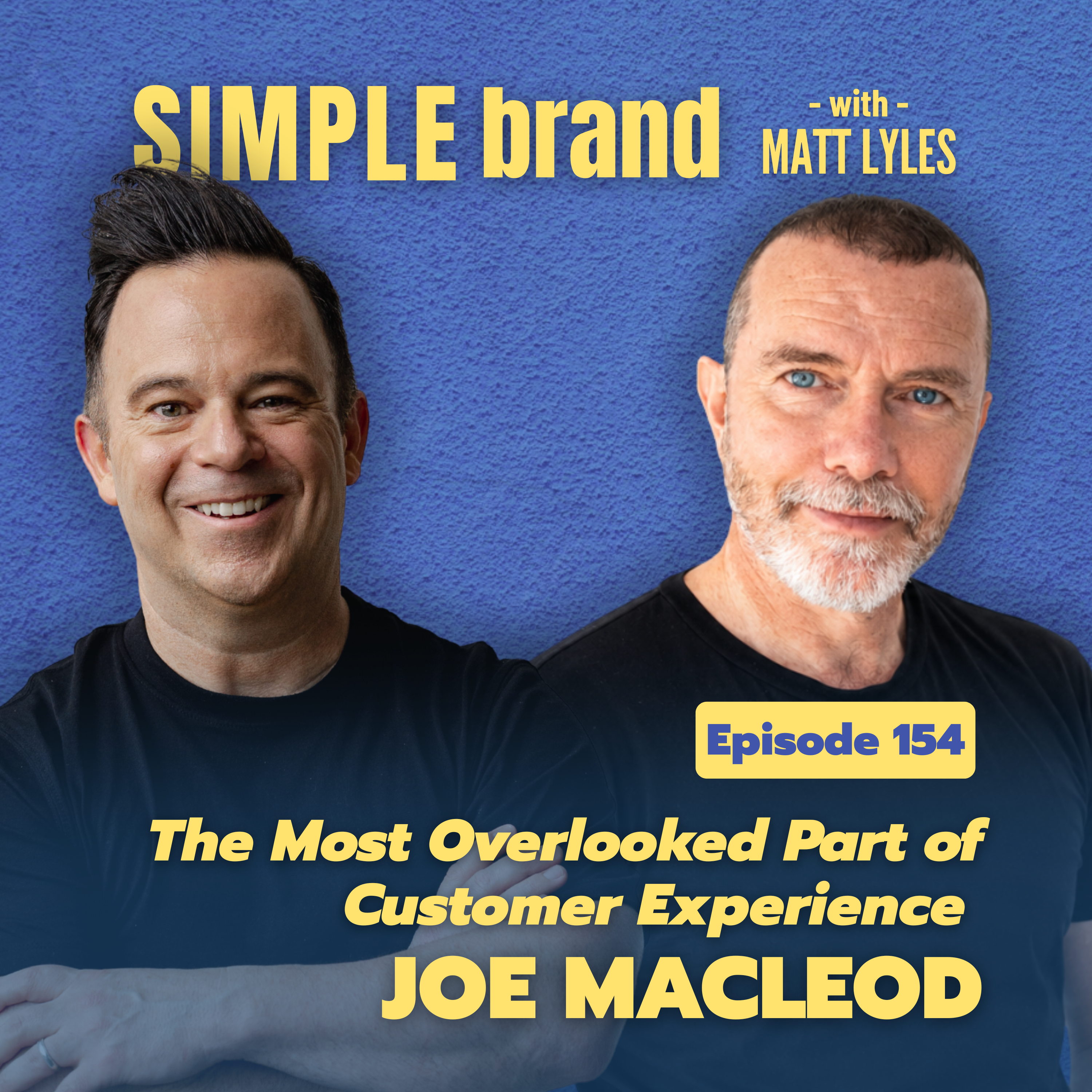
SIMPLE brand With Matt Lyles · Matt Lyles
In this episode of SIMPLE brand, I talk with Joe Macleod, founder of andEnd and author of Ends and Endineering. He helps brands intentionally design better customer endings. Joe and I explore why the end of the customer experience is so often overlooked, why an ending can influence how customers remember the entire relationship, and why businesses need to think about endings as something they can actually design rather than something that simply happens. We also talk about the different kinds of endings customers experience - from the end of an individual transaction or product to the end of an ongoing customer relationship - and why making it easier for customers to leave can actually strengthen your brand. What You’ll Learn Why businesses invest so much in the beginning of the customer journey but often neglect the end The difference between the end of a transaction, the end of a product or service, and the end of a customer relationship Why a customer's final experience shapes how they remember the entire relationship How to identify how your customer experience ends today and how to design how it should end Why making it easier for customers to leave doesn't mean losing more customers How intentionally designed endings preserve trust and make it easier for customers to return Why customer offboarding should be treated as part of the customer experience Why the increase in AI makes intentionally designed endings even more important Chapters 00:00 Introduction to Designing Endings in the Customer Journey 03:53 Defining Customer Journey Endings 04:48 The History and Psychology of Endings 07:58 Why Brands Neglect Customer Offboarding and Endings 11:21 Sustainability, Trust, and Product Endings 16:28 The Different Types of Customer Endings 21:25 How to Analyze Your Customer Journey Ending 24:15 How to Design the End of the Customer Experience 28:31 How Simple Endings Increase Customer Retention and Exits Brand Loyalty 36:44 How AI and Automation Effect Customer Endings 41:53 Joe's 5-song Playlist About Joe Macleod Joe Macleod is the founder of andEnd, the world's first business dedicated to designing customer endings. He’s the pioneer of Endineering, a recognized expertise in sustainable consumption and ethical customer offboarding. And Joe is the author of Ends and Endineering. Connect with Joe Macleod Joe’s website Joe on LinkedIn Joe’s book - Endineering Get 25% off with this discount code: NCKEV Connect with Matt Lyles Check Matt's speaking availability Subscribe on YouTube Matt on LinkedIn Matt on Instagram Subscribe to the SIMPLE brand newsletter Subscribe to the SIMPLE brand show
Joe Macleod: People leave gyms, they go to the gym a bit, but they like being gym members more. but often they want to then leave the gym because it costs them money. But then Matt Lyles: Right. Joe Macleod: gyms make the ending so awful that they hate that gym. So who's going to be the best competitor of that industry is the gym that turns around and says we do really good endings because that's what people do is they leave gyms and they have gym ending experiences more than they care about gym beginning or usage experiences. Matt: Helping you create loyal customers and loyal employees all through the power of simplicity. This is the Simple Brand Podcast, now heard around the world, including Poheim, Germany. I'm Matt Lyles. Today I'm talking with Joe McLeod. Joe's the founder of And End, and he's the author of Ends and Endineering. He spent three decades working in product development, design, and customer experience. And he's the pioneer of what he calls endineering intentionally designing better customer endings. And that's an area where there's a pretty big blind spot in the way that most brands think about customer experience. think about it. We put a lot of focus in designing how a customer journey begins. We design the acquisition, we design the onboarding. And then of course, we place a lot of focus in how we deliver the experience while the customer is still with us. But what happens when the experience ends? unfortunately, that's where most brands fall short. Usually we treat the end as just something that just happens. A product reaches the end of its life, a transaction's completed, a customer cancels their account, and we move on. But the ending is still part of the customer experience. And it's still something that shapes the customer's view of your brand. And if you're willing to intentionally design the beginning and the middle of the customer journey, then you need to be willing to intentionally design the end too. Because the end can still create meaning. It builds trust. It can reinforce the value of the experience that the customer just had. And sometimes making it simple for a customer to leave can actually make it easier for them to come back. And it makes them easier for them to refer others to you. And that's what Joe and I discussed today. We talk about why businesses have historically treated endings as something negative. We talk about how to identify your customer experience actually ends today, and how to design an ending that better reflects your brand. We also explore the different kinds of endings that customers experience, from the end of an individual transaction or a product to the end of an ongoing customer relationship. And why making it simpler for customers to leave doesn't really mean losing more customers. And then Joe and I actually get into the future of endings, including how AI and automation can make intentionally designing the end of digital experiences even more important today. If you've spent a lot of time designing the beginning and the middle of your customer journey, but maybe not nearly as much time thinking about how it ends, then this episode is for you. So here's my conversation with Joe McLeod. Matt Lyles: Hi Joe, welcome to the show. Joe Macleod: How's it going? Thank you. Thanks for inviting me. Matt Lyles: we were talking earlier about I think you know it was Sam Stern, I believe, that turned me on to your work and I started digging in and I thought, well, Joe Macleod: Brilliant. Yeah. Matt Lyles: I really, really want to have the conversation with you about endings. Joe Macleod: Perfect. Delighted to be on the show and I'm really excited to chat about it. Matt Lyles: All right, so when most business leaders hear the term endings or even customer offboarding, they're probably thinking about simply cancellations, but it seems like endings can be defined a bit more broadly than that. What's your take? Joe Macleod: absolutely. think for many businesses and for many people in leadership positions in businesses, we've never really had an opportunity to talk in any other format about endings unless it's negative. So we've always been told like anyone leaving your business, the end of your product, that's always been culturally in the business culture mindset, a really bad thing to happen. So we hate it when endings happen. Matt Lyles: Well, even like before we get into to talking about what endings are actually like today, you've got some pretty good knowledge and insight into Joe Macleod: Yeah. Matt Lyles: the whole history of endings. Can we dive into that a little bit? Joe Macleod: Yeah, for sure. So, in the first book that I wrote, way back in 2017, it, I dug into that and very accidentally, really, I started to look at, endings as an experience and this whole world opened up and I, I started to think to myself, I think people need to hear about this. And so I started the long journey of writing a book and I'm quite dyslexic. So that wasn't an easy idea to write a book. So, what was really fascinating to me is how big a part endings are in our emotions, our society, sociological sort of relationships with one another and our psychology, yet in our consumer experiences. I come from a background of design, which is very much about the creative act, but we have so little vocabulary about the end. so digging into this section. I started to realise that it goes way back in history. So you look at like the way religions have a relationship with the end of the life and the Matt Lyles: Yeah. Joe Macleod: aftermath of that. just as an example, the perception of those places after death, whether you go into religions that talk about silks and jewels or rivers of milk and honey or great big feasts we tell ourselves a story of abundance and consumption at the end and so we've had this framing in our mind of perseverance abundance consumption and so it goes on all over the place and rolled forward for centuries in in sort of different formats so yeah fascinating really when you dig back into it Matt Lyles: yeah. Well, and then thinking about it from that perspective, you've got that one side of, you know, there's the opportunity for abundance and for all these things. But then there's also the opposite, like depending on any choice you make or what you do, there can also be a completely opposite ending that is full of every possible negative thing. An absence away from God or being in in a lake of fire and all of these things. Joe Macleod: Absolutely. So, especially about that off-boarding experience when we talk about life in almost all religions, the how you end, as it were, is Matt Lyles: Yeah. Joe Macleod: critical to which direction you go in. So have you off-boarded life correctly? You end up in some religions, it's called purgatory, and other religions you might end up in a version of hell. And so we had such obsession around that in previous previous generations going way back and the vocabulary was rich, was meaningful, it was emotional and although it's still there in religion, we have failed to bring it into other more modern versions of our lives, especially around some things like consumerism and other business. Matt Lyles: So especially around business, with consumer products, with the customer experience, why do you think we have failed to even place focus on endings? Joe Macleod: if you think about how it goes back to the experience of consumption. So historically we would very much make tools and I mean, wider versions of products in a local community. You might know someone who's created that product and if it failed, you'd probably go back to them or fix it yourself. And when the industrial revolution comes along, we then have this incredible machine that creates loads and loads of products. But the other aspect of that is the products are far more distant to our relationships. So we distance ourselves from that relationship aspect. We then distance ourselves from the skill aspect of mending things and to the point now where we ship our products overseas to be sold to to consumers. So on every level, we've distanced ourselves in that thing. Another aspect is if you just think of digitization as a application in business, we have digitized everything on boarding and usage periods. And then the off boarding of any sort of product experience, you're ringing up somebody on the 20th century bit of technology like a phone and speaking to a human again. And it baffles me to think about digitization and the failure of applying endings to even the business benefit. Matt Lyles: when we think of it that way too, a lot of times it seems like there's so much effort placed on introducing a customer to a product or introducing them to a service or the relationship. There's a lot Joe Macleod: Yeah. Matt Lyles: that goes into customer onboarding, but then when it comes to offboarding, ending that relationship, there's so little thought. Joe Macleod: Absolutely. I remember a really good quote by, I think it was Daniel Pink, the sort sales good, it is Daniel Pink. He Matt Lyles: Right. Right. Joe Macleod: talked about one of the best skills in sales is people will be happy to take an on-ramp when they can see an off-ramp. And I think that's such a good way of looking at some of the sales aspects of endings. I think... When you dig into endings, some of the groups that will benefit from looking at the books and looking deeper into endings are salespeople to see the opportunity space at the end for not just an upsell, but adding meaning and brand awareness and to really bed in that product benefit. yeah, I think there's enormous opportunities in that that space as well. Matt Lyles: Well, and that speaks to providing the customer with with some level of certainty. Like knowing, Joe Macleod: Yeah. Matt Lyles: okay, this is what it looks like, and I know, at least based on what they're communicating to me, I know that when it's time to leave, whatever time that may be, I know that there's a process and I'm aware of it and I know the steps to take. Therefore it seems pretty simple to me. Joe Macleod: Absolutely. So if you think of how we've had to frame products historically, let's say 20 years ago to build brands, you had to build quality bedding that perception of a product frame it in different characteristics and whether that be branding or product placement or promotions. But I think what's happened in the last sort of 10 years around circularity sustainability is really sort of, I think, challenged the intellectual sort of rigor of the industry in terms of grappling with how we frame brands in the long term. So we've now got to a point where onboarding and usage, you still talk about brand positioning, the promises of the product, and at the end of the product life cycle, brands walk away, they throw their equity away, And then all of a sudden the customers having to grapple with terms around material matter. So is this made of plastic? I mean, I say to people when I do the training, like no one has ever gone out and said, I'm just popping down the road to get some plastic. But at the end of the customer Matt Lyles: Yeah. Joe Macleod: life cycle, we talk about plastic all the time. the, where our messaging breaks down as brands as product owners and developers is not looking at that last space in the customer journey. Because believe me, they have to take your product from their home to recycling or wherever it is. They have been abandoned by the provider and the brand at that point. And there have been a grapple with all sorts of really challenging issues around waste shame as well. I think is a big place in that last quadrant of the customer life cycle. And brands need to start stepping into that space. Matt Lyles: What would it look like for the ideal situation for a brand to step in that place and help a consumer with the end of a physical product like Joe Macleod: For sure, it's a really good question. Let's frame it in terms of what you need to provide legally across the world now, whether you'll be digital, physical service sectors. across the world, you're going to need to provide aspects of digital deletion, digital protection. You need to provide aspects of electrical product, waste management, waste recycling. And the The barrier between you and the consumer as a provider and the consumer at that point is that you also as a producer need to do reporting back to your governments and XYZ. But at the moment that place is full of legislation, cold language, and it's emotionless and the connection between the consumer and the provider is broken. The opportunity there is to build meaning, emotion, instruction, guidance, partnerships. And that's such a big brand opportunity that the sort of stuff that we do at Onboarding really, you you'll make a product placement video with so-and-so, you'll talk about language, you'll celebrate the fact that this person has signed up with you. You know, you're doing all of these really emotional things. But at the end, you've thrown it all away. And you also have thrown away that emotional, that sentiment the customer has with your brand and your product. Matt Lyles: when it comes to experience design, so much of it is ensuring that we're w that we're at least focusing on the customer's emotion throughout the customer journey and at each interaction. But, you know, to hear you talk about the end like that, there's no thought to emotion at all. Joe Macleod: Yeah, and I think one of the reasons we've got into the problems we have with greenwashing, I personally feel a lot of businesses have fallen into that space, not really meaning to have done greenwashing, but have accidentally ended up trying to position themselves. And I think it's because we talk about carbon tonnage and plastics and what we make it out of. instead of being present at the end and showing them and making the experience of the end happen. Because without that, then the customer is going to feel abandoned and lost and talk about it in terms of that was greenwashing. Matt Lyles: to me, when that happens, I think there's just a lot of trust that ends up getting lost between the customer and that brand going forward. Joe Macleod: absolutely, Matt Lyles: so that's that's looking at it from a physical product standpoint. Joe Macleod: Yeah. Matt Lyles: but there's there's all types of endings from other brands for say it's professional services, say it's experiences, or even like digital relationships. when we talk about designing the ending, Is it just the ending at the very end of the relationship or should there be a focus placed on any of the endings with transactions throughout that relationship? Joe Macleod: Yeah, so transactions are a really good aspect there's a whole chapter about transaction models in my book. And basically you could have five broad transaction models, payment before payment afterwards, continuous payment, like subscription models. You could have immediate transaction you like with cash in the shop, or you could have continuous object observation that we do very much with digital products like Google Maps, for example. With those types of models, each one of those frames the relationship in a power dynamic. you have, if I pay before I get a service, I have no leverage on that relationship as a customer. But if I pay afterwards, like a good restaurant meal, then you have loads of leverage at the end. And it's one of the reasons, talk to people who work in restaurants and have made the business or their profession out of working in restaurant and actually being a customer of restaurant everything is being pushed towards the end of the experience so when the food comes it's how's the food are you happy do you need some more wine so they're they're always pushing towards the end because they want to make sure that absolutely they've inquired all the way through so they know you're on track to have a good time at the end and therefore then the tip is hopefully reflective of that. But in other places, that's right really payment after delivery for those Matt Lyles: Right. Joe Macleod: type of things really good but if you do payment before like let's say flights or train travel is a terrible one, Matt Lyles: my goodness. Joe Macleod: you haven't got any leverage you'll walk away from a one hour delayed train without any real leverage. And then you get into two other ones. So each one of these has an ability to be really good for your brand at the end and creating a really great experience around that. And you need to think about that moment of transaction. Is this the right transaction model for our business? And loads of sectors just pick one from history. They had the same transaction model throughout history and have never changed it. Matt Lyles: Well, so w how should they approach looking at the transaction model and and deciding if they need to go against what they've done historically and move to a different transaction model? Joe Macleod: I think very much about the opportunity that it provides them to have a better relationship with the customer. at, think utility companies is a good example as utility companies move into regular payment, direct debit. The moment of the end as a transaction point where you are going to have this discussion. metaphorically it will be the similar one you have at the end of a meal, you have an opportunity in utilities to have that, how's it gone? How have we performed? And really with the direct debit, people forget about it, dribbles out of their account to the electric company or the water company and the water company aren't going to upset their... apple cart by asking questions so we all end up in this like no one really cares about this moment of reflection which the restaurant meal can is a good example of creating that space. Matt Lyles: and then thinking of utility companies, you're right. I I think for the most part we aren't thinking about it, we aren't reflecting on it until we get the bill and there's something just w wildly outside the Joe Macleod: Yeah. Matt Lyles: norm like, wait a minute, why am I being charged this much this month when it's, so much higher than last month? What happened? Joe Macleod: think when that goes on, then you're into that sort of service rescue mindset where the customer really wants to have a conversation with someone. And as we've automated so many of our call center things, we haven't created these continuous spaces for feedback discussion. And I think that's sort of interesting. It's only in the panic mode where we have that. Matt Lyles: thinking through these different models here too, one of the things that I've been focusing on lately is understanding the fact that I think a lot of brands assume the experience ends at a different time that the customer thinks that it ends. Sometimes they assume that it ends before the customer believes it ends. Sometimes they Joe Macleod: Yeah. Matt Lyles: assume that it ends even after. So how can we determine where a transaction or even where a relationship actually ends from the customer's perspective. Joe Macleod: So I think there's a lot of assumptions around product lifespans. we've both been in product companies in different sense. And if you go into a product company, you can ask anyone in there and they will have specific, really deep knowledge about how the customer acquires the product and uses the product. And then I've been in there and asked them, so how does it end? And it is incredible. incredible the barren knowledge of that space i've been into companies and I I asked one company about their product and It was a physical product and I said how long does it last and they were like I think about two or three years and I look it took me seconds to look up the functionality of that product and how long it lasted and for most people it would last 10 years and to have just that difference of knowledge to assumption and actually even to be that in that position and just make assumptions about end of product life, I find it amazing. the first thing I get any business to do is to look how does it end currently? Because most most businesses have no idea how it really ends unless they're really in the nuts and bolts of it and to get into there is to say how does it end and that's the first question the next question is how should it end and then you get into like the types of endings that products have so there's broadly eight types of endings products have whether that is a credit out ending or a time out ending or a task event completion type ending or a cultural ending that's for things like fashion is a really good example of cultural endings. So you've got these eight types of endings. Is your business the right type of ending? That's one of the simplest questions to really have a discussion around. Matt Lyles: that's part of your process, your Endineering framework. And Joe Macleod: Yeah. Matt Lyles: then there's the third question too, right? how will we make it end that way once they decide how it should end? Joe Macleod: Yeah, so really after finding out the type of ending your product is and if it's the right type of ending then you really need to look at what does your business do as an ending. It's really funny when you chat to businesses and like our brand says this, we're proud as a brand, we're transparent, we're brave, we're honest and then you find them like doing dark patterns in the call centre and And it's amazing how lacking that last third of the customer life cycle is in terms of the connectivity between the emotional promises are onboarding and the experience, the cold experience that customers have at the end. Matt Lyles: Well, that so going back to that first question of like like really knowing, okay, how does it end? what should their steps be? Like how would they actually examine and know for certain how it does end today? Joe Macleod: in terms of all of the processes I would go through, the first one is to change your mindset about endings. That's basically management or leadership, I should say, need to have a change, re-change their mindset to say, this is a space to do real work and business. The second thing is to then look, how does it end right now? how is the customer experience? And then the third one is really, yeah, how should it end? So what would your brand do if it was going to create an ending? So you then you bring your emotions across to that ending space and say, what would our transparent version on boarding be a transparent off boarding? Are we doing the right thing currently? And then start to look at that. type of ending and then phases of the end is the narrative structure that you go through. So if you think of For example, people talk about metaphors of the three act play. If you think of onboarding as the first act, the second act is where most of the action happens. And it's so important to have that third act, which is about resolution, emotion, and tidying things up, adding meaning. And that sort of third act, you need to think about the phases of off-boarding. in my work there's seven of those phases you go through from the crack of doubt which is like maybe this is over now as a consumer to the rebirth which is about right at the end right in the aftermath is rebirth which is about am i ready to buy another product am i ready to engage again and so you need to think about how all of those phases go on and then one of the most important things is to grab data around that because you really want to know about are we improving? One thing which is also interesting is that when we create products, it's like a big crescendo. You you do the market and there's the launch date. At the end, there's no such thing. So it's a different type of observation or data collection of sort of watching the improvement happen or the lack of that happening. So yeah, there's lots of stuff to do. Matt Lyles: in that regards, what Joe Macleod: Yeah. Matt Lyles: sort of data should they be looking at? What should we be measuring? Joe Macleod: I think because we don't do so much of that thing. mean, we ask about sentiment around product and, you know, we've given them a form to fill in, but I think with a lot more digital stuff, we can start to say like, what choices have they made as they've left the customer life cycle? What spaces have we allowed them and built experiences around? because we build so little experience around the end. We don't really observe very many of those places, but if we start to build places and experiences that they go through, we can start analyzing, that, was that successful? Was that not successful? Have we achieved this? how's the sentiment now? so, yeah, I think there'd be opportunities to a lot more data that come out of that. Matt Lyles: Yeah. And then just, you know, learn and apply learnings and then pivot pivot where necessary. Joe Macleod: Yeah, absolutely man. mean basically a lot of the skills that we have for onboarding in terms of our skill sets and our teams and the people who do good work there, they can really apply them to that other place and it's about building those things using the tools that I've put forward but you know taking a lot of your skills and tools and judgment to say how should this end Matt Lyles: going back to one of the things you mentioned earlier too was changing a mindset or ensuring that they have the right mindset around endings. Joe Macleod: Yeah. Matt Lyles: And I think that there are a lot of leaders that just simply say that they don't want endings. They want to do everything possible Joe Macleod: Yeah. Matt Lyles: within the brand and within their front line to try to prevent endings. on one side you've got the mindset of just simply making it harder for there to be an ending. Let's bury the page, bury the process where customers would know how to end. and then on the other side you've got where if customers are able to, pick up the phone and talk to someone, talk to a frontline team member, the frontline team member is told to do what they can to retain that customer. how do those efforts end up really affecting the true ending? Joe Macleod: one of the, the second book I talk about, because I interviewed quite a few people in for the books and Matt Lyles: Yeah. Joe Macleod: I talked to somebody who worked at a big telecoms company and they were talking to their service team, the call center team who wanted to stop doing the hard retention calls. And so they, they decided to build an app. a feature in their app, which was basically a really smooth, simple ending. when the app was built and they were going to launch it, the senior management were terrified. They thought that everyone was going to leave and they were really watching the numbers very attentively over that period when the app launched. And of course, the numbers didn't go up at all. It was the same amount of people leaving. but they left with a really good sentiment about the brand. And I think it's a really good example of the trapped logic we're in about endings. To put it in another category, if you had that psychosis about your product, that the only reason people use our product is because they can't leave, what does that say about A, you as a leader, and B, your product? Matt Lyles: Right. You've got a lot of other things to be focusing on then. Joe Macleod: Yeah, I think you really should allow the person to leave and really focus on building a really good product because the majority of people leave, A, because the product isn't fulfilling their needs or is poor. So you need to focus on product improvement or B, external factors. you can't, stop people leaving if they need to leave the country and leave your telephone service or their parents have died. I mean I get so many people contacting me about their parents have died and they can't shut down their accounts. It's insane! Matt Lyles: especially in some of those specific situations like that, there is an opportunity for a brand to create significant positive affinity by either either customers or the customer's family members by walking them through Joe Macleod: absolutely yep yep yep yep yep Matt Lyles: a positively emotional ending like that. Joe Macleod: Yeah, absolutely. You know who do really well actually when we just talk about death, human death, second most common user case on earth. We've all been born, that's the first most common one. Some of us haven't experienced death yet or haven't you know witnessed that sort of thing. Matt Lyles: But a hundred percent of us will. Joe Macleod: 100 % of us will. What's the parallel industry is the pet industry where people And I get so many positive stories from the pet industry. And it's amazing that we do so poorly with ourselves and so good watching other things die and making great off-boarding experiences for them. Matt Lyles: talking about the pet industry, one of the ones that I go back to a lot is Chewy. Chewy does a great job with this. Not only do they make the ending a really simple ending when a pet owner's pet dies, but they also provide a lot of positive emotions around it. They will send flowers, they will send cards to a customer, they will tell a customer Don't worry about having to return an item. You know, if you want to, you can go and donate this food to a local dog shelter. they do so much around ensuring as much as possible a positive ending in that relationship. Joe Macleod: It's amazing we don't do it for human ones on that level. I wonder if it's because people find it awkward or something. I don't know. But yeah, it's really amazing, isn't it, that the difference between the two. Matt Lyles: It is. You know, you were talking about the two different situations of leaving. I am curious if there's consideration for a third scenario where a customer has at least the perception that a different brand will serve them in the way that they want to be served, you know having that the grass is always greener mindset, Joe Macleod: Yeah, yeah. Matt Lyles: going to a different brand. Realizing that it really wasn't all that better. And then like, should I go back to the previous brand? But if they didn't have a simple, if they didn't have a positive ending with that original brand, deciding, yeah, I don't even want to go back to them anymore, even though what they gave me was just the same, or even maybe even a little bit better than what I'm getting now. Joe Macleod: Yeah, there's a couple of examples I can give you one from banking and one from the gym industry. So years ago in the UK, the banking industry, a lot of people found it really hard to leave their bank accounts because it would be so hard to reset up direct debits and stuff. no one could afford it because no one's got like three months salary in their accounts. So average lifespan of your bank account would be 27 years of customer relationships until they introduced a thing called the seven day switch where banks had to allow you to leave in seven days and there was another part of that legislation which was to share data with new products to see if it would work and that's I think great and that's coming to other digital platforms across the EU shortly as well. The gym industry I find fascinating because they used to have a situation where they wouldn't allow you to leave and they'd really ramp you into these tight contracts and you'd have Matt Lyles: Yeah. Joe Macleod: to get a doctor's note and stuff like that and what I found interesting and when you change it into endings is that a lot of people don't go to the gym. People leave gyms, they go to the gym a bit, but they like being gym members more. Like they could go to the gym, be a gym member with the opportunity to go to the gym, but often they want to then leave the gym because it costs them money. But then Matt Lyles: Right. Joe Macleod: gyms make the ending so awful that they hate that gym. And so let's say you're a person who doesn't like going to the gym much, but you signed up for one company. You stay there for six months from January after Christmas. Let's go to the gym a little bit, get fed up with it, try and leave. Nightmare to leave. Anyway, next Christmas you end up doing the same thing. You have a terrible experience at leaving again. And then the third one, you go to the third three years, you've been having terrible gym leaving experiences. So who's going to be the best competitor of that industry is the gym that turns around and says we do really good endings because that's what people do is they leave gyms and they have gym ending experiences more than they care about gym beginning or usage experiences. Matt Lyles: Yeah. Joe Macleod: So I think that that's an interesting way to look at it is that are we losing out because we have a bad ending and half the time we wouldn't know because people have left and they've take that knowledge with them. Matt Lyles: Right, right. And then, you there's the thought around if you make it simple and even a positive experience for somebody to leave, then to me it makes it that much easier for them to come back if and when they decide to come back. Joe Macleod: Absolutely and we're back to the Daniel Pink thing you know Ramp Off Ramp On isn't it? Yeah Matt Lyles: Yeah. Yeah. Yeah. Well, so it's been a few years since you've written your books and especially since Endineering. And since that time, over the past few years, of of course like we've seen this exponential growth in AI and automation, especially around digital experiences and digital relationships. So I'm curious about your take on AI. Has it made it easier for companies to create better endings? Joe Macleod: I'm writing a book currently and it'll bring me out soon about more the tech space and this real Matt Lyles: Yeah. Joe Macleod: problem. it's a really good example, the AI issues which are going to come up in digital products and digital product experiences for people. If you, for example, let's say sunset a regular digital product, it's actually a very linear well-established process. So you go to the backend, turn the servers off, remove the APIs, remove the front end GUI, sort of interface apps, et cetera, et cetera, turn people's identity systems off and their passwords, et cetera. When we've built so many products, and I'm sure you and all your guests have been witnessing this crazy product creation stuff going on, Many of those products, on average, 40 % of those products are being built by AI, even in big companies. And what's been happening in those companies, especially the big ones where they've got big development teams, and when they start using AI, is there's this term, and I haven't come up with this term, I think it was a good guy from Google came up with it, but there's this term called comprehension debt. But we have technical debt in, in products where you just sort of hacker, you know, solution together and you think, I'll come back to do deal with that later. But that the development team understand they comprehend the previous products, but they don't comprehend because they haven't built all of these components to these new AI products. And this comprehension Matt Lyles: Right. Joe Macleod: debt. of understanding just how to undo this. So for example, just on the monetary level, if you sunset a regular product, it's about 4 % of your build of a digital product. When you start to think about sunsetting a AI product, according to San Francisco AI lab, they reckon it's going to be between 12 and 25 % of your build costs to unravel and unpick all of the crazy twists and turns and so many of those products are also stitched into other AI products and it does create another problem in legislative terms across whether it be CCPA in America or GDPR all of these bits of legislation require you to have very clear identifiers across those products And if you don't know how and where people's IDs or their names have gone because you've just stitched it into another AI product, it's going to be an absolute quagmire. So in terms of endings and digital, I think it's going to be the most awful experience for customers in the next 24 months, I think. Matt Lyles: wow. Wow. like that's a big big mess. usually especially as it relates to digital technical messes like that throughout my career, a lot of times the approach has been to just kick the can down the road and just Joe Macleod: Yeah. Matt Lyles: see if it can just quietly die on its own. but the way that that's described right there, it sounds like it's gonna be Pretty massive and unignorable, I guess. Joe Macleod: Absolutely Matt, and I think it's that end shitification isn't it by Corey, Doctorow I think we're gonna be that and ten times because end shitification is based on lack of craft and attention to detail and the amount of product I know of being created in everyone's gardens and garages or wherever you create. AI products, I don't know. Yeah, it's gonna be an absolute hellhole. Matt Lyles: So is there a way for a leader, for an individual brand to be able to look at what they're doing and to try and solve for that within their own house right now? Joe Macleod: I think it comes back again to look, where does it end for us? How does the customer experience end? Don't get distracted by what it means in an AI sense. think because you could create a surface pattern on top of this, which you will be able to off board those people safely, securely with data intact. If you start looking now into saying like, how does it currently end and how should we build this ending? Because a lot of the AI is going to be built into the usage of the product, but you can still control some of those aspects and off-boarding, think, without getting too tangled. Keep your head above water of the noise and create good customer experiences to off-board those products. Matt Lyles: that goes back to what you were saying earlier too, around simply changing your mindset around what an ending is and Joe Macleod: Yeah. Yeah. Matt Lyles: what an ending should look like for your customer and then build from there. Cool. All right. Well, thank Joe Macleod: Absolutely. Yeah, perfect. That's it, man. That's it. Absolutely. Matt Lyles: you. All right. Well, Joe I got one last question for you. If you were Joe Macleod: Yeah, go for it! Matt Lyles: if you were to create a five song playlist for Endineering, what songs would you include? Joe Macleod: Yeah, well, so I think the doors, the end has to be one of them. I really like Matt Lyles: Yeah. yeah. Joe Macleod: that song. yeah, I was doing karaoke the other week and we were singing LA Woman, so that has to... Matt Lyles: okay. I was gonna say like you didn't sing the end karaoke. That would have brought the karaoke party down probably. Joe Macleod: Yeah, yeah, no, we're not gonna end karaoke. That would be an insane thing to do. We were talking earlier in Closing Time by Simisonic, is it? That was one. And then Matt Lyles: Yeah, yeah. Joe Macleod: Hurt by Johnny Cash. I like Johnny Cash. Matt Lyles: Hmm. Yeah, that's that that's a great one. Joe Macleod: Yeah. The Beatles, The End. Another The End one by The Beatles. think Matt Lyles: Right. Joe Macleod: that was that on the Abbey Road Out? Matt Lyles: I think that was Abbey Road. Yeah. Joe Macleod: Yeah, breaking up is hard to do. Is that one we were thinking of? Yeah. Matt Lyles: yeah, yeah. Yep. It is hard. Yeah. Joe Macleod: Yeah. Matt Lyles: It is hard. But you know, but that means that you just need to change your mindset around it. Joe Macleod: Yeah, I need to change my mindset to think about a playlist which has these on because this I should have shouldn't I? And I could share it. Yeah. Matt Lyles: There you go. Well, those are some fun songs and fun to think about too. Well, Joe Macleod: Yeah. Matt Lyles: Joe, I've learned so much from you and I've learned so much from our talk here today, but where can people go to learn more? Joe Macleod: If you go onto the website, that's andend.co. So andend.co. And on there, there is lots about why you should, as a business, look at endings. And that goes across physical, digital, service sectors. I talk about things like whether it be fashion or cars or digital products or electronics or something. There's loads of articles on there. There's also loads of methods on there. There's ways to get in, get the books. You can get them on Amazon. The first book is also an audio book and both of them are available as eBooks. And you can get a discount code off Matt's notes for the podcast. And also you can sign up to become an Endineer There's over a thousand Endineers and we Matt Lyles: well. Joe Macleod: have a chat. group we talk about endings in which is really a diverse subject matter it's fascinating Matt Lyles: that's a great opportunity. And and thank you for offering up that discount code for your books. I will Joe Macleod: Absolutely welcome. Matt Lyles: put that code in the show notes. So wherever this show is placed, you can look at the code and use that to get your discounted book. Joe Macleod: And you can also on the website book me for talks. I do talks all over the world. I'm often traveling for talks and also get me in as a consultant. I can help you build your ending. Matt Lyles: Great opportunities for anyone to learn how to work with you at any level to figure out how to change their mindset and build the right endings. Well, Joe, thank you so Joe Macleod: Thank you. Matt Lyles: much for being here today. Joe Macleod: Thanks a lot Matt. Thank you. Matt: Well, thanks again to Joe McLeod for joining me on the show. And thank you for joining me. Now, here's the one thing that I want to focus on from my conversation with Joe. Making it simpler for customers to leave can actually make it easier for them to come back. I know that sounds backwards, right? I mean, if you're trying to build customer loyalty, why would you make it easier for them to leave? But Joe shared a great example of a telecom company that built a simple way for customers to end their service. And then initially, the senior leaders were worried that making it easier to leave would cause more customers to leave. But it didn't. The number of customers leaving remained essentially flat. And then the ones that did leave actually left with a better sentiment about the brand. And so that got me thinking. I mean, how many brands make it harder for customers to leave because they're afraid of losing them? Yeah, I know. It's a lot. Because you and I deal with that every day whenever we try to leave or try to cancel service. some brands bury the cancellation process information so that it's impossible to find. Some force you to call customer service and then wait an hour to talk to a live person. Then they make you explain why you're leaving. Then They transfer you to someone whose sole job is to convince you to stay. And then in the end, the endings become so frustrating that you leave with a negative opinion about the brand. But what if you looked at the ending differently for your brand? What if you said, if this customer is going to leave, how can we help them leave well? That means make the process simple. That means giving them clear information about what happens next. That means actually thanking them for their time being a customer. That means making it easy for them to come back someday in the future. So here's your takeaway. Think about just one of the ways that a customer can leave your brand. It could be canceling a subscription, it could be returning a product, It could even be just the end of a transaction. Now, walk through and experience that ending for yourself. How does it feel? Is it simple? Does it reflect the brand experience that you've worked so hard to create while the customer was with you? And if you'd like for that customer to come back someday, have you given them a reason to want to come back? Because the end of the customer relationship may not. Be the end of their relationship with your brand. It could be the beginning of the next one, or it could be the connection to a new customer if they feel so great that they want to refer you to someone else. So, thanks for listening. Thanks for watching. And until next time, keep it simple.