
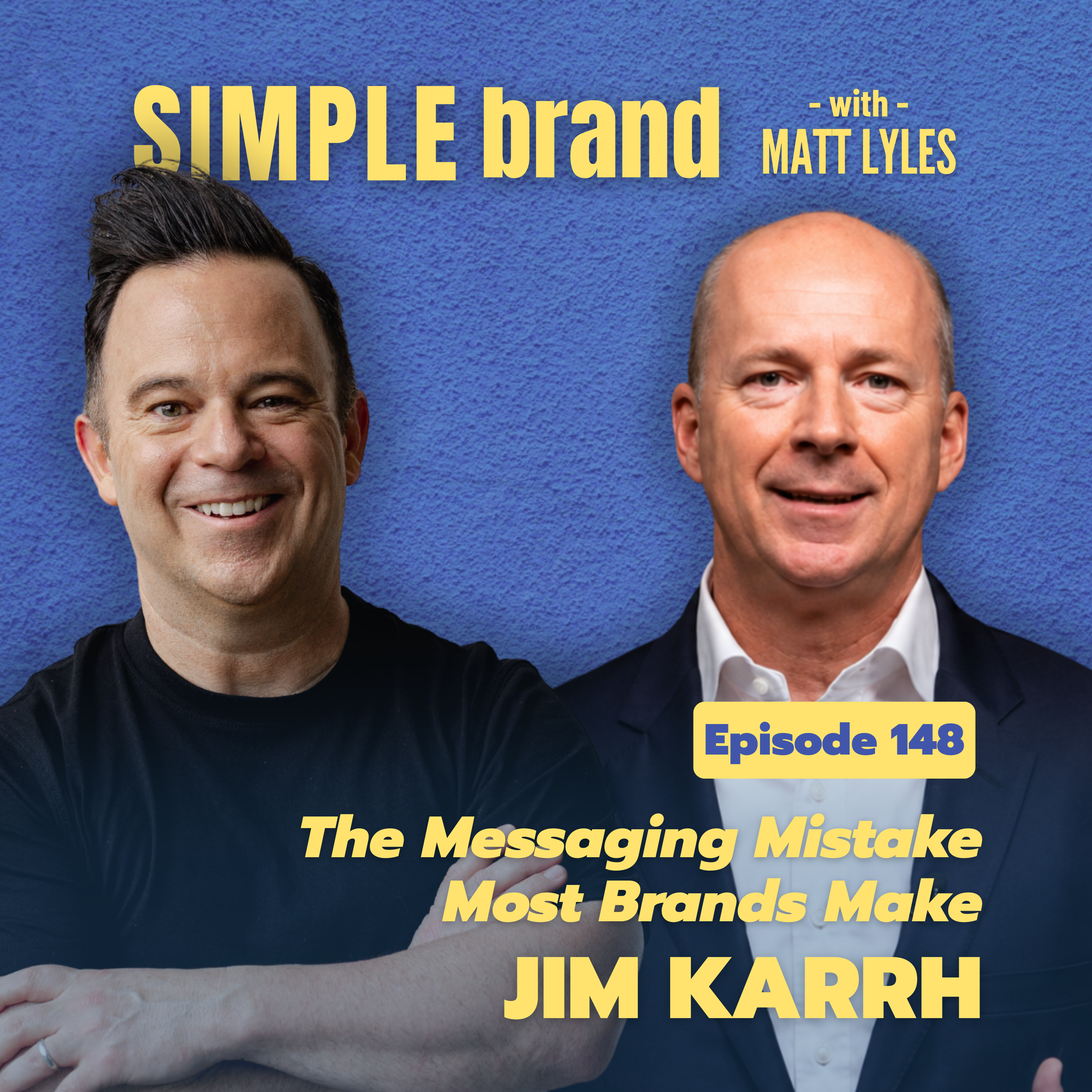
SIMPLE brand With Matt Lyles · Matt Lyles
In this episode, I sit down with marketing professor, consultant, and keynote speaker Jim Karrh, author of The Science of Customer Connections: Manage Your Message to Grow Your Business. Together, we explore why so many brands unintentionally confuse customers, why sales teams are often far more confident in what they sell than in how they talk about it, and how clear, customer-focused messaging can transform everyone—from marketing and sales to customer experience and frontline employees—into stronger ambassadors for your brand. What You'll Learn Why brands with great products still struggle to communicate their value. How your customers compare you on price when your messaging sounds like everyone else's. The three biggest warning signs your messaging isn't working. How to create messaging that's consistent without turning your employees into scripted robots. Why talking about your customer's world is more persuasive than talking about your own. The three components every brand needs to create clear, consistent messaging. How expertise and empathy work together to build trust with customers. Why your employees may be your most overlooked brand messengers. Chapters 00:00 Introduction to The Science of Customer Connections 03:37 Understanding Messaging Gaps in Organizations 04:28 What Holds Brands Back With Their Messaging 05:24 The Confidence Gap Every Sales Team Faces 10:01 The 3 Big Symptoms of Poor Messaging 18:45 The Importance of Consistency and Cohesiveness in Messaging 19:52 The 3-Point Strategy for Effective Messaging 23:59 How to Ensure Your Message Is Trustworthy 29:03 The Role of Messengers in Communication 33:23 Using Word of Mouth to Spread Your Message 35:50 How AI Can Help or Hinder Our Messaging Efforts 39:38 Jim's 5-Song Playlist About Jim Karrh Dr. Jim Karrh is a marketing professor at The University of Alabama's Culverhouse College of Business. Roll Tide Roll! He’s also a keynote speaker, consultant, and author of The Science of Customer Connections: Manage Your Message to Grow Your Business. Drawing from experience as a chief marketing officer, researcher, entrepreneur, and consultant, Jim helps B2B sales and marketing teams develop clearer, more customer-focused messaging that drives growth. He also hosts The Manage Your Message Podcast and is a frequent contributor to leading business and marketing publications. Connect with Jim Karrh Jim on LinkedIn Jim’s Book - The Science of Customer Connections: Manage Your Message to Grow Your Business Connect with Matt Lyles Check Matt's speaking availability Subscribe on YouTube Matt on LinkedIn Matt on Instagram Subscribe to the SIMPLE brand newsletter Subscribe to the SIMPLE brand show
Matt: Helping you create loyal customers and loyal employees all through the power of simplicity. This is the Simple Brand Podcast, now heard around the world, including Temple More, Ireland. I'm Matt Lyles, and today I'm talking with Jim Carr. Jim's a marketing professor at the University of Alabama, Roll Tide. He's also a keynote speaker, a consultant, and author of the book, The Science of Customer Connections. Manage your message to grow your business. Now, here's something I see a lot of the time. A company may have a great product, it may have a great service, it may even have great people, but it struggles to explain why any of that matters. And when customers don't understand your value, then the only choice they give themselves is to start comparing you on price instead. That's not really a product problem, that's a messaging problem. And that's exactly what Jim and I discuss. We talk about why so many brands unintentionally confuse customers. We talk about why sales teams are often much more confident in what they sell versus how they actually talk about it. We talk about Jim's framework for identifying messaging problems and the three components every brand needs to create clear, consistent messaging. And we also explore why messaging isn't just marketing's responsibility. It influences sales, customer experience, leadership, and really every employee who represents your brand. So If you ever wondered why customers just aren't getting it, or even why your own team struggles to consistently explain what makes your brand different, this conversation is going to help you communicate your value more clearly. So here's my interview with Jim Carr. Matt Lyles: Hey Jim, welcome to the show. Jim Karrh: Hey Matt, it's a pleasure to be here. I really appreciate the invitation and the chance to speak with you and your audience. These are my people. Matt Lyles: Yeah, I know, far as customer experience, as far as messaging, but also as far as the Culverhouse College of Business at the University of Alabama, Roll Tide. Jim Karrh: RTR as we say around here. And listen, I'm an alumnus of both the University of Florida and Duke University and I'm a kid of the South. But yes, as your audience may not know, I also am on the faculty of our business school here at University of Alabama. And that takes up a good bit of my time. So that's part of my teaching. And then the rest is, I guess I teach kind of with air quotes here. with a bunch of sales teams, marketing teams, just a lot of business to business entities, and then audiences for speaking and consulting, all that sort of thing as well. Matt Lyles: And so I graduated there undergrad in business and then I went back a couple of years later and got my MBA there as well. certainly have a heart for Alabama. Jim Karrh: Well, We're happy to spread that around. And I say, roll tide, and you say, that's the convention, everyone. Matt Lyles: Roll Tide. I think that's the first time we've said Roll Tide on the show here. Awesome. Well, so we're not gonna talk too much about Alabama today. We're gonna talk really about your approach, your lessons around messaging, you even have your book around it, The Science of Customer Connections, Manage Your Message to Grow Your Business. Jim Karrh: It is. Matt Lyles: so today, I see this a lot with companies and I will look at companies, it's their online content, whether it's advertising, whether it's PR, or sometimes whether it's even their frontline employees or even salespeople, and I'm thinking something's just off to me. This isn't clicking to me. And I'm seeing it more and more. What is it? What is it that holds companies back with their message? Jim Karrh: Now, Matt, what you see is what I see and what I'm sure a lot of your audience members see as well. I'll put it this way. First of all, let's define terms. When I talk about message and messaging, it's almost like a Venn diagram. You got a lot of things and people think about their sales collateral, their website, their social media presence, their pitch, And there's no magic formula, just different ways of communicating. Matt Lyles: Yeah. Jim Karrh: with your audience, your market or your prospects. one of the main things that we can talk about some cues to getting this better is inconsistency and people just trying to figure out is there some sort of code or fairy dust that we can sprinkle around and make it all good and get people to understand us and want to buy what we're selling. I will tell you this is a very common and very human sort of thing. what I call a very arresting data point a few years ago, Matt. It's from a fellow named Tim Pollard who'd done a lot of work as an author and a speaker himself. And he was sharing with me something that confirmed in a very stark way this trend that I've been seeing out among businesses and teams around the world. He had a group of a couple of hundred high performing business to business sellers. These are people who made the President's Club, they're doing great. They're typically selling fairly high value services and solutions. But they were at this event, which was essentially a reward for them, for their great performance. So we have very, very good people who are doing really good work. Matt Lyles: Okay. Jim Karrh: were asked two questions, and they were both a level of confidence from a scale of one to 10, right? One, zero, really no confidence, and 10, very high confidence. The first is, How confident are you in the value of what you sell? And in that, the average score was a little more than eight on one to 10. Really? And that makes sense. It's not perfect. Nothing that we offer is right for everyone, know, and everything has some sorts of flaws. But they're like, you know what? Yeah, for what we sell to the right people, for the right reasons, it works. But they also ask, what level of confidence do you have in the messaging? Matt Lyles: Really? Okay. Yeah. course. Jim Karrh: behind what you sell? And there the answer was an average of less than four on a one to 10 scale. My response was much like that. I knew there was a gap. I didn't realize the gap was the size of the Grand Canyon between people knowing that they have something valuable to offer the world But how to message it, how to get that across. So know that Matt Lyles: Whoa! Wow. Yeah. Yeah! Jim Karrh: Whatever your answers would be to that same question, you're probably more confident in what you have to offer than in how to talk about it. And that's very common, but it also is, as Matt, you and I can talk about, it's manageable. It doesn't have to be perfect, but there are ways to do it. there's just, this is a chronic problem. Partly it's by industry habits. Sometimes it's our brain rewarding us for saying the wrong things. Common problem, but we can help fix it. Matt Lyles: Right. that is a pretty significant gap. I was expecting the first answer to be a little bit lower, maybe six and a half to seven. And then the answer to the second question, yes, I was expecting it to be low, but I was thinking more like five, but that is significantly low. these are all salespeople as well. And so, I have interacted with, I've dealt with a number of salespeople and sales leaders and sales executives throughout a lot of my career, and I do have to say that in that situation, my assumption is that would be that tendency for the individual to know that in the back of their mind, they're not confident, but they're going to confidently make, not. not make up a lie, but confidently deliver their own message, which may or may not be the right message. Jim Karrh: And Matt, I agree what you've seen in practice does tend to play out from my experience. And this is a little bit of research and a lot of practical experience over the years of working with similar kinds of people. And just think from a human perspective, if you're not confident in how to talk about yourself or your solutions or your products, what happens when you lack confidence in what to say? Well, I find that there are two different reactions. Neither one is good for business. The first is that you tend to avoid the conversation. just, I don't want to, I'm afraid of sounding silly or inconsistent or whatever. So I'll just keep my trap shut. And that's the, that's the sales person who won't, who won't make that extra call. That's the person who won't go to a community event or a networking event. That's a person who won't ask for a recommendation or a referral because they're just not sure how to do it. And that's Matt Lyles: Yeah. Yeah, that makes Jim Karrh: That's opportunity Matt Lyles: sense. Jim Karrh: lost. The other thing that can happen is when people aren't confident in what they're selling or what they're offering, they'll talk about something they are confident in, which is probably themselves and their stuff. And it becomes a little too self-focused and not really on the problem or the opportunity that your customer might be having. So neither one of those is good. Part of our, and the kind of things that you and I do is how do we bridge that? gap in confidence and give people the tools, even if it's not perfect, doesn't have to be perfect, folks. But how do we, how do we lessen that gap? Matt Lyles: Yeah, well, so to me, those would be some of the symptoms of not having a message effectively dialed in. Those would be some of the symptoms, especially as it relates to the messengers, the people that deliver the message. Are there any other symptoms across an organization that show that you don't have your message fully dialed in? Jim Karrh: There are, and it gives us some shorthand that's, I believe, easy to remember. So I have three different symptoms of where this may be an issue for you, especially if you lead a team or you're an entrepreneur, you have a company, you have an organization, and you're like, that resonates a bit, Matt and Jim, but where would it be showing up? And I call them the three Cs. There are crickets, commodities, and cowboys. So I'm gonna take these in turns. So crickets, I'm a Southern kid. And when the crickets are chirping early in the evening, that means there's just nothing going on, right? And you hear that sometimes. And the crickets in this case are when there's just not that many opportunities out there. You don't have a lot of good prospects. Your pipeline isn't very good. You're not getting referrals or recommendations in. And when the crickets are chirping for your business, Matt Lyles: Right, yeah. Jim Karrh: that would be a messenger problem. In other words, you don't have enough people who are helping you, who are getting you referrals. You may not have enough people on your team, either external or internal, who can share opportunities and who are also confident in message. And you're just not feeding that system very well. I see it a lot of times with leaders or entrepreneurs, people run small businesses, they tend to take a lot of it on themselves. And even the people are around him like, hey, boss, you know, line me up with somebody. Or maybe you know somebody that I can, I can talk to, get us the appointment. We'll be okay. So that's the first one. The crickets are chirping. You probably don't have enough messengers, maybe outside of yourself. Commodity and a commodity is like something that's fairly generic. It's not distinctive. And that means that likely what you're saying is what your competitors are saying. It's, it's, it's a message that's not distinctive. Matt Lyles: Right. Okay. Jim Karrh: And that can happen a lot of times in particular industries. If you're selling software or you're an accountant or you do lawn service or whatever that might be, people in the same industry tend to use the same language. You train in the same way. You've got the same experiences and you get some lingo and acronyms. That probably isn't a language that your customers can understand. it's, you're going to, if you sound like everybody else and it's just hard to be distinctive, you don't have any pricing power. You get the idea. There's no way to stand out. And in fact, you might be absolutely convinced and you may be correct that you are better or you are different than your competitors. But if you sound the same, that will never come out into the marketplace. the third and final symptom to keep in mind is what I call cowboys or it could be cowgirls. And this is a consistency problem about how you're actually managing across a team. Matt Lyles: Yeah, there's no way to stand out. Yeah. Yeah. Yes. Jim Karrh: or across an organization. You might have, whether it be your church, your company, your not-for-profit, your team, you might have 10 different people who are out there telling the story. They're probably telling it eight different ways and doing it their own way. And especially we see this across sales teams. There tend to be a few people who are really, really good at it, but everyone will say, Boy, that Matt, I can't do it the way Matt does. I'm just going to kind of do it the way I do it. And then you wind up spreading a lot of inconsistency into the marketplace. That can also carry over not only to what you're saying in person, in meetings or at networking events or in the community, but again, the inconsistency of that versus what's on your website versus what's in your social media feeds versus what's in your collateral material and advertising. So what we want is more consistency. It's not a script. It's not rote. We're not going to be robotic. We're going to be human in this and let our expertise come through. But there does need to be consistency so that people who see your site or they hear you speak or they hear a customer talk about you, it doesn't seem like they're talking in different worlds. So those are the things, crickets, commodities and cowboys. And those point us to different fixes to try to bring things together. Matt Lyles: Yeah, and it relates to the cowboy symptoms, that's one of the things that I tend to see a lot, or at least that's where my brain focuses the most, because I come from a brand management background. And so we wanted to ensure that everyone across the organization wasn't trying to create their own rogue or their own cowboy message. Sometimes we would say that there was a need for consistency. Sometimes we would say that there was a need for cohesiveness because what our legal department says shouldn't have to be 100 % consistent to what our social media team says. But it should be all aligned. It should be one cohesive message that when you have all those different teams aligned with the same message, That just gives your message that much more strength. Jim Karrh: from your brand messaging, brand management background, where did you run into resistance or just lack of information or people just not getting it? I'm just going to do my thing because my thing works for Matt Lyles: Yeah. was two things. It was ego, it was, like, I know how to talk about this to my audience better than what you think and better than everybody else does. And then the other side was the trying to ensure that their message was distinct. you know what, across the company, say this message the same way every time. I wanna make sure my message stands out, so I'll make sure my message is a bit different. What they don't understand is for the brand, when everyone says the same message and it's all aligned, all the different teams, saying the same message to the customer, makes that message distinct for the brand and it just helps strengthen that distinction. Jim Karrh: it's a delicate balance and it gets to the larger issue for a lot of companies of how we bring together sales and marketing in an effective way as well. so run into that all the time and they tend to operate in their different worlds. The one thing that we do try to get across, especially to folks who are in a sales organization is, look, we're not going to put a script in front of people. Matt Lyles: Right. Yeah. Jim Karrh: We never do that. And my work with companies, we always come up with something that's we create together as a way of how we want to speak and what our customers are liking, what our opportunities are and anything. If you handed people a script, it's your best performers would be the ones to push back the hardest and they should. And like, don't, don't treat me like I don't know what I'm doing, but what we want to do is be able to take the best elements of what our best high performers do. And. and be able to do that across the team. And so sometimes that will happen informally. You say, well, you we've got a new person on and let's pair them up with Matt during their onboarding process. And maybe some of that will rub off on them a little bit in terms of watching what he does. it's better if you're going to manage the message, as I say, is let's do that in a little bit more formalized way and create that in together. So we will have consistency. You do want people. Matt Lyles: Horse. Jim Karrh: inside and outside the company to have a little latitude in what they do, make it their own. But the fundamental part is going out into them in a very competitive marketplace, whatever you're doing. Lack of consistency undercuts trustworthiness because if people are hearing something different from different human beings and the website and the social media and your advertising, all those sorts of things. Matt Lyles: Absolutely. Jim Karrh: they won't know quite what to believe, so they won't believe much of anything about you. So it's in everyone's best interest to have at least a high degree of consistency across all those different message settings and media. Matt Lyles: one of the things that we try to help people understand, is to me there's a difference between consistency and cohesiveness. Because sometimes, some people when they hear the word consistent or consistency, their mind may go right to, oh, it has to be a script. And every single employee, every single team, has to say these exact words this right way. That's consistent. I say, okay, well let's get away from that. It doesn't have to be that way. In fact, like you said, it shouldn't, but it should be a cohesive message to where every team, every interaction that a customer goes through, they see an aligned message, one that is full of trustworthiness. Yeah. Jim Karrh: That's right. it leads to a common understanding, some common language, and importantly, it's a language that we share with our customers and prospects. It's not industry speak. It's not a bunch of technical jargon or anything like that. We want to be able to speak in a relatable human way. Matt Lyles: Okay, so then how do we get to that point? What's the ideal way, what's the ideal formula to address these problems, to address these symptoms, and then to actually best manage our messaging? Jim Karrh: Well, my formula, if you will, and this is some shortcuts, simplicity. Yeah, Matt, you're all about simplicity. So if there are three categories of symptoms that this is a particular problem for your organization, I have three different, you can think of it as a three-legged stool or just three different tillers that will help bring these things together. So it's your message, your messengers, and how you manage. Matt Lyles: Yep. It's pretty simple. Jim Karrh: three M's. the message and that's where a lot of people and especially teams want to begin. And that makes some sense. They'll say, Jim, we're not hitting the mark, we're not hitting our numbers or we're being commoditized. So we're losing out on price negotiations or it comes down to us and two others and we're not winning enough. Those sorts of things. What do we say? What do we do differently? Is it about storytelling? Is it about visualization? Is it about... And I go, all right, so let's figure that message. And there are some tools that I think are effective. Is good storytelling a useful tool? Absolutely. So you want people better able to do that. Are there certain words and phrases that help? Yes. So I have a few in the book. Matt Lyles: Yeah. Jim Karrh: There are words and I'll just sprinkle a couple in here. None of these are magic, but they all help. For example, the word because I think is really powerful when people are giving you a price objection or they're asking you to justify something. If you can say, well, that is because and then you've opened the door to there's something that's actually logical, practical, reasonable on the other side of that rather than being defensive about Matt Lyles: course. Jim Karrh: There's some other things that you can do in terms of words. think more than anything else is we want to make sure that our message and our language is focused on the outside, not on the inside. It's that tug that we talked about a few minutes ago, man. If you're not really confident what you say, talk about yourself and your products and your history and your founding story and your awards and all of that. It's fine at a certain point, but fundamentally, Matt Lyles: Right. Jim Karrh: want people to buy something from you is because you're solving a problem that is defined in their terms, in their world. So we want to make sure and a quick check for everyone is, is take a look at your social media posts and your website and your marketing materials and, your sales pitch and your presentation deck. I hope you don't have one, but if you do, might find that it's dominated by self-focused Matt Lyles: Yeah. Jim Karrh: language and examples rather than a just think through. I help, you know, fill in the blank, a certain type of customer to do so and so to avoid risk, to take about uncertainty, to perform better as a so. There are lots of different answers there, but the main message problem that I see is something that is too inward or inside focused rather than that it's customer. aspect of this. What do you think, Matt, from your experience? Matt Lyles: Yeah, focusing on yourself, your history, your awards, your accolades, all the things that you do that are part of your strengths, for the most part, especially when it's early in the customer relationship, the customer doesn't care about those things. They care about themselves. They care about the problems they're facing today. So absolutely the message should be more focused on like, help customers like you, whatever you are, to accomplish this goal so that this will happen and this is what you'll see from that, the outcome. Jim Karrh: Yes. Yes. the outcome that they want. And that's great. One other little bit of shorthand, and a lot of people talk about, we talked about trustworthiness earlier, and I have a very simple, based in psychology and just practical experience that your level of trustworthiness is basically a balance of two factors. It's expertise and empathy. So expertise is what you've shown you can do, whether you're, again, you're an accountant. Matt Lyles: Yeah. Yeah. Right. Jim Karrh: or you're a technical salesperson or you're a landscaper or whatever you might do, you know your stuff. But empathy is that I understand the customer situation, what that makes them feel, what they're worried about in their language. And what tends to happen is organization over index on the expertise because it feels the most objective. And we can put the logos on our website. We can tell the success stories and we can give the return on investment metrics that we've worked out. And that's great. But people can think that you're a really good estate planner, but not for me, not for my situation. so the empathy part, and that's all about good language. That's not talking about yourself. That's about listening, that's having good conversations and having enough background where you can demonstrate not only do I know what I'm doing, but I get you. And I will say one little word of caution, and Matt, you brought up a great example about saying I help customers like you or I help clients like you. In terms of word choice, I would not say exactly like you because no one wants to be told that they're exactly like some other client or some other customer. You can be a lot like them. I get the pattern in people who I know that have been in that situation. Matt Lyles: Right. Jim Karrh: they were struggling with this and I helped them. You can say, you remind me a lot of so and so, or we deal with people that had this sort of problem. You're always gonna have a different wrinkle. There's always gonna be a little different flavor from your situation. So I'm gonna ask good questions and I'm gonna tailor my approach in from what you tell me. So that's part of art of the conversation as well. Matt Lyles: it's listening as much as you can and I think there's something to be said for observing that customer as well, observing them in their natural habitat, it's gonna bring up some things, likely, that you might not have thought of and that the customer might not have thought of either because it's just part of their regular day to day. Jim Karrh: Part of being an expert is seeing the pattern and paying attention to those sorts of things. And I'll quickly, Matt, to your question, the other two parts of managing the message. We talked about the message and briefly the other two parts. They're the messengers and managing. And so the messengers are the people who can help carry that story, find opportunities and refer you. And if there's Matt Lyles: Yeah. Jim Karrh: Any bit of advice I would have or anything that's a little counterintuitive for a lot of the managers and leaders out there is that you probably have a lot more potential messengers than you think. One thing that we've learned interestingly from research lately is that extroverts are not the best salespeople. Matt Lyles: Yeah. Jim Karrh: We tend to think of it that way. And you think of all my messengers are the people who have the gift of gab. They're on the sales team or they're the folks who are going to get out there and do it. And probably not my so-called customer facing folks. And I'd say that's not true. on average, extroverts don't do any better at selling and influencing than do introverts. They operate very differently. But it's the people in the middle who are most people. what we call ambiverts, they're actually the most effective because they balance talking and listening. And that makes for good conversation. So think of all the people inside your organization and outside your organization, your current customers, people you know in the community You have a likely big latent portfolio of messengers and they just need to be able to feed them with the kinds of things that they can help. So keeping it super simple, but sometimes it may be people that you're around in the community, they're friends, they're your neighbors, that you go to church with them and they may not know what you do for a living. And it may be that you say, do you do? Well, I help, people who are in the midst of divorce sort out their finances. I help people who are, need to take care of the grounds around their building. Matt Lyles: Right. Jim Karrh: thousand different businesses out there, but giving them a shorthand, a brief, simple, short message that they can know. So people who know you and like you want to help you cultivate those messengers. And the managing part is just keeping that as part of your daily, weekly, monthly habits with your team and just reminding them of what's going on, keeping them informed, acknowledging the work that they do and building the consistency that you and I talked about a few minutes ago. Matt Lyles: so we've talked about the three things being the message, the messengers, and the management of it, the management habits. Let's go back into the message a bit because when developing your message, I've heard you talk about we need to involve the very human beings you expect to carry the message. Why is that important? Jim Karrh: Yes. Yes. Yes. Sometimes at a strategic level, Matt, when I'm working with clients and they've got a sales team and they may have a marketing team and they may have a team that does installations or customer service or even the so-called back office stuff, which isn't really back office, everybody deals with customers. But you mentioned earlier too, it's like sometimes this disconnect between different people. They all kind of want to do it their own way. One of the things that we're very common is we'll go in and we'll do some, some brief workshops inside a company. We'll selectively pick people from sales and marketing and those who are out in the field, maybe doing installations or updates and customer service and people who work back in the payments office that are still dealing with customers and say, what do hear from them? let's review what they're saying. What do they, where do they say you're doing a great job with this? what's going on in their lives, where do they tend to have complaints or questions or anxieties. And it's natural that over time people do get siloed. They're trained in different ways, they're compensated in different ways, they don't see one another. Matt, I can't tell you how often I've been in with a client and we put together one of these workshops and somebody from the sales team will meet somebody at the workshop from another part of the business and go, you know, we've both been here for four years is first time I've seen you in person. I've heard your name. And they learn from one another that way. And we also develop a lot of those really good customer stories that way. So yes, let's take that stuff and apart from our customer satisfaction surveys, which are great and have their place, and apart from our other things that we have going on inside the silos, let's pick some of our best people to put together a playbook. guide for our customer conversations and how we're going to message. You'll build more buy-in internally because if you've got people in your organization that are helping put it together, they will be advocates for the change that you want to make and you'll get better content, you'll get a better product. Matt Lyles: having that organizational buy-in is really key. And that's something I found in my career too, was making sure that the people that we bring in from those different functional areas are able to share to their teams, were represented in this. And so your perspective is actually part of this. And that does help with that buy-in. Jim Karrh: And that's a very important point too, that just the sense of being acknowledged and listened to inside the company as well as with your customer or your prospect base. And so at some point you're going to be rolling out. We've got this new messaging, we've got some messaging guides and conversational guides. You want people going in there and say, yeah, I worked at it. And I learned, it was interesting. I heard some things from the sales folks that I did not know. I heard something from our customer service teams that I didn't know. And we will, Matt, sometimes there may be a sales kickoff meeting or some event where we're rolling this out. We will have taken a picture of the people who are in the workshop and put their names up and say, let's give some thanks. These are folks who put in some time. They were voluntold. I mean, they offered to come and do this. And people say, okay, well, our voice was in here as well as the customers and the sales team, et cetera. Matt Lyles: Yeah, that's right. Well, so there is one aspect of the messengers, and I don't know if this technically falls under messengers or not, but I do wanna talk about this, is once we have everything down, once we've got all three of these down, the message, the messengers, the manager habits, how does that impact word of mouth from customers in spreading the message? Is there a way to influence how our customers spread the message to others and include them as messengers. Jim Karrh: It should, and I think they are an important and often underutilized way of building your messenger base and building more growth opportunities. And that can happen in a few different ways. And it doesn't require, these are not huge, bulky transformations. I think it's fine tuning a lot of the things that you already do. But if you go through this process and you develop, for example, a clearer sense of your ideal customers, you develop, Matt Lyles: Yeah. Jim Karrh: the language that involves them more, you involve, you maybe get some really good relevant customer stories and some skill in packaging those up. All of those are things that you can share in lots of different settings, not just with prospects, but also with your current customers, involving them in some of the stories, which is great. some people will go on the record, there'll be referenceable stories, others you may, redact them a little bit, and that's okay too. But oftentimes you're involving current customers in developing this as well, and they will feel acknowledged, and they will naturally do that sort of thing as well. So you're basically packaging things in a way that's more simple, it's more relevant, more timely, and just continuing to build momentum. And this is not... like most things, Matt, is not set it and forget it because trends will change, the economy will change, your set of solutions will change, your competitors will change. So you're always going to be looking for feedback. What's working? Let's talk about what's working and what's resonating. are some areas that we probably need to tweak or update on a regular basis? But that's just part of managing the process as well. Matt Lyles: to me that goes back to those, that management habit piece is making sure that you're staying on top of things and as things change, whether things change within your organization, your capabilities, your strengths, or as things change in your industry, you're able to make sure that the message still ties to that appropriately. Jim Karrh: it should feel fresh and something that people can still, there are certain parts of what you do that are more or less evergreen in terms of where your focus is, where your expertise is, but there are going to be more examples and more questions that you get to answer for the marketplace. Matt Lyles: Right. so I think we gotta talk about AI, at least a little bit, because everyone's always talking about it. But how can AI help or even hinder our messaging efforts? Jim Karrh: You know, Matt, I do get that a lot in AI applications all over the place. I think with your message and we think messaging as conversations, conversations with customers and prospects, we can err there. So if we have expertise and empathy, and I think expertise is great and we can use AI to keep abreast of industry trends, to go through data. Matt Lyles: Yeah. Jim Karrh: We can continue to build our capabilities, be more efficient, waste less time in our prospecting efforts. There are lot of things we can do more efficiently. I don't think AI helps a whole lot on the empathy side. I'm not sure about you, Matt. I think I know the answer to this. And for everyone watching and listening, you're probably get a nod of the head of, you seem like you're getting more automated messages, email, text, LinkedIn, whatever platform? Matt Lyles: Yeah. Jim Karrh: You connect with someone or they scrape and then all of a sudden you're getting a bunch of irrelevant messages delivered rapidly and at scale. So AI can be a way of not being empathetic, of not being personal. And I think taking off a lot of the marketplace Matt Lyles: Yeah. Yeah. Jim Karrh: the process. So I would say the personal aspect, the empathetic, personal understanding aspect of this is not to be overlooked. There are things that AI can do again to help us be much more efficient, to keep tabs on things. and I'll just pull a kind of random example that came to mind. We were working with a sales team and they had a couple of prospects in mind and they were like, one of the things you can do is the CEO is a public company and his remarks add an earnings call. Well, you go through the transcript and if a human being is trying to do that, it's a snooze fest and it takes forever. Plug it into AI in matter of seconds, you can get some really pithy things that come out of that. That's great. But how you deliver that message and being able to bring personalization and empathy to it, I would just say don't try to push AI into areas where it really doesn't belong. Your personal expertise, your listening, your understanding. Matt Lyles: Right. Yeah. Jim Karrh: is a competitive edge if you can do it efficiently. Matt Lyles: we were saying earlier, as much as you can help an individual customer feel like you know them as an individual person that's not like anybody else, that's going to help them have more trust in you. And that's difficult, that's difficult to do with AI. Jim Karrh: It is difficult to do with AI. So it can help you get to a point of seeing some patterns and again, being very efficient. A lot of salespeople will complain, I spend most of my time doing non-sales things. Well, AI can help with that, but let's not get too far out with AI on doing the sales things and being personal and making those connections. And it's like you say, sometimes getting on site and observing and being able to. Matt Lyles: Yeah. Yeah. Jim Karrh: to use all the elements of your expertise in the right sort of way. So it can help, it can also hurt you at scale, I think, if not used properly. Matt Lyles: Can, yeah, so I think we're in agreement. It comes down to using it in the right places and not using it in those places where you as a real human being are needed and are going to be most valuable. Jim Karrh: Said very well, and simply as I would expect. Matt Lyles: Yes, and as a real human being saying it too. All right, Jim, Jim Karrh: Yes. So. Matt Lyles: question for you. If you were to create a five song playlist for your work, what songs would you include? Jim Karrh: you know, I knew this was coming, Matt, because I, I enjoy your podcast, but I'm going to ask permission to cheat here just a little bit. Cause I know you asked for a five song playlist and for, messaging. mean, there's some things that immediately would come to mind. thought of heard it through the grapevine, barb and gay, you know, because the importance of, of referrals and recommendations and that sort of thing. Matt Lyles: Yeah, thank you. Cheat away. Jim Karrh: or say what you need to say, the John Mayer song. But I would kind of cheat here because for me, mine would be a one song, it's not even a real song, it's a parody on the playlist. There's an individual and I think you know of him, Matt Lyles: nice. Jim Karrh: Ryan Anderson. And Ryan, he does this really neat content for companies and for Matt Lyles: Yes! Yeah! Ryan! Jim Karrh: like book authors and speakers, people in our worlds, where he will create song parodies based on that person or that company's work. And it's very clever stuff. And he had heard me on another podcast a few years ago, and we were chatting We were chatting via email. And he asked me, was there a favorite song that I had? Well, one of my favorite songs personally is from YouTube called, Still Haven't Found What I'm Looking For. Couple of days later, Ryan sends me this thing he had done in his studio as a song parody and it was called, I Still Haven't Found Words I'm Looking For. It was hilarious and it was clever and I posted it in LinkedIn and gave all the requisite thanks and kudos to Ryan for doing that. So maybe that's it would be, I Still Haven't Found Words I'm Looking For. Matt Lyles: Joshua Tree. Nice. Jim Karrh: even though that's not really a song. Matt Lyles: Well, if Ryan created it, I'll count it as a song. Of course. Yeah, I love his work. Jim Karrh: I'll try to dig up some someplace maybe. Matt Lyles: Yeah, I love Ryan Anderson's work. Yeah, he is great at coming up with really fun song parodies for a lot of, actually, I think I've got quite a few author friends that have had songs created by him for their work. That's awesome. Love that, Well, Jim, where can we go to learn more from you? Jim Karrh: Yes. Well, as we record this map, my website, Jim car dot com is under construction. but you can you can definitely find me on LinkedIn. That's my platform of choice. The most challenging thing is the spelling of my last name. K.A.R.R.H. You can find me there. And you can always, you can email me, jim at jimcar.com as well. I'd love to connect with anyone if I can be of help to you or I can connect you to someone else who might be of help to you. Matt Lyles: Nice, or people can also just road trip down to Tuscaloosa, Alabama and see you. Jim Karrh: They can, or just go on buy my book on Amazon or Barnes and Noble or all those places. And there's an audio version as well. Or come on down to Tesco Lusa, you know, that's fine too. Matt Lyles: Yeah, roll tide. Well, Jim, it was so great having him on the show. Thanks very much. Jim Karrh: Ha Thank you, man. I knew we'd have a great conversation and I really appreciate this forum in your community as well. Matt: Well, thanks again to Jim Carr for joining me on the show. And thank you for joining me. You know, one thing that stayed with me from my conversation with Jim was the confidence gap that he shared. Remember the research that he talked about? High performing salespeople rated their confidence in the value of what they sell at more than 8 out of 10. But when they were asked how Confident they were in the messaging behind what they sell, that number dropped to less than four. That's a pretty crazy gap. And remember, these weren't struggling salespeople, these were top performers. They believed in what they were selling. They just weren't confident in how to explain why it mattered. Now I don't think that's really just a sales problem. I think that's a leadership problem. So if your employees aren't Confident explaining what makes your brand different, then how can you expect your customers to understand it? So here's my question for you. If you talk to five of your employees tomorrow and you ask them, why should a customer choose us instead of our competition? How confident do you think they'd be in their answer? And just as important, how consistent would their different answers be? If you want to create clarity for your customers, you've got to create it for your employees first. Then when your people clearly understand your message, They're far more likely to deliver it confidently, convincingly, and consistently. Thanks for listening, thanks for watching, and until next time, keep it simple.