
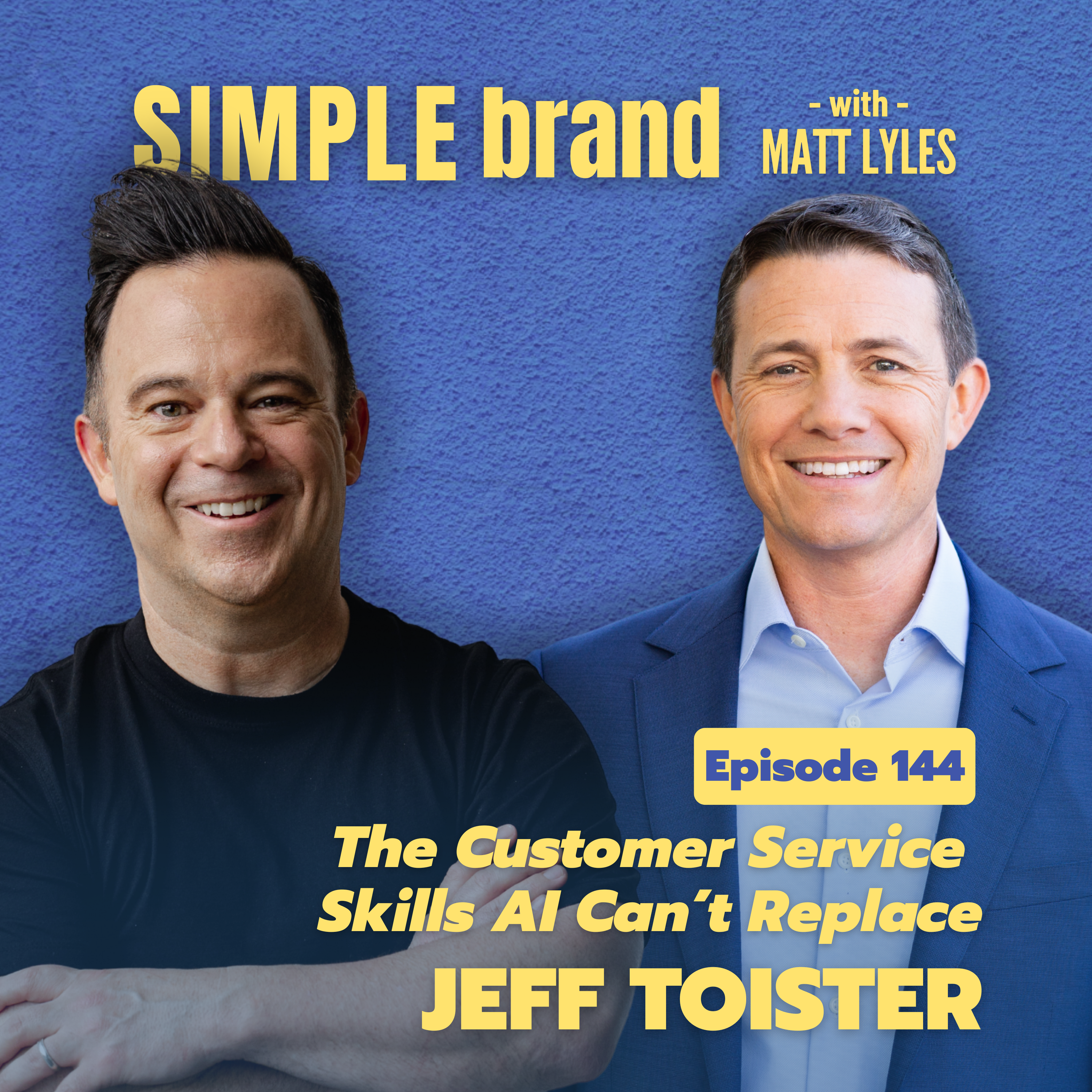
SIMPLE brand With Matt Lyles · Matt Lyles
Customer service leaders are under increasing pressure to use AI and automate more of the customer experience. But how do you know what should be automated—and what should stay human? It turns out, automation for automation’s sake isn’t your goal. Creating a better customer experience is. In this episode, I sit down with customer service expert, trainer, and author Jeff Toister to discuss his latest book, Human Service: The Skills AI Can't Replace. We explore where AI can improve the customer experience, where it often falls short, and why the organizations that win won't be the ones that automate everything—they'll be the ones that know when human service matters most. What You'll Learn Why customers don't mind AI when it works—but hate it when it doesn't Jeff's simple framework for deciding what should and shouldn't be automated The three human service skills AI can't replace Why connection still matters in a world filled with automation How understanding a customer's true needs leads to better outcomes The critical role advocacy plays in creating better customer experiences What Chick-fil-A gets right about balancing technology and hospitality How AI can amplify both great and terrible customer experiences The iceberg exercise that helps uncover hidden customer experience problems Chapters 00:00 Introduction to Human-Centric AI 05:07 Customers' Biggest Frustrations with AI 09:03 How to Decide What to Automate vs Humanize 12:55 The Value of Genuine Human Interaction 20:47 How Chick-fil-A Excels by Prioritizing Human Service 24:03 In-N-Out Burger Prioritizes Quality Over Automation 27:52 Drawbacks to Relying Solely on AI 32:25 How to Use AI to be More Proactive in Customer Service 35:04 The Iceberg Approach to Finding Hidden Issues in Customer Experience 37:00 One Change to Make to Instill Human Service Into Your CX About Jeff Toister Jeff Toister is a customer service consultant, trainer, speaker, and bestselling author who helps organizations build stronger customer-focused cultures. He is the author of multiple customer service books, including Human Service: The Skills AI Can't Replace, and has worked with organizations ranging from Fortune 500 companies to small businesses and government agencies. Connect with Jeff Toister Jeff’s Website Jeff’s Book - Human Service Book Jeff on LinkedIn Jeff’s Customer Service Tip of the Week Connect with Matt Lyles Check Matt's speaking availability Subscribe on YouTube here Matt on LinkedIn Matt on Instagram SIMPLE brand newsletter
Matt Lyles: Hey Jeff, welcome back to the show. Jeff Toister: Hey, Matt, thanks for having me. And the video version this time, this is awesome. Because the last time I think we agreed, I had a face for audio, but you gave me time to clean up. So I really appreciate that. Matt Lyles: That's it, that's it. And you know, I saw something like just this morning, think, how, I forget what the percentage is, but I think it's like a significant percentage of new podcasts today are completely AI-generated podcasts. And so I thought, you know what, I wanna make sure that people recognize that there are real human beings behind the Simple Brand podcast. Well, thanks again to Jeff Toyster for joining me on the show. And thank you for joining me. Now, there's one thing that stuck with me from our conversation, and that's Jeff's iceberg exercise. Now, remember, an iceberg is a problem that appears small on the surface, but it's actually hiding something much bigger underneath. And what I found interesting is that Jeff wasn't talking about some massive customer experience failure. Helping you create loyal customers and loyal employees all through the power of simplicity. This is the Simple Brand Podcast, now heard around the world, including San Gabriel, Mexico. I'm Matt Lyles, and before we get into this week's guest, I need you to know this: the Simple Brand Podcast is now on YouTube. Jeff Toister: Absolutely. And with that in mind, I'm going to just step up for just a little bit. want everybody to a certified human. So this is a human podcast today. At least ⁓ the people speaking are humans. Maybe there's AI in the background, but we're human. Matt Lyles: That's it. He was talking about things that seem small at first. You know, a customer complaint, a return, a recurring question, a process that doesn't work quite the way that it should. And then so, because of that, the temptation is to dismiss those as just isolated incidents. But what if they're not isolated incidents? What if they're actually pointing to something bigger? a little bit of AI finesse, but there's two real humans talking today. And you know what? None of us even had to check and say like which images of these are a bicycle. So if you're listening to this episode right now and you're not driving, then you can just go switch over and go watch the conversation and subscribe at youtube.com/slash at MattLyles. And now on to this week's guest. Guess who's back? Back again. That's right, it's Jeff Toyster. Jeff is back on the Simple Brand Podcast. Jeff Toister: ⁓ you know what throws me off really? is, is a real thing. ⁓ like, which ones are these? They're like a motorcycle and then there's a scooter in there and I'm like, well technically. But do they want me to answer it? ⁓ It's stressful. Matt Lyles: What if they're revealing a major gap in your customer experience, a broken process, or even an opportunity that's being overlooked? So here's my question for you: How are you training your team to look for those icebergs? How are you empowering them to bring those icebergs to your attention so that they can be investigated, they can be understood, and they can be solved? Yeah. last week there one where ⁓ which of these be used in gardening? And it was like, which of these can be used in gardening? I was like, well, a lot of these can be if you got creative. ⁓ Yeah, maybe that's they were looking for. They were looking for the creative ⁓ human answer. And speaking ⁓ of, congratulations on service. Jeff previously joined me in episode 102, where we talked about guaranteeing your customers an amazing experience and then delivering on that promise every single time. So if you haven't listened to that episode yet, be sure to go check it out. Jeff Toister: That's right. Don't put limits on me, AI. Matt Lyles: the skills AI can't replace. Jeff Toister: Thank you, I appreciate it. I'm excited the book is out. Matt Lyles: so ⁓ based that, like, I'm curious, what are customers' biggest concerns and with AI today? next iceberg your team discovers ⁓ not just be a customer complaint or return or a recurring question. It may be revealing a much larger problem. ⁓ it may be uncovering an opportunity that you've been missing all along. So, ⁓ for listening, thanks for watching, and until next time, keep it simple. Jeff's a customer service speaker, his customer service trainer, and he's the author of the new book, Human Service The Skills AI Can't Replace. Now listen, I know there's this big narrative around implementing AI to replace pretty much everything in business, and especially in our customer service. But AI isn't the answer to every single customer service problem. In fact, sometimes AI simply Jeff Toister: it's definitely a little bit, but generally speaking, what I'm seeing ⁓ in research after research report after report is that customers don't enjoy being forced to interact with incompetent AI. So, you know, be specific when you are forced to deal with an AI bot or an AI voice assistant, and it's clearly not able to help you. Matt Lyles: Amplifies the customer experience that you already have. So if your experience is clear, helpful and customer focused, AI can make it faster. But if your experience is broken or it's confusing or it's frustrating, then AI can actually make it even worse. So then how do you know what to automate and what to humanize in your customer service? Well, that's exactly what Jeff and I discuss. Jeff Toister: or you're not confident that it can assist you and there's no way out. That is the worst kind of customer experience. I will say that the caveat is that when it works well, customers don't seem to mind. Like when I call my auto dealership now, instead of having it ring a bunch of times and then a harried receptionist is like, ⁓ can I help you? Where can I direct your call? Like a very clear ⁓ Matt Lyles: We talk about the customer service skills that AI can't replace. We talk about why companies should automate the right things instead of everything. And we talk about how humans create value through connection, understanding, and advocacy. And we talk about why the best customer experiences still need real human beings in all the right moments. Jeff Toister: AI voice answers and says, where can I direct your call? I think most people are fine with that. It's just being forced to deal with AI when it doesn't work that seems to be the worst experience for most customers. Matt Lyles: and when talk about that and talk about ⁓ AI being AI being ⁓ incompetent, I there's a lot of people that say, well, you're just using the wrong AI or you're not using it correctly. know, certainly AI is competent, but I've started to notice something and really started to dig into something lately is the fact that AI really just ⁓ whatever Jeff Toister: Sure. Matt Lyles: So here it is. Here's my interview with Jeff Toyster. customer experience, whatever customer mindset, whatever customer experience processes and approach you already have in place. solidified it for me when I was reading your story about leaving your jacket ⁓ in the car and then trying to get in touch with them and nobody ⁓ actually. listening to you, nobody understanding you, and then receiving these auto-generated AI messages over and over and over, but then after you talked about that, you went on to describe all the previous negative interactions you had had with that company already, and that's when I thought, you know what, that's it. Just the AI that they put in place was just simply amplifying their focus on customer experience, which was nominal at best already. Jeff Toister: Yeah, I think that's a good way to put it. going back to what you said earlier, a lot of people say you're using it wrong. And I won't argue with that, but it's also the reality. as a customer, your experience with AI is consistently negative, then you just will trust it less. ⁓ So we maybe we need some companies to use it right. You know, the story you're referring to for listeners who are like, what's going on? I being a dumb dumb left my jacket in the back of a rental car and the rental car company had such a broken system for retrieving it that not only did I never get my jacket back, even though I knew exactly where I'd left it about a month of not getting any help at all from five people that I talked to. ⁓ All of a sudden, this AI system that rental car company was using started sending me emails telling me they were still looking for my jacket. ⁓ and frustrating. to point, it was just ⁓ amplifying the broken parts of a broken culture. ⁓ This AI was just part of Matt Lyles: Well, and so we talk about, whether it's brands using it correctly or incorrectly, you know, a lot of times I think what I'm hearing a lot of companies saying ⁓ is asking, okay, what can do to automate more and more? But reading your book, I think that's the wrong to ask. It's more the question of where should we automate? Where should we not automate? And so, How can we be intentional about making the right decision on to automate versus what to humanize? Jeff Toister: think we ⁓ need to look at AI not as a destination, ⁓ ⁓ broad set of tools. ⁓ like any tools, like you have a toolkit ⁓ you turn to the right tool for the right job. I think we really need to look at AI not as a destination, but a broad set of tools. like any tools, like you have a toolkit ⁓ you turn to the right tool for the right job. What found, ⁓ and really talking about customer facing AI, because there's a lot of AI that's helping the experience behind the scenes. ⁓ But we're putting AI ⁓ in of a customer, I've generally there's three criteria where it works really well. Matt Lyles: Right. Jeff Toister: One is customers are confident AI. When have had a million bad experiences and they don't trust it, they're going to resist. That friction will make everything worse. But like the example I gave you where I just called and the AI is like, Who do you want to talk to? That's fine. So there has to be confidence. The second is it needs to routine. AI, just like a ⁓ human employee, needs to be trained to do the job correctly. ⁓ train AI really helps to have a lot of cases to say, this is a good result, not such a great result. Is there a policy procedure, et cetera? So it tends to do better with routine interactions, and it tends to struggle with edge cases or things that are unusual. It lacks the context. The third thing is it needs to be predictable. So if I ask AI, what time does the store open on Monday, if the answer is 9 AM, it should always answer 9 AM until the answer is no longer 9 AM. And often we get unpredictable behavior from AI. So that's what undermines it. So the acronym that I use, confident, routine, and predictable, is CRAP. Automate the crap that Matt Lyles: Right. Yeah. Jeff Toister: Your customers don't want to sit around waiting for an employee to be available to help them with. And the crap that's frankly a little tedious for your employees to have to do over and over again, especially it's maybe not cost effective to pay someone. stuff definitely automate. I think we need to add humans to the mix when our customers are not confident with AI. When automation fails, ⁓ So there's a system in automation just can't handle it. there's moments that are emotionally charged. ⁓ talked to someone who put it so clearly. She said, I mind AI sending me a reminder that it's time for me to schedule my annual checkup with my doctor. I don't want AI telling me that the results came in and I have cancer. Matt Lyles: Yeah, that can be weighty, that's something ⁓ that emotion, it requires empathy. Jeff Toister: Yes. And when emotions are involved, mean, empathy is defined as being able to to and understand what someone's experiencing, including their emotions. And by definition, we can program some, some empathy into AI, but AI can't, AI won't know what it feels like to have cancer because AI won't get cancer. Matt Lyles: Right. Yeah. Jeff Toister: But a human does, or a human's had a relative who has, or a human's been ill or gotten some really weighty bad news before. So we have a different capacity to empathize in those particular moments. Matt Lyles: Yeah, mimic some that but it fully, truly empathize 100%. Jeff Toister: That's a good way to put it. It can mimic it. It can emulate it in certain ways. not being able to do it 100%, yeah, I think that's a good way to put it. Matt Lyles: and so when we talk about actual human beings that work with us, especially on the front line, ⁓ you make distinction around two types of people that can be in our frontline, like ⁓ real humans or automatons, transactional people. the difference between those two? What's difference between transactional and real humans? Jeff Toister: So think about your experience with cashiers, whether you're at a grocery store, retail store, restaurant. And what human value is that person adding? So a transactional person essentially does their job like a robot. They don't add human value. They're not making your experience any better. They're just part of the process. And they approach their job that way. And I think this is a really dangerous middle ground because If an employee is acting like a robot, eventually we will just automate that job. We're seeing self-service kiosks, for example. And that's fine, I guess, if you're able to get through self-service. But there's other places where humans can add value. And so the human value is ⁓ recognizing If an employee is acting like a robot, eventually we will just automate that job. seeing self-service kiosks, for example. ⁓ went to the grocery store this morning, and the only way to check out of the grocery store was self-service. There were no employees around to help out. And fine, I guess, if you're able to get through self-service. But there's other places where humans can add value. And so the human value is ⁓ recognizing Matt Lyles: Yeah, why not? Yeah, why not? Jeff Toister: How can I make that experience better? How can I make that experience better? of cashiers, I want to point to a shared experience that you and I had together. Do you remember, was a couple of years ago, we went to Hattie B's, Hot Chicken and Lunch Bill. Do you remember that cashier? Matt Lyles: Yes, yeah, that's right, yeah. I do, yeah. I mean, he was, yeah, he was so energetic and excited and like for every single person. Jeff Toister: He, I remember he took, I mean, he made oppression on all, there was a group of us that went out to eat and he made this impression on all of us. to me, that's adding human value to something that's otherwise routine. And he actually emulated the three core skillsets that, that I talk about in the book. The first is connection. He made every single person feel welcome, which is a lot different than next. It's like, Hey, how's it go? Like he really greeted you like you were a friend. Matt Lyles: Yeah, we got a selfie with him. Right. Jeff Toister: So automatically your defenses came down, your expectation is now this is going to be a good experience. The second thing he did in the second skill set is understanding. And understanding at a different level than just, I'd like to order this chicken sandwich. understood a few of us had never been to Hattie B's before. I'd never been. So he's like, hey, let me take a moment to give you the walkthrough, tell you about some of my favorites, okay? Matt Lyles: Yeah. That's right. Jeff Toister: And the third thing is advocacy. AI doesn't care if you have a better experience or not, but I remember this cashier, he took personal pride in making sure we all had a great experience. And later on that evening, we're all sitting at the table eating our meals. He comes back over just to check on us and have this conversation with us. He genuinely cared whether or not we were having a great experience. And I remember that really stood out for me because Matt Lyles: Yeah. Jeff Toister: This was more than just a transaction. He now became part of that Hattie B's experience. And I think all of us had a great evening that night. Matt Lyles: ⁓ absolutely. And then one of the things too was that could tell, we knew he was ⁓ in his approach. He was not being scripted. Even he came back to check on us, it wasn't so much, well, how was everything? Good, great, okay, great. We could yeah, no checklist for him, no scripts. ⁓ He was Jeff Toister: that off, Check off. ⁓ Matt Lyles: interested and genuinely cared about our experience. Jeff Toister: And I think that's such a great way to frame it because the genuineness, the authenticity, it's just different. And you asked earlier, what's the difference between a human and that transactional person? A human is genuine, they're authentic. The transactional person, they're just following the process and the vibe's different. You can tell they don't really care. It's like when someone asks you, are you finding everything okay? And I love that question in the store because sometimes I'll say no. And the other day I was in Walgreens and the person asked me, are you finding everything okay? And I said, no, big moment. And to his credit, the employee said, well, what are you looking for? said, I'm looking for the little travel size Kleenex. And he's like, let me tell you what, we've got some at the register. Matt Lyles: Ha Jeff Toister: But if you follow me, I'm gonna show you where you can get a better value, same product, but an eight pack for the same price as the one pack at the register. And he led me through the store for a $2 item, but here we are talking about Walgreens. And I think that one question with a genuine intent to make the experience better, that's adding real human value. Matt Lyles: That is it. And this was at a Walgreens. Did you ask him if he also worked part-time at Trader Joe's? But because like ⁓ Jeff Toister: You know, tempted to say, are you new? Do you do this a lot? ⁓ Matt Lyles: Yeah, yeah, you know you're at Walgreens, right? Yeah, they don't do that here. But no, like like like Jeff Toister: They don't, I would say that the opportunity for companies like Walgreens is that's not the norm. and, it could be it's cashier. they didn't, this is strange. This Walgreens did not have self-service checkout. They had a very kind human cashier. I don't mind self-service checkout when it works. If, once you how to do it, it actually it's faster. Most of the time. Matt Lyles: Right. ⁓ nice. Jeff Toister: I think humans add more value, let's say, at a Walgreens in that moment where I'm trying to find something or I have a question or I just need a little bit of assistance and they're helping me. That's connecting me to revenue. And it's also making sure that I'm going back to that Walgreens the next time I need something versus one of their competitors. I think that's a lot more value added than somebody who's just ringing up my transactions. Unless they're also doing that Matt Lyles: Yeah. Right. Jeff Toister: human value added move. But if I'm a business, I'm trying to decide what to automate, I'd rather have people on the sales floor helping customers than bringing up transactions if I had to choose. Matt Lyles: I the point is in that interaction, in that experience of going to the store, having a human, not just a human being that is there existing and taking up space, ⁓ but one who is ⁓ genuinely helping you to be better or to feel better after having that store. Like that should be the goal. ⁓ And that's what it sounds like ⁓ that. employee at Walgreens did, which is phenomenal. That's the norm at Walgreens, at least the ones I go to. Jeff Toister: Yeah, yeah. And that's, I think that the other thing is sometimes people get confused by is, you don't need that person to do that for every customer, every visit to Walgreens. mean, sometimes I know exactly what I want and exactly where it is. just need them to be available for the moments when that does add value to the experience. Matt Lyles: Yeah, yeah, so that's what it is. ⁓ digging in deep and pausing to understand ⁓ ⁓ those moments where it does make sense for us to automate, where are the crap moments, and then where are those moments where it does make sense for us to actually deliver ⁓ genuine, human service? And ⁓ we at a lot of executives like looking at AI at a very high level tend to assume, okay, if we just automate things, it's going to save us money. But when we talk about like your specific Walgreens experience, or there are other stories and companies and case studies in your book that show ⁓ where using ⁓ gave an unintentional result of losing money ⁓ or deciding ⁓ focus real genuine, caring human service actually drives revenue even more. So you share some of those stories? Jeff Toister: Yeah, I think that's one of the surprises. One of the examples I highlight in the book is the fast food industry. There is, if you look at the biggest chains, there's an annual study that's done by a company called InTouch Insight on customer satisfaction, specifically with drive-through. And every year the leader is Chick-fil-A. Now, if you look at the mid-pack companies, what they're doing is leaning heavily into automation. They're changing the drive-through process so AI is taking your order. If you walk into the dining room, they're replacing cashiers with kiosks. And from their perspective, it's with good reason. Kiosks, for example, Yum brand, so this is Taco Bell, Pizza Hut, KFC, they're finding that average order value with a kiosk is a 10 % lift or more compared to a cashier. So mean, I think there's a business case for that. With drive-through, it's difficult to have a human on the drive-through line because they're distracted. You can't hear them clearly half the time. So AI is always crystal clear. There's some in the road for sure, but generally they're finding some good results there. I get why these companies are doing it. But then you look at Chick-fil-A. Now Chick-fil-A does, on average, two times the revenue per store that a McDonald's does, open one less day per week. On average, three times the revenue per store of Wendy's. So let's look at the leader. A busy day at Chick-fil-A, you're not dealing with AI in the drive-through. There's a human standing right there. They greet you, they make your experience a little bit better. If you walk into the dining room, you will be greeted by a human. One of the first things they ask is, what is your name? And they're going to create a human connection with you. And then when they hand you your order, there's a human connection again. So Chick-fil-A does use some automation. They do use things like meal delivery services, which takes out the human element. But when I look at the revenue lift that Chick-fil-A gets from many things, but including the human element, I'm thinking there's the business case. ⁓ Matt Lyles: Right. Jeff Toister: for putting humans, I think what the other chains are missing out on is they're comparing AI to that transactional person who's not adding value. And I agree with that, but if you compare AI to a human who's adding real value in those moments of hospitality, you'll drive more revenue. Matt Lyles: That's what it is. ⁓ yeah, well, and if I'm understanding correctly, I think that the drive-through experience at Chick-fil-A ⁓ a longer experience. they've studied it takes a longer time for an individual to go through the Chick-fil-A drive-through than it does for McDonald's, Wendy's, Taco Bell. But that's because of that human interaction, that human experience, and that drives that revenue lift too. Jeff Toister: Yes. Well, it's mostly because Chick-fil-A is more popular. There's just a longer line at Chick-fil-A. Matt Lyles: Yeah, longer lines too, yeah. Jeff Toister: than there is at those other establishments. Chick-fil-A overcomes that by being the friendliest and having the best overall experience. So while time is somewhat important in fast food, I think speed is sometimes overrated compared to other elements. I we both an affinity for in and out. ⁓ And ⁓ and is, they're not amongst the major Matt Lyles: That's right. Jeff Toister: brands in these some of these studies. So it's a little harder to get in and out data. But the line in and out is, you know, Monday night at 9pm in my neighborhood, it's it's still a long line, you're gonna wait. But they don't start making your order until you order it. So your food is super fresh. There's no AI involved. There's a human who takes your order. There's a human who processes your payment. There's a human who hands you your order in that drive-through. And it's amazing. It's always a good experience despite the weight. They're still a lot busier than some of their competitors in the neighborhood. Matt Lyles: Oh yeah, and then we were talking earlier too, I think recently at a panel at Pepperdine University, In-N-Out CEO was asked about mobile ordering and she said no, they will not introduce mobile ordering for those reasons that you just mentioned. The fact that all their food, all their meals are made to order and made to order like in real time. They don't want to make it ahead of time and have it just. sitting there under a heating lamp, just sitting there going bad. have such fresh quality ingredients, that's quality they want when something is made to order. Jeff Toister: And it was interesting to hear her say she wasn't saying this from a position of anti-automation or anti-AI. She was focused first and foremost on the experience. What's the best experience that fits their brand and is going to help satisfy their customers? What's the best way to deliver that experience? Which goes back to we shouldn't be choosing AI just to choose AI. Choose AI where it helps make the experience better, for sure. Matt Lyles: Right. Jeff Toister: For example, I've talked to a lot of contact center leaders who are adding AI as that first line of defense, primarily because it's really, really hard to staff for big spikes in volume, especially big spikes in volume for transactional types of issues. Like, Loves Travel Centers, they offer roadside assistance. And you can staff for a certain level of roadside assistance calls, but if there's a snowstorm, of sudden your demand just goes astronomically higher. And they found that having AI answer those calls means the difference between a 13-minute wait time and a 13-second wait time just to dispatch a mechanic. Those customers who are truck drivers broken down on the side of the road are happy with that. They also found that by eliminating that wait, you can still get to a human agent if you want to, or it's more complicated and you need to. Matt Lyles: Yeah. Jeff Toister: And they found a 50 % reduction in agent turnover, in part because agents enjoyed having more capacity to help the people who really needed it. So that's a smart deployment of AI to help with this customer experience issue, not just to implement it for no particular reason other than deflection. Matt Lyles: Right, yeah, so again, goes back to being intentional about how you choose the right moments for automation versus human service. All with three ⁓ qualities human service that we've talked about, we've talked about connecting, understanding, and advocacy. So in understanding, when we talk about understanding our customers, Jeff Toister: Absolutely. Matt Lyles: What are some of the drawbacks to relying solely on, or at least mostly on AI for understanding our customers? Jeff Toister: I think there's a lot of times where AI just gets it wrong or lacks context will provide ⁓ worse experience because it ⁓ simply understand what you need. And that's humans come in. But sometimes I will tell you that the understanding is ⁓ a undervalued for humans. And ⁓ we practice enough. ⁓ Just the other I had a conversation ⁓ Matt Lyles: ⁓ yeah. Jeff Toister: with my friend Paul. And my friend Paul asked me a question. He said, he knows I travel a lot. So he said, Jeff, is premium economy worth it? And I'm about to say no, because I know Paul probably doesn't value spending extra money. rather just get from A to B. And I can imagine, like this is a question you could ask AI, is premium economy worth it? And you can get probably this long paragraph from ChatGPT or whoever your provider of choice is. I had to catch myself. I said, wait a minute, Paul, why are you asking me this question? Oh, my wife and I are traveling to Rome. We're going on a cruise. But we first have to get to Rome. Okay, well getting to Rome is from where we live in San Diego, at least two flights. It's a long flight, at least one of them. so I asked him, well, tell me a little bit more about that. He's the last time they went to Europe. He was never able to really feel rested because he was so uncomfortable on the flight over. It's an overnight flight, he couldn't sleep. So he's thinking about maybe upgrading the experience a little bit so that his flight over is a bit more restful. Matt Lyles: night. Jeff Toister: So now that I'm really understanding Paul and having flown overseas and understanding what that's like with your body clock, having had that experience, I can empathize with him. My answer changed from, no, not worth it to, yes, it's worth it, but probably only on the outbound leg. You won't need it as much on the return since you won't be sleeping overnight. very nuanced answer that came from really truly understanding the needs but I had to catch myself at the beginning to not just blow out the first thing that came to mind. Matt Lyles: ⁓ yeah. Yeah. and takes digging in and understanding the specific person, their specific situation, and their specific need in this moment. And so therefore, based on all of that, you can deliver that answer and then even tell them why too. So I bet he was thankful thinking, ⁓ you know what, ⁓ Jeff really his time. Like Jeff is telling me based on ⁓ our specific and what we're wanting to do. Jeff Toister: Yeah. And was, and it ended up being a very nice conversation. And the interesting thing about it is AI, if you give it the right prompt and say, this is what I'm concerned about, ⁓ these are the variables and the fact, AI is really good at the analysis ⁓ would then probably give you a very good response. The challenge ⁓ humans, we don't always tell our story very well. We don't share what our emotions are as freely or... Matt Lyles: Right. Right. Jeff Toister: describe one path, we think, to get there rather than, hey, my intention is I want to be well-rested when I arrive in Rome for my cruise, but I don't want to overspend. And I know that upgrading the premium economy is pricey. How do I weigh that? ⁓ don't type that in as a prompt, so it's tougher for AI to decipher that. Matt Lyles: No, what you mean think to? and so sometimes it comes down to pausing to ⁓ that you've got the right information to give the answer. And sometimes that means asking some questions. ⁓ Jeff Toister: And that's the human service skill, right? Of being a good listener sometimes is like you said, asking the questions for clarity. Matt Lyles: that's part of one of my regular practices when I'm interacting with and asking for And usually at end I'll say, ⁓ what questions can I in order to help you deliver this answer? And so it'll say, ⁓ thank you for asking. Here's some questions. And so ⁓ usually, I the sense it's actually taking that information into account. Who knows? right, so then the last thing is, you know, we talked about connecting, understanding, now ⁓ advocacy. it comes to advocacy, how can we use AI with our advocacy? How can we use AI to make service ⁓ even more proactive? Jeff Toister: I first we need to look at advocacy means ⁓ I'm working on your behalf. And I you to have a better experience. AI doesn't want anything. It follows its So when it comes to... Matt Lyles: Okay. Yeah. Jeff Toister: integrating AI into that, I think there's opportunities for us to use the power of AI to help us make better decisions for our customers. So I'll give you an example. My internet service provider, I was having a chat with ⁓ a technician who told me that they have an AI tool now that has an astonishing ability to troubleshoot problems in the network and help them pinpoint exactly where to go to fix an issue. So from an advocacy perspective, like if I want to create a better experience, having tools to quickly diagnose and fix an outage, for example, that's amazing. But there's also a downside. And the downside is the same company has a policy that people from the same neighborhood have to contact the company and say, I think my internet's down. before they start looking into it. And so if you're sitting at four people, the assumption from tech support is that it's at your site, and you should reset your router two more times, even though you've already done that. So think it's ⁓ a because now the employee is not acting as an advocate to say, no, I believe you. You did reset your modem. You did reset your router. We've gone through the typical troubleshooting. Let's. Matt Lyles: ⁓ well. Jeff Toister: now get this AI tool involved, for example. That's the void. think in the future now, we could have automated tools that would predict outages and help as customers ⁓ sticking with internet. If you got a message ahead of time that says, we're detecting an issue in your area, and for the next hour, we think bandwidth is going to be much slower. Matt Lyles: Yeah. Jeff Toister: And here are a couple of options to mitigate that. It's just following programming, but at least it's a better form of helping you have a better experience. But true advocacy is something's not going well, so I'm going, or true advocacy in this case would be designing a system to do that. Matt Lyles: And then, know, like one of the things ⁓ that you've about a number of ⁓ before focusing on AI the ⁓ iceberg approach, the iceberg approach digging in ⁓ and finding customer experience issues. I think ⁓ there's an opportunity to be to use AI to look for those icebergs in advance before we can even notice them. Jeff Toister: ⁓ for sure. And for people who are not familiar with icebergs, iceberg is an issue that seems small on the surface is really hiding a larger and more gnarly problem. ⁓ had a conversation with a customer experience leader ⁓ yesterday about this, where her company had a very small issue with ⁓ card payments. And weren't and they had to figure out a workaround. But where this was an iceberg was ⁓ that a large segment of their customer population was buying their product as a gift. And there were other bumps in the gift buying journey. going back to work in AI help, well, AI can help automate some of these fixes, but it also could help ⁓ the analysis. Like, what's a rough estimate of how many customers are buying this product as a gift based upon where they're shipping it? Or if they checked this as a gift wrap, or this is a gift, put a note in the box, or there's probably other parameters you could use where AI can help you do that analysis. Because her challenge was estimating the dollar value of this issue. She needed it to be big enough to get her CEO's attention to invest dollars in fixing it. Because if you say, hey, I've got a couple of customers that are having trouble with gift cards, ⁓ well. I think 30 % of our buyers are gift givers. And if we can improve the customer experience, we could probably double the revenue from that segment. Your CEO is going to listen. Matt Lyles: sound like a big deal. yeah, so it helps be able to help them understand, here's the size of this, and here's what we see if this continues to happen. All right, well, for someone listening here, whether they're ⁓ on the front their manager, their executive, what's ⁓ one change they make tomorrow to bring more human service into their experience? Jeff Toister: I think the exercise is probably a great place to start. Earlier talked about losing my ⁓ and leaving a rental car, but there was an there because the system said once you file your lost item claim, you could then browse inventory of lost items, the items they already found, and the inventory was zero. Matt Lyles: Yeah. Jeff Toister: That's, to me, that's an iceberg. It's an unusual or unexplainable problem. And the exercise is ask your team to be on the alert for icebergs. And the key is you spot an unusual or unexplainable problem, and then you have to have an avenue to bring it to someone's attention. So if you're a leader, asking your team to bring it to your attention. And now we're going to investigate and figure out what's causing this. And often, these little icebergs are the sign of something much bigger. I talked to a customer experience leader who noticed that they were getting what seemed like an unusual amount of returns of products that were perfectly functional. They worked perfectly well. But customers were saying they didn't work. They were broken. They did some analysis. jumped, instead of just dismissing this, they jumped into it and they found two things. One, this was a million dollar problem. Like they were getting a million dollars worth of these returns per year. So this was not insignificant. They just hadn't put all the pieces together yet. But two, when they looked at this problem, it was one very specific customer segment who was confused about how to use this product. Matt Lyles: ⁓ wow. Jeff Toister: And previously, they had sold to people who were already experts and didn't need a lot of handholding. This new segment needed more instruction on how to use the product correctly. So that iceberg wasn't just a couple of bad returns. It was a million dollar issue. And I think anybody can do this exercise just by looking for unexplained or unusual issues and being the human that says, hey, I think we need to look into this. Matt Lyles: Yeah. that's great. Like that's a great approach to take. ⁓ Well, Jeff, always, I've learned so much from you just from interacting with you, ⁓ but where can go to learn more from you today? Jeff Toister: Easiest place is probably my website, toystersolutions.com, slash tips. You can sign up for my customer service tip of the week. One email, one tip per week to help keep you and your team sharp. talk about things like this iceberg activity. If you want to check out the book, download the first chapter and read about my lost jacket misery. It's humanservicebook.com. ⁓ post a lot of my research and content. Matt Lyles: Yeah. Jeff Toister: on LinkedIn, come follow me there. My one ask if you come to LinkedIn is be human. Follow me comment. ⁓ You can find my personal contact information in my LinkedIn profile. you want to be connected, send me a message. ⁓ And let's do some networking. So be human if you go that route and that's a good way to set yourself apart. Matt Lyles: Great for every day. Always be human. Jeff Toister: That's it. Instead of ABC, it's ABH now, right? Always be closing? No, no. Always be human. Matt Lyles: That's it. Always be human. Cool. Well, Jeff, thank you so much. Jeff Toister: ⁓ it's been my pleasure, Matt. I really appreciate it.