
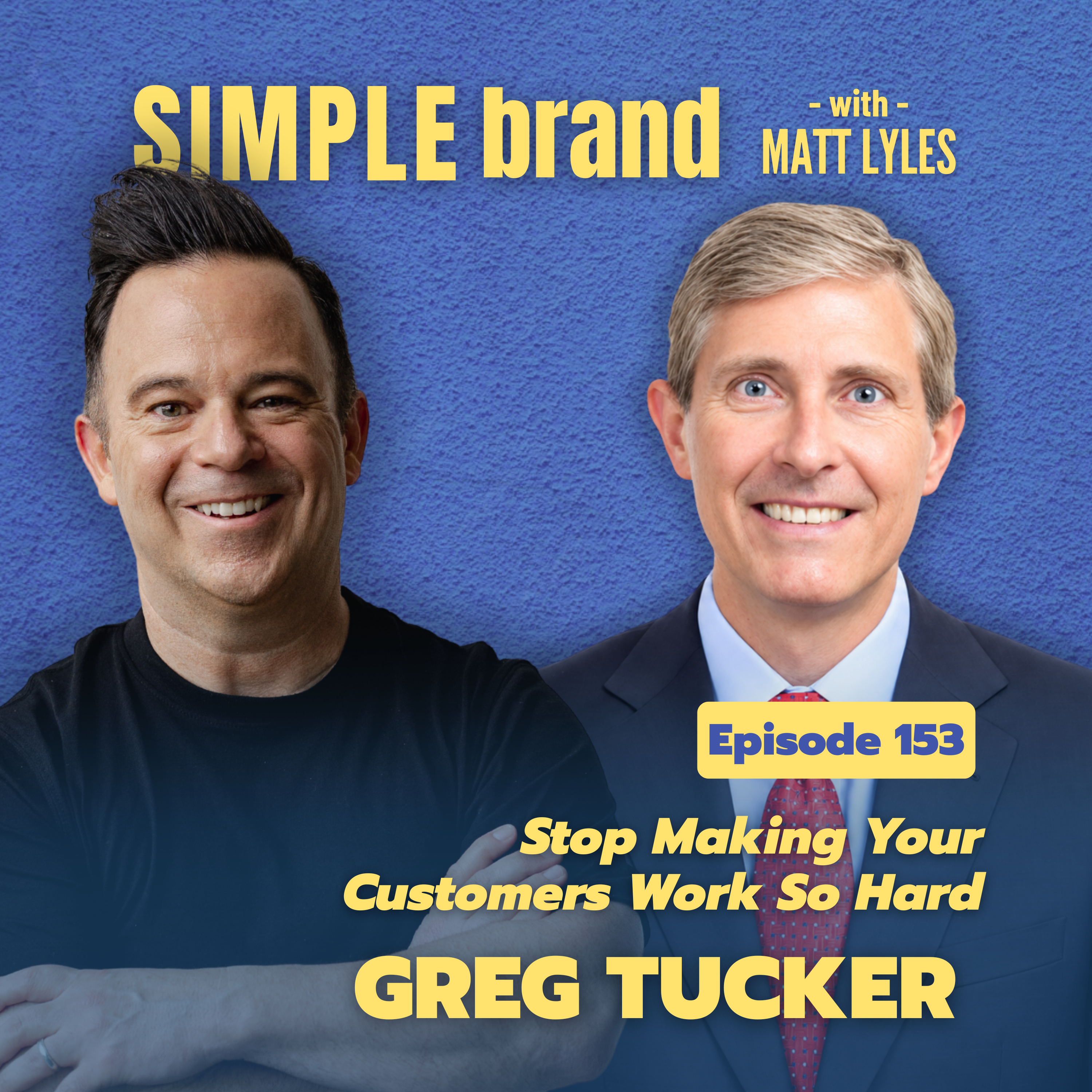
SIMPLE brand With Matt Lyles · Matt Lyles
In this SIMPLE brand episode, I talk with Greg Tucker, CEO of Tucker & Company and author of Frictionless Brand Experience. Greg shares the six sources of customer friction that can keep you from delivering on your brand promise - and how reducing the right friction can improve the experience for your customers and your employees. We also explore an important question: Should your goal really be to eliminate all friction? Greg and I discuss why some “productive friction” actually creates a better experience - and why removing too much friction can sometimes remove something your customers value. What You’ll Learn * The difference between customer experience and brand experience - and why your brand promise matters * The six types of friction that can keep you from delivering the customer experience you promise * Why solving internal friction shouldn’t mean transferring more work to your customers * How frontline employees can help you uncover friction your leaders may never see * Why too much information creates decision friction - and how to give customers just what they need when they need it * How observing customer behavior reveals problems that surveys alone may miss * Why 100% frictionless isn’t necessarily the goal * How to stay connected to your customers as your organization grows Chapters 00:00 Introduction to Frictionless Brand Experience 04:34 The Difference between customer experience and brand experience 06:34 The importance of delivering on your brand promise 06:57 How FedEx delivers on its brand promise 08:41 Aligning employee and organizational efforts with brand promise 11:00 Overcoming organizational friction and silos 13:10 The role of leadership in customer-centric culture 18:28 The relationship between employee experience and customer experience 24:05 How to identify friction points in your customer experience 26:26 The negative impact of decision friction and cognitive load 31:27 When some friction is actually valuable 32:56 Brand personality and the role of intentional friction 39:16 Greg’s 5-song playlist About Greg Tucker Greg Tucker is CEO of Tucker & Company, a customer experience advisory firm that helps organizations improve customer experience and business performance. He’s the author of Frictionless Brand Experience, which explores how organizations can identify and eliminate the friction that gets in the way of growth and a consistent brand experience. Greg’s work combines customer research, journey mapping, user experience design, and practical strategies to help organizations better understand their customers and deliver on their brand promise every time. Connect with Matt Lyles Check Matt's speaking availability Subscribe on YouTube Matt on LinkedIn Matt on Instagram Subscribe to the SIMPLE brand newsletter Subscribe to the SIMPLE brand show
Greg Tucker: What if Taco Bell sold chicken strips? Now that just makes no sense, But what Taco Bell does is they put the chicken strips into the middle of a taco and people are digging it. part of their innovation program is talking to their customers and saying, what do you do with your Taco Bell when you get home? And people were opening up their tacos and putting Doritos in, or chicken strips in. And they go, well, why don't we just sell it that way? that way people can have that experience without going home and doing it. And that's where a lot of the ideas comein So so when you integrate it in, it actually works for them. But when you just staple it on, it creates a a little bit of brand dissonance. Matt: Helping you create loyal customers and loyal employees all through the power of simplicity. And this is the Simple Brand Podcast, now heard around the world, including Barberton, Ohio. I'm Matt Liles, and today I'm talking with Greg Tucker. Greg's the CEO of Tucker Company, and he's the author of Frictionless Brand Experience. He spent nearly 30 years helping organizations improve customer experience, understand customer behavior. And deliver better experiences for their customers. And Greg believes that, well, there's a pretty big problem getting in the way for most brands. Look, I get it. Your brand can have a solid brand promise. You can have an innovative product. You can have great people. But if there's friction getting in the way, then your customers aren't going to experience your brand the way that you intended. And that friction can come from a lot of different places. It comes from Your product, your technology, your processes, your operations, even your culture. And sometimes you think you've removed the friction when really you just simply moved it elsewhere, making something easier for employees while making it harder for your customers. So how do you find that friction that's getting in the way? Well, you start by looking at the experience from your customer's perspective. Talk to your customers, listen to them. But also observe what they're actually doing. And ask your frontline employees where they're seeing customers struggle. Then you can start removing the friction that doesn't need to be there, and then making the experience easy for the people that you're actually trying to serve. And that's exactly what Greg and I discussed today. Greg shares the six different sources of friction that keep brands from delivering on their brand promise. We talk about how customer experience and brand experience connect, how your employees can be one of the best sources of customer insight and why understanding your customers actual behavior is super important. And we also explore a question that I think is worth asking. Is 100% frictionless the real goal? Does every bit of friction really need to be removed? That question may make you rethink your approach to friction and customer experience. So here's my conversation with Greg Tucker. Matt Lyles: Hey Greg, welcome to the show. Greg Tucker: Thanks, Matt. L great to be here. Matt Lyles: I'm excited to talk to you. I think we were talking about this earlier, like I geek out on this kind of subject all the time. excited to talk about especially your book, you know, frictionless brand experience. Greg Tucker: it was thirty years in the making and when the when the final title kind of came around to me, I thought, you know, like it it it finally found me. it went through a different a number of different titles and they all got rejected. So that that one was the one that stuck. So as a branding guy, you know when that moment occurs. Matt Lyles: of course. Well and it's pretty descriptive. you know, part of my career too was in brand naming and I love to focus more on descriptive naming and well that book's pretty descriptive. It tells you exactly what you're gonna get. Greg Tucker: Exactly. I've been doing customer experience for the longest time. And we started out as frictionless customer experience. But the way the case examples and the power came to light meant it was really more about the brand than the customer experience. It it was a higher level, something a little bit more important to the organization than just customer experience. that's why it arrived at that final spot. Matt Lyles: Well talk to me about that. Talk to me about the distinction between customer experience and brand experience. What do you see as the difference between the two? Greg Tucker: Yeah, customer experience is a big broad category. there's no question about it, and it covers a lot of different things. But there were certain times where in certain examples people say, well, we improved the customer experience, but it it didn't line up to what the brand promise was. and we found that that's the gap. And the other part is customer experience is what you deliver, the brand experience is and the brand promise is what you're promising to customers. And we found That distinction and it's a little bit bigger. it includes a lot more messaging, talking about the attributes of the product, like you just putting you know, the ad campaigns. it's also a little bit more on imagery. How are you using it to communicate those things? So it's a little bit broader on that part, but what we found is the companies who deliver on their brand, promise by delivering a frictionless brand experience were absolutely killing it in the marketplace. Customer by customer, their growth was organic, everything was great, you know, like you it couldn't be beat. Matt Lyles: I think that's worth people understanding as it relates to everything that encompasses the brand, everything that's going to impact the customer, potential customers, your public, and how they perceive your brand. Greg Tucker: Right. Well, you know, an example would be social media. it's an important part of brand awareness and about brand distinction. if people are talking about you and it's not on brand, then you know that doesn't really help you as much as people think. You really want every comment to be commenting on how well they deliver on brand. when you have that type of laser focus where the numbers just continue to work. And you know, the organization is absolutely in sync and in harmony at that point in time. And when they're not, they're not. And everyone kinda knows it. Matt Lyles: to go back to what you were referencing earlier, I think a lot of that ties back to the promise that the brand is making, the brand promise. And then kind of everything feeds from that brand promise. Greg Tucker: well the top companies really understand that and they make the investment in doing that. An example w is Federal Express. You know, a million years ago they came out and Fred Smith founded the firm based on one idea and he coined it in a term which was, you know, absolutely positively overnight. When you need it to be absolutely positively overnight. He engineered every system, every machine, every plane decision, the airport location, the headquarters decision based on the way to optimize that and deliver it every time at a high level of consistency. Anything that was in the way, he got rid of. Okay? And he tried to take the friction out of everything along that line, just so they could be more and more efficient every single time. it worked great and it grew very quickly. Everything was by word of mouth. I mean they had plenty of advertising, but everyone talked about if you gotta get it there, it's gotta go FedEx. That's right. Yeah. Matt Lyles: That's right. Yeah. Yeah. That was certainly an example of being able to deliver on that brand promise. And I actually had like the the majority of my corporate career at FedEx, in branding and in marketing. And the the later years in my career, like I actually got to lead the brand strategy. I got to lead our efforts around our brand promise. And then how do we continue to focus on removing friction where where possible? focusing it on simplicity, but then ensuring that we taught that and communicated that to five hundred thousand employees across the globe to help them understand what it meant in their roles, in what they did to deliver to customers, but also in how they interacted with each other. Greg Tucker: Yeah, e exactly. And in that case, I think that's a perfect example where the brand is the bigger, issue. And underneath that is what's the customer experience we want to deliver that delivers on our brand promise? And then how do you get that ingrained into five hundred thousand people? I bet, Matt, at that time, if you went out to the Federal Express employees and you said, do you understand our brand promise? that the numbers would been, i bouncing off of a hundred percent at that time. And if they said like and do you understand what you do to deliver on that, it would also be extraordinarily high. Matt Lyles: You know, at times, yes, but what's interesting, and I see this with other companies too, is that you may have some leaders and you may have their teams that think that they know what the brand promise is and that they think that they understand how their role ties to the brand promise. And sometimes they're dead on. Sometimes they're pretty close. Sometimes they're not there. So Greg Tucker: Yeah. Matt Lyles: that's why I do think that it does take some accountability, like some group Greg Tucker: Yeah. Matt Lyles: has to be accountable for that brand promise and for ensuring that everyone understands what it means regularly. Greg Tucker: Yeah. Yeah, and and by the way, it's hard. You know, like everyone thinks like, well, brand, that's the marketing person's job. And if you define what the brand promise is, we pulled lots of research as we were putting together the book. But there's you know, if you ask the number of corporate leaders, what percent think that they actually have a distinctive brand promise, you're gonna get numbers well above eighty percent. Eighty, eighty five percent say, Hey, we've got one. When you ask a question like how well is that being delivered, and you ask that at the employee level, you get a number that looks like thirty to thirty-five percent. And our experience is that when you ask the customers, are you receiving the brand you are getting, it's around thirty to thirty-five percent. we've looked at multiple brands, and when we talk to the customers who are receiving that, they're extraordinarily happy. Their net promoter score would be Plus eighty-five, plus ninety. I mean almost perfection, which is plus one hundred. You know, the customer lifetime value is off the charts, positive, high retention, high satisfaction, big word of mouth, everything you'd want when you deliver it. Okay. But it's only being delivered 30% of the time. And it's because some leaders think that they've got it and they really don't. when we unpacked that, we found six sources of friction that got in the way of that being delivered. And some of that's brand friction, which is there, you know, like it's just not being explained in all the right places and all the right ways. Exactly right. There's product friction, which it's conceived in a certain way, but it's not engineered and doesn't work the way everyone does. A lot of product managers are in denial about that. And then you have digital friction which is changing all the time. And you have organizational friction and operational friction and cultural friction where, you know, when you know what the product management group thinks everyone works for them and the brand management does something else. And they're just, you know, they're they're yeah, skilled players not playing as a team. Okay. And the answer is you gotta have them all played on the same team. Matt Lyles: Yeah, yeah. You you you have to all be on the same team and recognize who you're really playing for and you're playing for the customer. Greg Tucker: i exactly right. And I think that, you know, when people say are we customer centric, the test is it's not saying it, it's doing it. Is that are you making the hard choices and making the hard decisions about we're gonna do this because it's better for the customer and you know, and everyone thinks, well, you know, what about our shareholders? There's no question in any that if you're hitting on all the elements your brand promise, you're gonna serve customers great, you're gonna serve the employees great, you're gonna serve your shareholders great. There's no question there. So like when people ask me that, it's like, you've just shown me that you don't know that much about the synchronicity that goes into delivering this stuff really, really well. there's a lot of different companies that have really performed well. And when they do, you can see it. And when they don't, you start seeing a little bit more sluggishness and growth. blips in their profitability, you see attrition in their employee base, attrition in their customer base. And those are your signals that you're not operating on all cylinders Matt Lyles: Yeah. Well, so we can see those signals. We know that it's Greg Tucker: Right. Matt Lyles: happening. We can sometimes like even when we measure what our leadership believes about delivering on the brand promise versus what our employees believe and then versus what customers believe. why do you think this is not being addressed at the senior leadership Greg Tucker: Yeah. Matt Lyles: level? Greg Tucker: Yeah. Well, I think one thing is that when you look at senior leaders, especially in the whole C suite, a lot of their backgrounds wasn't driven by brand or the word experience. So branding, you know, for a lot of people meant cute marketing programs, teaching the world to sing, the snazzy ad campaigns and all that. That's not delivering your brand promise. That's a tagline. Okay. It's necessary. But it's a way short of sufficient. So I think a lot of it is the operational side, which is can you engineer it in? When you see the companies who do it, what you see is somebody who's understands the soul of their target customer really well. I can understand the operation side, can understand the employee side of it and link that piece up. Herb Kelleher at Southwest Airlines was exactly that way. Fred Smith at FedEx was that way. Steve Jobs was that way at Apple. Okay, he said, Hey, we want this certain design, we want a certain experience that's going on. And it was a product experience for him, but it also you know went into what his brand experience and a digital experience as well. So he saw it, and you know, he was one of those who would say, What did we intend to deliver and why aren't we delivering that? there was no BS taken, which is hey, we made a commitment to be the best and to deliver this. Let's focus on doing that. Now, Steve was probably pretty terse about how he did it. Some others are smoother about it, but that's the way it goes. But being able to call that out and not just have a rah-rah party of like, we're the best and all that, when when that happens, people tend to kind of start fanning out in different directions, having different focus. And at that point in time, there's always that one department, like you mentioned, who's not doing it, who's not delivering it. thinks they are, makes a good case for why they are, but most of the employees know they're not. Matt Lyles: and a lot of times too, I will see some departments when they fall in this experience, a lot of their decisions seem to be made around what's best for them. You know, Greg Tucker: Yeah. Matt Lyles: like what's best for them. And then if they remove any kind of friction, a lot of times it's removing their own friction and just kind of replacing it onto the customer. Greg Tucker: Yeah, there's a lot of people who do that, which is like, hey, couldn't we have the customer do this and make our life a little easier? And you can't really do that. if the customers of FedEx had to go track down their own packages, and do put a lot of work into that, then they're gonna switch, you know, v based on the competitive set. And you can kind of see that. It's like an employee's job got easier and if the customer's job got harder. That's not a better solution at any mode. I think that's where the organizational, you know, silos, which is one of the biggest internal friction points, pops up, is when the organizations are focused in different directions. And so one of the things we did is, you know, like giving the employees a vote. if you put the brand promise out and asked everyone, Are we delivering that thing and you ask it at the employee level and ask about certain friction points at the employee level? They will give you a ton of feedback and they will tell you the truth. companies who really want to know that, because they don't always know. They approve something, it gets changed as it gets implemented. It's not implemented as designed. and then the employees aren't trained on it. or you get a supervisor who wants them to go in a different direction because they came from another company and that's how they were trained. we saw it in places where some call center managers want to manage by average handle times, like, well, I just want to have shorter calls instead of first contact resolution, which is I just want to solve the customer's problem as fast and best as I can. And if you go with first call resolution, you may have longer times, but you'll have fewer calls. You'll have happier customers. Everyone knows it. But there's some people who are trained the other way. they want to cut their costs, like, well, you know, let's just have faster calls. We'll push everything to digital. And then you know, people get frustrated and leave. And then they can easily say, well, that's not one of, our target customers. And the answer is it's not their job to determine that. It's the brand promise job to determine that. Their job is to execute that. So when that's out of alignment, it's kind of easy to see, but the employees will tell you that. So we have employees do little friction workshop identification. We put sticky dots up. you put all the different friction types up there and ask employees what are they experiencing? And they'll quickly tell you the top five places where you can reduce friction and then use that friction reduction to deliver something better for the customer. And they'll do that in a heartbeat. Matt Lyles: yeah. your frontline employees are always going to be a significant valuable source for identifying and for sharing with you Greg Tucker: Yeah. Yeah. Matt Lyles: what the top friction points with your customer are. But in talking about, you know, different functional areas, different teams, different employee teams, this leads to something that I've heard you say in the past is that the power behind a brand experience is a great customer experience. And the power Greg Tucker: Yeah. Matt Lyles: behind a great customer experience is the employee experience. So can you walk Greg Tucker: Exactly. Matt Lyles: me through that? Greg Tucker: a lot of people say, well, you've got to focus on the employee first. I think that you you can do that from a execution standpoint, but from a design standpoint, it still needs to be outside in, because that's where you look at competitive sources. So if you define a a great brand experience, okay. And so one restaurant had us check out twenty-six elements of what their brand experience could be. And they said, we really want to know what's the most important and what people are counting on us for. And here are 26 different items. And we came back after eye tracking re research, after customer interviews, in the drive-through inside the store for takeout, for delivery, thousands of surveys. We came back and said there are four items that your customers are counting on you for. And when you deliver those four, you're meeting every one of their needs. Okay, four not 26. And they go, What are those? Now this is gonna sound kind of common sense, but you know the answer is they expect the food that you promised them. And that's different. McDonald's foods are gonna be different than you know than a pizza food. Like so different ways of describing the food quality and and tastiness is is one of those. They expect friendly associates, accurate orders. In a clean restaurant. and their their feedback to me was point blank, but from the highest level of the company, I can't believe we paid you to tell us that. And my answer is, you didn't pay me to tell you that. I'll give you that for free. What I am telling you is that you're only delivering that 30% of the time. And when you do deliver that, Your numbers are off the charts positive. your sales per customer are way up. your return ratio is really high. Positive word of mouth is off the charts positive. and everybody's happy. The employees are happy, your profits are high, everything about your business is spinning. Why don't we talk about what's getting in the way of d delivering that a hundred percent of the time? And they go, I said the other twenty-two things you're focusing on are taken away from that. You are confusing people by trying to do too many things, trying to be all things to all people. you can do a lot of positive things, but you've got to deliver those things better. and then it flipped over into, well, how do we identify those? It's like you you've got 30%, you know, if you if you're delivering that 30% of the time, let's go find your best practices in those four areas. Somebody's delivering that really, really high. So we went in, we found great store managers who are delivering clean restaurants, okay, happy friendly employees, helpful, accurate orders, and the best food. And they wrote the playbook for how the rest of the company can do it. And there's no argument. It's not some outsider's idea that hasn't been proven. It's proven inside. You've got high performers. Why not just shine the spotlight on them? Thank them for being leaders, spread it around to 500,000 more people and get it going. And it's like it just made common sense. so a lot of this is not inspiration, it's perspiration. It's like you gotta you gotta really get after it. Matt Lyles: what I've found too is that when you can find those success stories, those best practices, to be able to show this is how it's done and this is the value in doing it that's happening inside your own brand. And then being able to share that with everybody else, that's a big inspiration to all those other teams, all those other employees, because they see that. No one's asking them to do something completely new, completely different. It's it's something that's already being done and it's being done by someone that I know or I've at least heard of. Therefore that means I can do the same. Greg Tucker: Yeah. Well it it also starts, it starts changing the dynamics, it adds a little competitive dynamic, which is, hey, I want to be the best. Well like, well, let be. But you can measure it as well and you can give out, you know, rewards for the things like that, like most improved and highest performer. So everyone's got a chance to do it. But let's talk about that employee experience. When you look at it and when you interview the managers, like what are you doing with your employees? that allows you for them to be happy, you know deliver the accurate orders, make sure that the food is the top quality, and make sure you have a clean restaurant. What are you doing with employees? it's who they hire, who they want to hire, who they do hire, how they train how they reinforce how they promote how they inspire them. And then how they collaborate as a team to do it. So there's a variety of different ways, but the innovation that happens at the employee level is really one of those fantastic things. And that changes the culture and that's a lot of what goes into the employee experience. So at the end of it, when they said, Well, how are you gonna do it? We didn't work from the outside, we worked from the inside out. So we started with at the employee and the manager level, we moved it all up and said that's how we're gonna deliver it. And Yeah, it worked out great. So it's not a bunch of theory. it gets very practical, Matt Lyles: Yeah, love that. So when you were describing how you went about getting all this information from customers, you talked about surveys and then you also talked about eye tracking as well Greg Tucker: Yeah. Matt Lyles: and I think a few other things, but to me that speaks to the importance of not just talking to customers, but also actually observing customers. So in situations Greg Tucker: Yeah, yeah. Matt Lyles: like that, are customers more reliable narrators when we can actually observe their actions instead of just listening to what they say. Greg Tucker: in the book chapter six we talk a lot about the importance of research. And you know, so we talk about friction, but the question is how do you do the research for doing that? Qualitative research is one of those that's really valuable of understanding what's really going on with the customer. And so a lot of those are just interviews. We do it through observation as well, which is just watching people do things and asking them why they did what they did. Because many of them aren't even conscious of what they did. the eye tracking piece is interesting because sometimes we say, we just want you to go through your entire experience. We're going to observe you, okay? And then we just want you to go through your shopping experience. And they're not aware what they're looking at, how long they're looking at it, whether it's frustrating them or not. But the data that we collect from the eye tracking glasses and biometric research, it says you know, when they're frustrated. So you can imagine. Putting eye tracking glasses of somebody going through the drive-thru at lunchtime at a restaurant. It's like they're looking all over the place for what they want. Okay, their stress levels going through the roof. It's like knowing where that happens, when it happens, allows people to say, look, I understand it. I can quantify it. it's no longer just a story. You can quantify their stress levels as well. But then you understand it, and then the the quantitative research that comes on it allows it to be projectable, You can tell a story in the C suite, but when you tell the story, it's like, hey, let me tell how Matt you know, was stressed in the drive-thru. That's one thing. Tell him like Matt went through there and bought twenty percent less because he was stressed at this moment, okay, and that Matt left with you know with a negative impression because of these things, and here's what we're gonna do to fix it, then you've actually got people's attention because the C-suite they probably dream in numbers, okay, but stories, pictures and numbers are you're the three food groups for inspiring them. Matt Lyles: Of course. Well, and then hearing you talk about that experience and looking at a menu or even talking about, this restaurant thinking that they had like twenty-six things they had to focus on, that ties back to one of the areas of friction that you described, decision friction. So talk to me about decision friction. what happens psychologically when we give Too much information, too many choices to our customers. Greg Tucker: Yeah. there's a technical term that goes into decision friction called cognitive load. there's just too much cognitive load in here. It could be that there's too many things put in being put up there. I call the Microsoft product description versus the Apple product description. Apple is simplicity. Here's what it's gonna do for you, trust us. And everything else is not even in the box. It's somewhere on the internet that you can look up with a QR code. Microsoft's boxes have tons of information, and people look at it and they get confused because they've got to process all that. And by the way, that happens both B2C, happens a lot in B2B as well, which is you know, people aren't giving people the right information. What you want to do is make their jobs simple and easy to determine. Number one, is this product right for me? Number two, does it feel like it's a good value? And will I have all the things I need to use it without a lot of extra effort? Apple does a great job of that. everything's in the box, everything's presented beautifully, it's simplicity, at its core because it's designed in and they've perfected that piece. a lot of people try and copy it. But yeah, a lot of it is just part of their culture, which is making the hard decisions about those things and always making it smoother and easier for the customers to do that. And that's why they're great. Amazon does it inside of their websites. The one click ordering instead of going through a bunch of different things, we need to give them plenty of options. We need to make it easy for So I think those are some of the things. But we noticed it in people shopping for whole body deodorant as an example. there are a lot of different factors is this right for me? Will it work for me? Is it got the type of chemicals that you know that I want to avoid? about sixty percent of the people who want to buy that, product, don't buy it because of lack of information. They walk out, they bought something inferior. They were willing to pay four times the normal amount for the product that would work, but they left with something inferior and they're dissatisfied so we found out through eye tracking glasses and post shopping interviews that they were confused as all get out and we had the details on it. And if you add three pieces of information to the aisle. then you could actually get them out of it and then you allow them to make an easy decision. And it wasn't hard, but you just kinda had to get in the mind of the customers. You can't do that with a survey. you gotta talk to customers. And if you do that in the right way, which is what are you trying to achieve, what's getting in your way, they'll be honest. They'll help you solve the problem. And then when they do, just do what they tell you to do. I know it's Simple but not easy. If it was easy, Matt Lyles: Yeah. Greg Tucker: everyone would be doing it. Matt Lyles: Of course, of course. and now, especially as it relates to B2B, there are times where I know that a brand will say, but our customer needs all this information. we have to give them all this information. But what they fail to realize is that the customer doesn't need all that information all at once. Greg Tucker: What's exactly. Matt Lyles: And so it's figuring out what do they need right now. And once they've digested that, learned that, or made whatever decision from that, what's the next piece of information to kind of Greg Tucker: Right. Matt Lyles: help guide them on the way? Greg Tucker: Yeah. Matt, that's exactly right. And if you look at a customer journey at what that path to purchase looks like, you know, what do they need at the awareness stage, at the consideration stage, at the evaluation stage, and the decision stage? if you interview them, a lot of B2B companies have me do the research on that one. We break it down that way and we say, here's the information they need at every stage. You've got it all available. if there's one person out there who wants it earlier, You know, you can get it to them in a heartbeat, but when you give it all to them, then they can't process it. in some cases, if you help guide them through the process, they'll narrow their set of competitors that they're considering down to the few, or sometimes just a sole person because they've been guided through. And and if you give them all the information up front, then they have to go collect it from all the others and then compare it. Your odds of winning are going down and you've made it their life much harder. So I say, Why do that? Why don't you just guide through the process? Matt Lyles: Yeah. Just make it easier for them. All right. So Greg Tucker: Yeah. Yeah. Matt Lyles: in talking about removing friction, becoming frictionless, lately I've started to become convinced, or I'm exploring, the concept that maybe not all friction is bad. And maybe we don't need to get to a hundred percent frictionless. Do you believe that a truly hundred percent frictionless experience is the goal? Greg Tucker: probably not. the first time I put out "Frictionless" I talked to some of my buddies. We interviewed sixty-five people and highlighted their thoughts in the book, their thought leaders in the area. And a bunch of them said, No, no, there's good friction. I said, I don't know that friction is good or bad, but tell me what you think. and here's examples. Two-factor authentication. that's friction on the sign-in process. You could get rid of that. What you're gonna replace it with is a fraud situation, which is a lot more friction. So yeah it's a minimum of friction. I don't call it good friction, I call it productive friction, which is we want you to go slow to make sure that you don't actually have a negative incident at certain points of time. It's probably why they have driver's training class for kids in high school before they give the keys to the car. That's a lot of friction to get there, but it's saves everyone lot of hassle, later on. some people do training programs or onboarding programs to show people how to use it. sometimes people want to go fast, when they buy something. And I think the question is, do you want your customers to go fast or do you want them to go far? that's one of the questions that helps guide people around how much friction to introduce up front or not. and then again, customer feedback about That was great, but you went too slow for me and we needed a little bit faster. you can just take their feedback on that. Matt Lyles: that makes sense. And I like how you shared about productive friction. Productive friction is a good Greg Tucker: Yeah. Matt Lyles: example. one example that I've been focused on lately is brand personality or brand experience friction. And I'm seeing this in fast food restaurants and in grocery stores. So fast food restaurants where they have taken a lot of the friction of the ordering process and put everything into a self-service kiosk. I've experienced that a few times over the past couple of months, where I would do my order through a self-service kiosk, I would pay, and an employee at some point would come in like just set the food on the counter. And I never ever really interacted with an employee. Greg Tucker: Right. Matt Lyles: Like there was no personality. There was no treatment of hospitality toward me. it just felt like it was a almost soulless transaction. It was friction free, you know, it w it Greg Tucker: Right. Yeah. Matt Lyles: was frictionless, but there was there was no soul there. So then I got to thinking about, restaurants like In N Out Burger or like Chick-fil-A. They could become much more frictionless by going that same route. But they're choosing not to. Greg Tucker: Yeah, I think their brand is they want a warm homey experience. everyone compares themselves, the restaurant I talked about has no food item in common with Chick-fil-A. And when we asked them, Who do you think your leading competitor is? They said, Chick-fil-A. And I go, I have no idea why. And they said, There's something about the brand resonance with their customers that makes it strong. And we looked at it, we said, You're right. there's a high brand resonance, but what's your brand resonance with yours? it's gotta be different, because you have different customers. And the other part is that when people just try and staple other products on, there's a little brand confusion about what do you stand for. so an example would be Taco Bell. What if Taco Bell sold chicken strips? Now that just makes no sense, okay. But what Taco Bell does is they put the the chicken strips into the middle of a taco and people are digging it. And you know, part of their innovation program is talking to their customers and saying, what do you do with your Taco Bell when you get home? And people were opening up their tacos and putting Fritos in or Doritos in, or chicken strips in. Or any Matt Lyles: Yeah. Greg Tucker: or things in. And they go, well, why don't we just sell it that way? And like, duh, that way people can have that experience without going home and doing it. And that's where a lot of the ideas comein so when you integrate it in, it actually works for them. But when you just staple it on, it creates a a little bit of brand dissonance. Matt Lyles: Yeah, absolutely. if you're doing it in a way that customers wouldn't understand, if you're doing it in way that confuses your customers, that's friction right there. Greg Tucker: Yeah, yeah. But I I Matt, I think there's an important point when you talk to customers and you ask them the candid question, what do you expect from the brand? the loyalist will tell you something that's really important and soulful. They will say, I count on this brand to do these things. If you talk to enough of them, they will lead you to something that's fantastic and great and based on their loyalty. And their commitment and your serving a need for them. Let them do that. Pay attention. are sketching out the journey map for you to the treasure map. So let them do it. I mean, come on. it's not that hard. You just have to you let them do it. So it's good. the other part is this isn't kind of a nice to have problem. This is a three trillion dollar global problem. And my assessment of that $3 trillion is way low. It's probably three times higher. It's probably $10 billion. but the Qualtrics put it out there and said, it's three trillion dollars. I'm just going with that until I have three trillion dollars of my own. Then I'm I'm going with theirs. But it impacts every industry, every company in a variety of different ways. it's a big number. People should pay attention to it both from a profitability and growth side as well as a customer side, which is you want to you know treat the customers better. You also want to grow and you want to be profitable and your shareholders and the have better careers for your employees when employees and customers are in sync, then there's nothing better. You know, it's a it's a beautiful yin and yang. It's like and you see it when the companies are just great. they can hire the best, they can retain the best, and it's wonderful. So why why not do it? Matt Lyles: Course. it's like they're in a flow, so to speak. Greg Tucker: Yeah. Yeah. Yeah. They can finish each other's sentences. I think the other part is, you know, why you asked a question earlier, why don't the C suite players? many of them are disconnected from the customers. they spend a lot of time on vendors or geographic expansion or financial markets. It's like when you actually had sit inside and actually had to listen to customers and all that. One of my early experiences with the ATT Universal card. They would actually have their entire C suite spend two hours a month on the phone listening to calls of customers. And if you didn't do that, and if you missed a month, then you got a warning. And if you missed your second month, you lost your bonus for the quarter. and if you missed enough months in a row, you lost your job. it was that important. Matt Lyles: As you should. Greg Tucker: So that program has teeth, okay. A lot of people go, Well, if they miss it, you know, that's not the end of the world. The answer is you gotta stay with it all the time. And when you do, then then everyone is aligned. And that type of brand alignment is really important out of every department and every employee. Matt Lyles: going back to talking about FedEx, when I was there, at least up until say six years ago or so, every officer of the company, so that's VP and above, every officer of the company was tied to a certain sales region, a sales area. And once a quarter They had to go on a sales visit and actually visit with a few different customers, along with that customer's sales account executive. And so Greg Tucker: Yeah. Matt Lyles: they were in constant contact with these with these customers, every single officer across the company. So that so yeah, that included marketing, but it also included IT and it included operations. Greg Tucker: Yeah. absolutely. And that's how you get the alignment, which is if you don't understand the customer, then it's hard to be aligned. So that's one of the things. Can it be done through research? Not as effectively as going out there and being face to face. Yeah. Matt Lyles: Yeah, yeah. So always making sure you've got your finger on the pulse of the customer. All right, Greg, one last question for you. If you were to create a five song playlist for frictionless brand experience, what songs would you include? Greg Tucker: Well, I don't know that I have five songs, Matt, but I've got a handful. Okay, so one of these Matt Lyles: We'll take Greg Tucker: would be Easy by Lionel Richie. another would be Smooth by Carlos Santana. Matt Lyles: nice. Greg Tucker: Another would be out of my favorite group of all time, the Eagles, peaceful, easy feeling, what you want to leave your customers with. And then the other part is take it easy by the Eagles, which is, Matt Lyles: Yeah. Greg Tucker: in this case I'd say make it easy, but their part was take it easy. So those are my four. Matt Lyles: There you go. Yeah. love that with the Eagles. Yeah. I mean it's on you, the brand, to make it easy so that your customer can take it easy. Love that. Greg Tucker: Yeah. Yeah, yeah. Exactly. Matt Lyles: Well, Greg, I have learned a lot from you and I've learned a lot from our discussion today, but where can people go to learn more? Greg Tucker: Well you can go to Tucker dash co dot com, which is the website and you can download portions of the book for free. Go to Amazon and find frictionless brand experience. through LinkedIn, find me. Set up a call. If you have questions about it, just set up a call. Let's have a complimentary discussion about concepts of the book and how they might apply to you. Matt Lyles: nice. That's a great offer. Well, Greg, thank you so much for being here today. Greg Tucker: Thanks, man. It was a pleasure. Matt: Well, thanks again to Greg Tucker for joining me on the show. And thank you for joining me. Now, here's the one thing that I keep thinking about from our discussion. Is all friction bad? Is 100% frictionless the real goal? And I think the answer comes down to viewing any specific friction with this lens. Is this friction hindering or is it actually helping in some cases? Wait, friction that helps? That's crazy talk, right? Well, consider this. Not every bit of friction is necessarily bad. Some friction can actually help your customers. Two factor authentication that protects them. Training can help them become more capable. Onboarding helps them become set up for success. And sometimes a human interaction can add that emotional value that you don't just want to automate away. Now that's the type of friction that Greg calls productive friction. And it's important to know the difference between friction that gets in the way and productive friction. So here's my challenge for you Find one interaction in your customer journey where you've identified friction and then ask yourself, is this actually making the experience harder, or is it helping our customer get to where they need to go? If it's getting in the customer's way and making it harder for them, then remove it. No questions. But what if it's helping them? Maybe that friction actually belongs there. Because making an experience simple doesn't necessarily mean removing every single bit of friction. It means removing the friction that doesn't need to be there, and then keeping the friction that actually helps. thanks for listening, thanks for watching, and until next time, keep it simple.