
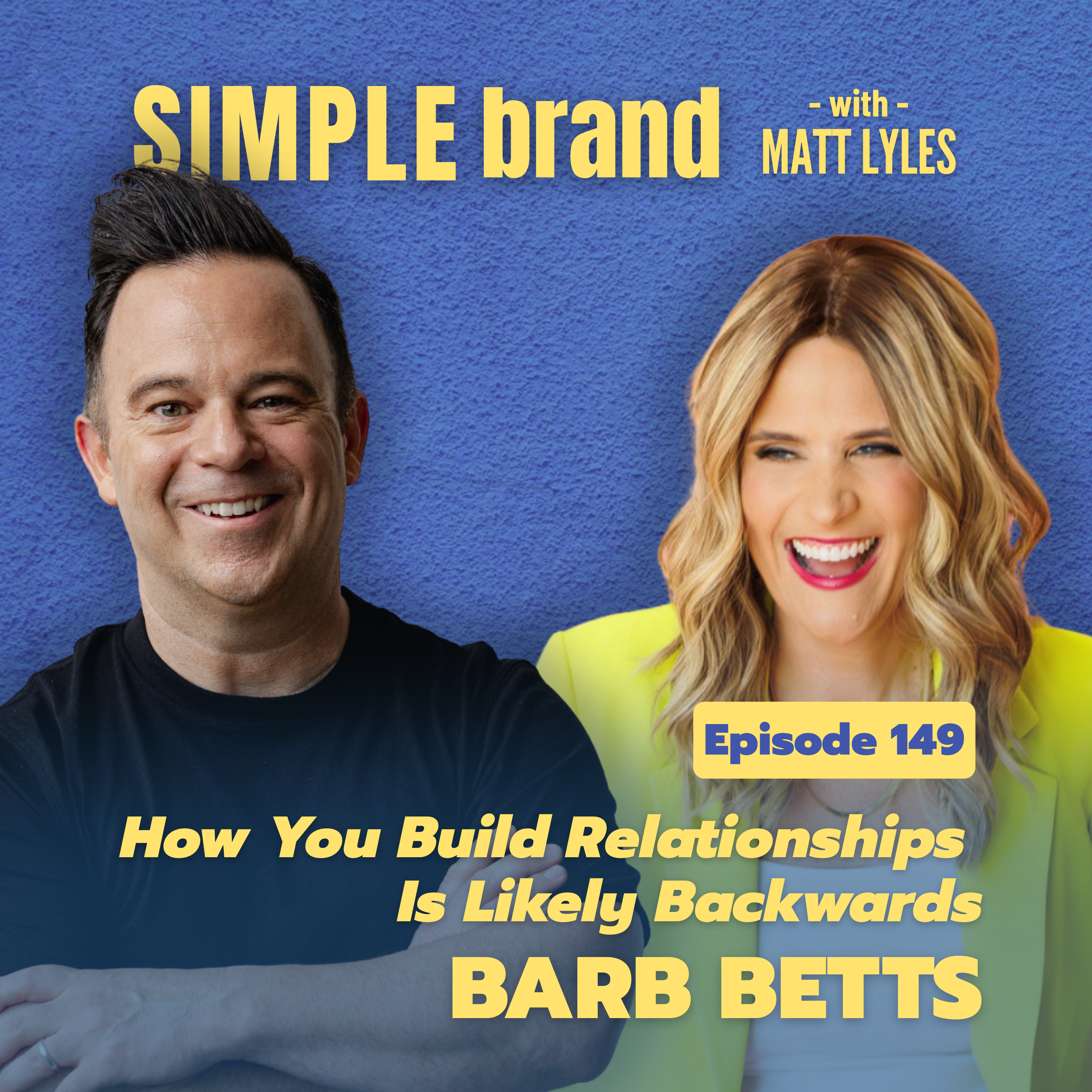
SIMPLE brand With Matt Lyles · Matt Lyles
Have you ever wondered why some relationships naturally grow stronger while others slowly drift apart—even when you have the best intentions? Your strongest relationships won't be built through grand gestures. They'll be built through simple, intentional habits. In this episode, I sit down with relationship strategist, keynote speaker, and author of The Relationship Advantage, Barb Betts, to discuss what it really takes to build, strengthen, and nurture meaningful relationships. What You’ll Learn Why your most important relationship may be the one you neglect the most What self-doubt and imposter syndrome may actually tell you The three ingredients every meaningful relationship needs Why knowing a lot of people isn’t the same as making people feel known A better method than asking for referrals for your business Why treating everyone the same is actually harmful A simple system for keeping your most important relationships from drifting The five-minute daily habit that will transform your customer, professional, and personal relationships Chapters 0:00 Introduction to Relationships and Their Importance 03:14 Are Business Relationships Limited to Sales Relationships? 08:30 Your Most Important Relationship 14:01 Managing Self-Doubt and Imposter Syndrome 17:17 The Right Way to Show Vulnerability in Relationships 21:33 The Difference Between Knowing People and Making People Feel Known 24:39 The Right Way to Ask For Referrals 30:05 A System For Managing Your Relationships 35:52 Barb's 5-Song Playlist About Barb Betts Barb Betts is a keynote speaker, CEO, relationship strategist, and author of The Relationship Advantage. For more than 23 years, she has helped leaders, sales professionals, and business owners build stronger customer and professional relationships that drive growth, trust, and long-term success. After building and sustaining a seven-figure business for more than a decade with no ad spend or cold outreach, Barb now teaches strategies for building authentic relationships that fuel both business and life. Connect With Barb Betts Barb’s Website Barb’s Book - The Relationship Advantage Barb on LinkedIn Barb on YouTube Connect with Matt Lyles Check Matt's speaking availability Subscribe on YouTube Matt on LinkedIn Matt on Instagram Subscribe to the SIMPLE brand newsletter Subscribe to the SIMPLE brand show
Barb Betts: a lot of industries, specifically the one I came from, you are so programmed to go out and get referrals. Matt Lyles: Yeah. Barb Betts: you're not taught to build the relationship first. And I truly believe you can't get a referral until you've built a relationship. So that's what I talk about. You've got to build the relationships before you need them. That's how you succeed in this business, Matt Lyles: Yeah. Matt: Helping you create loyal customers and loyal employees all through the power of simplicity. This is the Simple Brand podcast, now heard around the world, including Teguci Gappa Honduras. I'm Matt Lyles, and this week I'm talking with Barb Betts. Barb's a keynote speaker, she's a relationship strategist, and she's the author of The Relationship Advantage Unlocking the Life-Ching Power of Human Connections. After building and sustaining a seven-figure business for more than a decade with get this, no ad spin and no cold outreach, Barb now teaches leaders, sales professionals, and business owners how to build stronger customer and professional relationships. And that's exactly what we're talking about today. You know, when you think about relationships, most relationships don't fail because people don't care. They fail because people aren't intentional. Think about it. You know, most of us have good intentions. We mean to check in, we mean to make that phone call. We mean to schedule that lunch. We mean to follow up. But work gets busy, life gets busy, time passes, and then before you know it, the relationship begins to drift. Even though we had good intentions about that relationship. But here's the thing: good intentions don't build great relationships. Intentionality does. In our conversation, Barb and I discuss why the most important relationship in your life may be the one that you're neglecting the most. We talk about why knowing people isn't nearly as valuable as making people feel known. And we talk about why asking for referrals is the wrong tactic. But there's a better way that you can get people to actually refer you and your business. And we talk about the simple habits and methods you can easily instill to keep your relationships from slowly drifting apart. Now, here's my conversation with Barb Betts. Matt Lyles: Hey Barb, welcome to the show. Barb Betts: Hey Matt, so happy to be here. Matt Lyles: Yeah, well I am excited to be able to spend this time with you, especially talking about your new book, The Relationship Advantage. Congrats! Barb Betts: Thank you. So happy it's finally out in the world. Matt Lyles: Yeah, it's been cool seeing that journey and I think I met you maybe two and a half, three years ago or so listening to your lessons around managing relationships. So I'm excited to see this imprint in something that people can actually hold and read and learn from themselves too. But when we think about relationships, especially related to our businesses, I think we can have this tendency to want to limit relationships to just sales relationships. But I don't think that's necessarily how you feel and how you limit your focus. So how should we be viewing the relationships that we Barb Betts: You know, the thing is, you of course, all of us in business and all of us in sales, we want more business and we want more sales, right? So we tend to focus on Matt Lyles: Of course. Barb Betts: things that we feel like are going to give us the most rapid, you know, acceleration to our goals. And that is very important. But we have to understand that the core foundation of the concept of relationships, you have all different kinds of relationships in your life. You have all different types of relationships in your life. from friends and family to, you your partners, your spouses, the people that you do life with, to, you know, your adopted kids and family members that become like family to you. And then of course we've got our business relationships. And then of Matt Lyles: Yeah. Yeah. Barb Betts: course we've got, you know, acquaintances and we've got relationships that are maybe on the peripheral and maybe are, you know, a two degree of separation. You know, the friend of a friend that you always see at the barbecue every year or Matt Lyles: Yeah. Barb Betts: Like I'm going to a graduation party this weekend, I'm a dear friend of mine, and I will see a lot of her friends that I have a relationship with through my girlfriend, Sarah. So we've got relationships in all areas of our lives. And the reason I wrote the book the way I did is because I specifically wanted to make sure that this was not just a book about business relationships. So this wasn't just a book about sales, that this was truly a book that if you implement some of the strategies and the mindsets inside of the book, It truly can transform your relationships in business and in life. Matt Lyles: I have to think that if you have strong, healthy relationships with anybody, there's this aspect of you serving the people that you have a relationship with, and then there's a reciprocation that comes with that, where they come back and serve you as well, usually. And sometimes that may be when you have personal needs, like you may have a need where you may be struggling or facing a challenge in your personal life, but then also in your business life as well. Barb Betts: Right. Well, a couple of things to unpack there. Number one is to understand that relationships are a two way street. Right. You have to understand that relationships have to give and take. You have to give and you take a little from the relationship. Matt Lyles: Yeah. Barb Betts: And on the flip side, they give a little and they take a little. So that's a really, really important concept to understand, which is why I talk about and I'm sure we'll get into this concept of the level of relationships that we have in our life. Right. Matt Lyles: Right. Barb Betts: The other thing is to understand that not all people in your life want a relationship with you like you want a relationship with them. That's also a very important concept to understand that not every relationship is going to exist at the level you want it. That's a real hard lesson I've had to learn and I have a couple really clear examples of that that I've gone through in my life. And then the last point is that not all relationships are around forever. Some relationships are for a season. Some relationships are because Matt Lyles: Yeah. Barb Betts: or part of a company or a group that you're no longer part of and you just have no interest in continuing that relationship or the relationship level changes. All of that is okay. All of that is normal. And when we understand that relationships are in our control, I think that's when people will wake up to the concept and the idea that you can actually change and nurture and decide who you have relationships with and who you don't. Matt Lyles: You know, that's not something that I have really thought about or that's like really hit my head that hard enough was the fact that we have control in our relationships. And to me that should take off any kind of overwhelm that I may want to feel in a relationship if I'm trying and trying and not getting from the other person or if I'm getting a lot from somebody else but then I'm thinking like Well, I just don't have the time to prioritize this person and now I feel so bad because of that. Barb Betts: Right. Matt Lyles: Recognizing that I've got control over the relationships that I have. Barb Betts: Right and that and that's why I I tell people and I write about in the book. You can't treat everyone the same Right Matt Lyles: Yeah. Barb Betts: treat everyone the same you're treating no one special And we all know we have our closer relationships than other relationships and if you try to treat everyone the same, especially in business It doesn't work And Matt Lyles: Yeah. Barb Betts: you will burn out and then you'll be not connected to anybody because you just want to talk to anybody anymore which is why I believe that we have to put some intentionality behind our relationships for sure. Matt Lyles: Yeah. And if you try and treat everyone the same, you're not able to go as deep enough into some of those relationships that should be more special. Yeah, that makes sense. Well, Barb Betts: right. Matt Lyles: so thinking of all the different relationships that we have, whether they're you know, their business, their family, their friends, their friends of friends, out of all the relationships that we have, what is the most important relationship? Barb Betts: So the most important relationship I believe and the one that we neglect the most in life and the one that if we don't fix the intimacy, the confidence and the level of the relationship with this one particular person in our lives, you can't build a real relationship with anyone else. And that's the relationship that you have with yourself. And it's the relationship that I neglected my entire life until about seven years ago. And it's the relationship that I was the most ashamed of. Matt Lyles: Wow. Barb Betts: It was the relationship that I didn't believe in. I performed it on the outside and looked like this confident person that had it all together when inside, I didn't like myself, didn't believe in myself, talked horribly to myself, all of the things. And in my keynote, when I go deep on the relationship with yourself and I talk about this idea, I talk about the idea of the average lifespan or not average lifespan, but all of us know someone who's lived to 85 years old. Matt Lyles: Yeah. Barb Betts: You live until you're years old, you will actually have spent 14 million minutes with yourself. Because you can't leave yourself. Like you cannot Matt Lyles: Yeah. Yeah. Barb Betts: get away from yourself. You can't even go to the bathroom to get away from yourself, right? We go Matt Lyles: You're pretty much stuck with you. Barb Betts: everywhere. And I often say, imagine being stuck inside an elevator for millions of minutes with someone who was talking horribly to you. Someone who didn't like you, who didn't believe in you, who told you that you weren't worth anything. Right? And we Matt Lyles: Yeah. Barb Betts: would call that a toxic relationship. And yet most Matt Lyles: Absolutely. Barb Betts: adults are walking around in a toxic relationship with the most important person in their life, themselves. And we've Matt Lyles: Yeah. Barb Betts: got to fix that relationship first. Matt Lyles: I'm so glad that you focus on that and preach that. honestly, guess moment of vulnerability for me, I was the same way. I think it was maybe 10 years ago that I started to even focus on my relationship with myself. And it's been a journey. And it's still a journey. Like there are still days where I talk down to myself, like I say things to myself that that I wouldn't say to anybody else. so, you you know me, like, I'm a solo printer. I work for myself and I like to joke saying that I work for the worst boss that I've ever had in my career. Barb Betts: Yeah, don't say that anymore. We're not going to say that anymore. Matt Lyles: Yeah, but I will say this and this came up actually I think during workout sessions to kind of help myself continue and kind of have some endurance where I felt like I was failing. This saying, and I haven't shared this with anybody else yet, this is weird. I would say to myself, I love you, I'm proud of you, good job, let's keep going. And I would say that during workouts. And then I realized I can say that any other time as well. And I should be saying that Barb Betts: Right, Matt Lyles: to myself. Barb Betts: right. You should be saying that that's a fantastic affirmation and so very true. And it's so I get into the book, you know, the books broken down into three sections. The first section is a relationship with yourself. The next section is how do we build effective relationships with others? And then the third section is how relationships make an impact in our life. And ultimately ending in that relationships are truly your life. It's what you leave behind and we don't even realize Matt Lyles: Yeah. Barb Betts: and understand that relationships are actually rippling past us But when I start the book out I talk about why we need to fix this relationship with ourself and one of the reasons that I say that is because I firmly believe that Showing up authentic and real and human and being the truest version of yourself is the foundation of all human connection Because you can't Matt Lyles: Yeah. Barb Betts: connect with another human if you don't even know who you are And if you're showing up fake and not who you really are and you're not seeing the things, then the other person is connecting with a different version of you than you really are designed to be. That's why we have connection issues in the world. It's because the person standing across from you, the person you're trying to build this relationship with, doesn't even know who they are. That's problem. So until we fix that relationship, when I fixed my relationship with myself and I understood Matt Lyles: Yeah. Yeah. Barb Betts: who I really was and I had the courage to finally show up as that person. Because I say often, until you know who you really are and love that person, You will never have the courage to fully show up as them in this world, period. Matt Lyles: Yeah. Barb Betts: And then if you can't show up as the real you in the world, you can't build the real relationships you're looking for. And so when I went through this journey, Matt Lyles: So, we're going start with little bit of a bit a bit little little bit a a Barb Betts: many years ago, and I kind of finally decided to stop hiding and people pleasing and all of the things I write about in the first section of the book is when I all of a sudden had relationships and people and humans and opportunities and it's because this level of trust was built. It's because I became attractive to others and like I want to be around her. I love her aura. I love her energy. All of that changed because I changed. People around me didn't change. I had to go first. Matt Lyles: One of the things or a couple of things that tie into looking at ourselves and embracing ourselves, be able to genuinely connect with others is when we have self-doubt. when we have imposter syndrome and you talk about the need for embracing those. How Barb Betts: Right. Matt Lyles: can those actually be helpful in how we connect with others? Barb Betts: Right, so I say in the book that self-doubt is the space where your confidence is born, right? You cannot grow your confidence if you don't ever go through doubt. People that you admire, the most successful people in the world, we think they are so confident and that they never have a bad day and they never doubt themselves. The difference is they doubt themselves all the time, they still have the courage to step into that moment anyways. They understand they're not perfect. They understand they're gonna make mistakes. They understand they're not supposed to know how it goes. Imposter syndrome, I have a huge problem with that word and people being told about imposter syndrome and the definition of imposter syndrome in the world typically is that you're a fraud or you're a fake. That's really what you're programmed as and that is not true. Imposter syndrome simply is a sign that you're growing, Like that's all it is. You think you're a fraud or a fake. Matt Lyles: Yeah. Thank Barb Betts: It's because you're doing something you've never done before. I've had it as Matt Lyles: Right. Barb Betts: Like I just wrote a book and I was like who am I to think I can write a book who am I to think some Publishers gonna take my book who am I to think I'm gonna write 250 words about relationships and people are actually gonna listen to it and People are actually gonna buy the book but I had to step forward anyways because that was a growth moment for me Right Matt Lyles: Yeah. Yeah. Barb Betts: self-doubt and imposter syndrome. You can't have confidence my opinion without those two things Matt Lyles: Well, in recognizing that everybody else that has grown, that has developed, that's gotten to any next level, when you get to that next level, that's always the first time for you. So this book is your first book. Every other Barb Betts: Right. Right. Right. Matt Lyles: successful author had to go through writing their first book. Barb Betts: their first book, and now all of us, and nobody walks into it with like, unless you were like a journalism major, maybe you had a PhD and you've already done all the research and you've already written all the papers and you're just compiling it. But for most people, whether it's your first time on stage, whether it's your first time on a podcast, whether it's my first time going from, you know, the biggest audience I've spoken to is about 3,500 people. Well, when I go speak in front of 10,000 people, I'm going to feel some kind of doubt. Matt Lyles: Yeah. Barb Betts: I'm gonna be like, my God, because it's a bigger stage, there's gonna be more cameras, there's gonna be bigger lights, there's gonna be bigger media, there's gonna be a bigger something on the line, And we're all gonna have that in our life. But if you withdraw from it and hide from it and pretend that you don't have doubt, you'll never have the space to actually grow the confidence. Or of course, if you run away from it, which we know is what most people do. Matt Lyles: Right, sadly. Well, kind of tying to tying to that level of self-confidence and also tying to the level of being able to connect with others genuinely. There's vulnerability that comes with that. So on one end of the spectrum, you've got people that think that they should never show any vulnerability because it's a sign of weakness. And then on the other end of the spectrum, you've got some people that show way too much vulnerability because they just get into oversharing. So what's the ideal way to be vulnerable and still have a genuine connection with people? Barb Betts: Right. So what you're talking about is my kind of concept on the three pieces that we have to have in every relationship. And I believe this wholeheartedly if you look at every relationship you have within your life, good or bad, worked out or didn't, if you did not have these three things, it's why the relationship didn't work. So the first is visibility. We have to actually be present. And I don't mean just in the room. I mean present. Right. So when people tell me, insert whatever networking community. That didn't work for me. My question always is, did you actually show up? Did Matt Lyles: Yeah. Barb Betts: you actually go to the events? Did you attend the masterminds? Did you pop on Zoom and attend the networking opportunities? So the first is visibility. Are we really visible and are we present? The second is the vulnerability piece. We have to have some level of vulnerability with every relationship that we have. And I'll get back to your original question in a second. And the third piece, Matt Lyles: More. Barb Betts: in the key to a relationship is relatability. The reason most relationships don't continue is because you don't have anything in common. And if Matt Lyles: . Barb Betts: you're smart, you don't force it. And what do I mean by something in common? I mean, it simply can be, why do you have relationships at work? Because you have something in common. Why do you have relationships with someone? Why do you connect with someone so quickly at a cocktail party? It's probably because you got into a conversation about personal life and you found out you like the same sport. Your kids are the same age. Matt Lyles: Yeah. Right. Barb Betts: You love traveling to the same place. You have an obsession with a celebrity in the same way. Some point of relatability outside of why you're there. So Matt Lyles: Yeah. Barb Betts: specifically speaking to the vulnerability piece, I talk about you have to have some level of vulnerability with another human. That does not mean throwing up your entire life on somebody. As you said, that's called oversharing. That is not what I'm talking about. Matt Lyles: Right. Barb Betts: But if you don't have a level of vulnerability with someone else to admit you're having a bad day, to admit you made a mistake, to admit you don't know the answer to something, that's all levels of vulnerability. All the way down to the highest level of vulnerability, which is where you do share everything, your deepest, darkest secrets, your most vulnerable moments, your biggest fears that you don't want anyone to know. And that level of vulnerability should be reserved for your best relationships, your best friends, your spouse, your partner, your family. Matt Lyles: Okay. Yeah. Barb Betts: I'm not always your family, but in some cases, your family. Where, like when I talk to leaders, I talk a lot in leadership. And when I talk to leaders and I talk about these levels of vulnerability, I use this example all the time. You're a leader of a team and the company just came out with some new piece of software that your entire team hates and they're complaining and they hate it. What most leaders do is they fake it and they try to get their team all riled up. about how good the software is and how amazing it is, even though the leader hates it too. A good leader who wants to Matt Lyles: Yeah. Barb Betts: build authentic trust-based relationships with their team will say something like this. Guess what, team? I don't like the new software either. I'm frustrated just like you. But you know what? It's the software that we've been given, and we need to make our best efforts to make it work. Right there, that leader showed a level of vulnerability with their team to admit they don't like something either, but then was a leader and gave a solution. We have to do that with all of our relationships. So you don't have to throw up your entire life on somebody. Authenticity, people have that word completely backwards and they don't even know how to perform it or do it. And that's the problem is they do try to perform it, but. At the end of the day, visibility, vulnerability, relatability, you have to have those three things. And if any of your relationships are lacking one of those pieces, you either need to fix it or understand that you don't have a real relationship. Matt Lyles: sense. recognizing that there is a time and a place and there's a right time and a right place and the right connection for different levels of vulnerability. Yeah. Barb Betts: absolutely. Matt Lyles: we were talking about networking earlier and whether it's, being at a networking event or when you're networking with individuals one-on-one. A lot of people feel they're successful at networking because they know a lot of people. But you make a really good distinction between knowing a lot of people and making people feel known. What does that look like? Barb Betts: It means that we run around especially in sales. So when I'm talking specifically to sales and business people is like we run around with the size of our database or our CRM or our number of clients is like a badge of honor. And I come from the real estate industry and the real estate industry professionals at doing this and like, well, I have 750 people in my SOI and I have 5,000 houses in my farm. I could really care less how many people are in your phone. how many of those people Matt Lyles: Yeah. Barb Betts: actually feel known by Matt? Like how many of those people actually feel connected to Matt? Because it can't be about how many people you know, it has to be about how many of those people actually feel known by you. And I specifically don't use the word just seen. Because be seen, now, Jen Gottlieb is one of my, I love her, she's one of my dear friends, and she wrote the book. Matt Lyles: Okay. nice, yeah. Barb Betts: Your premise behind the book is 100 % true and I believe every word in the book. But when we just say I want to be seen, that can be very flippant as like, okay, I see you. Okay. Right? And you can see the look on my face, like very like, okay, I see you. Matt Lyles: Yeah. Yep, there you are. Barb Betts: I don't know you. I don't know anything about you. I don't know what keeps you up at night. I don't know about your dreams. I don't know any facts about you. I don't know your favorites. I don't know what lights you up. That's how you actually have a true relationship is when you make someone feel known. Matt Lyles: my thought is if I feel like I'm known by somebody, like where they demonstrate that, where they share something that is like not just surface level about me, then I feel known by them, but that means that they actually care about me. Like that's what I want is I want people to actually care about me. Barb Betts: Yep. Yep. And when someone actually feels known by someone, they're going to give more, they're going to show up more, they're going to be a Matt Lyles: yeah. Barb Betts: help or resource to somebody, they're going to answer the phone. How many times have you called somebody? Well, I shouldn't say this. I should say this the other way. How many times has someone called you and you look at the phone and you're like, my God, what do they need now? Right? Instead of, Matt's calling. I can't wait to talk to Matt. Right. Matt Lyles: cool, yeah. Yeah, I understood. know, there are probably a couple of people where when my phone rings and I look at the name, I'm like, do I want to do this right now? Do I want to? Maybe I'll just let it go to voicemail. Barb Betts: Be a clue. Yep. Matt Lyles: Yeah, and then there are some that are calling me like, wow, I'm so excited. Like, I'll drop everything. Barb Betts: You're like, you're like willing, like, right or like text him right back and be like, my god, I'll get back to you in five minutes. I'm finishing up a call. Yeah. Matt Lyles: Yeah, yeah, love that. So that helps really in understanding where you've got those significant star levels of relationships. Barb Betts: Yes. Matt Lyles: one of the things that I've heard you talk about for a few years, and I've always just been fascinated by this because it really helped change my thinking around this, is around referrals. You know, and so many of us, whether it's small business owners or in professional services, we rely on referrals as a significant channel for building our business. But Barb Betts: Right. Matt Lyles: you say that we need to take a different approach when it comes to referrals. Can Barb Betts: Yeah. Matt Lyles: you share your take on that? Barb Betts: Yeah. So a couple of things on referrals. Referrals are how I've built every business I've ever had. It's how I built my real estate practice. It's how I'm building my speaking career. And referrals are the most profitable, productive, best energy, best happiness, longevity way to do business. There's nothing like if you were not striving to build your business by repeat and referral business and retention. then you're doing it wrong in my opinion. And I'm not saying that other ways of doing sales and generating business don't work and all of them I believe work. It just depends on how much time, energy and money it takes you. But if you're not striving to get most of your business by repeat and referral business, then you're doing it wrong. when I specifically talk about referrals, a couple of issues I have with referrals is a lot of industries, specifically the one I came from, you are so programmed to go out and get referrals. Matt Lyles: Yeah. Barb Betts: you're not taught to build the relationship first. And I truly believe you can't get a referral until you've built a relationship. So that's what I talk about. You've got to build the relationships before you need them. That's how you succeed in this business, in any business. And then the next thing that I'm super passionate about when it comes to referrals is not asking for the referral. Because I believe when you ask for a referral, Matt Lyles: Yeah. Barb Betts: and you ask for business that way, it triggers the other person to think about, I know someone who's ready to transact right now? Do I know someone who needs to buy your service or product right now? And I would think for most business owners, you would love to get your hands on someone who might need your services before they're ready so you can nurture the relationship and get them to the point of being ready. Matt Lyles: Right. Barb Betts: So that's why I'm a huge proponent of asking for introductions and connections instead. and asking for your, to your people, to your friends, to your family, to your spirits, to your past clients, your colleagues, your vendors, whoever it is, asking for giving them the ideal person you'd like to be connected with and why, and then asking them, can you do me a favor when you come across, insert who you need? Would you do me a favor and introduce me to them? Because here's what that does. If I'm at a cocktail party with you and I speak to corporate audiences, okay? So if I walk up to you and say, Matt Lyles: Yep. Barb Betts: Matt, Do you have any referrals to any corporate CEOs that hire speakers? You're gonna look at me and go, not right now. No, not that I can think of, but if I do, I'll let you know. Now, if I walk up Matt Lyles: Yeah. Yeah. If they came up. Barb Betts: to you and say, Matt, one of the things I struggle with in speaking is finding corporations that have CEOs who are interested in hiring speakers. But what I've learned is most corporations at some point in their tenure need a speaker, a trainer, or someone to do a workshop. Do you know any CEOs of corporations you could introduce me to? You're gonna immediately go, yeah. Especially Matt Lyles: Yeah, that changes it. Barb Betts: if I'm specific, like I'm looking for financial services or I'm looking for healthcare or I'm looking for something that I know bonus points if you know Matt, you're gonna ask him something that you know he can help you with. But when I said the difference between refer me and introduce me, did your mindset not immediately shift? Matt Lyles: Oh yeah, absolutely. Yeah, it Barb Betts: when any. Matt Lyles: helped create a different kind of filter. Barb Betts: Right, and the introduction is easy. Matt Lyles: course. Barb Betts: Hey, John, Barb mentioned she's looking for great corporate CEOs and financial services. I immediately thought of you. I know you're not the CEO, but I know you're a vice president and you know the CEO and she's a great sales trainer and she'd just love to be connected. I'll let you two take it from here. Then it's my job to go out and capture that relationship and build that relationship and nurture that relationship. The introduction and connection makes it easy. It's not salesy. It's not pitchy. And then you have to go do your job. You don't get to just sit around and wait for something to be handed to you on a platter. And that's what happens when we say, who do you know that needs my services? I'd love a referral. Then I'm like, well, I don't know anybody who wants to buy your services right now, so I'm not going to give Matt Lyles: Right. Yeah. Barb Betts: you anybody. It's a huge difference. Matt Lyles: and a lot of times I can think that people would want to be helpful and would want to say, you know, I actually would like to connect you with that kind of person. I just can't think of them right now based on what you just shared. Barb Betts: Right. When you come across them, right. And that's the other reason why I love introduction and connection. And I love using the words, I call them magic words. Can you do me a favor? Because Matt Lyles: Okay. Barb Betts: everyone wants to help you. Matt Lyles: Yeah, yeah, that's really key. Can you do me a favor? I like, yeah, I get to Barb Betts: Right. Matt Lyles: do a favor for somebody. I get to feel useful for a friend. Barb Betts: Right, right. Matt Lyles: you mentioned this early on, but as much as we like, we can't have the same level of relationship with everybody. There's simply not enough time to do that or else we're gonna get burned out. But you've got a five-star system for managing relationships to ensure that you're intentional about all your relationships. So can you walk me through that system? Barb Betts: Yeah, so huge proponent of ranking your relationships and having some kind of systematic approach to your relationships. And people will say to me, Barb, that's so transactional of you to say you have a system behind your relationships. And that what I say is the opposite, is if you don't have a system, your relationships are drifting away and that's why you have a problem. If you don't have a system, it's why no one feels special to you. So that is transactional. Right? Because then you show up and you need something and you've done nothing to deepen the relationship. And it goes back to this concept of you can't treat everyone the same. So I use a simple five star ranking system and you can do whatever you want. But I believe everyone knows what a five star experience is versus a one star experience. Right? So Matt Lyles: Yeah. Barb Betts: five, four, three, two, one. And you simply rank them based on your level of relationship with them. I give you all kinds of ideas in the book, but you get to choose how you want to rank your relationships. But I think five stars of as advocates, walking, talking billboards. Matt Lyles: Right. Barb Betts: They talk about you in rooms you're not in, right? They're a constant source of business and energy for you. They answer the phone every time you call. four stars are champions. You're very well connected. They are deep relationships that you have. There's just a slight difference between advocate and a champion. An advocate are your besties. They're your business besties, Matt Lyles: Okay. Yeah. Barb Betts: right? Champions are really, really good business partners. Three stars are connections. You're connected in some way, You have their information. You see each other at various different events. They might be a past client of yours that you're not as close to anymore. You are connected. They know what you do. They know you're good at it. And if you actually did some more effort, they would move up in the strategy. And then two stars I call acquaintances, friends of friends. You maybe Matt Lyles: Yeah. Barb Betts: see them every month at the chamber event, but you don't do much more than say hello to each other, but you have their contact information. And then one stars are your mailing list and it's okay to have a mailing list in business. We all have got to have it. So those people are people that are there are contact. You have their information. You wouldn't even recognize them probably if they walked into a room. And then the secret in this ranking system is another piece that I teach, which is adding a frequency formula to your communication, outgoing community Matt Lyles: Yeah. Right. Barb Betts: to this list of people. And so in my world, and you can do it however you want, In my world, five stars are hearing from you in an authentic way, not about business, no agenda, no direct ask, just how are you? Five stars are every 30 days, four stars are every 60, three stars are every 90, two stars are 120, and one stars are a mailing list. And again, you may hear that and go, 30 days? You're crazy. Make it 45, make it 60, whatever you want. You may hear 30 and go, I better do every seven or I'm gonna lose that relationship. Do whatever you want. Matt Lyles: Okay. Okay. Barb Betts: But if you don't have some kind of frequency in how you connect and nurture these relationships, that's why they're drifting away. Because people aren't hearing from you in an authentic way often enough. People think that they are not important to you anymore. Matt Lyles: Yeah. Well, and then, you know, thinking about it as, that transactional? Well, no, to me, it's being intentional. If you want to have a strong relationship with somebody, you've got to be intentional. And then for those five star ones, at least, at least the ones in my mind that I see as my five star ones, if I'm intentional about staying in touch with them in a genuine, authentic way, I don't necessarily have to do that every 30 days because they're also reaching out to me as well. And we're just organically staying in touch with each other. Barb Betts: Right and and I talk about that where like oftentimes I'm going to my list and I have a CRM that's built tell me it's been 30 days since I've had an authentic connection point with somebody nine out of ten times when my five stars come up I'm just clearing them off the list because I just saw them last week I just talked to them every Matt Lyles: Right. Barb Betts: day so you're absolutely correct what it does though is it allows those important people to you that maybe you're not intentionally in contact with enough and you they pop up on the list and you're like dang I haven't talked to so and so and so long I need to Matt Lyles: Yeah. Barb Betts: reach out and connect with them. Matt Lyles: and that's helpful because we always have like at least that one person where we know, I really intended to talk to them and it's been over 30 days and I really want to, well, this is my trigger, my reminder that I should. Barb Betts: Right. Which is why, you know, I'll tie a bow on that in the strat, the biggest behavior change that I teach and the number one thing that you can implement today, regardless of if you rank your relationships, regardless of if you put them on a frequency formula is what I call the five by five method. And it's five messages a day to five people you care about five days a week. If everybody in the world implemented that strategy, we would have a better world. I will do the math for you. It's 1300 connections a year. If you made 1300 intentional connections a year, would your business not be better? It absolutely would. So every Matt Lyles: Yes, absolutely. Barb Betts: day when I get up before I start any work, I am sending five messages to five people I care about every day. And it's just checking in. It's I noticed something on social media. It's I know they went on vacation. I'm following up on the vacation. It's hey, I miss you. We haven't talked in a long time. Let's go get coffee or let's hop on Zoom. But you have to be intentional. And it's this idea that's probably going to be the idea behind the second book, which is reach out first. Matt Lyles: Yeah. Barb Betts: Because that's why human connection is lacking because no one's reaching out first. And if someone doesn't go first, can't be a conversation and a relationship. Matt Lyles: And then I actually call that giving them the gift of going second. Yeah. Barb Betts: Right. Yep, absolutely. Matt Lyles: right. I got one last question for you, Barb, if you were to create a five song playlist for the relationship advantage, what songs would you choose? Barb Betts: Well, the first is This Is Me from The Greatest Showman, It's Matt Lyles: cool. Yeah. Barb Betts: one of my favorite Pump Myself Up songs. Don't Stop Believing, My Journey. Gotta have that on the playlist. The Matt Lyles: Nice. Barb Betts: Champion by Carrie Underwood and Ludacris, love that, Matt Lyles: Okay, yeah. Barb Betts: right? People that are thinking less of you and don't believe you can do it, well, you know what? You can do it. And then the last two are really just because they're my two of my favorite just get up and dance songs and have fun, which is September by Earth, Wind and Fire. Fun fact, if that song ever comes on and I am anywhere near you, I will get up and dance. And Country Girl Matt Lyles: You Barb Betts: Shake It for Me by Luke Bryan, because how can you not dance to Country Girl Shake It for Me? There you go. Matt Lyles: wow, nice. Okay, that's a fun eclectic mix. I love that. Barb Betts: It is a very eclectic mix. Matt Lyles: Thanks for playing along. Well, Barb, I've always learned a lot from you. I've learned a lot here today and from your book, but where can we go to learn more? Barb Betts: Yeah, the best places, you I love to hang out on Instagram. So if you want to connect, go on Instagram and LinkedIn. If you want to learn more about the book, go to my website, barbets.com slash book. Matt Lyles: Well, Barb, so great seeing you. Thanks for being here today. Barb Betts: Thank you for having me, Matt. I appreciate it. Matt: Well, thanks again to Barb Betts for joining me on the show today. And thank you for joining me. You know, one thing that really stuck with me from my conversation with Barb was her five by five method. It's five messages to five people that you care about five days a week. That's it. And if you know me, you know that I love this method because it's simple. Ridiculously simple. And it's action-oriented. It doesn't require a complicated system. It doesn't require hours out of your day. It doesn't require some elaborate relationship strategy. It simply requires intentionality. And I think it's important because we often convince ourselves that building stronger relationships requires some grand gestures, or even just some medium-sized gestures. We think we need to schedule lunch or go and grab coffee or we need to find an hour to catch up. And those things are all great, but they're also the kind of things that can easily be put off until next week or next month. And then suddenly you find yourself sending Christmas cards to this person and realizing, wow, I don't think I've talked to them at all this year, even though I meant to. Sometimes building and strengthening a relationship is as simple as sending a quick text. You know, it can be, hey, I was thinking about you earlier today. Or, hey, you had that big presentation last week. How did it go? Or, congratulations on the promotion. I know you've been working really hard towards it. So those small moments. may not seem all that significant to you, but they can mean a lot to the person that's actually receiving them. Remember, relationships rarely drift because of one big decision. They drift because we miss dozens of small opportunities to stay connected. But good news, they also grow through dozens of small opportunities to reconnect. So here's my question for you. Who are five people you could reach out to connect with and encourage today? And not because you need something from them, and not because you're asking them for a referral. I mean, remember, we're not asking for referrals anymore, anyway. But you're reaching out simply because the relationship with that person matters to you. So do that, then take some notes on what they share. And then repeat the next day. And then repeat the next day. Five days a week. And then a year from now, some of those relationships will be stronger than they've ever been. Thanks for listening. Thanks for watching. Until next time, keep it simple.