
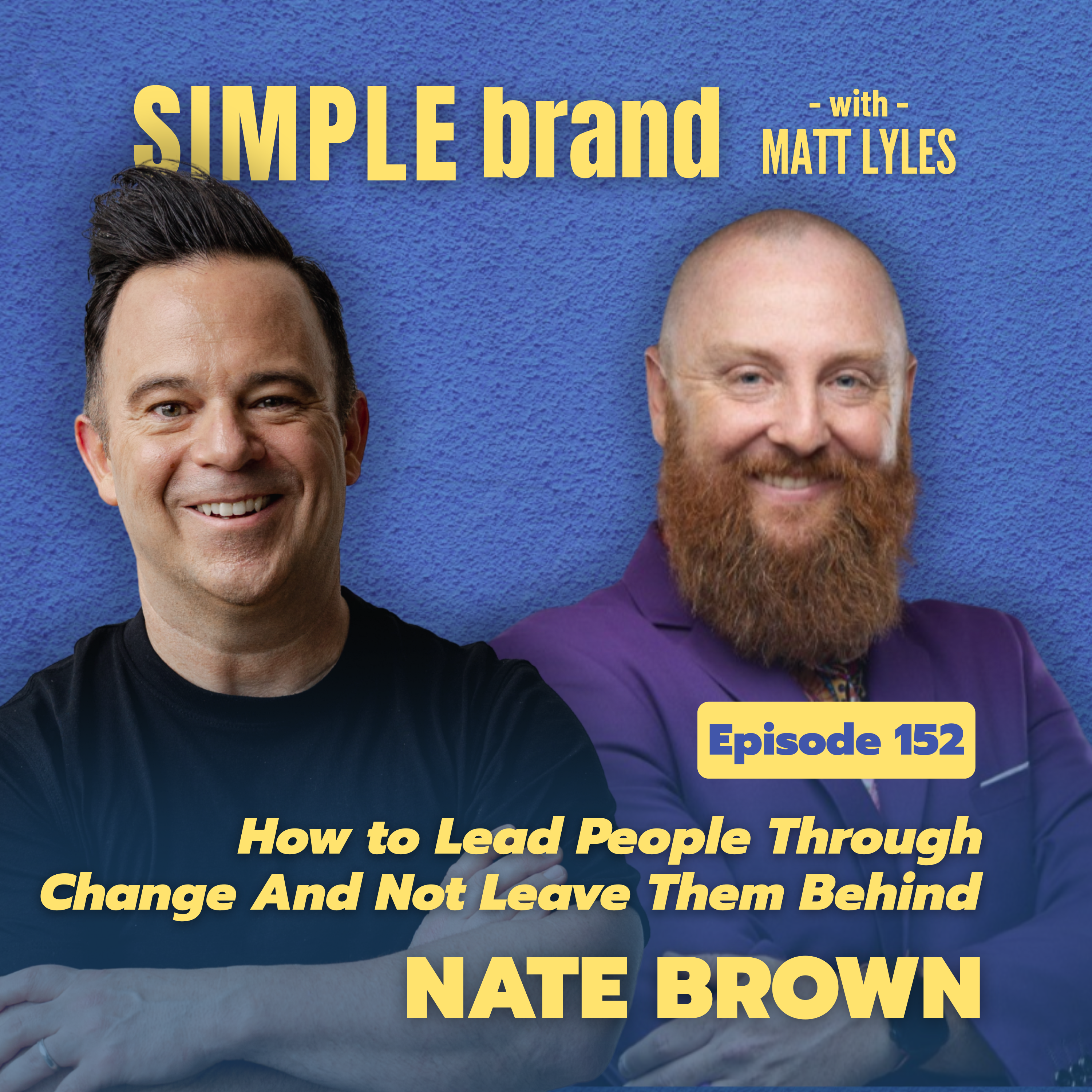
SIMPLE brand With Matt Lyles · Matt Lyles
Register to attend the 2026 CX Day Celebration in-person or virtually. In this SIMPLE brand episode, I talk with CX leader and CX Accelerator co-founder Nate Brown about his concept of Servant Challenger Leadership - combining the service, humility, and trust-building of servant leadership with the courage to challenge old systems, assumptions, and ways of working. We explore how CX leaders can create psychological safety without creating complacency and create an environment where people can challenge ideas, collaborate, and move through change together. What You’ll Learn * Why challenging the status quo isn’t enough to lead meaningful organizational change * How Servant Challenger Leadership combines service, trust, and productive challenge * Why psychological safety shouldn’t mean avoiding disagreement, discomfort, or change * How “creative abrasion” helps teams collaborate, innovate, and develop better ideas together * Why CX leaders need cross-functional allies to create lasting customer experience change * How leaders can create an environment where great ideas emerge instead of trying to have all the answers themselves * The attributes needed to lead people through change * How to help employees participate in customer-centric change Chapters 00:00 Introduction to Servant Challenger Leadership 03:19 The Servant Challenger Leadership Model 12:47 How to Manage Psychological Safety and Creative Tension 17:53 Leaders Need Desire, Confidence, and Capabilities 22:39 Leading Change With a Change Management Coalition 29:09 Examples of Brands Demonstrating Customer Curiosity 33:35 Learn All About the CX Accelerator Community 38:10 The 2026 CX Day Celebration 39:40 Nate's 5-Song Playlist 44:08 2026 CX Day Celebration Details About Nate Brown Nate Brown helps organizations better understand and serve their customers. As a CX practitioner, consultant, and leader, he’s built contact centers from scratch, led complex CX functions, and helped organizations create stronger connections between employees and customers across multiple industries. Nate is also the co-founder of CX Accelerator, a global community of over 5,000 customer experience professionals helping one another grow throughout their careers. Connect With Nate Brown Register for the 2026 CX Day Celebration Nate’s Website CX Accelerator Nate on LinkedIn Connect with Matt Lyles Check Matt's speaking availability Subscribe on YouTube Matt on LinkedIn Matt on Instagram Subscribe to the SIMPLE brand newsletter Subscribe to the SIMPLE brand show
Nate Brown: when you take that collective tension of half-formed ideas, and you've got people challenging to the point where they are willing to. To bring those ideas to the forefront. And even if it's not the perfect idea, there they have so so little fear of peer-to-peer judgment. They're so excited about the possibilities that they're they're bubbling over with the half-formed ideas. Then the creative process starts to happen. And it once again, there's some canabolic, that's not gonna work, let's tear that part off, let's connect this dot to it. And all of a sudden you're collaborating and creating this collective genius that no one could do alone. Matt: Helping you create loyal customers and loyal employees all through the power of simplicity. This is the Simple Brand Podcast, now heard around the world, including Murfreesboro, Tennessee. I'm Matt Lyles, and today I'm talking with my friend Nate Brown. Now, Nate was on the show back in episode 81, and he's back again today. So if you've been in the customer experience industry for any amount of time, then you've likely seen or heard of Nate. But if you haven't, well, Nate's a longtime customer experience leader. He's an educator, and he's a community builder. He's considered a top global CX thought leader by ICMI, CX Network, Martech Vibe, and others. And Nate's the co-founder of CX Accelerator. It's a community supporting more than 5,000 customer experience professionals around the world. Now I'm part of CX Accelerator as well, and I get to serve on the board. Now Nate and I get to hang out. Pretty regularly here in Nashville. And when we get together, our conversations almost always end up going somewhere around customer experience and leadership. And lately, there's been a lot to talk about. I mean, technology's changing, customer expectations are changing, organizations are changing, employee engagement is changing. And all that means that the way that we approach customer experience, well, it has to change too. But here's the challenge. Knowing that something needs to change, and then actually leading people through that change, they're two very different things. As leaders, you can challenge the status quo. You can tell people to innovate. You can tell them to move faster, work differently. But if you haven't earned their trust, if you haven't created a shared vision, if you haven't helped them understand where you're going together, then you're likely going to create more chaos than actual progress. Now, Nate has a name for the kind of leader who can help navigate that tension, the servant challenger. It's the leader who combines the humility and service of servant leadership with the confidence, desire, and capability to challenge what needs to change. And Nate and I talk all about what servant challenger leadership looks like. We talk about how some leaders get psychological safety wrong and end up creating what Nate refers to as worthless harmony. We talk about how healthy disagreement can actually lead to better ideas and innovation. And we talk about why CX leaders need Allies across the organization if they want to create meaningful customer experience change. So here's my conversation with Nate Brown. Matt Lyles: Hey Nate, welcome back to the show. Nate Brown: I'm back. What's going on, Matt? It's so nice to be here. Matt Lyles: I know. You know, well it's it's funny. we hang out pretty regularly in person in Nashville, at least like, you know, once a month or more sometimes. So this is weird. This is weird being virtual. Nate Brown: It is a little odd, but any mat time I can get, whether it's on Riverside or at a barbecue joint, I I it's good time for me. So I'm thrilled to be here. Matt Lyles: Yeah, or or Hattie B's. Nate Brown: Hattie B's. Matt Lyles: Well, it's great seeing you. we've got some things to talk about. I know we can talk about a lot of things, but I wanna focus more around like what we're seeing in the CX industry today and then specifically around leadership too. Nate Brown: Yeah, there's so much we could talk about here, Matt. I mean, we are in the midst of a significant leadership crisis that extends far beyond the CX universe, but in some ways it's amplified in the CX universe because all of this technology disruption, it's taking center stage right on top of the customer service environment. Matt Lyles: Yeah, absolutely. And so much of it is is affecting the customer service frontline, but it's also affecting everything else that impacts the customer experience. So I guess like, you know, high level then, like what are we seeing? What is it that's affecting leaders today? Nate Brown: What isn't? I mean, I get there's there's so many factors that are in in ways working against us. I mean, there there's the typical circle of psychological safety is is been broken in in quite a few ways inside of most organizations. I mean, there's significant external fear and and disruption that's happening. The rate of change, Matt, is absolutely wild. But then as we look inside these organizations, the these executives know they cannot continue to do business the way that they've been doing it. They can't have the organization structured the way that it has been. You know, as Justin Robbins has said so many times, CX is an outcome that the business produces together. It's not a function, it's not a team, but yet most of these organizations are still organized to try to do CX in this little functional box. And people are waking up and the technology is accelerating the urgency around the fact we cannot keep doing business this way. Matt Lyles: Yeah, well, and there's so many that are used to that status quo. You know, like like Nate Brown: Good word Matt Lyles: this is how it's always been done. And I know that a lot of leaders say that we should never say that. We should never say this is how it's always been done. At the same time, it's how they're continuing to operate because it's all they know, so what do we do to be able to go against that status quo? Nate Brown: Yes. So I I have a leadership methodology that I've been introducing over a period of time, which Matt, you have certainly helped me to to try to round Matt Lyles: Yeah. Nate Brown: out. But it really begins with the this idea of a challenger activating ourselves as a challenger, somebody with the confidence, the desire, and the capability to push the boundaries of the status quo and to take these changes that most most organizations are a victim of. To be able to embrace that change and to be able to harness it and unify people in a way that's ultimately going to produce these wonderful outcomes. I've been using this metaphor lately. I mean, there's a storm a brewing. Like, you know, the water's choppy out there in economically in our society, but we gotta get from point A across the harbor to point B. And these organizations are sending out their team members in jet skis. And saying, good luck. I hope you make it. And what we need to be doing is before we accelerate change, we got to anchor people in to that place of safety, that place of unified vision. So let's create this seaworthy vessel, invite people on board, then we get to accelerate the change together instead of the jet ski that's about to get wiped out. Matt Lyles: Well and and I love that you said having a unified vision to align people around because you know a lot of times when organizations want to say that they're gonna become more innovative, they will challenge their individuals. They'll challenge all their people, hey, go out there and make change. You know, I don't care what it is, just go and do something. what I've seen, and I think you've seen this too, is that yeah, some some individuals will go out there and they may make a change, but that change may only be beneficial to themselves, or it may be beneficial to something that's really not even tied to that what what should have been that unified vision. Nate Brown: Yeah. Yeah. So I mean that's that's very typical. And and when we awaken a challenger mindset, hey, go break. And you know, Lauren Gildry is is informed me of these these two types of energy in the universe. I mean, there's cannibalic, the the energy of destruction, which you know sometimes we need that warrior energy of I'm gonna break this down so that we can then what? Anabolic energy. We can build up, we can restore, we can heal, we can bring peace and harmony into these situations where There's a lot of distrust and a lot of a lack of hope that are that are in these situations. So it is a combination of cannibalic and anabolic energy with a strong leaning towards anabolic. But you in some ways we got to break apart and destroy, you know, these legacy things that are holding us back, these structures, these ways of thinking that have been holding people back from being able to produce the ideal outcome of elevated experiences. Tapping into what's now possible, Matt, through the technology disruption, we shouldn't be talking about it like some kind of awful thing. I mean, as a CX leader who has been struggling to do omnichannel, who has been struggling to do voice of customer in a way where I can truly understand the thoughts and perceptions of my customers out in the wild, the what we have available to us in terms of technology capability is unmatched. I mean, it's just amazing what we can now do, the experiences that we can now create for customers. So, I mean, it's a dreamer's paradise right now. We're we're kids in a candy store if we have a vision for what could, could, should, would be in terms of experience design. But what we've not been able to do yet is awaken the right, collagulation of collaboration between our people to to activate. Matt Lyles: Collagulation's a big word there. Nate Brown: I d I've never used that word in my life. I'm not sure where that came from. but you know, we got people running around on jet skis, Matt. They're they're out there, they know they need to change, they know there's a storm of brewing, and so they're running around on the jet ski. How do we create the ship and the vessel that's gonna get people to the harbor of great experiences? Matt Lyles: Well and and I I still like love this analogy of having a ship because a ship is g you know takes a crew. It takes a number of people to do Nate Brown: Yeah. Matt Lyles: this. And when I think about the typical challenger, a lot of times, you know, y what what I've witnessed is somebody will come in and they will lead a challenge on their own. And a lot of times it's just based on what they want to do, what they wanna have happen. And Nate Brown: Sure, yeah. Matt Lyles: They're able to get some momentum simply because they've got a loud voice. But if you get too far down the road, if it's not part of that unified vision, then you've simply got this rogue challenger that is just creating chaos. Nate Brown: Yeah. Yeah. No, it's it's a great point. So just the challenger mindset isn't enough. So what so what do we bring to to help to balance the canabolic and the anabolic? What do we help to balance the individual uplift of the challenger versus the unified building of a group of people with a unified vision? And that's where that's where I like to use the phrase servant challenger. And and that idea that that bringing in servant leadership principles. That idea of lifting up the voices of others, growing people before performing tasks, creating bridges and earning trust through service, through caring, caring very personally to use that Kim Scott model of before we go challenge directly, which by the way is the trademark of a great team with the capability to innovate and do new things. We've got to be able to challenge directly. But the only way that can happen is when we care personally. And we earn that trust, and we earn that trust through service. Matt Lyles: So like getting down into the details, what does it look like to earn that trust? What does it look like to be that servant challenger for the for the organization? Nate Brown: Yeah. And it can happen at any level. I mean, it's certainly it's nice when, the executives or the leaders, the directors who have significant influence and and have the ability to to really impact a larger group of people, you know, when they catch the vision for this leadership mindset, you know, remarkable things can happen, but it does not have to happen there. And and I have seen several grassroots movements that have occurred. Where a servant challenger is activated somewhere, you know, lower down in the organization and just starts to invite their peers into that specialized circle of psychological safety. And that's that safety is not a comfort zone there. Like I think that's kind of the big difference between Timothy R. Clark's circle of psychological safety, which kind of exists over here in this bottom left-hand corner versus what we're talking about, Matt, which is. We're putting that circle of safety on a ship. And that ship is going somewhere. It's moving. The changes are happening. They have to happen and they should be happening. So that the circle isn't stagnant. it's something we're bringing with us and mobilizing into this wonderful force that's going to be able to elevate experiences for our customers. Matt Lyles: that's a good point. because it's it's not so much psychological safety and that you're you are free, you're comfortable, you don't have to be challenged, so to speak, but like putting it on that ship, that ship is going forward. As an organization, we are going forward, and if you're on the ship, you're going forward with us. Otherwise, you're not on the ship. And then so that kind of changes the way of thinking around what psychological safety looks like. And Nate Brown: Yeah. It does. Matt Lyles: I think a lot of leaders will look at psychological safety and equate that to making things efficient for each individual to be able to just accomplish their work. Not having arguments, not having debates, it quells a lot of debates, so to speak. Nate Brown: yeah. when you said that, Matt, it's almost like this idea of worthless harmony. it seems like that would be good and helpful, but it's actually not. And it actually doesn't serve anybody in this period of time in which Matt, I don't know about you. I don't know anybody that's comfortable right now. Like that that ship has sailed a while ago. And you've got people now that are either in a very hard place because they're not keeping up with all the changes that are going on, or you've got people that are excited and they're helping to drive the trade. I mean, there's there's really not much in between, at least in in my opinion, from you know, the many CX leaders that I'm talking to. So I mean, to answer your question in terms of what does this servant leader look like, a servant challenger really. a great answer to that question is seen in collective genius, which is an amazing resource that you and I have both seen, Matt. And I mean it's just this amazing visual of what an activated team looks like when you take that collective tension of half-formed ideas, you've got people challenging to the point where they are willing to. To bring those ideas to the forefront. And even if it's not the perfect idea, there they have so little fear of peer-to-peer judgment. They're so excited about the possibilities that they're bubbling over with the half-formed ideas. Then the creative process starts to happen. And it once again, there's some canabolic, that's not gonna work, let's tear that part off, let's connect this dot to it. I know who we need to talk to. We need to go talk to Susan in accounting. She's Matt Lyles: Yeah. Nate Brown: gonna have a perspective on this. And all of a sudden you're collaborating and creating this collective genius that no one could do alone. And that's how real innovation happens. Matt Lyles: that's the whole point, I think, of it being collective genius is that you're creating something that no one individual in that organization could have come up on their own. it is brought about by everyone collaborating, working together in a productive, in a healthy manner to do that. Do you allow for debate or do you like allow for full on contact debate or do you allow for no debate at all? or where in the spectrum is it? And I like how collective genius refers to it. I I think they refer to it as creative abrasion. You know, it's Nate Brown: That's so good. Matt Lyles: it's a productive disagreement, a productive debate. Nate Brown: And you've got to earn the right to get there. Most Matt Lyles: Yeah, yeah. Nate Brown: teams are never in a place culturally from an EQ standpoint where that creative abrasion is possible. Most organizations will never get there. it requires the servant challengers to to help to create that environment of creative tension, safe creative tension. you gotta earn the right first. you gotta get that circle of psychological going through service and through earning trust. But then you don't stop there. you don't stop in the place of harmony and comfort. You bust forward in in that process of innovation. Matt Lyles: Well, and I think what is key at at least from how I understand a servant challenger, especially when it comes to innovation, it's not the type of leader that says, I've got the answers, come to me for the answers and I will disseminate them down. Like they're not there to create the answers. you said some moment ago, they're there to create the environment that brings those answers. Nate Brown: Yes. Matt Lyles: earlier you said a servant challenger has confidence, desire, and capabilities, right? So Nate Brown: Capability. Yeah. Matt Lyles: so out of those three things, my my belief is the confidence, the desire, like those have to be internal to that leader. And if Nate Brown: Yeah. Matt Lyles: they're gonna replicate or even multiply other servant. challengers. each of those challengers has to have those two attributes as well, internal to them. But the capabilities, I think, can probably be maybe a combination of someone creating their own capabilities, but the organization creating those capabilities as well. So how Nate Brown: Mm. Matt Lyles: does that happen? how do you ensure that your leaders have those right capabilities? Nate Brown: Nobody's ever asked me a question quite like that before. I I really like how you worded that, Matt. I mean, you know, and it's not enlisted in order of what's most important in that formula of an effective chance Matt Lyles: yeah. Nate Brown: challenger. You know, I really think the most important one and the one that most people are missing today is starts with the desire. you've got to actually want. You've got to have a conviction level that's up here to to again use that that care personally phrase from Tim Scott. I care personally. Personally about this community, this workplace that I'm a part of, and the promise that this community has made to its customers. I personally care about that. I care personally about the other members of that community and my relationship to them. Like these things matter to me. And until that desire is real and authentic, the other two are kind of irrelevant. But but I do love your question, Matt. You know, in terms of capability, that is definitely the least important. Because you can kind of outsource the capability. That the capability could come from all kinds of places. And as Steve Jobs talks about, creativity and innovation is just connecting dots. It's bringing these pieces together. So the person with the desire and the confidence to bring the pieces together, the dots together, that's where the capability is going to rise to the top of the cream. Matt Lyles: that helps. That makes sense. And you're right. I mean, if if you had to prioritize those, I would say that desire should absolutely come first. You Nate Brown: Gotta be. Matt Lyles: you have to have that drive, that want to to actually make it happen. And Nate Brown: Mm-hmm. Matt Lyles: then from there it's like, okay, I've got this dream, I've got this vision, this goal. can I do this? Can I do this as an individual leader? Can I do this within this environment that I'm in? Like is this brand, is this organization going to allow me to do this? that plays into the confidence too, I think. Nate Brown: yeah. And I mean, not so long ago. I I was inside of an organization where I was trying to build a ship Matt Lyles: Yeah. Yeah. Nate Brown: and they kept sticking me on a jet ski. it just became very clear that, like, Nate, you we're giving you only a jet ski. That that's all we're interested in for you is this jet ski. and of course, you know, I just kind of lost my voice and and ended up in a pretty dark place. And that was a lesson whereas like This is not a place where I can impact real change and and had to move forward from that place. There are some environments where being a servant challenger is really not possible. Matt Lyles: Yeah. so I I think maybe maybe it's it's taking that confidence and breaking it into two different pieces. confidence in your ability to lead and influence others, but then also confidence in the organization to allow you to do that. And then if you realize that that organization won't allow you to do that, either based on leadership or structure or anything else, I would say that it doesn't make much sense to spin your wheels, to spend that much time and effort trying to go against the grain to do that. Sometimes you just gotta you just gotta shake the dust off your feet and move on. Nate Brown: Yeah. I mean, you gotta be able to earn allies. I don't care if you're the CEO or or a customer service representative number seven, your Matt Lyles: Yeah. Nate Brown: ability to earn allies and invite people into the change initiative with you, that's going to make or break if if you're actually gonna board that ship together. Matt Lyles: Okay. So then let's assume. you are confident in yourself. You're confident in your organization and you see that your organization is going to allow for this to happen. you've got servant challengers in place now. I mean, just having those challenges in place is really is is that's just the first step, right? Like now now you got the challenges in place, you've got to go do the challenging. Nate Brown: True. Matt Lyles: What does that look like? Nate Brown: Yeah, you know, it's gonna look different in inside of each organization and each change initiative. Like, what is it that we're trying to create? But I love going back to John Cotter. I mean, in terms of that initial lighting of the match, you know, how does it gonna look initially? It's a sense of urgency. We can't keep living this way, Matt. Like we we have to make a change. We get to make it's not even that we have to, we get to make a change. And Matt Lyles: Yeah. Nate Brown: and this is where we are today. This is where we get to go in terms of elevating our experience in this community, this workplace, and elevating the experience of what's possible for our customers. You you've got to cast a really compelling vision for that and awaken people towards it. That's that's the first step in John Cotter's model, is establishing the sense of urgency. Number two is creating that CX change coalition, or or in his words, just change coalition, where you're sticking the right people together, the right dots are connected. To where you can influence change, you can unite the vision of the change and the practical steps. You can get the project plan laid out, you can get the milestones there, you can premeditate your quick wins, which is number four in the model. You can go ahead and do that together as a change coalition. And that the individuals inside of that coalition can bring it down to their teams and help them to be able to participate, not be a victim of the change. But but be part and and part of the celebration of what's happening across the org. Matt Lyles: Well, and what I've seen in in leading change management efforts like that too is that having those those representatives in the coalition that are representing different teams, that helps their teams act as a sounding board. to to raise their hand pretty quickly and say, Hey, this piece right here, this isn't going to work in the way that you've defined it. But here's what we think can work if you just change it to this way. Nate Brown: absolutely. it's more dots to connect, and it's very intelligent dots. You know, it's kind of weird. I think part of what's got us stuck i in this season right now is that if we look at who's controlling the data and who's controlling the roadmap of agentic technology and other things, oftentimes it's it's IT, it's information services. there there has not historically inside of many organizations Been a good relationship and a good collaboration between IT and the customer-facing areas of the business. And so now, I mean, those are coming together in a wild way. I mean, driven again by the technology, but I mean, who's gonna want to have, you know, a case ticketing system for IT with with agentic capabilities and self-service knowledge base and all that stuff, and then replicate all of that as a customer-facing thing? So then you're like, well, we don't need to do that. This is the same process, it's the same technology. wait a minute. It's also the same mentality. It's also the same thing we're doing. We're providing service, whether it's an internal stakeholder or our customers out here. So much of this is the same. So the these legacy boundaries, these walls are coming down. But it's really hard for these folks to give up that territory to see the new world for what it is. So mean these are hard changes, Matt. I'm not saying they aren't. And it requires Matt Lyles: yeah. Nate Brown: people that have a lot of emotional intelligence, a lot of the gifts that we're talking about through this servant challenger activation, a s a strong, unique leader that has the ability to shepherd an organization through this time of change. Matt Lyles: I think it helps, especially when you're trying to pull other functional areas on board. It really helps when you can show them, demonstrate to them that you are learning about their organization and that you understand their organization and what they actually do and how they actually do it. And you don't you don't have to get into all the details. You don't have to be an expert, like they're the experts. But to at least be able to say, Okay, you know what? I'm sitting down with you and I'm learning how things work so that I can better understand how you can come along and better connect to this. Nate Brown: Yeah, and and another layer to that, you know, n that so that I would put that in that care personally category. You know, before Matt Lyles: Yeah. Nate Brown: we go off and challenge directly, let's let's truly care personally. And you and you know this story, Matt. I mean, I had a season where I first time I ever had a CX director title in my life, I could not have done a worse job because I tried to inherit the mantle from every other part of the business into me, like everything customers mine, mine, mine, mine. I was so territorial and non-collaborative in in the way that I was viewing the work. And it's it's literally the worst thing that I could have done at that time. And it was a mentor, Debbie Hummel, who came into my office one day and looked at me as like, you look like you've been through a a war. What is the deal? I'm like, I'm tired. I can't I can't get anybody to do anything. I feel like I'm coming to work every day and I'm doing battle with my peers, trying to get them to care about customers. And she's like, dude No, like that's completely wrong. Like you this is your moment of servant. You you need to go and ask the good questions. What, hey, what are you struggling with right now? How can I help you? How can I partner with you? And only then are you gonna earn the right to help them to see the reality of the customer and unify people towards customer centric change. You you are going about this all wrong. And holy cow, was she right? Matt Lyles: Nice. Well that's a good lesson learned, though. Nate Brown: Yeah. Yeah. It it was and and definitely, you know, led to a a better season inside of that organization and for the rest of my career, you know, now that I I'm saying this for the first time, in that moment, you know, is kind of that revelation is really where this concept of servant challenger and the combination of the two things, you know, that that's probably where that really started to awaken inside of me. You've got to have both. Matt Lyles: a lot of times like when we create something like that, it helps for us to ha to go through that experience to learn that lesson to know how it should be created. I Nate Brown: Yeah. Matt Lyles: I don't think it was just innate in you to you know, to know, like there needs to be a servant challenger is like, here's the mistake that Nate made and here's how it solved. Well, so are there any brands that stand out as like really good examples of being able to do this, being able to have and cultivate a servant challenger mentality? Nate Brown: Yeah, I'd like to to brag on Golfer Sport. You know, they're a an equipment provider and manufacturer in in the Midwest. And they they are are making and distributing PE equipment for PE teachers. And they they do such a good job with this. And I I've had the the honor of being inside that organization and seeing how a lot of things work and and helping with s with certain small things. And one of the things that really stood out to me is how they got so addicted and so curious. About their customer, the the PE teacher. Well, what is it that they're struggling with? What are they challenged by with this generation of students? And how could we create an experience for them that's truly going to make their life better and easier? And when people in the shipping department and accounting and you know the supply line and then customer, like when when everybody kind of gets that addiction and that excitement around What what's that customer up to and how can I learn more about them? When when that starts to happen in an organization together, it's it's a beautiful thing. Matt Lyles: Nice. to me, that speaks to something that a lot of organizations forget to focus on. It helps if your customer is very defined. And I know a lot of brands, a lot of leaders, like you know, take the Simon Cynic approach of you know, starting with why. but when they do that, they forget about the who. Who is our customer? And helping everybody across the organization, everybody across the brand see and know this is who our customer is. This is who we are doing this for. And this is what this person goes through on a day to day basis. this is their challenge, their struggles. Nate Brown: That that's a cool way of saying that, Matt. You know, it's almost like, you know, that obvious question, that Simon Cynic question of why? It is the first question. And it's what brings the community together, the workplace together, and the promise is formed in terms of why do we need to do this? Why, why are we in this period of time offering this service, this product, you know, crystallizing that? But then what is the next step? It is who. And nobody answers that question better in my mind than Donald Miller and the story brand framework. Matt Lyles: yeah. Yeah, nice. Nate Brown: Those two things should come together somehow. Matt Lyles: they should. there there are a handful of brands out there that do a good job of doing that. and that was a great example right there. but too many forget. Too many forget to focus on the who. Nate Brown: Yeah, you know, and I think Ring dot com has been under some fire. You know, I know there was some some privacy Matt Lyles: yeah. Nate Brown: concerns and some things that that were there, but you know, I I called into that service desk recently and I was blown away by the experience that I had there. And it's an interesting combination of the digital and the human, you know, the community element. they gave Matt Lyles: Nice. Nate Brown: me so much guidance digitally before I ever reached out. And had tried all these things and you know, all the all this, you know, I was well guided through the digital experience and through the self-service capabilities. And then when I did finally have to call, this person had full visibility over these things that I had tried, knew exactly how to pick up on my journey and fill in the one gap that I was missing, and was so friendly about it and was so on brand with this idea of neighbors protecting neighbors. it was a beautiful experience, Matt. Matt Lyles: that's a good story of being able to combine all the automation, all the technology, all those tools along with a human experience, a human interaction. so like that they were equipped with all that information pretty quickly, and they were equipped to be able to help you as an individual. Nice. Nate Brown: I mean, it's just kind of an amazing thing to think about. it wasn't that long ago, the idea of just some dude buying his own security system and installing it in like an hour. Like what Matt Lyles: Yeah. Nate Brown: what a what an what a remarkable innovation. But like that is absolutely what has happened. It's it's pretty cool to me. Matt Lyles: It is. Well, I want to talk about another group of who's, another who, so to speak. CX professionals specifically. Nate Brown: Mm. Yeah. Matt Lyles: you support over 5,000, I think like 5,500 CX professionals across the globe through CX Accelerator, the global community of CX professionals. talk to me a little bit about. How it got started and then today, like what do people experience in the community? Nate Brown: Yeah. Well you you also support them, Matt, as a board member of CX Accelerator. And thank you for your service Matt Lyles: Well, thank you. Nate Brown: in that way. We are so grateful to you for that. And you are an amazing board member. but you know, in terms of how that got started, you know, I was very lonely in the work of CX I shouldn't have been. You know, there's some different things I could have done, but like, you know, I I was not able to find a community of people that were gonna help to inspire me forward in my CX career. And so, you know, I got together with some some of the right folks at that time and And started it was just a Slack channel. And then we created CXAccelerator.com, which had some pretty cool resources on it, including the CX primer, which was meant to help CX professionals on every stage of their career journey to be able to take the next step. And that right there became the mission of what we were doing. and since then it's been mentorship at scale, mentorship not at scale, one-to-one. We have these wonderful digital cohorts. that that are achieving a specific career milestone and helping people. Dan Schmidtly posted about that today and in Sarah Kameniti's experienced speaker cohort that that has been out there and the the wonderful impact that that has made. So we've got another one that Allison Groves has designed that we're going to be launching soon to help those really deep SMEs that want to become like principals, those technical folks that want to have a wonderful career path without necessarily managing people. We want to serve those folks in the form of a cohort. so that that's really what we're doing. I mean, we're equipping people, we're educating them, we're inspiring them on their career journey to to make the most of it, to enjoy their career journey in the CX space. And the the one other big thing that we're doing, Matt, is we've got in-person gatherings. You know, as of these Matt Lyles: Yeah. Nate Brown: past couple of years, we've been sparking off in different cities, you know, focused on the United States right now. And we've got one in Melbourne. hello, Luke Jameson. but we're doing these, I guess you could call them chapters, and they're doing quarterly gatherings to bring the community together. And it's really just giving folks the opportunity to say two things. Where where are you getting momentum right now in your CX career? Where where could you potentially spill over and help others? And then where do you feel stuck? And you'd be amazed when a group of people gets to articulate those two things, how much edification and help. gets to happen across that room. that's our goal in those sessions. Matt Lyles: those local in-person gatherings have been really, really powerful because, having the online community is great because you're able to interact with, hear from, get support from professionals from all over the US, all over the world. But Nate Brown: Mm. Matt Lyles: then what we've seen with these local gatherings is that there is this desire for community, this real desire for community and to be able to be supported from others, but also at the same time support other people based on what skills and capabilities and knowledge we have. Nate Brown: Yeah. It's a gift on both sides of that equation. it's a cool thing when the CX community gets to truly ch tangibly, practically help one another on every stage of of their CX career. So that is our mission, that's our goal. Come join us. You know, it's right there, CXAccelerator.com. That's gonna guide you straight into the Slack channel and activate you with all these other benefits and things as well. It's completely free. We'll always be free for members. We have some generous organizations that care about the future of CX professionals that have donated. You know, that's our engine of how we're able to do what we're able to do. so thank you to those donors. but you know, it's it's absolutely free for you as a CX I I don't even say CX leader or practitioner. I I just say if you're somebody who's customer curious, that there's a place in in CX accelerator for you. Matt Lyles: if you have anything to do with, if you have any love for customers, that's your community. And then Nate Brown: Yeah. Matt Lyles: speaking of, you know, for the global CX community, what October 6th, CX Day, we've Nate Brown: Yes. Matt Lyles: got an awesome event for CX professionals around the globe. What can people expect from that event? Nate Brown: Yeah. So I mean that's going to be a time of education. You know, we're going to have some great lightning talks from folks that have discovered something in their CX career that's a very shareable idea. And they're gonna be passing that on. So we've got like 12 wonderful lightning talkers. you're one of those, Matt. can't wait to hear your mini session there. We've got some celebrating Matt Lyles: Me too. Nate Brown: that we're gonna do. And some things. So I mean it's it's just going to be a very uplifting, very, very encouraging time, but also some very practical wisdom will be exchanged. And, you know, that's gonna be from eleven to three on October 6th, which is International CX Day. we are endorsed in this event by the CXPA themselves. So excited to partner with them for this. but it's it's a live stream, so you can join us virtually from anywhere, or we would absolutely love to have you live in Nashville, Tennessee with us as well. Matt Lyles: Yeah, we will have an awesome in-person event right here in Nashville. And Nate Brown: Yes. Matt Lyles: people can register for it at cxaccelerator dot com slash cx day. Nate Brown: That's it? Matt Lyles: Awesome. I am looking forward to that. Nate Brown: Me too. Yeah, that's gonna be a sweet thing. we kicked this off last year, Matt, and we had fun. We learned a lot. And and I hope that we're gonna have an even more elevated event this year. it's gonna be a very organic, high impact event. Matt Lyles: definitely high impact. It's gonna be awesome. All right, Nate, but before we go, last question for you. Nate Brown: Roman. Yeah. Matt Lyles: if you were to create a five song playlist for CX Accelerator for your work, what songs would you include? Nate Brown: Okay, well I love this question. this is my one moment of premeditated answer here. So Justin Timberlake, suit and tie. if you've ever seen me out of at a conference, you know I love my flamboyant colored suits. And man, when student Matt Lyles: That song suits you. Nate Brown: it does. Thank you. Yeah, good one. Good good joke there, Dad. I just love that song and I I will do some very bad but exuberant dancing whenever that song comes on. Number two, Careless Whisper is my absolute go to karaoke song. it will not take any alcohol at all for me to roll that out if there's karaoke happening. So hopefully you'll get to get to see that someday. And then the next one, take it easy by the Eagles. I tend to get a little hyper mad and I all overthink things and you know I can go into you know I'm What what am I? I think I'm a a maximizer or something like that, on strengths profile. So like when my energy's up, it's up. But the moment that's not it's like the collapse is thorough. and so you know that that song Take It Easy, like it's it's a really good centering song that just helps me to breathe and make the climb back up to a a sweet spot in terms of me viewing things optimistically. so the next one is fun, fun, fun by the Beach Boys. the Beach Boys is my favorite band throughout my entire life. And my retirement dream is to be a pickleball instructor on a cruise ship in the day, and then at night have a Beach Boys cover band called The Good Vibrations. So I'm actively Matt Lyles: He's Nate Brown: pursuing this dream. Matt Lyles: Who would you be in that band? Would you be Mike Love, Brian? who else? Nate Brown: I do not have the vocal prowess to be Brian, so I'd probably be more of that Mike guy. You know, I play I play guitar, I play mandolin. Not that there's a lot of mandolin in the Beach Boys, but you know, I'd have to learn some keys for sure, and and some other instruments, but I'm definitely on my way towards that retirement goal. Yep. Matt Lyles: There you go. Love that. Nate Brown: And my fifth, probably a song you've never heard of. But I absolutely love it. And I think it's one of the most underrated songs out there. It's The Power of Gold by Dan Fogelberg. And it talks about Matt Lyles: Okay. Nate Brown: the greed of humanity and how that greed ultimately leads straight to the downfall and these very selfish outcomes. And so I just, Matt Lyles: Yeah. Wow. Nate Brown: I mean, it's just a solid reminder, for me and for the things that I'm doing. It's like to be selfless in the way that I'm leading and to not get. lured in by the power of these external motivators that are not healthy long-term things that that don't lead to the outcomes that I want to be creating, the legacy that I want to lead in this space. you know, not that I'm especially lured in by money, but I am lured in by some other things that have that same allure as gold. And so it's just a Matt Lyles: Yeah. Nate Brown: good reminder for me. Matt Lyles: it is hard to be a servant leader. It's hard to be a servant challenger if you are chasing the wrong motives, the wrong goals. Nate Brown: it's a very selfless mentality. And I think that's why it's so hard and so rare to see leaders that can embrace it. I'm still very much on a pathway to where I'm trying to become, you know, that vision of a servant challenger. And it just requires a lot of humility and selflessness, but not in a way where you just kind of lose your voice and kind of go off into an irrelevant place. it's funny because it's becoming humble and selfless, but at the same time actively improving the lives of the people around you. that's an interesting dichotomy. Matt Lyles: there will be value, there will be gain from that. It just becomes the byproduct. All right. Well, Nate, so good seeing you today. I always learn a lot whenever we talk, but where can people go to learn more from you? Nate Brown: Yeah, come on over to cxaccelerator dot com. That's gonna be the best spot. Would love for you to follow along with me on LinkedIn. If you put on in Nate Brown and look for an atrociously bright red suit, that's gonna be me. Matt Lyles: Well, Nate, always great hanging out. Always good seeing you. Thanks for being here today. Nate Brown: Thank you, Matt. Thanks for everything you're doing. Keep it simple, everybody. Matt: Well, thanks again to Nate Brown for joining me on the show. And thank you for joining me. Now, usually this is the point in the show where I talk about one key thing that I want you to walk away with. But the biggest thing I want you to know is that we're bringing back our annual CX Day celebration delivered by CX Accelerator and the CXPA. And it's happening on October 6th. That's Global CX Day. You can join us in person here in Nashville, Tennessee. Or you can join virtually from anywhere in the world. And it's free. The event's all about equipping CX leaders and professionals at any stage in their career journey. We'll do that with awesome speakers, interactive exercises, networking, and a lot more. So, if you or your team are in customer experience, customer service, customer support, customer success, marketing, or any role where you want to learn how to better serve your customers, this event is for you. You can register for free at cxaccelerator.com/slash cx day. There's a link to register in the show notes. So come join us live in person in Nashville or watch the simulcast from anywhere. We'll see you on October 6th. Thanks for listening. Thanks for watching, and until next time, keep it simple.