
Signals with Shayna Davis · Shayna Rattler Davis
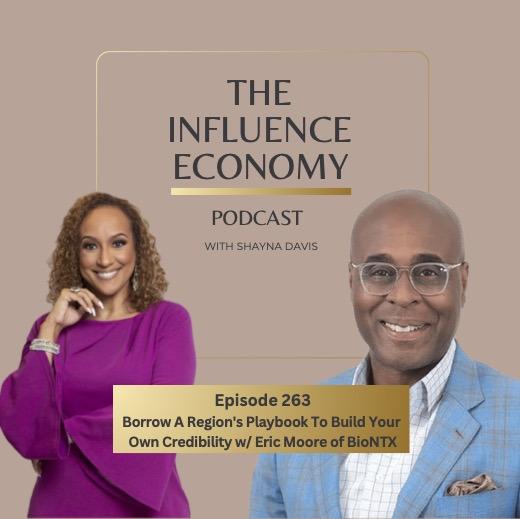
Let's keep it real. Great tech doesn't close rounds. Great tech doesn't win categories. And great tech definitely doesn't stop a competitor with a weaker product from eating your lunch. What closes the gap is credibility, and this week's guest has spent years building it for an entire region. I sat down with Eric Moore, Chief Development Officer at Bio North Texas, to talk about what it actually takes to get investors, partners, and stakeholders to buy into your story. Eric leads strategic communications, partnerships, and marketing for one of the fastest growing biotech and lifesciences ecosystems in the country, and he's spent his career convening the founders, scientists, and investors who make that ecosystem credible. This conversation gets into why VCs are betting on the founder more than the tech, why your internal messaging is quietly killing your external credibility, and why "what is your why" might be the most important question you're not asking yourself. What You'll Learn: Why investors say they're almost never pitched a bad tech idea, and what they're actually evaluating instead The difference between talking to your team and talking to the market, and why founders confuse the two How to build one credible narrative that holds up across investors, customers, media, and your board Why proximity and community, not just product, are part of your credibility equation Resources Mentioned: Bio North Texas: https://biontx.org Eric Moore on LinkedIn: https://www.linkedin.com/in/eric-b-moore-mba-0b076215/ BioNTX's podcast featuring interviews with BioNTX's Rising Stars: https://youtu.be/CXfKks7tOmM?is=421YfCXtfBUGgYpm Your Next Steps: Access the white paper: External Influence: The Currency Every Leader Must Carry. https://externalinfluence.us Follow Shayna on LinkedIn: https://www.linkedin.com/in/shaynarattler/ Visit our website: https://executivesignalsgroup.com
00:00:01 [Speaker 1] Hello everyone. 00:00:02 [Speaker 1] And welcome back to another episode of the Influence Economy podcast. 00:00:07 [Speaker 1] I'm your host, Shana Davis, and I'm so glad you're here. 00:00:09 [Speaker 1] But if you've listened to this show before, you know, before we get started, I have a favor to ask. 00:00:14 [Speaker 1] And my favor is really simple. 00:00:16 [Speaker 1] Wherever it is that you are listening to this episode, I want you to take a screenshot. 00:00:21 [Speaker 1] With your screenshot, I want you to post it on LinkedIn, tag me at shayna rattler davis, and then I just wanna hear your biggest moment or your biggest takeaway from this episode. 00:00:32 [Speaker 1] And the reason why I do that, I don't care so much about downloads and some of the other metrics that we have. 00:00:37 [Speaker 1] But what I do care about is that I just think that nowadays, there are far too many leaders that don't really know how to cultivate and, and build the external influence that the new world demands. 00:00:48 [Speaker 1] And so the more times that we share these episodes is going to actually extend to the signals that they need to, to develop in order to be able to lead better. 00:00:57 [Speaker 1] So I appreciate you being willing to do so. 00:01:01 [Speaker 1] So I am gonna read my guest bio. 00:01:03 [Speaker 1] I'm really excited about this. 00:01:04 [Speaker 1] We've been trying to make this podcast happen for six months now since February. 00:01:10 [Speaker 1] So I think like almost six months now, and we're finally here and I'm really excited, about this conversation. 00:01:16 [Speaker 1] This brother is a phenomenal leader and he has some great things to share with founders like you that are listening. 00:01:21 [Speaker 1] So I'm gonna read his bio. 00:01:23 [Speaker 1] We'll get into what I know is gonna be a great conversation about credibility. 00:01:27 [Speaker 1] Here we go. 00:01:28 [Speaker 1] My guest today is the chief communications officer at BIO North Texas, and that is the life sciences and healthcare innovation association serving North Texas. 00:01:39 [Speaker 1] He leads strategic communications, partnerships, and marketing positions for the region's biotech ecosystem. 00:01:46 [Speaker 1] If you don't know, we have a huge biotech and a huge biopharma and all the things. 00:01:52 [Speaker 1] There's an entire ecosystem here right here in the Dallas area. 00:01:55 [Speaker 1] We're chasing Boston. 00:01:56 [Speaker 1] I think we're better than Boston, but anyway, I'll reserve, I'll reserve that. 00:02:00 [Speaker 1] But anyway, with over twenty years leading marketing PR and strategic strategic growth initiatives, he has built Bio North Texas' voice as a national leader in life sciences, including creating Bio North Texas presents inside innovation. 00:02:17 [Speaker 1] And that is a platform convening industry leaders to spotlight innovation across the space. 00:02:24 [Speaker 1] And so I am excited to welcome to the show, Eric Moore. 00:02:27 [Speaker 2] Shana, thank you. 00:02:28 [Speaker 2] I I need to meet the person that you were introducing. 00:02:31 [Speaker 2] I I I need to meet that guy. 00:02:33 [Speaker 2] He seems like, he can, improve my narrative. 00:02:37 [Speaker 2] Right? 00:02:37 [Speaker 1] That's the way I always feel when people are reading my bio too. 00:02:40 [Speaker 1] I'm like, I don't know if I should just smile or not, but then I'm like, man, she sounds dope. 00:02:44 [Speaker 2] I love it. 00:02:44 [Speaker 2] I love it. 00:02:45 [Speaker 2] Hey, Shannon. 00:02:45 [Speaker 2] Thank you. 00:02:46 [Speaker 2] Thank you for your patience. 00:02:47 [Speaker 2] It has been, about six months, and we've seen each other at various events. 00:02:51 [Speaker 2] Thank you for your support of Bob North Texas and being visible. 00:02:55 [Speaker 2] Thank you for your leadership, your vision, and your your creativity. 00:02:59 [Speaker 2] So it's an honor to be here. 00:03:00 [Speaker 2] Let me also share in that six months, I am I was chief communications officer, now I've transitioned over to chief development officer. 00:03:09 [Speaker 2] Nice. 00:03:10 [Speaker 1] So so you notice I didn't say moved up. 00:03:12 [Speaker 2] I said transitioned over. 00:03:13 [Speaker 2] Right? 00:03:14 [Speaker 2] But, no, it it's an honor to be here with you today. 00:03:18 [Speaker 1] Awesome. 00:03:18 [Speaker 1] Well, I'm glad you're here. 00:03:19 [Speaker 1] You've done some amazing work for Bio North Texas, especially as it lends itself to to showcase them as a credible organization. 00:03:30 [Speaker 1] And so where I would love to start this conversation is that when you're building credibility for something as complex as an entire region, right, like, you're not just looking at building something for one town, you're literally building credibility for an entire region. 00:03:46 [Speaker 1] So when you look at something like that, what would you say are kind of like the one or two signals that you have to nail before somebody takes you seriously? 00:03:56 [Speaker 1] And which of those still apply even if we're just building credibility just for our one company? 00:04:02 [Speaker 2] Yeah. 00:04:03 [Speaker 2] Really, really good question. 00:04:05 [Speaker 2] And let me let me let me take a step back and credibility, yes. 00:04:10 [Speaker 2] Value, all of those things. 00:04:13 [Speaker 2] But it's more than just me. 00:04:15 [Speaker 2] I just so happen to have a an outstanding seat at the table, but I stand shoulder to shoulder with and stand on the shoulders of others who've come way before me, the scientists, the innovators, and others, who have helped make a name for, our region. 00:04:33 [Speaker 2] And so for me, it's really looking at the core fundamentals of what makes our region viable. 00:04:39 [Speaker 2] It's great academic institutions. 00:04:41 [Speaker 2] It's the can do, spirit, relentless pursuit, of solutions. 00:04:46 [Speaker 2] It's a powerful network of organizations like where I office, Biola Labs, Pegasus Park, other visionaries and and and funders like Lyda Hill Foundation, and many others who've really set the foundation. 00:05:00 [Speaker 2] So me having an opportunity to be at this a seat having a seat at the table is really looking at those key components. 00:05:07 [Speaker 2] And how do I how do I articulate a value proposition, a narrative that explains the best of who we and then communicate that to broader audiences. 00:05:17 [Speaker 2] You mentioned, Boston, earlier, and and I I I I must correct. 00:05:23 [Speaker 2] We're not necessarily chasing Boston. 00:05:25 [Speaker 2] Boston's got about a twenty year head start. 00:05:27 [Speaker 2] We are trying to define ourselves, within this space in the middle of the country as a formidable biotech and life science, region, that is anchored in great science, that is anchored in innovation, that is anchored in a great network, but also anchored possibilities. 00:05:47 [Speaker 2] And so when you talk about credibility, it's about being consistent. 00:05:52 [Speaker 1] Yeah. 00:05:53 [Speaker 2] It's about being focused. 00:05:55 [Speaker 2] It's about knowing when to adjust. 00:05:58 [Speaker 2] It's about being authentic, and more so it's about being courageous and being present. 00:06:04 [Speaker 2] I have an opportunity to spend time with founders, early stage companies, and so I'm in constant communication with those of who are on the front line. 00:06:13 [Speaker 2] And they are courageous in what they do, but they believe inherently the value that that they're innovating. 00:06:19 [Speaker 2] And so credibility, I think, is built over time, but it's also built, with proximity, and those that are part of your network. 00:06:28 [Speaker 2] You are valued. 00:06:29 [Speaker 2] You are perceived by those that you network and that you are associated with. 00:06:35 [Speaker 1] One of the things that I love that you said is you said the best of who we are. 00:06:40 [Speaker 1] Because oftentimes, I noticed that I, by and large, work with tech founders. 00:06:45 [Speaker 1] The majority of my clients are are tech founders. 00:06:49 [Speaker 1] And they think about credibility and they think about their comms and their messaging. 00:06:54 [Speaker 1] They think that it's only about the features of what it is that their technology is. 00:06:59 [Speaker 1] And I like to say that does nothing to build trust and credibility, especially in a market when three hours from now, someone else is probably gonna come out with a technology that seemingly appears as though it's the exact same thing or better. 00:07:15 [Speaker 1] And we're seeing teams that are actually I say losing. 00:07:20 [Speaker 1] They're losing investment rounds, or they're losing categories. 00:07:23 [Speaker 1] They're losing enterprise customers to companies that have weaker tech because they haven't actually mastered demonstrating, like, this is who we are, and this is why what we're doing matters now more than ever. 00:07:38 [Speaker 1] Those things, I believe, when we're talking about credibility, are so much more important than the individual features of the technology that, very rarely is it about the thing. 00:07:55 [Speaker 1] It's so much more, you know, that that goes into building trust. 00:08:00 [Speaker 2] Yeah. 00:08:00 [Speaker 2] Let me let let me add a dimension to that, thought process, that stream of consciousness, Shana. 00:08:06 [Speaker 2] And you're a 100% right. 00:08:08 [Speaker 2] Technology, fundamentally is a tool. 00:08:12 [Speaker 2] And tools have changed, over the years, based on the timing, the evolution of the culture, the needs, all of these things, assets available to you, resources that are available, your your population, your market, you know, audiences, and all of that. 00:08:31 [Speaker 2] But people don't do business from an investment perspective, and the same applies here in biotech and life sciences. 00:08:37 [Speaker 2] Yes. 00:08:38 [Speaker 2] Great ideas, great innovation, all of those things. 00:08:40 [Speaker 2] But when you're talking about investing, when you're talking about those relationships, regardless of the vertical, technology, science, energy, whatever, it's about relationships, and it's about the the the the the ability of the founder to articulate a a clear value proposition Yeah. 00:09:04 [Speaker 2] And how that value proposition within the context of something bigger and greater. 00:09:09 [Speaker 2] Right? 00:09:10 [Speaker 2] Right? 00:09:11 [Speaker 2] And you're right. 00:09:12 [Speaker 2] A widget sometimes is a widget is a widget is a widget. 00:09:15 [Speaker 2] Yeah. 00:09:15 [Speaker 2] But why should I choose your widget given the fact that maybe a a better widget, may be developed somewhere down the line? 00:09:23 [Speaker 2] And I think that has to do with, the relationship. 00:09:26 [Speaker 2] I think it has to do with imbuing a sense of confidence, but also the ability to grow and scale. 00:09:32 [Speaker 1] Yeah. 00:09:32 [Speaker 2] Right? 00:09:33 [Speaker 2] And so I one of the things that I hear from a lot of founders is the initial technology, the initial solution is part of a potential suite of options that can happen over time. 00:09:45 [Speaker 2] And so, really, what these investors are looking at, they're looking at the widget, but they're looking at your ability to innovate. 00:09:51 [Speaker 1] Yeah. 00:09:52 [Speaker 2] Right? 00:09:52 [Speaker 2] Right? 00:09:52 [Speaker 2] They're looking at your ability to grow, to scale. 00:09:57 [Speaker 2] Once you've built the relationship, you may go in not necessarily different directions. 00:10:02 [Speaker 2] You may go in broader directions. 00:10:04 [Speaker 2] You may go in tangent directions and all of these things. 00:10:06 [Speaker 2] So what they're buying into is a relationship. 00:10:09 [Speaker 2] This person innovate. 00:10:11 [Speaker 2] Can they take the initial widget and turn it into a multiplicity of widgets? 00:10:16 [Speaker 2] Can they take the initial concept and turn it into something that is broader and something that is adaptable over time? 00:10:24 [Speaker 2] So I think thinking about it more broadly, thinking about your innovation in a broader sense, not just about today, but where it could be tomorrow, is informative in how you form those relationships, and, narrate and position, your technology or your widget illusion. 00:10:42 [Speaker 1] You talked about some of the different stakeholders that are kind of in your ecosystem. 00:10:48 [Speaker 1] You talked about the institutions. 00:10:50 [Speaker 1] Right? 00:10:50 [Speaker 1] So you have, like, the research institutions, the hospital systems, the biotech companies, the investors. 00:10:57 [Speaker 1] You have all of these different stakeholders, if you will, and they all want different different things. 00:11:03 [Speaker 1] And I think that if we look at, like, the communications work that you've done and the other things that your the executive team at Bio North Texas has done is that you guys have done really good job of building one credible narrative with stakeholders who all want different things. 00:11:19 [Speaker 1] So what do you think is the discipline behind that that a founder could use when they're trying to get their own board and investors and media and customers all bought into the same story about who they are? 00:11:32 [Speaker 1] Because like you said, like, it's more about the jockey than it is the horse. 00:11:36 [Speaker 1] So how do they take all of the players that are in their ecosystem who all want different things and create one credible narrative that gets everybody to buy in? 00:11:45 [Speaker 2] You know, it's interesting. 00:11:46 [Speaker 2] I was at a an event. 00:11:48 [Speaker 2] We're partnering with, CEO three sixty, and and the whole jockey and the horse analogy came up several times 00:11:55 [Speaker 1] Oh, really? 00:11:55 [Speaker 1] Yesterday. 00:11:56 [Speaker 1] It came up several times. 00:11:57 [Speaker 1] It's more about the jockeys than 00:11:58 [Speaker 2] the jockey and the horse. 00:11:59 [Speaker 2] So I love that. 00:11:59 [Speaker 2] So I must be doing the right thing. 00:12:01 [Speaker 2] Right. 00:12:02 [Speaker 2] I I I think there's a core narrative. 00:12:03 [Speaker 2] Right? 00:12:04 [Speaker 2] It it it it it it it it's who you are. 00:12:06 [Speaker 2] It's why you are who you are. 00:12:09 [Speaker 2] And in in in some, spiritual religious, circles, it's your testimony. 00:12:15 [Speaker 2] Right? 00:12:15 [Speaker 2] I term testimony. 00:12:16 [Speaker 2] And so the testimony is is is fundamentally going to be consistent, over time because it speaks to the essence. 00:12:23 [Speaker 2] It speaks to the essence of you as a leader. 00:12:26 [Speaker 2] It speaks to the essence of the spark, that caused you or inspired you to want to build a company or or or or innovate and and all of these things. 00:12:36 [Speaker 2] So I think that's fundamentally consistent. 00:12:38 [Speaker 1] Yeah. 00:12:38 [Speaker 2] And once you have that core, you have the ability to adjust that based on your audiences. 00:12:44 [Speaker 2] So how you speak to an investor may be other than how you speak to a strategic partner, and what have you, but the core of your message remains, consistent. 00:12:56 [Speaker 2] And I think it's that, and it's the authenticity of that. 00:12:59 [Speaker 2] The other part of that, Shana, is is is one of the things that we do very well at Bau North Texas. 00:13:05 [Speaker 2] And, basically, we are a convening organization. 00:13:08 [Speaker 2] My job is one of the best jobs in the world because I get to tell the stories about people that are way infinitely smarter than I am. 00:13:16 [Speaker 2] Right? 00:13:17 [Speaker 2] And I get to, position our region as one that you should be paying attention to. 00:13:22 [Speaker 2] Whether you're an investor, whether you're looking to move a company here, a big pharma company, a manufacturing company, whether you're, a work speaking to workforce development and you're looking, to see how how wonderful and how dynamic our workforce is. 00:13:39 [Speaker 2] So I have a chance to speak to all these different audiences and create convenings. 00:13:44 [Speaker 2] Mhmm. 00:13:44 [Speaker 2] Create, curated rooms where whether you're in a early founder, an academic, an investor, what have you, I curate rooms to get good peep smart people together to meet each other, to talk to each other, to get to know each other. 00:14:03 [Speaker 2] And oftentimes, I guarantee you 95% of the time, good things happen. 00:14:09 [Speaker 2] Sparks and connections that I or we could not even conceive of happen organically on their own. 00:14:16 [Speaker 2] And so much of what I do is creating those rooms, and you've been in those rooms, Shana. 00:14:20 [Speaker 2] You were at one of our convenings, you know, several weeks ago. 00:14:23 [Speaker 2] I can control everything in those rooms, but what I can do is set the context and set the tonality for you're here today because, North Texas is an ecosystem that is growing. 00:14:40 [Speaker 2] Each of you have a commitment to your, individual goals, your investment goals, your innovation goals, your academic goals, and I can't speak to all of those individually. 00:14:51 [Speaker 2] But what I can say is that we have something in common. 00:14:54 [Speaker 2] And that something in common is that we want to make sure that the investment in North Texas as a biotech life science ecosystem is for the future, and each of you have a role to play. 00:15:06 [Speaker 1] Yeah. 00:15:06 [Speaker 2] Right? 00:15:07 [Speaker 2] And you let them connect. 00:15:08 [Speaker 2] And you let them connect. 00:15:09 [Speaker 2] And and one of the things I wanna give to your audience in particular, Shana, if you're not part of an ecosystem, if you're not part of a community, if you're not part of a network, and I'm not talking about a digital network, but a place where people get together, share ideas, share pain points, share aspirations, share context, then you're leaving a lot on because we're still fundamentally social beings, and you learn from each other. 00:15:40 [Speaker 2] No one founder has all the questions. 00:15:43 [Speaker 2] You won't be a founder for very long because you'll drive yourself insane trying to figure it out on your own. 00:15:50 [Speaker 2] Yeah. 00:15:50 [Speaker 2] Right? 00:15:51 [Speaker 2] So network. 00:15:52 [Speaker 2] Be a part of a community. 00:15:54 [Speaker 2] Be a part and around people that may be a little bit further down the road. 00:15:59 [Speaker 2] Be around young people who don't even know there's a road. 00:16:02 [Speaker 2] Right? 00:16:03 [Speaker 2] All of those things help you become a better founder, but help shine light, on your on your on your individual past. 00:16:11 [Speaker 1] Yeah. 00:16:12 [Speaker 1] The the last question that I usually ask all of my guests on the show is usually related to them giving some type of tip, but I think you've already given so many great tips. 00:16:24 [Speaker 1] But I actually wanna ask you a little bit of a different question to kind of round this conversation out. 00:16:31 [Speaker 1] I because I know people probably come to you all the time for advice. 00:16:34 [Speaker 1] You know? 00:16:34 [Speaker 1] How do I do this? 00:16:35 [Speaker 1] How do I do that? 00:16:35 [Speaker 1] What would you recommend for this? 00:16:37 [Speaker 1] But if I found you tomorrow and they were like, Eric, I want you to help me get noticed the same way that you guys have been able to get North Texas noticed. 00:16:50 [Speaker 1] What would be the first question you would ask them? 00:16:55 [Speaker 2] What is your why? 00:16:59 [Speaker 2] What is your why? 00:17:01 [Speaker 1] And why is that so important? 00:17:04 [Speaker 2] Be because it it allows you to do a self analysis that is authentic to your to yourself. 00:17:10 [Speaker 2] There's only one you. 00:17:12 [Speaker 2] Right? 00:17:13 [Speaker 2] There's only one you, and that why serves as the catalyst and serves as the spark for your who. 00:17:22 [Speaker 1] Yeah. 00:17:24 [Speaker 1] Yeah. 00:17:24 [Speaker 1] I think it drives I think or let me say it this way. 00:17:27 [Speaker 1] I think that's what should largely drive the messaging. 00:17:31 [Speaker 1] I think that's what should largely drive the marketing. 00:17:34 [Speaker 1] I think that's what should largely drive the conversations that we're having with multiple different stakeholders. 00:17:40 [Speaker 1] You go back to the betting jockey versus the the horse analogy. 00:17:43 [Speaker 1] And, you know, I had, as a matter of fact, it was at the exact same event that I met you at in February. 00:17:50 [Speaker 1] I asked, there was a VC panel. 00:17:52 [Speaker 1] I think it was the very last panel of the day was a 00:17:55 [Speaker 2] VC panel. 00:17:56 [Speaker 1] And I asked one of the VCs, I said, how important is it to you when you are determining whether or not you are going to invest in a tech company? 00:18:05 [Speaker 1] How is it, how important is it to you that they actually have taken time to talk about their unique point of view, the industry and where it's headed and why them? 00:18:15 [Speaker 1] And he said something that is so key. 00:18:17 [Speaker 1] He said, nowadays, very seldom are we tech are we pitched a bad tech idea? 00:18:23 [Speaker 1] So we're almost always betting on the founder and their core team. 00:18:29 [Speaker 1] So it's so important, but I don't think that founders, especially in the tech place space, because I think they're brilliant at building the thing, and I think they're brilliant at leading their teams, but they think that the same way that they talk to their team, same way that they talk internally is the exact same messaging that has to be presented when they want someone to bet on them. 00:18:51 [Speaker 1] And I think that that is the biggest mistake. 00:18:53 [Speaker 1] If you go and you look at my LinkedIn, the banner at the top of my LinkedIn says strong product plus right team equals tech company failure. 00:19:03 [Speaker 1] And the reason why I say that is because I think that era is dead when the only thing that you needed was a great product and the right people on the team, and that's the only thing that mattered. 00:19:15 [Speaker 1] I don't think the world will ever be again. 00:19:17 [Speaker 2] So let me give you an example. 00:19:19 [Speaker 2] And you're a 100% right. 00:19:21 [Speaker 2] And I won't use the term mistake. 00:19:23 [Speaker 2] I'll use unrealized opportunity. 00:19:25 [Speaker 2] Right? 00:19:26 [Speaker 2] And you're you're spot on relative to the investors in tech, and it's not complete apples to apples in our sector. 00:19:34 [Speaker 2] But at the end of the day, we have to understand the power of narrative. 00:19:38 [Speaker 2] We have to understand the power of nomenclature, the power of language, all of those things. 00:19:43 [Speaker 2] We are social biological beings and fundamentally change from the first of us, that walked the Earth, beginning, on the great continent of Africa. 00:19:55 [Speaker 2] Steve Jobs. 00:19:58 [Speaker 2] Steve didn't want to just, invent a phone. 00:20:03 [Speaker 2] Right? 00:20:04 [Speaker 2] Because a phone is a phone is a phone is a phone. 00:20:09 [Speaker 2] What he created was something that was beautiful, and it felt good in your hand. 00:20:16 [Speaker 2] And the materials that composed the phone gave it a a a a certain symmetry. 00:20:23 [Speaker 2] It gave it a a certain cache. 00:20:26 [Speaker 2] It gave it something beyond the tech. 00:20:29 [Speaker 2] Right? 00:20:30 [Speaker 2] And we can't lose sight of that. 00:20:33 [Speaker 2] Right? 00:20:33 [Speaker 2] And so, yes, you may be creating a solution, a tech solution, a a a white label this, a white label. 00:20:39 [Speaker 2] And so where do you get that that that feel? 00:20:43 [Speaker 2] Where do you get that that artistry? 00:20:45 [Speaker 2] Where do you get those things that differentiate, your product? 00:20:50 [Speaker 2] And that oftentimes is in the personality of the founder or the narrative. 00:20:56 [Speaker 2] Right? 00:20:57 [Speaker 2] It's that. 00:20:57 [Speaker 2] It that's where you make up that space. 00:21:00 [Speaker 2] I can ink pen all day long, but I really like the guy or the woman that's creating that ink pen. 00:21:07 [Speaker 1] Yes. 00:21:07 [Speaker 2] Right? 00:21:08 [Speaker 2] Right? 00:21:08 [Speaker 2] Right? 00:21:08 [Speaker 2] And the ink pen that they create feels so good in my hand, and and I am not unlike various other human beings, and I know eventually they will feel the same way if they have a chance to experience this product. 00:21:22 [Speaker 2] And so it's just thinking about it differently and not negating the human component. 00:21:29 [Speaker 2] The human component. 00:21:30 [Speaker 2] The numbers, yeah, you got accounting, and you got lawyers. 00:21:33 [Speaker 2] You got all of that. 00:21:34 [Speaker 2] But I do business with people primarily that I like. 00:21:39 [Speaker 1] Yep. 00:21:41 [Speaker 2] I like you. 00:21:42 [Speaker 2] There's something about you that I'm attracted to. 00:21:46 [Speaker 2] There's something about your your confidence, your your your creativity. 00:21:52 [Speaker 2] There's something about how you speak that I'm attracted to. 00:21:56 [Speaker 2] And, oh, by the way, you've got a product that my analysts say has the potential to do well in the market if get if supported financially or whatever, vise you know, whatever. 00:22:07 [Speaker 2] Right? 00:22:07 [Speaker 2] But I like you. 00:22:09 [Speaker 2] And if I like you, we scale that up, and the market might like you as well. 00:22:14 [Speaker 2] Yeah. 00:22:15 [Speaker 2] Absolutely. 00:22:16 [Speaker 2] And and and it's that it's fundamentally that fundamental. 00:22:21 [Speaker 1] Absolutely. 00:22:21 [Speaker 1] Well, Eric, you have been a wealth of knowledge. 00:22:24 [Speaker 1] I know that this episode is gonna be a hit. 00:22:26 [Speaker 1] And so if folks want to learn more about you, they wanna learn more about Bionorf Texas, where do you recommend that they go? 00:22:34 [Speaker 2] Yeah. 00:22:34 [Speaker 2] You can, from thank you, Shana, for that. 00:22:36 [Speaker 2] You can find me on LinkedIn, Eric B. 00:22:38 [Speaker 2] Moore, Bio North Texas, and if you, for Bio North Texas, bio biontx,uh,.org. 00:22:46 [Speaker 2] And I also wanna give a a just a quick plug, and I think you may post it, but I just finished on my own podcast interviewing about seven founders in the biotech and life science, sector. 00:22:59 [Speaker 2] And and and part of your education to your audience, I do, and hopefully, you'll put a link up in all of that. 00:23:05 [Speaker 1] I will. 00:23:05 [Speaker 2] But it's direct, indirect, conversation with founders who are literally in the middle of it right now. 00:23:12 [Speaker 2] And they're openly sharing their lessons, sharing their wins, sharing their learnings, sharing their repositions. 00:23:19 [Speaker 2] But more so, you'll get a chance to see and share in their personalities. 00:23:25 [Speaker 2] Good. 00:23:26 [Speaker 2] Their personalities. 00:23:27 [Speaker 2] And that should be some exciting some exciting content. 00:23:31 [Speaker 1] Absolutely. 00:23:32 [Speaker 1] Well, we will make sure that the links to all of that is in the show notes so that all you have to do is click. 00:23:37 [Speaker 1] Everyone share this wide with every founder that is in your network. 00:23:41 [Speaker 1] I hope back that you will go back and listen to previous and future episodes as well. 00:23:45 [Speaker 1] Everyone have a great day. 00:23:46 [Speaker 1] Bye bye.