
Sidedoor · Smithsonian Institution
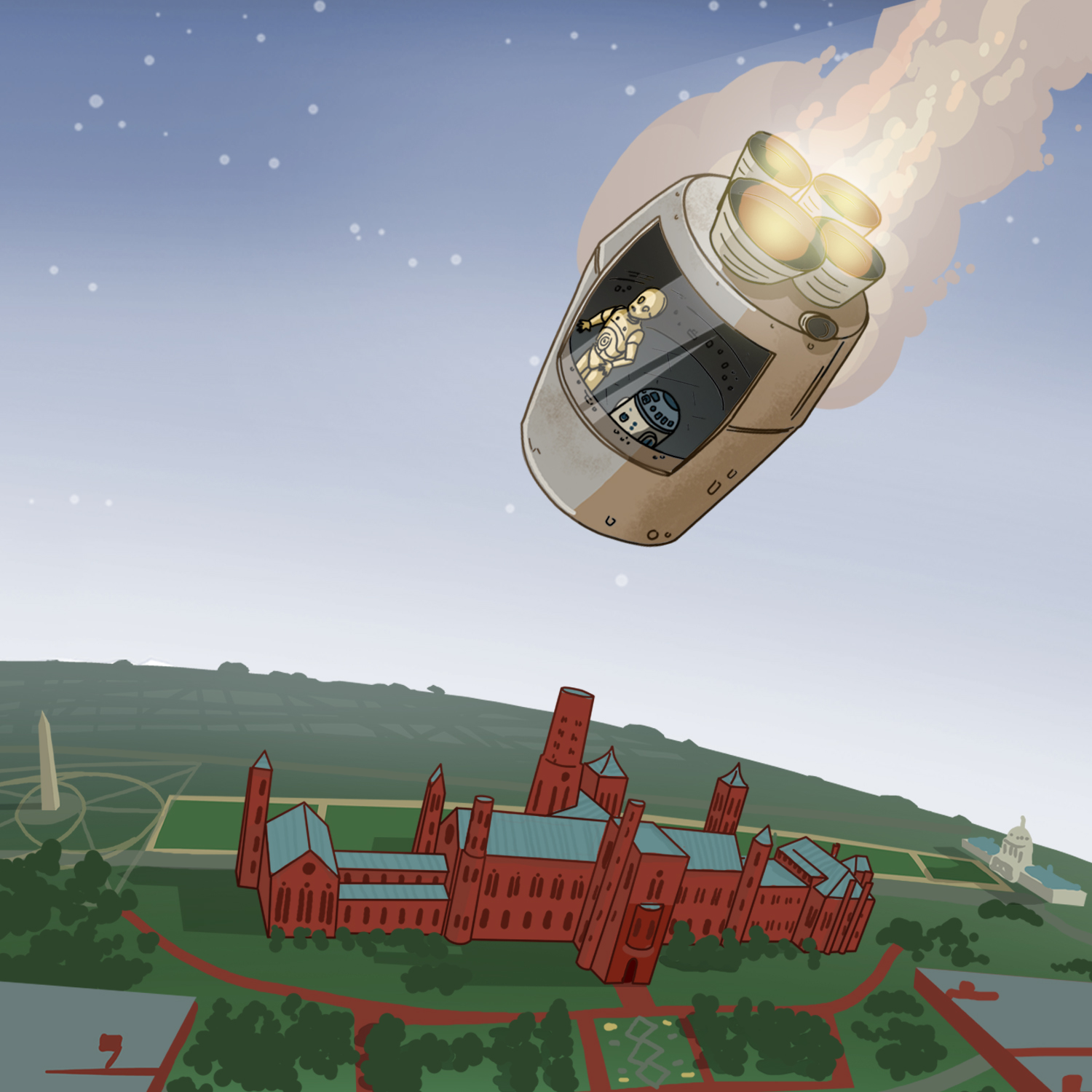
A long time ago, in movie theaters not far away, Star Wars: A New Hope revolutionized American entertainment. In honor of May the 4th, we explore how a scrappy space fantasy reinvented a tale as old as time — and gave Americans hope in a time of difficulty. We'll also trace the journey of two bickering droids from a galaxy far, far away to the Smithsonian's National Museum of American History. Guests: Ryan Lintelman, curator of entertainment at the Smithsonian National Museum of American History Eric Jentsch, curator at the Smithsonian National Museum of American History Dawn Wallace, objects conservator at the Smithsonian National Museum of American History
Sidedoor (S12E12) – May the 4th final web transcript Lizzie Peabody: This is Sidedoor, a podcast from the Smithsonian with support from PRX. I'm Lizzie Peabody. There's a famous story you might have heard. Lizzie: How does it begin, "In a galaxy far, far away?" Eric Jentsch: Yeah. Lizzie: A long time ago? Eric Jentsch: A long time ago. In a galaxy far, far away. Lizzie: Okay, and a less famous story you probably haven't heard. Lizzie: So a moderate amount of time ago in a suburb of Illinois. Eric Jentsch: Yeah. Lizzie: Young Eric Jentsch, seven years old, goes to the movies with his family. Lizzie: Eric is the curator of entertainment at the Smithsonian's National Museum of American History. But back in 1977, he was a consumer of entertainment. A little kid. And the day his parents took him to the theater to see the very first Star Wars movie, he had no idea what he was in for. He snuggled into his theater seat, the lights went down, and the iconic—copyrighted—music began to play. [humming Star Wars theme] Eric Jentsch: I remember just being blown away, very beginning, from the scroll to the end, just being fixated, excited. Just my world opened up and changed. It sounds really dramatic, but it's true. Lizzie: Eric, in all his seven years on Earth, had never seen anything like this. Eric Jentsch: Oh, wow. Robots! Ray guns! You know, evil! Like, strange religions. It's, like, all new, right? Lizzie: It was a revelation to Eric that movies or TV could even be like this. Eric Jentsch: Oh, this is something for me. This is something I like. It's not something that you're brought to, or something that's, like, supposedly for kids. Or, like, a Disney thing, which I liked but, you know, there was a moral and a message to it. This was, like, exciting. Like, wait, what? There's aliens, it's kind of scary. It's funny. And the whole idea of The Force? Like, to me that was like, whoa! Lizzie: And the second he left the movies, all he could think about was how to get back there and see Star Wars again. And so a short time later when his family went on vacation to Hawaii ... Eric Jentsch: I made my family go see Star Wars in Honolulu. And that was the highlight of my trip to Hawaii. So I'm sure my family was thrilled that they went all the way, you know, to Hawaii to go see Star Wars again. Lizzie: [laughs] Eric Jentsch: It wasn't even the first time. It was, like, a second or third time, yeah. Lizzie: When he got home, he saw it again—and again. Six, seven, ten times. It became a fixation. And not just for Eric, for all of his friends at school. Eric Jentsch: It became pretty much what we thought about all the time. It was just so instantly important to us. Lizzie: But it wasn't just Eric and friends who were enraptured by this sci-fi action movie. [NEWS CLIP: Although lines at North Park Cinema stretched more than a half mile long, no one tonight seemed to mind the crowds.] [NEWS CLIP: It's Star Wars, the blockbuster movie that's drawing massive crowds around the country.] [NEWS CLIP: If the movie continues to draw the crowds and money it has during these early weeks, the North Park Theater manager says Star Wars will go on to break all existing motion picture records.] [NEWS CLIP: It's been called the best thing since The Wizard of Oz. It has bad guys and two lovable, good guy robots.] [NEWS CLIP, child: It was neato!] Lizzie: This time on Sidedoor, we're blasting into the past to explore how Star Wars marked a pivotal moment for entertainment in the United States. What about this sci-fi sensation struck a chord with so many Americans? In honor of May the 4th, we're touring Star Wars history alongside two of the film's most iconic characters: R2-D2 and C-3PO, who now call the Smithsonian home. These are the droids you're looking for. After the break. *** Lizzie: It's morning time, and the Smithsonian's National Museum of American History hasn't opened its doors for the day, so it's quiet in the third floor gallery called Entertainment Nation. This gallery is full of famous objects and characters from TV, music, movies and sports, from Dorothy's ruby slippers to Mohammad Ali's robe, and Prince's yellow cloud guitar. All of which help tell a story about how entertainment has shaped and reflected American culture over time. And standing at the very front of the gallery, the first two characters we see are two robots from the Star Wars movies: C-3PO and R2-D2. Dawn Wallace: They're friends, they're partners. We want to show them together. Lizzie: This is Dawn Wallace. She's a conservator at the museum, and she has spent hundreds of hours with these droids. Lizzie: Can you just sort of introduce us to these two? You know them pretty well by now. Dawn Wallace: [laughs] Of course. So C3PO ... Lizzie: She points to the droid on the left. Dawn Wallace: He is tall. He is this gold, gleaming droid. Lizzie: With a humanoid form—arms, legs, you know. Dawn Wallace: And then, like, the two eyes at the top, just like circles. And they just, like, light up, and they blink. And his mouth doesn't move, but you know he has expressions. Lizzie: Mm-hmm. Dawn Wallace: And I really love that about him. Lizzie: C-3PO is a protocol droid, fluent in over six million different languages. And he's kind of like a cultural translator, well-versed in social mores across the galaxy. And he's a little uptight. [ARCHIVE CLIP, Star Wars: (C-3PO) How rude!] Dawn Wallace: You have C-3PO is gonna be sort of the rule follower. R2-D2, a little bit of a rogue. He likes to step outside the line. He doesn't really think the rules really should be followed by him. Lizzie: R2 may be a little trashcan-sized robot that speaks only in beeps and boops, but he can say a lot with those beeps and boops. [ARCHIVE CLIP, Star Wars: (R2-D2) [beeps and boops]] Dawn Wallace: He definitely has a very high level of sass. Lizzie: [laughs] Lizzie: R2 is pretty much the opposite of C-3PO, and together they make quite the odd-couple. [ARCHIVE CLIP, Star Wars: (R2-D2) [beeps]] [ARCHIVE CLIP, Star Wars: (C-3PO) No, I don't think he likes you at all.] [ARCHIVE CLIP, Star Wars: (R2-D2) [beeps]] [ARCHIVE CLIP, Star Wars: (C-3PO) No, I don't like you either.] Lizzie: And both of these droids have been through a lot. Dawn Wallace: If you look at R2-D2, when he came into the collection, he actually had sand still in the base of his feet. Lizzie: Wow! Dawn Wallace: When he's been cleaned, we collect the sand. And that there is a small baggy in storage of sand that came from R2-D2. Lizzie: From Tatooine? Dawn Wallace: From Tatooine. It is Tatooine sand, and you can't find that anywhere else. [laughs] Lizzie: Except Tunisia, where the Tatooine scenes were filmed. When we meet R2-D2 and C-3PO in the first Star Wars movie, they've just landed in an escape pod on a desert planet, Tatooine. And we watch them struggle slowly through the sand dunes. [ARCHIVE CLIP, Star Wars: (C-3PO) How did we get into this mess? I really don't know how.] Ryan Lintelman: Yeah, so, you know, they're lost in the desert, these two bickering characters. They seem like they're the most lowly characters in this entire universe, just trying to figure out what they're doing, where they're going. Lizzie: This is Ryan Lintelman. He's curator of entertainment at the museum, and he says the way the movie starts with these characters is significant. Ryan Lintelman: It's a great introduction to an epic story, right? Because here you are, the audience, trying to figure out what is this? Why are we starting with these two people who seem lost and in the middle of nowhere, right? Lizzie: We, the audience, like the droids, have no idea what to expect. Ryan Lintelman: And so as you see these two characters start to interact with the universe, you learn about it, but you also kind of like feel invested in their journey, right? This is the beginning of the epic story, again, with the most lowly characters that exist in this universe. Lizzie: What Ryan calls this "storytelling from the bottom," from the perspective of the lowest-status characters, this was intentional. Ryan Lintelman: This was something that George Lucas was very specific about wanting to do. He wanted to kind of start out, you know, assuming that you, the audience, see yourselves in these characters. Lizzie: And American audiences did see themselves in these characters. There were kids like seven-year-old Eric Jentsch, who felt dropped in a new world of adventure. But Star Wars resonated with adults, too. And Ryan argues this cultural resonance had something to do with what was going on historically and politically in 1977. Lizzie: Situate us in time. Like, what was going on in the United States then? Ryan Lintelman: The mid-70s I often talk about as kind of like a period of malaise in American life, You know, it's not long after the Watergate scandal, and the Cold War seems to be ramping up. And a lot of blue collar workers especially are losing their jobs. There's a lot of economic changes that are really shaking the foundation of how Americans like to think of themselves as a nation that is sort of an industrial powerhouse, that's always moving forward in a morally right way. But Vietnam had really shaken that idea. You know, people are thinking like, "Wait, were we the good guys or the bad guys in this war? It's kind of hard to tell." Lizzie: Ryan says all of this amounted to a sort of moral and economic crisis of faith among Americans. And that national mood was reflected in pop culture. Ryan Lintelman: So you've got a lot of, you know, crime films or films about the mob like, you know, The Godfather that are morally ambiguous. Or you sometimes find yourselves rooting for the bad guys, or you don't know who the good guy is. Lizzie: This was the era of Taxi Driver, Serpico, All the President's Men, Apocalypse Now—movies with flawed protagonists and dubious authority figures. But this wasn't the Hollywood that George Lucas grew up with. In fact, it was quite different. Ryan Lintelman: You know, Hollywood in the 1930s and '40s was still governed by the production code, which really limited the way that filmmakers told stories. And one of the things was that good always had to triumph over evil. Lizzie: Really? That was a requirement? Ryan Lintelman: And that's written into this code that was self-enforcing in the industry. Lizzie: George Lucas grew up watching movies where the good guys always won. Westerns where the hero rode on a white horse and drove the ne'er-do-wells out of town. And one samurai movie in particular called The Hidden Fortress. Lizzie: This is a Samurai film that I admittedly have not seen, so lay it out for me. What was the importance of that movie? Ryan Lintelman: The Hidden Fortress, I think at the time Star Wars came out wasn't as well known. It's now recognized as one of the great films of Japanese cinema. But it's set in 16th-century Japan. And there are two peasants, one is tall and one is short. This is how it starts. These two peasants can't stop squabbling as they're traipsing through a desert. Lizzie: Huh! Sounds familiar. Ryan Lintelman: [laughs] Yeah. [ARCHIVE CLIP, The Hidden Fortress: [squabbling in Japanese]] [ARCHIVE CLIP, Star Wars: (C-3PO) Go that way. You'll be malfunctioning in a day, you nearsighted scrap pile. And don't let me catch you following me.] Ryan Lintelman: You know, like these droids in the Star Wars films, they split up and are eventually reunited. Lizzie: Eric Jentsch says Lucas might also have gotten inspiration from old comic books. Like, there's this one he remembers ... Eric Jentsch: Jack Kirby's New Gods. Um, there's a character named Darkseid, who's sort of helmeted. There's a power called The Source. There's a story about his son Orion is on the other side of things, and doesn't know. You know, they kind of trade children in a way. And that's sort of like the Luke-Darth Vader connection. Lizzie: But George Lucas was also drawing on something much older than the media of his youth—something ancient. Ryan Lintelman: So there is this theorist named Joseph Campbell, who wrote a very influential book in the mid-century called The Hero With A Thousand Faces, where he made this argument that there's something that he called the monomyth, that every civilization has a very similar story. Lizzie: A story where there's a lowly hero who, usually with the help of a wise guide, discovers they have special powers. And after a time away learning and improving their skills, they return home and overcome the bad guys and justice is restored. This is also called "The Hero's Journey." Ryan Lintelman: That also was very much on George Lucas's mind. He had read that book. He was very, you know, thoughtful about building in all of the facets of the monomyth into the story. Lizzie: So with Star Wars, Lucas wasn't trying to do something new. In fact, you could argue he was telling the oldest story ever told. And if you're not familiar with Star Wars, never fear. I will lay out the basics for you. The movie drops us into a galaxy at a time of civil war. Rebels are fighting back against an evil and authoritarian galactic empire. The empire rules through violence and intimidation, and the Rebel Alliance is working in secret to overthrow the empire and restore freedom and self-governance to the galaxy. Lizzie: The hero, Luke Skywalker, is a farm boy learning to harness his power to fight for good. He's helped out by a ragtag coalition thrown together by circumstance: a strange, old hermit with mystical powers, a couple of droids, a princess with a killer hairdo, a smuggler and a Wookie. They're loveable and brave, and the odds are definitely stacked against them. Ryan Lintelman: People really saw themselves in the characters in Star Wars—American audiences did. And part of that is because of the sort of original foundational myth of the United States, these scrappy rebels that are fighting against an authoritarian empire. You know, troops coming in and knocking down doors and just trampling over people's rights. That's the American Revolution, right? And that's how Americans like to think of themselves. That they decided it was time to make a stand. That is the story of Star Wars from the beginning. Lizzie: This was a story the nation could feel good about: a new American fairy tale. Lizzie: So it sounds like while the story itself was not new, the moment was right for it. Ryan Lintelman: Yeah. Yeah. And I think that this really self-conscious idea of, like, giving Americans something to believe in again, of thinking of themselves in a new way as the morally just force in the world, it's an implicit message that I think people walked away with, like, just feeling good. Lizzie: So good, they wanted to see it again. And again. Star Wars quickly became the highest grossing film ever to hit American theaters—and stay there. It played continuously in theaters for well over a year, and it actually pulled the entire movie industry out of the tank. Ryan Lintelman: The thing that's true as a film historian, you always hear, like, every generation thinks that Hollywood is dead and the movies are over, right? Lizzie: Every generation? Ryan Lintelman: Every generation they think the same thing. And that was happening again at that era: the studios were closing down, right? This was something that—all of the old studios like MGM that sold off its backlog and all of its props. That's why we have the ruby slippers here, because they sold at auction. Literally, it seemed like Hollywood was just closing up shop, and then Lucas comes in and creates this new model. "Yeah, I am an independent filmmaker, but I can work within a studio system. I can, you know, build a film with special effects and, you know, build new stars." Americans came back to theaters. And so it was really this rebirth of American cinema that carried through all the way to today. Lizzie: No film before Star Wars had turned toys, action figures, lunchboxes and Thermoses, comic books—many of which we have in the collections of the museum—into a prime revenue stream. The merch fueled the film, and the film fueled more merch, and all of a sudden people were wearing costumes and lining up around the block to get into the movies. Ryan Lintelman: And so you see this sort of new style of fandom come about, too. Lizzie: Was that new? Like, dressing up as your favorite character, that started with Star Wars? Ryan Lintelman: Yeah. Lizzie: Really? Ryan Lintelman: I mean, you know, you see a little bit before like, you know, people have Mickey Mouse ears or, you know, they'd wear the cowboy hat or something like that. Lizzie: Uh-huh. Ryan Lintelman: But, you know, people are starting to have these fan conventions that they would go to, right? And dressing up in costumes, and really making this a part of their personality. Lizzie: And even people who weren't necessarily fans came to recognize references to Star Wars. Ryan Lintelman: One of the greatest successes a film series can have is influencing daily language, right? There are phrases that carried over, and it joins the lexicon, the sort of, you know, shared cultural vernacular that we have. [ARCHIVE CLIP, The Empire Strikes Back: (Yoda) Do or do not. There is no try.] Lizzie: Yes, Yoda! Ryan Lintelman: Yeah, that's a good one. Lizzie: It's a trap! Ryan Lintelman: It's a trap! Lizzie: [laughs] Lizzie: I have a bad feeling about this. [ARCHIVE CLIP, Star Wars: (Han Solo) I got a bad feeling about this.] Ryan Lintelman: Han Solo. Lizzie: Han Solo. Oh, that's right. I have a bad feeling about this. And of course ... [ARCHIVE CLIP, Star Wars: (Han Solo) May the force be with you.] Lizzie: ... may the force be with you. Or may for the fourth be with you. Ryan Lintelman: There you go! [laughs] I mean, what other movie has inspired a coincidental date holiday, right? That's kind of funny. Lizzie: Star Wars became a shared cultural language among Americans. The lines, sound effects, and even the musical score were everywhere. But most beloved of all were the characters. So how did R2-D2 and C-3PO get from a galaxy far far away—known as Hollywood—to the Smithsonian? We'll get into that in less than 12 parsecs. *** Lizzie: In 1977, Star Wars mania was catching across the country, and it caught the attention of one curator in particular at the Smithsonian's National Museum of American History. Ryan Lintelman: Curator Otto Mayr, who was our curator of mechanisms, wrote to George Lucas and said he was working on a new exhibit on automation and asked if he could have the droids. Lizzie: That's right, it was actually the robotics curator who first set his sights on R2-D2. Ryan Lintelman says the robotics team was fighting an uphill battle. Ryan Lintelman: You know, the curators of that collection are always trying to find ways to get people interested in industrial robots. Lizzie: So as the kids say, Otto Mayr shot his shot—or blasted his laser. Ryan Lintelman: And Lucas's secretary wrote back and said, "Uh, we're still working on those films." This is 1977, so ... Lizzie: Right, the first movie had just come out. Ryan Lintelman: Yeah. [laughs] Lizzie: There were several others. Ryan Lintelman: Yeah. "You may have heard it was popular. We'd like to do a sequel." So it didn't work out at that time, but it kind of planted the seed. Lizzie: A few years later, after The Empire Strikes Back and The Return of the Jedi came out, Mayr's successor, David Noble, tried again. He wrote ... Ryan Lintelman: "So far as I know, no further sequel is planned. So ..." Lizzie: [laughs] This was what year? Ryan Lintelman: This was 1983. Lizzie: Okay. Ryan Lintelman: And so he wrote, "You know, I would suggest the Smithsonian is a suitable retirement home for your mechanical stars." Which was a very nice way of saying that. Lizzie: Mm-hmm. Lizzie: And it worked! Lucas Films sent not just R2-D2, but also C-3PO to the Smithsonian. Friends gotta stick together, you know? Lizzie: But R2-D2 and C-3PO are basically the only two characters that are in almost every single Star Wars movie. And there have been many since. I think there's only one they don't appear in. Ryan Lintelman: Mm-hmm. Lizzie: So does that mean they made different costumes for ... Ryan Lintelman: Yeah. Yeah. Lizzie: Okay. Ryan Lintelman: This is the dirty secret of filmmaking is there's always more than one, right? So R2-D2 in particular, you know, there were some that were remote control that you could drive around and they'd interact in a set. And then there were some that were built more as costumes that would have an actor inside and could operate some of the features inside the puppet. Lizzie: Okay, this surprised me. I knew C-3PO, who after all, is human-shaped, is played by an actual human, Anthony Daniels. But I did not realize that both droids are costumes. Lizzie: Wait, R2-D2 had a person inside? Dawn Wallace: Yes. Kenny Baker. Actually, if you look down on the bottom, you could see here, he has boots. There's a little seat on the inside. Lizzie: Oh my gosh! Dawn Wallace: Where he could sit, he could put his legs into the boots, and ... Lizzie: Back in the exhibition space with Dawn Wallace, I take a closer look. Sure enough, nestled inside R2-D2's little robot legs are two white leather boots. Lizzie: I would never have noticed these. That's wild! Dawn Wallace: Yeah. And there's sort of like a little bucket seat with, like, a seat belt system so that like, to hold them in. Lizzie: Dawn says in any scene where R2-D2 has a third leg, where you see him kind of rolling along at a distance, he's a remote control robot with no actor inside. But when he's interacting with other characters ... Dawn Wallace: If you see that, he is, like, jumping back and forth and, like, he's opening up the doors on the side to, like, extend the probe and unlock the door to get inside, those are gonna be where Kenny Baker's inside the costume. Lizzie: Actor Kenny Baker was a little person—3'8" tall. And R2D2 is fashioned specifically for him. But the fact that these droids are both functioning costumes makes Dawn's work as a conservator especially tricky. After all, costumes are really not built to last any longer than the filming of the movie, let alone decades. And when you look at them up close, you see a lot of things you don't see on screen. Dawn points to C-3PO's torso, where wires supposedly join his top and bottom half. Dawn Wallace: You can see that it's a piece of rubber where it just has wires that are glued onto the surface and painted lines. Lizzie: Oh, wow. Yeah, it's an optical illusion. It's not actually ... Dawn Wallace: And it zips up on one of the sides. It's like a girdle that he would wear in between the two portions. Lizzie: Wait, where's—show me the zipper. Lizzie: This rubber girdle was once flexible. Dawn Wallace: Now it is incredibly stiff and frozen, and it no longer has any movement to it, so we can't zip it up anymore. Lizzie: And someday in the not-so-distant future, it will need a total overhaul before it crumbles away. For Dawn, this is what makes her job both endlessly interesting and endlessly challenging. Lizzie: To give me a peek behind the scenes of that restoration process, Dawn takes me down to the conservation lab under the museum. It's a windowless room, spotless, like an extra large operating room, but with fancy cameras and microscopes. We sit at her desk as she shows me some photos of the work she did on these two droids while getting them ready for display in the exhibition. Dawn Wallace: So these are pictures of inside R2-D2. And I'll just have them large. And you can see this is a handlebar that he could have used to support himself and help move whenever, like, R2-D2 gets agitated. Lizzie: Oh, I see. Dawn Wallace: And he kinda wiggles back and forth. Lizzie: Pull. I see. Oh, wow! Lizzie: Dawn says working with these droids, you really get a sense of their personalities. Especially R2. Dawn Wallace: See this magnet? Lizzie: Mm-hmm. Dawn Wallace: There. Lizzie: At one point, the magnet on R2-D2's little side door broke, leaving his door propped open. Dawn Wallace: I had to fix this one. And as soon as I did, one of the other doors broke. Lizzie: The R2 costume had the same personality as the R2 character—finicky and strong-willed. Dawn Wallace: He's just way too sassy. It would never all happen at once. It would happen one at a time. You'd fix it and then something else would occur. Lizzie: Just like a whack-a-mole kind of situation. Dawn Wallace: Yeah. Lizzie: But Dawn has a lot of love for R2. She grew up fan-girling over the Star Wars movies. Lizzie: When you were, like, skipping school to go see Star Wars as a teenager with your hair in Princess Leia buns, would you ever have guessed that you would be working with these movie characters professionally? Dawn Wallace: I think when I was in high school skipping the classes, I didn't even know that this job existed. And so this is sort of wild. I think it's just wild. Lizzie: And even for Dawn, who knows these droids inside and out on a technical level, the Star Wars magic lives on. During the months she was working on R2-D2 in the lab ... Dawn Wallace: That was absolutely crazy. I don't—I don't think I ever got over it. I think every morning walking in I was like, "R2-D2's right here." Lizzie: It's a feeling she gets to witness in visitors every day in the gallery. Back upstairs in the museum, I take one last look at R2 and C-3PO. Lizzie: You know what I love actually, Dawn? Dawn Wallace: Yeah? Lizzie: I love all the little tiny fingerprints on the glass! You can see how many little kids came and just, like, pressed their faces right up to it. And then you see some fingerprints up here at adult level, too. Dawn Wallace: Yeah. Lizzie: It's like everybody's—everyone's pawing at the glass. Dawn Wallace: Yeah. Nose prints, fingerprints. And they're at the front of the gallery, so whenever you see the families come in and you see the kids and you hear them scream like, "Oh my gosh!" Lizzie: Look, there's even fingerprints over here. There's just fingerprints everywhere. [laughs] Dawn Wallace: Mm-hmm. Lizzie: Here's a forehead print. Dawn Wallace: Yes. Foreheads, noses, hands. Lizzie: Star Wars captivated the nation at a time when Americans needed a new fairy tale. Nearly 50 years later, Ryan says that story can still teach us. Ryan Lintelman: The thing that's been in the Star Wars series from the very beginning is that there is always hope no matter what the circumstances are, no matter how bleak things look. That the empire has won this war, right? It's done. Everyone is subject now to this authoritarian empire. Still, there's always hope. There's always something that's out there that can help turn the tide, and even that smallest seed can grow into, like, a giant tree, right, as long as people believe in it and are willing to put everything on the line. There's always new hope that can carry through and help inspire new generations to make change. Lizzie: So whether you celebrate or not, May the 4th be with you! *** Lizzie: You've been listening to Sidedoor, a podcast from the Smithsonian with support from PRX. Lizzie: If you want to meet R2-D2 and C-3PO, well, what are you waiting for? Come by the Smithsonian's National Museum of American History any ol' time and you'll find these friends stationed right in front of the Entertainment Nation exhibition. You can also see an X-wing fighter on display at the Smithsonian's National Air and Space Museum. And for some behind-the-scenes photos of James and me wielding our microphones like ray guns, pretending to be Luke and Leia—I'm obviously Luke—check out our social media @SidedoorPOD. We'll also include some photos of Dawn trying to wrangle R2D2's head back on. Lizzie: Look at the consternation on your face! Oh my gosh! Lizzie: Big thanks to Ryan Lintelman, Dawn Wallace, Eric Jentsch, Laura Duff and Valeska Hilbig. We were inspired to make this episode based on the presentation given by Smithsonian Associates in May of 2025. They've got tons of great events, both in person and online, from art classes and Zoom wine tastings to children's programs. Check them out at SmithsonianAssociates.org. Lizzie: Our podcast is produced by James Morrison, and me, Lizzie Peabody. Executive producer is Ann Conanan. Our editorial team is Jess Sadeq and Sharon Bryant. Episode artwork is by Dave Leonard. Transcripts are done by Russell Gragg. Fact-checking by Nathalie Boyd. Extra support comes from PRX. Our show is mixed by Tarek Fouda. Our theme song and episode music are by Breakmaster Cylinder, with the exception of Holst's "The Planets, movement 1, Mars the Bringer of War." Oh, and the silly singing I did with my dear friend Elizabeth Moran so we don't get sued. I think you'll know which track that is. Lizzie: If you want to sponsor our show, please email sponsorship [at] prx [dot] org. Lizzie: I'm your host, Lizzie Peabody. Thanks for listening. Eric Jentsch: I remember there's a song by Queen where Freddy Mercury says he doesn't like Star Wars, and it kind of blew my mind as a kid because I just had never encountered that before. But that was my first, like, notice of resistance. Lizzie: Wait, what song is that? Eric Jentsch: That [singing] "Bicycle. All I want to do is bicycle." Lizzie: Oh! Eric Jentsch: You know, and he was like, "I don't like Star Wars." Lizzie: I don't remember that line from that song. Bicycle song? No way! Eric Jentsch: I forgot about the microphone here for a second. But yeah. Yeah, yeah. [humming Star Wars theme] Elizabeth Moran: I started laughing because of your face. Lizzie: [laughs] Hey! That's so mean! I'm trying to make music! -30-