
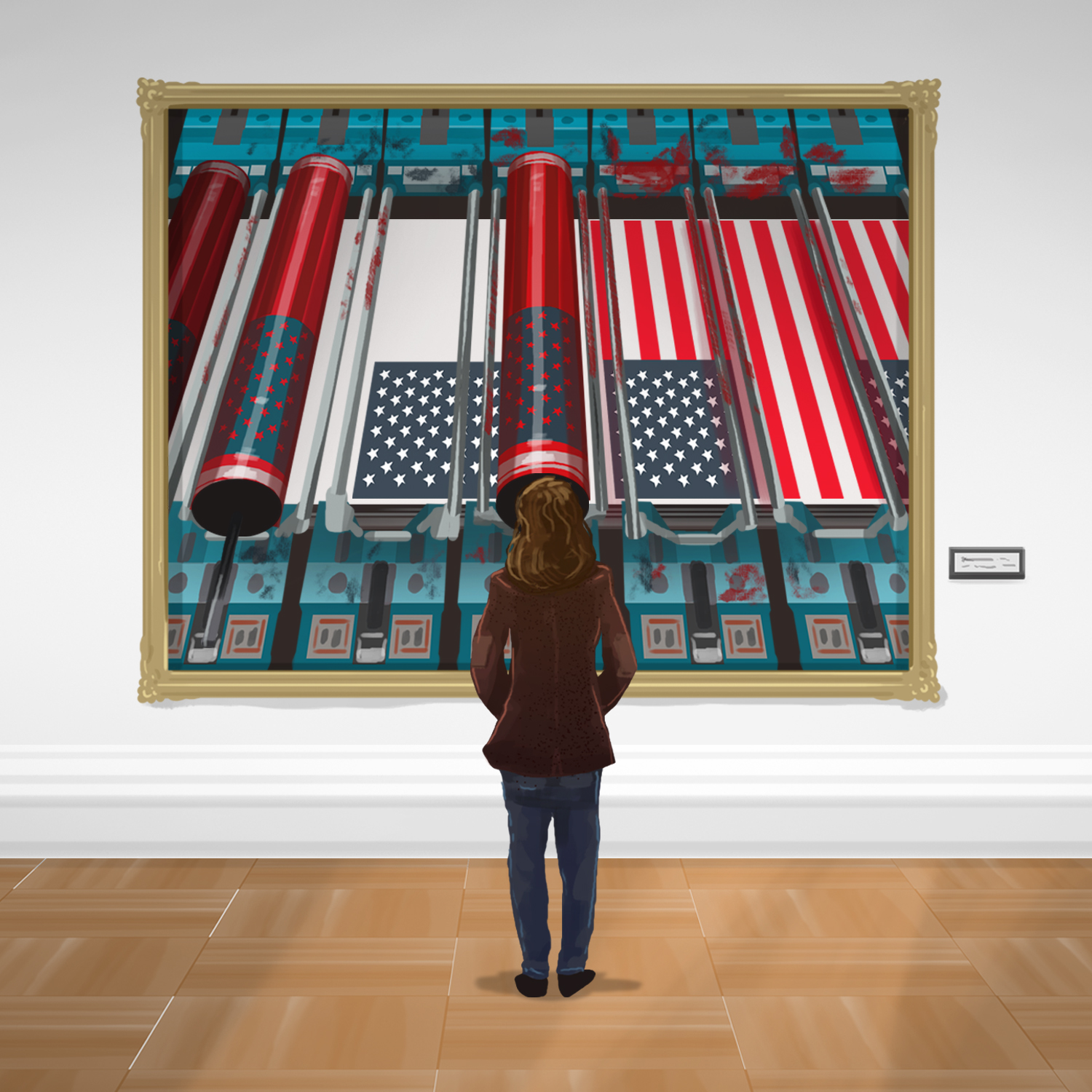
Sidedoor · Smithsonian Institution
What does it look like for something to be made in America? Through the photography of Christopher Payne, we journey across the past, present and future of American manufacturing to answer this question. From centuries-old textile mills to modern assembly lines, Payne’s photographs offer a rare, behind-the-scenes view of how everyday objects—from pencils to airplanes to marshmallow Peeps—are made. With the help of Smithsonian curator, Susan Brown, and author, Rachel Slade, we also explore the history behind these factories, and how the story of American manufacturing is the story of our nation itself. Guests: Christopher Payne, Industrial photographer Susan Brown, associate curator, and acting head of textiles at Cooper Hewitt Smithsonian Design Museum; curator of the exhibition Made in America Rachel Slade, author of the book Making it in America: The Almost Impossible Quest to Manufacture in the U.S.A. (and How it Got That Way)
Sidedoor (S12E11) – Made in America final web transcript Lizzie Peabody: This is Sidedoor, a podcast from the Smithsonian with support from PRX. I'm Lizzie Peabody. Lizzie: In the winter of 1775, Britain tried to end the American experiment before it could even begin. With the revolutionary spirit brewing in the colonies, British Parliament slammed the door on trade. The goal? To cripple the American economy and crush the early stages of revolution. Lizzie: The blockade didn't stop the United States from declaring independence in 1776, but it did make fighting a war much, much harder. That's because the colonies relied on Britain for almost ALL of their imported goods, and especially textiles—clothes and fabric. Without those, the colonial soldiers were in rough shape. Rachel Slade: They had no coats, they had no hats. It was a serious problem. The American patriots were very—not only underfunded, but under-clothed. Lizzie: Rachel Slade is author of the book Making It in America. Rachel Slade: A lot of casualties actually came from disease, illness, and frankly, cold. Lizzie: Just because [CROSSTALK][a]. My God! Rachel Slade: Yeah, because they were—they were not properly equipped. Lizzie: America had no mass manufacturing at the time—at least, nothing close to the Brits. And you simply cannot hand-sew enough coats and hand-forge enough muskets to win a revolution with a global superpower. So the colonists turned to the only people they could think of who could help: Britain's greatest rival, the French. Lizzie: But it wouldn't be easy to convince King Louis XVI for help. He still wasn't convinced the colonists could win, and he didn't want to back the losing side. Luckily, we had a secret weapon. Lizzie: In late 1776, Benjamin Franklin set off for Paris to ask the French for help. Rachel Slade: The thing about him was that he wasn't just an American coming in asking for money to support this revolution. He was famous for his scientific discoveries. Lizzie: When he arrived in France, Parisians chanted "Vive Franklin!" and greeted him like a celebrity. Some French ladies fan-girled out by wearing 'lightning dresses' in honor of the inventor who "snatched lightning from the sky." Lizzie: But Franklin hadn't come all the way to France to bask in the glow of his celebrity. He was on a mission. And by the time he got an audience with the King and Queen of France, the Americans were in dire straits. Without help, they would surely lose the Revolutionary War. Everything hinged on Franklin's appeal to the monarchy. Lizzie: So he stepped into the sprawling gilded halls of the palace of Versailles. You might assume he dressed his very best for the occasion. But ... Rachel Slade: Actually, it was a point of pride that he showed up in 'homespun.' Lizzie: 'Homespun' meaning handmade clothing from America. It has all the uniqueness and charm of a handmade piece of clothing—you know, like the wool scarf your grandmother knitted for you. And Franklin topped off his outfit with a fur cap most likely made from a beaver. Rachel Slade: Ben Franklin did this for theatrical purposes. Like, he had access to ... Lizzie: This was marketing. Rachel Slade: It was a hundred percent marketing. It really helped the American cause for the French to see that the Americans were really bootstrapping, right? They were wearing their own imperfect hand-spun stuff in the court at Versailles, right? I mean, that's—that's a big statement. Lizzie: Remember, the French were the epitome of fashion at the time. Rachel Slade: So what you wore was pretty much the whole game, right? You had to have courtly manners and everything else, but yes, we are talking about very foo-foo, very fancy people. Lizzie: We're talking ruffles, golden brocade, perfume and precious stones and those high-heeled buckle shoes for men. So in walks Benjamin Franklin, and King Louis XVI and Queen Marie Antoinette look him up and down, dressed in a lumpy, handwoven brown suit, and "Mon dieu! Is that a beaver on his head?" Rachel Slade: And they found this, you know, septuagenarian in his brown homespun suit pretty charming. It got the job done. Lizzie: King Louis loved it! He said, "You all can have all the guns and clothes you need. Clearly, mon ami, you need them!" Lizzie: It was a turning point, not just for the war, but for American manufacturing. Because after we won the Revolutionary War, our founding fathers realized that we may have gained our independence through fighting, but if we were gonna keep it, we needed to start making things right here in the good old US of A. Lizzie: This time on Sidedoor, we explore how the United States of America went from a collection of farmers and artisans to a global manufacturing powerhouse. And along the way, we'll get a peek into the world of modern American factories through the work of one photographer. Ever wonder how a Peep becomes a Peep? From homespun to chicks in a sugar shower—I'm talking about Peeps, of course—what does it look like for something to be made in America? So take off your beaver hat and put on your hardhat, because we're answering that question after the break. *** Lizzie: Christopher Payne is an architectural and industrial photographer who's been photographing the inside of American factories for the past 15 years. And nothing he does is improvisational. Chris Payne: Nothing in the work is ever accidental for me. It's not point and shoot. Lizzie: Chris' photos capture a single moment in an otherwise bustling factory, helping us see the things we use everyday in a new light. He spends hours—or even days—setting up to get the perfect shot of a car being welded or a piece of metal being stamped. Just name an American manufacturer, and there's a good chance he's taken a photo of one of their factories. Chris Payne: John Deere, Kohler, Whirlpool, Boeing, GE. Lizzie: And many, many more. We hear a lot about the decline of manufacturing in America, and it's true that we don't make as many things domestically as we once did, but there are still lots and lots of factories of all types here in the United States. And Chris is photographing as many as he can. Chris Payne: Some are old, some are new, some are large, some are small. They're making lots of different things. Susan Brown: From very, very handcrafted things to fully automated things, from microscopically, tiny things to giant container ships and jets and rockets. Lizzie: Susan Brown is Associate Curator and Acting Head of Textiles at Cooper Hewitt, Smithsonian Design Museum. She's curating a new exhibit featuring Chris's photographs called "Made in America." She says Chris' photos give us a peek into American factories, where many of the old ways of doing things are dying out. Chris Payne: As a photographer, I do sometimes feel that, you know, I'm chasing something that doesn't really exist anymore. Lizzie: And to understand how American manufacturing grew into something that evokes nostalgia today, it helps to go back in time a bit. After America won its independence from Great Britain in 1783, our new nation found itself in a bit of a predicament. Rachel Slade: After the revolution, the government was broke. Lizzie: Rachel Slade again. She says without money, America's newfound independence was fragile. And by the time the young country saw its next war in 1812, even the notoriously pro-farming, anti-manufacturing Virginian, Thomas Jefferson, admitted it, saying ... [Voice actor: Manufactures are now as necessary to our independence as to our comfort.] Lizzie: Manufacturing was officially a matter of national security. Rachel Slade: And so we had to jumpstart the industrialization of America real fast. Lizzie: There was a problem, though: The British were pretty cagey about the secrets of mass production. They didn't sell their manufacturing equipment, and they didn't let any outsiders into their factories. Luckily for us, again, we had another secret weapon—a spy guy. Rachel Slade: One of our founding fathers, Cabot Lowell, actually took his family to England in the early 19th century. Lizzie: And Cabot said, "Aw shucks and darn, I'm just a simple American. I'd love to see the inside some of your fancy British factories." Rachel Slade: Passed himself off as just like a country bumpkin, which played really well into the British idea of Americans. Lizzie: The British were like, "This rube isn't gonna know what the heck he's looking at." So they gave him free reign to check out Britain's textile factories. Rachel Slade: And he spent five years studying the power looms. Lizzie: It wasn't until Lowell was setting sail back to America that the Brits were like, "Wait a minute!" Halfway across the Atlantic, a British frigate intercepted Lowell's ship. Officers searched his bags—and even his shoes—for schematics of the factories. But they came up empty handed. Rachel Slade: He didn't write anything down. He must have had a prodigious memory. Lizzie: Everything was in his head. So with nothing for the Brits to object to, they said "Cheerio" and sent him on his way. And as soon as he got home ... Rachel Slade: He drew up his plans with a little help from immigrants from England who had actually worked or engineered these factories. Lizzie: And they created the Boston Manufacturing Company—a water-powered textile mill. This act of espionage gave birth to American textile manufacturing, with power looms spreading across New England and the South. Lizzie: In 2010, Chris Payne was driving through Harmony Maine, a small hamlet in the center of the state. That's when he spotted what looked like an old mill. Chris Payne: If you drove by the mill, you probably wouldn't look twice, but someone like myself would notice it because it looks like a classic old mill building by the river. Lizzie: You can see one of Chris' photos of the mill in the "Made in America" exhibit. The building dates back to 1821, and it looks like a rusted metal barn with windows. You might say it would fit right into an old Stephen King novel because well, it was actually in a film based off his book Graveyard Shift. And it's this factory that got Chris started on the project that would become Made in America. Through his photos you can see inside the factory, which is like stepping back in time. Chris Payne: Bartlett Yarns is filled with this vintage machinery, all made in New England. Lizzie: A machine called a 'spinning mule' runs what looks like the entire length of the building, whirling purple yarn on a hexagonal wheel. Chris Payne: And this whole thing slides across the floor. And as it's sliding across the floor, it draws the yarn out and twists it. Lizzie: In a photo, a worker stands with a heaping armful of purple yarn as the mule spins away on the stained wooden floor. Chris Payne: It's this magical thing that's just going back and forth. And there's a rhythm to it, you know, the sound of, like, these old metal parts clinking and clacking. And there's a smell of the wood and the oil and the wool and the floor. All these, mixed in with, like, the coolness of the main temperature outside. You know, it's like your grandmother's attic, but also the old workshop. Lizzie: Words don't quite do these photos justice, so we'll include links in our show notes. There's a simplicity, even a sense of nostalgia. That's because you don't see many American factories as old as Bartlett Yarns still up and running. This old mill opened its doors 200 years ago, when American manufacturing was in its infancy. And that's why it was built next to a river. Lizzie: Old factories and mills got power from putting waterwheels in nearby streams or rivers. But in the 1800s, coal power was growing fast. And by the 1880s, coal made it possible to electrify factories and supercharge production. This was a game changer, and it gave rise to the American Industrial Revolution. Lizzie: The industrial revolution changed America from an agrarian society to a manufacturing one. People moved in droves from farms to cities looking for work. New immigrants poured in from abroad, and America became an industrial giant on the world stage, creating new, unseen amounts of wealth—for some. Lizzie: This time was also known as the Gilded Age, and Rachel says it was not a great time to work in a factory. Rachel Slade: The Gilded Age was horrific, and the body count was very, very high. If you were a worker and you got injured, it was your fault. [laughs] And ... Lizzie: You shouldn't have been so careless. Rachel Slade: Yeah, exactly. And you might even have to pay for the equipment that got damaged when yeah, it ate your hand. Lizzie: Oh my God! Rachel Slade: I'm not kidding. Lizzie: During the Industrial Revolution, America became a mass manufacturing powerhouse. If there was any process that could be mechanized and made in a factory, it was. But it wasn't until the early 1900s that American factories really went into overdrive. And the reason for that was World War I. Rachel Slade: This was a real turning point for America. All of Europe was locked in a devastating war. So how could we get food to them? How could we get clothing to them? How could we get, you know, ships and munitions to them? This became a real question, and so that was phase two of American industrialization, in my opinion. Lizzie: Rachel says this second phase was about investing in infrastructure to move goods—more roads, more rails, more ports. And that infrastructure meant factories didn't have to be in major cities anymore. They started popping up around the country. And the style of production changed, too. Rachel Slade: American industrialization is all about efficiency. You've got innovation in terms of what we make, and then innovation in terms of efficiency. Lizzie: The quest for efficiency gave rise to the assembly line, made famous by Henry Ford. In this production process, a single worker builds one part of a car instead of an entire car. A byproduct of this style of production—besides, you know, the mass-manufactured goods—is that it creates a lot of repetition. Susan Brown: So it's kind of a natural feature of industrial photography that there is a lot of repetition. Lizzie: And this repetition is central to many of Chris' photos in the part of the exhibition called "Production at Scale." Lizzie: Picture pencil after pencil moving down a conveyor belt. Or identical neon golf balls being forged in metal molds. Susan Brown: I think we have an innate attraction to the order and symmetry and repetition that are characteristic of pattern. You know, whether that's a quilting pattern or a marching band or the Rockettes or whatever. Like, seeing a whole line of identical things is something we just are naturally attracted to. Lizzie: You gotta love the Rockettes. But besides symmetry and pattern, there's another satisfying quality to Chris's photos. Chris Payne: I'm always trying to find that—that a-ha moment, "A-ha, so that's how they do it" moment. Lizzie: Why do you think that's such a satisfying feeling for us? Susan Brown: I think, whether you've spent your lifetime asking the question, "How do they get the lead inside the pencil," or whether you have never given it a moment's thought in your lifetime, when you're actually confronted with how it is done, it's different from what you thought, in a way that's interesting. Lizzie: Through a series of photos, Chris manages to capture the "a-ha moment" of a pencil being made at the General Pencil Company, a factory that's been in operation since 1860. Susan Brown: Would I have imagined that a person laid the core inside my pencil by hand? Never in a million years. Would I have imagined that the pastel cores are, like, floppy like spaghetti? No, I would not. And certainly I would not have imagined that the person who does it changes her manicure every week to match the pastel color that they're running. Lizzie: Wait a minute, there is a person placing the core in my pencil? It's little touches like seeing someone's nail polish that reminds you there are people involved in making everything we use every day, from our kitchen sinks to our shoes and cars. Lizzie: This mass production of goods inside American factories boomed during the first and second world wars. We were making nearly everything we used in America—from pencils to clothes to cars and trains and aeroplanes. We were also making the steel that would then become the car engine or hubcap. We grew the cotton, processed it and sewed it into clothes. All of this was made in America. So what happened? Why do we hear so much today about the decline of American manufacturing? We'll get into that after the break. *** Lizzie: When I picture American manufacturing, I see big muscular dudes in tank tops and hard hats guiding cauldrons of molten steel down a track, and another hammering a rivet into a girder as sweat beads on his forehead. Lizzie: Is that what's happening at the Peeps factory? Chris Payne: Not at all. Not at all. Lizzie: You probably don't want to sledgehammer a Peep. Chris Payne: No, you don't. You don't. Lizzie: Just Born Quality Confections has been making candy in Bethlehem, Pennsylvania for the last 100 years. That includes Peeps. You know, the little yellow marshmallow chicks that are so popular at Easter. Some of my favorite photos of Chris' are of the Peep-making process. Although he admits there are some drawbacks. Chris Payne: One of the things I don't like about, let's say, making the pictures at the Peeps factory, as much as I love that place, by the time you see the Peeps on a conveyor, you know, they're almost done. They're basically done. So you're not really learning anything about how they're made. Lizzie: Hmm. Chris Payne: And so it skews more towards just sheer kind of beauty, the beauty of repetition and color. Lizzie: It's true. A tube squeezes out a dollop of white marshmallow onto a conveyor belt and that's, like, 90 percent of the process. But as Chris' photos show, there's still some very cool things to see as this parade of Peeps goes marching through the factory. Chris Payne: You have this perfectly deposited dollop of white marshmallow. And that's the secret of what they do is that all these little dollops are the same—same size, same shape, and they look like—kind of like a little chicken. Lizzie: That part happens out of sight—proprietary secrets, you know? But when the marshmallow squiggles emerge on a conveyor belt five abreast in multiple rows streaming endlessly through the factory, it really is like a military parade of Peeps marching along. Chris Payne: And then they're on this—this bed of a very granular, you know, yellow-gold sugar. So it's this contrast, you know? It's like these perfectly shaped white, pristine, marshmallow dollops. And then there's this really sandy bed that they're on, and then a few seconds later ... Lizzie: The peeps go marching five by five—hoorah!—into the sugar shower. Susan Brown: I would've imagined that the sugar would snow down from above to coat the marshmallow. Lizzie: Cooper Hewitt curator Susan Brown again. Susan Brown: But in fact, it's underneath. And then they vibrate it to such an extent that the sugar sort of jumps up. Chris Payne: And then it lands on top of these little chickens. And so they go from being white to yellow. Lizzie: And then a machine dots two eyes on the sugary, yellow chicks and a Peep is born. Lizzie: Peeps have been being made like this in Bethlehem, Pennsylvania, for the last 70 years. This area, along with Michigan, Ohio and Illinois, was the heart of American manufacturing in the mid-20th century. See, after World War II, European and Asian countries were in shambles from years of conflict—but not America! Rachel Slade: It was a bonanza for an entire generation, as Europe and Asia got their crap together again, you know, after being devastated by war. Lizzie: It was a bonanza for the US because, unlike the Gilded Age, more of the wealth being created was spread to the working class, thanks to labor unions, which are widely credited with the rise of America's middle class. By this time, America's workforce was highly unionized. Rachel Slade: One in three workers in America carried a union card. Lizzie: Because of the labor movement, workers saw wages increase by double digits. Healthcare, retirement and paid leave became standard benefits. And then, the bonanza began to bust. Rachel Slade: I'd actually argue that the demise of manufacturing started probably around 1972. Lizzie: Rachel argues that a few things led to this downfall, but there was one big thing that sort of started the domino effect. [ARCHIVE CLIP: We have at present an absolute shortage of natural gas. We cannot produce as much as we can use, as we are equipped to use in our homes and our factories. This situation is destined to continue indefinitely.] Lizzie: This is an economist explaining the gas crisis of 1973, which happened because America was using more oil than it could produce. To fill the gap, we started importing oil, mostly from the Middle East. [ARCHIVE CLIP: Then in 1973, the big Middle East producers cut off oil shipments to major consuming countries.] Rachel Slade: And that shuttered a lot of American factories. Like, that was the first shock, because energy just became too expensive. And manufacturing is an intensely energy-expensive endeavor. Lizzie: When American companies did the math, they realized it had become cheaper to build things overseas, where labor and energy was less expensive. They started firing workers and making as many things as possible abroad. This began the half-century march of factories leaving America. Today, what's left of American manufacturing is largely centered around aerospace. And this is because of an act of Congress. Rachel Slade: The Berry Amendment required the military and Department of Defense to buy American whenever they could. Lizzie: The Berry Amendment was meant to protect supply lines for critical American military defense in case of a war. Take the American company Boeing, for example. They have multiple contracts with the American government for military aircraft and satellite support. They're also a big commercial airplane manufacturer based in America. And when I say big, I mean big! Chris Payne: An airplane factory, like a shipyard, it's when you first walk into a factory like that, you almost feel like you've entered a land of giants. Lizzie: Chris Payne has taken numerous photos of Boeing factories. Chris Payne: The only time we see planes are either from the window of an airport, looking out at our plane and wondering why it's not there yet, or when you're gonna board or when you're inside a plane and then you're thinking, like, this thing is so cramped, right? Lizzie: In Chris' photos, we see the fuselages of the planes, which are recognizable as a plane. But there are no wings or doors. They're these bright green tubes side by side in a humungous factory. Susan Brown: Kind of removing the airplane from its functional context enables you to focus on the sculptural aspect of the shape of the body. But then it's also—there's a very unexpected color, right, that is bright green, which is a primer layer of paint that's underneath the finished paint surface that we would normally see. So there's an element of surprise, I guess, in seeing underneath the surface, literally of what we normally see at the airport. Lizzie: The photos, again, peel back the layers of production like peeping behind the curtain in Oz to see there's a human back there. You see this again and again in the exhibition. But as production processes evolve and change with new technologies, Chris is finding it harder and harder to capture the essence of manufacturing in a still shot. Chris Payne: Microchips are a very hot button item today. They power everything that we use. Lizzie: Chris says his photography has had to adapt as production processes evolve to make things smaller and more high tech. It might be easy to capture the "a-ha moment" of a city bus being welded together, but how do you capture the creation of a silicon chip that is thousands of times smaller than a strand of human hair? Chris Payne: You don't really know what you're photographing, because you can't see it. And you actually can't really, even if you might kind of understand the process, you can't photograph the process. Lizzie: That's because the process is usually highly proprietary and secret. But it also takes place inside of crazy, sophisticated machines. Chris Payne: And these cost upwards of $250 million apiece. Lizzie: Wow! Chris Payne: And yeah, they're the most sophisticated machines on the planet. They're interesting, but they're not photogenic. Lizzie: And these machines are often housed inside sterile facilities called "fabs." Chris Payne: A fab is—you know, they're these super, super high-tech buildings that take a decade to build. They're something like a thousand times cleaner than an operating room. I mean, they have to be just, like, insanely clean. Lizzie: These machines are dust-free cubes inside of larger dust-free cubes—the buildings. Chris says he was in one of these fabs not too long ago trying to figure out how to capture that "a-ha moment" of making a microchip. And then as he was wandering around in the basement, he looked up and saw all the mechanical systems. Chris Payne: The wiring, the piping cables, like, the electricity, the water, everything that you would need to keep the machines running. And it was that wonderful balance of, like, complexity and chaos and order that said—where I said to myself, "Wow! You know, this really tells the story of this place in a way that you can't glean or understand, you know, when you're in the clean room." Lizzie: But for everything that is changing in manufacturing these days, from new processes in these super clean fabs, to robots and artificial intelligence, there's one thing that does stay the same. Rachel Slade: Humans are still involved in production of everything. Lizzie: Rachel says people have always been at the heart of American manufacturing. Rachel Slade: Even if we're talking about a very sophisticated power loom that's creating beautiful rugs, there's an operator there who might spend up to a month loading the loom by hand with yarn. So at the heart of production everywhere, there are humans and hands. Lizzie: The number of manufacturing jobs in America has gone down drastically since World War II. From more than 30 percent of our workforce to less than 10. In poll after poll, Americans say we need to bring these jobs back. It's a goal that spans both sides of the political aisle. But as it turns out, it's not so easy to bring manufacturing back once it's gone. Rachel Slade: The problem is that when you take away one piece of manufacturing—like, let's say apparel. So when you stop making apparel, suddenly there is this ripple effect throughout the nation of other industries that were related to that industry, right? So when you remove one piece of an industry, everything else kind of crumbles. Chris Payne: And you can't just, like, restart that. You can't—it just takes decades. This has been happening for decades, and if you want to reverse it, it'll take another, you know, several decades. Lizzie: Manufacturing is a complex, interwoven network of skilled workers, raw materials and production facilities. You need all the pieces to make it work. But Chris says the past 15 years he's spent visiting American factories have given him hope about the future. Chris Payne: The one thing I love about going into a factory—and it could be any factory, really—is that there is a sense of energy that you get when you walk in there. And a sense of people having to work as a team. A machine doesn't care what side of the political spectrum you're on. You know, an assembly line, it doesn't—it doesn't matter. Things have to work precisely, and everyone has to work together. And so I see people from all walks of life: old and young, native American-born, immigrants, people with years of experience, people who are just starting, you know, kind of all working side by side. And, you know, in this time of polarization, I believe they give us a glimmer of hope. *** Lizzie: You've been listening to Sidedoor, a podcast from the Smithsonian with support from PRX. To learn more about the "Made in America" exhibit and to see some of Chris' photography, find us on social media. We're @SidedoorPod. Chris also has a book of his photos called—wait for it—Made in America. You should check that out, too. Lizzie: For help with this episode, we want to thank Susan Brown, Christopher Payne, Rachel Slade, Xhosa Fray-Chinn, Laurie Bohlk and Ashley Tickle. Lizzie: Our podcast is produced by James Morrison, and me, Lizzie Peabody. Executive producer is Ann Conanan. Our editorial team is Jess Sadeq and Sharon Bryant. Episode artwork is by Dave Leonard. Transcripts are done by Russell Gragg. Fact checking by Nathalie Boyd. Our show is mixed by Tarek Fouda. Our theme song and episode music are by Breakmaster Cylinder. Lizzie: This episode received support from Smithsonian's Our Shared Future: 250, a Smithsonian-wide initiative commemorating the nation's 250th. Signature support for Smithsonian's Our Shared Future: 250 has been provided by Lilly Endowment Inc. Additional support has been made by Target. Lizzie: If you have a pitch for us, send us an email at Sidedoor [at] si [dot] edu. And if you want to sponsor our show, please email sponsorship [at] prx [dot] org. Lizzie: I'm your host, Lizzie Peabody. Thanks for listening. Rachel Slade: So when we talk about Luddites, we think a Luddite is somebody who, like, doesn't like new technology. Lizzie: Can't use a computer. Rachel Slade: Right. And resistant, or—or yeah, just plain, old I don't wanna know about it. But it's a much more interesting history. The Luddite was a movement of the hand weavers back in the late 18th century who went in and literally smashed power looms, because they thought this was a terrible thing to happen to British society. -30- [a]I tried several times, but I can't make out exactly what Lizzie says here. Are they mic'ed on two separate tracks?