
Ship It Weekly - DevOps, SRE, Platform and Cloud Engineering News · Teller's Tech - DevOps, SRE and Cloud Podcast
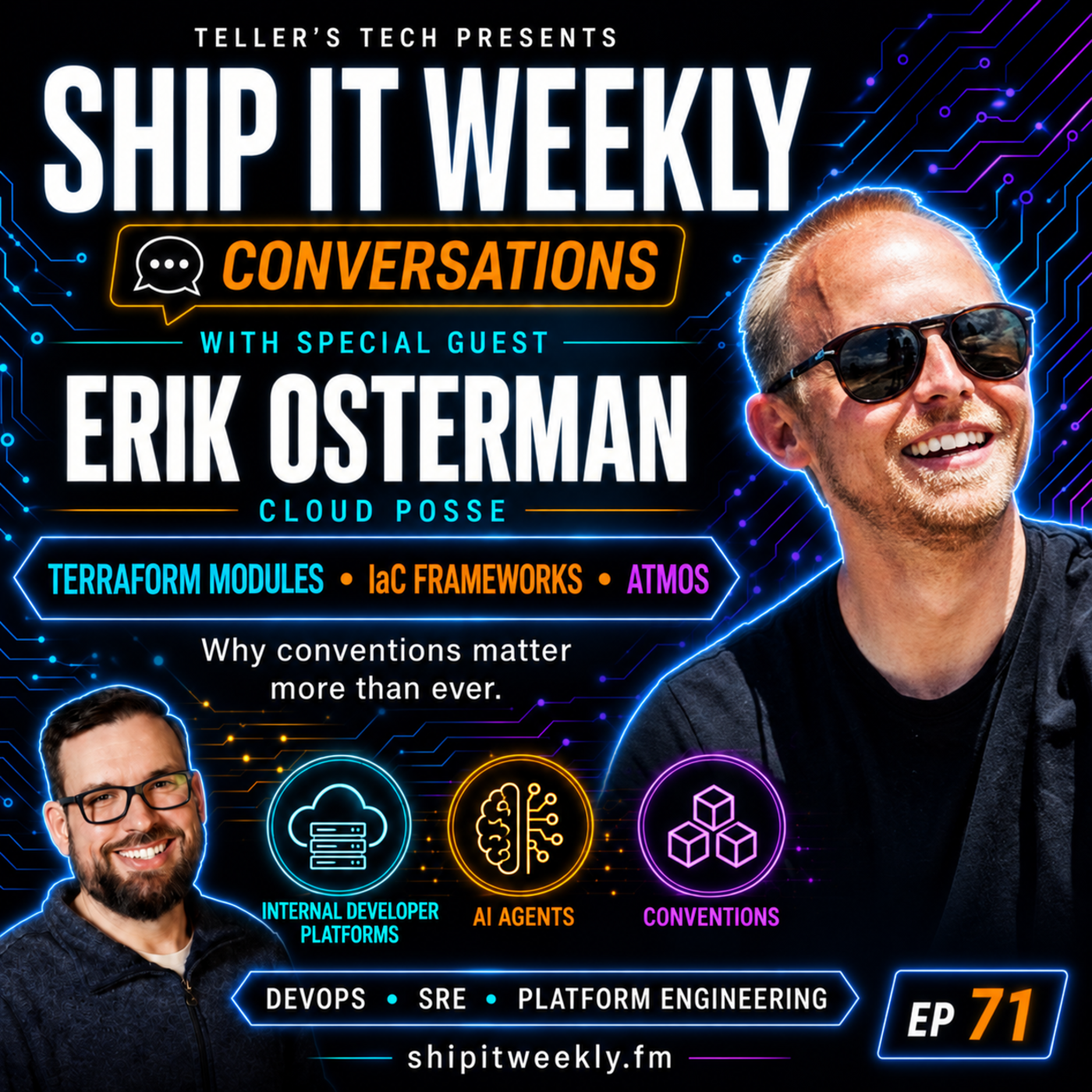
This is a guest conversation episode of Ship It Weekly, separate from the weekly news recaps. In this Ship It Conversations episode, I talk with Erik Osterman of Cloud Posse about Terraform modules, infrastructure as code frameworks, internal developer platforms, and why AI makes conventions more valuable, not less. Erik is the founder and CEO of Cloud Posse, which has published more than 180 open source Terraform modules, and he hosts Cloud Posse's weekly DevOps Office Hours. We start with what AI has done to open source infrastructure projects, then get into what makes a good Terraform module: consistent naming, a consistent interface, not so small that it wraps a single resource, and not so large that it has a hundred inputs nobody can test. We also talk about CloudFormation, Pulumi, and why HCL's constraints helped build the module ecosystem. Erik explains where Crossplane fits, and why accounts, IAM, networking, DNS and certificates all come before the cluster. A big part of the conversation is frameworks. Erik argues that nobody actually runs "vanilla Terraform," because Terraform alone doesn't handle state layout, promotion, authentication, tool installation or repository structure. Every team ends up building its own framework, usually undocumented. We talk about Terragrunt, Atmos, naming conventions, brownfield adoption, and breaking a monolithic root module into services. Near the end, we get into AI and self-service. Erik's team now generates most of its infrastructure work with AI, and it works because the conventions, agent skills, MCPs and pipelines are already in place. Self-service doesn't have to mean another no-code platform. The big takeaway: AI can generate infrastructure code faster than ever, but without conventions it is generating into chaos. Highlights • What makes a good Terraform module • Root modules vs. child modules • CloudFormation, Terraform, Pulumi, and why constraints helped HCL win • Where Crossplane fits, and what has to exist before the cluster • Why internal developer platforms like Backstage come after zero-to-one • Why infrastructure as code needs frameworks, not just modules • Agent skills, MCPs, and self-service without a no-code platform Links Cloud Posse: https://cloudposse.com Atmos: https://atmos.tools Cloud Posse on GitHub: https://github.com/cloudposse DevOps Office Hours: https://tsn.io/2gq7v Erik Osterman on LinkedIn: https://www.linkedin.com/in/osterman More episodes and show notes: https://tsn.io/NqkdP On Call Brief: https://tsn.io/Gpz2d LMGT Awards: https://lmgt.org
0:00AI can write a lot of infrastructure code now.
0:03But if every team organizes Terraform differently,
0:06names resources differently, handles authentication
0:10differently, and reinvents the same deployment
0:13patterns, faster code generation does not necessarily
0:17mean better infrastructure. That is where conventions
0:21start to matter. Because the real leverage is
0:24not just getting AI to write HCL faster. It is
0:28giving it a framework, a golden path, and enough
0:32context to know how your organization actually
0:35works. I'm Brian Teller from Teller's Tech, and
0:38this is Ship It Weekly.
0:56Welcome back to Ship
0:57It Weekly, where I filter the noise and focus
1:00on what matters when you are the one running
More Ship It Weekly - DevOps, SRE, Platform and Cloud Engineering News episodes →