
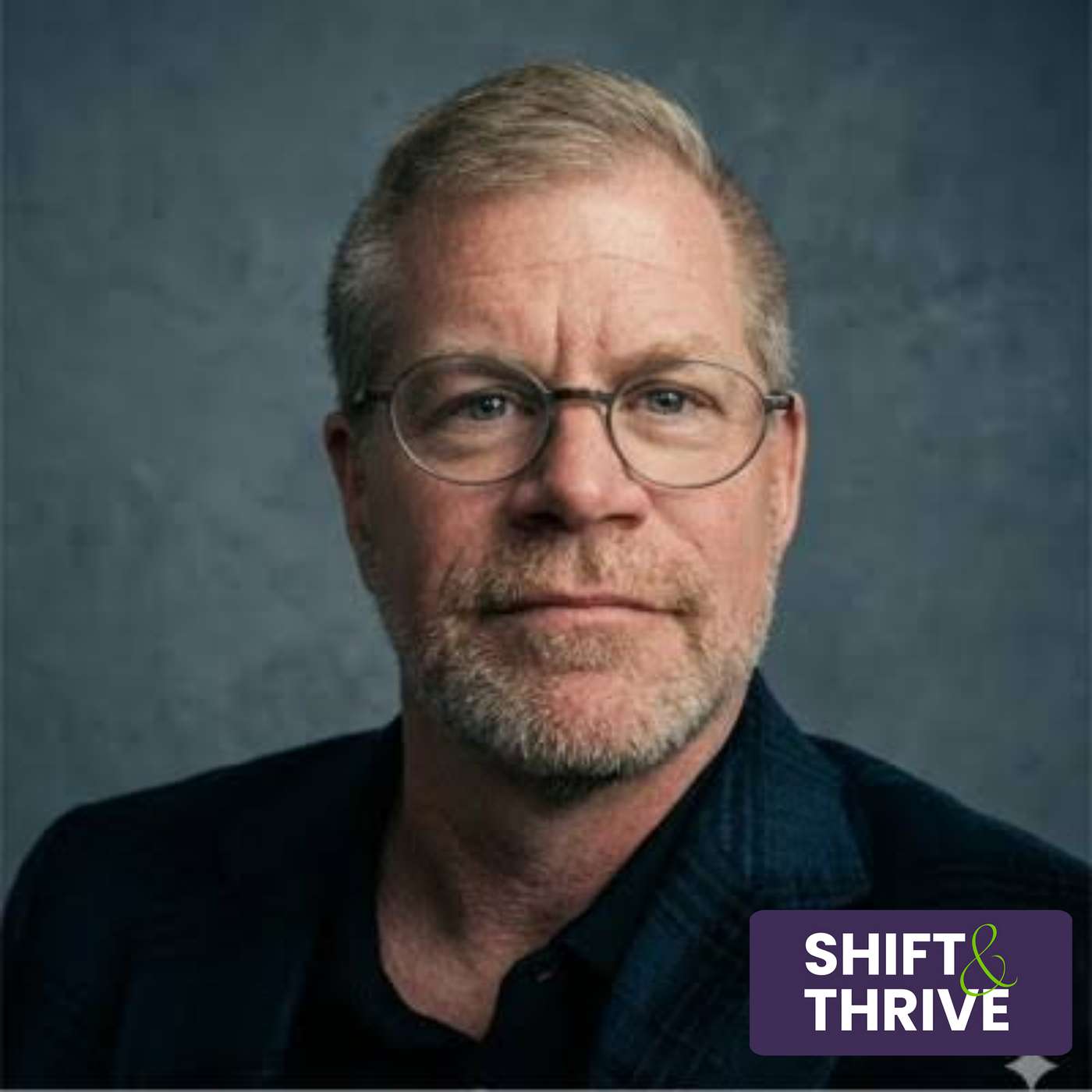
Shift & Thrive: CEO Insights on Driving Change · Natalie Nathanson
How do CEOs lead a company through radical business transformation without losing employee trust? In this episode of Shift & Thrive, host Natalie Nathanson talks with Jon Billow, Chief Revenue Officer of BNS and CEO of BNS Networks, about change management and leadership transformation in fast-moving markets. Jon shares the story of pivoting an entire data center company into a consulting organization after a major customer breach and why he chose extreme transparency with employees during that transition. Drawing on his background in Army Special Forces and stints across nearly every C-suite role, Jon breaks down how leadership style needs to flex depending on the seat you are sitting in, why building a perfect go-to-market strategy can become a fool's errand, and how he approaches strategy in the AI infrastructure space where the landscape is still shifting. Takeaways: ~ Choose transparency over false confidence, even without all the answers, to preserve trust during transformation. ~ Create multiple communication channels, like all-hands meetings and one-on-ones, so people can process change in their own way. ~ Define success and failure criteria before launching an initiative, not after you are emotionally invested. ~ Apply an MVP mindset to go-to-market strategy: define the minimum needed, launch, then iterate on real feedback. ~ Match your leadership style to the seat you currently sit in, not just your personality. ~ Avoid over-planning around fast-moving assumptions, like AI infrastructure shifts, when building a long-term strategy. ~ Build adaptability into your leadership approach. Getting comfortable being uncomfortable matters more than having it all figured out. Quote of the Show: ~ “Things are moving at an increasing velocity compared with where they were in years past. If you can get into that mindset where you're not gonna know it all, you're not gonna have it all figured out, what you wake up to tomorrow is gonna be different than today, and you can be okay with that, I think that adaptability is critically important for the world that we're in.” - Jon Billow Links: ~ LinkedIn: https://www.linkedin.com/in/jonbillow/ ~ Website: https://boldnew.com Ways to Tune In: Spotify: https://open.spotify.com/show/2D1YbT2QhKxIwbREpU7EMb Apple Podcasts: https://podcasts.apple.com/us/podcast/shift-thrive-ceo-insights-on-driving-change/id1740828813 Amazon Music: https://music.amazon.com/podcasts/fa60b654-1955-4055-93df-fdd40c2a5c8f/shift-thrive-ceo-insights-on-driving-change iHeart Radio: https://www.iheart.com/podcast/269-shift-thrive-ceo-insights-166792501 Pandora: https://www.pandora.com/podcast/shift-and-thrive-ceo-insights-on-driving-change/PC:1001086797 YouTube: https://www.youtube.com/channel/UClf9QxGUxZw_Sv8_4bZP34Q This show is sponsored by Magnetude Consulting, bringing you the thinking-Power of a Growth Consultancy and the Getting-It-Done Power of a full-service B2B Marketing Agency. Learn more at:...
Intro: [00:00:00] In today's business world, change is the only constant, and mastering transformation is the ultimate key to success. Welcome to Shift and Thrive. I'm your host, Natalie Nathanson. Each week we'll bring you conversations with CEOs who delve into how they successfully drove critical change in their organization. This show is sponsored by Magnitude Consulting, bringing you the thinking power of a growth consult. And the getting it done, power of a full service B2B marketing agency. Natalie Nathanson: I am really looking forward to speaking with today's guest. He is a serial entrepreneur and technology executive who spent over 25 years building companies at the intersection of IT infrastructure, cloud computing, and enterprise technology. He has founded, led, and successfully exited multiple technology companies, and through that journey, has served in nearly every C-suite role from [00:01:00] CEO, COO, CIO, CTO, and currently Chief Revenue Officer. Along the way, he's helped scale organizations including NameSecure, PeakHosting, SnapRoute, and most recently, Sphera, the AI infrastructure company he founded before selling to BNS. Today, he's helping organizations build mission-critical infrastructure needed to power the next generation of AI. He is the Chief Revenue Officer of BNS and CEO of BNS Networks. Jon Billow, welcome to the show Jon Billow: thank you. Sorry about the technical difficulties there. Natalie Nathanson: No worries. No worries. Great to have you on. And, uh, you know, to kick us off, you know, given that you have built, led, and sold companies across several major technology waves, I know you've seen tons of transformation, both industry transformation as well as in the companies that you've led. So I'd love to, uh, start by talking through one of those transformations that you led, and we'll dive into, uh, what were the, the lessons learned. But can you start by walking us through what [00:02:00] was the situation you were navigating? Jon Billow: Yeah. Well, you know, I think the, um, the reality of building a company from scratch, you know, anybody who, who has a startup, you know, there's a, there's a phrase... There's a couple variations on a phrase basically that no, no good, um, plan survives first enemy contact, right? And so, you know, that, that kind of goes without saying for anybody who started a company, that you can come up with all these great ideas for what you wanna do, and then you start talking to customers, and then you start experiencing the realities of the business, and you figure out pretty quick that you have to morph and adapt if you want to survive. ~That means you've got to build your organization to be~ ~very~ ~responsive to the market, and people need to really, um, internalize that flexibility to be able to roll with the punches.~ ~So there's a,~ ~there are a lot of really important attributes, I think, that, um, that, that, you know, brings with the need~ ~f- for~ ~hiring, uh, when you're, when you're, you know, coming out of the gate.~ So, you know, an, an example, uh, you know, I was running a data center company for, uh, for some number of years, a company called Peak Hosting. Um, we had a, a very large, um, customer concentration with a customer, as it turns out, was very unhappy with the, the company and, uh, they breached their contract. This was l- literally about three months after I started with the, with the, with the company, so, you know, yay me. Um, so we had to pivot the, the entire company from being a, a data [00:03:00] center, uh, hosting company to basically being a consulting organization. And, uh, so that transformation was, was profound, both in terms of the impact on the staff, the core competencies that we needed, the way we approached the market. You know, every aspect of the business all of a sudden was upended and, and flipped on its head. So, um, you know, that, that's probably the most extreme, uh, example I can, I can think of, and it, and it had, you know, a, a pretty significant ripple effect on, on, you know, everything that we did for the, the three years following that. Natalie Nathanson: Yeah. Yeah. I can imagine. And like you said, it really does permeate every facet of the organization. Uh, can you talk me through how did you approach it and kind of mapping, you know, what to do immediately, kind of what to roll out over time, existing staff versus, uh, kind of new hires? What was the, what was the beginning of that process like? Jon Billow: You know, I think it, it really started with a strategic decision with the executive team as to [00:04:00] what approach we were going to take as far as transparency with our employees and with our customers and all the other stakeholders involved. ~You know, there's a fine line~ ~between~ ~full transparency even when you don't really know yet what's going to happen or where the chips are falling. Um, you ~ ~know, the, ~ ~the pros and cons of that are that you're obviously being completely transparent about what you know and giving people the opportunity to roll with the punches.~ The downside to it is not everybody is built for that, and that can bring with it an awful lot of uncertainty and, um, and scare people. And so you always have to kind of find, you know, the, the fine line there between bringing people along with you through all of the sausage-making, if you will, versus, you know, holding your cards too close and then, and then, you know, a lot of, uh, a lot of resentment and bad feelings about, "Well, why didn't leadership tell us what was going on?" kind of a thing. So we made the decision, uh, to make a, a short answer long, we made the decision to err on the side of extreme transparency, uh, in particular with our employee base. And so, you know, we, we had a fairly mature employee base, a, a fairly, you know, sophisticated em- employee base that we felt like, um, could handle it, and we felt like really that was in [00:05:00] everybody's best interest, giving everyone, you know, the ability to opt out if the chaos quotient became too much. But we felt like that was the right answer, and I think in retrospect, it, it actually was Natalie Nathanson: Yeah. Do you have any examples that come to mind, uh, around kind of what that looked like in practice? Jon Billow: Yeah. So a lot of all-hands meetings where we literally pulled everybody into a room and said, "Okay, this is the lay of the land. This is where we're at as far as, um, you know, what's going on with these customers. This is where we're at as far as what we're thinking we're gonna do about it. These are the unknowns. This is what it, it probably means to you. And by the way, we could end up having to do this all-hands again three days from now, and everything that I told you is now different." Um, so you know, it wa- we were a virtual company, um, and so we had people all over the, all over the world actually, that, um, needed to dial in and do these all-hands meetings on a, on a fairly regular cadence while we, while we worked through, um, you know, some of the, the chaos and drama. [00:06:00] And, um, and, and that was, you know, kind of mechanically how we, how we took care of it. You know, there was a, a lot of, um, outreach with our leadership team to make sure that there was, you know, extra, uh, one-on-one time with folks, so you know, because not everybody is comfortable in kind of a company all-hands to ask the question that's actually on their mind. So you have to provide people that outlet and that, that ability to kind of, um, you know, communicate in, in, in ways that are, that are, uh, aligned with, with our personalities. So you know, those were some of the things that we did to try and, and, um, again, strike that balance between transparency and still giving people a, a chance to, to make their own decisions, you know, knowing full well that we didn't have all the answers. Until the very end, we didn't have all the answers. Natalie Nathanson: Yeah. A tension I often feel is kind of the balance of transparency and also, like, feeling responsible for kind of sharing a, a vision and the strategy and giving kind of that comfort level, which, you know, fast-forwarding to today I know is, is [00:07:00] hard because there is so much uncertainty in the market. So I'm curious how you think about that, um, right, people being comforted by wanting to know that the leadership has a clear vision, but also the transparency that a lot is changing and we don't have all the answers all the time. Jon Billow: Yeah, I, I think part of it for me is a- a- acknowledging that, you know, some vulnerability. That, yeah, people are comforted by, um, confidence, but you can be confidently dead wrong. Um, you know, I worked for a guy that said, "I may be wrong, but I'm never in doubt." So, you know, there's an element of that that I think is, is important, but I also think on balance, it is not a bad thing to be a bit vulnerable and transparent and say, "Hey, we don't have all the answers." Especially when the environment's really dynamic and things are changing or you're concerned that they may change rapidly, it can send a real, you know, [00:08:00] um, real disturbing message to people when they believe that that leadership is extremely confident and extremely assertive in the direction that they're going, and extremely confident and extremely assertive in the direction that they're going 180 degrees opposite three days later. You know, at a certain point in time, you lose credibility with that kind of a thing. So I look at it as being, you know, better to tell people, "Hey, we don't know. We're making our best guess. We're trying to figure it out. There are market forces outside of our control. There are customer behaviors outside of our control." So the whole point of the game is to, is to shiny up your crystal ball as best you can and hope you get it right, but acknowledge that you might not all the time. Natalie Nathanson: Right. I also think there's a l- level of empowerment that, you know, you have to have the right culture around it, but it gives the, the team more opportunity to bring new ideas to help shape the vision. And so in these kind of times, I think that can be, you know, for the, the right team and the right environment, that can be very empowering Jon Billow: I, I think it is. A- [00:09:00] and I also think it, it, um, you know, it, it im- imbues a sense of responsibility in people too, because now they're actually part of the conversation, they're part of the dialogue, and there's, you know, a, a implicit, if not explicit, invitation to be then part of the solution. Natalie Nathanson: Right. Uh, one other area I want to ask you about around this transformation was the customer communications, because one thing I often, uh, experience is customer communications are too much of an afterthought, kind of brought in, uh, too late or kind of not enough, uh, attention around, you know, the different segments of customers and, uh, the right people kind of delivering the right message, doing that repeatedly, uh, versus kind of one and done. So curious whether you felt that was something that went well or, uh, things you would have done differently in hindsight. Can you talk me through that? Jon Billow: I think it went as well as it could. That's a, that's a tougher one because, you know, you can very much be at [00:10:00] cross purposes in, in in scenarios where, you know, you, you kinda need to keep your customers around through the journey because they're literally the guys that are paying the bills, even if you are behind closed doors making decisions that, that might impact your ability to service them or maybe taking the company in a direction that you know is counter to what they're interested in. Um, you know, again, that's just kind of the harsh, the harsh truth to it. And, um, and I, and I think you have to, you gotta find your own, your own comfortable ground. You know? Maybe comfortable being uncomfortable, finding a, a compromise that's the least worst solution. I, I... You know, I don't have a really crisp, clean answer for you there because there's so many nuances of what that might mean in a given situation that I don't know that you can be overly prescriptive about that. But I, I think you gotta take care of your customers, of course. Um, I always put the employees, you know, higher on the, on the pedestal for, you know, order of, order of importance there, though. Natalie Nathanson: Yeah. yeah, for sure. [00:11:00] Uh, I want to, uh, shift gears a bit and talk a bit more about, uh, your leadership. And I know, you know, I, I mentioned you've sat in a number of different executive seats. Um, would love to just start by asking you, how do you describe your leadership style and a bit of, you know, what has shaped it? Jon Billow: Early in, in my, uh, I guess career, after, after school, I, uh, enlisted in the Army. Spent five years in the, um, in the Army Special Forces, uh, Ranger unit, and, um, that had a very, very impactful, um, influence on my leadership style, on my communication style, you know, just in general and my personality, I feel like. And, um, so you know, I'm, I'm very much a bottom line up front. You know, you, you see what you get. I'm not real big on mincing words. Uh, you know, I, I try and, and be fair and, and even-handed in, in my approach to things. I don't always succeed, but, um, you know, I, I have a very, very straightforward, you know, [00:12:00] kinda upfront, um, style, I think, and that very much, you know, goes back to the, to the influence that, that I got from, from the service. Natalie Nathanson: I was curious if there's anything you had to unlearn from kind of your time in the military that, uh, kind of translation to, uh, to the business world because I s- I had a guest on the podcast recently, and a lot of the conversation around kind of m- leading through change was around, uh, the skills that a leader needs to unlearn just as much as they need to learn. So not sure if there was anything specific to your military experience that, that had to shift for you. Jon Billow: Yeah, no, a, lot of things. I mean, it's a completely different paradigm. You know, people, um, people enlist in, in the service for very different reasons, um, as when they enter into the workforce. You know, the commitment is dramatically different. You know, the, the stakes are, are potentially, you know, very different. I mean, there are some profound differences, and the expectations that you have of people are, are necessarily different. You know, the, the way that, you know, the, the, [00:13:00] um, the hierarchy, the chain of command, the, uh, the way that you have to, have to execute in the, in, in the military is dramatically different in many regards than, than in private sector. So you know, uh, I think there's some really good foundational, um, skills that, that anybody's gonna get coming out of the, the, the service in terms of, you know, organization and, um, you know, uh, focus on mission and, and a whole bunch of other things. But, but I do think you have to kind of adapt your lens a little bit to understand that, you know, it, it is a different scenario. People come into the workforce with very different motivations and, um, and expectations, and, you know, you, you really have to, you really have to understand what those are, um, in, in order to, effectively motivate people, and those are not the same from company to company, by the way, but certainly not going from, you know, military to civilian, civilian life. Natalie Nathanson: Yeah. yeah. Are there any other times in your career [00:14:00] that you experienced kind of major transformation, uh, of your own leadership? Jon Billow: I mean, some roles are, you know, like when you're in operations as a, as a COO, you're, you tend to be more tactical. You tend to be more, uh, focusing on efficiencies and, you know, focusing on execution models and less looking at longer term strategy, kind of from the, the business lens of your, of your actual scope of responsibility. And I do think that means you have to take a different approach with your team in terms of, you know, how to position, uh, you know, the, the roadmap and the things you're asking them to do and, and how to, how to get it done. I don't know that it necessarily, you know, drives back into a leadership style per se, but I do think that, that in some senses those are difficult to extract from one another. Um, you know, if I'm spending all my day thinking about what the, the, the product roadmap is gonna be 10 years from now and, and having to have my team focusing on things like that, it's a very different kind of, um, you know, modeling than if [00:15:00] I'm literally focusing on, you know, how do I make sure that we have a 4% efficiency improvement in, in execution, you know, month over month kind of a thing. Natalie Nathanson: Mm-hmm. Yeah. So more about the current hat that you're wearing rather than, uh, kind of the leadership style think so. I think that there's sort of core, you know, core principles to, to leadership that are going to transcend all of that, um, you know, in terms of, you know, how you're holding people accountable, how you motivate people Jon Billow: and, and things like that. But I do think that there's an adaptation to that that's important based on, you know, the lens that you're looking at it through. Natalie Nathanson: And, you know, speaking a bit more about that lens, um, because I know you have sat in, uh, you know, numerous executive seats, are there areas that you find, you know, CEOs often misunderstand, uh, in some of those other functions because they haven't personally kinda sat in that seat? Jon Billow: ~Well, you know, yes, but again, I think that gets a little bit to, um, leadership style, personality type. ~The, uh, the team itself, you know, there's a, there's a whole, there's a whole framing with, with teamwork that you have to go [00:16:00] through, you know, the forming, storming, norming, performing kind of a, kind of a cycle, and you really can't shortchange that. And so, you know, if you are a CEO and you have a newly formed team where you may not necessarily have gone through that journey, you may not necessarily have that trust, you, uh, you're gonna have to figure out how to basically, um you know, either develop the trust very, very rapidly, blindly trust, or come up with some kind of inspection framework if you don't have it, especially if it's in a subject area where you don't have that personal experience. You know, it, it can be a little bit, a little bit challenging. So, so I do, I do think that there's a, a a definite, um... You know, again, it's very different if you're coming from a startup mentality or a startup where you have, you know, two guys in a garage that are forming the company and you're organically growing it. You bracket those things in as you grow, and so it becomes much more of an organic kind of a thing, And in theory, you have time to figure out that team [00:17:00] dynamic and that trust dynamic, and the roles and responsibilities. It's a lot harder if you're kind of, you know, um, you know, air dropped into, uh, to an organization that already exists, and you may never have held one of those positions before. You don't know the team. You know, you've gotta figure some of those things out differently. Natalie Nathanson: Yeah, for sure. Uh, I want to talk a bit, uh, about the go-to-market side of things, and there was something you said when we last spoke. Uh, we were talking about fast-moving markets and, um, that kind of building that perfect go-to-market plan can be a bit of a fool's errand. Uh, can you talk a bit about how you approach go-to-market in fast-changing markets, which I would argue is most markets these days? Jon Billow: You know, you have to put a stake in the ground, and you have to, and you have to, you know, approach your market with something that you believe is going to work based on, you know, the market research you've done and whatever the product market fit is that you, you believe you have and, you know, all the other aspects of how you, how you build a strategy. But then you gotta take a look at the reality of it. You gotta put the metrics in place. You gotta make sure that [00:18:00] you have the ability to measure and inspect as you go, and you've gotta be willing to let go of things. You know, you gotta be able to take a look at things in a clear-eyed manner and say, "Okay, you know, this isn't working. Um, why is it not working? Is it not working because we haven't done it correctly? Is it not working because we haven't given it enough time? Is it not working because it's not going to work?" Um, you know, and that's the, that, that's that sort of polishing your crystal ball thing again, right? 'Cause you, you generally don't know, um, until too late when you've been pursuing something for too long and it's a, and it's a losing strategy. Um, you know, there obviously a lot of Silicon Valley has got kind of that fail fast kind of, um, men- mentality to things, and, and I do generally think that there's a, there's a, a good amount of value to that. Um, you just gotta be careful that you don't whipsaw the organization, you know, in such a dramatic fashion that people don't really know what they're doing. Natalie Nathanson: Hey, this is Natalie, your Shift and Thrive host. After chatting with lots of CEOs, one thing is crystal clear. [00:19:00] Leveling up your company means having a killer Go-to-market strategy. That's what my crew at Magnitude Consulting does every day. If you're trying to step up your marketing game, whether it's strategizing, accelerating your pipeline, expanding into new markets, or getting into AI and automation, let's talk. No pitch, no pressure. Just good conversation. Visit shift and thrive podcast.com/natalie to schedule a time. Can't wait to connect. Right. And I think that kind of w- whiplash approach, you know, I think often about patience and what is kind of the right sized, uh, amount of patience to give a certain initiative or direction before figuring out if it's working or not. And I think oftentimes I do see, uh, companies giving up too quickly, uh, or maybe the execution wasn't as strong as it could have been, and so blaming the, the kind of the tactic or the approach versus, um, versus the other way around. Um, curious if there are [00:20:00] any, uh, examples or, or insights you have about, right, how do you find that balance that it's not... You're not waiting too long, uh, but you're also not, uh, kind of throwing in the towel prematurely? Jon Billow: Well, you know, when you're, uh, software development world anyway, you talk about a minimally viable product, right? So you, you go with kind of the bare bones of what you think it is that the market is looking for, and that's what you build, and not one iota more than that. Because anything more than that, and you're already, by definition of the term, you're already going beyond what the market minimally needs in order to, you know, give you that feedback on the product. So once you get to that point, I think you, you really should get into more of, of an iterative model where you're actually soliciting customer feedback one way or the other, and measuring, you know, what the re- reaction is that the market is, is telling you, uh, with their pocketbook about how, how well you've, you've built your, your widget. Um, so you know, I, I do think that that's really important, and having those metrics [00:21:00] identified upfront. The worst thing I think you can do is develop something without having the measurement, you know, KPIs defined, and without defining what success and defining what failure are gonna look like. You gotta do that upfront. You may wanna revisit it, but you've got to at least put that stake in the ground upfront, because the first thing that goes out the window is objectivity. And, you know, you'll develop this thing and now you're invested in it, and now you are gonna look at it and kind of go, "Well, you know, if we just turn it 15 degrees to the left, I'm sure it'll sell this time." Or, "Well, if we just paint it blue rather than yellow, I'm sure it'll sell this time." So I actually think that there, may be a, scenario where people give up too, soon. There may be a scenario where people stick with it too long. But I would maybe argue that that comes back to the same core issue, which is, you know, you're not defining your success and failure criteria upfront, and you're not putting the harness in place to measure it along the way [00:22:00] so that if you're clear-eyed and objective about it You know, it's harder to delude yourself if you've got that framework built. in Natalie Nathanson: Yeah. Yeah. I think that's very smart and, like you said, something that then everyone can, can look back to and point back to. And even if those definitions shift, uh, that becomes a deliberate decision that you're making,~ uh,~ ~with the right inputs-~ ~midstream. Um,~ I like they use the, the term kind of MVP in that context because I often talk about, uh, kind of minimally viable go-to-market strategy. And I think some folks think of, you know, go-to-market consulting that my, my company does and think of, you know, six months and a giant plan and, you know, over-architecture of, of, uh, all the inputs that by the time you finish it, you're gonna need to be right back where you started. Um, but I think oftentimes it's, you know, needing to make sure you have clarity on your positioning, your differentiation, the customer pain points, but then, like, move very quickly into, into action against that. So it's kind of that balance of what [00:23:00] are the con- what are the convictions you need to have in place and have that grounded in kind of the realities of the market, uh, but then don't spend too long making it perfect. Just get, get going and get the reaction of the market. Jon Billow: Yeah. You know, I I think there are, there are obvious exceptions to that. I don't think most people have the Steve Jobs kind of clarity of vision of I'm not going to ask you what you want, I'm going to tell you what you need, and I'm going to just damn the torpedoes, uh, build it. Um, you know, and Steve Jobs almost went out of business many times in his career, you know, so it is a very, uh, risky, you know, approach to, to take that kind of, um, you know, that kind of strategy. So I, I don't actually think most people are cut out for that, and I don't know that it, that it works for the most part. I do think you have to take that kind of, you know, reflective, kind of iterative, um, approach and, and, and see what people tell you. Natalie Nathanson: Oh. I wanna talk a bit about, uh, kinda customer proximity, [00:24:00] and I believe you're in a very channel-heavy environment, uh, currently. Um, so just wanna hear, like, how do you keep the organization kinda close enough to the customers, close enough to the channel, given some of those relationships are being managed kinda one, one step removed? Jon Billow: Well, we're really close to it. I mean, we have to be because at the end of the day, i- it's not a scenario like in a, in a classic product where we're selling to a distribution channel and we lose visibility to, you know, the transaction downstream from that. I mean, we're a, we are a services business. We are building products and developing services on, you know, for an end customer, and the requirements are coming from that customer. The end product is something that they have a high degree of, of, um, interaction with us around. So, you know, the fact that we're doing it through a channel, um, in, in some ways is the worst of both worlds because it means that [00:25:00] we are a bit at arm's length from kind of a commercial term perspective with customers, and in some cases means that requirements and input comes, you know, by way of a proxy and has to be translated, and that can bring friction and it can bring delays into the, into the process. But we're close enough to it that we damn sure hear about it if there are any disconnects in what we built versus what they wanted. So, you know, we have, uh, we have almost instantaneous feedback, um, from the end, uh, end consumer of, of, of what we build, such that we, we have a very, uh, tight feedback loop there. Like I said, in our case, it's a little bit of the worst of both worlds. You know, we, we get all that feedback, but we're not necessarily able to control, you know, the, um, the sales motion, uh, up until that point because we're coming at it with, um, you know, with a, with a channel in the middle there. Natalie Nathanson: wanna talk a little bit about, and AI, because I know you're using it internally, but also helping your customers kinda build, uh, you know, the solutions or [00:26:00] infrastructure that helps to support them in that ecosystem. Um, so wanna hear, um, I guess first just a little bit about how are you, uh, looking at it and thinking about it as far as kind of the internal use? Jon Billow: Well, you know, it's a tool like everything else, and we use it in that context. So for every aspect of the organization, there is an appropriate use case where AI can basically help with efficiencies. Um, we're not in a scenario where I, I cannot conceive of a scenario where anybody loses their job in our company because of It's something that augments, and it's something that streamlines and improves the quality of job functions and what it is that we do, but it's never gonna be a thing that I can envision where it would, where it would re-replace people. Um, just the nature of our business and what we do, I don't, just don't think it's very condu-conducive to that. So we're, you know, I in particular, uh, really champion, uh, the, the use of, of AI at, at every level within [00:27:00] every job function, basically from the perspective of, look, use it to do all the grunt work, use it to do all the research, use it to, you know, fill out the vendor form, use it to, f- to reconcile your cash forecast, You know, use it to, to, to figure out who your competitors are in the industry. Use it to figure out, you know, where your bottlenecks were in your production pipeline. You know, I mean, all those kinds of things that people have to do anyway, it's just a way to, you know, i- in, in general, optimize and, and make that a little bit more efficient. So internally, that- that's how we're using it. You know, we use it literally in every, in every aspect of the business to a greater or lesser extent, you know, for those reasons. If nothing else, just as an external sounding board to basically see if there's anything creative and unique that AI comes back and tells us that maybe we hadn't thought of. Well, you know, it's a cheap insurance policy, if nothing else, even if that's all it's being used for You know, externally is a different scenario. The nature of what we do is that we are building the AI infrastructure that, that [00:28:00] most of the, the world is leveraging, either from a consumer perspective or from a Frontier Labs perspective. You know, we're the, we're the physical layer build guys, so we're in there with the electricians and the plumbers and the, and the ladders and the screwdrivers, and we're physically putting the environment together and getting it, um, you know, optimized and then handed back to the end customer. So, you know, from kind of a, a, you know, a external business-facing angle on it, it is a big, big part of what we, what we do and where we play in the world. Um, and then, you know, the consumer end of it is as I mentioned. Natalie Nathanson: ~Yeah. Um, and in terms of the, you know, the side where you support your, your customers, can you talk about just h- how you view the lay of the land and, you know, what's, what's changing in that environment that you're finding kind of the need to, you know, partner with customers through?~ Jon Billow: ~In, in, in what sense?~ Natalie Nathanson: ~Uh, with the solutions that you're bringing to customers or kind of around those builds?~ Jon Billow: ~Around, ~ ~around AI?~ Natalie Nathanson: ~Yeah so we're, so we are kind of the, um, you ~ Jon Billow: ~know, we're, ~ ~we're selling the pickaxes to the miners, if~ ~you will,~ ~right? So we're not involved with the, the use of AI for our customers.~ ~We're, are, we are involved with building the capabilities for them to the requirements that~ ~they give us. So~ ~we're gonna put together a 16K cluster and hand it back to the customer, uh, what they do with it, how they're, you know, whether they're gonna use an open or closed source model and~ ~if they're~ ~gonna be using it for whatever they're gonna be using it for, we, we typically go, don't get involved with the business layer and the~ ~actual consumption~ ~model of, of what they're gonna be doing.~ ~We really, you know, limit ourselves to understanding what the technology requirements are at a, at an infrastructure and critical infrastructure layer to, to make sure that it, it, it does whatever the heck they're gonna, they're gonna do with it. ~ Natalie Nathanson: Mm-hmm. How much does it matter, you know, what the customer has, uh, kind of the, their full kind of strategy and vision laid out at the outset versus, uh, kind of th- that that is kind of changing as, uh, as it unfolds? Jon Billow: Yeah, it, it's, it's a little bit of a difficult one because it's moving so fast, um, that I don't think most people really know [00:29:00] what they are going to need or how they're, you know, going to use it until they, they get involved with it. And the, the challenge that that brings, it is a very, very capital intense, uh, exercise. And so- you know, if you, if you can't, if you can't tell me what you're gonna use it for or what you might be wanting to do with it, you know, three years from now, it's gonna be hard for me to tell you that the infrastructure we build will support, you know, a three-year use case. Um, but then again, if we look back at where we were three years ago with AI, nobody would've predicted we are where we are now. So I don't know that anybody's getting too wrapped around the axle on that because it's kind of been an, you know, an impossible thing to, uh, to answer. I mean, put it this way, I'm actually in Paris right now at a, at a big AI conference, and one of the, uh, one of the panelists today was asked, you know, " Where do you think you're gonna be in a year?" And, And, he just kinda laughed and said, "You know, a year is an eternity for us. I mean, I can't, I can't predict that. I have absolutely no idea," right? So that's been one thing that AI really has done, is kind of shortened everybody's event horizon to, you know, what, what [00:30:00] long range planning is. You know, I mean, once upon a time, a million years ago, we would put together five-year strategic plans. Okay, well, that's fairly laughable at this point, right? Especially, you know, if you're in if you're in my industry. You know, a, a six-month strategic plan, yeah, maybe. That might be even pushing it a little bit. But, um, but it's a long-winded answer to your question, but it's not really terribly relevant, to be honest with you, where people think they're going to be in the long term because the ground is shifting and evolving so fast that, um, that nobody can possibly really, um, you know, make intelligent guesses around that. Natalie Nathanson: Yeah. Yeah, for sure. I was laughing a bit when you were talking about the, the five-year timelines, the six-month timelines because it, it's so true. And, you know, we operate on, uh, EOS and have a number of clients on, uh, that, that use that as well. And a lot of the, like, planning, uh, disciplines there, uh, just feel, just feel laughable. Um, at the same time, right, there needs to be [00:31:00] something to, to replace, to replace that with, and, like, having that, uh, clear pulse on the landscape, revisiting kinda annual plans or quarterly plans, uh, more Jon Billow: Yeah, Yeah, I, I think that's reasonable, and I also think you, you just need to kinda, you know, understand that things are changing and we don't know where it's going to go. And so, you know, be careful of building too much into your overall strategy around, you know, e- effectively a product that's being developed as we speak, right? ~I mean, you~ ~know, you~ ~don't know, you don't know what's gonna, what's gonna happen with, uh, with government regulation and, and intervention with, with some of these frontier lab products, and you don't know where we're gonna end up being from an infrastructure, you know, build-out perspective and capabilities.~ ~And so I think ~the only cautionary thing I would say is if you don't know, don't bake it too deep into your strategy 'cause you ge- could get a really nasty surprise. Natalie Nathanson: John, I'd love to shift gears a bit, and, uh, love all the things that, that you've shared with us, and would love to hear a bit more, uh, about you. You talked a bit about your, your military, uh, background, um, but tell me a bit about your childhood. Uh, who was little John, and did you have a sense you'd kinda end up with the kind of career you have today? Jon Billow: You know, I, I've always had a bit [00:32:00] of an entrepreneurial, uh, spirit. I mean, I was, I was a kid in, in middle school who was like, you know, selling my, my peanut butter and jelly and swapping it for a cupcake, and then selling the cupcake for a, you know, a, a Pop-Tart, you know, kind of a thing in the, in the lunchroom. So, so I, I think that, that kind of came, came through pretty clearly from a, from a real young age. Um, you know, how that, how that got channeled obviously had a lot to do with the rest of my life. But, um, but I grew up in, in rural New Jersey. Uh, my, my family, um, w- you know, raised and trained horses, and I kinda had that in my, in my DNA. Um, you know, we, we moved to California when I was in high school, and, and I, uh, I met my wife when we were there and, and, uh, you know, started some companies and, and flipped them and, and, had some kids and decided we wanted to, uh, wanted to move back to my roots. So we picked up and moved to, to Oregon 26 years ago, mostly because I wanted my kids to have that same, you know, experience that I did in [00:33:00] living kind of rural life and, and being exposed to rural values and developing a, you know, a strong physical work ethic. Um, those were really foundational for me growing up. You know, I spent a lot more time outdoors than indoors. This was obviously way before cell phones and, you know, it's kinda crazy if I look back on it now, and certainly l- look back at my parenting style with my kids. But, you know, my mom had absolutely no idea where I was for, you know, 12 hours of the day 'cause I was off running around in the woods. And, um, you know, I think that was real important for me, uh, based on my personality. Uh, I don't know what the hell... would I would've ended up in jail if I'd been, you know, lived in any other kind of circumstance, I'm pretty sure. But, um, but yeah, so you know, it was important to me to provide those kinds of opportunities for, for my kids when I started a family, and I think that's, that served my, my family well. Um, and you know, I, e- everybody's different, but, uh, I guess I just got lucky that my upbringing and my environment kinda matched my personality and, uh, and I think, you [00:34:00] know, was fairly, I think with everybody, but, but, you know, helped get me where I am today. Natalie Nathanson: Yeah. yeah. Um, well that's, uh, wonderful, so thank you for sharing that. And, uh, ...as we get ready to wrap up, I'd love to, uh, ask a question that I ask every guest, and that is, what's the best piece of advice you've been given that still sticks with you today? Jon Billow: you know, I can't remember who gave me this bit of advice, but, you know, get comfortable being uncomfortable is, um, is very, very true for my career. I think it's probably true for anybody at any stage in their career if they wanna keep pace with, you know, what's going on in the world. Things are moving at an increasing velocity, you know, compared with where they were, you know, in years past. And, and I think, I, I, think if you, if you can get into that mindset where y- you're not gonna know it all, you're not gonna have it all figured out, what you [00:35:00] wake up to tomorrow is gonna be different than today, and you can be okay with that, I think that adaptability is, is, is critically important for the, for the world that we're in and what I expect we're gonna, gonna be in for, for the foreseeable future. So that would be my, that would be my advice. Natalie Nathanson: Yeah. Thank you. Thank you. And as we wrap up today's conversation, can you let listeners know how they can get in touch? Jon Billow: Uh, yeah. So our website is, uh, boldnew.com. Uh, BNS is, is, uh, how we, how we go by. So, um, that's probably the easiest way. I'm on, uh, I'm on LinkedIn. Um, I don't do the Twitter thing. I certainly don't do the TikTok thing. So website and, and LinkedIn, and, and email is, is John, J-O-N, @boldnew.com. Those are the, those are the best options. Natalie Nathanson: Okay. wonderful. Uh, well, thank you so much, John. I loved hearing so much of what you shared and the conversation around, uh, your leadership, some of the lessons learned from, uh, the change management and, uh, and, [00:36:00] the different areas where, where that has shown up through- throughout your career. So thank you so much for everything you shared Jon Billow: Hey, you're welcome. Good talking to You Natalie Nathanson: You as well. And, uh, thank you too to everyone who's listening. If today's conversation sparked something for you, and I'm sure that it did, please pass this along to another leader. We know that insights like this fuel fresh thinking for each of us and help us drive real transformation in our companies and in ourselves. So thank you again, Jon, and this has been another wonderful conversation on Shift and Thrive. I'll see you all next time Outro: That's a wrap for this week's episode. For show notes and more visit Shift and thrive podcast.com. A special thank you to our sponsor, magnitude Consulting, bringing you the thinking power of a growth consultancy and the getting it done Power of a full service marketing agency to help B2B companies fuel their growth. For more information on magnitude and to get your complimentary transformation readiness [00:37:00] assessment, visit magnitude consulting.com/. Get ready. Thank you so much for listening. We'll see you next week.
More Shift & Thrive: CEO Insights on Driving Change episodes →