
Shadow Warrior by Rajeev Srinivasan · Prof. Rajeev Srinivasan
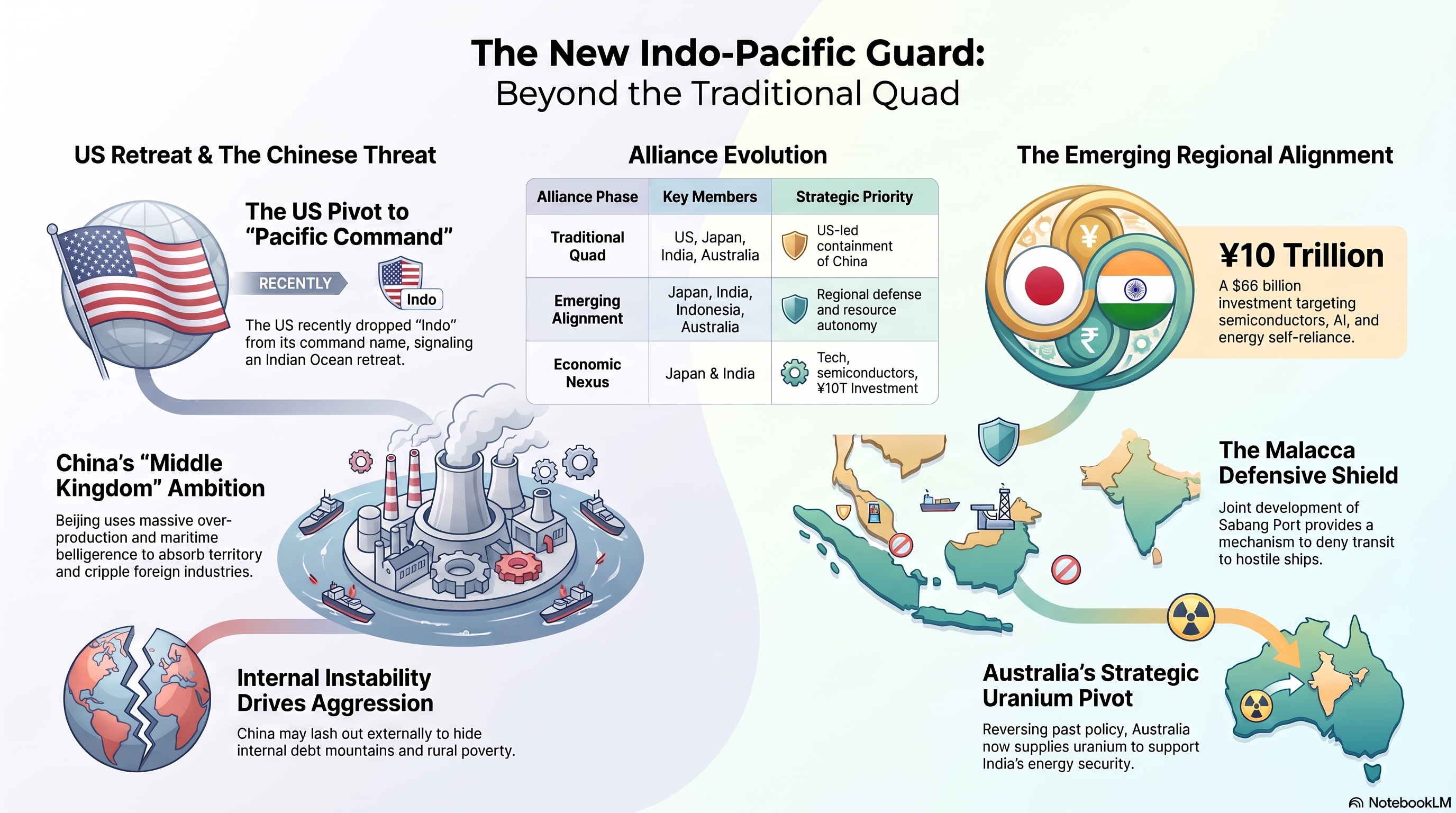
A version of this essay was published by firstpost.com at https://www.firstpost.com/opinion/the-old-quad-is-dying-time-for-a-new-quad-14030966.html The Quad, a 2007 partnership broadly intended to contain China’s hegemonistic ambitions in the Indo-Pacific, was a brainchild of then-Japanese Prime Minister Abe Shinzo. It makes sense: China is rampaging in its neighborhood, and gives every sign of wanting to either grab territory that belongs to others, or bully them into acquiescence and tributary status. The belligerence that created the current Chinese empire, that is the forced absorption of Tibet, Xinjiang, Inner Mongolia and Manchuria into the core Han coastal heartland, is part of a harking back to ancient Chinese empires. Xi Jinping, perhaps even more than Mao, embodies a hankering to be the almighty King-Emperor of the erstwhile Middle Kingdom The US unwittingly allowed China to rapidly de-industrialize it post joining the WTO, and to come up with a business plan that calls for massive over-production and the resultant price collapse, which is a template they use to rape and pillage industry after industry. A recent casualty is Germany’s prized automobile industry: bellwether Volkswagen has been forced to lay off 100,000 workers, brutalized by a tsunami of Chinese electric vehicles. However, as Utpal Kumar points out in an insightful essay, all is not well in Xi’s kingdom: e.g., the debt mountain, paranoia as seen in regular purges of military brass, and propaganda that conceals all bad news (did you hear of a small plane hitting a tower in central Beijing? Yes, a mini-9/11. But the information was blanked out). Continuing rural poverty is also censored, although Indians on x.com posted images of extreme filth and poverty, far from the glossy high-rise, bullet-train image that Chinese propaganda projects. Paradoxically, that is precisely what makes China yet more dangerous: it will probably lash out in external adventurism to preserve legitimacy internally. Thus the need for sober containment of China’s destructive power. The US, which has been the natural candidate for reining in this rogue power, has now demonstrated that it is retrenching. It has, for instance, demonstrated that it is no longer willing to indefinitely support its NATO allies. The “nuclear umbrella” that it has offered Japan may also be getting a little threadbare. It is likely that President Trump invaded Iran with the good idea of denying China oil both Iranian and Venezuelan oil, as retaliation for China’s squeeze on rare earths. Alas, that has turned into a fiasco, creating collateral damage for innocent bystanders such as India. In game-theoretic terms, if an isolationist “Fortress America” mood has descended on the US, then a “G2 condominium” with China may be the simplest option, as I said several years ago. If the US has indeed acquiesced to China being the hegemon in its sphere of influence, namely the Indo-Pacific, then there is good reason for the jilted...
0:00SPEAKER_00You know,
0:02SPEAKER_00if you look at a printed map of the world,
0:04SPEAKER_00there's this really comforting illusion of permanence.
0:07SPEAKER_01Right.
0:07SPEAKER_01The borders look like they're set in stone.
0:09SPEAKER_00Exactly.
0:10SPEAKER_00The borders are drawn in thick, bold ink.
0:12SPEAKER_00The oceans are this solid, immovable blue.
0:15SPEAKER_00But if you look closely at the geopolitical reality of the Indo-Pacific right now,
0:20SPEAKER_00that printed map is more like an Eche sketch.
0:23SPEAKER_01That's a great way to put it.
0:24SPEAKER_00Yeah, I mean, someone is violently shaking it up.
0:26SPEAKER_00The lines are blurring and a completely new architecture
0:30SPEAKER_00of global power is being drawn in real time.
0:32SPEAKER_01It's a dizzying pace of change.