
Series 7 Whisperer · capadvantage
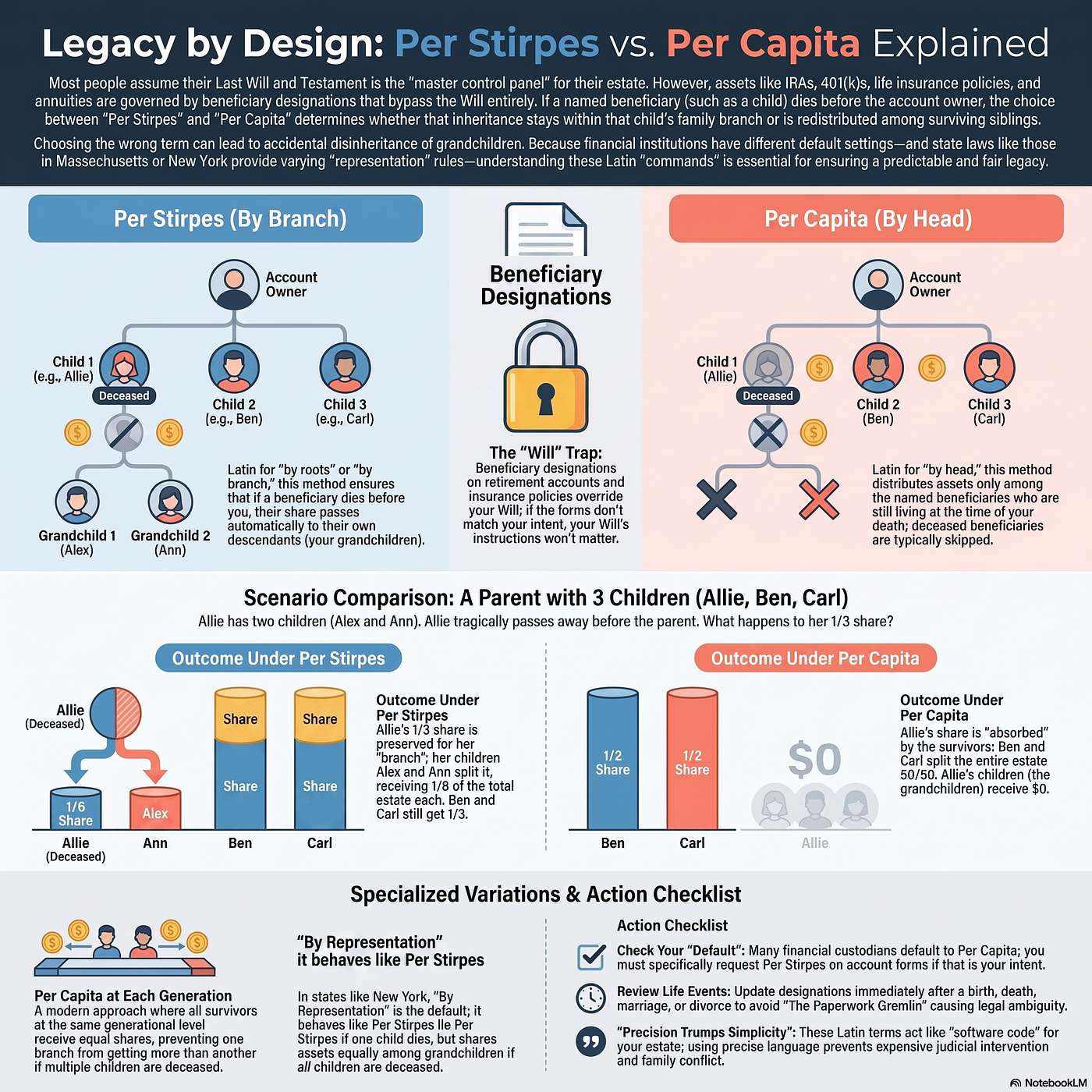
Send us Fan Mail The difference between these two distribution methods comes down to how the "class" of beneficiaries is defined, which radically changes who is included in the final headcount (since per capita translates to "by head"). Here is the breakdown of how each designation works: "To My Children, Per Capita" Who is included: The beneficiary class is strictly confined to your immediate, first-generation children. How it works: The estate is divided equally only among your children who outlive you. If a child predeceases you: Their share is permanently lost to their family branch and is instead reabsorbed and divided among your remaining surviving children. The grandchildren belonging to the deceased child's branch receive absolutely nothing (0%). Why it's used: This approach is often chosen by individuals who want to keep assets concentrated strictly within their immediate living generation—for instance, to prevent minor grandchildren from inheriting complex assets that could trigger court-appointed guardianships. "To My Descendants, Per Capita" Who is included: The designated class expands exponentially to encompass all living direct linear descendants across all generations. This includes surviving children, grandchildren, great-grandchildren, and so on. How it works: The estate is divided into equal shares based on a total headcount of all surviving descendants, regardless of their generation. If a child predeceases you: The deceased child's share is added to the total pool, which is then split equally among all living heads. Consequently, grandchildren will inherit equal shares right alongside their living parents, aunts, and uncles. Why it's dangerous: This method often results in a massive dilution of individual shares. It can also create significant family friction, as your living children will see their portions drastically reduced by the sheer number of grandchildren and great-grandchildren counted in the distribution. A Practical Example To illustrate the difference, imagine you have an estate to pass on. You have three children, and between them, they have given you seven grandchildren. Tragically, one of your children passes away before you do. Under "To My Children, Per Capita": Your two surviving children would split the entire estate (50% each). All seven grandchildren would receive $0. Under "To My Descendants, Per Capita": The headcount would include your two surviving children and all seven grandchildren (totaling 8 living heads). The estate would be divided into eight equal pieces, meaning each child and grandchild would receive a 12.5% share Support the show 📚 About the Podcast Real-world finance explained the way exams and real life actually test it. Ideal for the SIE, Series 7, Series 65/66, and anyone who wants to actually understand money—not just memorize buzzwords. ⚠️ Disclosure This podcast is for educational purposes only and is not a recommendation to buy or sell any security. Opinions expressed are solely...
0:57SPEAKER_02So imagine uh writing a check for one million dollars to your grandchildren, right?
1:03SPEAKER_02You put it in a bank vault, and then a corporate computer glitch just well, it legally sets it on fire the exact moment you die.
1:10SPEAKER_01Which sounds completely absurd.
1:12SPEAKER_02Right.
1:12SPEAKER_02It sounds like a dystopian novel or, I don't know, massive hyperbole.
1:17SPEAKER_02But it isn't.
1:18SPEAKER_02It is literally what happens every single day when financial advisors and, you know, just regular individuals misunderstand a two-word Latin phrase.
1:27SPEAKER_02So welcome to the deep dive.
1:28SPEAKER_01Aaron Powell Yeah, we are looking at a legal landscape today that functions uh honestly like a financial trapdoor.
1:33SPEAKER_02Aaron Powell A trapdoor, I like that.
1:35SPEAKER_01Because we all assume our final wishes are insulated from the chaos of the real world, right?
1:39SPEAKER_01Because they're written down, they're notarized, they have fancy stamps on them.
1:42SPEAKER_01Trevor Burrus, Jr.
1:42SPEAKER_01Right.
1:42SPEAKER_02You pay a lawyer five grand and think you're safe.