
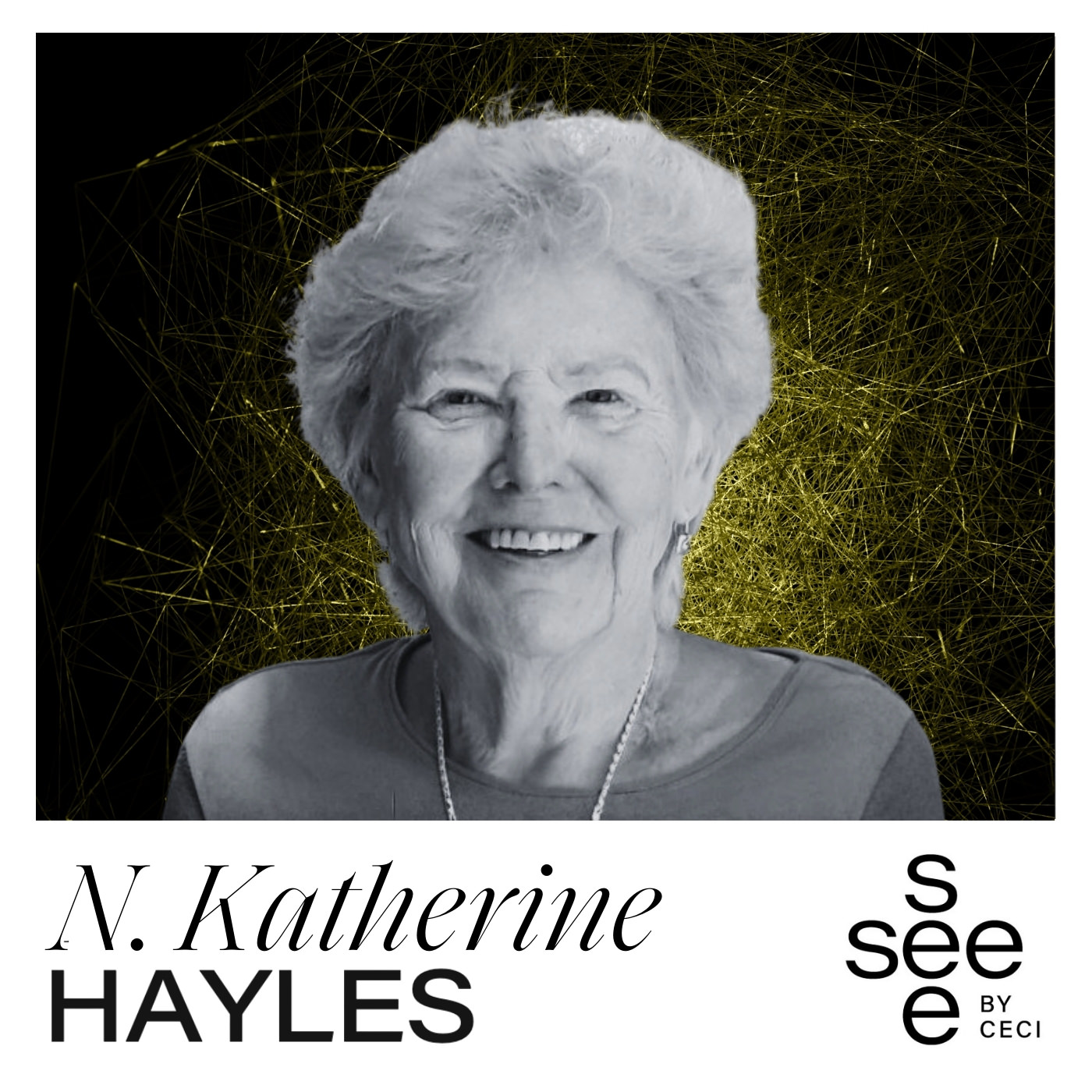
See See by Ceci · Dr. Cecilia Ponce Rivera
In this episode of See See by Ceci, N. Katherine Hayles, Distinguished Research Professor at UCLA, James B. Duke Professor Emerita at Duke, Guggenheim Fellow and member of the American Academy of Arts and Sciences, joins us from the rare crossroads at which she has worked for forty years: literature, science, technology and, now, artificial intelligence. Trained as a chemist at Rochester and Caltech before crossing into literary scholarship, she is a foremost authority on the relations between literature and computational media, and the author of How We Became Posthuman (1999) and, most recently, Bacteria to AI: Human Futures with our Nonhuman Symbionts (University of Chicago Press, 2025). In this rich and demanding conversation, Hayles redefines cognition as the interpretation of information in contexts that connect with meaning, a capacity she ascribes to bacteria, plants, fungi, animals and, increasingly, AI. She walks us through her integrated cognitive framework and the SIRAL criteria (sensing, interpreting, responding adaptively, anticipating, learning); through von Uexküll's umwelt, the world each species spins for itself; through cognitive assemblages in which humans, microbes and machines decide together; and through her sharp distinction between actors and agents. As a literary critic, she also turns her gaze on AI-produced literature, on hallucinations as imagination, and on Walter Benjamin's aura in the age of the deep fake. With reflections from neuroscientist John Cryan on the gut microbiome, historian Richard Bourke on the Kantian self, classicist Richard P. Martin on AI and imagination, and choreographer Alexander Whitley on embodiment. This is an episode about the uncoupling of cognition from consciousness, Hayles' most crucial move. About a posthuman in which the human itself is being rewritten. And about the very determined optimism of a thinker who insists that hope is not the reward at the end of the work, but the precondition for it. N. Katherine Hayles is the author of twelve influential books, including the landmark How We Became Posthuman, widely regarded as a seminal foundation for posthumanism, My Mother Was a Computer: Digital Subjects and Literary Texts (2005), Unthought: The Power of the Cognitive Nonconscious (2017), and her latest, Bacteria to AI: Human Futures with our Nonhuman Symbionts (University of Chicago Press, 2025). A member of the American Academy of Arts and Sciences and recipient of fellowships from the Guggenheim Foundation, the National Endowment for the Humanities, and the Rockefeller Foundation, Hayles has transformed our understanding of the digital age.
0:07Speaker 0: Undoubtedly, artificial intelligence can interact both with consciousness and non-conscious awareness.
0:17Speaker 0: Yes we should be concerned because there are enormous risks here.
0:23Speaker 0: any time a species enters into deep symbiosis within other species they're always risk.
0:33Speaker 0: When I published my book How We Became Posthuman which is now quarter of a century old the title was conceived in an ironic mode as if we had already become post-human.
0:47Speaker 1: The
0:48Speaker 0: issue here is, If We Are In An Era Of Eroding The Human Aura?
0:54Speaker 0: If the originality of human person being challenged by all these new technologies how can that serve a liberatory purpose not merely be the loss of nostalgic past.
1:10Speaker 0: So I think that real key here is to understand, That The Human Is a Social and Cultural Construction And We Are Jointly Collectively As A Global Society In The Process Of Fashioning What The Human Means in The Twenty-First Century.
1:39Speaker 1: Welcome To CC The podcast where you see what others see.
1:53Speaker 1: Hi there, good morning!
1:57Speaker 1: So today uh... What are we talking about?
2:03Speaker 0: Hello
2:05Speaker 1: hello can you
2:08Speaker 0: hear me?
2:10Speaker 1: Ceci here is anyone there?