
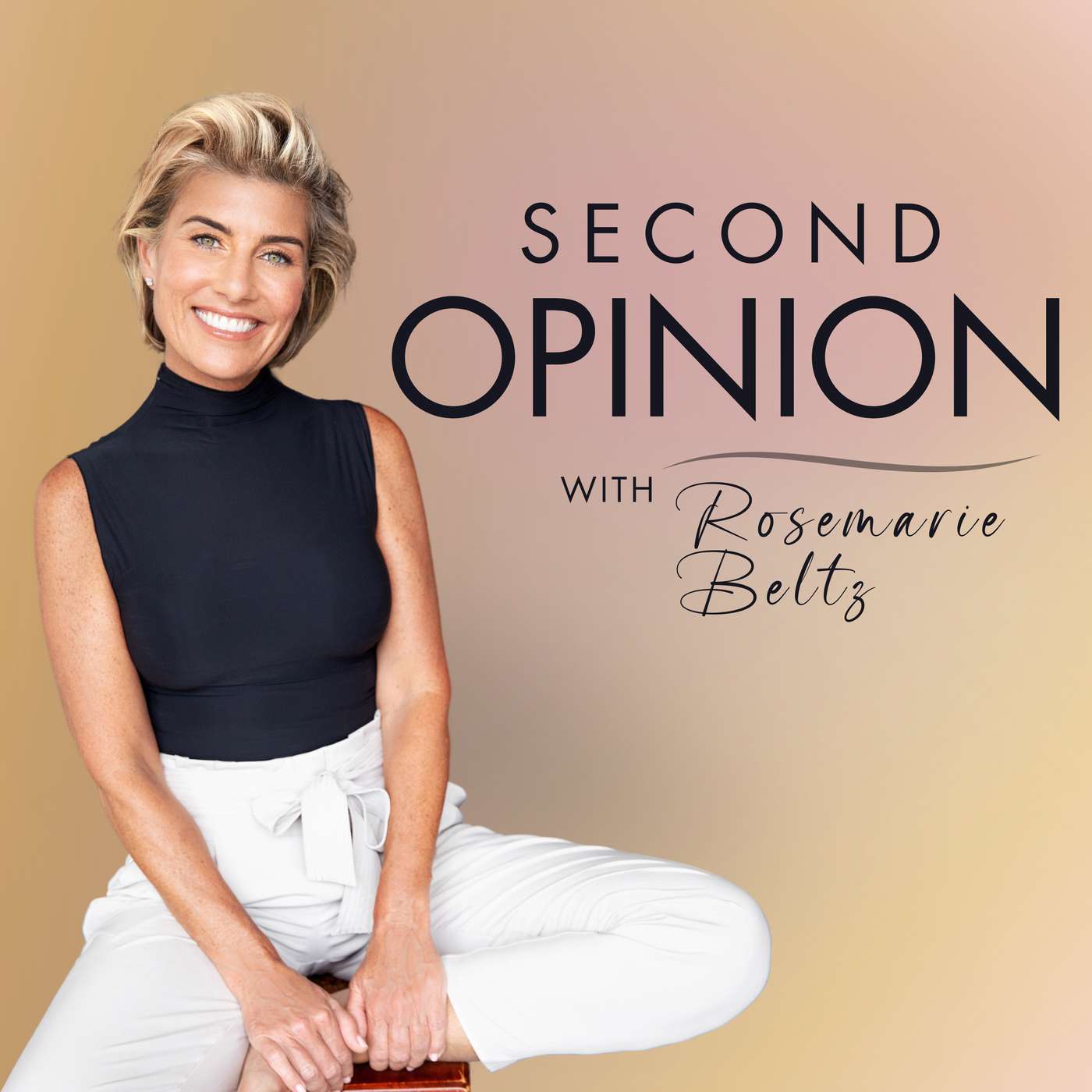
Second Opinion with Rosemarie Beltz · Rosemarie Beltz
What if the biggest lesson of midlife isn't learning more...but learning to trust yourself? In this milestone 50th episode of Second Opinion, Rosemarie Beltz reflects on a journey that has spanned decades of healthcare, journalism, achievement, loss, reinvention, and ultimately, self-discovery. After producing fifty episodes independently and reaching listeners in fifty-six countries, Rosemarie realized something unexpected: the story she thought she was telling wasn't really about podcasting, media, healthcare, or even midlife. It was about self-trust. For most of her life, she trusted authority, credentials, institutions, accomplishments, and the opinions of people she respected. But as life unfolded—with the loss of her beloved dog Oscar, the experience of building her first home, and the evolution of Second Opinion itself—she found herself confronting a deeper question: How do you know when to trust your gut instead of your fear? This deeply personal solo episode explores the invisible search for permission, the surprising limitations of credentials, the difference between intuition and anxiety, and why some of the most important decisions in life cannot be outsourced to experts. Rosemarie shares lessons learned from nearly three decades in medicine, her transition into journalism, the realities of creating an independent media platform, and the profound shifts that occur when we stop asking to be chosen and start choosing for ourselves. If Episode 49 explored the cost of trying to earn your place, Episode 50 explores something even more important: What happens when you finally trust yourself enough to take it. IN THIS EPISODE ✔️ Why high-achieving adults often seek permission without realizing it ✔️ The hidden difference between achievement and self-trust ✔️ How fear and intuition can sound remarkably similar ✔️ Why credentials can only take you so far ✔️ The surprising lessons grief teaches about what truly matters ✔️ How losing Oscar clarified Rosemarie's priorities ✔️ The difference between building a career and building a life ✔️ Why getting into the room doesn't always make you admire the people inside it ✔️ The evolution of Second Opinion from podcast to community ✔️ How midlife changes the way we think about time, energy, and purpose ✔️ Why self-trust may be one of the final great lessons of adulthood KEY TAKEAWAYS Fear screams. Intuition whispers. Credentials and character are not the same thing. Permission is often disguised as preparation. Grief clarifies what matters. Midlife is less about proving and more about choosing. Communities change lives. Self-trust is built through action, not certainty. Courage is not a personality trait. It's a practice. You may not need more information. You may need more trust in yourself. A NOTE FROM ROSEMARIE When I launched Second Opinion, I thought I was creating a platform. What I discovered was that I was building a community. Every message, every conversation, every story you've shared...
Rosemarie Beltz: Have you ever noticed that some of the loudest voices in your head aren't actually yours? The voice that says, be practical, don't risk too much, work harder, get one more certification, one more degree. Wait until you're ready. Wait until you're sure. Wait until somebody tells you it's a good idea. If you've listened to episode 49, we talked about the cost of trying to earn your place. This episode is different because then eventually the question becomes, what happens after you stop waiting for permission? I'm Rosemarie and this is Second Opinion. The exhausting belief that if we worked hard enough, achieved enough, prepared enough, proved enough, and perfected, maybe we'd finally feel secure. And judging by the responses, that conversation held up a mirror for a lot of people. It certainly did for me. But here's what's interesting. The truth is this, I wasn't planning on making episode 50 about courage. I thought it was going to talk about intuition. And I promise I'm still going to deliver on that promise. However, it has slightly shifted since I've been researching a bit. Fear versus instinct, trusting your gut, how do you know the difference? I had pages of notes. I had the idea, the whole thing. But the more I reflected on the last year, losing my dog Oscar, building a home, producing 50 episodes on my own, essentially, reaching listeners in 55, 56, and counting, countries around the world, the more I realized something. None of it happened because I ever felt ready. It is the complete opposite. It happened because I started. And that realization changed the entire episode. Because when I really sat with it, marinated on it, thought about it, slept on it, I realized that almost every meaningful thing that's happened in my life began before I ever felt prepared, before I ever felt ready, before I ever really felt sure of myself. Yes, I thought I felt sure of myself, but there was always this underlying belief or feeling of insecurity before I felt confident, before I felt certain. And maybe that is true for you as well. For most of my life, I trusted degrees. Childhood taught me to trust authority. School taught me to trust grades. Medicine taught me to trust in credentials. Journalism taught me to question institutions. Media taught me to question gatekeepers. Achievement taught me to trust accomplishment incessantly. But somewhere along the way, life began asking a different question. Not what do you know? But do you trust yourself? Now, that is a completely different conversation. That is in alignment with intuition. And honestly, that is the conversation I think we're gonna have today. Because after a lot of contemplating and really sitting on this, I was thinking about my life and my upbringing and the generations that have come before me. Because I have come from people who worked. They worked really hard without question, without questioning themselves, and without questioning authority. My mom is the youngest of six kids. My dad is the middle of 13 or something like that. To be honest with you, my father's family is so big. I have probably 50 cousins on my father's side of the family. I'm thinking he's about the middle of 13. My grandparents and my family did what they needed to do to make ends meet. There is no doubt about that. They sacrificed. They showed up. They carried responsibility. Responsibility that probably wasn't even theirs to carry. They built things. They went to war. And I have enormous respect for that family legacy matters to me very much so. And part of who I am and my ambition came from wanting to honor those sacrifices, wanting to make them proud, wanting to make the most of opportunities previous generations worked incredibly hard to create. And that is a beautiful thing. But here's what I've been also realizing. Family legacies don't just pass down values. They pass down survival strategies. Work hard, be responsible, play it safe. Don't waste anything, especially opportunities. Be very practical, be compliant. And all of those lessons make perfect sense and they create law abiding tax paying citizens. The challenge is that sometimes the survival strategies that helped one generation survive and thrive become the emotional ceilings the next generation has to learn to push through. Not because anyone did anything wrong. This is not about blaming or anything like that because life changes and it evolves. Look how fast life has changed just in the last five years. And maybe that's one of the greatest challenges of midlife, learning which lessons to keep, tuck away in that hope chest, and which lessons need a little bit of updating, a little bit of a facelift. My family taught me how to survive. There is no doubt about that. They have grit, Irish immigrants, and the tenacity about them that quite frankly, I wish I had a smidge of the strength that both of my grandmothers have. And I say my grandmothers because I don't really remember my grandfathers. My mom's father passed before I was born, and my dad's father passed when I was very young. So I happened to spend more time with the grandmothers of the family. They taught me how to make ends meet. Midlife is teaching me instead how to choose and choose for myself. Years ago, long before Second Opinion existed, I had a bit of an idea. Actually, I've had a lot of ideas along the way. Full disclosure. But for this episode, intentionally, I had an idea for a health platform. I've always had ideas for a platform, even when I was in journalism school. But then that evolved into a media company, a place where medicine, journalism, curiosity, and real life could sit at the same table and have discussions. And because I rarely mix business with friendship, very much so, I did something a little unusual. I went to a couple of friends that I deeply respected, very successful women, people who had built companies, people who understood business way more than I have up, you know, until this point, and still do. And I brought them my idea. And looking back, I realized something. I wasn't really asking whether the idea would work. I was asking whether they believed I could do it. Very, very different energies. Because sometimes we think we're asking for advice, when we're really asking for is a little bit of validation. Permission is one of the most invisible things high achieving adults chase. They do this without even realizing because they're so caught up in the striving and proving. We disguise it so beautifully. We call it research, prep work, due diligence, being thought out, being responsible. But underneath it is often the same question. Do you think I can? Do you think I'm ready? Do you think this is possible? And eventually, it made me realize nobody was coming with a permission slip. Nobody. And maybe that's what adulthood really is. And we know all these things, and we think about these things. But I put it together in this podcast. Because even as I create and learn every single day, I still realize I questioned my doubts and value. Maybe that's what adulthood really is all about. I you know, it's like when we're kids, we're told what we to do. And when we're in school and heck, even if we're an employee, we're pretty much we know our responsibilities. And then we get older and we work so hard to have options. And then we get to this point where we have options and we have so many decisions to make sometimes we kinda get lost in that. I've actually gone to my parents. I'm like, please tell me what to do or my mentors. And nobody wants to be responsible for that. Nobody wants to be put in that situation. And I get it time and time and again. You know what to do. You're a smart woman. I'm like, am I? Do I know what to do? And realizing that nobody is coming to hand you a script for that next chapter, it's exciting, but it can also be a little exhausting, decision fatigue. And at some point, you have to write it yourself. Not my friends, not my mentors, not the audience, not the industry that you're in. Zero. Nobody. And oddly enough, that turned out to be one of the most liberating realizations of my life. Because the moment I stopped waiting for someone else's opinion, I started. I put my money on myself. And then life taught me something I never learned from a classroom. One of the strangest realizations of midlife is discovering that credentials can only take you so far. They can get you in the room. Heck, they can even get you a seat or maybe close to the table. They can get you opportunities. They can get you respect, admiration, but they cannot tell you who to trust. They cannot tell you which relationship is right. They cannot tell you when to walk away. They cannot tell you to run. They cannot tell you what matters. And they certainly cannot tell you who you're becoming. And at some point, life asks a different question. Not what do you know, but do you trust yourself? Do you believe in yourself? Are you brave? Like, do you have confidence in your ability? Talent and grit at the end of the day, common sense, and street smarts. And there I have it. And I think that's why midlife is such a beautiful thing because we go through all these lessons and then one day, all the dots connect. And one of the surprises as we age is discovering that getting into the room doesn't automatically make you admire the people inside it or even want to stay in the room. Some of the most disappointing experiences of my life came from rooms I once idolized. Medicine taught me that. Media taught me that. Success taught me that. Lots of times, I rarely care about what is going on behind the curtain anymore. Credentials and character are not the same thing. And that realization forces you into a much, much deeper conversation with yourself and with the world. Because eventually you stop asking, who should I listen to? And you start asking, what do I know to be true? Which brings us back to fear and intuition, which I did promise. The topic that I thought was gonna be at the root of this conversation. Fear and intuition can sound remarkably similar, especially if you spent your life being responsible, especially if you spent your life trying to get things right. But I've noticed fear screams really loud. Intuition is not loud enough. Sometimes it's only a whisper. Fear wants certainty and proof and receipts. Intuition wants honesty. Fear creates urgency and white knuckling. Intuition creates awareness, space, and peace. Fear catastrophizes. Intuition patiently observes. Fear demands an answer. Intuition asks a question. It wants space. It wants harmony. It wants alignment. And one of the most useful things I've learned is to ask myself, does this feel urgent or does it feel clear? Am I shrinking in this situation or am I discerning and weeding things out? Am I protecting myself? Or am I limiting myself? Does this person welcome questions? Do they welcome my opinion? Do they welcome my 2¢? Or are they punishing them? That last one has saved me more times than almost anything else. Because healthy people welcome dialogue. They welcome thought out conversation. And they also welcome challenges. They actually want you to challenge. Healthy relationships welcome thoughtfulness. Organizations are the same way. People with integrity do not fear curiosity. They actually embrace it. And maybe that's why second opinion exists. I don't know. I'm still figuring it out. Because originally, it was an outlet for my frustration. But I do believe questions matter in all seriousness. Curiosity matters. Second opinions matter. Not because they're always right. No. Not at all. Because they create perspective. And perspective usually changes things, and it can really enhance and change your life. This year, grief taught me that as well. When Oscar passed away, I thought I was grieving a dog. Yes, I was grieving a dog and my BFF. What I was actually grieving was a whole entire chapter of my life. Who I was at 38 years old, who I was at 40 years old, who I was at 45 and 50, all the way up until 53. Grief has a way of stripping performance right off of your body revealing just pretty much everything. It doesn't care about your resume. It could care less about your achievements. It does not care about your to do list. Grief asks, what matters? What is real? And what remained for me was and is very clear. Love, loyalty, connection, trust, family, meaning, community, purpose. And if I haven't said it, integrity. Just feeling good about how I'm showing up in the world. And with that, I am building my Brooklyn home, my Brooklyn apartment that I've dreamt up my entire adult life. And what surprised me is that constructing this home isn't really about furniture. It's not about paint. It's not about square footage. It's about identity. It's about asking how do I want to live? Who am I becoming? What is next for me? Like, what is my next era even gonna be about? For most of my adult life, I was building a career, so much so, I've kinda had blinders on along the way. Today, I'm deciding to build a life, a life that I feel really good about, a life that feels in alignment with all of my values. And they're not always the same thing. A career is gonna ask like, what do you do? And by the way, this isn't wrong. I mean, the majority of people walking this earth identify with what they do for a living. However, life asks, who are you? What do you want? Who do you wanna become? Because I personally don't think that ever stops. We are learning and evolving every single moment of the day. And maybe that's why this podcast has evolved too. Because when I first started out to launch Second Opinion, I thought I wanted a platform, a media platform, a place to, you know, post video content and interviews. But what I discovered is that I really wanted a community. Platforms are great, right? They are a place where we can amplify voices, but communities make a difference in the world. And somewhere along the way, this stopped feeling like a podcast, and it really started feeling like a conversation. And every time I see another country show up in the analytics, I am ecstatic, completely surprised because it reminds me that somebody somewhere is asking the same thoughts and questions about purpose, medicine, health, identity, loss. Things that I hope to provide in this space, growth, what's next, how do I trust myself? Those are human questions and concerns, which bring me back to where we started. Episode 49 helped me understand why I spent so much of my life trying to earn my place. This episode helped me to understand something else. Looking back, I think self trust may be one of the last great lessons among midlife. Okay. Maybe not last, but one of the ones that we sort of like start to peak with. Life wasn't asking me to earn my place anymore. Life was asking me to choose it, create it. Very different energy. And maybe that's what these first 50 episodes have really taught me. Not how to build a podcast or anything, not how to interview better, not how to grow an audience. They've taught me that courage isn't a personality trait. It's practice. A decision you make over and over again, a promise to yourself every day. Every time you tell the truth, every time you trust yourself, every time you begin before you feel ready. I spent decades learning who to listen to. Midlife is teaching me when to listen to myself. And maybe that's the invitation for all of us. If this episode resonated with you, share it. Not because it's helping an algorithm, because it helps the conversation. The midlife movement we're building here grows one thoughtful chat at a time. One shared episode, one meaningful discussion, one person realizing they are not alone. That's how communities are built. That's how change happens. This is how things move forward. And if you'd like to continue the conversation, jump on over to rosemarieb.com because quite frankly, it's almost like life. At fifty, fifty episodes, I truly believe it's a 2.0. It's an opportunity to just begin again and again, but not from scratch. You are bringing all of those fifty years, that that advantage with you. And that is super exciting. So yeah, we are just getting started. We're just warming up. And I'd really love to have you along for the ride. Now, next time I am celebrating a birthday, and I've been reflecting on what this chapter has taught me and what I am desiring up for my summer. What surprised me, what I finally understand, what makes sense, and what I could use a little more this summer, and what I would tell my younger self if we sat down for a coffee somewhere in the world. So look out for that. This is now really all starting to feel personal. Listen, we know that life rarely unfolds exactly as planned. You know, we probably found that out many years ago. But sometimes, as we know, after a real dose of life experience, it doesn't fold exactly as we need. And trusting that along the way. And often the things that change us the most begin the moment we stop waiting for permission. From New York City, from one curious midlife to another, I'm Rosemarie Beltz. This is Second Opinion, where curiosity is the real fountain of youth and age. Age is absolutely the advantage. Until next time.