
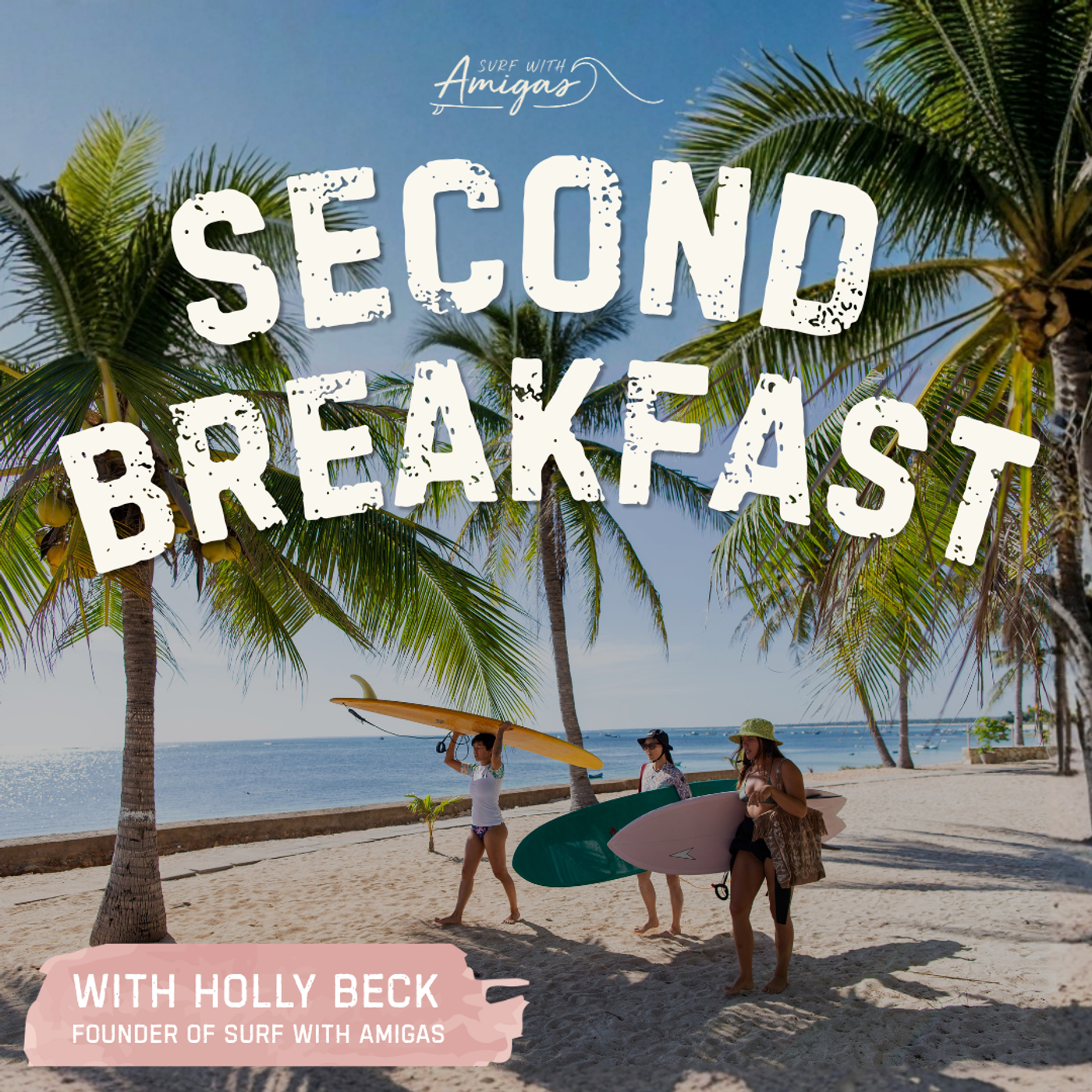
Second Breakfast with Surf With Amigas · Surf With Amigas
After years of climbing the corporate ladder and navigating major life transitions, amiga Kati took a leap: walking away from stability to build her own consulting business from the ground up. In this episode, she shares the mindset shifts, hard lessons, and unconventional tools that shaped her journey. Her greatest key is her “joy menu," a personal system she created to break out of ruts, interrupt bad habits, and reconnect with what actually fuels her. Sit down with us as we chat about what it means to redefine success on your own terms, and how to create career and mindset shifts that align with your personal growth. Surf With Amigas runs surf coaching and yoga retreats for women in Nicaragua, Costa Rica, Mexico, Peru, Morocco, and Indonesia — http://surfwithamigas.com Train with us! online.surfwithamigas.com
Holly: Hey, amigos. I just got a chance to connect with someone that I've been trying to connect with for years now, but you know, when the timing is right, the timing is right. And we finally were able to chat about being a woman in business, kind of some themes that we've talked about in other episodes about when you get to a certain age and you decide that the stress of a corporate life or working for somebody else is no longer serving you. Emma: Hey, Amigas, we've been putting a lot of effort into our online training platform and I want to make sure you know about it. SWA online is a membership based platform that is packed with surf tutorial videos categorized by experience level and board length. You can learn everything from how to wrap your longboard leash so it actually stays on to tips to troubleshoot backside tube riding and everything in between. Holly: And it's always interesting to me to hear like, was the moment? What was the catalyst for making that change? And so Katie shares her story and talks about what she's doing now and what the future of running a business might look like in the age of technology and the way that business is changing. But more than anything else, she explains the concept of the joy menu and how Emma: all taught by super knowledgeable female surf coaches. There's also surf specific yoga classes, workout programs, surf edits to get you frothy and interesting and inspiring stories from women in our circle. There's both a monthly and yearly membership option, but if you're not looking to add another one of those to your collection, there's also the option to buy individual courses and workout series like our six week. Holly: Where are you checking in from in the world right now? KT: Yeah, so I'm back in Portland. ⁓ I actually am just coming off a Surf with Amiga's retreat in Mexico at El Muro, which was fucking amazing. ⁓ my god, it was so fun. Ugh, I turned 50 on that trip too, so it was like... Holly: she was able to use that to break some habits that were no longer serving her. And I think that is the thing that I am going to be taking with me over the next few days as I, as I think through what would be on my joy menu. So take a listen and I'd love to hear what you'd put on yours. KT: special Briant Belif. ⁓ And then I went to Costa Rica for about 10 days after that. And then I just got home last week. ⁓ And ⁓ actually part time in Portland now. And I live part time in Bend ⁓ because I teach in Bend. And we'll talk about that. So I'm either in Bend or in Portland. But this weekend, I'm in Portland. And I'm telling you what, it's the first dose of kind cold, rainy weather I've had in almost a month. Emma: Surf Trip Ready Workout Program, which is probably the most popular on the platform. If you've got a retreat coming up, you definitely want to check that one out. So head over to surfwithamigas.com and click on the Surf Tutorials and tab to check it all out ⁓ and I'll see you there. KT: It's kind of messing with me today. I'm not going to lie. I'm like missing those warm, dry days from surfing in Mexico and Costa Rica and everything. So yeah, that's where I'm at. Long story short, Portland. Holly: Yeah, I would almost feel like I sort of expected you to say like, ⁓ and it's so nice to like be cozy and inside with the tea and be able to get work done. No. KT: No, no. Part of no because this is our like eight months out of the year, you know? And what's weird is this year we didn't get any snow. which is like really challenging. If you live in the Northwest and you love snowboarding and surfing and all that kind of stuff and you don't have any snow, it just makes the rainy weather like, what's the point? And I have to remind myself, because I love living in the Northwest because it's green, it's lush. Like, you know, our environment here defines, I mean, really defines like how we live. ⁓ And so normally I'm cool with it, but because we didn't get the snow, it just makes the rainy season long. Hence why I ran away to Mexico and Costa Rica. So I can't complain. My first world problems are overflowing right now. So yeah. Holly: Yeah, we are at the very end of the dry season and it actually today was the first day that it was like a real like daytime rain and I was, I was surfing and then I came in and I was sitting on the beach and it just dumped rain. Like it was like, absolutely. It was like showering like outside and that was really cool for the first like 15 minutes. And then I was just like sitting on a log, like shivering with like all the dogs also were just like hunkered down and. It was like that mix of like, this is good, we need the rain, this is beautiful. And also I'm ready for the sun to come back out. So no matter where you are, it's like the rain has its good and bad. KT: Yeah. Yeah. Right. Holly: yeah, it's fun to connect with people who I have known for years. I I've known you for years now. think recently we launched our like, buy 10 get one free ⁓ 10 club. And you you were one of the ones that came to mind as someone that was like up there in the 10 range. But I only know you, you know, I know you as an Amiga and I know that you're a badass and you do all these cool things. And I've kind of, you know, heard stories here and there, but. KT: Mm-hmm. Holly: These chats are a fun way to get to know you a little bit deeper and share some of what you've been up to. But it's always fun to hear a little bit of your story of getting into surfing. So how did surfing first come into your life? KT: ⁓ it's such a good question. was thinking about this recently. So yes, I just celebrated my ninth retreat with Surf of the Amigas. And when you and I first met, it was like, I mean, I think you'd maybe done a season, maybe. I don't know. It was in Nicaragua. And I remember just being like. I'm going on this surf retreat. My friend had watched you on what was the House Hunters or whatever. And she was like, you got to go do this retreat, blah, blah, blah. And then of course, I fell in love with everything you were doing and Coco Loco and all the things. And then I was like hooked on Surf with Amigos after that. ⁓ So yeah, it was many moons ago, almost 15 years ago. Yeah, well, it's like. Holly: time. KT: 500 lifetimes or what it feels like. So yeah, surfing, I grown up in the Northwest and so in Portland in Oregon. And when I was in high school, I had a bunch of guy friends. I've always been into board sports, like sports in general, but definitely stuff like skateboarding and snowboarding. And ⁓ I had a bunch of guy friends and one girlfriend that were learning to surf in high school. And she was dating this guy and he was like the surfer in school. Well, in the Northwest, back then, that meant there were like six people in the water in total. We were all wearing 5-4-3s and it was probably raining and the conditions were probably chaos and we were like, this is amazing. ⁓ And so we all would like go and camp out. could camp at the beach back then and in this like amazing like. like wooded area called Short Sands. And now it's like a day use spot, but back in the day you could camp there. And it's literally like Lord of the Rings-y type fairy, Gnomey land where big tall trees and just like, you you're camping in the Pacific Northwest. It's pretty like rural and rugged. especially back then. mean, this is the 90s, right? I just turned 50. So that was a long time ago. And so that's how I first started. And I remember my first surf session was with my friend and her boyfriend. And he essentially, the advice he gave me was don't drown and follow me. And I was comfortable in the ocean, but I had no business, none. following him into where we were. And of course, then I was just getting thrown around like left and right. But I'm a pretty rugged person. And then I was like, I love this and just kind of fell in love. I mean, honestly. And then over the course of the last, what, like 25, 30 years, ⁓ even though that was my first introduction, I've fallen in and out of surfing and yeah, just kind of collected people along the way, traveled along the way. My surfing, it's weird. It's like up until this last trip, it like progresses and then it dies out and it progresses and then it dies out because you know, I just don't invest enough time and energy honestly in getting into the water as much as I should. But then I'm like, well, go snowboarding or I'll go skateboarding or something like that. So it kind of balances out but it's not the same thing. So yeah, that was my first time. My journey with it has been so much love and just like in and out and falling in and never really falling out of love, just not investing as much time and energy. as I would have liked. Holly: I mean, to think that, you know, you're a few years older than me, not many, but a few, and that you got into surfing. I mean, those are the early days of surfing. Like I would, it almost sounds like maybe you started surfing before I did or like right around the same time. So I can only imagine. I know when I, I grew up in LA and getting into surfing in the nineties, I think I, my, was like 94, 95 getting into surfing. Like there were very few women. I can only imagine how many there were up in the Pacific Northwest. KT: Yes, like two. And I think I knew both of them. What was cool was that then in my 20s, like none of my friends really surfed other than these like group of guys. And you know, that was just a vibe. wasn't, I like was into, but not really. And then my best, best girl, she ⁓ won a contest, a contest. might've been like Surfer Girl Magazine or something like that to go to Costa Rica for like three weeks. And she's an Amiga. She's been on trips to my girl Sally. And she went on this amazing surf trip where she lear and she came back and surf moved to the coast a really became like the want to go and surf wi a great surfer. She's and she and I've been in s grew up in sport togethe up snowboarding together So if there's ever a time o I'm always like, okay, I w beach or let's go on a tri spent two and a half weeks together on that ⁓ Mexico and Costa Rica trip. And we've been best friends for 35 years. So without her, I don't even know. mean, honestly, it'd be so lonely because now I have more friends that surf because it's just gotten more popular here in the Northwest. But in those early days in our like 20s and 30s, like, yeah, without her, I probably wouldn't have been going. So I owe a lot of it to her. Holly: And how do you feel about how surfing has changed? Like in the beginning it was really hard, it was really rugged, but there was a lot more freedom. Like you could camp at this. I've actually been to short stands. My ex sister-in-law lives in Portland, so I've spent a little bit of time in that area. And I know what you mean. It's like so gorgeous. I can't even imagine how cool it would be to be camping. And also it's cold and... you know, wild and now it feels like surfing has gotten friendlier and easier and how do feel about how that has changed and your relation to it? KT: Yeah. You know, I mean, I again, like being in the Pacific Northwest, like our again, our environment really does. influence a lot of who we are as human beings here because you have to be able to roll with some inclement weather. And if you don't like inclement weather, you're going to be sad and probably depressed. Like you got to get out in it to love it. And so for me, like that part growing up in Portland's pretty central in the Valley, right. It's an hour and a half to the coast, an hour and a half to the mountains. So I just for me, like surfing was one of those things where just being able to be in the elements and doing something that was so rugged and beautiful. It didn't even matter if it was like a shit day or pouring rain or whitewash or like whatever, because it's like, ⁓ this is amazing. Now when I go, I mean, it's definitely gotten busier. ⁓ But what I would say is like... You can still have a fair, I mean a lot of space. It just depends on where you go and if you follow the report and if you're going during the week, you know, it's kind of like with anywhere. The Northwest is interesting because I think more and more people have discovered the outdoors here, which I actually love in the sense that. you know, the outdoors are for everyone and I'm seeing a more inclusive space and more diversity and all of that. And I love that. And so for me, I'm like, I don't own any of this business, right? I just am here to support and protect it and make it feel inclusive and accommodating. ⁓ So I kind of almost in a weird way living here and spending as much time in the outdoors and I worked in the outdoor industry and stuff. So I feel a little bit like, Not a shepherd, but like a protector, but also like a welcome mat, you know, because again, it's not mine. Holly: Yeah, and I feel like there is a little bit of a fine line to walk there, right? Like I know I encounter that as well because like you, I feel like this isn't mine and I want to, I love that more and more women and kids and people of all body types and everything are getting into surfing and that's really cool. And yet also there is this element of like, ⁓ but it is special and it is like, yes, it's like abundant. And also like those days that are really magical are KT: Right. Holly: always that abundant and how to kind of find that balance of like, I'm going to welcome you in and I'm going to encourage you. But also there are some like rules of the game here and this is how we're going to take care of this place and this is how we're going to take care of each other. And do ever find that it's hard to find that line? KT: I do. I think it's hard to find that line in the outdoors in general. I I experience it a lot here on trails, honestly, because more and more people. Hiking is probably like the most accessible, I would say, like outdoor sport in the Northwest. And it didn't. It used to be that I would go for hikes even here in Portland. We've got what over 30 miles of pretty like raw forest hiking trails. So it used to be I would be out in the back like part of that, which would be like a version of a backwoods in many other parts, but for us it's like an urban park with my dog off leash roaming around, really, you know, intending to see anybody. And then all of a sudden now I come up on like hiking groups and you know what I mean, runners and like now now it's busy and I don't see the owls anymore and I don't, you know, so yeah, I mean, I think between surfing, I experienced that. think on the trails I experienced that definitely snowboarding. mean, snowboarding is tricky because it's so expensive here. I mean, really anywhere, but here in particular. So I only go like during the day, in the morning when no one's around and it's like a Tuesday, you know? So I think that's the way that I've managed it is I have a really flexible schedule. And so I tend to be in the outdoors when everyone's at work. That's my new play for the back half of my life. Holly: Thanks. KT: Yeah, when you walk away from your corporate job, it's amazing to figure out like, ⁓ shit, I can benefit from all of this because you guys are all at work. Love you, thank you for doing that. Holly: Yeah, so let's talk about that. So what was your path? remember, gosh, it's been a couple years now when you were just starting to branch out on your own and do your own thing. And then looking at your website now, looks pretty awesome. So can you talk about like, what was your career path in the corporate world before you decided to do your own thing? KT: So I spent about 20 plus years in corporate. ⁓ I like to couch it as fashion to fork. Meaning I worked in fashion, I worked in outdoor, I worked in sport, I worked in food, all in the kind of product creation zone, which is like design, product management, product development. And I had an amazing career. worked for Nike and Columbia Sportswear and Banana Republic and ⁓ moved into the food space here in the Northwest, which is like crazy abundant, right? Because we have so many amazing farmers and ranchers and growers in general. It's just a really sweet space for food. And I loved every bit of my career, lived abroad, traveled internationally for, I mean, literally, I think I was like. Jet lag, the majority of my 20s and 40s and early 40s. And like, I look back on that and I'm like, fuck yeah, like what an amazing life. That's how I got to see the world on somebody else's dime. And that was kind of the design of the career I wanted. And went to school and did all the things. And then in about 20, 23. Yeah, about 2022, 2023, I decided that I'd had a couple of really big girl jobs, C-suite level, and experienced what it's like to be running companies at a level that I had always kind of figured I would and wanted to work towards, and then realized the stress of it and realized that there's a lot, you get dumped a lot, and you have to raise a lot of money all the time, and the politics were rough, and I just wanted to figure out a different way forward for this, phase three of life. And I realized that the thing that I really wanted to do was to pay forward all of the amazing just opportunities and privilege and skills that I have and also combine that with creating a lifestyle that was more accommodating to the kind of stress I wanted. You can't really live a life without stress. It's modern America. Like it is what it is. But I wanted to create the stress and I wanted to design the flow of my life. You can't really live a without stress. It's modern America. Like it is what it is. But I wanted to create the stress and I wanted to design the flow of my life. So ⁓ I essentially left lot of really amazing opportunities behind. and started my own consultancy and through that started doing a lot of leadership and people-centric, kind of strategy-centric workshops and retreats and consulting gigs. And that parlayed into any number of amazing opportunities. And now I'm a professor and I'm consulting and I'm getting ready to launch some new stuff in my business this summer, which is really exciting. ⁓ I do a lot of just workshops and retreats for women in leadership, women in Holly: Bye KT: business, which I love. And yeah, I just, you know, I went through a lot of shit from 2019 to about 2023, like we all did and stuff that honestly probably could have crushed my soul and spirit. And so I needed to find a different pathway forward. And that's what I'm on now is figuring out kind of inviting that in every day to see, see what see what might come see what might happen. So yeah, that's where I'm at now. Holly: I mean, that story seems really seamless. Like, ⁓ I lived my dream and I traveled the world and I worked up and I'm a badass in the C-suite. And then I was like, yeah, I want a different type of stress. So I'm gonna transition to do all these things. I'm sure that that's not exactly how it went. there something in particular that was like kind of the wake up call or was like a bunch of things all adding up? Because I would imagine that it might've been a... KT: you Holly: decision to make. KT: ⁓ yeah. You know, honestly, I, lately I've been, because I was, I'm 50, I've been in this like retrospective space where I'm like, when did this actually ⁓ all kind of start to shift? And what happened was, I mean, honestly, if I go back and I won't save you the saga part, but in 2018, I was a big runner for a really long time, probably like 10 years. And was always like running, running, running, running. And I was working at Nike. And like, again, I was jet lagged all the time. And I was in this beautiful, what I thought was beautiful long term relationship. And it was just great. And then one, and I had a small business in the community that was very focused on women. And ⁓ so it was just like, everything was aligned and I was out for a run one day, just like a spring day. Actually, it was technically two weeks ago, nine years ago. And I slipped and fell running, but I fell in the splits and I severed my hamstring. And in the moment and then tore like every muscle in my, and this was in my right leg and I'm goofy. So everything I do is right leg, right? So what happened from that moment though, is it changed the course of my life because all of a sudden I was like on the couch for four months, on crutches for six months, had to relearn how to walk. Like everything changed in this like split second. And I remember that time period like it was yesterday, cause sometimes, know, like we could, riff on this, like, you know how they say, if you've ever read that book, the body keeps score. You have this like, your body wants to close the loop until the trauma is sort of solved for. And even still to this day, I will wake up like right when I, when I fell. So my body's not fully there yet. And so, which means my spirit isn't either. And at that time, all of a sudden I realized that like, it had to have happened for like a reason. I didn't know what the reason was. I didn't know why, but I started to gather that I was living this like really intense and I'm a pretty intense person. ⁓ I tend to run really hot and always in ambition, always in fire. And I was looking at my life and I'm like, ⁓ my gosh, everything is on red. Your stress level, you're running, you're working, you're traveling, you're kind of a beast at home. You're like training for something all the time. I had no like, I follow Chinese medicine. So I had no like yin to my yang. I was just like full fire. And... That was like a beginning to what then became a tipping point and literally the domino started to fall from there. By 2019, I had to have another surgery. the love that I was with at the time, his twin brother passed away. And then it was like, I just needed to make some major life choices. And so I left Nike and I took my first C-suite job and it was running a restaurant company that I had never worked in for or for before. And I took that job. at the beginning of 2020. So then I'm like running this intense organization during a pandemic, which for a type A like gang oriented person, I will like feed my soul. You know what I mean? It's like a drug. Well, it Holly: you KT: pretty much like created an avalanche of what was to come on the other side, which was this like culmination of those handful of years of me just supercharging to then all of a sudden my relationship fell apart. I got fired. Menopause showed up. I started abusing drugs and alcohol. And I just literally like fell off a cliff. And I spiraled for probably a good two years in there, 18 months, two years. And at August 1st, 2023, I got to a point where I was like, I mean, abusing drugs and alcohol on my own in privacy, like in secrecy, to a point where I had to really check myself and get sober. So that was the catalyst to rebuilding what I'm doing now. And so to your point, it wasn't the series of like, I didn't feel very badass during that point, right? I was like, what was at my quintessential bottom? And I never thought I would ever be a person that would see a bottom. Honestly, I was pretty like in control of all my shit. But it was like, I couldn't get my head wrapped around or my spirit wrapped around grief and, you know, love loss and job loss and ego. and menopause and just all the, mean, I just couldn't get a hold of it. And it got a hold of me, that's for sure. So the last three, almost three years have been a total shift, rebuilds, redirection. And that's. Holly: So how do you do that? Because, I mean, it's like, okay, now the story is kind of taking shape. that I get the injury and then you're on couch and then the pandemic and, ⁓ you know, the relationship ⁓ shift. I mean, ⁓ that's completely reasonable that that would be super challenging and, you know, and alcohol are really coping mechanism and then spirals. Like that all makes sense to me. KT: Mm-hmm. Holly: And thank you so much for sharing, I'm sure you're not alone. And it's not something that a lot of people really talk about. So how do you then realize that you've hit rock bottom and start to turn that around? KT: That's such a great way of asking that question. So I've been a weed addict since I was 13. the place where don't, alcohol is like a salve, but alcohol was never my go-to, it was always weed. And so what happened was I was dating somebody new and I'm grateful for him. He checked me pretty hard. And I realized one day I was like standing out on my patio. I'm like looking at it now. And it was like a Tuesday in the middle of the day. Like I said, I would have been, I should have been surfing, but I was getting high on my patio and I had been using other drugs like, you know, mushrooms a lot, cocaine, like all sorts of stuff. I just was trying to over medicate to feel something. I could not feel anything. It's really in reality. If I go back in time, I was feeling less. And I was standing out on my patio and I was staring at this tree that I look at all the time. And I'm like at this point smoking grams of weed just to like feel it, right? That's a pretty high tolerance, especially for someone in their late forties, like career person, right? And I realized that I had been doing like little lines of this or that from like, like people would do for lunch and I couldn't get any higher. And I said out loud to myself, holy shit, I don't think I can get any higher. But I still couldn't feel anything. And it was this moment that was like my, know, people will say you have like a moment. That was my moment where I realized I didn't have the control anymore. I like was a it's weird because I hold the energy in my body sometimes where I can actually feel it. It was like not like a lightning bolt, but like a little like pulse of energy that freaked me out. And it was it literally had a voice and it said to me, like, you don't have control. And ⁓ I, course, didn't like rush to get sober the next day. It was like four or five months later. But that moment was an awakening for me. for me, like sobriety, I did alone. I did it solo. I did it with my therapist. I didn't go to, you ⁓ community with that. And none of my friends are really. And now a couple of them are sober. But at time, like, This is my hometown, right? So I've got loads of friends and people that are in my community and everybody smokes weed here. So for them, it was like no big deal. And meanwhile, I'm like, it's a big deal. And you know, I recently actually recorded a podcast about my journey with like marijuana sobriety because most people don't really talk about the abuse levels that you can get to there. ⁓ And so I think what's kind of terrifying about that is it's going to be the next wave of abuse because it's so readily available and so many people are switching from booze to weed and kids and it's so much more intensive than it was when we were growing up. ⁓ So anyway, long story short, I hit a bottom standing in the same place I stand. I stood many, many times getting high and realized that like, ⁓ my God, if I don't get like, get this under control, like my whole life. could implode. And that was pretty terrifying for a person who's really ambitious and generally in control. So yeah, terrifying. And that's pretty much what was the catalyst. Holly: Yeah, I feel like I definitely identify with that feeling of like feeling safe when I feel like I'm in control. And and so that recognition that that you're not in control is that that makes sense that that would be the thing. It's like, OK, I'm now I'm not in control of my own self. And that is a problem. But it's not easy to make that decision. And like you're saying, if you have a community that it's so prevalent, then. KT: Right. Holly: I can imagine that would make it really challenging as well. like part of, you know, it's part of life there, right? KT: Yeah, I mean, it's absolutely. I grew up around a lot of growers and farmers and all that. And what I realized going through this, I mean, I was, I had to like take myself out of society for probably the first 14 months. I didn't see anybody. I just worked on my business. I mean, that's when I built my business was through sobriety and I needed to really remove myself. because what happened for me, and it's interesting because it came up a lot on this most recent surf trip, ironically enough, was that all of a sudden I didn't have, know, when you're not in control and you're a person who's used to being in control, you start to second guess yourself, at least I did, about pretty much every choice I was making. And I was hesitating a lot about a lot of things. And what was... really weird about that was I'd never been like a person who hesitated. I'm like, you want the job, go get the job. You want the school, go to school. You want to take up skateboarding, go start skateboarding. You want to date that person, ask them out. You know, like I was not a person to like, ⁓ I just didn't, I never really have fear. And then going through that process, like fear showed up. And it's interesting because even on this most recent surf trip, I went into it with like, the only intention I went in was Do not hesitate. Because even in surfing, right? It's like hesitation, you can get hurt. Hesitation, you can miss the wave. Hesitation, you miss the fun. Because you're too busy, like, is it going to be too big? Am I going to go over the falls? Am I going to eat shit? And I really gold myself on this last trip. was like, it doesn't matter how many waves you catch. It doesn't matter how beautiful they are. None of that matters. Just do not hesitate. Commit and go. And for me, I had to like, I did this exercise with my therapist and it was called ⁓ creating a joy menu. And so because I wasn't getting sober in community because I didn't trust my community at the time and I was super socially like awkward and weird and just needed to stay home. I had this joy menu and I could put anything I wanted on it ⁓ that made me feel like, honestly, that helped with my dopamine. And What actually what had happened was when I got sober, I had to like rewire my dopamine levels because when you're super stressy in a corporate environment and you use drugs and alcohol to medicate, your dopamine levels are like jacked and out of whack. So I took everything out of my life. No coffee, no drugs and alcohol, no shopping, no men, no sex, no nada to reset. And that made me like a Holly: Wow. KT: Well, that was so boring. ⁓ my God, it was awful. Holly: So, but I mean, so how do you, how do you do that? Like, what were you replacing those things with? Cause I would think that that would, like, how do you, how do you do that? I, as I, as I hold my cup of coffee right here, I'm like, I'm not giving my coffee up. Come on. KT: Yeah, because you're a fox. Oh, tea girl. mean, tea, like, I'm a tea nerd now. Honestly, this Joy Menu, my therapist and I, she's like, are you going to go to, you know, AAMA or NA? And I was like, probably not. And she said, OK, well, let's put together program that you can work on your own. And she had this amazing idea called the Joy Menu. And she just said, pick 10 things that let's put together program that you can work on your own. And she had this amazing idea called the Joy Menu. And she just said, pick 10 things that Create joy in your being, either your energy level or your emotional or something, and put it on the list and put that list in five places. So anytime you have a craving, you pick something from the joy menu and you go do that. Create joy in your being, either your energy level or your emotional or something, and put it on the list and put that list in five places. So anytime you have a craving, you pick something from the joy menu and you go do that. So I'm telling you what, I probably walked my dog five miles a day. ⁓ I took up skateboarding a lot. ⁓ I worked out a lot. I read 1,000 books, ⁓ built a business. ⁓ use this joy menu as like a place to channel that energy and the healing and the like kind of getting to the root of my addiction and trauma and just like all that shit that's there and figure it out a way forward in it. And it's, mean, I work the joy menu still to this day and it's been two and a half years. So that was like my saving grace because without being in community. ⁓ I don't know how you really do like people some people go cold turkey and I don't I mean those people are amazing to me ⁓ and I guess I did that but I did it with the help of at least a therapist and at least this like practice of This joy menu because without it. I don't think I would be here sober today. Probably not Holly: I love the things on your Joy menu. It's like walk the dog, read a book, build a business, you know, like just basic things that anybody can access. KT: Okay. Right, I know. also, like, I became a total tea nerd. So then I was just like, me all the different types of teas. And I basically explored the world with tea. Like, yeah, I mean, it's funny, though, because I think about it now. And I was sharing with a friend of mine this idea of the Joy Menu. And she was like, I'm not going to take up skateboarding. And I was like, well, I mean, I don't know what to tell you. But skateboarding brought so much into my life because it was like, something I had done as a kid, but I was not great at. know, skateboarding, yes, while it's similar to other board sports, it's not the same because it's so unforgiving when you fall. And all of a sudden, I was like out at the skate park with kids all the time and teenagers. And then I realized that like that brought so much joy and hype that it was like a different kind of high, you know? ⁓ So when I... The Joy Menu skateboarding was like number one, two, and three some days. And that helped me a ton. Holly: So what kind of skate, what we're talking about, like the skateboard with the helmet and the pads and the ramps and stuff? Cool. KT: Bull on. Yeah, I definitely met a boy. That helped. ⁓ Man, whatever. ⁓ Holly: don't know, you're talking about teenagers at the skate park, and you know, no judgment, but... met a boy at the skate park. Okay. ⁓ KT: I know, I can definitely rephrase that. I met a Moana who at the skateboard had children who, yeah. But yeah, I mean, I just started to build this community around skateboarding. And here in Portland, we have this organization called Skate Like a Girl. ⁓ Yeah, which was really killer. And I was going to their stuff a lot. And yeah, I mean, I went for it. And what's hard about skateboarding is I have now broken my wrist and hand three times in the last three years. Holly: I've heard of it. KT: So it's funny because before I went on this most recent trip with Sally to El Morro, she was like, stay off your skateboard for at least four months before this trip. I showed up at one of the retreats in Nicaragua just out of a cast and she was so pissed. She was like, if you ruin our trip because you went out there skateboarding, I'm going to kill you. So yeah, skateboarding has been, it's just amazing. And it's an amazing community of people. It's totally, it's like. the highest of the high and the lowest of the low when you hurt yourself, but it's amazing. And when I wasn't getting into the water and I wasn't able to go to the mountain, it was like kind of fed that also that like board sport love, you know? So yeah, I mean, the joy menu was everything. And now even two and a half years in, I would say, I mean, and again, coming off this most recent Amigos trip, I feel like this like fear is starting to subside. and I have like a new sense of foundation in myself and a different kind of confidence that is different than the young woman confidence that I had, that I could like do anything and conquer everything and like, ah, you know, and now it's like a deep knowing of a different kind of confidence. And I really like it. Like I like turning 50. I think it's gonna be rad. And I'm here for this next phase of the ride, you know? Holly: Epic. Yeah, it's that's something sentiment that I've been working on embracing myself as I look at 46 in a few months. Yeah, that feeling of like, okay, my body is different and my energy levels are not the same. And also I have Yeah, like you, I think you put it really well. It's not that like young brazen, I can do anything. It's like a like more mature knowing that I can do anything. KT: Yeah. Mm-hmm. Bye. And you do it almost with, I don't know, like I felt even like on this most recent surf trip, what occurred to me was I had more grace. I don't know if that makes sense, but like, I think because I realized that when I was surfing when I was younger, it was like sport to me. Like I put that type of like competitive with myself type brain into it. Because again, if you grow up, in that environment, you're always raw on. You like train on and you're like, you know, and I had to remind myself like, I don't get paid to surf, I'm not you. It's not my, know, does it like, it's for joy, right? It's for play. And so not that it's not for you, but you know what I mean. It's like, it doesn't pay my bills. And so I realized on this last trip, I was like, ⁓ shit, like I'm finally here. I have been waiting to get here with it, which is this is just about play and joy and beauty and grace. And so the more that I leaned into it's funny, Sally said to me, she's like, you've caught more waves on this trip than I have ever seen you catch on any of the trips that we've been on. And I swear to you, it was purely because I was there not hesitating and I was treating it with more grace and ease. And I loved it. was so wonderful. Yeah. Holly: That's awesome. It's like you got out of your own way, it sounds like. KT: Right, because otherwise, like my big old fat ego, she shows up and she is a beast sometimes. So, you know, I have to own it. It's there. And every now and again, when you just like can figure out a way to tell it to just chill out, you just get so much more, you gain so much more, you know. Holly: So you want to talk about the business that you launched and how is that process different than the experiences that you had when you were working for other people? KT: Yeah, that's a great question. You know, I didn't grow up in an entrepreneurial family. ⁓ My parents are academics and educators. So even when I went into like corporate America, in my family, was kind of like, I mean, my brother's my brother's similar. He's kind of a corporate guy, also an entrepreneur. So but we always joke that like we just didn't grow up in an environment where like business was a conversation. was like politics and academics and nerdy shit. Right. And so Holly: you KT: when I decided to go into business for myself, it was hard for my family to understand because for them, my dad was at the same university for 40 years. And so why would I leave Nike, first of all? Like, why would you do that? And most people don't choose to leave Nike, right? And especially where the career trajectory I was on. So when I made the choice to leave and when I made the choice to try these other jobs on and then ultimately start my own show, my family, supported me, but they were curious, right? And so what happened essentially was I'd never been, I mean, I'd been an entrepreneur because I had a side hustle with a really dear friend of mine and great business partner, but I'd never been a solopreneur where all of a sudden you are, you're every team member, right? I mean, you know, it's like your first days of starting stuff when you're alone in that. you can come up with a million ideas, but if you can't execute them, it really doesn't matter. So I think like the beginning stage. So my business is shape shift is what it's called. And I essentially named that because I was in this place of flux, like shape shifting who I was as a female leader, who I was as a strategist, who I was as a human being in the world. And many of the people that I interacted with from a professional setting, especially once they'd hit like 30s and 40s were also going through their own shape shift. Like what does this mean for my life? What is purpose? What is my mission? You know, what do I want to do? If you're a woman, how do I stay relevant in business? Like all these like really big challenging ⁓ topics really. So for me, when I started ShapeShift, I knew that I wanted to stay close to product creation because it's the thing that I love and strategies like. I'm a nerd for it. I want to talk about it all day long. And so I just started kind of putting it out there to my community. Look, I'm going to go freelance at the time, right? I'm just going to freelance the things that I did in corporate and we'll see what happens. So I didn't really have like a huge plan when I went into it, but I knew I had a brand and I, you know, I've been in brand work for a long time. So I knew what I wanted it to look and feel like, which was very kind of riot girl, honestly, like a little edgier than what's in the industry, which tends to be very buttoned up and khaki pants and like very pressed, right? And I swear a lot and talk, I don't know, I just didn't fit the mold of like a true consultant in that space. So all of a sudden I had this, I forgot, I had this amazing network and started working with all the companies I had been an employee for. And then it started to parlay into working with small businesses and women owned businesses and. people who were doing startups and big turnarounds and like all of a sudden it started to get really amazing. And that's what I've been doing for the last two and a half years. What's cool about it is this summer, I'm getting ready to launch my first kind of big product out of my brand, which will be called Seril. And Seril is going to be an experiential learning platform that teaches creatives business fluency. So. When you're product creation, I work with a lot of innovators and designers and developers. many of them, I mean, honestly, they're creating things that are leading the world. But often, they struggle with business fluency, meaning they don't necessarily know about their own leadership identity or their strategic emotional intelligence or a P &L or strategy, right? And so I just kept doing this work in my business. ⁓ And I discovered, was like, but I don't want to charge people $10,000 a day to do that. I want to figure out a way to service the creative community, differently while I keep my big old clients, but like service the community differently. so because I'm a professor and I teach students this stuff, I have all this amazing content. And so I'm packaging it and we'll be building this experiential learning platform to help creatives influence organizations and the future of their strategy, perhaps better and differently. ⁓ and up level their business fluency. Yeah, I'm super excited about it. It's going to be so much fun. And I just love creating stuff. So that's what I'm working on now. And it'll be a combination between running ShapeShift and working in Serle and teaching. And yeah, that's kind of the future that I see, at least today. Holly: Amazing. It sounds like technology is a key part of your strategy going forward. KT: Right. Yeah, it's interesting. I host this entrepreneurial hiking group on Fridays and we were just having a conversation about it because one of the people in my group, she works in AI and she was asking me, what's your relationship with it? And I'm like, I'm in full relationship with technology. I'm not great at it by any means. But when you think of, I mean, again, I teach 18 to 20. four year olds. So I see who they are. I see how they learn. I see where they're headed. I see the gaps in their learning and in their critical thinking and in their, you know, in some of their skill and capability areas. But I know that the medium to communicate with them is digital and tech. So right, it's like even though I'm full on 50 year old Gen Xer, it's like figuring out my own comfort zone and nuance so that they can benefit from the content is really important because ultimately I want them to feel like they can be the next generation of leader in these organizations. So yeah, I've got a lot of learning to do. Holly: It's, I mean, it's got to be a scary thing if you are teaching ⁓ people of that generation. mean, I'm, my kids are younger, so I'm not there yet. But in talking to amigas who have older kids who are in college or, you know, contemplating going to college and what they're going to study, or even the ones that are graduating now, it seems like that education path that at least I grew up with, and maybe you too, hearing that you are the child of academics that You you get good grades and then you get into a good school and then you choose a major that's gonna get you a good job and then that's the path. And it seems like that is no longer the path or at least it's not so clearly the path. KT: Right. Yeah, I mean, it's interesting. Part of the reason why I'm I've started Seril too, is to help kind of fill the gaps, right? Because a lot of students won't choose to go to college. They may choose to study a trade. I mean, the trades are booming, right? They may, I think we're going to have, so if you think about the demographics of the U.S. just in particular, 96 % of our business community are entrepreneurial, meaning most of our businesses are small businesses, right? So we already have that undercurrent culturally here in the U.S. So it's appropriate that this next generation, those of the students who don't choose to go into ⁓ an academic setting or work for big corporate setting, which is usually that's the funnel, right? You go get a degree and then you go to work for somebody. ⁓ They're gonna start their own businesses. so I think that's quite beautiful. ⁓ I also think there's a lot challenge with that because to be successful in your own business takes anywhere from three to five years to see if it's gonna work. And, you know, that takes capital, that takes mentorship, that takes blah, blah. And so I think that the challenge is what I'm seeing in my students is that many of them are really eager to learn and they want to go to work and they want to do a good job and they want to learn, you know, on the job too. But there's less opportunities for them. And one of the things that I really work with them on is like, I'm like the easiest grader you've ever met in your life girl. Like I don't do quizzes, I don't do tests, I don't do midterms, fine. channels, any of that. But I challenge them in their critical thinking constantly because the difference for them is... many of them will go into organizations that, at least right now, as the pendulum swings, that will be those entry-level positions where they would have learned how to apply critical thinking to strategy or how to take data and turn it into story or how to influence an organization with information, which is usually what first-run jobs are about. Those are going to go away. With the swing of the pendulum, those are going to go to AI. So my students have to figure out how to jump that first job and come in more equipped. Well, that's assuming that an organization understands how to then mentor them from that place forward. Many organizations do not. So I actually think we while it's it's challenging for students, I actually think also it's really challenging for organizations and the organizational design and psychology, the future of that, the course of the next zero to 10 years is going to be fascinating to watch and participate in because I want to prepare the students and the young kind of emerging talent. And I want to also help the organizations to meet them where they're at so that we don't just get this completely just stalled out community of students and then organizations that are just churning out the same shit because it's all AI driven. So yeah, I'm super curious about this intersection point. Holly: That's a really interesting perspective. hadn't considered it from the organizational standpoint, but that makes sense. And so if you do, it does seem like the education has to shift in order to, as you're saying, like teach those things that you would normally learn at an entry level position in the job. Like you need to be able to have those skills then to get past. got to be better than the AI at doing these certain things, which is tricky. I mean, somebody like you that has had an entire career working in these different roles and moving yourself up, like it's a lot easier for you. Not that it's easy, but it's easier for you to start your own business already having had these experiences in the different places. But somebody who hasn't had that and doesn't have, you know, the financial stability either, it makes it so much more challenging. So that's great that there's people like you out there that are have that mindset go, okay, these are, this is what these students need to learn in order to be successful. KT: ⁓ yeah. Right, well thank you. I am learning as I go too. And yeah, I'm with you. mean, that's part of the reason when I made the shift in my career too to pay stuff forward. you know, I've got, I have a bachelor's, I've got two master's degrees. I'm about to start a PhD program in about probably six to 12 months. So for me, I'm flush. I got too much. But I'm so grateful that my life has afforded me the ability to do that. And I think my responsibility and accountability is to pay that forward. Because sure, I was saying to a friend of mine last night, I can do whatever I want. that's such a privileged place to be. And it also comes with, I think, really extreme and important responsibility to pay that forward. And so the part with my students that I'm loving right now in particular is they just also want to hear about the opportunities in life. Because they're looking at the landscape and they're like, I want to go design for this company. And I'm like, that's cute. You probably will be able to do that. But you know what? You're probably going to have to organize the sample closet first. That's what we all had to do. So you're probably gonna have to sweep the studio, organize the sample closet, and do some pretty basic shit you're not gonna wanna do. And I'm afraid to tell you, that's still probably, A, I can't do that. So you know what, that's a great job for you. So look for the opportunities that are analog. Look for the opportunities where you can build a unique skillset that may not be the job, the dream job that you want. Holly: Yeah. KT: And it's interesting because, ⁓ I'm kind of obsessed with this trifecta of like, then now we're going to get real nerdy, intergenerational, intertechnological, and intercultural that's happening in our organizations. And the intergenerational thing is fascinating because we have what, five to seven generations in an organization now? You're speaking five different languages. ⁓ And so I'm just watching my students really kind of get super excited, but also they're pretty terrified that they won't be able to find work and life is expensive and all the things that we hear about. So if I can make that a little bit, that transition a little easier and more empowered, I'm here for it. And then the flip side is it's the organizations, it's my clients. The amount of older 40 to 60 year olds that just sit around and complain about young talent, I'm like, You have got to change your tune. Your job is to bring that young talent into the fold. Your job is not self-preservation. But it happens. Holly: Well, I mean, I would say that the the complaint that I mean, even even even the organization that is Super the Migos that doesn't have so many generations like it, there is a little bit of confirmation bias going on maybe. But I also see potentially a difference in the younger generation that I don't know what the right word, the politically correct way to talk about it on the podcast. But KT: Right. Holly: And, know, I was like, ⁓ like I was, you know, doing this and this and this and working like all these hours and like all of our team, well, you know, of course it was my business. So I had that incentive, but you know, all of the team, there were fewer of us doing more jobs for more hours. And, and now it feels like the younger generation is so good at boundaries and like good for them. But also it's like, dude, your boundaries are a little intense right now. KT: Last one. No, it's not. it's fine. It's to your point. It's like striking. It's like the generation, a generation. So again, like I have clients that are Gen Xers and Boomers and I have clients, I use my students, right, who are Gen Z and soon to be Alphas, right? And what I discover in that is like, it's so challenging for the older generations to recognize. We, Holly: I don't know, is it just me? KT: we can only look at a lens to your point confirmation bias like through our own lived experience. And I look back at some stuff and I'm like, I wish I would have had a boundary. And I get irritated that you do because I didn't, right? And so in reality, it's like, and some of the time you guys that are younger just have to suck it up and do the thing, whether it feels good and nourishes you or like, or not, like it's a choice, but if you want the reward, sometimes you got to suck it up and do it. And so I just find that like for me, when I'm having these conversations, especially if it's like real time, I'll just check my students and be like, yeah, I hear you saying that, that you don't want that job because you don't want to have to do those things. Great. That's a choice. You're also missing out on X, Y, and Z opportunity as a result of making that choice. You choose, right? Are your boundaries that firm? Is your mental health, you know, like the thing that you have a ⁓ maybe parked it into, right? Like, I don't want to work that much because I have a lot of students with side hustles, right? So they want to be able to do it all. And I get it. And it's all choice, right? And same from our generation kind of looking down. It's like, we also were brought up by an entire generation of people who are now sitting on the majority of the wealth in this country. And so they want us to do what they did because it worked for them. Well, was a totally different context, totally different time, totally different system. Same system, I guess, but different time. So yeah, it's an interesting puzzle. And I love being a dare, it's pretty egocentric to say, but like a thought leader in it because I get to explore this stuff all the time. And it's so fun. Holly: Yeah, super cool. Well, I think that the thing that I will take from this more than anything else is the Joy menu. I really love that. I feel like that's something that I can even incorporate ⁓ in my day when there's the things that I feel like I need to do and I don't want to do. And it's like, OK, I'm going to choose from the Joy menu. And how am I going to? KT: Yeah. Holly: How am gonna approach the day when I'm selecting from these things? KT: Yeah, and you know, the thing I'll say about the Joymen just in closing on it is like, ⁓ it can change, right? It's a little bit like our values. Like, I don't know if you do any values work, but like, if you did your values when you started Surf with Amigos, the values that you have today, they probably may have like, if you do your top five, one or two are probably gonna be the same, but three, four and five might have changed just by nature of your life evolving and where you are in your season. And the thing about the Joy Menu that's so cool is like stuff changes. Holly: Yeah, absolutely. I mean, I it makes a lot of sense. That really resonated with me. So I'm going to continue to kind of ponder that, try to work it out in my own life. So thank you so much for sharing. really appreciate it. I'm so glad that we got to connect and thanks again for your flexibility and for sharing your story. you seem very confident in sharing it, but I know it's not always easy to talk about those ups and downs, or it's a lot easier to talk about the ups and the downs. And I think it makes it more... KT: I love it. Holly: more relatable because everybody goes through that stuff. So thank you. KT: Right. Well, yeah, anytime. I just, I have to say like, Surf With Amigas has given me so many opportunities to explore who I am as a human being, who I am as a woman, who I am, you who I want to be. And also like this amazing connection to something that is so special, which is not just surfing, but being in the ocean and being confident there and comfortable there. So back at you. Holly: Well, thanks for being such a big part of it over so many years.