
S A U N A I E · S A U N A I E
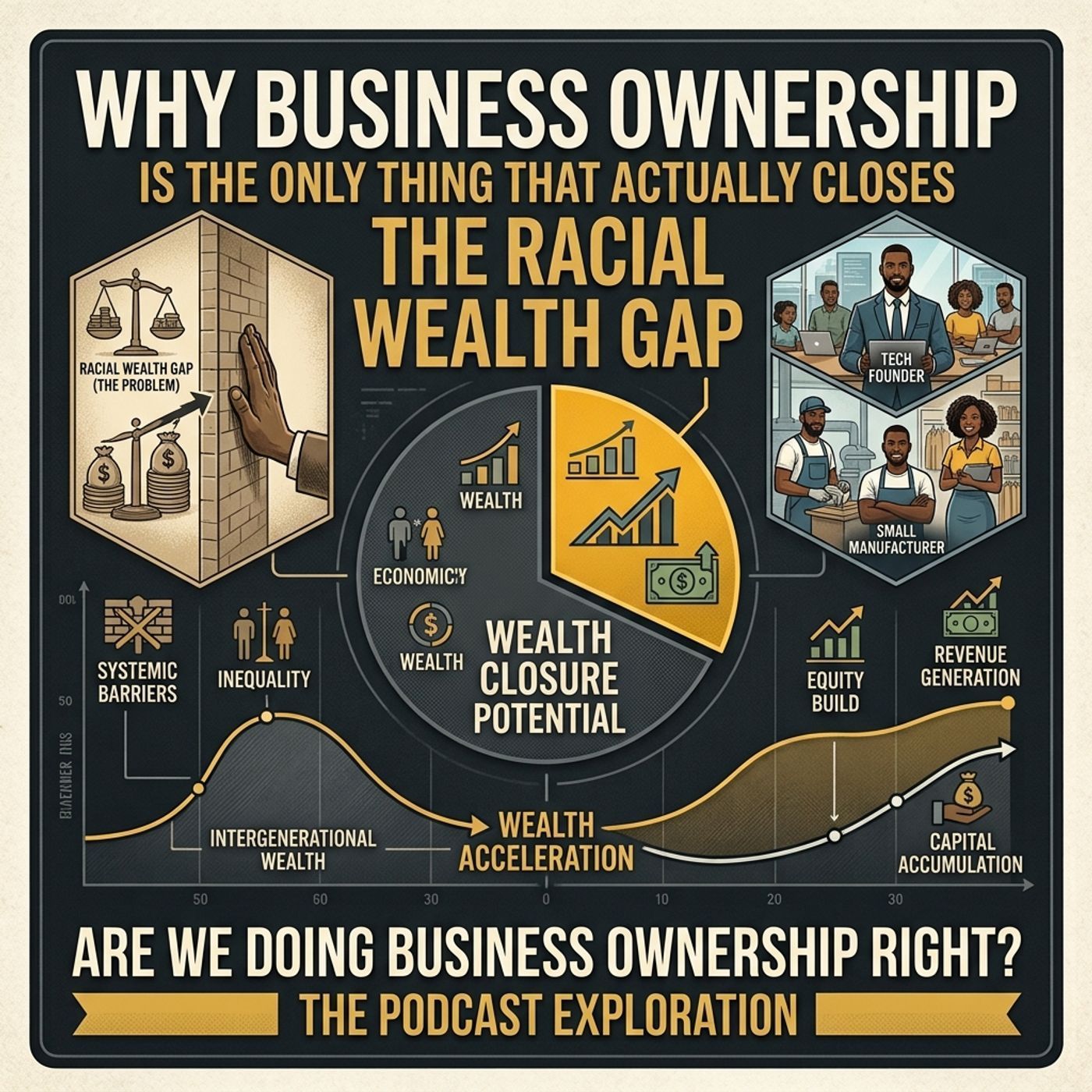
The conversation explores the transition from employment to business ownership as a means of wealth creation, addressing the racial wealth gap, barriers to business ownership, opportunities, and the importance of building systems for business growth. It emphasizes ownership as the final answer to wealth creation. Takeaways Employment funds investments, investments fund the asset base, and the business is the vehicle that makes wealth transferable. Business ownership addresses the wealth gap at its root, generating several forms of wealth simultaneously. Chapters 00:00 Employment and Wealth Creation 01:23 Business Ownership and Wealth Generation 03:08 Addressing the Racial Wealth Gap 04:19 Barriers to Business Ownership 06:47 Opportunities and Lowered Barriers 08:18 Choosing the Right Business 11:01 Building Systems for Business Growth 13:01 Ownership as the Final Answer
X O: Every hour you work, you're building wealth for someone. The question is who? If you're employed and there's absolutely nothing wrong with employment, we covered a career strategy in art two, and it matters. You are trading your time, your skills, and your most productive hours for a wage. That wage is real, but the wealth your labor creates, the value above and beyond your salary, the equity in the company, the compounding returns on the business you are helping to build. That wealth goes to the owner, not you. This isn't cynicism. It is the basic economic structure of employment. And the men who understand it are the ones who use employment as a launch pad rather than a destination. Last week, we talked about index funds and real estate, converting your earned income into productive assets. Today we close thing four with the most powerful asset available to any man who is willing to build it. A business. Something you own, something that creates value, something that employs people, serves a community, generates income, and ultimately transfers as wealth, as employment, as a infrastructure to the generation that comes after you. This is Sana I E I'm Exo. And let's talk about the business is the wealth. Let's get into it. First off, let me make a case for business ownership as specifically as I can because I think the conversation often stays at the level of inspiration when it actually when what is actually needed is the economic argument. The racial wealth gap, which we covered in full in Arc Two, drop that episode in the show notes, is fundamentally an ownership gap. Black Americans own a disproportionately small share of the productive. Assets in this economy. Businesses, commercial real estate, financial instruments, intellectual property. The income gap is real and documented. But income without ownership doesn't close the wealth gap. It funds a comfortable life while the gap persists. Business ownership addresses the wealth gap at its root because businesses generate several forms of wealth simultaneously. Income, the salary and or distributions the owner takes, equity, the value of the business itself, which grows as the business grows and can be sold or transferred. Employment, jobs that keep wages circulating in the community. And community infrastructure, the social and economic fabric that businesses create in the neighborhoods and markets they serve. Those are four. Four little pillars that a business helps create. And the Census Bureau data from the 2022 shows that Black owned employer businesses grew by 56.9% from 2017 to 2022, the highest growth rate of any demographic group measured. Black owned businesses generated 206 billion, yes, billion would it be in annual revenue and supported 3.5 or 3.5 million jobs. And research from Brookings Institution shows that black business owners have a net worth 12% higher than non-business owning black households with similar income. Business isn't just a career, it's a wealth vehicle, and the growth trend shows that men doing it are doing it at scale. And here is the generational dimension that I want to name clearly. Employment income can't be transferred. When the paycheck stops, it stops. We all know that, right? But a business structured correctly with systems and teams that don't depend entirely on the founder can be sold, transferred, or the best one inherited. It can be the asset that funds the next generation's education, investment, or owner entrepreneurship. The business is how earned income becomes lasting wealth. Outlives the earth. Now I gotta be honest about the barriers because pretending they don't exist doesn't help anyone at all. Capital access remains the most significant structural barrier. Black owned businesses are denied financing at more than double the rate of white owned businesses. The collateral requirements, the relationship banking bias, the algorithmic lending systems that replicate historical discrimination, these are real and documented. Knowing they exist means you go in prepared. Not blindsided. Network access is the second barrier. Business, business success depends heavily on networks for customers, for talent, for partnerships, for capital. Many of the most valuable businesses networks in America were built spaces Black entrepreneurs were historically excluded from. Breaking into the networks or building parallel ones, which is exactly what the community economic investment conversation in Theme 3 was about. requires deliberate strategy. And the knowledge gap is real. Most black entrepreneurs are first generation business owners. They don't have a parent who ran a business, a family network that understood financial statements and business structures, or the informal apprenticeship in entrepreneurship that children from business-owning families absorb by proximity. That knowledge has been sought after deliberately. Is available, but it requires intention. We have to get that knowledge. We have to read YouTube network, talk to people, talk to people around us. I believe part of that too is a lot of us having that crabs in a bucket mentality. If they gonna make it, you can't make it. No, there's enough to go around for everybody. It's changing the mentality too to think more of an abundance mindset and being more positive about any and every situation at hand. But The 2025 Federal Reserve Small Business Credit Survey found that black-owned businesses were more likely to face financing shortfalls, pay higher interest rates, and receive smaller loan amounts than white-owned businesses with comparable financial profiles. The barrier is in creditworthiness, it's structural bias in the lending system, which is exactly why the alternative capital ecosystem exists. CDFIs, community investment funds, Black owned banks, revenue-based financing, and pitch competitions designed for black entrepreneurs is supplementary. It is a primary pathway, and in 2026, that ecosystem is more developed than it has ever been. The opportunity landscape in 2026 is real. The internet has lowered the cost of starting a business near zero. Zilch for service or even knowledge-based businesses. E-commerce has opened markets that Geographically were closed previously. The creator at Commode has made expertise itself a mobile monetizable asset without a storefront or a physical product. Remote work has made talent available regardless of zip code and the growth of black lead accelerators, incubators, grant programs, and investment funds specifically designed to address. capital network gaps has created an infrastructure that didn't exist ten years ago. So the barriers, they're real. But they're lower than they have ever been. And the men who build anyway are the ones who close the gap. Now we can we can make it happen. Businesses are here. It's so easy to start a business. Now you can start a business in basically five minutes if you wanted to. But it's just like doing your research and seeing if you truly I was gonna say passionate, but we know passion changes. So what I'm gonna do right now, I'm gonna give you a framework for thinking about what kind of business to build. Because start a business without more specificity isn't useful advice, right? You think okay, I can start a business, what type of business? First question isn't what I'm passionate about. And we we address this in our first arc of this year. We talked about purpose versus passion. And we all know passion fluctuates. The better question is: what problem can I solve for home consistently at a price that makes the economics work? That intersection, problem, market, economics is where viable businesses live. And we don't really think about that when we start a business in our community, we just go straight to business started. But we don't think about what problem are we trying to solve. What type of market are we trying to dive into? What do the economics look like? We're doing do the research and then when we have the research we're prepared to start that business. So think about a problem that you can solve in a certain market and the economics that will justify what you're doing. Service businesses are the lowest barrier entry point for most people. Consulting, coaching, marketing, design, bookkeeping, bookkeeping, booking keeping Legal services, home services, personal training businesses, where the primary asset is your expertise and the primary cost is your time. No inventory, no physical location, often no outside capital needed to start. And in a service business, every client interaction teaches you something about what the market needs, which is the most valuable market research. Then we go up to product businesses. Whether you have a physical or digital product require more upfront investment but can scale beyond the limits of your personal time. A digital product that sells while you sleep is a game changer. And a physical product that can be manufactured and distributed, another game changer. The key question for product businesses is whether the margin, the difference between what it costs to produce and what the market will pay. Is sufficient to cover not just your costs but your time, your marketing, and the operational overhead of running a business. And systems businesses. The businesses that eventually run without the founder's daily involvement are where the most significant wealth gets built. The service business business that hires additional service providers, the product business with a team managing operations, the franchise that replicates a proven model. Getting to the stage requires building systems, hiring will, and the willingness to let go of control and extent in exchange for skill. Most entrepreneurs resist this transition. They want to control everything. They want to be the CEO, they want to be the CFO, they want to be the boss in charge. But it's like you have to let the reins go. The ones who make it are the ones who build the most. Also, Research on black entrepreneurship published in 2025 found that 90% of black entrepreneurs report greater income, autonomy, and work-life balance as primary motivations, but only a fraction build businesses with systems that allow for scale. The research identifies the transition from solo operator to systems-based business as the critical leverage point, a place where a self-employed person becomes a business owner. That transition requires intentional. investment in processes, people, and infrastructure. But it is the transition that converts a job you own into a business that generates wealth. So whatever type of business you build, start where your skills are, set a market you understand and price it so the economics work and build it with the intention of eventually creating systems that don't require your presence to run. The last part is what separates income. So now it's time to land this plan. Let me close this theme and set up the finale. Two episodes, one thing. Last week, the asset mindset, index funds, real estate, the compounding principle, converting earned income into productive assets that work while you sleep. This week, ownership, the business as the final answer, the vehicle that generates income, builds equity, employs people, builds community, and transfers wealth to the next generation that comes. After you. Together, these two episodes make completely complete the money 2.0 argument. Wealth isn't what you earn, wealth is what you own. And the men who understand that, who use their incomes as the seed capital for an asset portfolio and their skills as the foundation for a business they own, those men are building something that compounds across decades rather than resetting with every paycheck. Here's what I want to you to carry. Employment, we all love it. It's the it's the first, it's what we all have to do. It's honorable. Investment is strategic, and ownership is the final answer. Not one or the other. All three in sequence, building on each other. The job funds the investments, the investments fund the asset base. The business is the vehicle that makes the wealth transferable. Next week. Quarter three finale. Roots and wings. We tie the full year together. What you have built, what you are carrying forward, and what quarter four is going to acquire. That is a conversation that requires me to close this chapter. This is Sana I E XO. Share the show. Like, subscribe. With that, see y'all next week.