
S A U N A I E · S A U N A I E
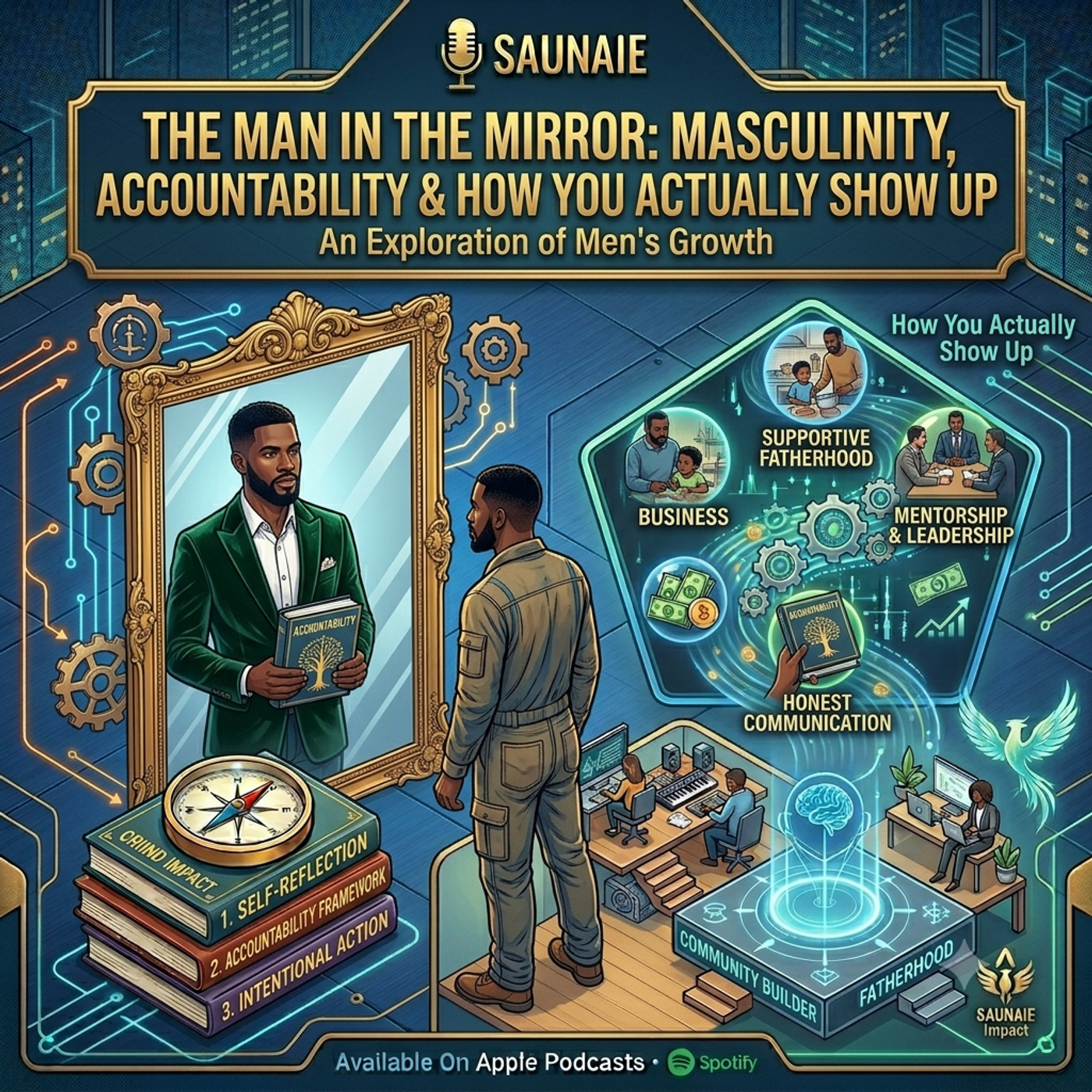
The conversation delves into the noise around masculinity, defining masculinity, men's mental health, accountability and integrity, three key areas for men, the importance of follow-through, and a relational check-in. Takeaways Defining masculinity goes beyond traditional norms Men's mental health is impacted by societal expectations Accountability and follow-through are crucial for personal growth Chapters 00:00 The Noise Around Masculinity 06:08 Men's Mental Health 11:51 Three Key Areas for Men 17:47 Relational Check-In
X O: And what we got to start right here is the first segment of the show is the noise around masculinity. Before we get into the practical work, I want to name what is happening in the culture around masculinity because I think the noise is making it harder for men to have a clear conversation about this, and it's not getting easier. On one side, there is growing space for voices online, ⁓ particularly that define manhood through dominance, emotional suppression, and attempt for vulnerability. Let me ask you something. And I want you to sit with this honestly. How do the people closest to you experience you? Not how you think of yourself, not your intentions, not the version of yourself you are working toward. How do the people who actually live with you, work with you, and also love you? How do they experience you day to day? Are you present or are you somewhere else physically in the room but mentally a thousand miles away? Are you consistent? The manosphere, it's a new word. ⁓ content that tells you, young men, that being emotional you close off is strength, that controlling relationships is leadership, that men who seek help or express feelings are weak. It is everywhere and it is growing. Did you know? A 2025 survey by the Movember Institute of Men's Health found that young men aged 16 to 25. The same man whether things are going well or not, are you someone who takes accountability when he gets it wrong? Or are you someone who deflects, defends, and moves on without really addressing it? These aren't easy questions. I know. They're not questions most men have been asked directly because the conversation about masculinity in this culture is almost always either about what men should stop doing or a reaction against being told what to stop doing. Neither of those conversations actually helps you become the man you want to be. Today, we're having a different conversation. Not about what masculinity should look like theoretically, about what it looks like. Who regularly consumed online masculinity influencer content reported significantly higher rates of emotional distress than their peers who did it. They were more likely to experience feelings of worthlessness, 27% versus 23%, nervousness, 26% versus 19%, sadness, 26% versus 19%. The content that it is supposed to be teaching young men's strength is measurably making them more psychologically fragile, not stronger, more distressed. So it's all it's about being aware of what you're consuming. practically in your relationships, in your household, as well as in the mirror. This is Sana I E Amexo. Man, pull up a chair. We about to dive into it. It's like overconsumption is never good. That's why they say take things into moderation. If you're looking in at these online influencers, people who's like, ⁓ masculinity is masculinity that, it's like taking that with a grain of salt, but still understanding your position, understanding what you're doing, understanding like, okay, I'm just supplying this knowledge to who I'm becoming and evolving and not letting that define who I am. And on the other side, there are spaces that sometimes overcorrect, right? That in the effort to dismantle harmful norms and end up producing a version of masculinity that does not resonate with how most men experience themselves, where masculinity itself becomes the problem rather than specific harmful expressions of it. You already know, as Sonai, we don't do that. We don't live on either end, and we never have and we never will be. What I believe. And what the research supports is that there is a version of masculinity that is genuinely powerful, genuinely healthy, and genuinely good for people around you. It is not defined by dominance or by the absence of strength. It is defined by accountability, by presence, by the ability to hold yourself to a standard, not because someone is watching, but because who you say. This is conversation. And this is what we're going to get into today. So, that being said, let me give you the definition I work from because words matter, and I want to be very specific with you. Masculinity at its best is the capacity to carry weight. Not because you have to prove something, but because you have chosen to. It is the ability to be strong and honest, to hold a standard for yourself without needing external validation to maintain it. And I'm gonna say that again for the people in the back because I know you're like, wait, what? To hold a standard for yourself without needing external validation to maintain it. To be emotionally present without being emotionally reactive, to lead in whatever context that means for your life, not by controlling others, but by taking full responsibility for yourself. And this is like masculinity is basically breaks down to really that pet personal development for yourself. understanding what it is to be a man and understanding what your masculine energy is, understanding yourself. Because we got so much stuff to over consume over over consumption out here when it comes to social media, the web and things like that, that we have to sometimes take a time take a step back and just think. Like really put the distractions away, spending like 15 or 30 minutes a day just thinking. Thinking about your past, thinking about your future, thinking about the present and just letting your mind wander without getting distracted. By all these things out here. Because I think nowadays we spend less time thinking and more time over consuming. And when we break that habit of overconsumption, we start thinking more and understanding, okay, this is the way I need to move. This is what's right and this is what's wrong. But that overconsumption really dulls your brain and makes it hard for you to think it for yourself. So ⁓ the definition that I just stated, that definition is isn't soft. It is actually harder than the version being sold online because dominance and emotional suppression are easy. They require no real self-awareness, no emotional labor, no genuine accountability. You just shut down and perform toughness. Most men do that in their sleep. What is actually hard is, and what the research identifies as the markers of psychological maturity in men is a combination of strength and openness. The ability to be genuinely tough when the situation requires it and genuinely present when the person in front of you needs that. Say that again because that one, psh, that's a bar. The ability to be genuinely tough when the situation requires it, and genuinely present when the person in front of you needs that. Not one or the other, both at the right time, in the right measure. That's the definition of masculinity. Another research that I found, Equip Mundo's State of the World's Men 2026 study, one of the most comprehensive global anal analysis of masculinity ever conducted, found that men who hold more flexible, equitable views of masculinity report better mental health, stronger relationships, and higher overall life satisfaction. Men who adhere rigidly to traditional dominant masculinity norms report higher rates of depression. Social isolation and relationship instability. The data does not support the idea that traditional dominance-based mass masculinity produces stronger, happier men. It actually produces the opposite. And with that being said, it is men's mental health month. And the main thing is really just checking on your mental health, checking on yourself, checking in with your people who you're the people that you love, you care about, and really just having those conversations too. Fellas, we gotta be on our mental health. No, we want to grind, grind, grind, do all we're supposed to do, but it's like always check in on yourself no matter what. Spend that the time alone checking on yourself, seeing how you're doing mentally, physically, and things like that. Don't just be caught up in the matrix, just going through cycles of life. But overall, here's the connection to everything we built during the the ⁓ arc two. A man who is emotionally reactive, who cannot regulate his own internal instinct, who is constantly in defensive or dominant mode. That man is making financial decisions, business decisions, and relationships decisions from that same dregulated place. The internal state is not separate from the external outcomes. It's the upstream of all of them. So, right now, what I want to do, I want to spend some time on accountability, specifically because I think it is one of the most misused words in the men's space. Accountability gets talked about as if it is primarily about holding other people to a standard. Accountability groups where men who monitor each other, systems where someone else checks your work, external ex structures that enforce behavior. That is not what I mean. Real accountability is external. It is the willingness to look honestly at the gap between who you say you are and how you actually showed up today, not as punishment. Not as a shameless self-criticism, but as honest self-assessment. The same clear-eyed evaluation you would apply to a business, what worked, what didn't work, what needs to change, what is the next move. That's how you apply it to your life as well. And here's what accountability looks like in practice. And I want to be specific because abstract accountability does not change anything. It looks like acknowledging. When you were wrong without immediately redirecting to why the person contributed to it. The I was wrong and here's what I'm going to do to differently. That's the full stop right there. It's really taking that self, taking accountability, like where did I fuck up in this situation? Excuse my language for the the young listeners out there, but it's understanding like how did I mess this up? How can I do better next time? Not I was wrong, but you also were wrong too. No, it's not no. Figure out what you did in that equation and figure out how to do better next time. And I know it'd be like the butt erases the accountability. Own it completely and separate. Separate yourself from it. The other person's contribution is a situation. The other person's contribution to the situation can be addressed separately at a different time when the relationship has space for it. It looks like keeping your word to yourself, not just to other people. We we know how it is. You'd be like, ⁓ I'm gonna go work out tomorrow. I'm gonna read tomorrow, I'm gonna do this tomorrow, I'm gonna do this, but you don't do it. Those silent Them them you breaking those promises to yourself holds weight. The commitments you made to yourself, whether that's eating right, fitness, ⁓ financial habit, the way you say you were going to show up as a father or a partner, or even as a friend, those count. The man who breaks agreements with himself regularly trains his nervous system to expect his own unreliability. And that internal unreliability eventually shows up. in every external commitment too. Ain't that something? I'll have to give y'all a little brief break real quick and I'm about to dive back into it because I know that was a lot too process. But with that being said, research on self integrity, the alignment between a person's stated values and their actual behavior shows that men with high self integrity report measurably lower anxiety, higher self efficiency, and stronger relationship satisfaction. The alignment itself is protective, not because it makes life easier. Keeping commitments to yourself is often hard. We all know that. But because the internal coherence of being someone who does what he says he will do creates a kind of psychological stability that external validation cannot replicate. And it looks like accountability without self destruction. This one matters especially for men who have high standards for themselves. If you're like me, you you have those high standards for yourself. Because the risk isn't that the standards are too high, it is that the response to falling short becomes punishing rather than corrective. Accountability is not a flagnation, it is a course correction. You look at what happened, you understand it, you decide what changes, and you move. Not spiral, not punish yourself, adjust and move. It's like bob and weave. It's like boxing. You gotta bob and weave, bob and weave. Adjust and send where you need to hold yourself accountable at. It's not like punish yourself that ⁓ I messed up, or I did that wrong. No. Just hold yourself accountable is just like, okay, let me assess the situation. I may have did this wrong, but I know next time I know how to fix it, and I'm gonna work on being better in that next form. So now we're gonna step into. How you actually show up, the three areas that really matter the most. And I want to get specific about showing up because be a better man without specificity is just a feeling. Here are three areas where the research consistently shows that how men show up has the most impact on their relationships, their families, and their own well-being. You might want to get a pen and pad for this. Area one: presence. And not just physical presence, psychological presence, the ability to actually be in a conversation and interaction, a moment with another person without being mentally somewhere else. This is increasingly rare, rare. The phone, the notifications, the mental weight of everything you are managing, all of it conspires to make genuine presence the exception rather than the rule. And the people in your life. feel its absence even when they cannot fully name it. So it's just like being fully present. We all got cell phones. We all all want to be our on our phones and it's understanding like, hey, let me put my phone down and dedicate this time to this person I'm talking to. Because they require my full presence. And it's best to be present in that conversation because you never know what you might learn or what they might learn from you or what they may need from you. So it's just like being fully present in that and not letting the distraction of your phone get to you but hey I'm having this conversation with this person I love. Or a friend, whatever it may be, let me be fully in tune, immersed in this conversation, and my phone can wait. And it and it shows on the other person's side that okay, this person's present and I'm not just here getting getting them tuned out, they're not fully present with me. And research on parental presence, fathers specifically, finds that quality of presence matters than quantity of time. A father who is physically available for hours but mentally absent produces Different outcomes in his children than a father who is genuinely present for focused, connected periods. The children of present fathers show better emotional regulation, higher academic performance, and stronger self-esteem. Presence isn't passive. It is an active choice that requires putting something else down. Area number two would be emotional regulation. This is the skill most men never taught. And it's crazy that we were never taught this. And that affects everything else. Emotional regulation is not emotional suppression, it's a it's a two difference. It is the ability to experience a strong emotional habit without being hijacked by it, to feel anger without becoming rage, to feel hurt without withdrawing, to feel fear without shutting down or lashing out. And y'all know I got some statistics for you. A 2025 dating and relationship survey found that 59% of women now place their highest value on emotional consistency and reliability in a partner above attractiveness, financial status, or social standing. Emotional consistency isn't the absence of emotion, it's the presence of regulation, the ability to be the same man, whether things are going well or falling apart. That consistency is what builds trust. And trust is the foundation of every relationship worth having. And the last and final one, area three. ⁓ it's like the triangle offense. Follow through. I think that's our as men, we we probably have a tough time following through. The gap between what you say and what you do is a space where either trust builds or erodes. Every commitment kept, however small, deposits into the trust account. Every broken commitment, every deflected accountability, every I'll get to that. That never gets gotten to. Those make withdrawals and trust accounts, once depleted, are slow to rebuild. And this applies to intimate relationships and parenting and friendships and professional relationships and in the relationship you have with yourself. Follow through. Keep the promises to yourself. Stay committed. The man who consists does what he says he would do, who is known for his follow-through, operates from a completely different relational foundation than the man who. Means well but doesn't deliver. Intention does not build trust. Behavior does. Whatever, so I ain't gonna lie to you. I like I love this episode, so I hope this was episode was good for you, man. ⁓ I learned a lot myself, especially with the three areas. I'll repeat the three areas again. Last third number three was follow through, number two was emotional sub regulation, and number one is presence. So being present with the people, regulating your emotions, and following through. Those are the three keys for men to grow when it comes to masculinity. Now Now we gotta say bye-bye. It's the end of the episode. But here's what I want to leave you with. The masculine conversation doesn't have to be loud, contested, political thing. It has become online. At its core, it is actually a very simple question. What kind of man are you choosing to be? And are your daily actions consistent with that choice? Not the man you were raised to be, not the man the culture is trying to sell you on being, the man you have decided consciously and deliberately to become. With all the work we have done in quarter two, the identity work, the financial work, the body and spirit work, you are building the man from the inside out. This episode is a relational check-in. The question on whether the internal work is actually showing up in how you treat people around you, because that is the real test. Not the mirror alone, the people in the room with you. And the three things I'm asking you to carry this week is be present in at least one interaction every day where you would normally be somewhere else in your head. When you get it wrong, and you will, we all do, trust me. Own it completely. Hold yourself accountable. Like hey, I got it wrong. Without the ⁓ but this and that. No. And also keep one promise to yourself that you have been breaking. Just one. Small things train the big things. And next week, ladies and gentlemen. ⁓ man. We just keep rocking and rolling, man. I hope y'all loving these episodes. I know I just dropped a three-part mini-series with ⁓ Alex Boykins, who talks about his him shooting 70 plus weddings, man. Go check that episode out. I mean, there's three of them, but check out the first one. The first one drops gems, all three of them have different personal gems in them. But next week we close out R3 and we're in the healing conversation. We're we're going with why doing the trauma work changes everything about how you Bill. And that one is going to be somewhere a lot of people have not been willing to go yet. That trauma, man. We're going to talk about that trauma next week. This is Sana ⁓ I. I'm XO. With that being said, ladies and gentlemen, already no timer going off. I'll see y'all next week, man. I love y'all. Subscribe to the show. If you're on YouTube, man, share this on YouTube. If you're not on YouTube, subscribe and subscribe on YouTube, man. We're trying to get our followers up on YouTube, trying to do bigger and better things on YouTube. With that being said, man, I love y'all. Enjoy y'all week. Back again next week with Sun I E.