
S A U N A I E · S A U N A I E
The conversation covers the integrated approach to wellness and the concept of the 'whole man.' It begins with a recap of Quarter Two and an introduction to Quarter Three, followed by a discussion on purpose, money, and body. The conversation then delves into the topics of spirit, masculinity, and healing, defining the 'whole man,' and exploring the connection between brain health and financial health. Finally, it previews Quarter Three, focusing on relationships, fatherhood, community, and money. Takeaways Integrated approach to wellness The whole man concept Chapters 00:00 Quarter Two Recap and Introduction to Quarter Three 05:22 Defining the Whole Man 12:47 Quarter Three Preview: Relationships, Fatherhood, Community, and Money
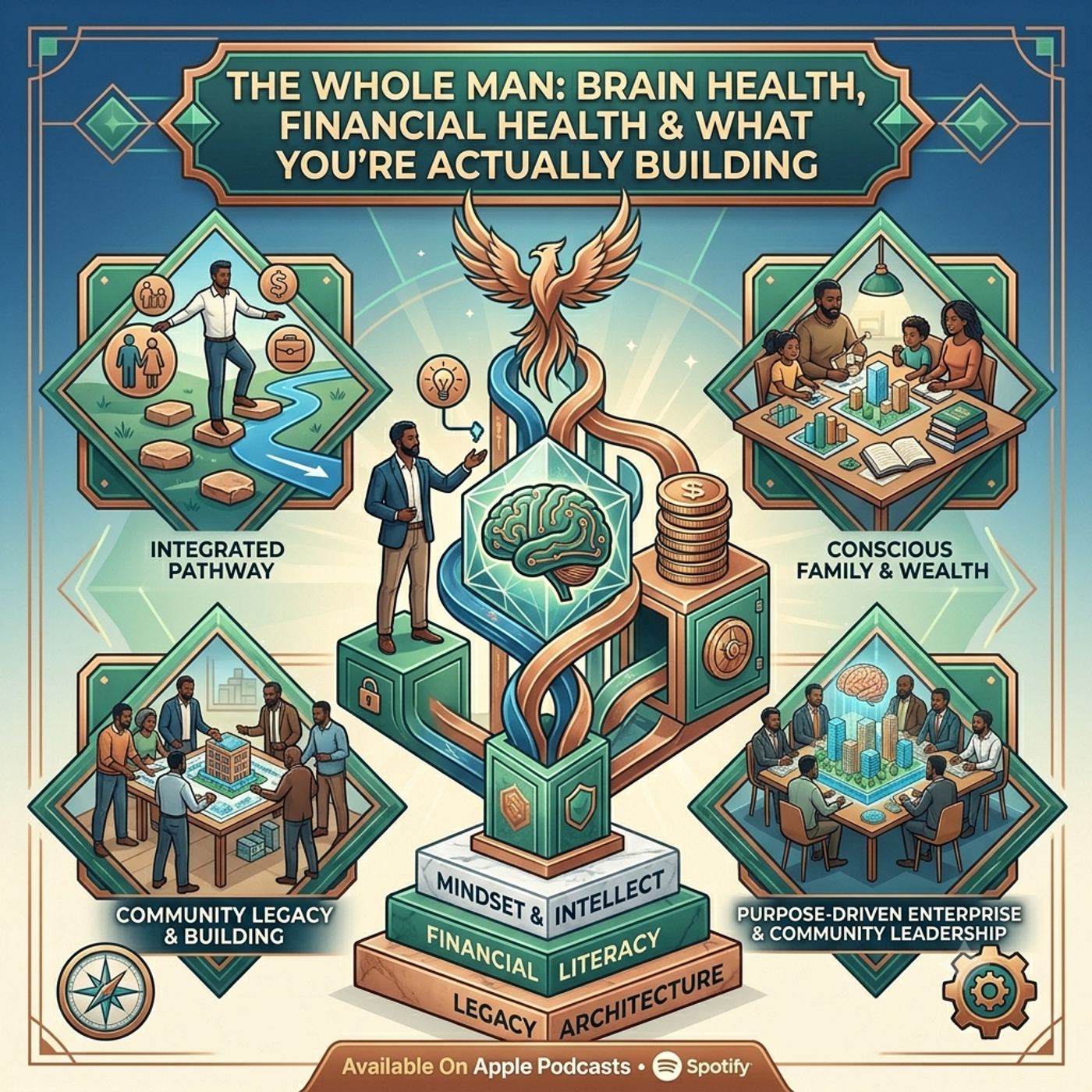
X O: We made it. We are here. We made it. And I don't say that as a throwaway. I say it because I know what it costs some of you to stay in this. Life doesn't stop where you're trying to build and grow a business as well as yourself. And quarter two was full, was full of like a lot of great episodes covering purpose, money, the body, the spirit, accountability, trauma, and the whole architecture of what it means to be a man building something real. And if you were here for all of it, or even most of it, you did the will work. And I wanna congratulate you. Today is a specific kind of episode. It's the last episode of quarter two, and it's also the first episode of quarter three. So it's like a bridge episode, right? And I want to use it the right way, not because we we covered a lot and I don't want to use this not just to recap what we build, but to show the full picture of it. Because I think when you can see all of it at once, something clicks that doesn't click while you're in the process of building, when you're in the middle of each individual episode. Today is about the whole man, you. Not a concept, not an aspiration, a specific, built, integrated vision of who you are becoming and what you are actually building when you invest in your brain health and financial health at the same time. This is Sunna I E Amexo. Let's close out this one and start another chapter, man. We still building. And I want to pull back and show you what quarter two is actually building, not episode by episode, but as a single unified construction. We started quarter two with purpose, right? The why underneath the doing. Because without a why, all of the strategy, all the discipline, all of the building is just motion, productive, look in motion. That does not actually go anywhere meaningful. From purpose, we went into money. The psychology of it first, because you can't fix what what you don't understand. Then we talked about the scarcity mindset and how to break it. This episode was impactful. I got a lot of feedback from it. it was just tough, man, because understanding that scarcity mindset, it's it's it was like I want to say it was indoctrinated in us. And it's understanding how to break it. And once you break it, you start realizing the abundance of life, the abundance within your life. Then we got into the history. The racial wealth gap and the deliberate architecture of it. Then we jump into the practical order of operations from building from wherever you are right now. Then we can talk about career income, building the ceiling higher than the foundation wider. Then we shift it into the body. Because the man building all of this is a physical being with a cortisol system, a sleep architecture, a nervous system that is either supporting the building or slowly undermining it. We talked about movement. About rest, about what chronic stress does to the exact cognitive systems that financial decision making depends on. Then we talked about the spirit, the internal anchor that holds when everything external is uncertain. Then masculinity and accountability, the relational proof of the inner work, how you actually show up for the people in your life, not how not just how you intend to. And last week, most powerful episode ever, healing. The trauma work. The thing most men are carrying underneath all the building that quietly caps what can be built. 13 episodes. We we dug deep. I know y'all like, damn, we covered all that. Yeah. We went real deep in quarter number two. And I'm grateful for each episode because I learned a lot as I was recording them as I was researching. I was like, man, it's crazy. But Overall, I want to appreciate y'all and I thank y'all for consistently showing up for yourselves. Because this Sonai, the platform, is truly for you. Help helping us all as a collective, as a community, just to build, build something greater for our families, for our future, for our legacies. But overall, I do have some research for y'all. Guardians 2025 Mind, Body, and Wallet study found that just 44% of Americans are very satisfied with their life. The lowest level recorded in a quarter century. Financial stress was identified as the primary driver of overall well-being decline. But here's what the same research confirms: financial wellness, mental wellness, and physical wellness aren't three separate categories. They are one integrated system. What hurts one hurts all. What heals one helps all. And as you know, Sanaii was built on this understanding before. The research confirmed confirmed it. The whole man isn't a metaphor, it is the sustainable architecture for a life that actually works. That is what quarter two was. Not 13 isolated episodes, one integrated blueprint for the whole man. So I'll keep saying the whole man, the whole man, the whole man. I want to give you the clearest definition I can of what the whole man actually is because I think the concept gets used loosely and I want to be precise. Y'all know I like to be precise. The whole man isn't the man who has it all figured out. He is not the man at the finish line. He is the man who is building all of the relevant dimensions of his life at the same time, not sequentially, not in silos, not one at a time when the others are done simultaneously. His brain health and financial health are connected, not because someone told him they should be, but because he has felt it. He has seen how financial stress impairs his thinking. He has experienced how clarity of mind improves his money decisions. He doesn't treat these as separate projects, he treats them as the same project. His body and his ambition are connected. He has learned that physical discipline is not just a vanity project. It is the mechanism that keeps cortisol in check, keeps his sleep architecture intact, and keeps the prefrontal cortex running at the level his goals require. He takes care of his body because he understands it is an infrastructure and not a decoration. His spirit, his purpose are connected. He has an anchor, some grounding force that gives the building direction and holds him when the external structures shape. He is not spiritual performing. He is spiritually rooted. His relationships and his inner work are connected. They go hand in hand, as you see right here if you're watching. He has done enough of the healing work or is actually doing the work now. But the walls are not fully up. He shows up for the people who matter. He is present, not just physically adjacent. That is the whole man. That is what the whole man is. Consistently working, growing on himself, healing himself, healing from the past traumas, healing from his communication tactics, his body, his spirit, his mind. They're all connected in one. It's just continuously doing the work at the same time. It's like a group project, but you're doing it by yourself at the end of the day. So it's understanding like it's always gonna be consistent work that needs to be done on yourself, whether that's physical, spiritual, mental. Whatever it may be, financial, it's always going to be continuous work. The work is never going to stop. You ain't going to be like, I'm done, finished. No, you're always going to have to be working on yourself to grow yourself with to reach new levels. And the National Center of for Complementary and Integrative Health now funds research specifically on whole person health, defined as the integration of physical, mental, emotional, social, and spiritual dimensions of well-being. This isn't alternative medicine. This is where most rigorous health research is going. The scientific community is confirming what Sonai has been saying all year. You can't optimize one dimension in isolation without affecting all the others. The whole person framework is the new standard of health science. That is the whole man. Not perfect, not finished, not arrived, but continuously building, growing, evolving, all of it together. with intention. That is the clearest definition for you. And I wanna take a minute. Talking about two pillars of this platform. Because after a full quarter two, four quarter two is a lot. I ain't gonna lie to you. It was like we we discussed a lot, we handled a lot, and we helped a lot. And I think you can hear this in a way you might not have been able to at the beginning of the year. Brain health, financial health. Two words on either side of the Sana'i name, and they were never meant to be separate. They were always meant to be understood as one thing. And here's the argument in the fullest form. Your financial decisions are made by your brain. Every investment choice, every negotiation, every savings habit, every impulse purchase, every avoidance of the account balance, those are cognitive and emotional events before they are financial ones. A man whose brain health is compromised by chronic stress, unresolved trauma, sleep deprivation, or scarcity thinking is making financial decisions from a degraded cognitive state. The money strategy is only as good as the mental state executing it. So it's like being aware of yourself, your brain health, unresolved trauma. If you have trauma from childhood or adulthood or maybe PTSD for something, it's understanding okay, where do I need to go to understand the trauma and heal from it? Sleep deprivation. My biggest thing lately has been recording my sleep, making sure I'm getting seven to eight hours of sleep. At night, because I've seen the benefits of it, as well as that scarcity thinking. I know how it is, is we've been programmed to think scarcity, think lack, but there's so much abundance in this world that we have to just take the time and stop and think for ourselves. Sometimes you may have to spend 15 minutes a day thinking, just thinking with no distractions, and let your mind wander on the possibilities, the abundance of the world, and understand that. Your mental health is really shaped by your financial reality. Chronic financial stress is one of the most significant drivers of anxiety, depression, and cognitive impairment. A scarcity loop where financial stress narrows cognitive bandwidth and drives short-term decisions that worsen financial stress. It's a documented cycle that traps men between the two pillars when those pillars are not held together. The man who fixes his mindset, but Not his finances is swimming upstream. The man who fixes his finances, but not his mindset, is building on the sand. But the man who does both, not because it sounds good, but because the research is explicit. Financial wellness and mental wellness are interdependent systems. You can't fully stabilize one without the other. And research from Global Wellness Institute, a 2025 report on inclusive. Wellness trends found that 83% of participants now prioritize mental wellness as the foundation, recognizing that it influences habits, decision making, and financial success across all life domains. Excuse me. The research showed that financial wellness remains the area of the highest stress and lowest performance. The gap between what people know they need and what they are actually building is widespread where the two pillars meet. Sunai, exact. Exact. This platform exists to close the gap. This is not a wellness podcast. This is not a finance podcast. This is the whole man podcast. And that distinction matters because it means every conversation we have has to touch both. Not separately, but together. So quarter two. That was the foundation. We laid the foundation out, right? The inner architect architecture. Mindset, the money framework, the body, the spirit, the relational accountability, the healing work. Quarter three takes that foundation and builds outward. So we're expanding in quarter three. We're building bigger, getting wider. We are going to we're going into relationships in love. How the whole man loves, not from a self-help angle, from an honest research-backed cultural specific angle. That respects the complexity of what it means to be in a partnership as a black man in 2026. We're going as a fatherhood, the most concrete expression of legacy available to most men. What your children actually need from you. And how to father differently when you were not fathered the way you needed. What a strong, present, intentional black father looks like right now. We're going as a community because individual growth has a healing and a ceiling when it Is not connected to collective power. How black men rebuild social fabric, invest in each other, and create ecosystems that outlast any one man's success. And we're going back into money. We're going to where the money resides. Not the foundation level though, the advanced level. Real estate, investing beyond the index fund, business ownership as the final answer to the wealth gap. Money 2.0 for the man who has the basics down is ready to go further. 13 episodes of four themes. One straight line through the whole man building outward from a solid foundation into the relationships, the community, and the wealth that make life meaningful. I'm hype. I'm ready. I know y'all ready. I'm like, these next 13 episodes are gonna show a lot within you and change a lot within you. Quarter two, like I said, it was the foundation. Quarter three, we're expanding. And Quarter three man, the relationships, the community, money, fatherhood. What more can you want? We we about to get into it. So let me land this plane, ladies and gentlemen. You started this year somewhere. Maybe you started with Sanaye from episode one. Great episode at that. Maybe you found the show mid mid-quarter two. Maybe this is your first episode. Wherever you came from, I'm honestly glad you're here because this isn't possible without you, without the daily, without the community, without the audience, without you guys consistently supporting. Because what we're building on this show is not content, it's a practice, a weekly commitment to. Take your brain health and financial health as seriously as your ambitions demand. A decision to be the whole man, not perfectly, not all at once, but deliberately and consistently. Quarter two gave you the blueprint. Quarter three gives you expansion and what you build in this quarter and your relationships and your fatherhood and your community and your money will be different because of the work you did in quarter two. That isn't motivation. That is the architecture working the way it was designed to. The whole man doesn't arrive. He builds every week, every day, every month, every episode, every decision that reflects who he is choosing to become. That doesn't work. And you're in it. So with that being said, welcome to quarter three. This is Sunai. And we back. And we back and we back and we back. I'm XL man. I'll see y'all next week. Share the episode. Subscribe if you're not watching us on YouTube. Subscribe on YouTube. Share on YouTube. I greatly appreciate it, man. If you need any questions, comments, concerns, you can email us at Sanaepodcast at gmail.com. The link will be in the show notes. But yeah, man, follow us on every social media platform at Sanaie. Greatly appreciate it. I love y'all, man. Enjoy y'all week. I'll be back again next week with Sana I. E