
S A U N A I E · S A U N A I E
The conversation explores the self-made myth, the isolation of black men, the erosion of black community infrastructure, the power of community as a health intervention, and the strategies for building real community in 2026. Key takeaways include the importance of community as a survival strategy and the value of investing in depth over breadth. Takeaways Community as a survival strategy Invest in depth over breadth Chapters 00:00 The Self-Made Myth 01:24 The Isolation of Black Men 03:20 Erosion of Black Community Infrastructure 05:29 The Power of Community as a Health Intervention 09:06 Building Real Community in 2026
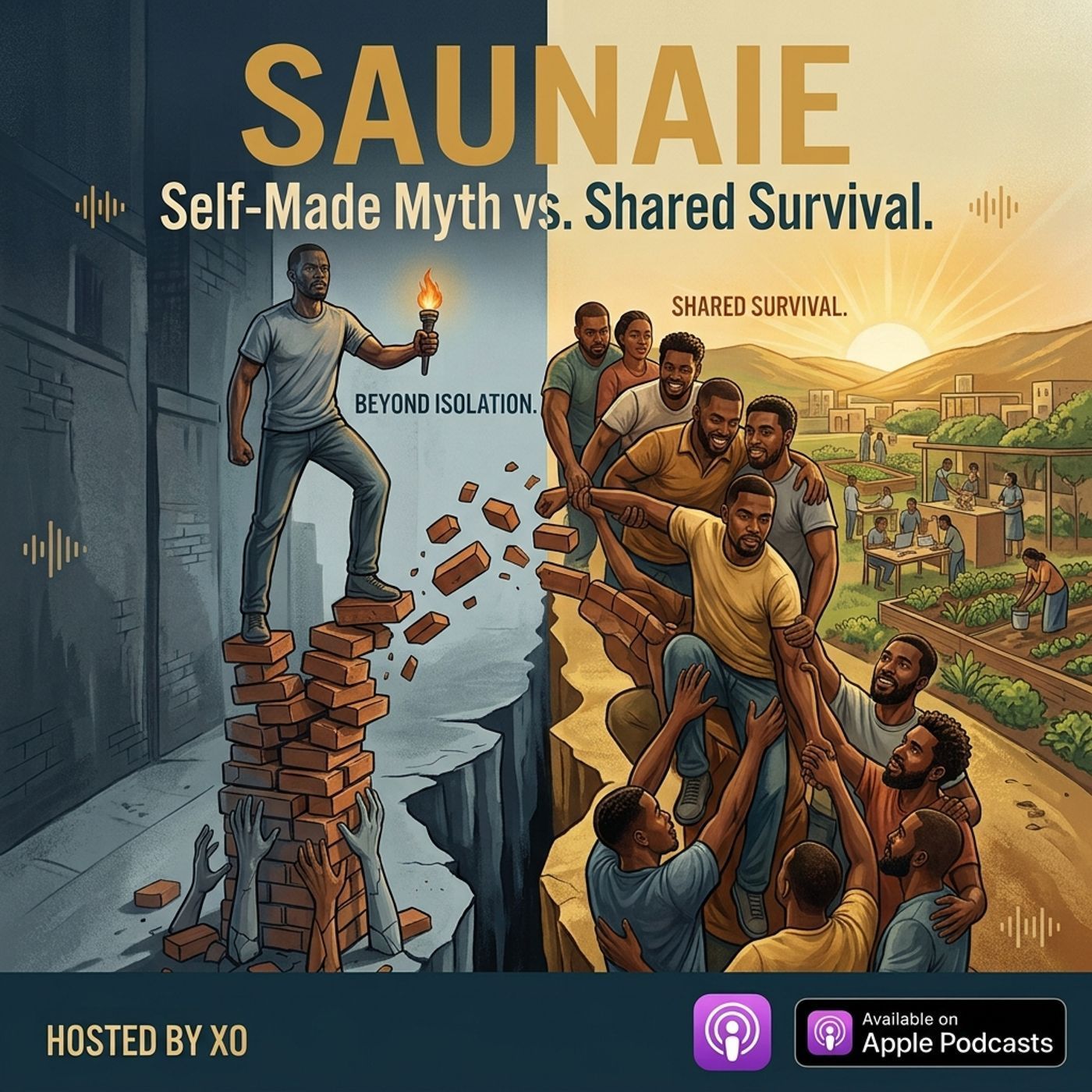
X O: I want to name something that I think has been sold to ambitious black men as a feature when it is actually a bug. Independence. The self-made narrative. The idea that the highest form of success is the one you built entirely on your own. No handouts, no help, just you against the world. We celebrate it, right? We wear like a badge of honor. I came from nothing. Nobody handed me anything. I did this all by myself. And There's real dignity in that, real resilience, real evidence of what a man can do when the systems aren't designed to support him and what he's building. So he builds it, anyways. But here is what that narrative costs us. And I think this is one of the most important things I will say in theme three. The self made myth isolates us, it teaches us to seek, to see asking. For help as weakness, receiving community as charity, and investing in others as a distraction from our own building. It produces men who are individually impressive and collectively disconnected. And that disconnection, the loneliness we talked about back in quarter one, the isolation that comes with leveling up, the arm's length relationship with other black men that so many of us maintain. That disconnection right there is killing us. Literally, in immeasurable, documented biological ways. Let me let y'all know this though. Community isn't soft. Community is a survival strategy. And today we talk about building the case for why. This is Sana I E. I'm XO. Let's talk about us, fellas. Let me give you the landscape of where black men are actually with where we're actually at when it comes to building community and social connection. Because I think the numbers clarify what the feeling often can't. We covered the male loneliness epidemic back in quarter one. Black men are among the most socially isolated groups in America, less likely to have close relationships, more likely to rely exclusively. On a romantic partner for emotional support, more likely to report having no one to call in a crisis. And the health consequences of that isolation aren't abstract. Social isolation increases the risk of premature death by approximately 26 to 29%. It's a sodius associated with the increased risk of heart disease, stroke, depression, cognitive decline, and immune dysfunction. The Surgeon General declared loneliness as a public health epidemic. And black men are at the intersection of the group most affected by loneliness and the group least likely to seek help for what that loneliness is producing. But here's the dimension that specific that is specific to this conversation and that goes beyond individual loneliness into collective fragmentation. The social fabric that once held black communities together, the church. The civic organizations, the neighborhood institutions, the informal networks of mutual aid and accountability has been significantly eroded. Not by accident, by specific policies. Urban renewal that would destroy black neighborhoods, mass incarceration that removed community anchors, economic disinvestment that collapsed the institutions that held people together. The infrastructure of black community was systematically dismantled. And the men who grew up in the aftermath of the dismantling inherited the isolation without fully inheriting the community building skills that might have prevented it. I know you're like, damn, I'm the same way, brother. And that's why I'm doing this episode. And here's a research from the Brookings Institution and John Hopkins Center for Communication Programs in 2025, drawing from communities in Baltimore, Montgomery County, and Little Rock. They found that black men define their well-being not through individual success metrics, but through connection, mentorship, community support. And environments where they can be authentic. The researchers describe the vision as thriving, not just surviving. And the pathway that thriving was consistently identified as relational, not individual. The men who reported the highest well-being were embedded in genuine community, not just successful, connected. And that is the gap. The ambition is there, the individual drive is there, and the individual drive is real. What is missing, what was taken, what was eroded, is community. The community infrastructure that makes the individual drive sustainable, accountable, and transferable to the next generation. Rebuilding is an optional. It is the work. So that leads me up to what I want to make a case for community as a strategy, not as value statement, as a clinical finding. Because I think one of the reasons ambitious men underinvest in community is That it feels soft, like a nice to have, like the thing you do when you have built enough individually to afford the distraction. And what I want to show you is that the research doesn't support that framing at all. Community is one of the most powerful health interventions available. I'll say that again for the people in bat. Community is one of the most powerful health interventions interventions interventions available. A 2024 BMC Psychiatry Study, the Black Impact program, ran a 24-week community-based intervention with 74 black men, combining physical activity, health education, and structured social network support. The results showed measurable improvements in depression tours, cardiovascular health markers, and overall mental health outcomes. The mechanism wasn't primarily the exercise or the education, it was a social network component. The experience of being embedded in a group of men who were accountable to each other, present with each other, building something together. Community was the active ingredient. And research on black-led community organizations published in 2024 found these organizations played multiple critical roles in supporting individual and collective mental health, mediating the effects of racism, providing culturally competent support that clinical systems routinely fail to offer. and creating the kind of shared identity and belonging that protects against the mental health impacts of systematic exclusion. The community doesn't tears down and builds us up. To the community does what the system wants. And the research on social capital, the networks of the relationships, trust and reciprocity that enable communities to function and thrive is consistent. Communities with high social capital produce better health outcomes, better economic outcomes, lower crime rates, and higher educational attainment for children growing up in them. So, with that being said, social capital isn't a soft concept. It's one of the most powerful predicators of collective flourishing available to researchers. Which means when black men invest in community, when they build real relationships with each other, when they Create networks of mutual support and accountability. When they show up for the brothers around them, they aren't being distracted from their individual success. They are building the infrastructure that makes individual success sustainable and collective through thriving. And thriving possible. Lost my train of thought, my bad. So the self-made myth says, I built this alone, but the truth says no one builds anything that lasts entirely. Alone and the men who try two are the ones who hit the ceiling the fastest. Thing about my time when I did that. I tried to build everything alone myself and I hit that selling because I try to do it all on my own. But I found out I was really just walking in quicksand. Because at the end of the day, I needed a community to help me build and get to where I need to go. Doing it alone and you'll you won't get far. But if you want to get further, win the race, build the build a massive empire or whatever your ultimate dream or goal is, you'll need community. And that leads me up to what real community actually looks like for black men in 2026. So let me be specific about what I mean by community. Because I think the word gets used in ways that don't actually describe what the research shows produces outcomes. Community isn't a social media following, even though we always bring it up. It's not the group chat that only gets active when someone posts a meme. It's not the network of communications you maintain at arm's length for professional purposes. It's not the crew that shows up for the turnup and disappears when the building gets hard. Real community has three elements that the research consistently identifies as the active ingredients. The first is mutual accountability. Real community holds you to something. It expects something from you. Not performance, but presence. The men in your community know what you are building and whether you are building it. They tell you the truth when you're off track. They celebrate the real wins, not just the ones that look good on the feed. Accountability that comes from genuine relationships is different from accountability that comes from external surveillance. It is a kind that actually sticks. The second is genuine reciprocity. Real community flows in both directions. You can't only extract from a community, take the mentorship, take the referrals, take the social support without investing. Back. Communities that sustain themselves are built on the expectation that what you receive, you will eventually give. Not immediately, not transactionally, but over time. The man who only takes from his community, who never to extract, who shows up for his own advancement and disappears when others need that man isn't building community, he is consuming it. And the third is cultural authenticity. This is specific to Black male community experience and it matters more than most wellness conversations acknowledge. The research is consistent. Black men thrive in communities where they can be authentic, where they don't have to code switch, where they they they can where their full experience is held, where the specific weight of being a black man in America is understood rather than minimized. Community that requires you to perform a version of yourself to is in a real community. It's it's another kind of ice it's another kind of isol isolation with better optics. So those are the three main ingredients of a real community. I'll say them again. Cultural authenticity. I gotta scroll up. genuine reprocess reprocess I can't even say it. Reprocessity and mutual accountability. I can't believe bridge that word, but y'all get what I'm saying. the 2025 PLS mental health study, co-produced with black men across the UK, found that mental health systems failure to provide culturally competent care has created a critical gap that black community organizations are the primary institutions filling it. The study noted that culturally familiar peer support, men who actually get it, who share the lived experience, maybe. In the best position to initiate sensitive conversation and provide meaningful support. This isn't a workaround for the absence of clinical care. It is a genuine more effective intervention for many of the men who need it most. That is the community worth building. Now, if the performance version, the real one, accountability, reciprocal, and authentic to who you actually. So here's what building real community looks like as an ambitious man in 2026. You might want to get your pen and pad for this one. Got four, maybe five, maybe six, maybe seven. Nah. But let's start with number one. Invest in depth over breadth. The research on social support is consistent. The quality of relationships matters far more than the quantity. One man who knows a real version of you and is present for the real moments is worth more than a hundred connections you maintain at surface level. Stop trying to expand the network horizontally and start going deeper with the people already in your orbit. Who in your life could become a genuine brother with more intentional investment? Move number two: create the recurring moment. We talked about this in the Brotherhood episode back in quarter one. Consistency builds trust, and trust builds community. A monthly dinner, a weekly call, a standing accountability check-in. Something regular enough that the relationship doesn't depend on each other separately deciding to invest. It is built into the rhythm. The communities that sustain themselves have structure. Some create some. Move number three. Give before you need. The men who build the most powerful communities are the most are the men who invest before they have a need to extract. They make the introduction, they share the resource, they show up for the brothers event. They offer the expertise before it is asked for. That posture of generosity before transaction is what builds the kind of social capital that actually holds under pressure. And when the hard season comes, it always cut does, that capital is there. Move number four. Find the space where you can be authentic. Whether that is a faith community, a professional organization, a men's group. A network, a neighborhood network, or something you build yourself. Find or create the space where you don't have to perform a version of yourself to belong. The mask costs energy. Real community gives it back. Move number five. Contribute to something larger than your household. The community your children grew up in shapes who they become. The ecosystem of mentorship, accountability, and shared investment around them. is part of their inheritance. Not just the money you leave, but the village you build around them. Show up for that village village. Be part of building it. Your presence in the broader community isn't a distraction for fatherhood and family. It's an extension of it. Man. Let me land this plane. Man, what what a sh what episode? I'm just thinking about on what I learned. I'm I'm in the process of building communities with my brothers and people that I've met. And it just comes down to understanding we need that accountability. We need to show up. We need to give before we take. And what I learned as well, the self-myth, the self-myth, the self-made myth has cost us more than we know. Not because of the resilience, but because it trained us to see community as weakness rather than strategy. And the result has been a generation of individually impressive men who are building in isolation, carrying the weight they were never meant to carry alone, and hitting the ceilings that the community would have helped them break past through. We've all been there, right? You all built individually. And the research is clear on that. Community is a health intervention. It is a wealth-building mechanism. It is the infrastructure through which legacy gets transmitted to the next generation. It's the thing that makes individual success sustainable over time. And black men have always known how to build it. When the conditions allow the mutual aid societies, the civic organizations, the church as a community hul hub. The informal networks of care and accountability that held people together through everything, the system throughout them. That capacity isn't gone. It's dormant. And what is dormant can be reactivated. The question isn't whether you believe in community. The question is whether you are building it, whether you are going deeper with the men already in your orbit, whether you are investing before you need, whether you are showing up for the village around your family. And we all need each other. Not as a feeling, but as a fact. And next week, we're going deeper. So bring your hard hats, bring your shovels. We go deeper about what real economic community investment actually looks like. Beyond buying black, the conversation about collective wealth building that our community needs to have. This is Sana I E Amexo. Share the show, like the show, follow us on YouTube. We are on YouTube. Subscribe. Wherever you listen to this, your If this is your first time listening, I just want to thank you for taking the time out of your day. Hopefully, this helps you build what you're trying to build when it comes to building community. We have a whole plethora of episodes dealing with mental health, physical, spiritual health, all that throughout this whole year. We've been just covering a lot of topics. But this one right now, we're talking about community building, building the community. Last episode we talked about refining Redefining the Black Father. A lot of great episodes, man. I thank y'all for listening, listening, staying tuned in. Like I said, share the show. Leave a review. Leave the review. If you love the show, leave a review. If you hated the show, leave the review. All reviews are good, in my opinion. But with that being said, man, enjoy y'all week. Have a blessed week. Have a great week. I'll see y'all next week. And with that being said, I'm out.