
S A U N A I E · S A U N A I E
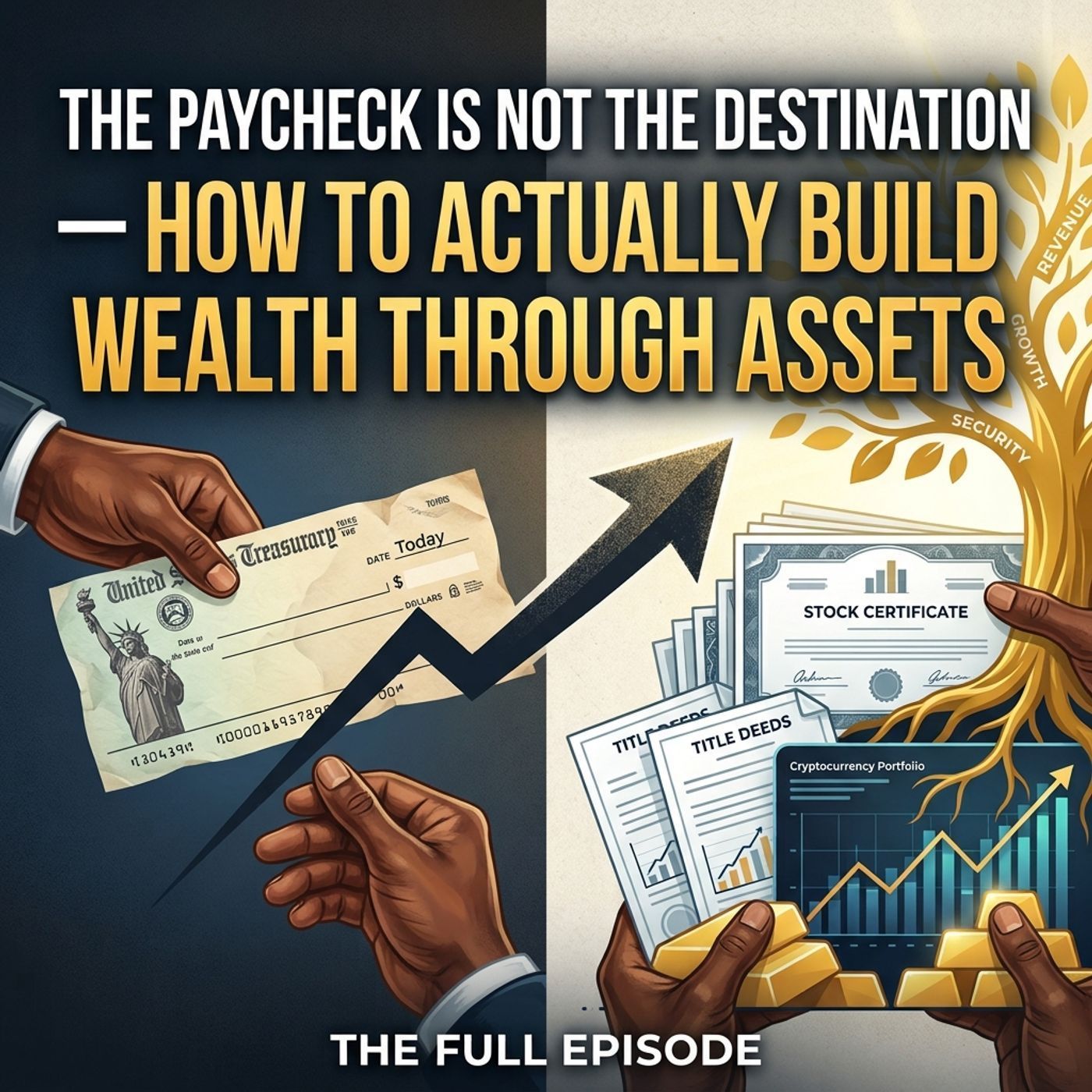
The conversation delves into the distinction between income and assets, emphasizing the importance of converting earned income into productive assets for long-term wealth. It then explores the wealth-building potential of index funds and real estate, highlighting their historical significance and practical entry points. The discussion concludes with a focus on the power of compounding and the critical role of time in wealth building. Takeaways Converting earned income into productive assets is essential for long-term wealth. Index funds and real estate are accessible wealth-building vehicles with historical significance. The power of compounding and the role of time are crucial in wealth building. Chapters 00:00 Income vs. Assets 03:21 Index Funds: The Wealth Building Vehicle 09:36 Real Estate: A Wealth-Building Mechanism 13:59 The Power of Compounding
X O: And we back. And we back. And we back. And we back. Let me ask you something that I think most people have never been asked directly. When you think about your financial life, when you picture where your money comes from, what do you see? For most people, the answer is a job, a paycheck, a number that shows up in their account on a regular basis in exchange for their time and their labor. You know, yesterday was Labor's Day. Labor's Day. Labor Day. And there's nothing wrong with that. The income from your work is real, it is valuable, and it is the engine that makes everything else possible. We spent all of our Arc 2 building the foundation, the order of operations, the emergency fund, the investments, the income strategy. That work matters deeply. But here is where Here's what I want you to sit with today. The paycheck isn't the destination. It's the starting point. The men who build real lasting generational wealth, the kind that compounds across decades and transfers to the next generation, they don't do it by earning more alone. They do it by converting what they earn into assets, into things that work while they sleep, into property that appreciates, into index funds that compound. Into ownership structures that generate income independent of their direct time and labor. That is Money 2.0. And today we're diving into it. This is Sana I'm XO. Let's level up, fellas. Let's let's start the conversation. So, before we get to into the specific vehicles, I want to give you the mental model that underlies all this because without the right framework the specific tools they won't stick there is distinction that wealthy people understand and that most people who are building toward wealth have never been explicitly taught the difference between income and assets income is what you earn it requires your time and labor to produce when you stop working it stops coming income is essential you need it to live to save to invest But income alone doesn't build wealth. It builds a comfortable life that requires you to keep showing up to sustain it. Assets are what you own. They produce value, whether that's income, appreciation, or both, independent of your direct time and labor, a rental property that generates monthly cash flow while you sleep, an index an index fund portfolio that compounds anly, whether you look at it or not. A business with systems that run without your presence. These are assets, and assets are how wealth actually builds. The shift from an income mindset to an asset mindset isn't about giving up your job or taking reckless risks. It is understanding that every dollar you earn is a seed. And the question is whether you spend it, save it, or plant it. Saving is necessary. Planting is what makes you wealthy. So Income versus assets. I believe we hear about that all the all the time. Assets of reliability. Shout out to freaking earn your leisure. but overall, it's all about us bec generating those assets, whether that's an index fund, you own a property, you have in a business, your skill set, whatever your skills you may have, whether that's customer service, sales, leading, your coaching, whatever it may be, turning that into an asset versus relying on the income. The income is just a start. Your income, wherever you're getting it from, your job, your nine-to-five, that is your angel investor into your business or your next asset. And it's understanding that. Also, the Federal Reserve data on wealth distribute distribution shows that the top wealth quintile holds nearly 70% of their wealth in financial assets and real property. Not in savings account, not in income. The bottom wealth quintile holds almost nothing in productive assets. The wealth gap is not primarily an income gap, it is an asset gap. The path to closing it runs directly through asset acquisition, which is why understanding and accessing these vehicles isn't a luxury conversation for the already wealthy. It is essential for us to have this conversation for the men building toward wealth from the ground up. And we've all been doing it. We've been building income over the years, over time. Now we have to build assets because the income is already there with the time and labor, you're gonna make that check. But let's start working on the next thing, which is assets. So let me start with the vehicle that is most accessible to most people in this audience, regardless of income level. Broad market index funds. An index fund is a single investment that holds a slice of hundreds or thousands of companies simultaneously. When you buy into a total market index fund, you are Betting on one company, you are buying a piece of an the entire stock market. When the stock market goes up, your investment goes up. When it goes down, and trust me, it will, periodically it does fluctuate like that, your investment goes down temporarily. But the long-term trajectory of the broad market over decades is consistently up. Also, the reason research on index fund investing versus active management is one of the clearest findings in. All of personal finance. Over the long term, the vast majority of actively managed funds run by professional investors, analysts, and teams of researchers don't outperform a simple, low-cost, broad market index fund. Not because the managers are bad at their jobs, because the market is highly efficient and the fees that active management charges eat into the returns that the market produces. Simple, right? But it ain't that simple. Standard Imports SPI VA scorecard, which tracks active versus personal fund performance, consistently finds that over a 15-year period, more than 88% of actively managed large cap funds underperform their benchmark index. The implication is direct. For most individual investors, a low-cost index fund helped consistently over decades outperforms the vast majority of sophisticated investment strategies. Simplicity simplicity. And consistency compounded over time beat complexity and activity almost every time. Just keep it simple. I know y'all heard the simple the saying, keep it simple, stupid. That reverse damn down to everything in life. So the practical entry point I like to say myself, which I've set up, is a Roth RA invested in a total market index fund like Vanguard, VX, VTX. S A X R Fidelities, Fidelities, Fidelities, F Z R O X, and Schwab's SWT SX is arguably the single most performing, single most powerful wealth building vehicle available to most people in this audience. Tax-free growth, tax-free withdrawals in retirement, low fees, broad diversification, automatic compounding. Start at whatever amount you can sustain. And that's the major key. Start with whatever amount you can sustain. Don't be like, I'm gonna start with a hundred dollars. Think it's look into the future, look for five years from now. Can you be consistent investing that a hundred dollars, whether that's weekly, bi-weekly, or even monthly? Just stick into that number and consistently set up those automatic payments to invest into your Roth IRA. increase it systematically as your income grows, but don't touch it, trust me. Have to let it compound. Cause once you let it compound over the years, you'll see the gains that you're supposed to get from it. The second entry point, your employers 401k. Particularly if there is a match. This is a major key. Cause when I was working for employers, I didn't know about the employer match, even though they were doing it under under the table. but I didn't know about it myself. And when I found out about it, game changer. And this we covered this in the Arc 2. Order of operations. If you haven't maxed out the match, that is the first move. Free money compounding tax advantage. Before we talk about anything else, that's where we start. And the principle underneath both time in the market beats timing the market. Every single time. The investor who puts in a fixed amount every month, regardless of whether the market is up or down. A strategy called dollar cost averaging. Consistently outperforms the investor who tries to buy at the perfect moment. The perfect moment doesn't exist. The consistent moment does. So it's about being consistent and staying consistent throughout the time. That leads us up to the next one, which is real estate. We all hear about real estate. People owning properties, flipping properties, renting properties out, whatever it is. You may be a renter yourself. Real estate is the wealth vehicle that gets talked about the most in black. Financial spaces and the one that is most often understood. But let me give you a clear picture. Real estate builds wealth through four mechanisms simultaneously. Appreciation. The property increases in value over time, building equity. Number two, cash flow. If you rent the property, the rental income can exceed your mortgage and expenses, producing monthly income. Number three, tax advantages. Real estate comes with significant tax benefits, including depreciation. Deductible expenses and capital gains treatment that most other investments don't offer. And number four, leverage. You can control a large asset with a relatively small down payment, meaning your return is calculated on the full asset value while you only put in a fraction of the cost. Those four mechanisms working together are why real estate has been one of the primary wealth-building vehicles in America for generations. And why? The exclusion of black Americans from it through redlining, discriminatory appraisals, predatory lending have been one of the most consequential wealth suppression mechanisms in our history. Did you know the Urban Institute research consistently shows that home ownership is the single largest source of wealth for most American families, accounting for approximately 25 to 40% of net worth for the typical homeowner? The racial homeownership gap. 44% for black Americans versus 73% for white Americans is one of the primary drivers of the racial wealth gap. Every percentage point of homeownership growth in the black community translates directly into wealth accumulation that compounds across generations. Getting into real estate isn't just a personal financial decision. It is a community economic act. We gotta own property. Owning real estate, whether that's you own a property, a storage facility, a warehouse, something that has to do with real estate, I believe we all should have within our families. We all should have home ownership or real estate ownership. And here's a practical landscape for 2026 because real estate entry requires honest context about the market. Primary home ownership is the first step for most people. Not because a house is always a great investment in the pure financial sense. But because it forces long-term equity, building provides housing security and historically appreciates over time. If homeownership is accessible in your market at your current income and credit profile, pursue it with the same deliberateness you brought to the foundation, foundational financial order of operations. Look to be a homeowner. We all want to be a homeowner because I believe that is one of the greatest pieces of wealth you can acquire and accumulate. Let's talk about house hacking. House hacking, buying, which is buying a multi-unit property living in one unit and renting out the others, is one of the most powerful entry strategies for first-time real estate investors. The rental income from other the other units reduces or eliminates your housing costs. You build equity in the asset and you begin developing the landlord skills and a knowledge base that scales to a larger portfolio. This is how many serious real estate investors get started. Number two is REITs. Real estate investment trusts are the entry point for a man who wants real estate exposure without the hands-on management. A REIT is a company that owns income-producing real estate and is required by law to distribute at least 90% of its taxable income to shareholders as dividends. You can invest in a REIT through your brokerage account for the price of a single share. You can get the real estate asset class, the dividend income, and the liquidity. Of a publicly traded security without finding a property, securing a mortgage, or managing tenants. That may be a route for some people. Some people like, yeah, I want I don't want I want to be hands-off. I just want to get my collected my monthly dividends. REITs are perfect for you. So Let's talk about the compound principle. Why time is the most valuable asset we all have. Time. I'm trying to see where I start with this. Hmm. I want to close the practical session with this principle that sits underneath all of it. Because I think this is the most important thing I can give you in a conversation about advanced wealth building. Compounding is the mechanism by which wealth actually builds. It isn't linear, it's exponential. Money growing at 7% annually does not produce the same amount in year 20 as it did in year 10. It produces dramatically more. Because in year 10, you're earning 7% of the original investment plus 7% on all the gains that you've accumulated. And in year 20, you're earning a 7% on a much larger number. The growth accelerates over time. That is the power of compounding. And here is what that means practically. The single most powerful variable in your wealth building equ equation isn't the rate of return. It's the time horizon. Starting 10 years earlier with a smaller amount often produces more wealth than starting later with a larger amount because time is the multiplier that no amount of clever investing can fully replicate once it's passed. Vanguard's long-term investor research found that investors who automate contributions and maintain a consistent strategy through market volatility, holding through the downturns rather than selling, outperform investors who try to time the market by an average of one and a half to two percent per year. Over 30 years, that gap compounds into a dramatically different retirement outcome. The discipline of staying consistent, of not reacting to every market movement. Of keeping money in the productive assets, even when the anxiety of the market drops, makes selling feel rational. That is the behavior that separates the men who build wealth from the men who almost did. The practical implication of compounding is this: the best time to start was 10 years ago. The second best time is right now. Not when the market looks better, not when you have more to invest, not when things feel right, right now with what you have. In the most low-cost, diversified, long horizon vehicles available to you. Index funds consistently funded. Real estate entered as soon as access is viable. The foundational order of operations from R2 running underneath both. And the financial health we have been building all year. The psychology, the scarcity pattern work, the income building, providing the stable base from which the asset accumulation can actually compound. That is money 2.0. It's not complex, not reserved for already wealthy, available to any man willing to be consistent, patient, and strategic. That's what it really comes down to. So let me close this out, fellas. Gotta land this plane. The paycheck isn't the destination. It's the seed capital for the real work. Converting earned income into productive assets that grow independently, that build equity over time. That create the kind of financial security that a job alone can never provide because a job requires you to keep showing up to keep the money coming. Index funds and real estate aren't exotic. They aren't reserved for people who started with advantages. They are the document research back vehicles through which ordinary people with consistent discipline build extraordinary long-term financial outcomes. The complexity Isn't in the vehicles, it's in the consistency required to let them work. So your action this week, look at your current current financial picture and identify which of these vehicles you are not yet using. Not all of them, just pick one, just start with one and build from there. The one that represents the most accessible next step from where you are right now. Maybe it's opening the Roth IRA you have been meaning to open. Maybe it is looking at your credit portfolio. your credit prof profile per that credit prof profile and understanding what home ownership realistically looks like in the market you're in. Look at it and see what it looks like in the next 12 to 18 months, the year, next year, year and a half. See what that real estate market looks like. Maybe you want to just invest your first dollar in a REIT through your existing brokerage. Whatever that next spec step is, please take it this week. The compounding starts when you start. And next week we close theme four. And we s we we talk about what we all need to build. The business ownership conversation. Why ownership is the final answer. That is the one that ties this whole year together. But with that being said, share the show. I appreciate y'all, man. we are on YouTube. If you ain't on YouTube, go ahead and hit the subscribe on YouTube. We all got YouTube. Be looking forward to y'all, man. I appreciate y'all. With that being said, this is Sana I E. I'm Mexo. I'll see you next week.