
S A U N A I E · S A U N A I E
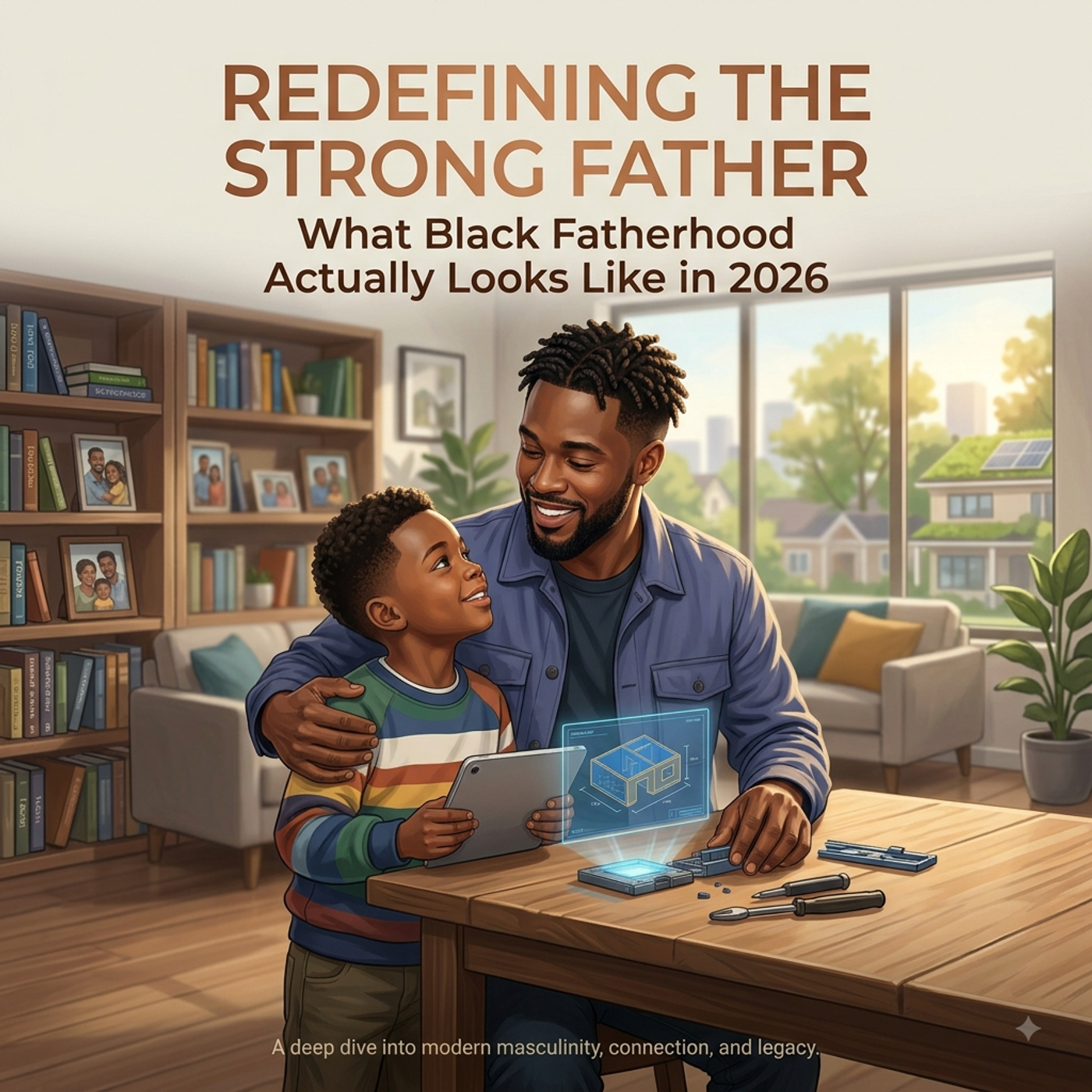
The episode delves into the truth about black fatherhood in America, challenging the incomplete and incorrect narrative. It presents data on black fatherhood, the impact of involved black fathers, and the remarkable commitment of black fathers. Additionally, it addresses the barriers faced by black fathers, particularly economic challenges. Takeaways Black fatherhood statistics challenge the dominant cultural narrative. The involvement of black fathers has a significant positive impact on children's outcomes. Chapters 00:00 The Truth About Black Fatherhood in America 02:14 The Data on Black Fatherhood 03:14 Impact of Involved Black Fathers 04:21 Black Fatherhood: A Remarkable Commitment 04:48 Barriers Faced by Black Fathers
X O: I want to start this episode by telling you the truth about black fathers in America. Not the version that's seen in headlines, not the version that gets used as political talking points, the actual data, the numbers that researchers have gathered from tens of thousands of families, the real version. Because the story being told about black fatherhood in this country is not only incomplete in many ways that matter most, it's actually wrong. And today We really gonna we're gonna knock it out the park and let y'all know. And every black father who has been showing up quietly, consistently in the face of economic pressure and systematic barriers, and a cultural narrative that has refused to see them deserves to hear the truth about what the data actually shows. We're gonna get into that today. This is Sana I E. And today We're closing our theme two by redefining what it means to be a strong black father in 2026. So, buckle up, get your notepads ready. Let's get into it and let me give you the numbers. 78% of black fathers describe fatherhood as central to their identity. Not important, but central. The single most defining element of who they are. Gotta love that. Shout out to our black fathers out there. 70% of black fathers who live with their children help them with homework daily. That number is higher than white fathers at 67%. Black fathers living with their children are more likely to take their children to activities. 80% compared to 68% of white fathers, more likely to bathe, dress, and care for young children daily. That's 70% compared to 60% white fathers. Nothing against white fathers, but we we just laying out the statistics here. And this one needs to be said loudly because it is one of the most directly contradicted by the dominant cultural narrative. Black fathers who don't live with their children maintain a higher rate of contact and involvement than non-resident fathers of any other racial group. The act the absent black father story isn't supported by the data. The data shows a father who found ways to stay present even when the household wasn't intact. Now we got to look at the research. And the research says this: A 2026 verified data analysis confirmed what researchers have been finding for years. Black fathers raise children in 1.2 million married couple households, spend more than more time on childcare per week than fathers of any other racial group. And 70% report that their relationship with their children is the most important part of their life. These aren't the statistics of an absent or disengaged population. These are the statistics of a group of men who have been carrying extraordinary weight and extraordinary commitment and receiving almost none of the credit. And here's what that involvement produces. Children with an involved black fathers are 31% more likely to graduate from high school. They are 50% less likely to be incarcerated. They have 15% lower rates of depression in adulthood. 91% of black fathers report that health education for their children is their personal responsibility. I love these statistics. I know y'all like, yeah, I know y'all root in the background. These statistics is what it's all about because we're doing our part, even though we didn't have the we didn't need the statistics, we already knew within our community. But this just resolidifies everything that we've been doing on a consistent basis. And these numbers right here don't describe a failed community. They describe a committed one operating under conditions that would have broken a group with less resolve. And I am saying this not to produce complacency. I am saying it because you can't build a stronger version of something you have been taught to see as broken. You build from the truth. And guess what the truth is? Black fatherhood is already something remarkable. The work now is taking it further. So, man, gotta love statistics, right? And I want to name the barriers honestly because pretending they don't exist doesn't honor the fathers who are navigating them. We all know the economic barrier is real. The unemployment rate among black fathers runs nearly double the rate for white fathers. The median household income gap is documented and significant. The poverty rate among black single fathers is more than twice that of married black fathers. Which means the men who are doing the hardest version of the job are often doing it with the fewest. Resources. Financial strain doesn't just create practical difficulty, it creates the kind of chronic stress we talked about in the body episode. The cortisol load, the cognitive narrowing, the survival mode that makes it harder to show up as the emotionally present father you want to be. And this the criminal justice system barrier is real. Mass incarceration removes fathers from families at rates that are not destructive. Distributed equally. Ain't that some shit? Excuse my language. If y'all got kids listening. But ain't that something? A father can't be present for his children from a prison cell, and the policies that produced those numbers were not accidents. The systematic support barrier is real. Fatherhood programs that exist are often not culturally responsive to black fathers' specific experiences. The research from The 2025 Social Development Journal makes this point explicitly. Programs designed for a generic fathering experience don't account for the racial stress, the navigating of hostile institutions, the specific identity pressures of being a black man trying to build, trying to be a father, well, in a system that wasn't built to support that project. Ain't that something? In a 2026 grounded theory study from Family process examining how social, economically disadvantaged black fathers construct fatherhood identity amid systematic adversity, found that structural, interpersonal, and identity-based factors all shape paternal engagement. Got a lot of going against us, right? But we still showing up day in and day out for our kids. And that's what it really comes down to, showing up regardless of what's going on with the system, with everything about you. It's all about focus on on focusing on what you can control. And I think that's why we have the statistics so high, because we're so resilient as black men, as well as black fathers, because we're resilient to know that at the end of the day, our kids need us. Our kids need us. Our kids need us. The fathers in the study weren't disengaged by choice or character. They were navigating a set of structural realities that made engagement harder and finding ways to stay present anyway. The research calls for fatherhood initiatives to be responsive to this specific experience rather than applying generic frameworks to a population with a distinct and complex context. I'm naming these barriers not to use them as an excuse for any individual father, because the data shows most Black fathers are not using them as excuses. They're navigating them. But I am naming them because a conversation about Black fatherhood that pretends These structural realities don't exist, is not an honest one. And Sanae does not do dishonest conversations. The strong black father in 2026 isn't strong in spite of these barriers. He is strong inside of them. That distinction matters. So, with that being said, let's read let's redefine what strength is. Redefining that strength is where we start. And here's why I want to offer. As a full definition of the strong black father in 2026. Not the one-dimensional version that equates strength with provision and science, the complete version. He provides that foundation is real and it matters. The man who ensures his family has what they need financially, logistically, practically is doing something essential. That has never not been true and it will never not stop being true. But provision is the floor. And not the ceiling. He is present, not just in the house or in the room, in the conversation, in the small moments that don't get photographed or celebrated, but that his children are feeling falling away as the definition of what it feels like to be known by their father. His presence is deliberate and his attention is real. He is emotionally available. He can receive his children's inner world without shutting it down. He knows their fears. And their excitements and their questions, not because they told him on schedule, but because he created the kind of ongoing safety that made them want to tell him. He created that safe space. His children bring him the real thing because they have learned over time that the real thing is safe with him. He's a cycle breaker. He has looked honestly at what he received and made deliberate decisions about what he will and will not pass on. He's a he isn't a perfect father. There's no such thing as a perfect father that doesn't exist. But he is a growing one. He's evolving with his children. His children will see the see him get things wrong and prepare them. They will see him become someone better over time. And that modeling will be worth more than any single lesson he could deliver. That's what the whole father is. And research from a 2026 on fatherhood on 2026. Research from 2026 on fatherhood identity construction among black fathers found that men who built the strongest paternal identity did so by integrating multiple dimensions of fatherhood provider, protector, emotional presence, and community contributor, rather than defining themselves through any single dimension. The men who define strength primarily through financial provision showed more identity, fragility, when finances fluctuated. The men with multi-dimensional fatherhood identity showed greater resilience, more consistent engagement, and better outcomes in their children across all measured dimensions. He invested in his community. The strong black father is. What we all aspire to be. The strong back father in 2026 understands that his children exist inside a community and that the health of that community shapes the context his children are growing up in. He is not just building a private family, he is contributing to something larger. He mentors, he shows up, he's a part of the ecosystem that makes the next generation possible. And he takes care of himself. He understands. That's what we've been building all year. That a depleted father cannot pour into his children at the level they deserve. He invests in his brain health, he protects his physical health, he builds his financial foundation, he does the healing work. Not because he is selfish, but because he knows that the whole man is better, is a better father than the fractured one. Shout out to him. That's what we all aspire to be. All aspire to be the strong black father. And it takes, and it starts with us changing what happened in the past, what happened in our childhood, whatever happened then, we learn from it and see how we can do things differently in the present time now. And that's what it really comes down to. Children who are measuredly better off, more emotionally regulated, more academically successful, less likely to be incarcerated, less likely to experience depression, more likely to go on and father well themselves. That isn't aspiration. That is a documented outcome of intentional black fatherhood at scale. So the vision is this: a generation of black children who grow. Grow up knowing without question that their father sees them, that their inner world is safe with him, that he is growing alongside them, that he has done the work to break what needed to be broken and built what needed to be built. That generation will be different. And the one after them will be different because of that difference. The compounding works in both directions. It has been working against us for centuries, and it can work for us for this generation more. for. That is a legacy. That is what this theme was all about. Theme two is complete. Congratulations. You made it. Three episodes, one theme, the full picture of black fatherhood, what children need, how the cycle gets broken, and what the strong black black black I'm talking way too fast. Let me slow down. And what the strong black father in 2026 actually is. So, every father, listen to this. I see you, brother. Not the version the media has constructed, not the stereotype that the culture has refused to let go of, the real version. The man who is showing up, who is carrying the weight, who is choosing every day to be present in whatever form that is possible, given everything he is navigating. You are not the exception. You are the majority that have been rendered invisible. And the data says so. And to the father who knows he has room to grow, who heard something in these three episodes that he recognizes in himself and wants to change, the door is open, the work is available. The community of men doing exactly this is growing. You're not alone in it. Next week, we move into theme number three: community and culture. Why black men were building community isn't optional, it is a survival strategy. And that conversation starts next week. This is Sana I E. I'm Exo. See you next week, man. I appreciate y'all showing up, showing out, and being here for this episode. I know what it means, especially over these last three episodes, discussing Black Fatherhood. We've all been through it, we all going through it. And it's like it starts with us to change how things were in the past. And we change that in the present. we visualize the future of what type of fatherhood we want to carry on for our kids, kids, kids, kids, kids, kids, kids. The list goes on. But with that being said, man, I love y'all. Appreciate y'all. We all in this together. share the show, man. Share the show. If you're watching this on YouTube, we had a little technical difficulty, but you know, we back. watching this on YouTube, subscribe, leave a comment, leave a review. We're trying to grow our subscribers on there, man. You know, everybody got a YouTube these days. So go ahead and subscribe to Sunai. I'll leave the the link in the show notes. Appreciate y'all. Love y'all. Review the show. Like the show. Share the show with any black fathers who need to hear this. Without y'all, none of this is possible. And, ladies, if y'all are listening, I know y'all are listening too, man. Share this, share this with somebody who you has the potential to be a father, who you want a father in your life, or who is already a father. I greatly appreciate it. With that being said, enjoy y'all week. We'll be back next week with Sana I E.