
S A U N A I E · S A U N A I E
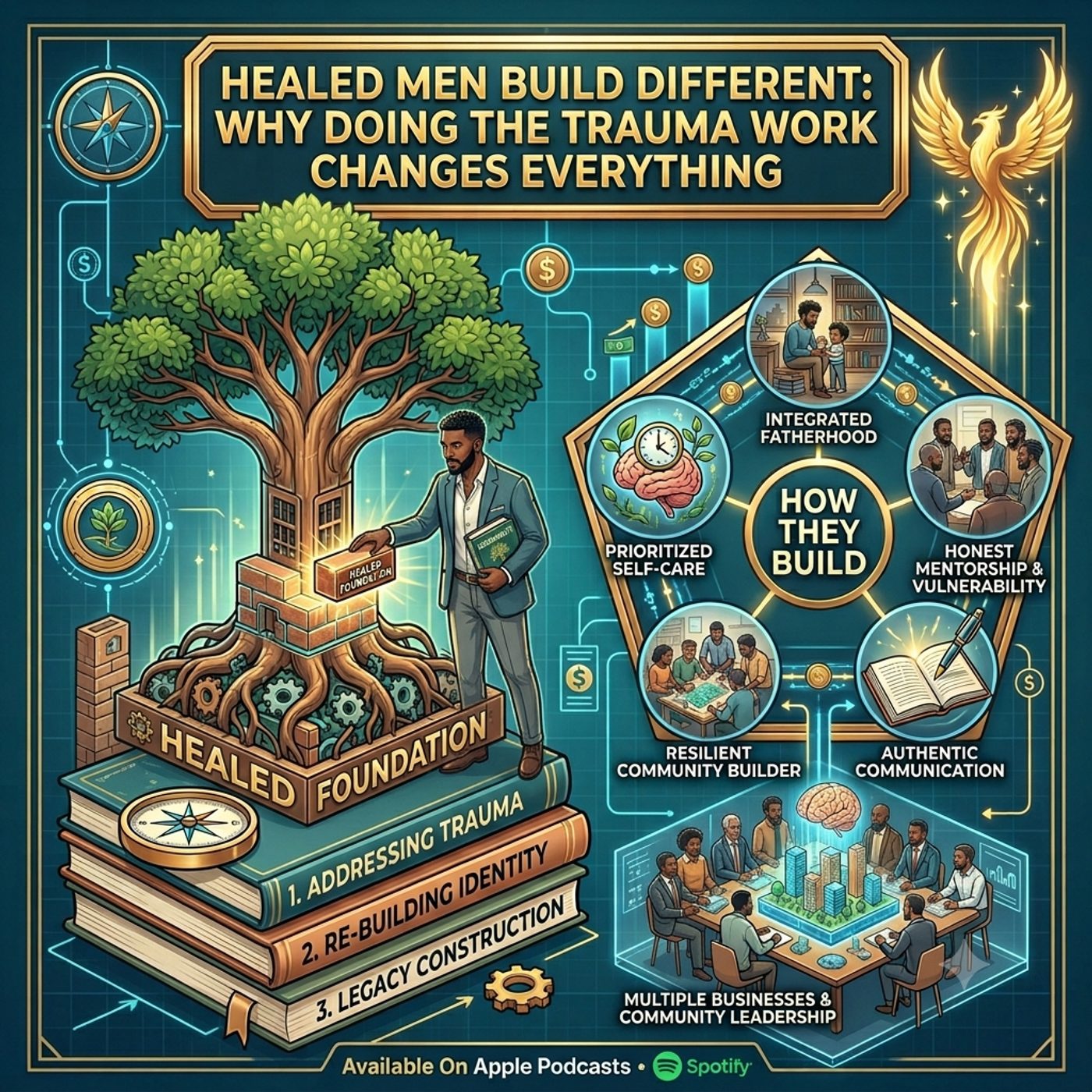
The conversation delves into the impact of unresolved trauma on men's lives, highlighting how it affects their relationships, health, and ambitions. It emphasizes the interconnectedness of healing and building, providing practical steps for addressing trauma and building a stable foundation for growth. Takeaways Unresolved trauma affects men's lives in various ways Healing and building go hand in hand Chapters 00:00 Understanding Trauma 04:51 How Unresolved Trauma Shows Up 12:53 The Cost of Unresolved Trauma
X O: I want talk about something that most men never get permission to talk about. Not because it doesn't exist in their lives, it does. In almost every life. Not because they don't feel it. Most do. Even if they can't rename what it is. But because the culture around manhood has made this particular conversation feel dangerous. Like admitting it means something is funnily wrong with you. Like going there means you're weak or broken. Or even less than. Talking about trauma, the things that happened to you, and in some cases, the things that happened to the people before you that left the mark that shaped how you see the world, how you respond to threat, how close you get to people, as well as how much you trust, how hard you work, and what you believe you are worth. Most men are carrying it, and most men have never been told it is okay to put it down. This episode right here is for the man who has been building financially, building a career, building a family, and who somewhere in the quiet moments has a sense that something underneath all of it has never fully been addressed. This is the conversation that goes there. This is Sana I'm Exo, and I'm glad you're here, man. Pull up a chair, get out your notebook. We're gonna dive right into it. ⁓ And I want to start I want to what I want to start at. ⁓ I want to start by clarifying what trauma is because I think the word gets used in ways that make some men feel like it doesn't apply to them. So let me break it down for you. Trauma isn't what happened only what happens after a war or a catastrophic event, those are real and serious, but they aren't the only forms of trauma. Trauma is any experience that overwhelm your capacity. To process to process it at that time and left that lasting imprint on how your nervous system responds to the world. So it may be growing up in a household where money was always scarce and adults were always stressed, that leaves an imprint. Or watching your father be absent or present but emotionally unavailable, or present but volatile, that leaves an imprint. Or maybe it could be being the kid who grew up fast. Who had to be the man of the house before you were old enough to understand what that meant, that as well leaves an imprint too. Experiencing violence in your neighborhood, in your school, in your home, that leaves an imprint. Being told explicitly or implicitly that your feelings were not safe to express, that strength meant silence, that asking for help was weakness. That leaves an imprint too. None of those experiences have to be dramatic to be formative. The cumulative weight of Of ordinary chronic difficulty is trauma. And for black men in America, that cumulative weight includes not just individual experiences, but the documented psychological impact of racial trauma. The ongoing stress of navigating a system that is structurally hostile to your advancement, your dignity, and your safety. Damn, ain't that some shit? It's a lot more. We're diving in today, man. We really unpacking what trauma is. And research published in the Journal of Urban Health in 2025 found that higher levels of adverse childhood experiences, aka aces, were strong predictors of PTSD and drama and drama, depression, severity in black men, even controlling for current circumstances. The wounds of the past do not stay in the past. They travel forward into Adult relationships, adult decisions, adult nervous systems. And until they're addressed, they'll still be there. Also, 56 to 74% of black males exposed to traumatic events may have an unmet need for mental health services. The need is there, the support mostly isn't. So when I say trauma, I'm not talking about a clinical diagnosis that applies to someone else. Talking about the thing that most of us are carrying and have been carrying for a long time: the thing underneath the hustle. The thing the building has not fully addressed because building, no matter how hard or how successful, does not hear what happened before the building started. Gotta get some water after that. So that was a lot. So I guess that's brings us to how. Unresolved trauma shows up in the way you build. Here's what I want you to understand. And this is the most important thing. I will say this in this episode by far. Unresolved trauma does not stay in your past. It shows up in your present. Specifically, it shows up in the very areas we spent this whole inquire inquire, this whole entire quarter two addressing. It shows up in the scarcity mindset, the persistent belief that there will never be enough, that security is fragile, that success can be taken away at any moment, is often not just a financial pattern. It is a nervous system pattern. A body that learned early that safety was unreliable doesn't automatically update that belief when the bank account improves. The money changes, the trauma response doesn't. Not on its own, at least. It shows up in the inability to be fully present. The man who is physically in the room, but mentally somewhere else. Has that been you? I know I've been like that occasionally, but me meditating more has really instilled in me to be present in my area. Whatever or your ⁓ maybe your mind is always scanning for the next threat, managing the next problem, rehearsing the next conversation. It doesn't mean you're often distracted. It means you're hyper vigilant. Hypervigilance is a trauma response. I'll say that again for the people in the back in case you didn't hear it. Hypervigilance is a trauma response. The nervous system learned to stay on alert because staying on alert once kept you safe and it will not turn off. It shows up in how close you let people get, the emotional walls, the difficulty trusting, the way intimacy triggers something that feels like danger rather than safety. These are not personality flaws, they are protective adaptations. At some point in your story, closeness was followed by loss or hurt or betrayal. And the nervous system filed that away as information. Now it is trying to protect you from something that happened 20 years ago by keeping you alone in the present. And research on racial trauma published in the Journal of Migration and Health in 2024. Found that racial trauma carries similar characteristics to PTSD, including hypervigilance, mood disturbances, disassociation, avoidance, and social and sleep disturbances. These aren't just emotional symptoms. They are physical and psychological, ⁓ physicological patterns that affect how the brain processes information, regulates emotion, and makes decisions. A man operating with unresolved racial and personal trauma isn't just emotionally burdened, he is cognitively operating at a level below his actual capacity. Damn. The ceiling on what he can build is being held back by what he hasn't healed. So it's a lot of unresolved trauma, a lot of healing that we have to do as men. I know when it comes to men, we'd be like, ⁓ healing, trauma, and stuff like that. We don't want to talk about because maybe we grew up to where healing, trauma, mental health, and things we were taught to keep quiet. Hey, you're a man, you're strong. Hold it in, ⁓ keep it to yourself, silence, silence and strength. ⁓ you're being weak if you're being emotional and things like that. That was all wrong. And it was really passed down through generations of what our I say ancestors were taught before we found out what it truly means. And sometimes it shows up in self sabotage. We talked about self sabotage in quarter one, but here is the layer beneath the layer. Some self sabotage isn't about mindset or habits. It's about a deep unconscious belief formed in trauma. That you don't deserve to have more than a certain amount, that success is dangerous, that being seen is risky, that something bad follows every good thing. Those beliefs were formed in experiences where those things were true. And until they're addressed at the root, no amount of goal setting or discipline will fully override. Man, I wanna I wanna name why men don't do the healing work because dismissing the barriers doesn't help anyone. So the word. Let's talk about it. The first barrier is a story about what it means. Seeking help with trauma has been coded in black male culture specifically as weakness, as inability to handle your own, as something you don't do in public because what happens in the family stays in the family. Remember that? The story was formed in environments where vulnerability was genuinely dangerous, where showing up or showing pain meant losing respect, where emotional disclosure meant being taken advantage of. The story served a purpose. It also it's also costing men their health, their relationships, and the ceiling on what they can build. The second barrier. Is the mental health system itself. Black men have legitimate historical reasons to distrust clinical mental health services, misdiagnosis over medication, being pathologized rather than hurt. The therapeutic relationship working best when the therapist understands the context of your life. And far too often finding therapists who don't. Just just keep it a buck. These are real barriers and they're not excuses. And the barriers the mental health community is working to address. Imperfectly, slowly, but genuinely. They're trying to address that because they know. Let's talk about the third barrier. And the third barrier is the idea that being productive is the same as being killed. That if you're building, working, achieving, you must be okay. That the output is evidence of the healing and it isn't. Some of the most driven men alive are running from something they've never stopped to face. The productivity is the coping mechanism, not the solution. The productivity is a coping mechanism, not the solution. Understand that. And that goes to the APA's 2024 report of supporting the well-being of black men and boys. Noted that effective strategies include reframing the conversation, using language like mental strength rather than mental illness. Meaning meeting men in comfortable and culturally familiar spaces and building mental health literacy in community settings. The insight is important. The pathway to healing for black men often doesn't start in a clinical office. It starts in community, in conversations like this one we're having today, in trusted relationships, in spaces where the language fits the life. And Sunai is one of those spaces. If you're going through anything mentally, whether that's trauma-based, ⁓ relationship-based, ⁓ career-based, whatever it is, don't hesitate to reach out to me, to somebody that you like, love, and trust. Because at the end of the day, we're all here for you. We all want to help you get through anything that you're dealing with. Don't think you're fighting a battle alone. There are people who love you and care about you and who want to help you get through whatever you're going through. But don't stay silent. open up about what you're going through. Let that be your strength. Not being silent is a weakness. And here is what not doing the work costs specifically. It costs you in relationship quality. Men with unresolved trauma have measuredly more difficulty maintaining close, trusting, emotional, available relationships. The walls that protect you also isolate you. It costs you in physical health. Unresolved trauma is one of the most significant risk factors for cardiovascular disease, immune dysfunction, and premature death. It costs you, it costs your children. Because unaddressed trauma is transmitted not inevitably but reliably unless it is interrupted. And it costs you in the ceiling on your ambition. Because you cannot build at a level you're capable of from a foundation that has never been stabilized. So I guess I gotta let's talk about the practical work. Because healing isn't a single event, it is a direction. And like every other form of building that we've been talking about this whole quarter too. It starts with one move. Not a perfect plan, not a complete transformation. And that number one move is name it. You can't heal what you will not acknowledge, not in a public forum, but just to yourself. What happened? What did it cost you? What did you learn to believe about yourself, about safety, about what you deserve because of it? Write it down if you need to. Say it out loud in an empty room if that's where you're at right now. The naming isn't the cure, but it is the beginning of the end of the silence that has been. Technically. Move number two. Talk to someone you trust. Not social media. You can go to social media event if you want to, but talk to someone you trust, not a broadcast, one person, whether that's a brother, a partner, a mentor, a therapist, a pastor, a counselor, gets to hear the real thing. Not the edited version, the real version of what you're going through. The research on trauma recovery is consistent on this point. Healing happens in relationship, not in isolation. The same relational wound that created the trauma requires a relational experience to begin to heal it. You need someone to know the real thing and still be present. Number three, consider therapy. Specifically culturally competent therapy. I know the barriers, I name them. And I'm still going to say it directly. Therapy works. Say it again for the people in the back, the people in the side, therapy works for trauma specifically, evidence-based modalities, EMDR, somatic therapy, trauma-focused CBT have documented measurable outcomes. The key is finding a therapist who understands your cultural context, who does not pathologize. I'll mess that up. Your experience who speaks your life. That therapist exists. Psychology today's Database allows you to filter by specialty, cultural competency, and race. The search is worth the effort. You can always find a therapist who suits you, who has the same culture as you, has the same background as you, so understands what you're going through. And research on this shows that culturally tailored mental health interventions programs designed specifically. For black men by practitioners who understand the cultural context produce significantly better engagement, retention, and outcomes that standard clinical approaches. So get that therapy. Reach out, do what you have to do. I'll leave some therapy sites in the show notes. Check them out. The Nimhead brother, you are on my ⁓ my support, you are on my mind initiative, peer support programs, and community-based mental health models. Are showing that when the pathway is healing to healing is built for men walking it, more men walk that same path. The help that fits is the help that works. Move number four. Understand that healing and building are not sequential. You do not have to be fully healed before you start building. You don't have to resolve every wound before you pursue your purpose. You build and heal simultaneously. They go hand in hand. Not as competing priorities, but as parallel practices. The building gives you purpose and momentum. The healing gives you the foundation that makes the building sustainable. One without the other eventually runs out of runway. Let me close this arc out. We started arc three talking about the body, the physical infrastructure that everything runs on. We moved into spirit, the internal anchor that holds when everything external was shaking. We talked about how you show up for the people around you. And today we went to the root, the unresolved wounds that live underneath all of the patterns, the postures, and the ways of making that. We have been working all quarter two. And here's the through line of this entire arc. The whole man. That's gonna that's gonna be on the next episode. Not the performing man, not the providing man, not the achieving man in isolation, the whole man. Body, spirit, and relational presence. And healed enough to build from a stable foundation. This is what Sun IE is for. Not just the financial strategy, not just the mindset upgrade, the whole idea of the man. And I want to say this directly to whoever needs to hear it. What you're carrying is not a character flaw. It is not evidence that you are broken or beyond repair or less than the man you're trying to become. It is weights, real weight. Placed on you by real experiences in a real world that was not always assigned to support your survival, let alone your thriving. You're allowed to put some of down. Not all at once, not in a single podcast episode. You might want to do it all right now, but you can't. But over time, with intention, with the right support, you're allowed to be lighter than you have been. And what's and what gets built from a lighter place, from a healed, routed, whole foundation is different. It lasts longer. It feels different. It treats people differently. It leads differently. It loves differently. Healed men don't build less. They build better. Next week, we move into The whole man trying everything from this whole quarter together before we move into quarter three. I know quarter three like literally around the corner, but that conversation is going to be worth everything we have built here on out. This is Sana I E. I'm XO. Take care of yourself. See you next week.