
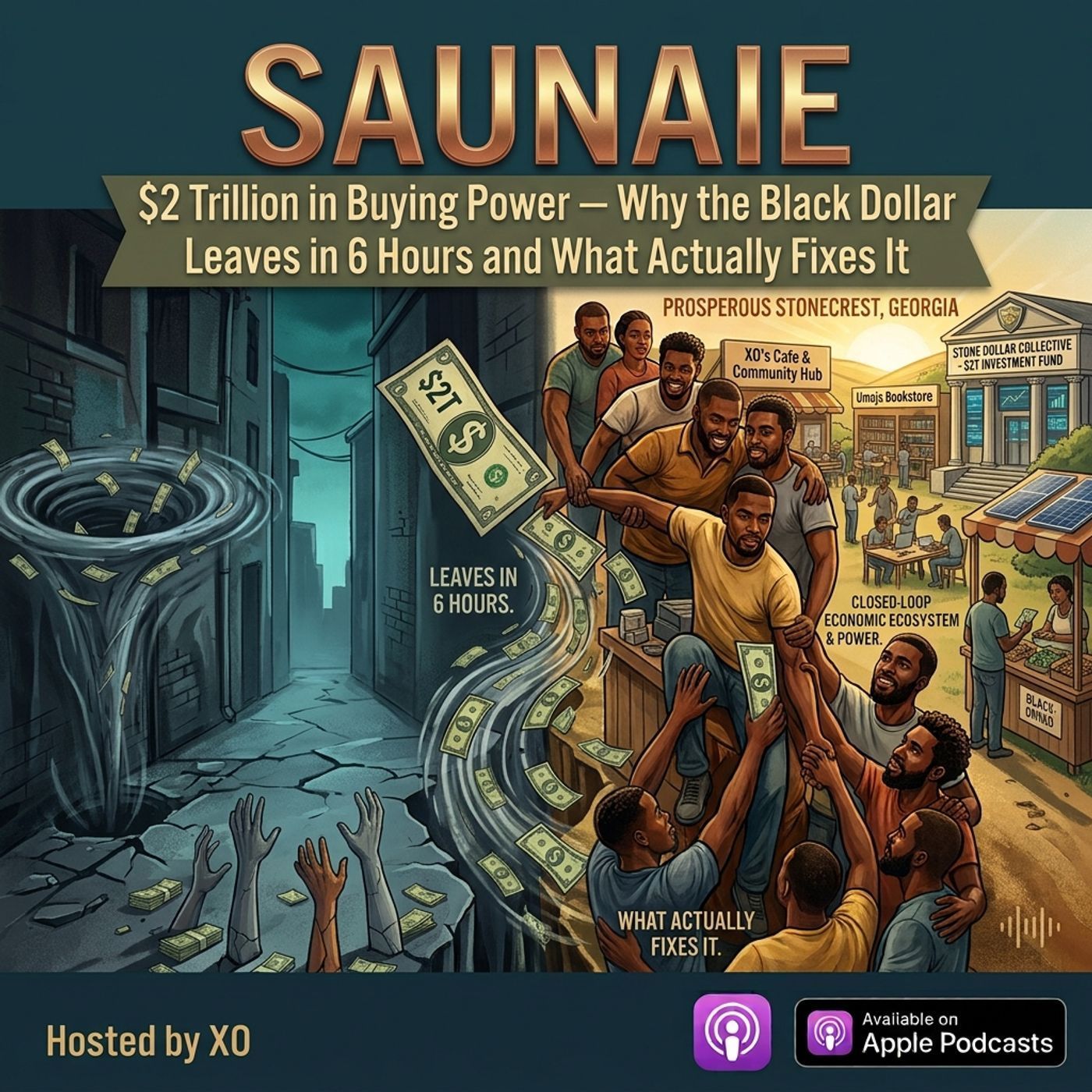
S A U N A I E · S A U N A I E
The conversation explores the economic power of Black America, focusing on the circulation of the black dollar and the structural barriers to wealth accumulation. It emphasizes the need for real economic community investment and outlines five levels of economic community reinforcement. Takeaways Black America's buying power is significant but the circulation of the black dollar is limited, highlighting the need for real economic community investment. Real economic community investment involves intentional consumer choices, business investment and referral networks, capital formation and investment networks, mentorship and knowledge transfer, and political economic power. Chapters 00:00 The Economic Power of Black America 01:22 The Structural Barriers to Wealth Accumulation 04:12 Levels of Economic Community Reinforcement 10:25 Psychological Barriers to Collective Economic Investment 14:23 Practical Moves for Real Economic Community Investment 17:33 Closing Thoughts and Call to Action
X O: Over two trillion dollars. That is a buying power of Black America in 2024, according to the C League Center for Economic Growth at the University of Georgia. $2 trillion. That number surpasses the entire GP of Portugal, Greece, and Peru combined. If Black America were a country, it would be one of the largest economies on earth. Now here's a question that that number demands. Where does it go? Because here's what the research shows about what happens to that two trillion dollars. The black dollar circulates inside the black community for approximately six hours before leaving. Six hours. Compare that to Asian communities where the dollar circulates for about 20 days, and Jewish communities, 17 days. The buying power is there, the circulation isn't. And that gap between the power. we have and the power we retain is one of the most consequential economic problems facing our community. One that buying black alone can't solve. Today we go beyond the slogan. This is Sana I E I'm Exo, let's talk about real economic community investment. But before we talk about what to do, I want to explain why the dollar leaves so quickly. Because this is a structural problem, not a character problem. And understanding the structure is what allows you to actually address it. The black dollar circulates briefly, primarily because the ownership infrastructure to keep it circulating doesn't fully exist. When you spend money, it stays in the community only if the businesses and institutions receiving it are themselves embedded in the community. Paying local employees, sourcing from local suppliers, reinvesting profits locally, building local wealth. When those businesses are owned externally, the money passes through and leaves. Black communities have historically had that ownership infrastructure destroyed or prevented from forming. Whether that's redlining, prevented black business owners from assessing the capital to scale, urban renewal demolished black commercial districts. Discriminatory lending denied black entrepreneurs the financing that white competitors received routinely. The infrastructure that would have kept money circulating was systematically prevented from being hit. So it's like we have to jump through hurdles to get that infrastructure built. But in this day and age, 2026, we are putting in the work to make it happen, to make sure that black dollars still circulates in the black community. The C League Center's 2025 reports notes that while buying while black buying power has grown dramatically from eight hundred and three billion dollars in 2000 to over 2 trillion in 2024, the gap between buying power and wealth accumulation remains stark because buying power measures what black Americans earn and spend, not what they own and build. Earning and spending Without ownership is what produces the six hour circulation. The money moves, it just doesn't stay. And the second structural factor is capital access. Black owned businesses are denied financing at more than double the rate of white-owned businesses. We covered that in R2, the racial wealth gap episode, which is a phenomenal episode. I'm gonna drop it in the show notes for the people that haven't heard it or watched it. But without capital, businesses can't scale. Without scale, they can't employ large numbers of community members. Without employment, the wages leave. Without wages staying, the circulation remains short. So buying black addresses one part of the equation, which is demand. What real economic community let's see. What real economic community investment addresses is the supply side, building the ownership infrastructure. the capital networks and the institutional capacity that allows the demand to actually circulate. And that's what it really comes down to. So here's the framework I want to give you. There's five levels of economic community and reinforce each other. Buying black is level one. Real economic power requires all five. So let's start with level one. Intentional consumer choices. Yes, this is buying black, but done strategically. Not symbolically, like everybody wants to do every now and then. The strategic version means identifying your recurring spending categories: food, services, professional services, entertainment, financial services, and systematically moving as much of what That's spending as possible to Black owned providers who are themselves community rooted. Not a single purchase in February, a systematic relocation of where your household economy flows. The research on consumer consumer solidarity economics shows that even a 20% shift in spending toward black owned businesses in a given market creates measurable impacts on employment and business sustainability in Level two, business investment and referral networks. Buying from black owned businesses is not as the same as actively building their customer base. Say that again for the people in the back. Buying from black owned businesses isn't the same as actively building that customer base. Real investment includes referrals, actively directing people in your network to the black owned businesses you trust, writing the reviews. Making the introductions, the Brookings Institution's Buy Back the Block research found that one of the most significant barriers to black businesses growth is access to networks, not just capital, but the referral pipeline and relationship networks that white owned businesses access through existing social infrastructure. You are not excuse me, you are that infrastructure for the businesses in your community. We have to use it strategically. We have to Get us as a collective to continue to buy black on a daily basis, not periodically. And the Brookings Institution's 2024 Buy Back the Block Lab launched specifically to navigate and to investigate how Black community real estate ownership can be structured to keep wealth circulating internally. They're finding community-simetered economic development where residents are the owners, not just the consumers. Is the mechanism that closes the circulation gap. When black people own the commercial real estate, the housing, and the businesses in their communities, spending stays. The ownership is the answer. We have to become owners. We have to look to own more instead of trying to not be owners, being consumers. We have to look at the ownership side. Level three: capital formation and investment networks. This is where the invented Individual investor meets the community economy. Community development financial institutions, CDFIs, are financial institutions specifically designed to provide capital to undeserved, underserved communities and black owned businesses that conventional banks exclude. Black owned CDFIs in particular are one of the most direct mechanisms for keeping capital in the community. Investing in them, depositing with Black owned banks and credit unions and participating in community investment funds are ways of directing your financial capital toward community circulation rather than away from it. So it's like investing with the black owned banks. I'll have a list as well as where you can look for black-owned banks within your community. Level four, mentorship and knowledge transfer. This one is less visible but critically important. Every black professional, entrepreneur, and skilled train person in this audience has knowledge that younger people in the community need and can't easily access through institutional channels. Mentoring is a form of economic investment. It transfers that intellectual capital that converts raw talent into productive economic output. The Bill 2025 Black Wealth Incubator found that. The programs producing the most durable business success were the ones that paired capital access with mentorship that provided not just funding but the knowledge infrastructure to deploy that funding effectively. Your knowledge is capital invested. Level five, political economic power. Individual and collective economic decisions are have political consequences where you bank, where you invest, where you hire, what businesses you support. How you vote on economic policy? All of these are economic acts with political dimensions. Communities that organize their economic power politically, that use their collective purchasing power as leverage, that support candidates and policies that create structural conditions for black wealth building, those communities produce better economic outcomes than communities that operate solely at the individual consumer level. The Montgomery Boy Montgomery bus boycott was not just a moral statement, it was an economic weapon that produced political change. That capacity still exists. I know it's a lot, but those five levels help us structure and get back to owning our own buying power. Two trillion dollars. That's the number I'm stuck on right now. But two trillion dollars of which we have that black. buying power which doesn't stand community longer than six hours. Ain't that something? But now I want to spend a few minutes on the internal dimension of this. Because I think there are real psychological barriers to collecting economic investment that don't get named enough. The first is scarcity thinking about other people's success. When you're operating from a scarcity mindset, which we covered in a deep dive in our R2, someone else's win can feel like a threat rather than an opportunity. The brother who is succeeding at a level you have not reached can Produce envy, skepticism, and distance rather than genuine investment. That response is a scarcity pattern operating at the community level. And it's one of the things that most directly prevents the kind of collective investment that builds community economic power. Other people's success isn't competition, it's proof of concept. And it is the social capital that community economic power is built on. Think collaboration over competition. We all can collab. There's enough money, wealth, success, fame, whatever you're striving to be, there's enough for everybody. There's an abundance of it in this world. The second is distrust built by historical exploitation. Black communities have been exploited by institutions claiming to invest in them. Pedatory lenders, extractive businesses, politicians who campaign on community and govern for donors. That history produces rational skepticism about collective economic schemes. And that skepticism has to be held and respected. The answer isn't to dismiss it, but to build the kind of track record and transparency that earns trust over time. Real community investment is visible, accountable, and produces outcomes that can be verified. The Urban Institute's February 2026 analysis on four ways to build black wealth and increase economic opportunity identified coordinated community investment as one of the highest leverage strategies, noting that communities where black wealth has grown fastest are the ones with organized institutional infrastructures. CDFIs, black owned banks, community land trusts, and business networks that create self reinforcing economic. Ecosystems. The coordination itself is the investment. Uncoordinated individual action, even at scale, doesn't produce the same outcomes. So it comes down to having those institutional infrastructures, the CDFIs, the Black Owned Banks, the Community Land Trust, Business Networks, where you can have the masterminds talk, all over stuff, have those mentorships. That's what builds the black wealth. Let's talk about the third barrier. And the third barrier is the individualism we talked about in episode eight. The self-made framing makes collective investment feel like it costs you something. Like directing money or energy toward community is diverting it from your own building. What the research consistently shows is the opposite. Men and businesses embedded in strong community economic networks have better access to capital, better referral programs, better. Mentorship pipelines, better resilience during economic downturn than those operating independently. Community isn't a tax on your success. It is a compounding mechanism for it. So I think that leads me up to what can we do this week as a collective? What are some practical moves we can do? And here's what real economic community investments look like that we can start this week. Not someday, not next year, not next month, not in September this week. Move number one. Audit your spin. Before you change anything, look at where your money actually goes. Not where you think it goes, your actual bank statements for the last 30 days. Identify the three largest spending categories and acts. Is there a black-owned alternative I could use for any of these? Not all of them, one or two. Start there and build systematically. Move number two. Move your deposits. If your money is sitting in a national bank that has no particular commitment to your community, consider moving at least a portion of it to a black owned bank or credit union. Your deposits are capital. Black owned financial institutions lend that capital back into the community at higher rates than conventional banks. Moving your deposits isn't a sacrifice, it's a redirection of capital that already belongs to you. Movement number three make two referrals this week. Think of two black-owned businesses you generally trust: a restaurant, a contractor, a professional service, a retailer, and actively send two people to them this week. Not a social media post, a direct personal referral to someone who has the need. That act costs you nothing and potentially changes the trajectory of a business that is trying to grow. Move number four. Invest your knowledge in one person. Identify one person, younger, earlier. Earlier in their career or business journey who could benefit from something you know, reach out, offer one hour. The mentorship economy is one of the most underutilized forms of community wealth transfer available and it requires nothing but the willingness to show up. Move number five, find your investment community. Whether it's a local investment club, a CDFI, a community development corporation, or an organized group of men building economic power together. Find the existing infrastructure in your area and plug in. You don't have to build from scratch. Most major cities have black-led economic organizations that are already doing this work and need people with resources, skills, and commitment to join them. That's all we got to do. It's all on us. And I'll go over those five moves again. Move number one, audit your spending. Move number two, move your deposits. Move number three, make two referrals this week. Move number four, invest your knowledge in one person. Move number five, find your investment community. Now let me land this. $2 trillion of buying power that circulates for six hours. That is the gap. And closing it isn't about guilt or obligation or performing community. It's about strategy. It's about understanding that the same principles of compounding that build individual wealth, consistent investment, intentional direction of capital, long-time horizons also build collective wealth when applied at The community level. Buying black is a starting point. It's necessary. It's meaningful and it's not sufficient. The next level is ownership. It's capital formation. It's organized economic power that doesn't depend on an any individual's generosity, but on the systematic structure of a community that has decided to keep its own money working for itself. That structure doesn't build itself. It gets built by men who understand what's at stake, who have done the individual work, the money psychology, the foundation, the income building, the excuse me, and who are now ready to direct how shall I put this? Some of that capital outward toward the community that shaped them, toward the businesses that need the networks they have built, toward the young people who need the knowledge they have earned. That is a full version of financial health. Not just your account balance, the community, economy, your children will inherit. And next week we close out this theme, theme three with mentorship, accountability, and showing up for the next generation. One's personal with that being said, man, like the show, subscribe if you haven't subscribed already. If this is your first time listening, thank you. Thank you for taking the time out your day. Hopefully, this helps you out and educated you on what to do to help out the next generation and the present generation. Let's buy back black. It's it starts with it starts with buying black, but then moving towards the next level, which is ownership. And we all can help. We all know some business owners within our community that we can. Help out that we can send referrals to. And don't be afraid to mentor. Mentor the people below you or mentor the people ahead of you. Mentorship helps us continuously building and growing. This is Sana I E. I'm XO, and I'll see y'all next week. Love y'all.