
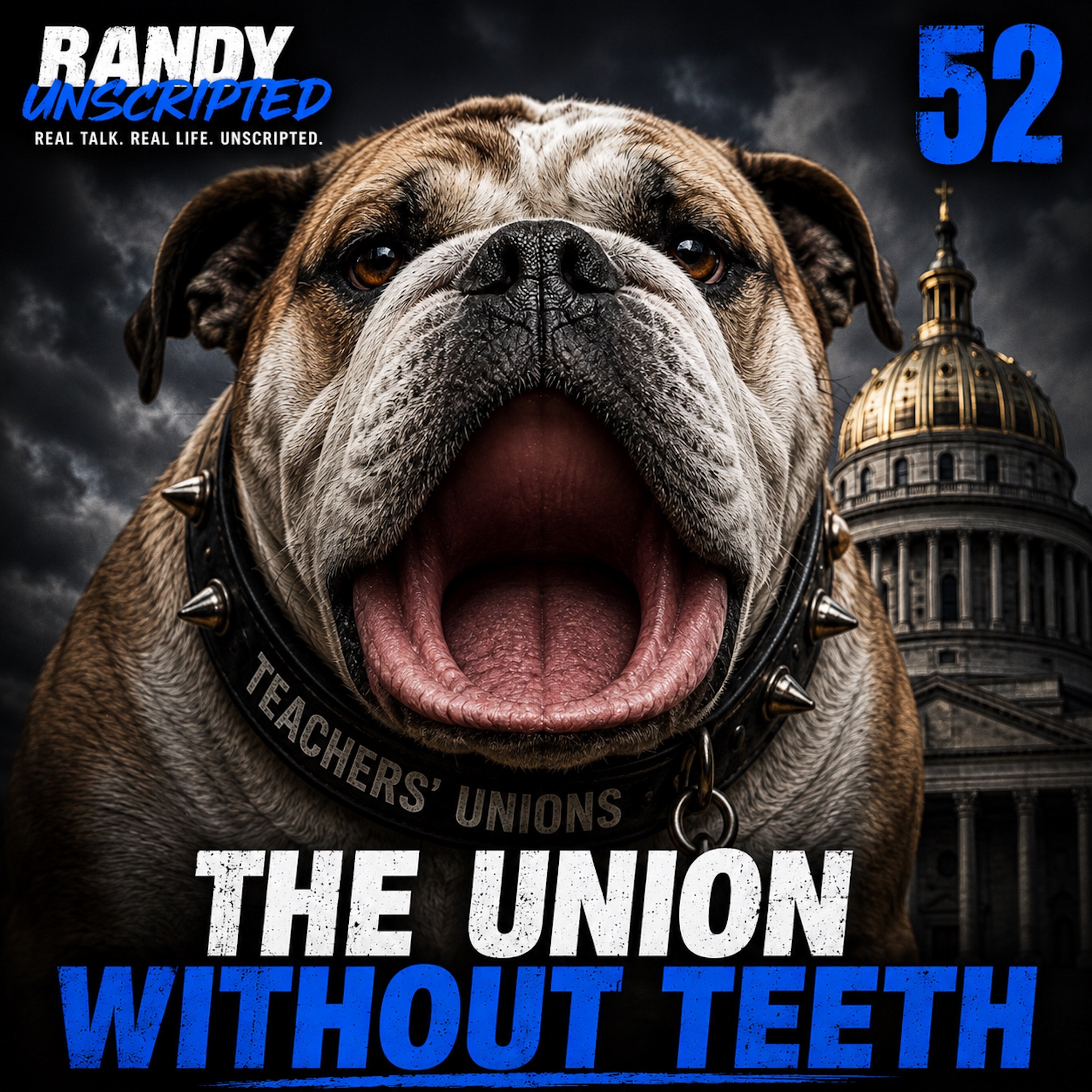
Randy Unscripted · Randy Black
What happens when a union loses the one tool that traditionally gives it power? In West Virginia, teachers’ unions operate without collective bargaining rights, forcing them to rely on political advocacy rather than direct negotiation. But does that leave teachers with meaningful representation, or merely the appearance of it? Episode Summary In this episode of Randy Unscripted, Randy Black takes a critical look at the role of teachers’ unions in West Virginia. While unions are often associated with contract negotiations and collective bargaining, public school teachers in the Mountain State operate under a very different system. Randy explores what unions traditionally do, what West Virginia’s teachers’ unions are actually able to accomplish, and whether the limitations imposed by state law have fundamentally changed their purpose. Along the way, he examines the 2018 teachers’ strike, the distinction between teacher power and union power, and asks whether educators are receiving the representation they expect. In This Episode What collective bargaining is and why it matters Why West Virginia teachers’ unions operate differently from unions in many other states The services and benefits unions provide to members The 2018 teachers’ strike and its complicated legacy Whether teachers’ unions still possess meaningful influence without collective bargaining authority The difference between advocacy, political influence, and labor representation A discussion about the future of teacher representation in West Virginia Closing Takeaway Teachers deserve a strong voice and effective representation. The question explored in this episode isn’t whether teachers need advocates—it’s whether organizations operating without collective bargaining can truly function as unions in the traditional sense. If the most powerful tool in organized labor’s toolbox has been removed, perhaps it’s time to rethink what representation should look like for educators in West Virginia. Music by Yurii Semchyshyn from Pixabay. If you enjoy Randy Unscripted and would like to help support the show, visit randyunscripted.com/support. Your support helps cover hosting, production, and the ongoing work of creating new episodes. Thank you for listening and for being part of this community. This podcast may be unscripted, but the conversation doesn’t have to end here. If you’d like to get in touch, share a thought, or suggest a future topic, visit randyunscripted.com/contact. I’d love to hear from you.
0:34Randy BlackA podcast where I just kind of talk about things that come across my brain,
0:40you know, whenever they just happen to come across it.
0:44Today, I want to talk about something that's kind of been rattling around in
0:47my head for quite a while. We're talking like years of time it's been running
0:51around in my head, and that's teachers' unions.
0:54And I work in education, so don't get me wrong. I understand the place and the
0:58point they're there for.
0:59But more specifically, I really
1:01want to focus on the teachers unions in my home state of West Virginia.
1:06Now, depending on your background, the very mention of teachers unions may already
1:12have you taking sides, taking a position.
1:15Some people view them as essential advocates for educators.
1:19Others see them as political organizations that have long outlived any sense
1:26of usefulness that they may have had.
1:28But that's not really where I want to start at with what I want to talk about