
Protrusive Dental Podcast · Jaz Gulati
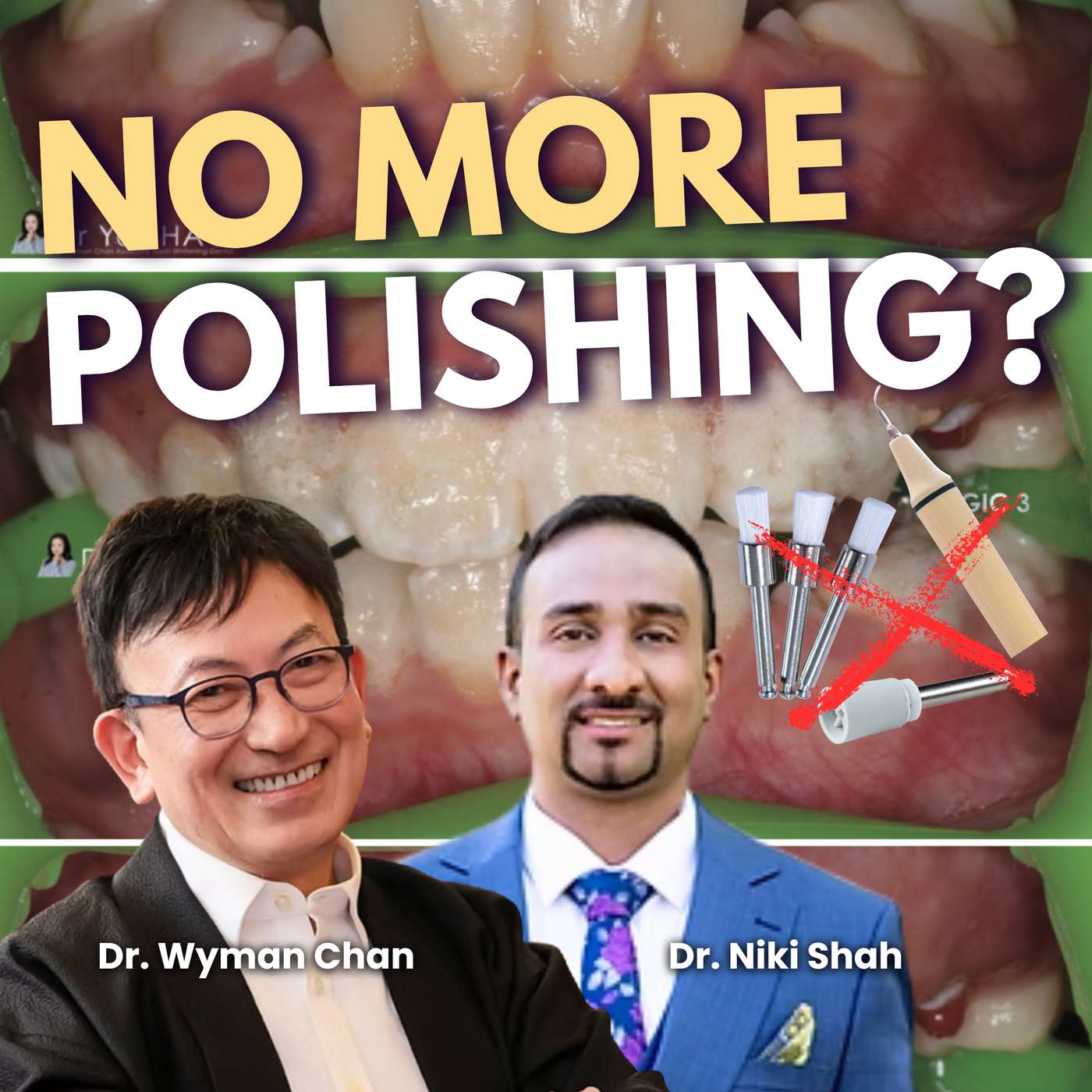
🦷 Plaque Friday™ is here! Get 20% off Protrusive Guidance Ultimate for as long as you stay, plus 7 days free to try it. That’s every masterclass, AskJaz, verifiable CPD on hundreds of podcast episodes, and our new live series Caries, Cracks and Contact Points with Dr Ronit Patel. Use code PF26 at checkout. Ends Monday 30 November, 11:59pm UK. 👉 https://protrusive.co.uk/plaquefriday Have you ever removed plaque using a scaler or ‘air-polisher’ and notice that the demineralised enamel flaked away? Scaling and polishing is a routine part of preventive dental care — but could some of our traditional cleaning methods be doing more than we realise? A whitening specialist who works without a drill, scaler or air polisher argues that some approaches to cleaning may affect the enamel, and that hydrogen peroxide gel can remove plaque without touching the tooth surface. Dr Wyman Chan has done nothing but tooth whitening since 2002, when he closed his general practice for a dedicated whitening centre, and he developed the chemical-polishing gel which is at the centre of this episode. He is joined by Dr Niki Shah, a UK general dentist and practice owner whose company distributes the product in the UK, and who now runs most of his hygiene this way. In this episode, they explain which patients they believe may benefit most, walk through the full chairside protocol, and discuss the limitations of the approach and where it may not be appropriate. Protrusive Dental Pearl: Manicuring Worn Lower Incisors Worn lower incisors sit sharp against the upper teeth, concentrating stress. Take a Sof-Lex disc and manicure them, rounding the edges from pointed to smooth. Show the patient in the mirror first and, borrowing Dr Michael Melkers’ framing, ask if you can make their teeth look a little younger. It is surface topography, changed for force management, and the patient feels it with their tongue. What You’ll Take From This Episode On sound enamel, prophy paste and air polishing are low-risk; on demineralised enamel hidden under plaque, the same abrasion can flake the surface. Chemical polishing does not lift calculus; where calculus is present, ultrasonic or hand scaling is still required. Dr. Wyman Chan offers a 3% hydrogen peroxide gel as a plaque and biofilm adjunct, not a replacement for oral hygiene instruction. The strongest cases for this are anxious, paediatric, orthodontic, special-needs and geriatric patients who tolerate scraping poorly. The chairside protocol runs about twelve minutes and still ends with manual agitation using a single-tufted brush. No published evidence supports the product’s clinical claims yet; Dr. Wyman Chan describes studies in progress. Highlights of This Episode 00:00 Teaser 01:21 Rethinking How We Polish Teeth 03:36 Protrusive Dental Pearl: Manicuring Worn Lower Incisors 05:23 Meet the Guests: From Whitening to Chemical Cleaning 12:10 What Is Chemical Polishing? Prophylaxis, Not Whitening 20:05 Is Traditional Polishing...
SEO METADATA SEO TITLE: Chemical Polishing vs Air Polishing with Magic 3 | PDP284 META DESCRIPTION: Dr Wyman Chan and Dr Niki Shah on chemical polishing with Magic 3: who it suits, the step-by-step protocol, and how it compares with air polishing. URL SLUG: chemical-polishing-air-polishing-magic-3 PRIMARY TOPIC: Chemical polishing as an alternative to mechanical and air polishing in dental hygiene SECONDARY SEARCH TOPICS: - Can air polishing damage demineralised enamel? - Plaque removal for anxious dental patients - Preventing white spot lesions during orthodontics - Managing pericoronitis without local anaesthetic - Hygiene for children, special needs and older patients - Chemical polishing protocol with a single tufted brush - Making time in the dental day for notes and referrals - Manicuring worn lower incisors with Sof-Lex discs CHEMICAL POLISHING: A NEW APPROACH TO DENTAL HYGIENE THE PROTRUSIVE DENTAL PODCAST, EPISODE PDP284 HOST: DR JAZ GULATI GUESTS: DR WYMAN CHAN AND DR NIKI SHAH EPISODE SUMMARY In this episode of the Protrusive Dental Podcast, Dr Jaz Gulati is joined by Dr Wyman Chan, a whitening specialist making his fourth appearance on the show, and Dr Niki Shah, a UK general dentist with Direct Oral Care Solutions (DOCS). They discuss Magic 3, a 3% hydrogen peroxide gel that Wyman developed for plaque removal and launched in October 2024, which they describe as "chemical polishing". Wyman explains how Magic 3 came from his whitening work and from white spot lesions in clear aligner patients in China, and why he believes mechanical polishing and air polishing can damage enamel that is already demineralised under plaque. Niki describes the patients he finds it most useful for: anxious patients, children, orthodontic patients, special needs and older patients, post-perio surgery patients, and urgent care cases such as pericoronitis and gingival abscesses. He walks through his 12-minute protocol, the cost per application, and how using the waiting time for notes and referrals helps him get home on time. They also discuss the current lack of published evidence and the studies under way. Jaz opens with a Protrusive Dental Pearl on manicuring worn lower incisors. IN SHORT This episode introduces chemical polishing with Magic 3, a 3% hydrogen peroxide gel used to remove plaque without mechanical instruments. Dr Wyman Chan and Dr Niki Shah explain who they find it most useful for, how they apply it, and why they believe it is gentler on demineralised enamel, while noting that it doesn't remove calculus and that research on it is still under way. KEY TAKEAWAYS - Magic 3 is a 3% hydrogen peroxide gel that Wyman developed for plaque control; it was launched in October 2024. - Wyman says mechanical and air polishing are safe on sound enamel, but can flake away enamel that is already demineralised under plaque. - Niki finds chemical polishing most useful for anxious patients, children, orthodontic patients, special needs and older patients, and after perio surgery. - Niki has used Magic 3 for pericoronitis and gingival abscesses in urgent care, without local anaesthetic. - The protocol: paint the gel into the sulcus, cover with a mask for eight to 10 minutes, then agitate with a soft single tufted brush away from the gums and rinse. - Magic 3 doesn't remove calculus, and oral hygiene instruction remains essential. - Niki says each application costs his practice about £10, and he uses the waiting time to write notes and referrals. - Wyman says studies are under way at DMU and with a periodontist in Taiwan; published evidence is still limited. QUESTIONS ANSWERED IN THIS EPISODE 1. What is chemical polishing? 2. Can polishing or air polishing damage tooth enamel? 3. Which patients benefit most from chemical polishing? 4. Can Magic 3 be used on children? 5. Can Magic 3 help with pericoronitis? 6. Does Magic 3 remove calculus and stains? 7. What is the Magic 3 chemical polishing protocol? 8. Is there evidence for Magic 3? 9. How much does chemical polishing cost per patient? IN THIS EPISODE 1. Introduction: chemical polishing as an alternative to air polishing 2. Protrusive Dental Pearl: manicure lower incisors for younger-looking teeth 3. Meet Dr Wyman Chan: from tooth whitening to plaque removal 4. How Dr Niki Shah discovered Magic 3 5. Where Magic 3 came from: white spot lesions in clear aligner patients 6. Why Dr Niki Shah changed the way he does hygiene 7. Can polishing and air polishing damage enamel? 8. Chemical polishing for anxious patients 9. Chemical polishing for children, adolescents and orthodontic patients 10. Magic 3 for pericoronitis, gingival abscesses and urgent care 11. Special needs, older patients, perio surgery, and what the evidence says 12. Introducing Magic 3 in practice: calculus, patient buy-in and stains 13. The Magic 3 chemical polishing protocol, step by step 14. The cost of chemical polishing, patient demand and getting home on time 15. Wrap-up: where to get Magic 3, and the live event CHAPTER 1: INTRODUCTION: CHEMICAL POLISHING AS AN ALTERNATIVE TO AIR POLISHING JAZ: This episode is going to make you rethink the current polishing protocols in your practice. I'm talking about air polishing, and using a brush or a cup with some sort of polishing paste. Whilst this might be more applicable to anyone who does hygiene... Personally, I work really closely with our hygienists, and I'm not doing the whole scale and polish anymore. You'll get the most out of this episode if you provide hygiene or if you're a hygienist or therapist, but there are a few reasons to listen even if you don't do hygiene yourself. Because this product we're talking about has pretty much revolutionised the way we polish teeth. This approach is non-mechanical. This is chemical polishing. And the product has some other advantages, such as the management of pericoronitis, or preventing white patches during orthodontics. Also, if you're a practice principal, you'll want to hear about this, because it will attract a whole bunch of new patients, particularly anxious patients who are afraid of mechanical polishing or find it really unpleasant. How can we please this cohort of patients? And of course, there are associates who want to free up their time a bit. This chemical polishing protocol means you can do other things while the chemical is working. So there's something in this episode for everyone. Hello, Protruserati. I'm Jaz Gulati, and welcome back to your favourite dental podcast. We are joined by the world-renowned expert that is Dr Wyman Chan. This is his fourth appearance on the show. Chemical polishing is really his baby. He is absolutely pioneering this. We're also joined by fellow dentist and pioneer Dr Niki Shah. Niki's a UK-based dentist who has been trained by Dr Wyman Chan, and he has completely changed the way he delivers hygiene. He's a true believer in Magic 3, the product used for chemical polishing as an alternative to air polishing, and there are good reasons why. You'll find out why it's safer, why it's a better choice for those undergoing orthodontics, and why it's excellent for anxious patients. In this episode, we'll go deep into all those scenarios. I think there's a place for chemical polishing in your practice if you see elderly patients, anxious patients or children. Oh my gosh, children hate the noise of cleaning, so that's a big one. Orthodontic patients, post-perio surgery patients who can't brush their teeth and can therefore use chemical plaque dissolution, special needs patients. And of course, if you work in community dental services, pay close attention to this episode. CHAPTER 2: PROTRUSIVE DENTAL PEARL: MANICURE LOWER INCISORS FOR YOUNGER-LOOKING TEETH JAZ: Now, before we join the main interview, let me give you your Protrusive Dental Pearl. The way I remember this pearl is that we're talking about polishing and chemical polishing, and that reminded me of smoothing. And what do I smooth a lot of? Lower incisors. Think of those jaggedy, worn lower incisors that so many of our patients have. I'm a huge believer in taking a Sof-Lex disc and manicuring them. It's a great word: we manicure the patient's lower incisors. It's one of the protocols that Mahmoud and I teach on both Unchippable and Bulletproof, our two occlusion courses. And it's so key for force management. Imagine you do some ceramic or composite veneers on the upper anteriors. Why would you want jaggedy, sharp lower incisors occluding against them? They concentrate stress, they look horrible, and there's no reason to have Himalayan lower incisors. So I've already mentioned one communication tip, which is that we're gonna "manicure" them. Patients get that. But there's one more I'll give you, inspired by Dr Michael Melkers, who was co-teaching with us on one of these workshops. He says to patients, "Is it okay if I make your teeth look a little younger?" I love that term: younger-looking teeth. Who doesn't want younger-looking teeth? And if you're thinking, "Whoa, this sounds really invasive or aggressive," it's a Sof-Lex disc. All it's doing is changing the very superficial shape. We're going from pointy and sharp to smooth and rounded. That's it. It's the surface topography, and we think this has a huge benefit when it comes to force management. We regularly check the edge-to-edge position. Why would you accept something sharp, pointy and jaggedy on those lower incisors? So next time, my friends, when you're manicuring lower incisors, show the patient a mirror and get their permission to make their teeth look younger. They will thank you for it. They'll feel it with their tongue afterwards, and it'll feel so nice and smooth. Anyway, let's now join the main episode, and I'll catch you in the outro. CHAPTER 3: MEET DR WYMAN CHAN: FROM TOOTH WHITENING TO PLAQUE REMOVAL JAZ: We are joined here today by Dr Wyman Chan again, and by Dr Niki Shah. Niki Shah is part of DOCS, Direct Oral Care Solutions. He's a general dentist. He's one of us, one of the good guys, and he's been in this game long enough to make some observations. He came to me with his observations, and I was absolutely gobsmacked. Basically, Niki's observation was that air polishing and polishing are borderline dangerous, and maybe there's another, better way to do hygiene. And obviously you've been working together with Dr Wyman Chan on developing products, and talking about these products that are just gonna change the way we do hygiene. For those of you listening to a Dr Wyman Chan episode for the first time, I'll let him introduce himself. Both of you featured in the episode we did last year on whitening, with all the questions we had from the community about whitening. But today is all about completely changing the way we think about how your practice delivers hygiene. No more polishing, no more air polishing, no more bristle brush. But why? Before we get to that, Dr Wyman Chan, please tell us about yourself and how you got involved in this space. DR WYMAN CHAN: Okay. As I said early on, I'm a tooth whitener. I'm a dentist like you. I qualified from Guy's many, many years ago, 40 or 45 years ago. A long, long time ago. And I started doing bleaching quite early on, in 1991. I tried all kinds of bleaching, and I fell in love with dental bleaching. I actually opened a dedicated whitening centre and hung up my drills in 2002, and I never looked back. I was doing lots of bleaching in my clinic, and I found that patients with poor oral hygiene, with lots of plaque on the tooth surfaces, tended to have poor results. That's why we need to clean the teeth first, actually using the bleach that we have, before we can get a better result. So oral hygiene is so important for producing good bleaching results. I don't think that's been talked about a lot, but it's really important. If you want to see why some results are good or bad, go and look at the trays. The trays are the best clue. If they are really dirty, you're wasting your effort. You're cleaning the trays with the bleach that you paid so much money for. And because of that, I started looking at how to remove this plaque from the tooth surfaces to enhance my bleaching effect. That was 20 years ago. And that's how it evolved. Now we've got a product called Magic 3, which is 3% hydrogen peroxide. It's very, very gentle, as gentle as DWCH, which is 8% carbamide peroxide, equivalent to 3% hydrogen peroxide. I just wanted to use it to clean the teeth initially, but bit by bit I found that we can do a lot more than just remove plaque. Because I don't have handpieces in my clinic. I restrict myself on mechanical devices. I don't have a drill, I don't have an air polishing machine, and I don't have an ultrasonic scaler. We do need a scaler if there's calculus, but I'm talking about plaque here. Lots of my patients are pretty good at oral hygiene. It's just plaque, in some areas where they're not brushing correctly. So that's how I developed Magic 3: to find a way to help patients improve their oral hygiene, mainly. And it's especially designed for patients who are really scared of cleaning, or scared of seeing dentists. I'm talking about children, and people who maybe had a bad experience when they were younger. I found that Magic 3 really helps them a lot, because we can remove plaque and clean teeth without any mechanical means. That means no slow handpieces and no air polishing. If it's just plaque, not even an ultrasonic scaler. Isn't it amazing? CHAPTER 4: HOW DR NIKI SHAH DISCOVERED MAGIC 3 JAZ: Amazing. And Niki, you've been using this for a while now, and it's changed the way you do hygiene. Tell us what sparked your interest in this different way. We're gonna go into the protocols, because that's what today's about. We're gonna discuss some scenarios and some protocols. But tell us about yourself and how you got into this. DR NIKI SHAH: Lovely. I had the pleasure of meeting Dr Wyman Chan about nine months ago. It just so happened that I was in Southeast Asia at my brother-in-law's wedding. After the wedding, I was scrolling through Facebook, as we all do, and I saw this amazing video of Dr Wyman Chan, who I knew, 'cause I graduated from Barts in 2011. I remember Dr Chan very well. I saw this amazing video from the Shanghai Dental Show, where someone had poor oral hygiene, quite inflamed gums and a lot of plaque on their teeth. And I saw them painting a gel on the gums, putting a mask over the retractor the patient had in, and then carrying on with the lecture they were giving. And then they took the mask off and washed it away, and I couldn't believe what I saw in the photo. The plaque was gone, and where there had been redness and inflammation, the gums were completely pink. I'd never seen anything like it. Now, me being me, and persistent, I contacted Dr Chan's team and said, "I've seen this amazing product. I really want to get my hands on it." But I think they were a bit surprised, because they'd been doing a lot of work in China and Southeast Asia, and they weren't really so active in the UK with Dr Chan's newer products. JAZ: I'm just surprised the Meta algorithm brought that to your attention. Whatever the reason was. DR NIKI SHAH: It was meant to be. It's one of those things. I was in Jakarta, Indonesia, at the time. And luckily, Dr Chan did call me back when I sent the enquiry, and then we discovered that my wife is from Malaysia, and Dr Chan is also from Malaysia, so we connected over that. I explained to Dr Chan that I was coming back to the UK in a couple of weeks, and it just so happened that Dr Chan was too. I wanted to meet him and find out more about this product, Magic 3. I wasn't looking at whitening or anything like that. I was just intrigued by this product, Magic 3. JAZ: And is it fair to say that Magic 3 comes under the broad umbrella term of prophylaxis? DR WYMAN CHAN: It is. I was talking to a US dentist who saw your podcast and saw Magic 3, and he was really looking for something like that. I like the term he used. He said he'd been looking for upstream dental products. JAZ: Upstream. DR WYMAN CHAN: Upstream. He had also decided not to be a clinical dentist anymore, and wanted to go into business, so he'd been looking for upstream products. That means products we use before we have disease. It means prevention. Basically, it's prevention. So I like the term upstream. We had a chat, and I think Niki has spoken to him as well. He was very keen and saw the innovation. He saw it as one way of taking him back into routine clinical dentistry. Maybe dentists in their 40s or early 50s who've had enough and have got enough money. They don't want to do routine dentistry anymore, and are looking for something easier in that way. So yes, I like it: it is prevention. But it's more than prevention. It can also, we'll say, repair, correct. I can see more and more functions for Magic 3 now, because we have a lot of dentists using it in China, and lots of them have experimented with other uses. So I'm really grateful to them. I hope Niki will try it out for many other treatments too. I can see this becoming an integral product that dentists use all over the world. CHAPTER 5: WHERE MAGIC 3 CAME FROM: WHITE SPOT LESIONS IN CLEAR ALIGNER PATIENTS JAZ: Niki has been using it for nine months. Tell us how long Magic 3, this 3% hydrogen peroxide, has actually been out there. I'm sure there's more to it than that in terms of formulation. How many dentists are using it in China? What have you seen? What surprised you? What was the evolution of it? DR WYMAN CHAN: Okay. We launched it at the Shanghai Dental Show in October 2024, so it's less than two years old. I launched it because of a very, very eminent orthodontist who used to be a professor at Peking University. Because we're doing bleaching, lots of cases are sent to us. I do treatment planning, for Invisalign, for example. Dentists send me cases, and I do the treatment planning. And I saw lots of them with white spot lesions, more severe ones, because the protocol is different in China. They actually ask patients to wear their aligners all the time, including while eating, and that's why they have a massive problem with white spot lesions, and not only that, decay as well, which I saw. This orthodontist and I had been talking a lot. At first, he didn't mention anything to me, but later I showed him the cases I'd encountered. I asked him, "Have you seen any of these cases?" The first time we met, he said, "No, I've never seen anything like that." So obviously there was denial. But he owned many clinics, about 30, so there were lots of cases from his chain, and slowly they encountered lots of complaints. So he came to me one day and asked me about this. "Do you have a solution?" I said, "Yes, I have." At that time, I had Magic 3, and I had other things, and I said I could do something to solve this problem. So I looked into it, a couple of years later- JAZ: So just to clarify, the problem at the time was poor oral hygiene during ortho: patients being told to wear their aligners while eating, and those with fixed appliances having generally poor oral hygiene. That's the issue you were trying to solve. DR WYMAN CHAN: Yes, yes, yes. But this chain does mostly removable, maybe 80% removable and only about 20% fixed. So they have a massive problem with demineralisation, because patients don't take the aligners out of their mouths when they eat. I could see that's a problem. So that's how we looked into how we could help them. And we came up with something they can use at their review appointments every four to six weeks. Patients come in, they look at the plaque control, and then they can apply Magic 3 as a plaque control system. That's what it was meant for initially, just plaque control. But then we discovered that it can make gum inflammation disappear and stop gingival bleeding, so there are more and more applications for Magic 3 now. When it was invented, it was only for plaque control. CHAPTER 6: WHY DR NIKI SHAH CHANGED THE WAY HE DOES HYGIENE JAZ: Okay, great. And Niki, what have you been using it for? DR NIKI SHAH: I've been using it generally for hygiene. I work in a mixed NHS practice two days a week, and I've been at the same practice for 13 years. I still see all my patients for hygiene. I don't send them to a hygienist. I try to, but they won't go to the hygienist, so I do my own hygiene. On the NHS, it's just quick. And to be honest- JAZ: Scale and polish. DR NIKI SHAH: Yes. JAZ: Formerly, that's what you'd call hygiene. Get the scaler out, remove some tartar, a bit of a polish with the bristle brush and the cherry-flavoured paste. Is that what you used? DR NIKI SHAH: Most of the time, just the scaler. Just quick, in and out. And to be honest, I could see I was causing damage, to teeth and to gums, and my patients were complaining. I had the most complaints of pain and sensitivity from doing hygiene. Not from fillings, not even from extractions, 'cause my general technique for giving LA is decent, so patients feel a little bit of discomfort, but not pain. But with scaling, first of all, they don't want to be lying down for three or four hours being scaled, so they're like... I can see them. They're holding on and going, "Ah, ah." Just pain and sensitivity. The bloodbath, I used to call it. All of these were pain points, things our patients hated about hygiene. And I also realised after years that I'd become a dentist who was just used to drilling, billing and filling. I didn't want to do that anymore, so I was looking for a different sort of dentistry. I went into clear aligners a few years ago, 'cause I thought, "Okay, that's a little bit less than doing crowns, bridges and all that." But after a while, I felt something was missing. And as I was doing more and more of the hygiene side of things, I met Dr Chan. That's when Magic 3 came along, and I saw it straight away. I thought, "Ah, this can really change my practice." You know, the days I was coming home really stressed, with my back hurting, sweating, always getting home late. And as we'll go through today, that's actually gone now. I don't get home late anymore. I don't have a stressful end to the day. These are all things that Magic 3 has helped me change about the way I practise. CHAPTER 7: CAN POLISHING AND AIR POLISHING DAMAGE ENAMEL? JAZ: I'm very intrigued to hear exactly how it's helped eradicate your back pain, made it "happy wife, happy life", and got you home on time. That's real magic in itself. But in terms of learning about the science: a typical hygiene appointment is a scaler, usually ultrasonic, though some patients still want a hand scaler, and some sort of polishing. That could be air polishing, which is the general term for using some sort of soft particle abrasion, usually with some flavouring. Or it could be a bristle brush and a mint or cherry-flavoured paste, right? That's traditional hygiene. What you're suggesting, Wyman, and part of the reason you've developed these protocols, is that there's a better way. And you told me before we hit record that these more traditional polishing methods are causing harm. Do you have any evidence to back that up? DR WYMAN CHAN: Yes. There are quite a few scientific articles. If you look at a lot of the articles on polishing paste, they weren't asking whether it damages enamel or not. They were asking which polishing paste causes the least damage to the enamel. And it's the same with the- JAZ: The least abrasive. DR WYMAN CHAN: Yeah, the least abrasive. Exactly. It depends on the powder or paste you're going to use and how abrasive it is. The same with air polishing. It depends on how abrasive the particles you use are. JAZ: And the pressure. DR WYMAN CHAN: And the pressure, yeah. At the moment, I know a lot of people use 65 microns, and then you have the finer one, which is 14 microns. And the studies show that, with both the finer and the coarser one, if the enamel is sound, there's no problem. They won't damage your enamel. But if your enamel is already demineralised, you don't know, because it's covered by plaque. That's my experience now. I found that if you remove the plaque gently, just using a probe, you can see enamel surfaces with white patches that are already damaged. If you use air polishing, or even a scaler, on those areas, the enamel will flake off. That's my experience. JAZ: They literally flake off, right? In those cases where a patient's got dry mouth or a high caries rate and plaque by the gingiva, and you've scaled before, you notice that you're the one who caused the cavitation. DR WYMAN CHAN: Cavitation, yeah. JAZ: Right? Because the enamel's so soft and so demineralised then. DR WYMAN CHAN: That's why, from my experience and what I've been developing, I think we can use chemical polishing to replace all these traditional polishing methods with mechanical devices, like a slow handpiece with a polishing cup or polishing brush and some nice-tasting polishing paste, or some nice-tasting air polishing powder. Probably with water as well. But if it's just to remove plaque, why don't we use Magic 3? It just dissolves the plaque away, and it makes the teeth nice and shiny as well. And there's no bleeding, because there's no mechanical cleaning. This is all chemical cleaning and polishing. JAZ: So it's a complete alternative to using, let's say, a bristle brush and polishing paste, or some sort of air polishing? DR WYMAN CHAN: If it's just for plaque, I would say that a lot of the dentists I've taught now wouldn't pick up any mechanical cleaning device just to remove plaque. They would use Magic 3. But if there's calculus, of course you need to use an ultrasonic scaler. I know lots of us dentists still use an ultrasonic scaler to remove plaque, especially soft plaque. It's not a good idea, because underneath soft plaque, the enamel is usually damaged. So let's just be careful. JAZ: Just circling back to make the point clear: the reason you're suggesting Magic 3 may work better is that, when you're removing plaque, these powders and the bristle brush with polishing paste are more abrasive and damaging to the underlying enamel than a chemical solution. Am I hearing that correctly? DR WYMAN CHAN: If the enamel is sound, not damaged, with no demineralisation, you can use all these mechanical methods. They will not damage the enamel. Enamel is really strong. I'm talking about damaged enamel. With enamel that's already damaged, you don't know how damaged it is. Unless you take a tooth out and slice it up, you don't know how damaged it is. So in cases with soft plaque, a lot of plaque on the tooth surfaces, I don't like to use those methods. Myself, when I see my patients, I don't even like to use scalers or scrapers. I just use Magic 3. I put Magic 3 on top of the teeth, clean them, remove the plaque, then I do my bleaching. So it's mainly for plaque removal. That's what I use Magic 3 for. If there's calculus that's been there for a long time, obviously you have to use an ultrasonic scaler or a hand scaler. But for removing plaque only, this is an alternative. CHAPTER 8: CHEMICAL POLISHING FOR ANXIOUS PATIENTS JAZ: So Niki, you've been using these protocols. I want to learn more about how long it takes and who your ideal patient is, but I think you've got four or five scenarios of patients who may be suitable for this kind of solution. The traditional scale and polish, as we call it, still has a place, of course. That's what all practices are doing, basically. But I want to really hone in on the cases where there's a very strong case for a chemical solution rather than a mechanical one. Can you give us those no-brainers? DR NIKI SHAH: Absolutely. The first case, and this is one you'll see typically, is a patient who hates hygiene, who's anxious about the scaler, who needs sedation for their cleaning appointments. We have plenty of patients who actually need sedation to come in. JAZ: Or they say, "Can you please use the hand scaler, not the ultrasonic?" And then they're still scared even with the hand scaler. That's the same category, right? DR NIKI SHAH: Absolutely. Those anxious patients who just avoid coming to the dentist or the hygienist because of the pain. JAZ: The tactile feedback of the scraping and- DR NIKI SHAH: Sensitivity. 'Cause they've let their teeth go for a while now. So unfortunately, it's a cascading problem, right? Because the oral hygiene is now poor, their gums are sensitive, and the teeth are sensitive because they're demineralised as well. It's a cascading effect, and then you put an ultrasonic on and make it even more sensitive. So, patients who are anxious about hygiene, which is a lot of patients the world over. JAZ: So really, for any practice that says on its website, "We cater for anxious patients," that's a great reason to invest in something like Magic 3, rather than sticking to the traditional means of hygiene. DR NIKI SHAH: Absolutely. And if you're a practice that advertises that, your patients will be able to see that this is a much kinder method. No scraping. "I'm just sitting there with a gel on my teeth that bubbles up, watching a bit of TV, and then I just wash it out." And the results you see, some people are like- JAZ: And no blood when you- DR NIKI SHAH: Zero blood, which is the most amazing thing. Because, I always say, plaque removal is great: just give the person a toothbrush, right? Just give the person- JAZ: But that still happens, right? You're still doing toothbrushing instruction adjunctively, that kind of stuff. DR NIKI SHAH: Absolutely. But the problem is that patients who haven't brushed their teeth for a while, who've got bleeding gums and soreness from their gums, aren't going to do it the second the brush touches them. JAZ: It's demotivating. It's the vicious cycle we were taught about in dental school, right? They brush, they bleed, so they don't brush anymore, and it continues to get worse and worse. It can break the cycle, is that the- DR NIKI SHAH: It totally breaks the cycle. As you'll see with some of the cases, people with severely inflamed, bleeding gums: 10 minutes of Magic 3, and it's all gone down. In 10 minutes. This is the crazy thing. I could understand two weeks. I could understand two months, at reviews. But 10 minutes? That's what did it for me. It completely changed me. You asked me earlier who I use it for. I use it for everyone now. And sometimes patients do ask me, "What, so I'm gonna pay you money for painting gel on my teeth?" I say, "We could do it that way, or I could do it the original, traditional way, with a scaler, pain, bleeding and sensitivity." "No, no, no, that's fine. I'll have the Magic 3 way." CHAPTER 9: CHEMICAL POLISHING FOR CHILDREN, ADOLESCENTS AND ORTHODONTIC PATIENTS JAZ: Okay. Anxious patients makes sense, for sure, if they're scared of the mechanical, tactile experience. So much of what we do is tactile, the scraping, so that makes sense to me. What other kind of patient? DR NIKI SHAH: Children. One of the questions that should be asked about Magic 3 is: it's a hydrogen peroxide product, so what are you talking about, using it on children? 'Cause in the UK and EU, it's illegal to whiten under-18s' teeth with hydrogen peroxide products. But it's amazing for children. It's been passed as a class one medical device by the MHRA in the UK, so therefore- JAZ: Does that also apply in the US? Can children have this as part of their hygiene in the US? DR NIKI SHAH: It's only the UK. DR WYMAN CHAN: The law only applies to the UK and EU. JAZ: Oh, yeah. So they can. Everyone in the world can use it 100%. DR WYMAN CHAN: It's only the UK and EU. JAZ: Okay. But because of the formulation and the class one medical device status, this can be used internationally by all dentists around the world who can get hold of it. DR NIKI SHAH: So that's using it on children. Now, you've got a lot of children who come in anxious. Why are they anxious? Some of them might even sit in the chair, but they're anxious because they're thinking, "Am I gonna see blood? Am I gonna feel sensitivity?" It's the noises. Children are very afraid of the noises. Well, that's another thing about Magic 3: it's silent. So it's amazing for children, for adolescents, and for those who have braces. We'll actually talk specifically about braces. I always say we usually do braces for children around the ages of 11 to 14, adolescents. Especially with boys, that's when oral hygiene is generally non-existent. You can't get them to take a bath, let alone clean their teeth. Then we put fixed appliances in, or in some cases removable appliances, and it's no wonder we see so much white patch demineralisation. And then we sit there in front of their parents, tell them off, blame them and say, "You're not cleaning your teeth." So the parents can then tell them off afterwards. That's not motivating anyone. Whereas now, this patient's got plaque and inflammation, and they know they need to improve it. We tell them, "Yes, you need to improve your oral hygiene. Let me give you a helping start." You give them a clean canvas to start on. That's what Magic 3 does. It removes all the plaque, and all the acute gingival inflammation, as I call it, the red gums. They go pink. And what's really amazing is the gingival bleeding. When we get a case in our surgery, we're not immediately going to grab a scaler and start scaling. What are we gonna do? We're gonna do some probing, a BPE. Now, if you've got really severely inflamed gums, what's gonna happen? Bleeding everywhere. Now imagine you can stop that bleeding, redness and inflammation completely in 10 minutes and make it pain-free again. JAZ: It's the speed that makes it hard to believe. DR NIKI SHAH: It is. It is the speed. JAZ: Right? Which really makes you question, "Well, how can it be so quick?" When you brush, a few weeks later the inflammation settles, if the oral hygiene's maintained. But from what we've seen, it's the speed at which it stops the bleeding. CHAPTER 10: MAGIC 3 FOR PERICORONITIS, GINGIVAL ABSCESSES AND URGENT CARE JAZ: And one of my favourite applications, which you discussed last time, is pericoronitis. I love that there's now something so easy, rather than having to use Corsodyl or chlorhexidine-based products. You just put this inside, it fizzes, and it visibly reduces the inflammation. DR NIKI SHAH: No local anaesthetic there. JAZ: No LA, yeah. DR NIKI SHAH: Normally, if you were a nice person, you would give them a bit of LA, then do some debridement and chlorhexidine. If you're not nice, you just debride it and that's it. Now, you can actually place Magic 3 in that swollen, inflamed area. JAZ: That one really resonates with me personally, 'cause I get young patients, 18 to 25 years old, as emergencies. It's a great application. DR NIKI SHAH: Abscesses as well, or what I call urgent care dentistry. I used to do the UDC, the evening Urgent Dental Care service, for those who don't do NHS. And in that, we used to get a lot of pericoronitis and abscesses. One time, after many months of not doing it, after I'd discovered Magic 3, I thought, "Let me give someone a break today at the practice. I'll do the UDC list, 7 to 10." I really wanted to test Magic 3. I had a pericoronitis case. I will never forget that patient. They came in and said, "Right, so can you numb me up and clean this for me, please? 'Cause I've had it before." I said, "I've got something different for you. I'm gonna put this gel just underneath the gum, in the area where you've got this pain." JAZ: Apically. DR NIKI SHAH: Apically, yeah. And he looked at me, and straight away I could tell he wasn't happy, 'cause he was expecting some real tough cleaning. That's what he'd always been used to. I said, "No, I'm just gonna put a few drops of this underneath here, apically, in the gum, and I'm gonna send you away." He swore at me. He said he wasn't paying £27.90 for band one, 'cause I'd basically just put two drops of water down there. I said, "No problem. Don't pay the band one. Here's my email address." This was an 8:30 PM patient. "Here's my email address. Just message me tomorrow and tell me how you are." At 11:30 AM the next day, and if you want to see the message, I'll send it to you, he apologised. He said he'd come to the practice and paid the band one. He said the bad taste, the smell, the heavy feeling and the pain had gone down. Now, we haven't got rid of the problem, but we've bought them time to go and get it sorted out by- JAZ: In the same way that, when you flush it out and give it a good clean underneath, it settles. But you deliver it in a painless way, without any local. DR NIKI SHAH: A totally painless way. And so, urgent care dentistry. An amazing concept. Periapical abscesses as well. JAZ: Abscess doesn't make sense to me, 'cause to me, an abscess is something you've got to pop. "Don't let the sun set on pus," as they say. DR NIKI SHAH: Gingival abscess. JAZ: Okay. DR NIKI SHAH: So you've got an opening through the pocket. You just put the Magic 3 gel down there. JAZ: Okay, super. So instead of instrumenting in there, you're putting the gel into the pocket? DR NIKI SHAH: Into the pocket, yes. JAZ: Understood. Into the pocket. But not for a periapical abscess, right? DR NIKI SHAH: Yeah, not when it's down there. 'Cause then you'd have to access it there. JAZ: Yeah, fine. So when we say abscess here, we mean a gingival abscess. DR NIKI SHAH: Gingival abscess, yes. CHAPTER 11: SPECIAL NEEDS, OLDER PATIENTS, PERIO SURGERY, AND WHAT THE EVIDENCE SAYS DR NIKI SHAH: So: urgent care dentistry, and children. And with children, we also mean adolescents, 'cause adolescents with fixed braces- JAZ: The ortho. DR NIKI SHAH: Or poor hygiene, or very, very anxious patients. Also special needs dentistry. I have a case that we'll discuss of a girl who has autism and doesn't like to brush her teeth. We'll see how we managed to take her from not brushing her teeth to now having really good oral hygiene. Because it's a matter of motivation. When their gums have been so inflamed and so poor, and they see bleeding every time they brush, they're demoralised. Now we've put them in a situation where they go home tonight, brush their teeth, and don't see a sign of blood. But they need to do this every day. So one thing that never changes, Jaz, is your oral hygiene instruction. Your oral hygiene instruction to your patients has got to be first class. That never changes, because what we're doing is only an adjunct. We're only helping patients get to where they need to be. But at home, every day, they've got to make sure they're doing interdental cleaning and all of that. JAZ: Okay. So: anxious patients, children, adolescents, especially during ortho if they're struggling with their oral hygiene, and special needs patients. I'm also gonna add community dental services. If anyone's working in community dental services, it makes sense to me. In those settings you're seeing geriatric patients who may not be able to brush as well, who are struggling, and who still need a hygiene service. Delivering that in a way that's non-instrument-based, at least for the plaque element of it, makes a lot of sense to me as well. DR NIKI SHAH: Also, the geriatric population are extremely anxious. Most of them had dentistry done in the '60s, '70s and '80s, when it was absolutely brutal. JAZ: They're also your best patients as well. DR NIKI SHAH: They are your best patients. Because our bedside manner's so much better nowadays, and they're not used to it, when they do get it, they're your best patients. By far. JAZ: Fine. Any other scenarios? DR NIKI SHAH: Plenty of scenarios. Periodontal surgery, for example. I could go through them all. You've had periodontal surgery, and now you can't brush your teeth. What are you gonna use, chlorhexidine? No, no, no. You give them a box of Magic 3 to use for the two-week period they're at home. They just paint it on their teeth and gums. Watch the healing after the perio surgery. It will be amazing. There are plenty of scenarios. You've got- JAZ: Is there any evidence to back all this up? This is a new product, two years old, so I imagine there's no evidence yet. That's the elephant in the room. We need to discuss it. DR WYMAN CHAN: Yeah. We're doing a lot of studies now. We have two PhD students at DMU. One of them is in their second year, in chemistry, and the other one is in microbiology, because Magic 3 is all about dealing with bacteria and germs. We're going to see how effective Magic 3 is against the pathogens that cause carious lesions and gingival inflammation, and we'd also like to look into periodontal disease as well. We haven't gone into that area yet, as it's very complicated. I'm working with a periodontist at a university in Taiwan, and they are very interested in looking at whether it can maintain gingival health and condition. Not to repair it. Everything you need to do, you still need to do: the scaling, the root cleaning, you can't get away from any of that. And with Magic 3, you still need to do the oral hygiene instruction. I know a lot of dentists say, "Why do I need Magic 3? I just give my patient a toothbrush." Yes, we've done that. JAZ: But it hasn't worked for the last 20 years. DR WYMAN CHAN: We've done it for so many years, and it did not work. Yes, I know. It's a good idea, and the cheapest way, but it did not work. We have to do something more, and give more incentive. And I think it's important to understand why people don't brush their teeth correctly. I wouldn't say properly, I'd say correctly. I believe a lot of the population do brush their teeth, but they don't brush them correctly. They miss some areas. So as dentists, we should use colour disclosing material to show them where they're missing. But now we can do the same thing with Magic 3, because it bubbles up and shows them where they're not brushing. It's a colourless plaque indicator, as you describe it. Colourless, yeah. I think it's better than a coloured one, because with the coloured one, you discolour the tooth, you dirty the tooth, and then you have to clean it. With this one, you don't have to clean it. You save a step, and they can still see where they're not brushing correctly. A lot of patients, as you've probably heard, say, "I brush my teeth twice a day. I do five minutes twice a day. I brush really well." And we dentists are used to telling them off and saying, "Oh, no, you don't." But they do try. They do try. A good example is my children. When they were younger, they did try, but they weren't doing it correctly. That's how it is. You have to spend time coaching them to do it correctly. I think we dentists need to spend time to really coach patients correctly. Not many patients want to cooperate with us, but we hope we can help a few percent. JAZ: Very true. DR WYMAN CHAN: If I can help 10%, I'm very happy. CHAPTER 12: INTRODUCING MAGIC 3 IN PRACTICE: CALCULUS, PATIENT BUY-IN AND STAINS JAZ: So it may not be for every single patient. I mean, Niki, you are doing it for every single patient, but what I want you to discuss is the scenarios where it really makes sense. Some practices, like you, may just go all in, but let's talk about the cost-benefit analysis. With air polishing, whether it's a fancy brand or whatever, there are maintenance costs, there's clogging, and there are different powders you have to buy. So against that, I can see some financial viability in a busy clinic with lots of hygiene patients. But compared to the old slow handpiece with a bristle brush and polishing paste, it probably works out more expensive. So how does it weave into a practice? How does a practice begin to implement this, and what kind of impact does it have on pricing? And lastly, tell us about yourself as a case study, as one of the first dentists in the UK to use it. What have you found? How have you been using it? And how has it improved your relationship with your wife, since you said you get home on time now? How does that work? DR NIKI SHAH: Yeah. I've been using it for nine months now. I originally started with just one tube, and actually didn't charge my patients, because if you suggest something new, people are gonna look at you and go, "Nah. What, it's a gel, you're gonna paint it on my gums, and it's gonna do the job of what you used to torture me with before? Nah, not believing it." So for me, it took a bit of time. With the first gel, I just did it for patients for free: "I just want you to experience it." After 10 patients, they started telling people around, and in fact, after three weeks, someone came in and said, "I want to have a clean done. I want that magic stuff. I don't want to have it done-" JAZ: A hands-free clean. DR NIKI SHAH: Something like that. And me being silly, I hadn't told our receptionist or anyone, so she was like, "We're a dental practice, we're not a circus here." And it just so happened that my nurse had heard it. I've got a male nurse, and he ran out and said, "No, no, no. It's a new treatment that we're doing here." So originally, yes, I saw the benefit of it simply because I was doing hygiene. Hygiene was the thing I liked least. I hated doing hygiene. I hated having a scaler in there, not knowing when the patient was gonna jump, all that sort of stuff, and generally all the bleeding. I just hated hygiene. So when Magic 3 came along, I thought, "Ah, here's something I can use without having to spend so much time in someone's mouth doing the hygiene bit." I was using it on generally everyone. But with calculus, it wasn't working. Because what is calculus? It's plaque that's been left there for a while and has now mineralised. So then the learning curve comes, and you're like, "Okay, I can't get rid of everything. I can't just sit back." But what I realised then was that I could make a deal with my patients: "You keep that tartar off your teeth at the back here," and I showed them how to clean using GUM Picks and everything, "and every time you come for your hygiene, I won't need to pick up this ultrasonic scaler and torture you with it." "But if you do have it built up, I'm sorry, I'm gonna have to remove a little bit for you." That's what happened, and a lot of my patients started turning up: "Okay, I'll come in a month's time so you can check, then three months, then six months." And they started turning up with no calculus. Now, there are patients with- JAZ: 'Cause their motivation is now, "I don't want him to use a scaler." DR NIKI SHAH: "I don't want him to hurt me. I don't want bleeding. I don't want any of that." I did have a patient say... and I thought this would be a much more common question: "So, Dr Shah, you're gonna paint this gel on my gums, sit at the computer typing away, I don't know what you're doing, and then you're just gonna wash this off my teeth, and I'm gonna pay you money for this?" I said, "Well, we could do it the old-school way, with the scaler and all the stuff you used to say you hated. We could do it that way." The patient just looked at me. 'Cause it's usually the joke: "Why am I paying you money for just painting gel on my teeth?" But the alternative is that I torture you. And we're getting a much better result this way. 'Cause with the scaler, I'd still have to use my polishing cups, pastes and everything like that to get rid of the plaque and biofilm. This gets rid of all the plaque and biofilm while I sit back. JAZ: Is it effective for the patient who just has some superficial extrinsic staining, where you'd get the cup or the bristle brush on the slow handpiece with paste and very quickly get rid of it? Or use the air polish and the stains are gone? Is this gonna be effective for stains? Obviously not for calculus. For plaque, yes. But will it get rid of the patient's stains? DR NIKI SHAH: Surface stains, yes. If it's deep staining, no. We've got to do bleaching. JAZ: Yeah, but it's the same when you use the bristle brush and polish, right? If it's deep, you need to do whitening, but- DR NIKI SHAH: It'll get rid of it, yeah. JAZ: ...will it get to the same level? Would you say it has the same efficacy as mechanical polishing at getting rid of- DR WYMAN CHAN: There's a very nice case over there, if you look. There, on the right-hand side. That's literally 10 minutes. JAZ: I don't want to break this frame. For those of you who are listening, I've got a case here with exactly this kind of brown and yellow staining, and 10 minutes later, I can verify the stain is gone. So, 10 minutes, or 12 minutes? I thought you said 12 minutes. What's the protocol? CHAPTER 13: THE MAGIC 3 CHEMICAL POLISHING PROTOCOL, STEP BY STEP DR NIKI SHAH: With a case like this... What I've described so far is that I just paint the gel on the gums, sit back, and then wash the mouth out. When you've got some staining, what you do is chemical polishing. You might have heard Dr Chan just mention chemical polishing. You paint the gel, the Magic 3, on the teeth and gums. Everywhere there's plaque and biofilm, you paint the gel. Then you leave it for eight to 10 minutes. You leave the patient for eight to 10 minutes to let the Magic 3 diffuse into the enamel. So the Magic 3 isn't just cleaning from the outside. It's also cleaning the inside, as it diffuses into the tooth. For those 10 minutes, you put a mask over the patient's mouth, because the heat from their breath accelerates the reaction, right? JAZ: 'Cause it is 3% hydrogen peroxide. Okay. DR NIKI SHAH: 3% hydrogen peroxide. So that 3% hydrogen peroxide will clean that bit. JAZ: Okay. Just so I don't lose it: you paint the gel on using a single tufted brush? DR NIKI SHAH: No, no. You just use a bristle brush, the one provided with Magic 3. JAZ: Okay. DR NIKI SHAH: Or you could use a microbrush. But if you want Magic 3 to get rid of the inflammation in the sulcus area, you've got to get the Magic 3 to the base of the sulcus. This is a key thing, because I had some cases with gingival inflammation where I put Magic 3 on and didn't see any change. No. You have to push the Magic 3 to the base of the sulcus. Wherever you imagine there's plaque and biofilm, you've got to get the Magic 3 there. JAZ: Subgingival plaque, yeah. DR NIKI SHAH: And once you've got it there, you leave it for 10 minutes. So you've got a mask on for eight to 10 minutes. You're just watching the patient- JAZ: And how are you keeping the patient's mouth open and the tissues retracted? DR NIKI SHAH: They've got a retractor in their mouth, and they're sitting at 45 degrees. So they're just sitting there at 45 degrees with a retractor in, and that's it. JAZ: And they're watching Netflix, or- DR NIKI SHAH: They're on their phone, playing with their phone. And this is something I must say: eight to 10 minutes is a long time. Especially for us dentists. Even 15 seconds of etching is a long time. As someone who's a bit ADHD, I actually have to leave the room and go into another room, because I found I was only leaving it there for two or three minutes. 'Cause in my mind I'm like, "Oh yeah, 10 minutes has gone. Let's stop there." But the key thing is that at the end of those eight minutes, when you pull the mask off, you must use a single tufted brush. A soft, single tufted brush. Two millimetres away from the gum margin, just rub the residual Magic 3 over the tooth surface and in between the teeth, and then wash it away. DR WYMAN CHAN: This is the polishing. We call it chemical polishing. JAZ: So the chemical polishing has now also become mechanical, because of the manual brushing. DR WYMAN CHAN: Not mechanical. Not a machine. JAZ: Yes, not a machine. Not a machine. DR WYMAN CHAN: It's manual. It's still manual, yeah. JAZ: Now, this makes me happy, and I'll tell you why. All this time, my biggest beef has been this. My perio teacher, I think she's a professor, Sandra from Sheffield, always taught me that when you take your car to the car wash, if all they did was put water and soap on it and didn't actually scrub it with anything, it wouldn't be clean enough. That's how I was always taught. You can't rely on mouthwash, right? Which is why we need to brush our teeth. So all this time, what was bugging me was the need for some degree of rubbing and agitation. And now it's been made clear to me. Thank you. So it's a single tufted brush to manually agitate, and that will obviously contact the tooth. DR NIKI SHAH: Don't touch the gums. Don't touch the gums. Don't touch the gums. And then you just wash it away. If you touch the gums, you'll elicit some bleeding. JAZ: Okay, you can get some bleeding. DR NIKI SHAH: But if you push the Magic 3 to the base of the sulcus or pockets, at the gum level where there's inflammation, you just need to wash it away. With the plaque on the teeth, though, especially plaque that's been built up for a while, you need to give it a little bit of, as you say, agitation with a single tufted brush. And then the water will completely take it away. JAZ: That makes perfect sense now. And from the photos you've shown me and what I've seen, the teeth are shinier. Just like when you do a polish, the teeth are shinier. It's polished, like an instant polishing effect. So the total protocol is 10 minutes, or 12 minutes? DR NIKI SHAH: 12 minutes. JAZ: 12 minutes, right? DR NIKI SHAH: And the reason it's 12 minutes is that it takes about two minutes to apply the Magic 3 gel. Then you spend about a minute showing the patient, taking photos, and saying, "Look, you've got to improve your oral hygiene here. We can see a lot of bubbling." That's where they've got to improve. Use interdental brushes. Use something called GUM Picks, G-U-M Picks. Gordon Christensen talks about it. JAZ: If Gordon talks about it, it's legit. DR NIKI SHAH: Yeah. And it's simple. You can buy it from Amazon. They're just curved- JAZ: GUM Picks. Is that P-I-X? DR NIKI SHAH: P-I-C-K-S. GUM, G-U-M, Picks. It's basically curved and made of silicone. No bristles. JAZ: TePe do a version of that, don't they? DR NIKI SHAH: Yes, they do. And this one is beautiful. And your patients will come back, and when you do your review appointments, you'll actually see improvements in their oral hygiene. The two things I've seen actually improve my patients' oral hygiene are a single tufted brush and these interdental GUM Picks. JAZ: But are you using these GUM Picks with the Magic 3 on, to drive the 3% Magic 3 formulation interproximally? Or did I get that wrong? DR NIKI SHAH: No, we can do that. If someone has more interproximal inflammation, then yes, you can use them to push the Magic 3 through. But I'm talking about home care. You tell your patients, "Use a single tufted brush and these GUM Picks at home." You'll see them present without the calculus and without the same level of inflammation. And then their hygiene visits just turn into a 15- or 20-minute Magic 3 cleaning appointment rather than half an hour. CHAPTER 14: THE COST OF CHEMICAL POLISHING, PATIENT DEMAND AND GETTING HOME ON TIME JAZ: But is this not an expensive way of doing it? DR NIKI SHAH: An expensive way of doing what? JAZ: An expensive way of polishing a patient's teeth? Going back to "why not just use..." That would be a sticking point. A lot of dentists out there will say, "Listen, I've got a system going. I know what I charge. I've got my slow handpiece, bristle brush and polishing paste, and patients like the taste of it." For those four or five cohorts of patients, I can see a strong indication. You've switched to using this exclusively, and it gives you time, which is what I like. But are you not running an expensive system? DR NIKI SHAH: In a way, yes, I am, because each application costs me £10. JAZ: So it's costing you £10, compared to using a slow handpiece, bristle brush and paste? DR NIKI SHAH: Compared to using a slow handpiece and all the other traditional methods. JAZ: That's your cost. DR NIKI SHAH: That's my cost. That's the practice's cost. JAZ: That's the practice's cost, yeah. DR NIKI SHAH: But my patients are now telling me, "I'm not having it done that way." JAZ: The old way? DR NIKI SHAH: The old way. Yeah. 'Cause they don't want the scraping. And they know that physically scraping can sometimes damage the teeth. They do know this. Our patients are much more savvy. You can also ask your patients to lick their teeth before the Magic 3 treatment and after, and you'll hear words like silky and satin smooth: "My teeth have never felt this smooth." A smooth tooth surface means there's no plaque on the teeth, and that means you're not gonna get trouble. It even takes away the bacteria in the micropores of the teeth. If you do polishing and all that, it's not gonna take it away from the micropores. This will strip- JAZ: And because it's hydrogen peroxide, it's actually diffusing a little bit into the tooth, like whitening products do. Is that fair to say? DR WYMAN CHAN: Yes. Yes. JAZ: Okay. There we are. At least I know the protocol now, and how the single tufted brush comes in, and how it's changed your practice. And now, like you said, you have those three 20-minute slots at the end of the day. DR NIKI SHAH: Oh, yes. My end of the day is quite interesting. I'm a newly married person. I only got married about three or four years ago. You might have to edit that out. JAZ: I will ask your wedding anniversary date now. DR NIKI SHAH: 1st of April. JAZ: 1st of April? April Fool's. Okay, well, thank goodness for that. DR NIKI SHAH: Yeah, April Fool's, 'cause it was Judith's birthday. JAZ: Who's the fool, her or you? DR NIKI SHAH: No comment. But actually, I'm newly married, and usually I'd finish my day at 6:00, but I wouldn't get home until about 8:30 PM. My drive is about an hour, but I was still spending an extra 45 minutes to an hour at the end of the day doing my records and notes and catching up with referrals, and still sometimes missing them and having angry patients saying, "Where's my referral from three months ago?" So what I did, strategically, once I got busy, was start booking Magic 3 patients at the end of the day- JAZ: When you say Magic 3 patients, you mean your hygiene patients generally, right? DR NIKI SHAH: My hygiene patients, yeah. Sorry, I shouldn't say that. My last three patients of the day, 20 minutes, 20 minutes, 20 minutes, are hygiene patients. Now, this is where it gets very beautiful. Once you're doing Magic 3 treatment, you have 10 minutes where the patient just sits back, letting the Magic 3 do its work. You paint it on, and for the 10 minutes the patient's got a mask over their face, that's the time I use to do all my records and referrals. Now I get three 10-minute slots, 30 minutes at the end of my day, to do all my referrals. That means at 6:00 I'm out the door, and I get home within the hour, so my wife is no longer angry. I get to spend some time with my daughter. And generally, the last hour of the day is almost like a winding down. After a long day, if you can have the last hour to wind down, your mental capacity is much better. Mine is a lot better these days. I'm a lot happier than I was. I don't feel like it's- JAZ: And if we ever have a pandemic again, this is an aerosol-free way of doing hygiene, right? DR NIKI SHAH: Well, this is a very, very important point. I think it was Curaden who made the point in their lecturing that if we have a pandemic again, this is non-invasive, so we don't have to shut our doors. Dr Chan was very lucky. He had his doors open, still improving patients' oral hygiene and whitening their teeth, 'cause there were no aerosols. CHAPTER 15: WRAP-UP: WHERE TO GET MAGIC 3, AND THE LIVE EVENT JAZ: Amazing. Well, I think we've covered a lot of ground there in terms of changing perceptions of traditional hygiene. I wanted to introduce all the dentists listening and watching out there to a new way of thinking about hygiene. What are we doing? What tools do we use? Critically analysing what we use at the moment, and thinking, could there be a better way? Now, it may be difficult to suggest that every hygiene appointment should be done this way, but I really like that we discussed those very strong case scenarios. And when you start using a product like this, if it works in your practice, you may then choose as a practice to expand its use, a bit like you have, Niki. You've given us a case study of a practice implementing it. But for those anxious patients, those children, preventing white patches, those geriatric patients, and those scenarios where patients just don't want the tactile feedback, I think you made a very strong case. So Niki, thank you so much for sharing this chemical way of cleaning teeth. DR NIKI SHAH: Thank you so much. JAZ: Wyman, it's always a pleasure to have you on, educating us. Guys, there we have it. I'll put the links below. In fact, let's just talk about that. For those around the world, how do they get hold of Magic 3, which is your invention? DR WYMAN CHAN: Yeah. They just need to go to our website, drwymanchan.com, or email [email protected]. JAZ: Okay, drwymanchan.com. But if it's for the UK, it's via DOCS, or is it from there? DR WYMAN CHAN: No, the .com is for international. If it's the UK, all the sales go through Niki. DR NIKI SHAH: www.directoralcare.com. Just Direct Oral Care. JAZ: Direct Oral Care. DOCS. Okay, fine. directoralcare.com. Great. So international people, you know where to get it from, and UK people, you know where to get it from. I'll put the links below. I'm excited to see how people change the way they deliver polishing from now on. DR WYMAN CHAN: Thank you. JAZ: Thanks so much. Well, there we have it, guys. Thank you so much for listening to Dr Wyman Chan, Dr Niki Shah and myself for this last hour. For those of you who are hungry for more, there's a live event coming up on Saturday the 5th of September. It's in London, between 1:00 and 5:00 PM, so a nice, easy day. It's all about redefining the management of plaque-induced diseases. There's gonna be some lecturing and live clinical demos, including a hands-on opportunity for all the protocols discussed in this episode. I'll put the link in the show notes for everyone who's interested. For anyone interested in Magic 3, I'll also put the links to purchase it in the show notes. It's different for the UK versus international. Now, if you're a good Protruserati and you were listening closely, you should answer some questions, get 80%, and our CPD queen, Mari, will send you your certificate. Remember, every episode is an opportunity to get a CPD or CE certificate. We are a PACE-approved education provider. Keep collecting that CPD, including from the masterclasses inside Protrusive Guidance. Every quarter, we also do a bonus thing where we email you a summary of what you've achieved so far, with your own Google Drive collecting all your certificates. We also look after you very well by sending you an annual review, so you never have to go fishing for any CE certificate. That's one of the perks of becoming a Protrusive Guidance member, home of the nicest and geekiest community of dentists in the world. Check out the options at www.protrusive.app. Sign up on the web browser, and once you've made your account, you can also use the Android or iOS app. It's used by thousands of Protruserati just like you, and if you identify as nice and geeky, we'd love to see you there. If you listened all the way to the end, please do hit that subscribe button, and I'll catch you same time, same place next week. Bye for now. FREQUENTLY ASKED QUESTIONS QUESTION: What is chemical polishing? ANSWER: Chemical polishing is the term Dr Wyman Chan uses for removing plaque with a gel rather than a slow handpiece, polishing cup, brush or air polisher. With Magic 3, a 3% hydrogen peroxide gel is painted onto the teeth and gums, left for eight to 10 minutes, then gently agitated with a single tufted brush and rinsed away, leaving the teeth smooth and shiny. QUESTION: Can polishing or air polishing damage tooth enamel? ANSWER: Wyman says studies on polishing pastes and air polishing powders compare how abrasive they are, and that on sound enamel they don't cause damage. His concern is enamel that is already demineralised under plaque, which can't be seen until the plaque is removed. In his experience, using air polishing or a scaler on those areas can make the enamel flake off. QUESTION: Which patients benefit most from chemical polishing? ANSWER: Niki finds it most useful for patients who are anxious about scaling, children who dislike the noise, adolescents with braces or aligners, special needs patients, and older patients. He also gives it to patients to use at home after periodontal surgery, when they can't brush. Jaz adds that it suits community dental services and any practice that caters for anxious patients. QUESTION: Can Magic 3 be used on children? ANSWER: Niki explains that, although whitening under-18s with hydrogen peroxide products is illegal in the UK and EU, Magic 3 has been registered as a class one medical device with the MHRA in the UK, so it can be used for children. He says it suits children because it's silent, causes no bleeding and gives them a clean start for brushing. QUESTION: Can Magic 3 help with pericoronitis? ANSWER: Niki has used Magic 3 for pericoronitis in urgent care by placing a few drops of gel under the gum around the affected tooth, with no local anaesthetic or debridement. He describes one patient whose pain, bad taste and heavy feeling had eased by the next morning. He stresses that this buys time rather than solving the underlying problem. QUESTION: Does Magic 3 remove calculus and stains? ANSWER: No, Magic 3 doesn't remove calculus, which is mineralised plaque, so an ultrasonic or hand scaler is still needed. Niki says it removes surface stains, but deeper staining needs bleaching, just as with conventional polishing. He encourages patients to keep calculus off with home care, so they can avoid scaling at future visits. QUESTION: What is the Magic 3 chemical polishing protocol? ANSWER: Niki paints Magic 3 onto the teeth and gums with the brush provided, pushing it to the base of the sulcus. With a retractor in place and the patient at 45 degrees, he covers the mouth with a mask for eight to 10 minutes. He then agitates the teeth with a soft single tufted brush, avoiding the gums, and rinses. The visit takes about 12 minutes. QUESTION: Is there evidence for Magic 3? ANSWER: Jaz raises the lack of evidence as the elephant in the room, given that Magic 3 is a new product. Wyman says two PhD students at DMU are studying its chemistry and its effect on bacteria, and that he is working with a periodontist at a university in Taiwan on whether it helps maintain gingival health. Published evidence is still limited. QUESTION: How much does chemical polishing cost per patient? ANSWER: Niki says each Magic 3 application costs his practice about £10, more than a slow handpiece, brush and paste. He feels it's worthwhile because his patients now prefer it to scaling, and because the eight to 10 minutes while the gel works give him time for notes and referrals, which means he finishes his day on time. ABOUT THE GUESTS Dr Wyman Chan qualified from Guy's and began tooth whitening in 1991. In 2002 he opened a dedicated whitening centre and stopped using drills. He developed Magic 3, a 3% hydrogen peroxide gel for plaque control, which was launched at the Shanghai Dental Show in October 2024. This is his fourth appearance on the Protrusive Dental Podcast. Dr Niki Shah graduated from Barts in 2011 and is a general dentist who has worked at the same mixed NHS practice for 13 years. He is part of Direct Oral Care Solutions (DOCS), which handles UK sales of Magic 3, and he provides clear aligner treatment and his own hygiene care. - Magic 3 (international): drwymanchan.com, or [email protected] - Magic 3 (UK): directoralcare.com