
Product Fields · Sander Dur, Ryan Brook, Jim Sammons, and Rich Visotcky
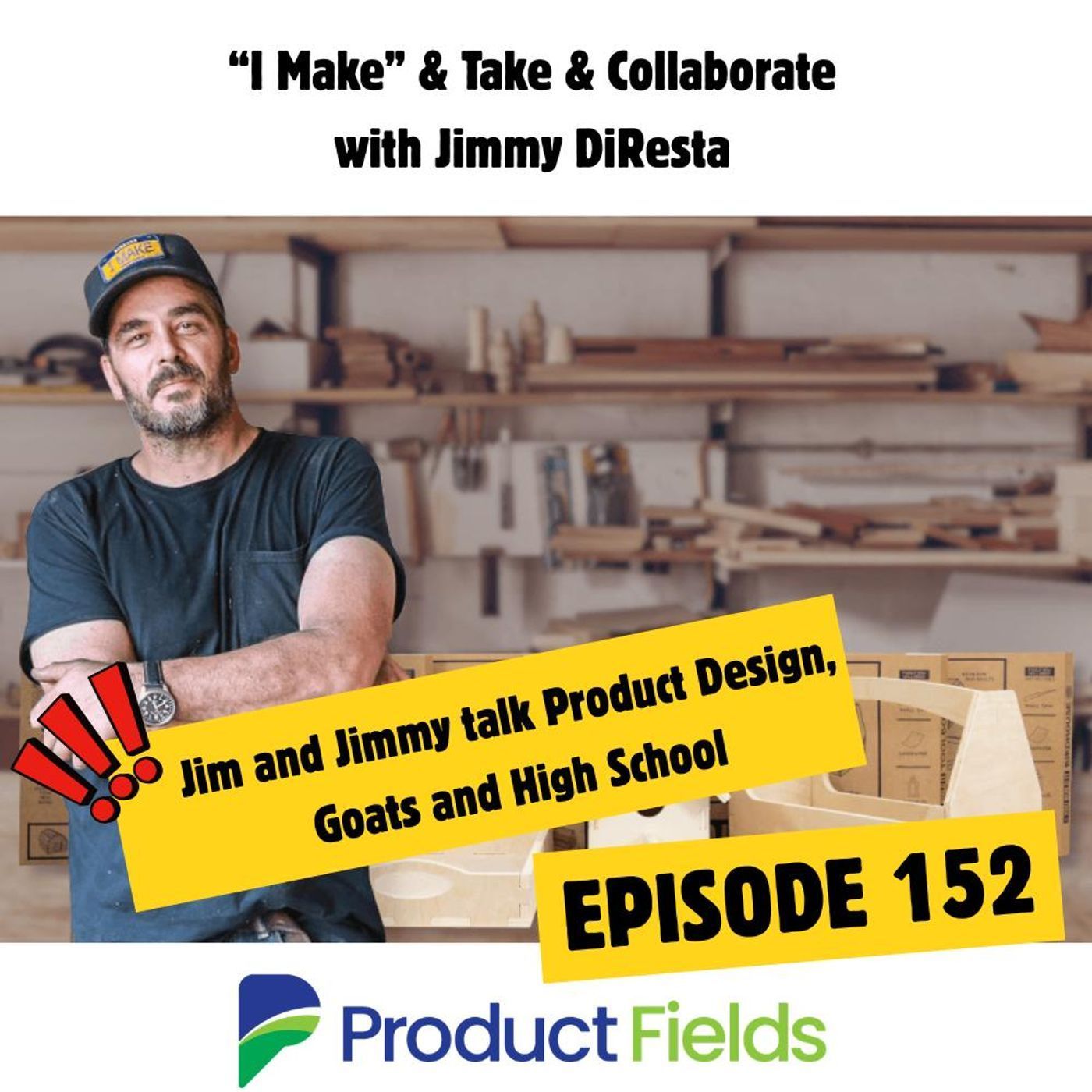
Jimmy DiResta has spent decades building things other people only imagine. Furniture. TV shows. A life that doesn't sit still. In this episode, we get past the shop tour and into what actually shaped him. We talk New York, the city that built his eye for craft and his tolerance for hustle. We talk Hollywood, and what it's like to make things for an industry built on illusion. We talk about how he approaches a problem, any problem, whether it's a broken hinge or a broken plan. And we get into the parts of his life that don't show up in a highlight reel: his hobbies, friends, family, and picking up pottery as a beginner all over again. This one isn't about tools. It's about how a maker keeps making, decade after decade, without losing the parts of himself that got him here. Most people stop learning new crafts once they've mastered one. Jimmy hasn't. This conversation is a case study in staying a beginner on purpose. What we get into Growing up in and around New York, and how the city and early years shaped his work ethic Hollywood: building for the screen, and what the industry taught him about craft His approach to problem-solving, on set and in the shop Starting pottery as a total beginner, and what it's like to be bad at something new again 00:00 Introduction to Jimmy DiResta 02:34 The Art of Making and Teaching 04:52 Crafts and Changing Times 07:40 Timeless Design Elements 10:32 Manufacturing History and Local Craftsmanship 13:21 Reflections on High School and Early Influences 19:14 From High School to Making Toys 22:04 From Art School to Graphic Design 23:03 Early Experiences in Advertising 23:28 Learning the Craft from Family 24:27 Transitioning to Toy Design 25:47 The Evolution of Problem Solving 28:01 Understanding the Nature of Props and Products 29:59 The Balance of Temporary and Permanent Creations 31:46 The Pressure of Client Work 33:46 Confidence in Problem Solving 37:00 The Joy of Troubleshooting 38:48 Memorable Moments with Howard Stern 41:20 Maker Style F-Marry-Kill 43:31 Collaboration in the Maker Community 46:16 Exploring Pottery as a New Medium 47:22 Embracing Mistakes in Craftsmanship 51:05 The Zen of Pottery and Creative Space 53:23 Gifts from You, Gifts to Me 54:17 The Value of Content as a Legacy 58:16 Interacting with Fans and Community Influence 01:07:24 Parting Thoughts on Positivity and Gratitude Connect with Product Fields: 📢 Follow the podcast for more inspiring stories 💬 Join the conversation on LinkedIn - https://linkedin.com/company/mastering-agility 📩 Contact us for trades or sponsorships 👉 If you enjoyed this episode, leave a review and share it with someone who needs to hear it! Connect with our guest: Jimmy DiResta https://www.youtube.com/user/jimmydiresta/ https://www.instagram.com/jimmydiresta/ https://www.instagram.com/makingfunshow/ https://www.joinmakersmob.com/diresta/ https://jimmydiresta.com/ https://imakeny.com/ https://direstaedc.com/ Check out our...
Jim: Welcome back everybody to product fields. I'm really excited to talk to today's guest. And you jimmy: Mm-hmm. Jim: know, he's got a killer name. His name's Jimmy as well. I go by Jim. Jimmy Duresta. Introduce yourself jimmy: What's up? Jim: to us. jimmy: I'm Jimmy Diresta the the maker. Jim: Yes. And I've been following you since about 2015, 2016. And I'm gonna give the audience a a little bit of rundown because I know you're an extremely humble guy, but Jimmy's jimmy: Mm-hmm. Jim: an an author. He has 500 plus episodes of a podcast. He's been on the cover of magazines. He's got a list celebrities in his phone. Maybe we'll get into some of that. Netflix, TLC, I mean how many TV networks have you had had shows on at this point? jimmy: I've been on FX Network. That was my first. Then H G T V, then DIY network, then This Old House, which I don't know what network that's on. I guess that's on PBS. I've been on NBC. I've been on obviously Netflix, YouTube, and I think that's everything that I think. Jim: Yeah, just a couple million followers. You know, nothing big on YouTube. And I is it safe to say you have a SAG card? Like is that a thing for you? jimmy: I did have to get a SAG car when I worked on NBC but I d I don't think it's up to it's up to it's Jim: Okay. jimmy: not current. Like I I next the next SAG Jim: I am D B. jimmy: job I get I probably have to pay like s seven, ten years worth of dues to get if I haven't done but I I don't think I think SAG's gonna go out of business. I mean it's like for the ten Hollywood people that actually do Hollywood jobs now. I think that's all it's for. Jim: Needless to say, you've got a large audience. You have a book of of history that is that most people would be envious of. And you know that that's just the public-facing stuff. There's all your private clients. I mean, I know you're an artist, you're a jimmy: Mm-hmm. Jim: fabricator, you're a maker. what do you identify of all those things? What do you identify with the most? jimmy: when people ask me what do I do for a living, I just say I make shit. They go, What kind of shit? I go, anything. Jim: Mm-hmm. jimmy: I'd like I point at a table, I go, I can make that. I go, I can make and then I put like a handbag, I go, I can make that. So you like you like make stuff? I go, Yeah, I make whatever. You hire me to make whatever you want, I'll make it. Within within reason. If it's something I don't think I can make, I'll pass it to somebody that I know can make it. Jim: Yeah, I think that's the the intangible thing that people like you have. And in my world I have it to an extent, but not anywhere near what you do is they have this network of people that even if you don't want to do something or can't do something, you know seven people that can. and I mean, you were a professor or a teacher, I guess, at the School of Visual Arts. jimmy: I was a teacher at the School of Visual Arts for 24 years. I taught what I know how to do. And teaching, they say it's funny teaching. You want to learn how to do something, teach it. But I prior to YouTube, I would try to learn things to teach my students. So for instance, book binding I probably wouldn't have done as often as I do because I wanted to show my students. I wanted to give them something that they could have a good experience in class and then walk away with something that they would possibly continue to do. I tried to come up with interesting things that the students would want to do on their own, not just do it to get through the course, which some people did, but most of the time, most of the students, out of the 15 sessions per semester, I always tried to come up with at least a few things that the students would latch into. And they weren't always things that I personally would do in my day to day, but I would learn them to teach the students. And now it's the same thing with YouTube. I want to show off something. I want to try and diversify my channel. I don't wanna always make the same thing. I don't always want to do woodwork. I wanna cast metal. I wanna see and see a new material. Stuff like that. Or a new CNC process, whether it's doing a two sided CNC, which I still really haven't done. But, you know, just there's always these things in the wings where I would learn for myself so I could show my students and my fans. Jim: Yeah, I'm I was just telling someone earlier today, I'm a trainer. P part of what I do, not much anymore, but I used to do it quite a bit was teaching. And I said the old adage of, you know, if you really want to learn something, teach it. Because it most people don't want to look stupid when they're at the front of the room teaching. And it normally forces you to go down that rabbit hole to be more knowledgeable when you know you're gonna other people are gonna be looking to you as that expert. And obviously you haven't let that that go since you stopped teaching. But in the kind of these crafts that are dying out, like book binding and in Boston there's a school that still teaches like piano making and violin making. And I've heard jimmy: Mm-hmm. Is that Bennett Street? The Bennett Street school maybe? Jim: Yes, exact I've been there and it's it's absolutely beautiful that school, by the way, if you haven't been. jimmy: Yeah. I've heard a lot about it, yeah. Jim: What do you think of that that some of these crafts are are dying off? jimmy: You you know it's funny, I've been going through this analytical comparison in my brain for the last several weeks. Whereas for I was listening to a comedy podcast last night, and there was on somebody was on there talking about how certain streets of New York changed. They're like, Yeah, it's changed, it's not the same and but they were kind of pining for the past and being a little aggravated about it. But if you look every hundred years, things change dramatically. And you know, the generations Like we we're in like a like a seventy five year window every generation. Things change drastically and crafts change drastically and techniques change drastically and technologies change drastically. If you look at every seventy five to a hundred years, so things are gonna change and it's funny when people immediately resist it. There's a lot of things that society right now resists changing, which is kind of crazy because there's nothing stu you can't stop it. You can't stop the the flood. Whether it's a flo you know, the there's a Bob Dylan song that kinda talks a little bit about that. come gather around people wherever you roam, admit that the times around you change, you know, whatever that song is called. you just have to roll with it. In the beginning everybody was grumpy about s people making things with C and C and saying that's not woodwork, that's not woodwork. But at the end of the day I'm getting paid. That's what it's about. I mean, we're not I'm not throwing out an old craft to to learn something that's not a no an old craft. because I know how to do this, I can incorporate this new thing with it. And I could make something altogether different. And then that's going to mutate to something Jim: Yeah. jimmy: else. You know, at one point, whatever C and C and 3D printing were now is going to be the old craft at some point. And people are going to be like, I can't believe the old crafts are dying. Now it's this this radar printing. You know, whatever the hell it's going to be. You just gotta roll with the changes. And Jim: Right. jimmy: every every year things speed up a hundred years at a time. You know, technology took a thousand years to get to however tens of thousands of years to get to bronze. And then the next thing, and then the next thing, and then the next thing, the next thing. That's how society is. Jim: But they're cyclical, aren't they? Like I I kind of was thinking recently that just like I now see 20 year olds wearing bell bottoms and and buying like I'm competing with 20 year olds and 25 year olds to buy mid century modern furniture and 70s era decor. jimmy: Yeah. Jim: there's certain things that are timeless. Like I have a a piece over my shoulder that's a a lane piece, mid century piece. Things like walnut and Danish style, those clean lines, leather, brass, jimmy: Mm. Jim: copper, those do you think those will ever go out of style? jimmy: I don't think so. Those are long lasting, very earthy. there's just an inherent beauty to those types of textures and and materials and the the natural look. I don't think they'll go out of style. How they get used is is gonna be always different. You know, there was there was the trend when people were pouring melted metal, typically aluminum into cracks of wood and letting the burn be the burn. You know, that's that was pretty cool to see people doing stuff like that and then you see people doing it into walnut. My some of my furniture design involves I don't know why I thought of the burn, but some of my furniture design involves me welding metal right onto the walnut. And I usually use walnut or or just welding metal right on top of wood and seeing what happens. And that's a new thing based on an old thing, you know, seeing like People would ordinarily make the metal over here and then introduce it to the wood over here. But I'm trying to figure out how to like get the metal so it's like never coming off the wood. The only way to do it is to wrap it around it, then weld it while it's there. And if it burns it, it burns it. Just roll with it. Jim: Right. The scorch becomes part of part of the piece. And jimmy: Yeah. Jim: something that I've kind of latched on to when I'm in an antique store or in a mall or wherever I am, if I can see a single piece that's got wood, leather, and metal, I I love that. And oftentimes jimmy: Mm-hmm. Yeah. Right. Jim: that looks like leather poles on something that's got brass or copper hardware jimmy: Okay. Jim: and a nice wood. Is there something like that that you look for that when you see these two elements or three elements together, you're like, man, that just hits on every level? jimmy: yeah, that's interesting. I typically Jim: Yeah. jimmy: look for old castings, things like the when before plastic existed, everything was made out of cast iron. There was a window there, say pre nineteen forties, nineteen thirties, where everything that was made was if it was a day-to-day product, it was most likely cast in iron. And I or brass cast in brass. I often look for those in stores, so it immediately puts it in a certain time frame before plastic. And it's just cool to see how the manufacturing of these weird objects, whether it's a potato peeler made in cast iron or a soup ladle with a cast iron element or anything. Anything that did anything was cast iron if it wasn't made out of wood. Jim: Yeah, well is there a was there a part of the US that was known for that? Like or were those casting places and foundries everywhere? jimmy: I don't know. I I think manufacturing was everywhere. It's funny where I live in upstate New York, I live in Green County, New York, which is about a hundred miles north of New York City. I I'm just getting so sweaty. I'm getting a hot flash. I keep wiping off with my rag. Jim: It's manopause. jimmy: manopause. in Green County where I am, every 10, 12 miles you pass the sign that says this the former bell factory or the former casting factory. So up in this area, there was a lot of bell factories for some odd reason. And there was these ro you just reminding me of things I hadn't thought of. I have a set of rolling door hardware that would roll on a rat on a rail above like a barn door rail. And it says right on it cast an Oak Hill Foundry, which is a mile from my house, which went out of business 130 years ago. You know, so those just regular door hardware which now you'd have to buy from China or India. You wouldn't nobody in America would want to make that 'cause it wouldn't be profitable in Jim: Right. Well, it's interesting because I am right now sitting in Hillsborough, Ohio, and Hillsboro is known for the CS Bell Company, which made millions probably, if not tens of thousands, of bells. And a few years ago I was in Costa Rica and checked into the Airbnb, you know, walking through, and on the on the patio was this dinner bell. And I walk up to it and I'll be damned, but it was made a mile from my house. jimmy: wild. Jim: Went on an entire other continent and there's a bell that says Hillsboro, Ohio on it. which is kind of why I asked, because I know that manufacturing was everywhere, but different parts of the world, different parts of the United States kind of become known for producing a lot of things. you know, like Pennsylvania with chocolate. You had Hershey and you had Mars and all these different things. Chicago with pinball machines. If you if you see an old pinball machine, chances are good that the thing has been in the Chicago area at some point. jimmy: I didn't realize that. I didn't know that Chicago was Jim: Yeah, back in the day Chicago was was a hotbed of pinball machines. A couple of the big manufacturers were there. jimmy: That's another thing. Pinball machine technology, like that window between like the sixties and to like the early eighties, when all those technologies were pre-microchip, pre-computer software, and you had these electromechanical things that would like flip and toggle and these like switches that would roll past each other and set off a series of lights. It was it it was crazy that the human innovation. that would take place inside of for instance, 'cause I had a pinball machine for a minute, occasionally we'd take it apart and fiddle with it. And just inside it was just like, whoa. You'd have to be a rocket scientist to figure out what was going wrong inside one of those things. Jim: I have one in the other room and I I pray to God it never stops working because I looked inside of it. I couldn't, I wouldn't know how to fix it. And luckily, my dad, one of his first jobs out of high school was a pinball, he repaired two things pinball machines and cigarette machines. And I asked him a year ago, like, could you still open it? And he said, I'm sure it's muscle memory. I'm sure I could open one up and and get it working again, even though it's been 40 years. jimmy: my cousin used to repair juke boxes. And so we'd go to his house and he would my it was my dad's cousin. He was kind of an uncle to me. And we'd go and he would have boxes and boxes and boxes of forty-fives. Cause he would go in and whatever current music was up, he would change the music inside the and Jim: Yeah. jimmy: so we he would give us these forty-fives. I mean they're all we used to use them to shoot at. That's how many we had. BBs, BB guns. Jim: So I wanna go back in time a little bit. one of the questions Mr. Picciuto asked me to ask you that he's jimmy: Mm-hmm. Jim: always want to know is what type of high school student was Jimmy Daresta? jimmy: That's funny. I was I stayed to myself. I had my little group of friends that I was pretty loyal to. We'd hang out after school and go get drunk in the schoolyard in the evenings. But I w we liked heavy metal. I just saw the thing today about it was just came across Instagram about the the the kids that sued Judas Priest. And that all happened in nineteen eighty five when I was in high school, eighty-five, eighty six, eighty seven. Like the kids did the suicide pact in eighty five. The everything happened right after that. But that totally brought me back to like my high school time. Like when you see I think it was either a AC D C concert or Metallica concert, like the parking lot where people were driving around. Do you remember those there's like a documentary? It's like the parking. Yeah. Jim: yeah. Yep. jimmy: That's my childhood. It's I remember in 1980, me and my brother went to a the Black Sabbath concert for the first album with Ronnie James Dio, Black and Blue. It was the name of the concert. So it was Black Sabbath and Blue Eyes the Cult. It was for Heaven and Hell. The album just came out. And this is like the moment of like my childhood, which is like way like still like the very residue of the 60s to my current life and to the 80s. Because Don Kirschhner's rock concert was there to record. And I don't know how old you are. I know if you know who Don Kirschhner is. Do you know who Don Kirschner Jim: It sounds clear. I'm almost fifty. jimmy: is? Okay, Don Kirschhner. When I was a little kid and we'd watch Saturday Live. Saturday Night Live would end. Me and my cousin would watch from the very beginning, in the very first episode. We watched every sentence. As soon as it would end, it would go, I'm Don Kirchner. Welcome to Don Kirchner's Rock Concert. He was the only music executive that thought live music had any value outside of being there and experiencing it in person. And he would record live concerts and they would play right after Saturday Night Live. So in like whenever Saturday Live started in 75, I was like eight or nine years old. for the first seven, ten years, Don Kirshner's rock concert would play right after. And then in 1980, We went to go see the Black Sabbath, Blue Oyster Cult show, and then the guy comes out, a producer comes out. We were at the Nassau Coliseum. John Bonham had just died, so there were posters going hanging around, everyone saying, Long live Led Zeppelin. They had just announced like that week that they weren't gonna get back together and they were gonna just basically call it quits since John Bonham was dead. And so the concert I smelled people like bouncing balloons around and blow up beach bowls and smoking pot, and some guy comes out and goes, Just want the whole audience to know and everybody was cheering. It was Thousands of people and that's the Coliseum is huge. The tonight's show is being recorded by Don Kirshner's Rock Concert. So if you're in the audience, please give us a good sh response to everything, blah blah blah. And then occasionally they turn the lights on and say, give us a cheer. They would like record audio cheers and stuff. It was fun. but that they see all that, it reminds me of my high school childhood of just like being a dirtbag metalhead. I I never really Jim: So jimmy: wore like cut off jackets and stuff like The other the other thing real reminiscent of my childhood is the the socials and and the greasers from outsiders. Because outsiders came out when we were in high Jim: Yeah. jimmy: school. So I was in high school in the eighties and that was about like 20 years earlier, like probably the sixties, and Jim: Yeah. jimmy: it really felt the same. I mean, I was definitely in the greasers. Like when you see all those kids, that was like my group of friends. We didn't dress like that. We didn't have you know, we dress like We wore like concert T shirts and hockey jerseys like dirtbags from Long Island. But when you see that movie, it was very similar to our childhood. Like I remember me and my friends going and seeing it with a bunch of girls from the other side of the tracks 'cause we always like hung out with the rich the rich girls. Jim: I was just gonna ask, who'd you identify identify with more in in the outsiders? Which side would you have been on? Would you add like the baseball bat and the bicycle thing or would you have been the preppy guy? Okay. Yeah. jimmy: definitely the dirt bags. That's what I'm saying. We were like the greasers. I don't know what it was called. I can't remember. Was it the greasers and the socials? The socials were like Jim: So yeah, socias or socials. Cause I I read that book and cause I'm a little younger than you, but I remember seeing the movie. My mom was a big or is a big Tom Cruise fan. So anything with Tom Cruise in it, we jimmy: You know? Jim: watched in my house. And that's kind of where my love of Top Gun came from. And so yeah, I mean The Outsiders was definitely one of our early VHS tapes, I think. jimmy: what else? What else? There was one other thing about my childhood. so I went I spent half of my high school years going to a vocational school. So I never really connected with like my my class of students. I still never went to a class reunion. It j we just had one on the fifth my fortieth class reunion was last year, and I didn't go because I was going to maker camp instead, which is kind of my I'm like it's I'm kind of like the host of the party there, along with Austin, the guy that runs it. And so I wasn't going to dip out of maker camp to go to my high school reunion that I had no real connection with the students anyway, except for the close friends that I kept that I still talk to. So I don't need to go to a high school reunion to go see them. Jim: Right. jimmy: my high school environment was kind of competitive, and instead of competing, I just didn't involve myself. I just stayed completely out of it. I would go to school for math and architecture half the day. So nine, ten ten, eleven, twelfth grade. I was I was only in school I was only in my regular high school for just a couple of hours at the end of every day. Just to go do what whatever high school Jim: So how does that dirt jimmy: things that I needed to do. But I was learning design while I was in high school. Jim: Right. I I think that's a segue to my question is is how does that version of you go to making toys and traveling to China and working with your brother and doing that? Like I I've jimmy: Mm-hmm. Jim: heard some of the stories, but I don't know that I've ever heard like how to connect A to B there. jimmy: Well, I tell you, I as a kid, I was always very naturally making things. I was just naturally gravitated towards making things and cutting stuff on the bandsaw. I was always doing that since I a little kid. So my dad really nurtured that in me. My dad saw that and pushed me. So in high school, he pushed me to be into architecture because he thought I could be a good builder or a good designer. And so I started taking architecture. I wouldn't have done any of it if my dad hadn't pushed. I wouldn't even have looked known to reach for it, but my dad enlightened me to it. And I said, My other brother had gone to my two older brothers, one went and stayed. one and my other John, my middle brother, he went and left for photography. Joey went for airframe mechanics and became a marine and then went into avionics. And so in high school, he was going to learn airframe mechanics, learn how to build an airplane. And so I was the third one to come along and my dad said, Go to Bose's for something, pick something. And so what I picked was architecture. And When I got out of high school, I was gonna go to architecture. I was gonna go enroll in architecture. And then I realized how long it was. And then this is kind of silly. I I say it on the podcast, I kind of think architects are like nerds that think they're artists. They're not really artists, they're kind of mathematicians. And so I hope you're not an architect. And so as I as I started to learn more about arch architects and architecture, I started really getting more involved in like real artists, started learning more. So I started to realize early on that I could hire anybody to design my vision. I can come I can literally draw a swirch a swoosh on a page and then hire a nerd to engineer what that swoosh is going to look like if it was gonna become a big object in 3D. I didn't have to be that nerd. I had to be the guy that really more conceptualizes. And that's really what why instead of going to architecture school, I ended up going to art school. Because I thought architecture is too rigid, it's too it's like felt like too construction y technology technologically, whereas I'm like more like I like the freeform art abstract artist versus Jim: But what was the first thing that somebody paid you to to design or make? It like and how did how did even that come about that somebody saw in you like you can produce something that people will pay for? jimmy: That's interesting. I guess the first thing that comes to mind when I went so I was going to art school and first couple of years of really just foundation painting. And then I started taking graphic design classes. And I realized I wasn't really into graphic design. I it's a good thing that I know it now. And and I'm not the best graphic designer, but I can I can mock up an image quickly for myself. You know, it definitely helps in marketing to be able to whip up a logo or organize graphics for a CNC machine. And that all goes back to my graphic design roots. I remember one of my friends had a car waxing business in the eighties and he turned to me and he's like, You could do this ad for me. So I drew this ad, I like drew it with a magic marker and a ruler, and they printed that in the paper. And he gave me like twenty bucks. And I remember thinking to myself, I'm a published artist. And looking back at it, I was like how horrible it was. But they basically did exactly it whatever I drew. The new the newspaper person doesn't care as long as it's spelled right, they're like, take it, just print it. Jim: And it fits in the little square that they got us fitted to. jimmy: Yeah, exactly. And it was for my friend's car wax and I drew like a picture of a Corvette. It looks like shit. I remember every occasionally I s find it at my mother's house and I laugh at how horrible it is. But i I mean, it was just a local paper thing. But if I think about the first time I got paid to do something, I remember that. That's the first thing that comes to mind. But then shortly after I was working with my dad doing home improvement stuff here and there, home I my dad was basically a hired carpenter. He would show up with a Truck full of tools, and if he needed extra humans, he would bring me and my brothers or who any or friends that we went to high school with. And my dad was basically a freelance contractor. He never wanted to run the job. He would always work for people that ran the job. So the guy would run the job and then pay my dad to do the work. So my dad would never wanted to deal with the clients. He just wanted to do the work. And so he would work for a couple of his cousins that always had these general contracting businesses. And other guys that he my dad was a New York City fireman, so there's you throw a rock, you hit ten contractors in the fire department. And so he would work for these other contractors. So he was always a hired hand and so he'd bring us along. And then occasionally I I I would like take on little projects for those clients, like build a shelf or something once they realized that I was capable. So occasionally I started doing stuff like that. And then I started making some stuff for local stores here and there. And then when I was in art school, this is I'll go through this quick. When I was in art school, I took the last semester, I was gonna go, my career path was gonna be I was gonna make props. I took a course with a teacher that really got me involved. His name was Kevin. Kevin got me involved in prop making. And even before I graduated school, he got me involved in a couple of his jobs where I actually made real objects that really became photographed and used in advertising. And it was definitely great on the job training as a student. But as I graduated, as I got closer to graduating in eighty six, I think I graduated no, that was when I started. I gra in ninety. I graduated in ninety. I met a guy named Mark, and Mark got me involved in the toy business because he was in the toy business. And he said, You got quick, fast, good ideas and the toy business is a fashion business and with your training of all this other stuff you've already been learning how to do. Technically I was always good at making stuff because I was always very curious and I started early. I didn't go to college and then decide to make stuff. I was making things since I'm like five years old. So I burned myself at the hot glue gun ten thousand times before I got to high school. I mean before I got to college. I've used a razor blade sixty thousand times before I got into Jim: I talking to the right night. jimmy: studio agency skills class. You know, kids were using an X Acto knife for the first time and I had already cut 17 fingertips off by then. And so I was always much more advanced than most of the students around me simply because I just had so much on-the-job training with my dad. So when it came to deciding whether to do props or whether to do toys, I was like, Toys is a better use of my brain. My hands can do both. Making toys is a better use of my inventive inventiveness, which I didn't know it was available. I didn't know. I didn't make that choice until it was presented to me. I wasn't like looking to be like, where can I use my inventions? When I met Mark, Mark goes, Hey, you got really good inventions. You can vent you can invent shit quickly, easily. You could see problem solutions really fast. And so Mark started giving me little freelance jobs. And he would say, I want this thing to do this, but it's gotta do that. And Mark was a little burnt out when we met, so he was like, He didn't want to take the time to figure out the mechanism and the pinion and the pinion gear and so he'd give it to me and I would really dig into it. I'd give him five versions of a toy and he's like, he was a magician too, so he'd be Let's I wanna do this trick that does this. I wanna see your ideas on it. I have five ideas on my own, but I don't want you to know them until I see yours. And like I started learning how to invent like that, like brainstorming with Jim: That's interesting though, right? Because in that scenario he was the vision guy and he was handing it off to you to to build it. jimmy: Yeah, well, that's true. But what was that's interesting, I didn't even realize that. But what what he was doing for me was allowing me to exercise my problem solving skills. And in Jim: Mm. jimmy: the process, I was there was no doubt I was in constantly inventing my own things throughout. I'd come back to him, like we'd have meetings once every couple of weeks, because he lived in the city and I lived in Long Island. So we would make a time to meet. And when I meet him, I'd show him the five or six things I was working on for him, but I'd also show him the four or five things I've thought of for myself. I go, What do you think of these? He's like, that's great. That's great marketing. If you did this, maybe you do that. You know, it's still few and far between that you actually sell products. But I can't rem I can't I don't have a good example of anything I showed to him. We talked about and it turned into a product. But so much of all of that slush just all just slurries together. And then when I'm problem solving for something now in my late 50s, you know, I'm still my brain still zaps back to those early days in the in the early nineties, thirty years ago when thirty five years ago when I was working with Mark. And then everything Jim: Yeah. Sure. jimmy: in between, you know, it's it's like it all the tentacles are just like you know, my hard drive goes deep Jim: Well, something when I wa when I watched your your content and when I was thinking last night about the big picture stuff, I I came up with a question. And you mentioned props. Props are by by their definition temporary. Toys jimmy: Mm-hmm. Jim: are temporary. I mean, kids are hard on shit. Like toys. I mean, yes, there's a lot of toys still around today from the old days, but you've done a lot of work for advertisers. You've done work for trade shows. You've done Things that are destroyed before they even get to their destination. Does does any of that and you've talked about television and how low quality, high speed is what the television industry matters or values. Does does any of that bother you as an artist or a maker? jimmy: no. There are things that I make that, and I can, you know, there's the there's the serenity prayer. God grant me the serenity to understand the to change the things I can, accept the things I can't, and the wisdom to know the difference. It's the same thing with props and real products. Like, God grant me the serenity to understand that this is just a prop. And I'm making the product as the video, and this is a client job. I'm gonna have a product as a video, but I'm also gonna have the product as a to give to the client. So there's two different approaches. So I certainly am fully aware of when I'm making a go-kart, it just has to look good on camera. I do want it to mechanically work because I'm going to put it through its paces. But at the same time, if it breaks, who cares as long as I get the beauty shot. Versus me Jim: Mm-hmm. jimmy: making a beautiful table with for a client that has some resin accents or even some steel welded up legs. I want to make sure that the finish is good, the legs aren't going to rust, the top, but If it's something, some shop furniture, I'll make it look good. I'll go cool. Boom. Da-da-da. It's it. And then it goes into the shop and it gets beat up right away. So I certainly do understand the differences between all of them and the prop, the stuff that's kind of props for YouTube. I try to make it fun and tongue in cheek if it needs to be. But at the same time, I know it's not gonna last forever. Jim: Yeah. Well and you jimmy: It could also lead to a product that does last forever. That's the other thing too. Is I'm always looking for opportunities to turn something into something. Jim: And I think I wonder if that's maybe why you like some of the metal metalwork, the blacksmithing, the casting, because that that feels very permanent. And one of your recent videos was these two leather chairs. And it it's so impressive, audience, to watch Jimmy make stuff. So that I highly encourage you to just check out almost anything in his catalog. But those chairs look very sturdy to me. And leather, like you've already said, it is timeless. It it's earthy. jimmy: I know. Jim: And I I just would assume that there is a difference in things you're making for yourself or your family or your friends versus something you're making for YouTube or a magazine or something that's temporary by nature. jimmy: Yeah, well those chairs I made what it's funny. I made one and then right away this the following week I made a second one for myself because my girlfriend's like, we should have a pair of those. And I'm like, you know what? I have the other half of the hide. I can certainly make another one right away. I before I cut up the hide and use it for a bag or something. And so I was like, you know what? Well, if Jim: Right. jimmy: I'll do it right now. 'Cause if I don't, the hide's gonna change color 'cause it's upstairs in the shop and this one's here. And not that they have to be perfectly matched, but Making them the same time in the same week, they're gonna have the same vibe. If I make one a month later or a week later, or I just or year later, it'll just won't have the same vibe. So I was in the mood, so I I was in the groove, I did it. But I was putting the leather on, I flipped it over and I'm like, Of course, there's one whole spot that's not painted because it's been doing it for myself. I just have this this gap whenever I make something for myself, or I'm just like, it's fine. Good enough, you know, the shoemakers, kids have no shoes, that kind of thing. But right away my business partner's like, You gotta make me two of those for my wife. I'm like, All right, all right, we'll like we'll we'll But in my mind, immediately the anxiety level goes up. Like, shit, I gotta make these for Howard. I gotta make sure that the I don't leave that unpainted spot under the foot. I gotta make sure the leather doesn't have any handprints on it. I gotta make sure the leather, I gotta use like no belly leather, because the second one had some belly leather in it, which is a little softer. Nobody'll notice that. Jim: So some people might say that you you, you know, are doing things for camera or that I I've seen you be called a hack, you've been called wasteful. But what you just said to me tells me that you have a very high internal bar for yourself because that stress you're feeling when you're doing something for someone else, whether it's Howard or Rachel or someone, if you didn't care, you wouldn't have that. jimmy: no, totally. I mean I certainly know where and when to spend my energy. You know, it's Jim: Right. jimmy: i I know where and when to turn it on and when it needs to be turned on. Jim: I I think the confidence you have to fix something if it breaks or to repair something to or to what I what I think looks to some people like you not caring or doing something less permanent is just the confidence you have to fix it and the engineering discipline to know like if this thing only needs to last for a weekend, I know how to build it. If it needs to last for a century, I know how to build jimmy: Yeah. Jim: it. jimmy: Yeah. You wanna this is a funny story. Jim: Yeah, just jimmy: This just came up this week. So me and Rob, the kid that works for me, we're repairing this nineteen fifty nine Cadillac. I don't own it, but I volunteered to fix it. I'm part of the aerodrome here in Rhinebeck, New York, and they have a lot of antique cars. It's a it's a airport plane collection and they have some antique cars. So they have this fifty nine Cadillac that was just sitting in the mud. I'm like, I'll take I'll fix it, we'll fix it, let's have fun with it. So right away we got ourselves into a dead end. We couldn't take the front wheels off because the brake pads was so fixed to the brake drums. We couldn't get the front wheels apart. I'm like, do we have to like take the entire front end off and put a new one on? So we were hammering, hammering getting the brake drums. So the only like the one last thing was this one thing I had to cut in half with a sawzole behind the brake drum and I cut this like the the star wheel thing in half. And we got everything cleaned out. We got it we got rid of everything. We got all new parts. And now today we're going into the parts parts and we're using what what we can use over and what's in the new kit. And Rob goes, this star wheel thing, you cut it in half. He goes, I goes, I knew you did what you had to do, but now we gotta buy a new one. It's the one thing that's holding me up. And so I'm gonna show you a picture. It's the star wheel thing cut completely in half. And Jim: So high. jimmy: I cut the shell in half too. The shell it was inside of a shell. And so now I said to Rob, I go, I go, Don't mess with me. I go, I'll fix that motherfucker. And so there it is, welded. And then somewhere in here is somewhere in here, I I I wanna pick up Jim: I thought you were gonna tell me you just ordered it at McMaster car and it was already at your house, but no, you just fixed it. Nice. jimmy: Yeah, there it is. You can't see, but the the shell that it was was cut in half two. I welded it all back together. So it was literally Jim: Wow. jimmy: cut into two pieces like diagonally through it. So I said to Rob, I'm like, I go, those Indian guys with no shoes on could make a handgun out of a chunk of steel. I was like, I could fix this screw. And so there were Jim: It's that innate confidence that I think it is you're not the only one who has, but I think you you're the one who displays it the best. I I think that's what people are attracted to and why they tune in to all your different ventures is they they may not when I ask them, they may not even know why. It's that confidence. It's that problem solving, troubleshooting, and confidence. Because I was telling somebody the other day, I I just fixed the the lights in my barn, my pole barn. And it made it more difficult because there were three conflicting variables. Right? I had a bad one bad light in series, I had a bad dimmer switch, and I had a loose wire. But I fixed it in an hour. Even though a licensed electrician did the fucking install and left with a shitty electrical job, someone jimmy: But Jim: said, How would you know how to do that? You're not an electrician. I go, my dad taught me how to troubleshoot things. Taught me how that there's only a few things that can go wrong to cause most problems. And if you just start eliminating them, you're left with whatever the problem is. Most people don't have that. Like you might you take it, you probably take it for granted. I take it for granted sometimes, and I don't even know a tenth of what you know, but many people don't have that. Whatever that is in the brain that can iterate and and troubleshoot something. jimmy: It's also it's also an interest in solving puzzles. I love solving puzzles. So when my girl says, I can't figure out why this light won't turn on, I'm like, Ooh, that's just another puzzle to solve and I'll be like, Well Jim: Do you do puzzles like Sudoku or crosswords or logic puzzles? jimmy: Not not necessarily. Like I'll do like physical, like blacksmithy puzzles, like how to unlatch something. But like nah, I don't do those type of puzzles. Like I'll see interesting puzzles on Instagram, like physical puzzles, like make a pyramid out of these like pile of like connected balls and stuff like that. Like I I might I always exercise my brain that way. But I really love the exercise of solving day to day problems of and how to get this Jim: Yeah. jimmy: fan belt off over the belt, over the fan, without having to take the entire front end of the old car apart. You know, stuff like that. And the other day I was using the Powhammer and every time I I did it, it was a little Instagram story, and I'd use it and it would just go bop bop bop up. Like, why was it speeding up? Like it would go pop up. It would go from like 10 RPMs to like almost a hundred rpms a second and a minute, and I couldn't figure out why. And I started playing with it and I started realizing, when the centrifugal speeds up. When the belt speeds up, it has to do with like throwing this like flare and it makes but that's because this was loose. I can't explain the problem without showing pictures, but I ended up having to just cut this little adjustment bar because it was adjusted as far as it can go. It wasn't gonna let at the thing tighten. So I took this turnbuckle, took it apart, cut it. Because the belt the problem was the belt was stretched and it was Jim: Hm. jimmy: resulting in this thing. So I was able to take the turnbuckle, cut one inch of the threaded rod off, put the turnbuckle back together. And was able to tension the belt so that the belt had a consistent grip on this giant flywheel. Long story short. Jim: Yeah? Trouble shooting. jimmy: But I was like, okay, what that's an interesting action. Why is that action happening? And had to like stop and think to myself, what is going on here? And I approached most of that stuff like, okay, this is an interesting problem to solve. How can we solve this problem? How do we get this 5,000 pound machine off of the bed of the truck? Interesting problem to solve. How are we gonna solve this problem? Jim: That's what my friend always says. Let's let's do some sketchy shit today. So jimmy: Yeah. And go ahead. Jim: I want to change gears for a sec, because I know you and I are both big Howard Stern fans. And jimmy: yeah yeah yeah. Jim: before I ask my my Stern-esque question, what's your best memory of Stern? Like your favorite interview or or just who's your favorite character on the show, maybe? jimmy: well shit. I loved I you know, I remember when Artie first came around. I wasn't gonna like Artie, but of course I love Artie. Artie's good. I got to meet Artie a few times in my life. And well, my brother got to be on Howard Stone twice and both times I came as his guest. So I got to hang out. So when I met Artie and I met I met everybody just briefly. when what year was that? It was like two thousand and one when my brother was on. It was right around nine eleven and I remember we the second visit, because my brother's a stand up comedian. He got on the show a couple of times. The second visit, for some reason, we ended up in the elevator. This was when he was working at Radio City. anyway, wherever that radio station was, was the New York radio station I can't even remember anymore. Ninety seven K W K R Q or what was what was the New York radio station he was on before two thousand Jim: K Rock yeah, it was K Rock. jimmy: Yeah, K Rock. When he was at K Rock, me and my brother went up there twice. And for some reason as we all left, my brother's was one of the last guests and Howard had to leave, we all ended up in the elevator together. It was me and my brother and Howard. And it was Jim: Wow. jimmy: it. And we were going down in the elevator. We were on like the 20th floor or something. And my brother goes, No bodyguard, no nothing. And Howard goes, That doesn't matter anymore. Doesn't it just doesn't matter? He just said it just so it's like that. We were dying laughing. And we had a couple of little bit of conversations, but he was just a regular guy. And you know, we both respected him enough to know, like, don't pry, don't waste, don't make this moment more awkward than it already is. Because we all were Jim: Right. jimmy: just a guest on the show. I was on the outside, I wasn't a guest. But my brother was a guest, and now we're in the elevator, and there's nothing left to talk about. Jim: Mm-hmm. jimmy: Just just value the silence. My brother said, Yeah, no Jim: Really experience, yep. jimmy: no bodyguard, no nothing. This is it. And he goes, it doesn't matter anymore. Big laugh. We got quiet. We got to the ground floor. We said, Thank you so much. And we walked our other ways. But I just remember being in that elevator and knowing like Howard doesn't want to chit chat. He doesn't want to see us again. He doesn't want to have dinner with us. He doesn't give a fuck where we're going. You know, we knew enough to just like let that moment be in silence. It was really funny. Jim: So I'm gonna give you a an F Mary Kill type of question, but maker style. So for this jimmy: Okay, yes. Sure. Jim: one, you're not sleeping with anybody. but for one of these people, you have to make them something, or you get to make them something. For the other person, they're gonna make you something. jimmy: Okay. Jim: And for the third person, you're gonna collaborate on something. You're gonna get something. jimmy: Make take collaborate. Jim: Yep. So the three names I I have two sets. The first set. Nick Offerman, Adam jimmy: Mm-hmm. Jim: Savage, and Casey Neistat. jimmy: Hmm. wow. Make I would make something for Adam, take something from Nick and collaborate with Casey. Jim: What do you want to make with Casey? jimmy: I would love to make a video with Casey, just like a day-to-day, whatever. Just I'd love to be you know, pull like every once in a while he pulls in like a somebody from his friend circle into his day. I would love to be one of those friend circles. I we met online. We never met in person. We met through an email because Nick Bilton, who just fired the guys at sixty minutes, Nick Bilton is an old friend of mine, and he's a friend of Casey's. So Nick introduced us. He's like, You guys gotta know each other. So Nick introduced us just when his first daughter was born. So if you put that in perspective. And Casey and I would chit-chatted and he just said he goes, I just had a baby, so I'm kind of busy. I said, I know I've been watching. So I was gonna I invited him to come talk in my class and he said I goes I would because when when things free up, I will. It was like in the middle of beam and all that other stuff, and we never really I never pushed it and we never connected again. But we've had a mutual friends a few times. I I mean we're we're literally like one degree of separation, me and Casey. We just Never really pushed it. I never pushed it. One of these days I'm sure we'll cross paths. Now that I'm upstate and I'm not in New York City, it's less likely, but one of these days we'll we'll be shoulder to shoulder talking about bullshit about something. Jim: That's awesome. All right, one more set. Slightly different here. Simone Geertz, Frank Howarth, and Seth Rogan. jimmy: Mm. Jim: And I threw Seth Rogan in because I know you're getting into pottery and I want to ask you about pottery next. He's a pothead and a potter. jimmy: Sure, sure, sure. I would make, take, and collaborate. I would take from Seth Rogan. And who who is the other name? Jim: Simone Geertz and Frank Howarth. jimmy: I would take from Seth Rogan to get his pottery. I would make something for Frank and collaborate with Simone. Jim: Interesting. Love it. Awesome. jimmy: I met I met I met Simone. She came to Maker Camp one year and we got a chance to meet and we had a really, really very nice couple hours together. We I showed around my shop, she got to see my shop and and we definitely connected and we didn't really maintain a friendship, but I mean if I reached out to her, Laura's in between us. You know, Laura's I think Laura's I would consider Laura Laura family, Laura Comf. I hope she considers me family because but Laura's amazing. Laura's Jim: I bet she does. jimmy: amazing. So Jim: It was hard to come up with names because I mean I could have thrown a hundred names at you from the maker community and and it it just wouldn't it'd be too easy, right? Because you jimmy: Okay. Jim: guys are giving each other, you're collaborating, you've got stuff jimmy: Yeah. Jim: from each other all the time. jimmy: I got to hang out with Frank too a long time ago when we all got together with one maker event and one woodworker event. And Frank is such a sweetheart. I mean, he's not very talkative because I suppose maybe because he stutters a little bit, but he's just always smiling. Like no matter like if you hang out with him in a social setting, he's just smiling the whole time. I just think he's just so happy to be alive and he's just so happy to be able to to be the artist and the and the designer and the builder that he is. It's so even though we didn't talk a lot. I definitely was inspired just watching his face. I mean he probably would be surprised to hear that, but when I think of Frank, I think of just a guy that just enjoys his atmosphere and enjoys his life. Just by the look on face. Jim: Frank's videos for me, although not very frequent, they're they're like they're like a Xanax when you're stressed. I mean, they're just like a nice, relaxing video. That little chuckle of his is kind of like Nick's, right? Like it's you jimmy: Yeah. Yeah. Jim: can tell from just listening to him that he is really enjoying what he does. jimmy: Hundred percent. A hundred percent. Jim: And he's a trained architect, isn't he? Isn't that his jimmy: I think so. Yeah. Like I said, we didn't really del delve into each other's lives, but we definitely were like respected each other when we saw each other and you know, certainly he's got a he's got some s real loyal fans. I mean, he's such a s such a great designer and builder and filmmaker. Jim: Yeah. So I mentioned pottery. how are you f I I've made I've thrown on a wheel multiple times. One of my close relatives is a lifelong professional potter. I know how frustrating it can be. I can know the pain of the kiln firsthand. How are you finding kind of the journey into a whole new medium? jimmy: it's interesting. It's like I I'll throw six seven lumps of clay every few days just to realize how shitty I am at it. You know, people see me throw something and they're like, you already got it. I'm like, You just saw me on a good day. You didn't seeing all the fuck ups that that I'm doing. And I try to save everything. Yeah, you know, I I try and literally give honor to every mistake. My teacher was about to like cut something. I'm like, No, no, no, no, no, leave it. I wanna wanna So I got a couple of fired pots around that are like like droopy sh turtle shells. And those are the ones my my girlfriend loves. So I try and give each mistake's its own respect. my breakthrough came when I realized you could just stop. Stop fucking with it. Let it dry and then recover it in the dried. Yeah. R Jim: Yes. God, that is so hard to learn. Yeah. jimmy: recover in the dried process. Okay. Okay. It's out it's already out of whack, but it's already raised up. It's you lifted the side. Leave it. You're not gonna fix Jim: Yes. jimmy: it anymore now. It's just gonna be a lump of shit if you keep playing with it. So I really Jim: Yeah. jimmy: gotta practice even though I'm good at centering, I'm a little too fast at pulling, and suddenly all of a sudden I have a big lump on one side of my cup or whatever it is I'm vesseling. So I gotta I just gotta slow down and just really take another zen approach. I I'm in my mind, I'm gonna take either tonight, late tonight, or tomorrow night and try and throw like about six or seven two pound lumps just to see what I could do with them. And I it's really just repetitive. I know that I just gotta keep doing it to have a little breakthroughs. I'm looking for those breakthroughs right now. And I had a big breakthrough Jim: I think jimmy: the other night, a breakthrough the other night that I kept trying to pull up with my middle finger because it's longer. And the other day I started pulling up accidentally with my pointer finger, which it's half cut off. I probably talked about this on the podcast. So I was like, Jim: Mm-hmm. jimmy: Don't use that finger because that's the bad finger. That's just what my brain always tells me. But the other day I was pulling up with my pointer finger and I was doing better results each time. So that's the breakthrough that I had the other day that I thought my my shitty finger was not worthy. See how the fingertips cut half off. But it worked. Jim: Well, when you were telling that story, I remembered my tattoo artist years ago said he was tattooing me and he said, If I could do anything, I'd cut off my pinky. And I go, What? He goes, jimmy: I was in the way. Jim: it just gets in my way. Like all he does is jimmy: Mm. Jim: just tucks it. He goes, I just want a a flat hand right there, four fingers on my tattooing hand. And I'm like, Wow, now that would be dedication to the craft. But jimmy: Well, it's funny. I Indian Larry, I I knew a lot of people that knew him. I can't honestly say I ever met him, but we we were in the same circles in the in the city for a minute. And Indian Larry had his hand he was involved in an explosion, he was making a bomb or something, and it blew off one of his fingers. So Indian Larry had three fingers on one hand. Yeah. Jim: wow. I wonder if that worked for him. jimmy: Yeah. He said it was easy to get into small spaces and stuff. I saw him in an interview once. Jim: Yeah. I I think we're gonna need a maybe in October, you and Derek recreating the famous scene from Ghosts. Like I don't know who's gonna be on the wheel and who's gonna be hugging, but I think that'd be a that that's a a month of Jackman's calendar you could have right there. jimmy: I did. I did that's very funny. I did teach Derek and his wife Christina a little bit on the pottery wheel. I just I I wanna get them interested enough so that they find a good teacher in Boston to to to go to. So I I'm Jim: Yeah. A good teacher in pottery is important. I I took my first wheel class when I was on vacation in Montana. the potter told me this is she's like, You're a natural. Look at him. And she was like calling other people over. And I was apparently getting a lot of height out of things. And just like you said, I'm like, don't worry. Like beginner's luck, and I couldn't replicate it again. The first two things I made were great. I still have them. jimmy: Yeah. Jim: After that, I I've struggled for the next thirty pieces to to do it again. But I find it very zen. jimmy: Yeah. I I love it. I love it. I just hate the cleanup. But that's why I started five years ago, but realizing I need sink, a slop sink, a hose, a dedicated space, I can't just like take the kitchen table and do pottery for two hours and then put it away. And now that I've finally Jim: Yeah. jimmy: I can finally got to that spot where I have this space I can just dedicate to just keeping everything out and a and ready to go. Jim: Wha when I heard you were learning pottery, I I remember saying to to my my partner, I wonder if Jimmy's ever dated a a clean freak. Because jimmy: Mm. Jim: I cannot imagine that you like you you just went from a bunch of dirty hobbies to one of the dirtiest hobbies there is. jimmy: yeah. It's funny, Rachel w me and Rachel had the opportunity. Well, she said, I'm gonna get ready Sunday afternoon. Well, we're gonna she just went she just went on a trip to Europe and she wanted to bring a toy to her friend's child who she's visiting. So we went to go shop for a toy and I said, All right, I'll be in the pottery shop until you'll need me, just call me. And she's like, Okay, I'm ready to go an hour and a half later after I threw a couple of chunks. And and we're out and we're at the toy store. She's like, you just came from the pottery class. She looked down. I had dried pottery splashes all over the front of my pants as if I just was like painting the side of the house with a shotgun. And the top of my sneakers. I knew it, I didn't care, but and she like kind of called it out. I looked down and was like, Yeah, yeah, I told you I was doing pottery before we came. I was like, You think anybody cared? Jim: I think artists wear that as a badge of honor. Like like my cousin in jimmy: Yeah. Jim: Cincinnati who's a professional. I mean that that dude's probably got porcelain and cracks of his body that haven't seen daylight in fifteen years. jimmy: Yeah. And my watch my watch is is look at the screen of my watch. It's cracked. Jim: Yeah. that's your Apple Watch. I I'll still never get over the fact when you're in some of your old videos wearing a Rolex and metal scatter jimmy: it's right here. Jim: everywhere. jimmy: It's right here. Here's my Rolex is right here. Jim: Jeez. Your Rolex jimmy: Not Jim: thanks you for buying an Apple Watch, I bet. jimmy: Yeah. I want to wear my Rolex in some new videos, and occasionally I do. I have a different Rolex that I wear sometimes now. But the problem is mostly is that I misplace my fucking phone so often that without my Apple Watch, I'd never find it. It would literally be like on the shelf in the pottery class, and I would just be at the Apple store buying a new Apple Watch. Buying a new Apple phone, rather. This is my other Rolex that I wear once in a while. Once in a while, my Jim: Yeah. very nice. I missed the window on those. I you can't touch watches like that these days. I I've had opportunities to buy cheap over the years and I I c I can't even touch now. jimmy: The the black Rolex I bought, well, the Black Rolex was a gift. Somebody owed me a lot of money. And so they said, How about I give you a Rolex instead? And I All right, so I'll take the Rolex, whatever. So that was why I got the Rolex. I got that brand new. Because my friend who owed me money was in Hong Kong and he was buying watches for him and a few people and he reached out to me. He's like, Hey, if I you want me to buy your watch? I was like, All right, yeah, fuck, I don't get a Rolex. And so that's how I ended up with that in two thousand and one. the other one I bought the same week we started making the T V show. I just as a gift to myself 'cause I had a couple of extra dollars in the bank and everybody talks about how watches are a good investment, like anvils, you know, they're just like so Jim: Some some people take themselves out to a nice dinner to celebrate something. And I know that you've you bought yourself a watch, you bought yourself a car to celebrate something. jimmy: Yeah. Jim: That that's just more proof that that you're cut from a a different cloth. I want to ask you one or two product questions because before we hit record, I asked you, I think maybe one of the the most interesting questions to me, which is is cut is your content a product in your mind? jimmy: Yes. I would definitely say my content is a product. People say, What is your biggest accomplishment or what is the best thing you made? I said it's my body of content because it's gonna be here for a lot longer than I am. And I think when people think of their legacy, if there's if they have something to share and inspire people with, what is your legacy? My legacy is all the content I've been making and it's certainly a product. It it kind of comes natural to me now at this point to make it. Even when I first started, I was like, this feels really good. This is like fun to do. And I've just basically created my my own rock song. It's rock song, a book, or whatever, you know, it's it's it's it's the easy it's an easy piece of entertainment for me to create and it's gotten millions of views collectively and it's gonna be here for a long time. And it inspires people and people can learn from it. And that's the best thing about creating that product is when you bump into somebody and they say, My life has changed because of what you did in this direction or that direction. You know, it it's it's enough to make me cry once in a while when people reach like for instance, I got this a couple days ago I posted a video of me cutting out these knife blanks. And An Instagram video and I made making a series of knife blanks to sell. We're doing a thing called at the maker camp we call Field of Tools, which is just a big flea market for nerds that like to buy other each other's tools. So we go there buy each other's tools. so for the field of tools, I'm making a bunch of knife blanks and I just spray my name on them and I sell them, and you can certainly take the blank and turn it into a knife. Anyway, there was a comment under it in Spanish, so I translated it, and he said. I remember when you made the very first version of this knife. You cut it out of a sawblade. Now, this was all written in Spanish. When you you cut it out of a sawblade that you pulled out of the woods, I know exactly what he's talking about. The knife is right here. He said, When you made that knife, it changed my life. The direction of my life changed because I am now a knife maker because I saw that video. And he said, And it's interesting, Jim: Yeah. jimmy: here it is 15 years later, and you're making the same shaped knife. And he was right. And so I went looked at his gram. I followed him and he makes knives. He's makes knives for a living. Followed Jim: That's amazing. jimmy: him right back. And we wrote back a vote a little bit, but I have to screen grab his things and translate them in Claude because there's no instant translation in the DMs. But it was really sweet. It was really so sweet. And he wants to buy a knife. Jim: Well, I know you put yourself out there a lot. You interact with your viewers, but a question I asked Dave, and I'm curious what you think, is how much does the fee so if I and by the way, I agree with you, your content is a product. But if we have a product, it means we have a customer. And, you know, I'm one of your customers. I've watched your material for years and I've bought your stuff. I love my ice pick. I show my ice pick to everybody and they the the the conversation about the ice pick always goes the exact same way. Why the fuck do you need an ice pick? How many times today have you needed a pointy thing? like five. Like exactly. And that's why I keep it. That's why it's in my EDC. But how much do those interactions with people that are your customers of your content influence what you do? jimmy: a lot. a lot more than people would believe. You you know, it's it's like there's a couple of snobs in the maker community when you speak to them in at at Workbench Con or wherever, you talk to them, you're like, there's no getting through to this asshole. They're just like they're in like a piece of Tupperware, which is their ego, you know. I just say hi and like if we're gonna have a meaningful conversation, I guess realize like no matter what I fucking say, it's just gonna be ignored. So I keep it light. There are some of Jim: Mm-hmm. jimmy: these egomaniacs at these events. And and I see them talking to the fans and they're like, they're in a they think they're in a higher echelon. And I certainly don't think that. And I talk to my fans and I get ideas from my fans and I meet my fans that know people that I want to know. And I get my fans like, hey, did you ever play with this? And I'm like, no, what is that? And they send me a video and I'm like, shit, this is something that's interesting. Like, for instance, my buddy Tom. He he's a maker too, but he's not he's not he's not a well-known maker. He's just he's well known amongst this close maker community friends, but he he's not actively out there trying to become an influencer. I'll put it to you that way. But he's a very smart guy, very great inventive guy. We were just chatting one day. We made friends through Instagram and the comment sections. And one day I saw him and he goes, Hey, do you ever see those like mini-go karts? It looks like an antique car. He goes, You should make one of those. I was like, Jim: Okay. jimmy: Holy shit, he's right. I should make one of those. And that was the electric car that I just made. It was because me and Tom chatted for a minute at an event. And I was like, fuck, he's right. I should make one of those. I was I love those things. And that's that was the inspiration for the last electric go-kart that I made was just bumping it. And then me and Tom saw each other at an event a couple weeks ago. He goes, You took my advice, you made that car. I'm like, I certainly did. Jim: That's awesome. Well, and just for the audience, like, one of my experiences with you kind of really hammered this point home because I I went to Spring Make in Cleveland in 2019. jimmy: right on. Jim: And 90% of the maker community is amazing. And they're very approachable. And and Jesse was there who's no longer with us and and a bunch of amazing makers. But it for the audience listening. Imagine this big auditorium with a bunch of shit going on. There's blacksmiths hammering over here, there's demos over here, and there's all this. jimmy: This was in the old brick building with the stage and everything. Jim: Yep, you were the keynote speaker. You were one of the keynote speakers. there's, you know, everybody kind of clustering and talking, a lot of people shooting content and all this stuff. And I just felt like an outsider at the time. And I feel still like an outsider, but maybe just a little less so now. And there's you hammering on a piece of metal on this bag full of like steel BBs. jimmy: yeah, I was making like a dish, I think. Jim: Didn't give a shit about anybody around you. Obviously weren't putting on a performance. And I I I went up and asked you and somebody else did, like, what do you and you're like, I don't know, I just want to figure out how to like use this thing. And I jimmy: Yeah, yeah. Jim: think that's really telling because there was kind of like a lot of vanity going on around you, and you were just focused on hammering this around the channel. jimmy: You're gonna laugh. That dish that was in 2019. That's almost eight years ago. That dish I just saw it this afternoon. It's still in my shop. I came home with Jim: No shit. jimmy: that dish that I hammered and I right away went to the English wheel because there was no English wheel at the event. And I was like, on the English wheel, like smoothing out all my hammer marks. And now I got this like half semi sphere and hemisphere. And I said, I don't know what to fucking do with this, but I I just Turned it, I transformed it, I can't throw it away now. It's like a piece of me. So it sits around Jim: Right. jimmy: and it just became it's it's like a dish that just like collect shit. It's it's sitting in my, it's on my plasma. Jim: We all need th we all need those like drop dishes that you just dump your pockets into. You need one you probably need five of jimmy: God, if I could turn my computer around my desk is covered with shit. Jim: my god. Well, listen, I've taken up a ton of your time. I just have one one more question. Well, actually two. One's quick. People love fits all. Fits all and making it are very different. I think they totally hit home for very different reasons. But what's the what's the genesis of fits all? Why are we not getting more? Who's the bottleneck? Who do we need to blow up on to get more than one a year? jimmy: I think it's Eric. Me and Andrew both think it's Eric. I think Jim: Okay. jimmy: Eric is just he's got his new studio, he's got some young kids. Who knows? I mean, every time it seems like he's got another new kid. I don't know what's going on, how many kids he's got. But Eric is a little bit insular. You know, he's rebuilt a whole new shop and studio, never once talked about it publicly. And all of a sudden he's in a new shop. He's like literally in a whole different city. He's two thousand miles away from where he started, didn't say a word about it publicly. I think Eric got a little bored with it. I hope he's not bored with us as friends, but every once in a while we both get a little self-conscious. Like, do you think Eric doesn't like us anymore? But I just think Eric just went he just got a little bit more insular with his with his work and his life and his family. we have an ongoing chat. We chatted earlier today. The ongoing chat was so fun and funny, and every once in a while, Andrew just Being who he is would just like put us all in a video call, whether it be or or even like a three-way phone call is really more likely. And we would just have a couple of laughs and the and then one day, whenever that was how many years ago, I was like, why don't we just it was like six five or six years ago, why don't we just turn this into a podcast? It'll be fucking hilarious. And we did get quite a bit into the nitty-gritty with all like the minutiae of who makes what, what is the hammer, when's the beginning of this cast iron thing and that. And then I think honestly, like there was a big trend and we were kind of on the wave of like all the blacksmithing stuff and all that stuff kind of settled out a little bit and there wasn't so many people buying and trading power hammers and Jim: Yeah. jimmy: trying to find the best deal, like you know, a hundred year old such and such. And I think we all got all our tools and we stopped having so much to chit chat and search about. It's kind of what it feels like. Jim: But your three personalities are so I mean shit. Like I think the funniest parts of that are just you all busting each other's balls and just talking about life. But jimmy: Yeah. Jim: I can see that. The the blacksmithing stuff. Eric Andrew feels like a character. I feel like that guy. I can't imagine jimmy: He is the point. He's so fucking Jim: how he gets through every day without he feels like a polarizing individual. Like people love him or hate him. Yeah. jimmy: Yeah, yeah, yeah. But he's he's he's really he's very generous. He he'll come Jim: sure. jimmy: to my house. He he might even be here next week. He doesn't know if he's coming for fielded tools or not. But he'll show up here and I don't know how he does it. Anytime we meet up somewhere in the United States, he pulls up in the biggest fucking brand newest truck that the place like he'll get like a literally get a sh like a Ford 350 as a rental car for two days. I remember with him once we I forget where we were, and he goes. He goes, shit, I'm running away from my plane. I gotta drop my car off. And I and so I drive helped him drop the car off and I drove him to the plane. And we literally just pulled into some parking lot and he just threw the keys on the front seat. I'm like, is this where it's supposed to go? He goes, I don't know. I don't give a fuck. This is where I picked it up. I gotta go. And I was like, someone's gonna steal that car. He goes, I don't give a shit. I'll call him on the fucking plane and tell him it's in the parking lot. It was the funniest thing. He's just so careful. He does not give a shit about anything, and he really means it. But I mean and but when I say generous, he'll come up here in a rent a car from the Albany airport, he'll come down from Albany Airport and he'll stop at the grocery store and buy a hundred and fifty dollars worth two hundred dollars worth of groceries. He'll buy like bananas, grapes, shit that he knows. I'll eat like a Danish ring and you know, fucking candy. Like he's like, I know you eat shit. He'll buy me like donuts and he'll get bananas and and cherries and stuff for himself and and it And he'll break it, he'll like cook a whole chicken dinner and be like, nah, I don't I'm I already ate, I don't want any of it. And it's just because he he's a chef by by by he's naturally a chef. He also went to culinary school. But no, he's just so generous. And Eric is the funniest motherfucker you've ever, ever met in your life. And he came from maker camp one year. The three of us were together in my kitchen. I could not stop laughing. Like I had a plant, and Eric is just goes, he goes, What is he just looks me and goes, what is wrong with you? He goes, That plant is screaming for help. And like the way he personified the plant, I was dying laughing. I go, I just wanted the other. He goes, You you should be arrested the way you treat you treating this plant. But it just in his his delivery is so funny. He's being 100% serious that I'm bad at taking care of plants. But his just the way he like wraps it, packages it is just so. Yes. Jim: Well he's a botanist, right? So he clearly cares about plants plants. jimmy: Yeah. When you when you walk around with him, he'll be like, Hmm, anthropychisseris. Why is that in this part of the state? This shouldn't be here. Like he even said he calls me one day and he goes, You have a pawpaw tree in your backyard, don't you? I go, Yeah, I do. He goes, Could you check and see if it's flowering yet? Or whatever. And I I try to produce I try to get to the fruit. The fruit lasts for like one day and then if it hits the ground the animals eat it. And I try to get seeds for him. And I Jim: Has Clarkson's Farm hit your radar? Do you know what that is? well you jimmy: No, I don't think so. Instagram or YouTube? Jim: No, it's on Amazon. Jeremy Clarkson's the guy from Top Gear. jimmy: yes, yes, yes. I seen the Instagram reels a little bit of him. Yeah, yeah, yeah. I know he he checked out and now he's a farmer. Yeah. Jim: Yes. And he's a so he's a car guy, he's a farmer, he's hilarious. Like I think I I think you would really like that show. jimmy: I I've been it's been suggested. I do have to take a close look, but I've seen some of the reels online. Jim: Yep. Yep. Well, Jimmy, I'm gonna let you go. Is there any jimmy: Thanks, dude. Jim: question that you've done so many interviews, is there any question you've always wanted to be asked that no one's ever asked you? jimmy: I mean nothing that I could think of. I just I I mean if anything, if I could do some parting words, I try and always stay positive. You know, I have a couple of friends that are always negative and I just say i i I reminded a friend the other day, I said, You you keep telling me all the shit that's wrong. I was like, Meanwhile, you're you got these fifteen other attributes which you'd never pay any attention to. I was like, Stop and write those down. Just write them down and on on a fucking wrapper and throw the wrapper away. But by writing them down They'll be more reaffirming than if you just like okay, I know I have this and I'm not homeless and I don't know. Write down and look at them and acknowledge them and stop fucking whining. You know? It's Jim: My therapist tells me every two weeks to gratitude journal. And I cannot bring myself to it. But there is something to what you just said writing something down and taking a moment to say all the things you do have. I think that's a very good lesson for everyone. jimmy: Yeah, and you know, people see me going and running all the time, and I am, but they're I said on the podcast a few weeks ago. I said I certainly take time to sit and just pet the cats on the wall. I just sit on the wall all the time and play with the cats and try not to scroll and just sit and play with the cats or sit with the turkey. Yesterday I sat down on the on the workshop floor with the turkey. The turkey just put a head in my lap and I just sat with the turkey for a half hour. And Jim: I used to do that with goats. And in fact, I am the one who tried to give you goat years ago. Yes. And I'll tell you, people that I used to work with I worked with jimmy: yes yes you tried to give me and Taylor a goat years and years ago. I totally remember that. Well where you w did you come to the house with it? You were gonna Jim: No, you were gonna when you were going to Streeter Illinois to pick up a tool, you were gonna come through Ohio and pick up two goats on your way home. And then something happened with your schedule, which big surprise there, and it didn't happen. But my co-workers in tech used to say, why the hell do you have goats? And I would tell them the same thing every time. Just come by the house. Because I lived in the city. I lived in the city and I had five acres. And they would come in and every single time within 10 minutes of sitting around a bunch of like tiny baby miniature goats, a couple feigning goats, they'd say, All right, I get it now. It's like literally having Seinfeld friends and Kribber enthusiasm on all times. Just sitting there with it with a cold drink, it w I found it really enjoyable. jimmy: If I had goats, could I just leave them in like a in like a garden pan? Like what do I how do I have to do that? Jim: They're very hardy, very easy to take care of. In upstate New York, you would need to keep the you would need to give them shelter in the winter, but they are extremely easy to take care of. jimmy: Hm. Is it goat Okay. Thanks, buddy. Thank you very much. Jim: Yeah, let's talk about that when we stop recording. Jimmy, thank you so much for spending time with us. Everybody, we're gonna drop all the links in the show notes to all of Jimmy's current and past products so you can go take a look. Thank you. jimmy: Thank you, buddy. Thank you, everybody.