
Problem Solved: The IISE Podcast · Institute of Industrial and Systems Engineers
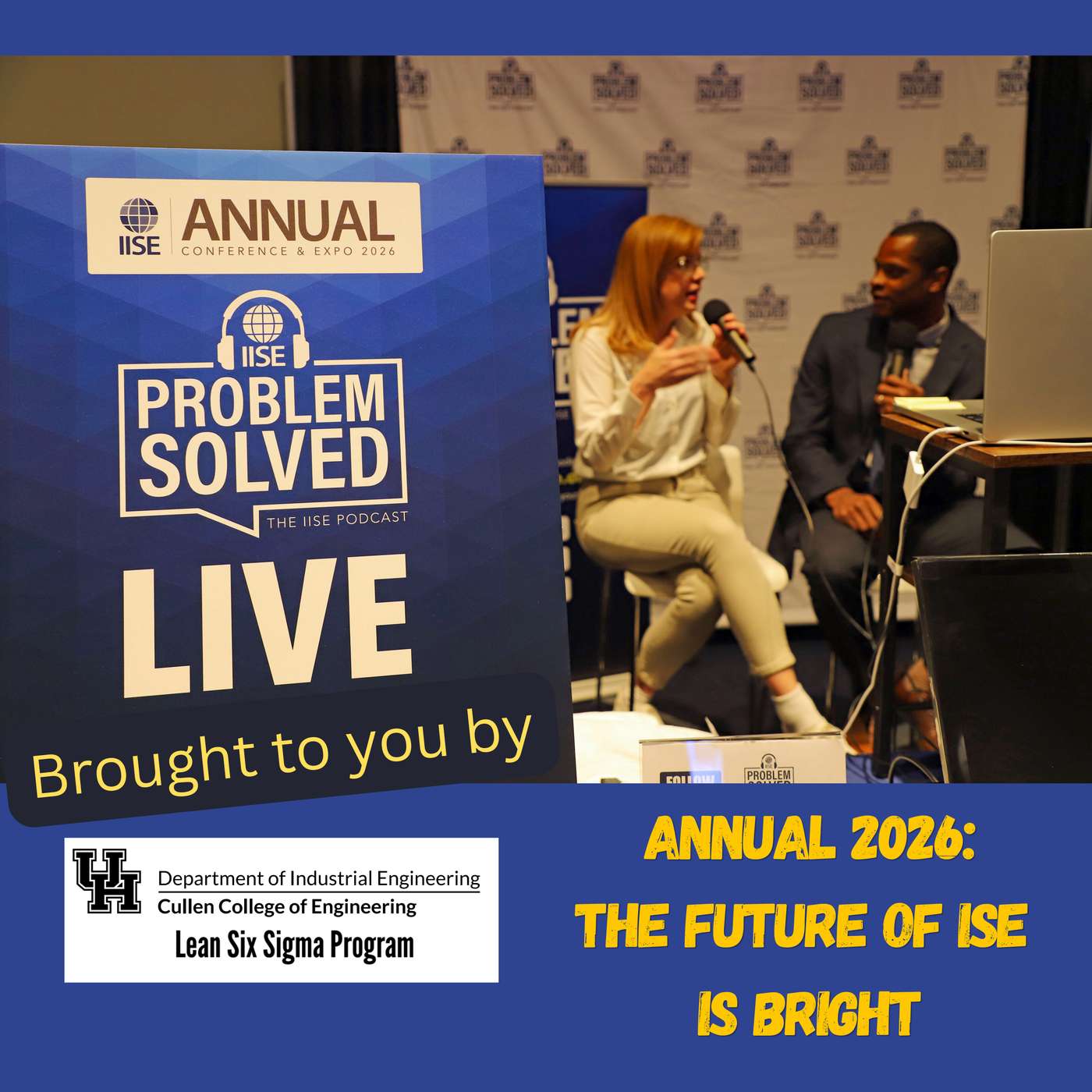
Achieve Excellence with the Experts at IISE https://iise.org/trainingcenter/ The IISE Training Center is unsurpassed in meeting the educational goals of professionals in myriad industries. IISE is an IACET Authorized Provider and “has complied with the ANSI/IACET Standard, which is recognized internationally as a standard of excellence in instructional practices and is authorized to issue the IACET CEU.” Our instructors are experts in essential topics including Lean and Six Sigma, concepts based on long-standing industrial engineering principles. We ensure that our students attain in-depth levels of understanding and practical knowledge of how to apply strategies to achieve business and professional excellence. Students earn digital badges and certificates to share on social media, email signatures, certificates, wherever employers are looking. The world is online - that's where your credentials should reside. In this special episode of Problem Solved LIVE from the IISE Annual Conference & Expo 2026, students, researchers, and industry professionals share their perspectives on the evolving future of industrial and systems engineering. Conversations explore artificial intelligence, healthcare systems, sustainability, automation, and the growing role of human-centered problem solving across industries. The episode also features highlights from the IISE Innovation Cup competition, where teams showcased innovative solutions with measurable real-world impact. From first-time conference attendees to experienced professionals leading organizational change, the episode captures the energy, optimism, and innovation shaping the next generation of ISE. Thanks to all our guests who contributed in this episode! Thank you to our sponsor, Cullen College of Engineering Lean Six Sigma program. Learn more at IE.UH.EDU IISE Annual Conference & Expo 2026 May 16–19 | Arlington, Texas Learn more about The Institute of Industrial and Systems Engineers (IISE) Problem Solved on LinkedIn Problem Solved on YouTube Problem Solved on Instagram Problem Solved on TikTok Problem Solved Executive Producer: Elizabeth Grimes Interested in contributing to the podcast or sponsoring an episode? Email [email protected] Achieve Excellence with the Experts at IISE https://iise.org/trainingcenter/
Annual 2026: The Future of ISE is Bright Ad: [00:00:00] This episode of Problem Solved is sponsored by the University of Houston's Cullen College of Engineering. At the University of Houston's Cullen College of Engineering, the Industrial and Systems Engineering Department prepares students not just to be team players, but to become dynamic leaders. Ranked among the top 50 public universities by US News and World Report, both the college and department are recognized for academic excellence and innovation. With flexible programs like professional project management and industry- relevant certifications such as their Lean Six Sigma program at lss.uh.edu, the University of Houston equips learners at every level to break through outdated systems and lead meaningful transformation. Discover more at ie.uh.edu.[00:01:00] Elizabeth: At this year's 2026 IISE Annual Conference, one thing became very clear. The future of industrial and systems engineering is evolving rapidly, and the next generation is already helping shape it. Throughout the conference, students, researchers, industry professionals, and longtime leaders gathered to share ideas, tackle emerging challenges, and explore how industrial and systems engineering continues to expand into nearly every industry imaginable. From AI and healthcare systems to sustainability, automation, and human- centered problem-solving, the conversations happening at Annual weren't just about where engineering is today. They were about where it's headed next. From students, academic leaders, and every level of industry professionals helping define that future. Ashish Goud Balagula: Thank you. My name is Ashish. I'm from Arizona State University. I'm a graduate student in industrial engineering. Elizabeth: [00:02:00] Okay. And is this your first conference? Ashish: Yeah, this is my first conference, and I feel so good to be here. Elizabeth: You're a graduate student. what is your, like, area of focus? Ashish: So my area of focus is in supply chain. I'm currently working on a thesis that is, structured segmentation based model selection policy. Elizabeth: Did you have a goal coming to the conference? Ashish: Yes, definitely. I have an objective of meeting people, making some valuable connections, and definitely I would like to know more about, the univer- universities that are here because I'd like to pursue a PhD in one of those. Elizabeth: Okay. Ashish: Uh-huh. Elizabeth: And so what do you think about the field of industrial and systems engineering? Where do you think it's going in the future? Ashish: Def- honestly, it's g- it's gonna be the booming ... one of the booming sectors compared to the other jobs, because we are everywhere. Elizabeth: Right. And so, if you could, like, describe your experience so far in one word, what would the one word be? Ashish: My experience overall here? Elizabeth: Yeah. Ashish: Yeah. I would say extraordinary, 'cause this is my first time I'm being to a [00:03:00] conference, and this was a really good kickstart for me. And I feel like I would like to attend the next event as soon as possible. I mean, again, I'm so interested to be ... amazed to be here, actually. Geshna Raghvan: Hi, I'm Geshna. I'm from Arizona State University, and I've just graduated with a master's in industrial engineering. Fatima Godino: Hello, I'm Fatima. I'm also for Arizona State University. I just graduated from my bachelor's in industrial engineering and data science. Elizabeth: And you were also student volunteers for IISE, so we love our student volunteers. Geshna: I had volunteered for yesterday, and it was something that I did not like ... You know, usually when you say volunteering, it's something serious, but I really felt so, It was very happening. It was very nice, and people like, they're ... It was so joyful. And it was nice interaction, and I did not expect I would make a lot of, friends, [00:04:00] I would say. I, I honestly met a lot of professionals, but I felt more close, more warm. And it didn't feel like a volunteering job, honestly. It felt like, oh, my God, I'm, I'm meeting this person, like, just like that. He's, like, such a huge position. So it was really fun and really nice. So beyond just seeing it as a professional thing, I really enjoyed the place. Fatima: It was my first time going to a conference and seeing the behind the scenes, how everything works. Getting to see how many people comes in one day, it's just insane to see everything working together, and all the pieces working together. So it's just amazing coming here and seeing different perspectives that everyone can have about the same topic. I'm just grateful that I got the opportunity to come. Thank you. Elizabeth: Thank you, guys, so much. Omar Faruq: Thank you. My name is Omar Fargis Sameh. I'm, from Binghamton University. I'm a third-year PhD student. Elizabeth: Okay. Great. Have you already done your presentation? Omar: Yes, I have done it, my presentation. How did it go? [00:05:00] they, they went well. Great. But in one of them, there was, there was less people to c- ... just, just to see the presentation. So it was kind of awkward. Even there was no chair. Elizabeth: Oh, no. All right. Well, you got through it. Good job. Omar: So, my paper was on- Its name was CoRis, so it's mainly the risk prediction, ordinal risk prediction for the pregnant womens. The reason for it was so we can predict any of their difficulties very early- Okay ... based on the focusing data. And also it's ordinal, so low, mid, and high. So sometimes, we see that, the, well, patients, they are diagnosed with the higher disease, but they are, the doctors say they are in the lower category of those disease or, or those problems. So, to find out those, solutions, so we, introduced this framework with, with the real data, clinical, real clinical data sets. Elizabeth: [00:06:00] So diag- the doctors are misdiagnosing them? Omar: Sometimes, yeah. Okay. We are using some physiological measures, so that gives us good opportunity to find out whether their decision is wrong or right. So we are saying that, and we think that though our dataset is not so large, so but still we believe that if w- if we can, add more data, it will work very well Prakash Patil: for welcoming. My name is Prakash Patil. I am from University of Michigan-Dearborn. I'm a first year PhD student, and I work in automotive industry. Oh, my major is industrial engineering, and I, I have worked in the automotive industry for a few years. Elizabeth: What has stood out to you so far at the conference? Prakash: definitely, definitely the people that I've met. brilliant people with a lot of good insights into, how I can direct my research during my PhD. Elizabeth: So what particularly, like, kind of research are you looking into? Prakash: To give you more details, human and AI interaction [00:07:00] to keep drivers awake while they're driving, especially on highways when it becomes very boring and sleepy. Elizabeth: Okay. Prakash: We try to use LLMs, to, keep an, have an engaging conversation, investigate what makes a conversation engaging that keeps the drivers awake. Elizabeth: Oh, that is fascinating. Prakash: It is. Wow. I'm excited. In the conference everybody's focused on elements of AI and future of this- Yeah ... a lot. And then I am very excited to explore how this is going to change industrial engineering specifically. this is just the beginning is what I feel. We are talking about AI a lot, but there's robots and, automation in industrial engineering that's gonna be, that's gonna change the face of the industry. It is. And then to explore this in the future is going to be very fascinating, because we think about robots now and how they will interact with humans now, but it may become a very different situation. For good. For good. Yeah. As well. [00:08:00] Something that I have, we are probably not thinking so much about, some kind of technology that disrupts the way we think about robots today. Elizabeth: Uh-huh. But you're optimistic. Prakash: Absolutely. Cool. Absolutely. Elizabeth: Welcome back to Problem Solved, and can you introduce yourself? Faruk Muritala thank you. I'm, Faruk Muritala I'm a student at Kennesaw State University. I'm in the program of, PhD data science, and I'm in sixth year. I got invited for innovative design competition. Elizabeth: Uh-huh. And what was your presentation? What was that about? Faruk: So we designed a data centric where we can effectively, propose a solution for cooling effect. Elizabeth: For what? Faruk: Cooling. Elizabeth: Oh, Faruk: cool. Cooling effect. Yeah, so that's what we're working on. Yeah. Elizabeth: Cool. All right. Faruk: So I think I felt much in- integrated with the company people. Okay. And they were able to, like, give me some feedback when I was doing my initial presentation. So- Yeah ... as a good thing, I was able to see today Elizabeth: For many students at Annual, [00:09:00] the conference represented something bigger than presentations and research papers. It was an opportunity to connect with professionals, explore new ideas, and begin imagining where the field might take them next. But while students are stepping into a rapidly changing profession, industry leaders and experienced engineers are already navigating the realities of that transformation, especially as artificial intelligence, automation, and new technologies continue reshaping the way organizations operate and solve problems. Ricardo Valerdi: I'm Ricardo Valerdi. I'm a professor at the University of Arizona. Elizabeth: Okay, great. And what brings you to annual conference this year? Ricardo: One of the attractions to come to the IISE conference is to attend the CIEADH meeting, which is one of the many times that we get together throughout the year and talk about all sorts of issues going on, not just in the profession, but at our own universities, and how we can exchange ideas, learn from each other, and help move industrial engineering and systems engineering forward.[00:10:00] Elizabeth: And for those listening who don't know what CIEADH is, can you explain what that is real quick? Ricardo: It's the Council of Industrial Engineering Academic Department Heads. Elizabeth: Nice. Okay. What's some of the things that y'all discussed during your time at, the conference this year? Ricardo: In addition to recognizing outstanding PhD students, outstanding papers, and outstanding young faculty, we also talk about really interesting things like artificial intelligence and how it's impacting the students that are at our universities, how we can prepare them for the workforce, but how we can get ahead of this because it's moving so quickly that, it's kind of head-spinning, and- Yeah just ideas on how we wrap our arms around it and, and really leverage it to move the profession forward. Elizabeth: Can you share any of those ideas with us? Ricardo: Certainly. What's interesting about Artificial intelligence is usually in academia, if you use AI, you're considered to be cheating. Elizabeth: Mm. Ricardo: But if you use AI in [00:11:00] industry, you're a hero. Elizabeth: Oh, interesting Ricardo: point. It's an interesting paradox, right? So we're trying to get away from the cheating mentality, but instead, how does AI become your assistant? How do you control AI to be more efficient, but also to do more things than you could do before? So analyzing large amounts of data, for instance, you could outsource that to AI. But the thinking of, well, how do you present the results, and how do you influence somebody to make a decision that has to be done by the human? So that line is very blurry right now. We wanna make it more clear. Elizabeth: Okay. anything else? Ricardo: Well, I think the, connection to ethical decision-making is important because if you let AI do the whole thing and make the decision for you, then you can be in a lot of trouble. So the other task is to figure out where the line is, where AI can give you ideas, but ultimately, you, the, the [00:12:00] human, has to decide whether something is ethically correct or not. You don't wanna ever outsource that to AI. Elizabeth: Yeah. What do you think all this is gonna do for students in the next couple years? Ricardo: Well, I think it's gonna change the types of jobs that they go into. in fact, I was just talking to another department head today that our students are going to be entering jobs that don't exist Elizabeth: yet. Ricardo: Mm. That's scary, right? So the job, the responsibility that we have is to teach them the fundamentals that will apply to anything that they do. Elizabeth: Oh, wow. That's interesting. Elizabeth: Yeah. and then just a- a little bit about yourself, I know that, you have a particular area of focus, and you also have a book coming out. Would you mind just talking about that for a minute? Ricardo: Sure. My research area is cost analysis, which is all numbers. Like a lot of industrial and systems engineers, we deal a lot with numbers. The context happens to be sports analytics as well, and my book that's coming out, in a [00:13:00] few months is about decision-making and sports, and it's called The Five-Tool Team. Elizabeth: Very interesting. Okay, and we're hopefully gonna talk about that more later on on an episode of Problem Solved, so everyone, be looking out for that episode. But, thank you for talking with us. Was there anything else that you wanted to say that we didn't touch on yet? Ricardo: No, I think it's great to see all the young attendees at the conference because that's the future of the profession. you know, there's a lot of gray hair in the, department head meeting, including my own, but it's great to see all the energy, all the papers that are being presented. that to me is extremely motivating, refreshing, and this is... that's why we do this, is to help those people make an impact on society in the next few decades. Elizabeth: Yeah. Any, For students who are listening, I mean, can you leave them with something either really motivating or a great piece of advice? If they're listening and they're moving forward, what can you tell them? What can you leave them with? Ricardo: I think being able to sell yourself as an industrial and systems engineer is [00:14:00] important, and so having like that one tagline or that one soundbite that allows you to communicate to others what you bring to the team. And one of the really effective ones is the science of better. We keep repeating that over and over in a lot of different contexts, so just for students to remember that this is what they bring to the table, is making things better. Elizabeth: Great. Thank you so much. Appreciate it. Ricardo: Thank you. Amy Sartain: Hello, my name is Amy Sartain, and I'm the co-founder of Industrial Engineer AI. We focus on the best of industrial engineering best practices, along with new and innovative AI tools, and we bring those together to help solve problems, reduce waste and defects within companies and within their workflows and their, within their pro- their business processes. Elizabeth: Fascinating. Amy: We are doing a hands-on interactive session where, students and faculty and all those that join will have eighty minutes to build their own AI agent, and we've got some [00:15:00] tools and platforms that help make that easier. And so looking forward to seeing what people create. We're gonna share out at the end of the session the things that people build and how they automate their processes. Elizabeth: So people listening who are interested in this kind of thing, what, what can you tell them about AI if they're interested in learning more about this, how to do it themselves, how to automate themselves? Amy: Absolutely. We think that it's really important for industrial engineers to lead the change in organizations with AI, and you have to start with yourself. You need to be a daily user, teaching yourself new things and work your way up. Challenge yourself. this is a great time to upskill. whether you're a student in school or whether you're a professional in industry, you should be learning something new about AI every single day, and you should be the one bringing that out within your organization so you can help others with the transition. Elizabeth: What do you see the future looking like? Amy: I think that cameras and sensors are going to be much more prevalent in operations. I think that, data will be more connected across organizations so that people [00:16:00] don't have to manually run reports and fish for things. I think we'll be able to see status at a glance, and that will help industrial engineers with problem-solving. and we also talk about outer space a lot. it's- Yeah ... it's fun and interesting. We think that the students today that are in school are gonna have s- part of their career involved with space in the future. And, so that's just kind of something exciting out there that, we w- we're following, and that we can't wait to hear from students and, and those that are working on projects with that. Elizabeth: Cool. we have a contest going right now that, we've got a astronaut coming up on an episode of Problems Solve, Colonel Shane Kimbrough. So if you could ask an astronaut a question, what do you think you would ask? Amy: Absolutely. That's a, that's an exciting episode. I can't wait to listen to that. I would probably ask, what do we think, industrial engineers should be doing to be helpful in getting involved in space exploration? Elizabeth: Awesome. Thank you so much. Amy: Yeah. Kyle Collins: How everybody doing? My name is, is Kyle Collins. I'm a industrial engineer, for UC Southwestern Medical Center. Been [00:17:00] there for about six years now, so in the healthcare industry. Love making the processes flow better and using all the tools that we learn here at this conference. Elizabeth: The, Gilbreth... Were you here this morning for the keynote speech? Kyle: I, I was not, no. Elizabeth: Okay. Mm-hmm. So one of the award winners, the Gilbreth, winner, he is in healthcare. Mm-hmm. So like, like that's like our biggest award. Kyle: Mm-hmm. Elizabeth: And he's a healthcare systems engineer. Okay. So that's kinda neat. Cool. So how did you get into that field? Like what drew you to that? Kyle: I didn't even know industrial engineers could be in healthcare initially. But, at, I w- went to Texas Tech U- U- University, and then for my senior design project, we had a, a hospital that we partnered with, and I did the project with that. So ended up doing that, loved it, and I applied to UT Southwestern Medical Center, ended up getting it, and then that's how I kinda got, got there. I, I like it. Yeah. I, I think everybody could relate to it. Yeah. You, you've been to the doctor or somebody else you know have been to the doctor, and you always go in there like, "Oh, it could be a little faster"- Yeah ... "or a little better or [00:18:00] a little more efficient in some type of way." Right, right, right. Yeah. So you can relate to it. Kyle: Yeah, Kyle: totally. So, I th- I think that helps, and then if you do make change, then you're changing it for somebody else or somebody else you may know that can, you know, that'll get a turnaround time faster. You might get a results faster than eight months or something like that, or you might can get it in, in 10 minutes, you know? Right. So that's kinda our goal to make things better- Elizabeth: Yeah ... Kyle: overall. I'm looking forward to some AI stuff that we can make 'cause, of course, that, that spits out information so quickly, and we just wanna make sure we can, get information to patients faster, so. Yeah. that's, that, those are the main things. Looking forward to that. But I think the, the change management piece of trying to implement all of these things, I did go to some, change management, classes, and it's nice to hear that everybody's in the same- Yeah ... space. Yousef Abushaaban: I used to go to Shaban. I've graduated at University of Texas at Arlington in 2017 as an industrial engineer. and now I'm working in the industry, as, at, [00:19:00] a natural gas company, here in Dallas. so I work as a, as a system planner. One thing I'm really passionate about is, modeling and simulation. Elizabeth: Uh-huh. Yousef: I, I got to see, like, how other industries, take on those challenges and, lesson learned, and I can take it away and, recapture that into my, day-to-day Elizabeth: Is there a certain way that you would use that in, in what you do? Yousef: Yeah, I can adapt really quick to, the change management side, just understanding like how change management is a, is quite a process in different industries. and I, I've learned that it- it's helped so many industries understand like how the resistors of change, what's coming, kinda like show that, personal relationship is what really, really is, built to build upon is change management. So I really like it. Yeah. Elizabeth: Why is that so important? Yousef: I believe it's really important, because, as industrial [00:20:00] engineers, it's driven as a people process and technology, and the value of us being, of me being an industrial engineer is what got me into the industrial engineer world. I'm more of a people person and I like to network. building that trust and, on a personal level and then professional level, I mean, it builds confidence. Elizabeth: Kind of the core- Yousef: Yeah, the core aspect- Yeah ... of industrial engineering. Yes. Elizabeth: Yeah. David: My name is David Burford. this is my first time at an IISE conference. Elizabeth: Oh, cool. David: I've been a part of IISE since about 2017. There's a lot of, sessions to see and there's a lot of rooms to go to, so I feel like I am, I'm seeing a lot, but there's a lot of stuff I'm missing too. I think the best, one of the best sessions I went to, was the Operational Excellence Town Hall. it was good to see a lot of the IISE operational excellence team and just, practitioners throughout the industry.[00:21:00] My avenue of interest is Lean Six Sigma. so I'm a Six Sigma Master Black Belt, and I've been doing projects for about 13 years. Elizabeth: Okay. So what do you hope to gain out of this conference? David: networking and some great, great knowledge. Elizabeth: The Innovation Cup competition offers a glimpse into what the future looks like in practice. It's one of the highlights of Annual each year. Teams from across industries showcase innovative solutions using industrial and systems engineering principles to solve real-world problems and create measurable impact. These are the third-place winners of the Innovation Cup. Congratulations, and go ahead and introduce yourselves. Brenden Mosier: Thank you. I'm Brendan Moser, and this is Tom Boose next to me. I am a performance consulting analyst with the Mayo Clinic in Rochester, Minnesota, and Tom is an environmental services manager in the same, enterprise group. And we're here from the Mayo Clinic, in Rochester [00:22:00] presenting about using automation and robotics to help solve some problems in our support services work groups. Elizabeth: What was the main problem that your team solved? Tom: Our team did a gap analysis using the demand framework to determine several issues within our support services departments of, staffing challenges, as well as a heavy manual burden on our staff. Brenden: By leveraging robotics to take care of that manual work stream and take, you know, near the 20% of the staff's walking distance, off their hands into the hands of robotics, we're able to drop that exertion days lost, to a total of 55 days combined between 2025 and 2026. It originally started as implementing robotics back in 2024, but since then, and in 2025 and 2026, it's been an upscaling of robotics, not only in, in new physical locations, but increasing the [00:23:00] usage of robotics in existing locations as well. Elizabeth: Fascinating. And the second place Innovation Cup winner. Naveen Chandra Kukkala: Hi, my name is Naveen. I'm from EssilorLuxottica. I work as a director of distribution, mostly work on warehouse optimization. Elizabeth: And can you talk a little bit about your organization and the problem that you solved, and just tell us about it. Naveen: Yeah. a lot of people doesn't know that EssilorLuxottica is behind a lot of brands. The, the Ray-Ban Meta that I'm wearing right now, we own this brand. Elizabeth: Okay. Naveen: And, we own a lot of brands like Oakley, Costa, Sunglass Hut, LensCrafters, and there are so many others, I don't have time for that . but, yeah, my- myself, my team, we work with warehouse optimization. We work with our other business partners in delivering products to our customers quicker and cheaper. So the problem that we tried to solve is within the warehouse. we [00:24:00] wanted to help our operations pick more and get the products to customers much faster. So i- previously, we used to measure, the forecast, but we started measuring our hope to measuring what we actually did. You know, hope is not the best plans, and right now we're measuring what we are doing, and previously we used to measure what we hope we're doing. So that's what, shifted, the previous results from... We used to get, like, 80% accurate on slotting. Now we're getting 99, 98 consistently. So- All right ... yeah. Elizabeth: That's great. Congratulations. Naveen: Thank you so much. All Elizabeth: right. I am here with the Gold Cup winners of the Innovation Cup. Congratulations, all from Smurfit Westrock. And could you all please introduce yourselves? Devin Corbett: Hi, I'm Devin Corbett. I'm a process engineer at the Covington, Virginia mill. Rishabh Bhandawat: Hello, I'm Rishabh, and I'm a data [00:25:00] scientist at Smurfit Westrock, and I work out of Atlanta, Georgia. Andre Perez : And I'm Andre Perez, an IT and process controls engineer. Devin: I work at a paperboard facility, that has an integrated power plant cogeneration, and it's, it has a lot of different boilers and turbine generators, separate electrical grids. Very complex and we needed to be... We needed to have a tool, where we could, real time compute what the most efficient and optimal, strategy to produce power was, with ever-changing electrical prices and gas prices. Rishabh: And part of the solution that we came up with was creating a, model with our data scientists where we took all the constraints, all the upper and lower constraints that we had for each, power boiler, all of our physical limitations, and we calculated including our dynamic economic factors, [00:26:00] what the best lowest cost scenario would be That would utilize the most, renewable energy sources that we had available, and to generate the most, you know, most profit and most renewable energy credits, which is something that we have. One of the beautiful things about the model that we created was it, it's a mixed integer linear programming model. And to be, to see something that I've learned in, during grad school being implemented at, at an industry level is good to see. And also, it solves really quickly, so we, like, brainstormed ideas where we can, we made sure that, this model works very fast and is adaptable to the changing, demand of the electricity and the steam that the mill requires, but also changing, electricity prices, and make sure it's, adaptable. Yeah. Elizabeth: And so, how's your experience been with the Innovation Cup? I know that you've had experience before, [00:27:00] so, what's your experience been this time, and, what's your advice to other people who are thinking about entering the Innovation Cup? Rishabh: So this year, definitely a better experience because we got gold. but yeah, it, it, people like Sagar, Bhanu, and other committee members of the Innovation Cup, they've been very helpful with, guiding us through the process. but it was also great to see what other companies are doing within their own organization and how, they're trying to be innovative and standing out. So, was great to hear other, other people's innovations as well. So if you think you have, you're doing some great work, definitely, definitely, submit for next year. This is a project that the three of us worked on. We're really proud about this project, so it felt great to have an audience, to be able to present our, you know, our results. We ... Th- this project led to about $6 million worth of savings per year at this [00:28:00] one facility, and we're looking to expand on that. And it was exciting because we had many different disciplines here. So we had, you know, process engineering, data science, IT, so all these different, you know, realms having to come together, collaborate to make a really working solution for operations was, was awesome. So yeah, just like Rishabh said, if you have a project that you want to, present and put in, in front of others and compete on, this is a great, this is a great avenue for that. Would highly recommend it. Amy: Well, thank you, guys, and congratulations again. Rishabh: Thank you. Thank you. Elizabeth: From first-time conference attendees to experienced professionals leading change across their industries, this year's IISE Annual Conference and Expo highlighted a profession that continues to evolve alongside the world's biggest challenges. Thanks for joining us on this special episode of Problem Solved. Every great solution is a story worth [00:29:00] telling