
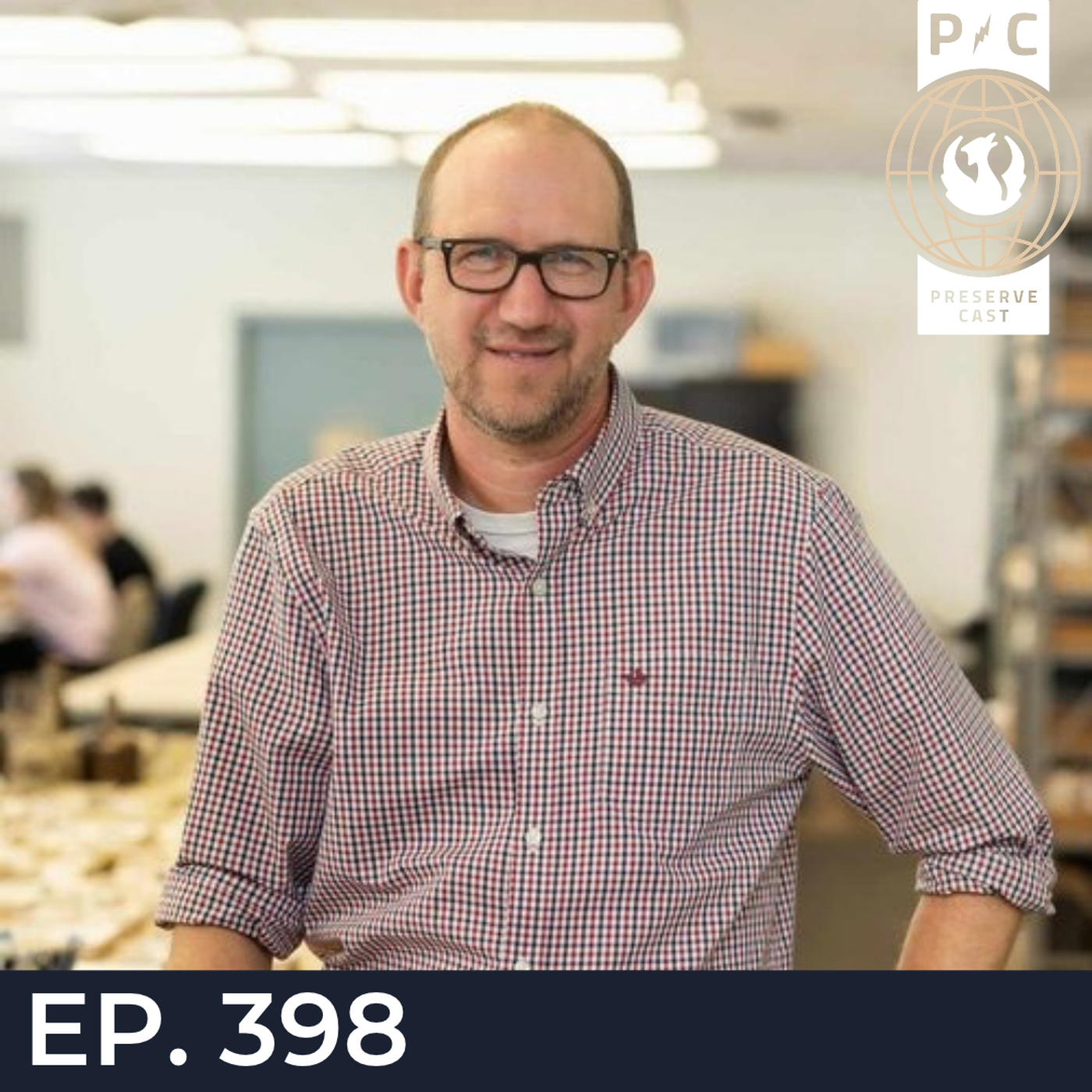
PreserveCast · Preservation Maryland
Colonial Williamsburg archaeologist Jack Gary joins us to explain how public-facing archaeology can make discovery accessible, and how descendants shaped the excavation and interpretation of Williamsburg’s early African Baptist Meeting House and burial ground. Gary describes the evidence behind the reconstruction, why the team stopped short of excavating most burials, and how the project broadened Colonial Williamsburg’s historical scope.
PC399 Jack Gary: Come along with us as we explore the broad world of preservation and the work being done to preserve, interpret, and save our past in a 21st century world. From aquaculture to historic foodways to forensic modeling, we're talking weekly with experts from across the globe. This is your host, Nick Redding. Welcome to PreserveCast. Did you know that the campaign for historic trades, which is powered by Preservation Maryland, is the sponsor of three registered apprenticeship programs? The campaign also hosts workshops across the nation, maybe even one in your backyard. Visit historictrades.org to learn more and find a way to learn a trade. This is Nick Redding. You are once again sitting down and listening to PreserveCast, and today we're excited to have someone from An institution that probably needs no introduction. A lot of times we you know, have the person go into and describe the site that they're working at. And the site itself will we'll really want to dig into, but the place is a place that many people are familiar with, not only here in the United States, but world world worldwide. the place, of course, we're talking about is Colonial Williamsburg, and we're going to be speaking with Jack Gary, who is leads all aspects of archaeological research within The Department of Archaeology at Columbia Williamsburg, which is an impressive scope and scale of archaeology, both in the length that it's been done and the number of sites and objects that it has collected and it has researched. we're gonna be zeroing in on one recent one and how that led to further interpretation on site and we'll we'll talk all about that here. Before we get started, if you're enjoying listening to Preserve Cast, please be sure to review, rate, and then subscribe. And then also if you've enjoyed this episode, be sure to share it so that we can continue to grow the listenership here. so Jack, getting into this a little bit and getting to know you a little bit, what was your path to preservation? Why when you were growing up, how did you end up with archaeology as a focus? And then maybe we'll talk a little bit about how you got to Colonial Williamsburg. But but as a a young person growing up, and obviously that's such an important part of the work at Clinton Williamsburg, sort of inspiring people, how were you inspired? How did it begin for you? Yeah, th thanks, Nick. And it it really did start out as a as a child. And l a lot of kids, I was in into dinosaurs, but you you quickly realize you yeah, I grew up in Roanoke, Virginia, in Southwest Virginia. Yeah, there aren't dinosaurs there. You can't find them in your backyard, but you you could find other stuff. And and so the I the the process of discovery, I think, was what really fascinated me as a child. And so you kind of you move away from dinosaurs and towards and you realize, there's this field called archaeology where I can I can also find things. And and I really have to credit my my parents who sought out opportunities for me as a child to have experiences interacting with archaeology. Matter of fact, I as probably as maybe 11 years old, there's an excavation happening in in Roanoke and my mother just took me down to it. And the archaeologist on site said, Hey, that's kind of a it was like, you know, hey, hey kid, c come on over. You want to see what we're doing. He put a trowel in my hand I was working next to these guys. I didn't know what I was doing, but I was part of that process. And so having that that moment of discovery, tactile, it's real. this wasn't a sandbox exercise. And man, I was hooked from from that moment on. And and and and it really has shaped my thinking about how we portray archaeology here at Colonial Williamsburg and making sure that our guests see it and have and have a connection with it. We we can't let everybody dig, but we can we can provide opportunities to get up close and personal, interact with us, because that's how we get the next that's how we get the next level and the next generation of stewards of these of these historic resources. Yeah, it seems like you ended up at the perfect place to do the kind of archaeology that you're doing. Because there's a lot of different archaeology that's done across the country. I think a lot of people think of well they they think of archaeologists, they probably, think of Indiana Jones and stuff like that. But but when they but I I think a lot of people think of the type of archaeology that you do, but probably ninety or ninety-five percent of archaeology out of the United States is done for compliance. And so it's it's not being done from a public research and public experience and interpretation standpoint, and you have the opportunity to slow down and to do some of those things, which is kind of unique. What was your what was your research background? Like where did you go to school and and how did you end up In this very specific type of archaeology. Because I wanted to do archaeology from such a young age, I would ask as a young person, okay, where do I go to college? That's the next step. Where do I go to college? And everyone at the time, so this would have been in the the late 80s, early 90s, everyone said, You gotta go to William and Mary, the College of William and Mary in Williamsburg. That's where you have to go if you want to do archaeology. I say, okay, that's where I'll go then. so I did. So I came to William and Mary, got my undergraduate degree, and then I and I started doing CRM work right out of right out of college and and working all over Virginia doing compliance driven projects. And boy, you you learn so much from it. But you get to the point where it's like, yeah, I want to I wanna be the guy in charge. And so went went to went to UMass Boston for graduate work. And that's where you know I really started to kind of develop, I think, my own my own research interests beyond just I love discovering things, I like the process of excavation. And so it was in in the graduate program there where I started to really get into particularly environmental archaeology and understanding the the the past through environmental analyses. And and and so to I took that then to my first real job as a professional archaeologist. Well, I mean CRM work, but you know, the as the guy in charge at Thomas Jefferson's Poplar Forest in Bedford County, Virginia, where I led those excavations. And and it was there that I I think I really realized that if we want if we want people to support our work and be stewards along with us, we need to start conveying information in ways that's really accessible. and so I I think it was there that I started to kind of form, you know, what I what I've then brought to Colonial Williamsburg is a an approach that that allows people to To truly understand what we're doing. We don't talk down to people. We meet them where they're at with their understanding of archaeology. And sometimes that is, okay, Indiana Jones, right? Okay, let's start there. So, you know, it's it's it's kind of meeting people where they're and bringing them along and then kind of getting them into the nuances and the and the you know the details that we can get at. And so I I think that kind of progression of of mine has kind of led me to Colonial Williamsburg, where where you're exactly right. We have the opportunity to Do what you just said, we can slow down. Doesn't mean we can take forever, but we can we can slow down and we can we can incorporate into our work the public and and and showing them, really showing them what we do and how we do it. and and so we're we don't take that for granted here at Colonial Williamsburg. We know that not all archaeologists have that opportunity. So, but we want to be the leaders in the field because we have that opportunity. Yeah, I feel like one of it's it's almost like you're the I don't know if you've ever thought of it this way, but sometimes I think about sites like this as the the ambassador animal that they take out, you know, the wildlife animal where they're like, This is why it's important to save owls and you get to meet the owl and everything like that. And it's like, this is why it's important to ha to fund archaeology and why we should have laws to make archaeology required. Because this is why it's important, because so much of archaeology, just like so much of, you know, rescuing an owl. is not really very public. it, it, it happens in the backgrounds. And sometimes it has to happen in the background because you don't want people to go and, pillage a site and and steal from a site and things like that. So you you can't just tell everyone where every archaeological deposit is. And so it's, it's not, I think it's such an important role that Colonial Roomsburg plays. And I I think that, you know, you guys obviously take that very seriously. And I've become even more robust in sort of the public outreach piece of that. I'm curious if you could talk to that public piece. So if if someone was listening across the country and they have a small historic site, they're going to be required. Maybe they're doing some work and they have to do some archaeology. What have you guys found have been sort of the best practices for engaging the public around archaeology? What works? Yeah. I'm inviting them in into the sites and getting up close and personal. We we don't advocate for for allowing people to excavate with us. You know, we we use only professional archaeologists for our excavations. But that doesn't mean you can't let people get right up there next to the screen with you, you know, and and and share in those moments of discovery. Let let them let them touch an artifact that's coming out of the ground. I mean, it's just that's it, as long as it's safe to do it. it's those tactile experiences that get people really excited and involved. But I think probably more than any of that, it is making sure your language is appropriate when you're talking People drop the jargon. Yeah, drop the jargon. People don't know what you know, a lot of the words that we use in in our everyday work as an archaeologist. And so so I I think it's really helpful to start to to to train your brain to think like the guest that's coming to the site and what is it that they understand about archaeology. And don't assume that they know some of the things. Don't talk down to people, but don't assume that they know the things that you're going to be talking about and and take a moment to explain. you know what what it is. If you use the word stratigraphy, stop and say stratigraphy is the layers of soil that we excavate. So it's so it's it's things like that that I think have have are are really helpful when trying to make those connections with with the public. And so that's in the field. Now in in the lab, and and I'll have to you know have to give a plug here because if our guests come to Colonial Windsor right now, they'll they'll be able to come to our brand new 40,000 square foot archaeology center, which we just opened in April, which has all of our laboratories, it has our our study collection and a on display, visible, visible display, and educational classroom space as well. And it's open to the public. And the and in this building, in the labs, they're all visible. You can you can see the work actually happening up close and personal. And so I I I think it's it's trying to take as much of the back of house stuff and bring it front of house, the lab side of things. so again, meet the people where they're at because they understand excavation. Most people, that's what they think about when they think of archaeology is the physical process of digging through dirt, recovering artifacts. All right, now show them as much as you can. all right, what happens next? Let people see washing artifacts. That that's something that I I people are, you know. Yeah, move take taking the dirt off of an artifact for the first time in hundreds of years, I I I still enjoyed doing it. So are your guests or the public seeing that in that moment of discovery? It's a simple thing to do. so so kind of drawing them in through some of the simple processes of archaeology. So we're trying to do that here in the new archaeology center by showing off the process. But also having some behind the scenes experiences where you get up close in person with an artifact that is not e it's not on display. And yeah, we're we're blessed that we have over sixty million artifacts in our collection. So you know if you can't find something you like in our collection, then this isn't for you at all. But so you know, we but there's a lot of stuff that we can't we can't display because the collection is so large. So use those moments of you can't it there there are things that you just can't show all the time. Use those as your hooks to get people in and say, hey, do you want to see something that no one ever gets to see? And then and invite them in to see something. So I that that's it that has been pretty successful for us. but I'll go back to what I you know, the the the top of what I said there, and that's language, language, just making sure you're not talking down to people and and are you're explaining in in lay terms what it is that that you're doing. Remember how you know how you were when you were a young archaeologist and didn't know much yet. And so Yeah, I that that's just I I think one of our best practices that we've we've engaged with. And we train our our employees to do that. Yeah, it seems like a a like an interpretive approach to archaeology, which is is a little different because interpretation isn't a science and archaeology is. And so it's it's a little bit more of a humanities kind of based approach. And and it I you know, you read a lot about, you know, I think AAS L H and and and National Council for Public History, they talk about the value of showing people the work of history and how history is done. And and I think that the public is very receptive to that. I think they're very interested in in how we know what we know. And particularly when it comes to things like like archaeology. And and you're right, the the site that you have there is is phenomenal. It's probably one of the best, if not the best, archaeological displays and exhibits in the country now. And open for everybody to see. So I know a lot of people listening probably haven't been there yet to see it because it's it's freshly opened. but we could probably do a whole thing just on that and and the work that went into that. But you were also busy at the same time as all that was coming together with another big project, which was the African Baptist Meeting House and the burial grounds. so tell us a little bit about this site. I think one of the things that's interesting is that. for some people listening that there are still new things to discover at Colonial Williamsburg. You would think, we're almost a hundred or we are a hundred years in. you found everything, you know, where everything is, you've discovered everything that's left to be discovered, and and that obviously isn't the case. maybe the first question here with this site is when did you sort of when did Colonial Williamsburg recognize that this was there and When was the decision made that we want to excavate the site and figure out what happened there? Colonial yeah, Colonial Williamsburg had had recognized that that the site of what we now call the African Baptist Meeting House, which is the first permanent structure built by the church that is today known as the historic First Baptist Church of Williamsburg, which is, which has the superlative of being one of the, if not the earliest Black Baptist congregations in the country. And it was founded right here in Williamsburg in 1776. And the site of their first meeting house, which dates to the early 19th century, the congregation had been had been meeting in secret in on on outline plantations prior to the early 19th century before coming into town and establishing a actual permanent building that they built themselves. And so we we knew we knew about its location for for quite a while. And in the 1980s, we put up a sign near its location, however. However, the actual location itself of this building was underneath a parking lot. And it it had been it had been paved over in the 1960s. and backing up a a couple steps further, the the first meeting house on this lot stood until 1834, when it was destroyed by a tornado. And The congregation then began to meet in a variety of different locations around Williamsburg before coming back to this piece of property. And in 1856, they built a larger church on top of what had the what had been the site of the first meeting house. This large, pretty large church stood until 1956 when it was purchased by Colonial Williamsburg. So Colonial Williamsburg had founded in 1926, and its goal was to restore the colonial city. And it approached property owners and and offered to buy their properties. And if they were eighteenth century structures, they would be restored and interpreted. If they were not eighteenth-century structures, often what happened is Colonial Windsor would then demolish them and restore whatever had been there in the eighteenth century. So Colonial Windsor approached the congregation in actually it was 1954, they approached the congregation, offered to buy the church, And and to give them a piece of land to build a new church. The congregation agreed. And in 1956, Colonial Williamsburg took ownership of this church. Now remember, it's an 1856 church. And so at this time period, the goal was to restore the 18th century, not the 19th century. So Colonial Williamsburg immediately upon possession demolished the church. We actually conducted an early archaeological excavation on the lot. Looking for anything that would have been from the 18th century. And those early excavations actually uncovered the foundation of the first meeting house that had been underneath the 1856 church. However, in 1956, that was not a story that Colonial Williamsburg was interested in. Matter of fact, I'm not even sure if we knew at that time what about the first meeting house. And so nothing of from the 18th century was discovered on the site. So Colonial Williamsburg paved it over, turned it into a parking lot. And so back to your question, do we recognize it? We we did, but it was a it was a parking lot. And in the 1980s we put a just a a simple sign next to the parking lot saying this is the location of the actually we just we called it the First Baptist Church of Williamsburg. So so we knew about it. However we we had also paved over it. And and so in 2020, at just at the beginning of the pandemic, Colonial Williamsburg, along with the Let Freedom Ring Foundation, which is an organization dedicated to preserving the history of the First Baptist Church of Williamsburg, along with the descendants and the first Baptist Church of Williamsburg, came together and and agreed that we we have one of the most important sites in the country to interpret. early black baptist history. And that that led to the development of a project that was done completely in in consultation, in tandem, in collaboration with the descendants, with the church, and with the Let Freedom Ring Foundation. And and we as archaeologists ceded, really tried to cede as much of our authority as it will on the site by asking descendants and the congregation, okay, w we have the site. It's underneath a parking lot, but what do you what what do you want us to to understand? How can we use archaeology to understand the site? What do you want? And the answer was clear. Find the first meeting house if you can, rebuild it, and confirm an oral history that states that there were that there that there were people buried on this property that would have been That would be the ancestors of this descendant community. That was our directive. It was great. That's that's how we started the project. So it was done and then throughout the project, it was done in collaboration with the descendant community throughout. At every moment of decision, we would turn to the community and ask, what would you like us to do next? And that's that has been one of the most rewarding things about this project. The archaeology has been fascinating too, but creating this, this, this relationship. with the community has been much more rewarding than if we just gone into it saying, We've got this, let us do our work and then we'll tell you what we find. It wasn't done that way at all. So I mean I guess that begs the question what's the scale of a project like this? You've you've mentioned it it was under a parking lot, are we talking about an acre? Are we talking how much ground are we talking and how extensive was the archaeology? and then we can talk a little bit about what was discovered and and how that informed interpretation. Yeah. It was a It's a quarter of an acre lot. And and this is this is interesting because in eighteen five there is so the the the first established preacher for this church, a man named Gowan Pamphlet, in eighteen five, he is listed in the tax records as being taxed for one quarter of a of a city lot in in Williamsburg. It's never listed where that is, but we're pretty sure it's it's this piece of property, this quarter acre of a lot in, in Williamsburg. So it's it's not massive. It's kind of a thin sliver of property that historically would have been partly unusable because a ravine cuts into this into this property. It would have been swampy and low lying and it w it was a pretty undesirable piece of property. how however the the congregation they they established their church here, they made this piece of property work, and and they flourished there and into the twentieth century. So even though it was undesirable for a lot of folks, this this was a real opportunity for this congregation. So yeah, not a not a big not a big lot, but we spent two and a half years excavating it. So we pulled up the parking lot. We made the commitment that this would never be used as a parking lot again. and pulled it up and began excavating for the next two and a half years. And and we excavated probably 90% of the lot. no, normally we we try and preserve as much of a site as we possibly can. Sure. yeah, excavate up to the point of being able to answer our research questions and then preserve the rest. In this case, the research questions kept kind of Yeah, we're growing and also we wanted to make sure we had everything in order to answer the questions that the that the community had had given us the directive to answer. And so you let's talk about the burial piece and then let's talk about the building. So you you sort of said that there was sort of legend and memory that this was a site of burials. What were you able to discover there? I mean, we we called it the the first African Baptist church site and burial ground. So Presumably there you you did find something there, but what was the scale of it? Yeah. And the oral history actually was in church minutes, from the nine I think nineteen fifty-three church minutes show that a woman named Sister named Sister Epps in the in the minutes spoke up during a meeting discussing building an addition onto the back of the the church. This is what we call the eighteen fifty six church, the second one. the congregation was still there, Colonial Williamsburg hadn't bought it yet. And they were they were discussing building an addition onto the back of it. And in the course of this conversation, Sister Epps spoke up and said, Well, that that's where my great-grandfather's buried. And that's the only documentary evidence that we have of of anyone being buried there. the the the congregation came to the the conclusion in 1953 that we'll put a plaque in the floor of the addition in honor of your great grandfather. And then they went ahead and broke ground, laid a foundation, and then and then didn't have enough money at the time to continue construction. And then Colonial Williamsburg came and bought them. So so the the this addition was never built, but it gave us the first clue that somebody might be buried there. So in our excavations, we we hit the this 20th century concrete foundation for this addition that the congregation started to build. And never completed. So once we found that, I was like, okay, all right. Based on this documentary evidence, there could be, there could be this could be where people are buried. And and sure enough, we uncovered a graveshaft. so the the stain in the ground from digging the hole of the grave and then filling it back in. And that was the first one that we that we knew definitively was a was a pretty important day. And I I I tell this story often and I I'll tell it here too. And I think all the all the players involved would are okay with it. But at the the day that we were doing this, when when we discovered the first graveshaft, the the the president of Colonial Windsor came by the site and and he said, So what are you looking at there? And I knew what it was and my team knew what it was, but we hadn't told the community yet. We hadn't told the descendants yet. And so So I lied to the president of Colony, William Spring, and said, I I I don't know what we're looking at. So he so he walked away, probably thinking, What am I paying these guys for? But I wanted to make sure that the first person that knew other than us were the descendants. And so as soon as he walked off the site, I I called up our our our contact, our liaison with the descendant community and the let Freedom Ring Foundation and and I and I told her, Connie Harshaw, I told her that we we do indeed We can confirm that people are are buried here. and once we knew that we had graves, that's that was another moment of decision. So we turned back to the community and said, okay, we know people are buried here. What what would you like us to do next? And the the response was okay, tell us how many people are buried there, what is the extent of the burial? And if you can well you confirm that they are our ancestors. Yeah, yeah, people are buried all over Colonial Williamsburg. There's there's quite a quite a few cemeteries, and it was always there's always the potential that maybe the cemetery predated the the congregation coming there. So it was make sure these are our ancestors. So with that directive, we expanded our excavation and discovered 62 burials. again, these are the graveshafts. And they're of different sizes. So you could you can start to tell based on the size where you have adults, where you have children, and particularly when you have infants. so really small graveshafts were also visible. Now is that a large is that a large scale for a colonial Williamsburg? I know you mentioned you have a lot of cemeteries around. Is that pretty decent size or is that r average? Yeah, that that is that is pretty decent size because most of the cemeteries that we have are fan are small family. And then there's we also have individual burials and people just buried on the lots on which they they lived. So yeah, this was this was a little bit this was a little bit larger scale. Bruton Parish, the Anglican church or now Episcopalian church in the center of town, has the largest burial burial ground. Right. But this yeah, this was this is pretty this is pretty big. so Yeah, the the other the other directive was make sure that these are our ancestors. Sure. And in order to do that, we we had that would require us excavating down to the skeletal remains themselves. So at the up to this point, we had not seen any skeletal remains. we had just excavated down to the tops of the graveshafts to map them all in. we did see a couple of the graves had what appeared to be some markers with them. one had a an inverted wine bottle had been buried, at least the base of it had been buried at the foot of one of the graves, which it was definitely intentional. So marking that that grave. Another one had a small pile of oyster shell kind of near the head of it. So these are, you know, impermanent markings, but we could still because we were excavating carefully enough, we were able to still see some of these some of these markings. But but nothing, no tombstones, nothing like that. Mm-hmm. so again, we we in order to really confirm that these were the ancestors, we needed to get down to the skeletal remains and and not knowing what the condition of the bone was going to be like, we decided to to just excavate three as a start. and we chose three that kind of spanned the the the the geography, if you will, of the cemetery to look at different areas within the cemetery to see if there's differential preservation of the bone based on different parts of the cemetery or the burial ground. And so we again turned to the community and said, this is what this is our proposal and this is what it'll look like. And I think this was an important part of this process is before we ever put any shovel in the ground or trowel in the ground to go excavate down to the remains, we had a community meeting where we outlined all of our steps And and and describe this is what it's gonna look like. we're gonna restrict access to the site completely. No one will be allowed on the site, and we'll put a privacy fence around the entire site so you can't see in. here's how we will collect DNA. It is it is slightly destructive, and we want to make sure everyone is okay with that before we move forward. These are the tools we'll use. This is what it's gonna look like. So I that was I I think that was a a Kind of a success story, if you will, of this project is doing that as a pre-step to actually excavating the burials, really just outlining what is this going to look like. So no one is surprised by by this. and we invited the the descendants, if they wanted to come to the site, they could come to the site while we were excavating. All right, so we we excavated three of the burials down to the skeletal remains, and we discovered that. All three of them, the condition of the bone was very, very poor, poorly, poorly degraded. all three individuals had been buried in coffins, in wooden coffins. the grave goods with them were primarily actually not primarily, and they were entirely clothing-related objects. And the the the button types that we found with one of the individuals dates to the First half of the 19th century. All the coffin nails also date to the first half of the 19th century. and so all of this was leading us to these people were buried in the first half of the 19th century when the meeting house stood on this site. Great, great. So the time period lined up. And then the next step was to do DNA. Due to the poor preservation of the bone. For two of the individuals, we unfortunately were not able to get any DNA out of those two individuals. and I'll back up. All three individuals were male as well. The third individual, however, we were able to get DNA that could be sequenced and revealing that this was an individual of sub-Saharan African ancestry. So all of these pieces of evidence lined up to allow us to confirm that. these these are the ancestors of the of the modern descendant community. and and so we we revealed that to the descendants first and again turned to them and say, what would you like to do next? But we would recommend not excavating any more of the burials because the bone preservation is so poor, the questions that you might want answered questions we might want might want answered, particularly if it's pertaining to DNA, probably can't be answered due to the poor preservation of the bone. And so you risk now excavating all these people and and it it kind of starts to tip over into desecration rather than excavation and research because you can't get any information out of it. Right. It's destructive too. I mean it's yeah, you're yeah, you're kind of destroying the the historic integrity of the site for not For, and and what you're saying is you're not really answering questions in the process. Right, right. And and Colonial Windsor had made the commitment that this property would never be developed for anything other than interpreting the the church. And so they don't need to be moved. We don't have to to excavate them to move them. And if we can't answer the research questions or don't feel like we have the techniques, the technologies right now to answer the research questions, we should probably stop because as you said, it's it's destructive. But that was a decision that was the descendants solely. But we we came with that recommendation. and they deliberated on that as and which was a difficult decision to come to because people wanted to know are are my ancestors or my direct ancestors buried there. Right. And in the case of the first one that where you were able to get a DNA match, we just recently did an episode on on genetic genealogy. and we talked to a researcher who had identified Maryland soldiers down in the Carolinas, I think it was, Battle of Camden. And and they were able to actually connect them with a true descendant. Like they were actually able to make the connection between the two. So not just that, okay, this was somebody from Maryland and we kind of identified that person, they actually were able to make the connection to a living descendant. Were you able to do that in this case as well? No, we no, we weren't. the again, we only had the one individual that that we had usable DNA from. And without without having another layer of documentary evidence that could have suggested who that individual was to be able to then do some genealogy to come back, i it would have been a it would have been a shot in the dark. And what what could have and so we didn't want to give any of the descendants false hope that we could do this. Sure. Because you didn't have that that next layer. You really have to have some starting point to get that far back in time back back to the mod back to a modern descendant. So you have to have some genealogy to start with. And we and unfortunately we didn't we didn't we didn't we had no idea who that person was by name. Again, so that's a I mean that's a frustrating thing, but the the descendants they they ultimately agreed with our conclusion that at this point it It would be better to commemorate the 62 individuals there than to continue trying to do research on them and subjecting the remains to to destructive testing. and and so that that led to the creation of a plan to to mark each individual burial with a stone marker that is we used blue stone and there the stone is cut in the shape of a hexagonal coffin, which is what we that's how these individuals were buried. And so it's a flat marker that lays directly on top of the grave. Each individual grave has a marker, and it is sized according to our interpretation as to whether they're an adult, a child, or an infant. So you can look out over the 62 burials, the burial ground, and you can you can see where everyone is. And we didn't we we laid the markers exactly in the orientation that the grave was. So we didn't make it nice and regular. We didn't create a monument there. It's it's marking the exact spot. These individuals lay. And you can start to see the patterns. There's a there's an adult and then two infants right next to it. And and we don't know the story there, but it's really, really powerful to see that connection. Yeah, most likely it's a it's a family group there. and and so that was what we that's what we the the the decision that we came to with the descendants is to mark the graves next and make sure that they're protected in perpetuity as opposed to subjecting them to additional research. So another big component of this project is also the the building itself. and I I some people might be surprised to learn that you can figure out how a building was constructed through archaeology. And obviously that has been a big component of Colonial Williamsburg's work over the years. But talk to us a little bit about that and what were you able to find? Because also in a site like this, you've had some disturbances, right? So you had an an early 19th century structure, then you had a mid-19th century structure, then you had a twenti or 20th century foundation put in that yeah, well you had the foundation put in, then the parking lot. so you've you've had a lot of things kind of coming and going. There's probably utilities, who knows what else is is going through the site. so this is not exactly a a pristine site. So what were you able to discover in terms of the earliest period of this congregation? Yeah, and the remains of the first meeting house were fragmentary d due to all the things that you just just said. The the second church the 1856 church significantly impacted the the foundations of the first meeting house but the it was still there were still fragments of it there. and and I'll I'll back up when we say foundations. It it was a brick foundation for this building, but it was a it would have been a frame structure on top of that. So based on the the size of the foundation, the way the bricks are laid, we can and how many bricks are used in the foundation, we can tell that it's not this isn't a full masonry structure. This is just the foundation for a a frame structure on top. And but I mean, you we can squeeze a lot of information out of out of the ground. That that's that's that's the job as an archaeologist. And so in addition to seeing just the the brick foundations, we have one corner of the building, we had another, we had another section of it. but then as we were excavating, we s we saw we saw kind of a a linear deposit of mortar and little bits of brick that we weren't quite sure how it fit into the into how all the the the layout of the building. But as we started to excavate more and more of it, we realized, that's actually the robbed-out foundation for the back wall of the church. So they actually took some of the bricks out at some point when they were probably building the new church. Anyhow, the the reason this was so important us is that When we came in, we we originally saw a foundation that was 16 feet by 24 feet. And then when we saw this line of robbed out brick, we realized, wait a minute, they that the big the building was actually bigger than what we had originally anticipated. And so it then allowed us to determine that the building was 16 feet by 32 feet. And we were able to find the front step for the building, which showed us where the door to the building was, which was on the south side. and We also this actually this was probably the one of the the coolest discoveries. After we had determined the footprint of the building, including this robbed-out portion, the fragmentary sections. Okay, we we had the footprints 16 feet by 32. And then running down the middle inside that footprint, there were individual bricks placed every every two feet. some of them were gone, but just just an individual brick. Now when excavating, We find bricks all over the place. Right. And so it could be it was it's really tempting when you see a brick and there's nothing else around it. It's like, okay, this is just a this is just a brick that's fallen off of something. you take it and you remove it. In this case, we left them in place, and I'm I'm so glad we did because we then we saw the pattern of these bricks running down the middle of the footprint. And what we were seeing were were supports for the floor joists of the building. This is where the f the wooden floor joists sat. So they didn't sag down into the s into the dirt underneath and rot out. So there's this a one brick pier. It's a one brick pier for each yeah, for each of the floor joists. And that was like, man, that's because it gives us the it gives us the center of the building, but it also shows us which way the floor joists are running. Right. So even though I can't see the floor of this building, a wooden floor is long gone. Those bricks showed us which way the joists are running. And then if you know which way the joists are running, which way the floorboards are running, because they're going the opposite direction. So you know it's one of these things where just the little tiny detail, then because we've we've been doing this so long at Colonial Williamsburg, and we have an amazing, amazing architectural preservation and research team. These these guys know everything about historic buildings. We can we can then go to them with all this information and they're instantly like, yeah, that's for the floor joists. And boop, boop, boop, boop, boop. Next thing you know, they've got. They've got the layout of the building. So I was gonna ask, is is that the process? So you take the raw information to architectural history in this case, in the way that Clinton Loomsburg is set up, and then they draft plans for the tradespeople to then build it. Exactly. Yeah, that that's that's the process. So and usually we work alongside them even during the excavation, so kind of feeding them information as we cover it. And they start to pull it all together. but yeah, our architectural preservation team takes that information. And because they've been studying, and we at Colonial Williamsburg have been studying colonial buildings and just all buildings for a hundred years, there's so much precedent data that they can bring. It's like, okay, if I've got a foundation that's one and a half brick wide, 16 by 32, let me look in the database. What other buildings? this building here has the same footprint. What is that building? How is it configured? So you know, they they put that information in to fill in the the pieces that we can't see archaeologically. And then yes, they'll draft the plan, the the actual the literal blueprint for the building, and then turn to our historic trades carpenters. And those guys will start hewing the timbers, start doing the Mortis and Tenon work. And they they actually framed up the building off site at their carpenter's yard. You know, our guests could see them doing that. And then they moved all the pieces onto the site and then and then erected it with an with an actual frame raising. So you know, pulling pulling the frame up by ropes and everything. It seems like a remarkably fast process from twenty twenty to twenty twenty. I mean, to go from research questions and a parking lot to reconstructed buildings and, you know, a full story and so I I I mean, you know, hats off to Clone Williamsburg, but you also did it through a consultative process, not just, okay, this is what we're gonna do and we'll tell you about it at the end. so I I think for the for the people out there who say, well we can't we can't afford to do A, B, or C because it's gonna take too much time, you're sort of the the counter argument to that, right? Like where it's I mean, guys six years is six years, but still it's you know, that that is pretty fast given all that you did. Yeah, yeah. And and and if you if you talk to to some of the members of the descendant community, they which is largely well, I it it spans all ages, but the ones that are really involved are largely older. And then it tells, hey, remember, we're we're dying every day. Can you sure can you s can you speed this up? and and you know, we we that allowed us to work with them and kind of explain the process, why it takes the time that it does. but but yeah, I mean, six years, I it it even for Colonia Williamsburg, it was it was a a bit of a quicker project. And I I I have to admit, one of the reasons that we were able to do it is because we had robust funding. That's that's always a that's always a part of these projects. And so when funding isn't a consideration, and I I know folks who are listening to this who who maybe s who struggle with that are probably like, Well, I don't want to hear it, but when when it's not when it wasn't a it wasn't a consideration necessarily for this this project because we had some very generous foundations and individual donors step up And and generously fund this. And I and I think they did that because of the collaborative and consultative nature of the project. That yeah, finding the stuff was cool, recreating it is cool. It's what we do. But what got the most attention, as it should have, is that this was directed by the descendants from the beginning and throughout the process. And I think I think that's that's what people gravitated to the most with this project. So a couple follow-ups to that before we come to a little conclusion here, which is remind me again of the date of construction of this church. Yes, we believe it was constructed around 1805. that's based on the archaeological evidence, some some thin documentary evidence, and also that that piece where we see Gowan Pamphlet getting taxed for a quarter acre of a lot in Williamsburg in 1805. And I'll I'll throw this one into this. Is actually this is a really interesting. piece of documentary evidence. A local judge, a white judge, in 1805, wrote a letter to the governor requesting more arms and armament to come to Williamsburg because now suddenly there are more well as he s as he stated it there are more black people in town on Sundays. He doesn't say the reason, but that's 1805, Gallant's tax in 1805 for a piece of property Archaeological evidence is is your TPQs, as it were, are eighteen five, say, man, that that's gotta be when they come and they set up the the church. So I promise I'm not trying to be like an attorney with a leading question here, but so I I I established the date of construction. Colonial Williamsburg famously is a s is a site dedicated to the colonial history, to this pre revolutionary story or the leading up to the revolution. And now we have something that comes some th I don't know, thirty whatever years after the revolution. Obviously an important story, no question about it. And and I I'm excited that you did it. But somebody might listening might say, Well, wait a second. I thought that they did eighteenth century. This is this is the nineteenth century. Is this a a shift to a broader interpretive approach? Is it an anomaly because it was just so I mean let's be clear, like kind of egregious to have a church buried under a parking lot and such an important church. Is it what what is it? What do you think it it means? Or is it sort of like we're gonna do this one, but everything else is sort of case by case? Like did you open a a box knowingly or unknowingly? We we yeah we did we did we did open a box to to the point that So zoning in Williamsburg. Actually, we went to the city. And now back up. Colonial Williamsburg has set the zoning for Colonial Williamsburg. And we said this is the time period. We went to the city and said, we want to amend that. We want to go ahead and and and move the timeline up in order to make sure that we can capture these important stories of the early 19th century as well. So we actually, we actually went again. Again, well, I won't say we went against the we're we needed a variance though, yeah. We did a variant. Well, yeah, we actually we changed we changed the we changed the the zoning. Yeah, we we did we did r some rezoning and so it we do have nineteenth century buildings in Colonial Williamsburg that we and that we call original buildings. so this this fits with that. you could also make the argument that Well, the congregation found was founded in 1776. All right. So this is this is appropriate. But I I I think probably more than that is that the project and the way we went about it, the way we worked with the community, it made us realize there are there are stories here in this town that are important that go beyond just the American Revolution. And and if if we ignore them because we're gonna stick to this, nope, it's gotta be this. Then we're doing a disservice to ourselves, to our guests, and to our community. And so y this the project actually forced us to to to acknowledge that to the point that we went to our to our own city council and got and and rezoned. so I I I think I see I see it as a success, as opposed to us kind of going against what what we are. It just it allows us to tell a fuller, broader story because the American Revolution is a it's a continuum. We're we're continuing to live with the consequences of it today. So let's let's tell the story. Yeah. I I a hundred percent agree with you. and you know, I think layers of history make history more interesting and you know, able to be there it's more approachable. but for many, many years, Colonial Williamsburg was sort of the the opposite that. And it's kind of interesting to see the evolution and what a perfect Place to do it. So I'm not poking poking fun or something like that. I'm just saying what a cool way to approach it and what a perfect project for this to kind of tease that out. Because you're right, it's got it has colonial connections and it and it it shows how the revolution impacted and and how this this new sense of liberty you know, was within all communities. And so this community is sort of grasping at liberty through. their religious practices and and establishing a a structure. And but I just think it's kind of interesting that that could have been missed if you were just so narrowly focused. And I guess for some period of time was. And so that's kind of cool. I I'm also curious too, just sort of like broader implications of a project like this. How has this impacted your thoughts on descendant communities? So obviously in this case, you have a very clear descendant community in that the church itself has has evolved and and descended, right? There there is the the community that still exists there, this this church that still worships in the, you know, in the same lineage. So it's very clear. But like let's say you're excavating a site that's associated with, you know, European, Caucasian, you know, Anglo people, and it's a, I don't know, it's a it's a a blacksmith shop or whatever it might be. Is this now a a turning point where it's like, well, we need to find maybe the descendants of of that group or or whatever it might be, but to try and connect yourselves to that, whether it be an African American site, an an European site, or even another African American site somewhere else in the campus, because you have a huge campus. Yeah. Yeah. No, this this has and and we have in the past done some consultative work on on burials, but this project has been the really the model for us to now follow. And and yes, we've even codified it and written it into our into our collections policy that any any time we're dealing with human remains that we will seek out guidance from a descendant community when we can when we can find it. And and I will give an example. We actually we have a great example of of doing this where we discovered and so completely different project, a completely different set of remains, and a completely different descendant community. When doing excavations at the powder magazine in the center of town, we discovered the remains of four Confederate soldiers. I remember that. I remember reading about that. Yeah. And and so is it well who who is we don't know who they are by name. We're we're getting close to them. That could be a whole other discussion. But when you don't know who they are by name, who who who is their descendant community. So what we did in that case is we we convened a kind of a broad group different what we consider stakeholders. So we don't have descendants yet, but we can have stakeholders. And so the the army was one of those. a local battlefield preservation organization was one. Civil war trails. The Sons of the Confederacy and the United Daughters of the Confederacy. They they had an interest in this as well. And so it's so we brought all of them together to help us make decisions until we could get to the point where we knew who descendants were. And so I think that's how we will go forward with this, is that we will figure out who are who are our stakeholders that want to be involved with these or who have an interest in this and and and we use them as our descendant community until we can get to the point of actually disc discovering who the descendant community is. And this is one of the arguments too for not destroying all of a site, because think about how far ahead we are in the process for identifying a descendant community today versus when Colonial Williamsburg started excavating. You know, if they if they had if they had just gone in and cleared everything out in the 30s, and then they couldn't have done that. But if they if they did, you would have no opportunity to do this. And so how far will archaeology and the ability to identify and connect descendants with What's been identified in say 80 years from now. I mean, we we don't even have any concept of what that might be. Yeah, absolutely. Absolutely. Yeah. You're you're 100% correct. And that's again why we don't excavate everything. If we don't have to, then, then don't, because who knows what the techniques, technologies are gonna be able to allow us to do in the future. and and so With the go back to the Confederate soldiers. We we actually we had to remove them because they were their remains were might have gotten impacted by construction. But when we reinterred them in the munici municipal cemetery, we did it in a way that would that would aid in the preservation. So gasketed stainless steel boxes, remains packed in undyed linens, so that in the future you could easily come back and each individual is in their own concrete vault. in this in stainless steel boxes inside that. So we're hedging all of our bets as it were that if someone could come back in the future if the technology is there to be able to make closer identifications. So you've got the the new museum, the is it the archerarium? Is that how you pronounce that? that's that's a Jamestown. Jamestown's museum is called the archaeological you don't call yours an archerarium. So you have the new you have the new archaeology exhibit You have sites like the ones that we've we've detailed. we're talking about the the first Baptist church and the burial grounds. so many different projects going on. What's what's on the horizon? What are you working on now? Yeah, we're wrapping up the excavations on the site. It's right on Duke of Gloucester Street, right on the main street of Colonial Williamsburg, right across the street from Bruton Parish, kind right in the center of town. It is the house and and workshop of a Scottish furniture maker named Peter Scott, who was making furniture in Williamsburg from as early as the 1720s until his death in 1775. And his house burned in 1776 when Continental troops were barracked in it and they accidentally burned it down. And and Colonial Windsor, despite knowing about the building, has never we've never rebuilt it. so we've we're excavating the site in order to understand the building so that we can reconstruct it, but also to understand the work of Peter Scott and and the and the site as a as a trade site. So that's wrapping up right now. And then I'll just you know leave with a a a little teaser in that we'll be moving soon to a very large site, which is the the site of the Continental Barracks, which was built in 1776 to house 2,000 continental troops for the war effort. And it was built in in 1776. And was used up until the the British burned it in 1781. We've never looked at it. And we actually matter of fact, we only just discovered it about three three or four years ago. And so we now are planning to go and do a large-scale excavation on that site. as we here at Colonial Williams were begin to to more fully interpret the war period of the American Revolution. So 1776 on the 250th anniversary of that has passed. So historically, where are we? We're in we're we're in conflict right now. An active armed conflict. And it impacted Williamsburg. And it was Williamsburg was a a a place where the war didn't touch it really fully until the very end, but it was a place where troops were mustering, where arms were being built, where they were getting supplies ready. The whole town was kind of part of the war effort, and so Our goal is now to for the next couple of years interpret that to our guests. And what better way to do that than to go excavate the site where two thousand soldiers were being mustered? and which is something we we don't know anything about. So that's that's on the horizon for later next year. Well, we'll have to have you back to talk about that because I mean that sounds like it it could be one of the the seminal archaeological projects of the the the two fiftieth. I mean, just nationally, right? I mean, I don't I can't think of something quite that large. that's being done elsewhere in the country. So that's pretty exciting. and is that in a part of Clinton Williamsburg that people would be familiar with or no? Well it's a if if you're if you're a super fan of Clinton Williamsburg and you know where our visitors center is, which is actually kind of disconnected from the historic town itself. Our visitors it's near our visitors center and just very quickly it's near a brand new Indoor sports complex that was constructed by the the the city of Williamsburg, James City County, and York County. And I won't go into the details of that facility, but this site is right next to this new indoor sports complex. And I'm gonna go back to the very beginning of our conversation. So we now have a great opportunity when we're gonna have thousands, there's gonna be thousands of kids going to that indoor sports complex for tournaments and for sports, and right next door. will be an active archaeological excavation that they can go see and have that and have hopefully that moment of discovery and hopefully we can we can develop some new stewards of history at that project. that's a perfect place to end the conversation because that's what it sounded like created Jack Gary and the person we know today. And we're gonna have a whole bunch of more hopefully little Jack Gary's running around. to make sure there's someone there to stand guard over this history and to tell these stories and answer these questions in the future. Jack, it's been a pleasure to have you on today and really appreciate you spending the time with us and telling us about this. We'll have to have you back to talk about that project next. Yeah, thanks, Nick. I really appreciate it. Happy to do it. Thanks for listening to PreserveCast. To dig deeper into this episode's story, head over to Preservcast.org for show notes and our collection of previous episodes. Don't forget to engage with this podcast by subscribing, commenting, and leaving a review. Follow along on Instagram, Twitter, and Facebook at PreserveCast for even more. PreserveCast is currently recorded in Walkersville, Maryland, and sponsored by the 1772 Foundation and powered by Preservation Maryland. Thanks for listening and keep on preserving.