
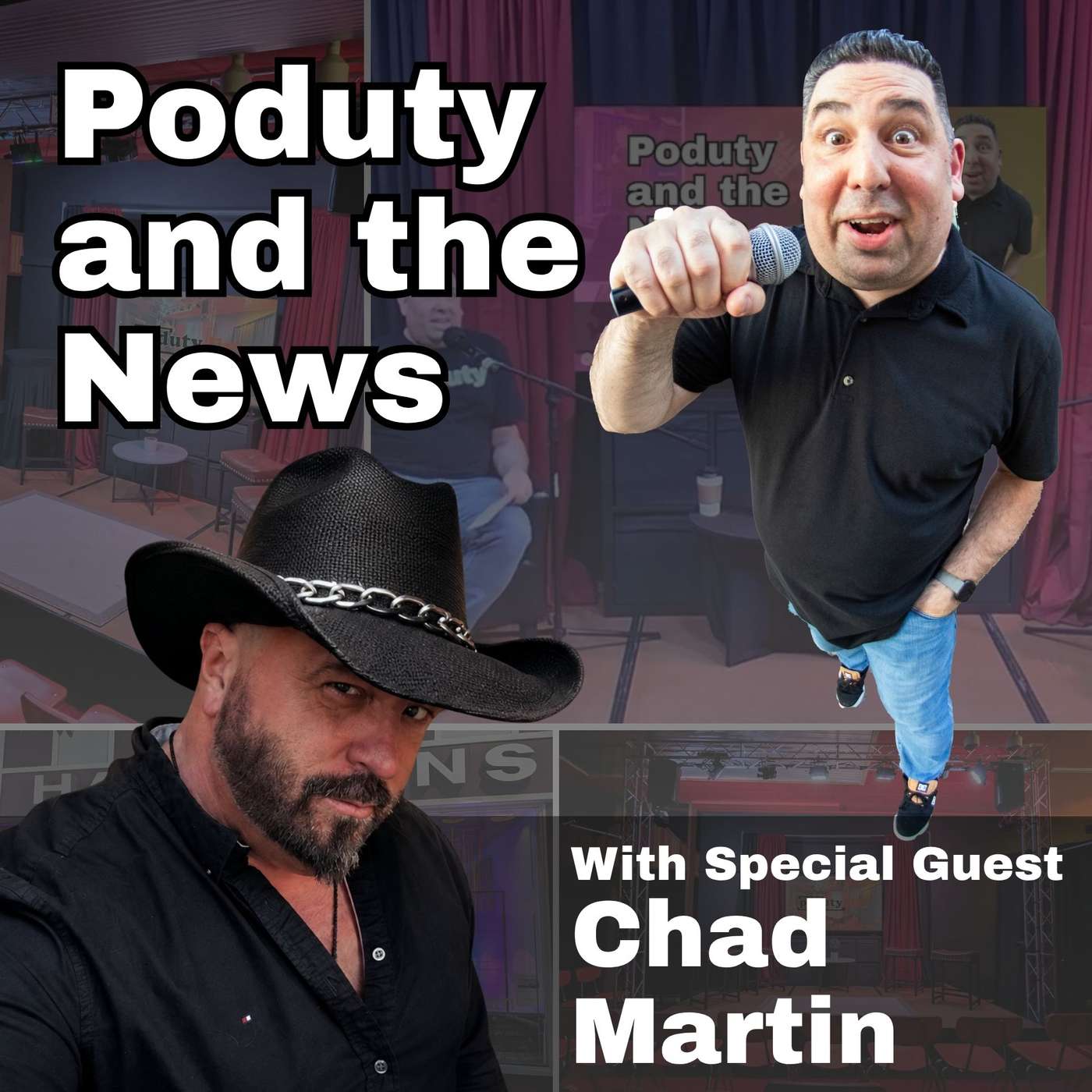
Poduty and the Podcast News! - The Only Live News Podcast about Live Podcasting! · Jeff Revilla | Podcast News & Live Podcast Trends
What happens when a professional wrestler, novelist, and podcast host joins the conversation about the future of live entertainment? On Poduty and the News, host Jeff Revilla welcomes Chad Martin for six stories exploring live performance, storytelling, audience connection, and the rise of video podcasting. Together, they look at what creators can learn from theater, music, comedy, true crime, and the changing media landscape. Chad Martin is the host of the FAFO Podcast, a former professional wrestler known as Big Daddy Storm, and the author of Hale County, his debut novel published in 2025 after fourteen years of persistence. Raised in Texas, Chad brings experience in community theater, fiction writing, and unscripted interviews to a lively conversation about what makes an audience care. Connect with Chad Martin at: https://chadrmartin.com/ Rogue Storm Media https://www.roguestormmedia.com/ Chapters in this Episode: (00:00) - Podcast News for October 13, 2026 (01:15) - Meet Our Guest Chad Martin (04:38) - Is Playing Live Still Worth It (08:05) - Live From Chapel Hill! The RISK! Podcast (11:35) - London's First Podcast Bar: A Great Idea or a Great Disappointment? (16:45) - Amy Poehler Takes Good Hang from the Podcast Studio to the Stage (21:30) - Lone Star Lore Brings Texas True Crime to a Live Audience (27:49) - Are Video Podcasts Replacing Traditional Television? (32:19) - Connect with Chad Martin and the FAFO Podcast! Stories Discussed 1. Is Playing Live Still Worth It? Source: Michael Whalen / Digital Music News (September 18, 2026) https://www.digitalmusicnews.com/2026/09/18/is-playing-live-still-worth-it/ Performing live can build connections, but travel, production, promotion, and unpaid labor add up. We explore when a live appearance is worth the investment and why artists need sustainable economics. 2. Live From Chapel Hill! — RISK! Podcast Source: RISK! (October 1, 2026) https://www.risk-show.com/podcast/live-from-chapel-hill-cre536 A newly released recording of a 2014 live storytelling show illustrates the staying power of personal stories and the unique connection between storytellers and audiences. 3. London's First Podcast Bar Source: Lotte Brundle / The Fence (September 8, 2026) https://thefence.substack.com/p/off-the-fence-londons-first-podcast A reporter visits a London venue advertised as a podcast bar but finds music, drinks, and no podcast recording during her visit. What makes a live podcast experience truly deliver? 4. Amy Poehler Brings Good Hang Podcast Live to Chicago Source: Damon R. Sheffield / Hoodline (September 16, 2026) https://hoodline.com/2026/09/amy-poehler-brings-good-hang-podcast-live-to-lakeview-s-vic-theatre/ Amy Poehler takes her conversational podcast to the Vic Theatre, raising questions about improvisation, audience participation, and how recorded shows become live entertainment. 5. Lone Star Lore Podcast to Record Live at Texas State Source: San Marcos Daily Record (October 4, 2026); event...
Jeff Revilla: Hey, everybody. Welcome to Poduty in the news for Tuesday, 10/13/2026. I've got an amazing, great guest joining. We're having some preshow witty banter. Having a good time. I've got Chad Martin from the FAFO Podcast, pro wrestler, author. We're gonna run through the gamut through these six stories. Chad, are you ready? Oh, do you know what time it is? Chad Martin: It's FAFO time, brother. Jeff Revilla: Oh, the only live news podcast about podcasting from the stage. It's Poduty in the News. We've got six live stories about people doing live podcasting all over the world, and I'm joined by a special guest, an amazing guy, somebody who I wouldn't wanna step in the ring with. It's Chad Chad Martin: Martin. What's up, guys? What's going on, Jeff? Jeff Revilla: Welcome. Welcome. Pro Wrestler and the FAFO Podcast, which I love. I was actually a guest on your podcast a while back. Yeah. It's a great conversation. You talk... Kinda digging into, you know, what's going on here? Why are you doing this? You know, what motivates you? I really enjoyed, you know, my time there being a guest. Tell us a little bit about the FAFO Podcast. Chad Martin: Dude, it's just a place where anybody and everybody could come talk, talk about how... Whatever you want, however you want. If you wanna cut loose with truly FAFO, you could do that. If you're more subdued, hey. You can do that too as long as you wanna have a conversation. I just allow everybody to come on there. I don't care what your point of view is. Left, right, center, outer space, inner space, just doesn't matter to me. As long as we can sit down and have a conversation, we're good. Jeff Revilla: I was was wondering which space I fell into in the... All spaces, buddy. All spaces, buddy. I was like... I was thinking of like a dipping sauce, a like KFC space, you know. Chad Martin: Well, depends on which sauce we're talking about. You're not wrong. Jeff Revilla: Like a little Chick fil A sauce. Chad Martin: A little little mustardy. Oh, you're not supposed to make me hungry. We still got... We got we got, like, quite a show ahead of us. Jeff Revilla: Well, Chad, also an author. Right? Tell us a little about the the books that you're writing and and and how people can find them. Chad Martin: Oh, dude. It's... I write all kinds of stuff. I've got I've got Black Ridge over here. That's science fiction. I've got Bodie Bagsley. It's more young adult. I've got Suicide of Mind, which is a whole different thing. If you're looking for psychological, just thrillers or horror, it's another one. But you can get them all at chadrmartin.com. I I love to write. I'm writing sequels now, so there's a lot going on. Jeff Revilla: Yeah. And and the last bit of element, which I really love, is the the pro wrestling background here. And we're talking about live performances and podcasting, but there's a lot of that crossover between, you know, performing the show for an audience, and you're doing that as a wrestler, as a part sport, part entertainment. Mhmm. And then you bring that to podcasting, and then we start talking about podcasting live. So you have this great background, great experience, the creative side with writing books, the performance side. So I think I think you're gonna give some great insights to to these six stories tonight. Chad Martin: I hope so. We'll we'll see how great my insight is when we get to it. Jeff Revilla: To be determined. Chad Martin: That's right. Exactly. Jeff Revilla: Part of the show and all my guests who come on the show get inducted into the Poduty and the crew, and you're gonna find Chad's links and bio over on the website at news.poduty.com. We'll link to the website to get the books, to learn more about the FAFO Podcast, and you'll be able to connect with Chad and and, you know, stay in contact over the years. And if Chad ever comes back, all all the shows will be updated on that page as well. Nice. Yeah. Chad Martin: I hope you'll have me back after tonight. I guess we're gonna see. Jeff Revilla: One one story at a time, they say. Chad Martin: That's it. Jeff Revilla: Are you ready for our stories? Chad Martin: Let's do it. Jeff Revilla: Am I ready to get my Chad Martin: glasses on? Jeff Revilla: We go. Well, this story comes to us from the artist expansion podcast, And they're asking the question, is performing live still worth the time, money, and effort? Musician Michael Whelan is challenging the idea that booking more shows automatically means building a successful career. He argues that artists need to consider everything from travel and promotion to venue costs, ticket sales, and their own time. In one example, an artist would need to sell 84 tickets at $45 each just to cover expenses and pay themselves. So the bigger question is whether live performances like this in the in the podcast theater, like wrestling shows, are those performances building a sustainable career or just keeping creators busy? And Chad, we've already mentioned some of your background, some of your history here. And have you ever questioned whether the time spent performing was worth all that effort? To prepare and prep and train and go live. You know, sometimes you have good nights, sometimes you don't. Mhmm. You ever had... You ever question, like, oh, why am I doing this? Every day of my existence Chad Martin: is a question. I mean, because truly, I mean, like when you're professional wrestling, like you said, you have to get ready. You have to train. That takes a whole lot. I mean, because you have to be dedicated to it. Then you have travel. And my travel is not thirty minutes up the road or ten minutes over here to this gig. It's usually hour and a half, two hours to the venue. Then you've gotta actually do the deed, which is... Takes all the effort in the world. It's insane how physical it is. And then you gotta drive back home. And he's... I wish I could get paid like what he's talking about. But usually, they're like, here's what you're gonna get paid. It's just a pittance, really. And is it is it for me worth it wrestling? No. Not even remotely. But I think music is a little different too, though. And maybe even doing what you're doing there, like having people in the studio and getting them live and introduce them to what you're doing. I think that could be huge. I think that could be a lot of fun, especially this around telling people stories. Jeff Revilla: And I think there's an aspect too that probably you focus on and I focus on a lot because this isn't... This theater space isn't a huge money making operation, but I do love podcasting. I do love performing in front of an audience. So, you know, sometimes we always get so focused on how much can this make? How can I turn a profit? But we also go back to the roots of why we started it. And for most podcasters, you know, making $20 for a night is good enough. It's what we wanna do, and we love doing it, and we love performing for our audience. And we'll do it for that rate sometimes. And, you know, while we get hung up on how much, you know, I'll tell you, I I work for free a lot of months in this theater. Chad Martin: It's the same with wrestling. You know, you're paying to get there. You're paying to eat and everything else. By the time you get home, if you didn't break even even, you're just hoping it was not too far in debt. Yeah. But you still love the thing you do. Jeff Revilla: Yeah. So, you know, you weigh those things. And if if it's something that you're passionate about and you wanna keep doing it, by all means, don't stop. You do it because you love it, do it for the right reasons and, you know, maybe somewhere down the road, you know, the the money will follow. But if it doesn't, it doesn't. Chad Martin: That's right. Jeff Revilla: So enjoy every day. Every day is a blessing. Well, speaking of blessings, this one's live from, I believe it's in North Carolina, Chapel Hill. It's the storytelling podcast Risk has released a classic live performance originally recorded at DSI Comedy Theater in Chapel Hill back in 2014. I chose this story because this is to show how long people have been doing live performance podcasting for, and we talk so much about how it's coming up and evolving. But here's an example from twelve years ago, and this episode featured three storytellers sharing deeply personal experiences ranging from complicated childhoods to the challenges of finding your place in the world. Risk has built its format around people sharing true stories in front of live audiences, often exploring difficult or uncomfortable subjects. More than a decade after the original performance, these stories are finding a new audience through podcasting, which I love. You know, you're a storyteller. You're a podcast host. And what makes the story powerful enough that that people would still wanna hear it twelve years later? Chad Martin: Well... And I and I think it's it's it's about the character that we're talking about within that story. Right? It's the people involved in it. And making that person has to be engaging. Like, the story, any story, whether it's books, podcasting, wrestling, the story has to be engaging. And that really centers on, first of all, the storyteller who's doing it. That sucker better be engaging. And then the subject you're talking about has to be engaging. But you can have a great storyteller and not have an engaging story, and that's one thing. But if you have a great story and a storyteller who's not engaging, that's gonna fail every single time. Jeff Revilla: Yeah. Again, this really comes back to that passion, that love of storytelling, getting behind there, getting into it, getting involved, and really just delivering everything you got. And if you got it, have fun. If it's a good story... And what a lot of people don't realize is a lot of these storytellers, they didn't just tell the story one time. It's almost like a comedian performing their act. They may have told that story 50 times in front of a live audience. And to get to a point where it's polished and rehearsed and the timing is right, all those things really go into what makes a great storytelling. Sometimes it's the practice and the repetition. Very rarely do you hear a story told right the first time and it's a classic. Even in performing for wrestling, you didn't just go on stage and entertain the crowd. It took a while. You had to work your way up. You had to be able to deliver that storyline. You had to be able to sell the action and the physicalness of of the event. And those things come through practice and repetition. And even though this happened twelve years ago, I'm sure some of them are still telling stories on stage. Chad Martin: I would imagine so because you're right. You you know, the more you do it, like with podcasting, the more we do this, the easier it gets because the more comfortable you are. Right? You know what's coming. You know how to do it. And with wrestling, it took me thirty years to learn how to do it, at least to get it perfected. And it's still not perfected, so every day I still do it. I still learn. Jeff Revilla: Yeah. It's the practice, the repetition, the learning. And and thirty years of experience is nothing to sneeze at. That's... You you have some skills now that you didn't have thirty years ago. 100%. And I I was looking at this story, and this next story, obviously, it's... I make a very easy case that I'm very bullish on live podcasting. Right? I've done some things that make you think that I'm... And I love this story because this was London's first podcast bar, which I love that, you know, somebody's taken the ambition. I love this business model. I love that somebody's trying it in London. The only problem was when the author showed up, there was no signs that there was a podcast bar. There was was no way you would know. And they've been promoting it and maybe it's it's in the works and something's coming up, but London has this new attraction calling itself the city's first podcast bar. But the one reporter discovered the experience didn't quite match the advertising. Chad Martin: Oh, no. Uh-oh. Jeff Revilla: Located beneath a falafel restaurant in the Leidenhall Market, the venue promises visitors a chance to grab a drink and join the conversation. But journalist, Lot Brundle, made multiple attempts to visit and when she finally got inside, a live... Found live music, a DJ and drinks, but no actual podcast recording during her visit. Completely opposite of this place. There's it's it's crickets, and then it's me up on the stage. There's no DJ. There's no music. There's no house band. And the owner explained that the podcast recordings typically involve invited guests. So they have a space dedicated for... It's not all time. It's not fully dedicated. But but this type of entertainment is making its way through mainstream, and and you've seen this over the years. How important is it to you to deliver an experience that people think they're coming to see? Right? You you bought a ticket for one thing and you got you got another... You got a different experience. Chad Martin: Well, it... Man, it happens, and that's the terrible thing about it. Like pro wrestling, you can put as many names as you want to on a poster. The bad thing is is that you have to deliver on those names. Right? Because what... If you don't, then people are gonna start looking at that poster and that company you're working for and going, oh, that's the company that lies. We're gonna tell you Jerry Lawler's coming, and we didn't get Jerry Lawler. We got Jerry Baller, and that's a totally different person. And now they don't trust you. Right? Because you you you don't have that trust. So if they go to this bar and then there's never any podcasting going on, well, then I'm not going to a podcasting bar because there's no podcasting at this bar. The drinks are great, and I listen to the band, but just tell me that. Right? And I think that's I think that's the biggest thing. I think these places can work. I think it's trying to find out how. What is the best what is the best way to present it? I don't know what that answer is, but I love I love the fact that you can do live podcasting with an audience. I just think it's awesome. Jeff Revilla: Yeah. And the effort's great. And I I completely understand, you know, that the bar probably had great intentions with opening this and thought like, okay, people love podcasting, people love drinking, they're gonna love drinking and listening to podcasts. And it's a hard ticket to sell it at a at a smaller level. We do see actors and comedians. We see them filling arenas, and we hear these million dollar contracts on Spotify. But when it comes to the smaller independent, it's a very tough ticket to sell still. People are still figuring it out. It's not a mainstream form of entertainment. So like this like this theater here that I'm in, like this podcast bar in London, we're probably a little bit early, but I also think this is a future. Chad kind of referenced it, like, this is the type of entertainment people are seeking. They're moving towards these these storytelling events, getting together with their their community. They're just hanging out, being together. Yeah. Bringing their dog... Bring the dog to the bar, and she can listen to a podcast. Chad Martin: Maybe we just need a dog podcast where the dogs talk, and we just sit over here and eat. See if it works. Jeff Revilla: So, yeah, I I love the story. I love the effort, and I just thought it was... Yeah. The story was kinda building off of the hype and the promotion, but they couldn't find it. Chad Martin: No. No. But I... And I think it's there, Jeff. I do. I think it's there. I believe it's go... I believe it's a great thing. And you may be right. Maybe we're just early to the party. But I think the party is gonna be there. Jeff Revilla: Yeah. That's why I like... How, you know, how long do I... I've been here two and a half years. Right? Yeah. You know, it's it's kinda creeping along, and I kinda have moments of genius where I feel... Mean, like, I can't believe I did this. I'm so smart. And then I have, like, a month of, like, what the heck am I doing? What an idiot would open a theater. And and so, you know, we have these like... This juxtaposition of, you know, good things that are happening and and coming down the road, but also like, it's a long road to get there. Chad Martin: For sure. Well, you know, most businesses take five years to to take off. Jeff Revilla: Yeah. Chad Martin: And it's just the truth of it. Jeff Revilla: Now you're convincing me to stick around. Chad Martin: I hope you do. Jeff Revilla: I'm only halfway there. That's Chad Martin: You're only halfway there, buddy. Yeah. Jeff Revilla: Well, let's keep it moving right along. We're going to Amy Puller. Speaking of somebody who can fill an arena, somebody who has kinda taken the podcast world by storm over the last year, Amy Puller took her... Or she has taken her Good Hang Podcast to Chicago's Vic Theater for a live performance in just a few days on October 18. Launched in March 2025, the interview podcast features conversations with comedians, actors, and creative personalities. The show has already experimented with live recordings, including an August performance in New York featuring surprise guests, improvisational comedy improvisational comedy, and music. Now Pooler is bringing her conversational format to another theater audience. And you think back some of your performances in the theater, the wrestling, and podcasting. You know, what changes when you take a conversation that's normally recorded privately and you perform it in front of an audience? Chad Martin: Well, I think it's, you know, it's it's it's a it's a weird thing too because, like, with Amy, she's so popular. People are gonna show up because it's her. It's kinda like our... When we were talking to that last question. But if you... If you're already a celebrity and you have a lot of people that are fans of you, they're going to show up to see what that's about. And she's a great storyteller when... If you've ever caught any of her shows, I mean, you know that. She's she's she's really good. But can can the people on our level do that? I think it's fun. I I believe the audience will go and have fun engaging because it's almost like going to a comedy store. Right? And it's sort of like the same thing. And I think what what you're doing here is a lot like that as well, have these live shows. I think it's doable. And I think there's a future in it. It's just getting people to realize that, hey. These lower level guys are just as good as storytellers as these upper tier people. Amy, I bet she'll be successful with me. I will be shocked if this show isn't sold out or at least close to it. Jeff Revilla: Yeah. I mean, tremendous talent. So Amy has a couple of things going for her. One, she built a career, had a great television career, now has this podcasting career. So as a comedian, as a performer, as an actress, is drawing from that experience already, built that up over time, now has this new asset with Podcasting. Mhmm. That's able to fill theater. So you're right. There's this... There's, like, almost two sides to this. Right? The the famous people who have the audience, who have the attention, who have the fans can can do this. They're already... Then they are doing it and proving it's a viable way to entertain people. The rest of us, we're trying to figure it out. Like, how do we do this at a smaller level? How do we do it for 20 people? You know, I I I tell most people the average ticket sales for independent podcast, it's about 20, 25. And at about $10 a ticket, you you end up walking out of this theater with a $100 in your pocket. And for 90% of podcasters, that's the first time their podcast has ever earned a dollar. It's probably the most money they've ever earned for their podcast, and they are excited. And if I could show more people that, like, you can do what Amy Pooler's doing and probably take a much bigger cut than she gets. She probably... You know, maybe she gets half of the house, but she has 10 for an agent, 10% for a manager, 10% for promotion, 10% for attorneys, 10% for ticketing fees if she use Live... Probably 20% if she use Live Nation. She's in the hole. Yeah. Yeah. Know? And she she gets a small percentage. But for smaller independent podcasters, like, if Chad and I were performing shows, you know, that $200 that we bring in, that's... We're taking a much higher percentage of that than than Amy would at at filling up a theater. Chad Martin: Yeah. Absolutely. I mean, I I I... Again, and I know we're beating this dead horse here, but I just think it's... When people discover that this is a thing, I think they like that because it was the same way with comedy stores. When comedy stores started popping up, people are like, oh, that's kinda weird. I mean, why is why is Jack Haney up here at a comedy store? What is this? And then all of sudden, they're like, oh, this is actually really cool. And then they start showing up. I do believe it's the same way here. The problem is most people give up way too soon. Even in just regular podcasting, how often do they quit? They're 10 shows in. They haven't made $12,000,000 yet. I got to go. I can't do this. Jeff Revilla: Alright. I feel like I feel like I feel like this show... I sched... You know, I scheduled this show to showcase your talents, but I think more more than anything, you're teaching me I need to stick around a little longer. Chad Martin: Well, I'm just saying, Jeff. I love what you're doing. Jeff Revilla: Well, you know, and I I try to match these stories to my guest talents, their experience, and this was Lone Star Lore, and you're in Texas. So I thought, okay, here's an author from Texas and here's a podcast telling stories about Texas. And this is a Texas history podcast that's inviting audiences to see how an episode comes together. Lone Star Lore will record a live episode at Texas State University on October 15, examining the 1976 murders connected to wealthy Fort Worth businessman, T Collins Davis. A lot of people in Texas have like a first initial first name. I like that. Chad Martin: I don't know why that is. Jeff Revilla: The event will feature criminal prosecutor Kirsta Melton and explore questions surrounding crime, wealth, and the justice system. This is a free event and it will also allow audience members to observe the podcast production process and potentially participate in the finished recording. You know, you're telling stories. You're from Texas. I just thought this was a great way to tie these two things together, your skill set, this podcast. And, you know, what's about... What is it about real life mysteries that make them so compelling... Make it such compelling material for storytelling? And especially ones that really go to history and and pull out those things that we may have experienced? Chad Martin: Well, first of all, because our lives are so boring that none of this stuff happens to us, right, most of the time. And we're glad of it. So we don't mind hearing other people going through it. It's like, oh, wow. That's crazy. Can you believe that? That's horrible. Thank god that wasn't me. But, well, that's awful. What a terrible thing. I'm more invested because I wanna know these things. And that's really the the truth about a lot of stuff like that is we are so happy it's not us. And we wanna know about, well, how did those people survive that or did they? And how did this all happen? And still thank god this wasn't us. And so I I think that just always draws people's attentions. Every time I do an episode on my show where it's about some kind of real life freaky thing, those always get better numbers than if I'm just talking about the weather that day and how the weather bank got it wrong again. They wanna know the crazy stuff. Let's talk about that. Because on a human level, we love misery, we love murder, we love mayhem, and we can't help it. Jeff Revilla: Like driving past the car crash scene. Yeah. You gotta look. You gotta see what happened. It's something that you haven't experienced, but, you know, you know, witnessing isn't so bad. You know, I I... You'd rather be on that side of the story, but these stories are fascinating that that this is like a one in a million thing that could have happened to somebody, and you're gonna hear the actual story. The... You know, sometimes you get that first person perspective. Mhmm. The prosecutor who was working on the case is gonna be there telling their side of the story. And you don't get that in your everyday conversation. You know, buying a pack of gum at the grocery store, you're not gonna hear about a a murder from 1976 from the prosecutor's mouth. You're gonna hear... You're gonna go to these events, enjoy them. You take them in and listen to... And it really is. Like, this is something I say. Like, this is how the sausage is made. You're you're going to see how a podcast comes together. And so many times, you're just listening to it in your car or on your morning commute or in a jog. You don't know what these podcasters look like. You don't know how they react in the moment. But when you see them live, everything about that podcast changes. You get... You see their facial expression. You see how they react to the crowd, how they react to their cohosts, how they how they treat other people. And all those things will really really show you, you know, how much you love that podcast and why you love it because you got to experience it firsthand live. Chad Martin: Yeah. You know, I I call this... It's it's it's almost like the Turning Point USA events. Right? Or any of these debates that go on these college campuses. Now people will go to these in droves regardless of what aisle they fall on. Like, it's the it's the... It's it's that whole process of being there amongst the circus. And you're... And a lot of these people in the audience are just riveted because they can't wait to see somebody get smoked on the microphone either one way or the other. Like, they're... That's what they want. They want that drama, and they wanna see it live. And I think that's kind of what we do as podcasters. When you can have an audience to talk to, like, some nights we'll do live stuff and have people in the studio here, and they're just back there rolling and laughing. They're like, oh my god. Did they just say that? And it's a great experience for everybody. They leave going, maybe sometimes a little bit more inebriated than when they came here, but they leave having the best time. Jeff Revilla: Yeah. There's just something about it. And until you experience live podcasting, until you're either there in the audience or part of a show, you just don't know. You you just think it's, oh, it's just like the podcast I listen to all the time. But it... There is so much more to it, like a live comedy event, like a rock concert. Like, there is an energy. There is a a a spirit of creativity that happens that you don't get anywhere else. So you only get in that moment at that podcast. That's a once in a life... Like, in the history of the world, that podcast that you're at that night, that's the only time in the history of the world that show will be performed. And it's such a special occasion. It's something that you can hold on to that you'll never experience again. Nobody will. But you were there, and you got to you got to be there in the audience and and take it all in. Chad Martin: Yeah. And how great would that be? We had a murder mystery on here two weeks ago. Well, we did... We help... We were solving the murder with the audience live on a Saturday night. And it was one of our best viewed shows because the audience was so interactive in the chat. Like, well, I don't think that's what happened here, and they're explaining it to us in the chat. And things like that is what make this fun. And I think, again, going back to what you're doing in these live podcast shows, I think there's something there for... That these audiences are gonna eventually gravitate towards. Jeff Revilla: And I think I I think I kinda know your answer to the last story tonight. I think it goes by so fast, but, you know, are video podcasts replacing traditional television? Are people starting to watch podcasts the same way they used to watch TV? A report from Colleges Times explores how video podcasts are becoming sophisticated, more cameras, professional lighting, studio sets that resemble traditional television productions. The article also highlights how short clips on TikTok, Instagram, and YouTube are helping viewers discover longer conversations. While video podcasts may not fully be replacing television, they're increasingly competing for the same audience attention. You know, you've mentioned going live. You just went live this past weekend. People are tuning in. This is a this is like... Think a form of entertainment that more and more people are catching on to. Chad Martin: Well well, they are because you know what? They trust the podcasters more than they do the TV show they're watching. I mean, they're they're no longer trusting the Hollywood writers to write the TV show they think they wanna watch and want to consume. They're just watching somebody else write what they want and not writing it for the audience. Right? And and that's... You know, people may or may not like that take, but it's it's the honest take because that's what it is now. Like, it's more about your politics, your point of view, or whether the sky is blue or green. Like, we don't we don't write for the people, and our our shows used to be about that. Like, we knew when we turned into the Twilight Zone, this is about to be some weird stuff. I don't know how weird. I don't know what we're doing, but I know what what this is gonna be. And now we're like, oh, the Twilight Zone is Barney? I didn't know this was supposed to be an episode of Barney. What are we doing? And so people don't trust that, but they can tune in these podcasts. They get to know the podcaster. And through them, the audience and the subject, they're going, that's what I wanna continue watching. That's why Joe Rogan is so huge. Theo Bond is becoming mega huge because they see the person. And Theo Bond wasn't that well known before. He was a comic, but he wasn't a household name. Theo Bond's becoming a household name because of his podcasting. Jeff Revilla: Absolutely. And and nothing's more authentic. Like, if you go to an event and you see Chad up on stage, you're getting Chad. Maybe, know, performance Chad Yep. But authentic Chad. Not written for... To please an executive or or to pass a board of of sensors or to to please a corporate sponsor who's buying, you know, a $10,000,000 ad for their detergent. Right. You're seeing Chad perform the show that Chad wants to perform, and that's why these smaller DIY shows are so important because it really is a true form of entertainment that isn't bastardized. It isn't, you know, sold off to the highest bidder. It's it's a real authentic conversation, a real authentic performance by the people on stage or the people in the audience. It's it's such a great even exchange at at this time in in in history where this is still a new form of entertainment. And if you find the right people doing the right things, it's it's magical. Chad Martin: It really is. I love it. I... There's nothing more fun to me than loading up a podcast and going, okay. Where is this one about to take us today? Like, I I love doing the interviews. I've never thought I'd be the interview guy where I was just doing a lot of interviews, but I truly love it because I learned so many new things about people that you would probably already make up your mind about just by seeing a picture of them. Alright. I know that. I know I've got a caveman base... Face and a caveman voice. It is what it is. But yet, if that's all you knew of me, you wouldn't know about all the other stuff. And podcast allow that window into this whole new human, which introduces what? Your audience to a whole new world, whole new aspect, and a whole new view on life that they probably never even thought of anymore. It's one of the brilliant things about what we do here. Jeff Revilla: Yeah. I do love it. I guess I do love it. I guess I'm sticking around a little bit longer. You could thank Chad Martin, FAFO Podcast Pro Wrestler author. One last thing we do before I go, I like to turn the floor over to you. You can plug, talk about anything you want. The floor is yours. Chad Martin: It... It's real easy, folks. If you enjoy podcasting and you enjoy just nonsense or podcasting because I don't I don't censor my stuff for full transparency here. The FAFO Podcast is a place for you. We just have conversations about whatever. And if you wanna be a guest on there, I would love to have you on here. Go to chadrmartin.com, and you can check out the author pages podcast is there. Or you can go to roguestormmedia.com, and you can get our new media company. It's there. It does all the podcasting, the writing, our radio stuff. Everything is there. And you could come and check it out. I answer any questions. And when I tell you it's full transparency, I don't hold anything back because I don't have time to. I just don't. So it's a great place for you as a audience just to come, chill, hang out. If got questions, we'll answer them. It's... And it's pretty much that easy. Because our thing is this, you don't let anybody tell you the life you should be living. You do that. Nobody controls your life. You do that. So be sure when you're watching podcasts, you're watching anything, reading anything, don't let that be your worldview. Your worldview is yours. You know what you wanna do, go for it. And that's how I look at everything, Jeff. Jeff Revilla: I love it. And I was I was saying to my wife, I've been... I'm having Chad. I was on his podcast. I said, probably one of the nicest guys I've met in podcasting so far. Like, we had such a good time on your show. Yeah. And just so genuine, so authentic. All the things that you talked about tonight, you could tell all from the heart, all things that you believe, all things that you're passionate about. So if you like what Chad said tonight, check out the FAFO Podcast. Check out the links in the show notes. Support Chad. Go ahead and, you know, hit him up. Hit him up on one of those. Please. See us. Follow him on everywhere you go. And I only have one more question for you before we wrap. Sure. Do you remember what time it was? Chad Martin: What? Which time? Which which time... What time was was?
More Poduty and the Podcast News! - The Only Live News Podcast about Live Podcasting! episodes →