
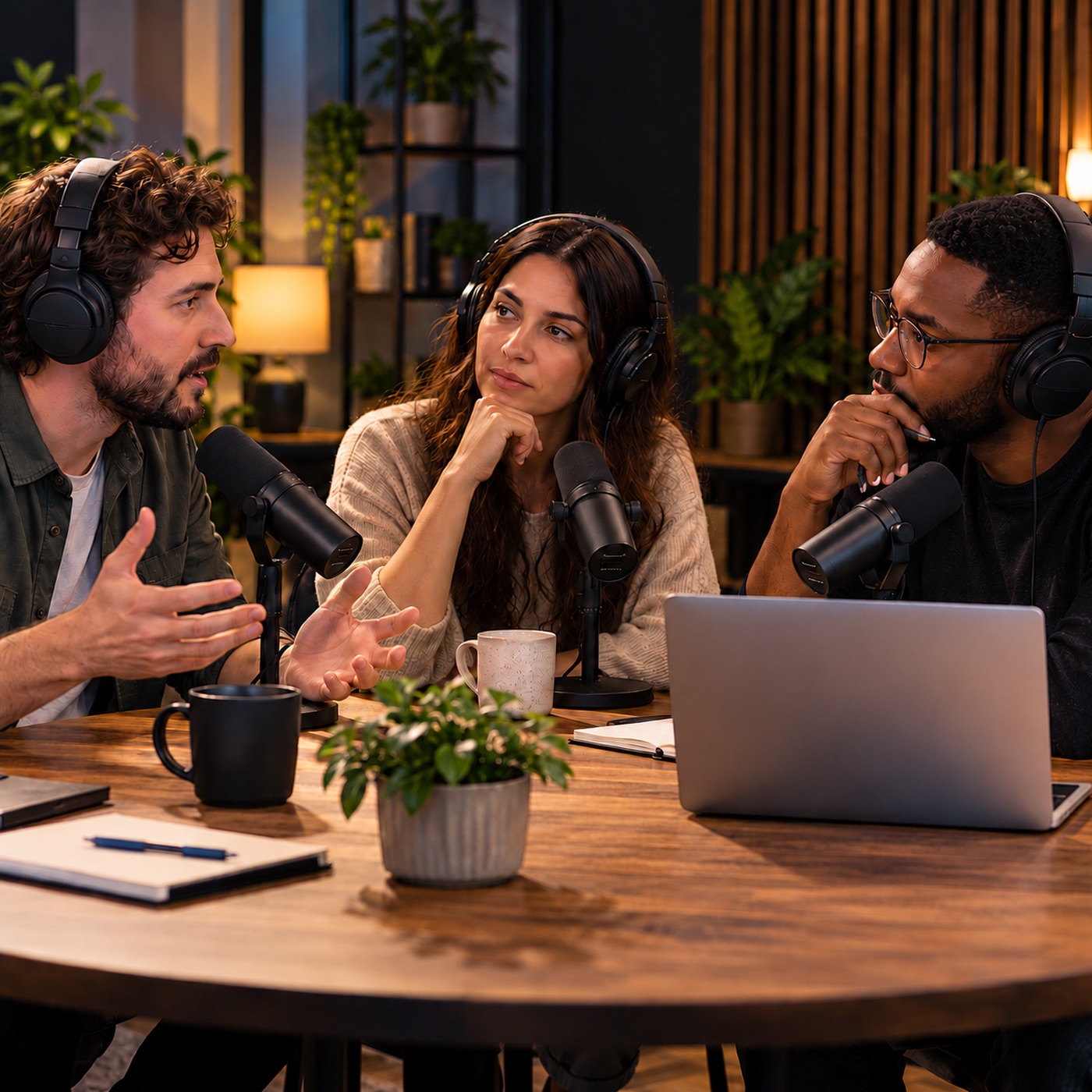
Podcast Insider · Mike Dell, MacKenzie Bennett, Dave Clements
In this episode of Podcast Insider, Mike Dell, Dave Clements and MacKenzie Bennett share how they’re currently using AI in podcast production—and where they think podcasters should draw the line. The conversation covers practical uses for AI, including creating transcripts, generating chapters, summarizing episodes, cleaning up audio, assisting with research and editing images. They also discuss why human review still matters, especially when AI-generated content can introduce errors, flatten a creator’s voice or make audiences question what they’re hearing and seeing. The team also gets into the bigger concerns surrounding AI in creative work: voice cloning, fully AI-generated podcasts, trust, privacy and the difference between using AI to enhance your work versus using it to replace the creative process altogether. Their takeaway is less about following a strict rule and more about being intentional. AI can be a useful assistant, but creators should still review the output, maintain their own voice and consider how their audience will perceive what they publish. The episode wraps up with a look at International Podcast Day on September 30, including its beginnings as National Podcast Day in 2014 and how it has grown into a worldwide celebration of podcasting, creators and the evolution of the medium. In this episode: How Mike, Dave and MacKenzie use AI in their own podcast workflows AI-generated show notes, chapters, transcripts and artwork Using AI for audio enhancement and media mastering Why creators should always review AI-generated output The difference between AI assistance and AI-generated content Voice cloning, authenticity and audience trust Why human creativity still matters in podcasting Using AI to enhance your work rather than simply cut corners The history and purpose of International Podcast Day There is not one universal answer to how much AI is too much. The better question may be whether the technology is helping you make a stronger podcast—or removing the human element that made the show worth listening to in the first place. Thanks for listening. Learn more and find additional podcasting resources at PodcastInsider.com, and visit the Blubrry Podcasting YouTube channel for more podcasting videos.
Speaker 0: Welcome to Podcast Insider. We're back with another great episode. We're gonna wing it. I'm Mike Dell, the VP of operations here at Blueberry. And, with me, I have Dave Clements Speaker 1: Hey. Hey. Speaker 0: And, Mackenzie Bennett. Speaker 2: Hello. Speaker 0: Yeah. And today, we're gonna talk about how much AI is too much AI in podcasting with the caveat, there really isn't any rules in podcasting. So we're gonna talk about our opinions and maybe best practices. Dave, I I'll give you the first shot here. What what's your opinion on how much AI to use or not use? Speaker 1: Is this the part where we just, like, end the episode real quick because I just upset everybody? Speaker 0: Don't use it. Speaker 1: Yeah. So for a long time, well, I guess when when AI became more accessible, I guess, commercially, I I thought it was the coolest stuff ever. And I could never figure out how I was gonna use it for any of my shows, other than just goofing off. And then we released Pie, a few years ago, and that is our podcast AI assistant that is still available to everybody. That kinda got me thinking about the way I personally would use AI. And so I've kind of gotten to the point where I prefer to use AI tools in, like, a post production sense. I like to have AI look through the transcript, and I will take that transcript because I will forget what I've said 90% of the time. And I go, okay. Summarize this for me. And then sometimes I use just that raw summary and throw it in my show notes. Or sometimes, like, I will clean it up so depending on the the show that I'm doing, it feels like the show. It doesn't just feel like, you know, a computer wrote it. But then one of my favorite things that I've discovered recently going back and actually reworking older episodes of a show is chapters. Sometimes, Py doesn't get the chapters right. And something like ChatGPT or specifically Claude will actually be able to go through your transcript and finds much better chapters than I've run into before. And so with the D and D podcast, I talk about all the time. Those are, like, hour plus episodes. And I honestly don't wanna go back and try and find all of those little chapter markers myself. So that those are kind of the the two big ways that I use it. And then the other thing that I I have been doing as of late is using, like, media mastering tools. I've been using the ones that we have with Auphonic. And I've also been dabbling with Adobe Podcasts. They have, like, an enhancement tool. And those are really nice because sometimes I don't have the time to really get in there and nitpick some of, like, the the loudness and normalization and some of those editing things. So that's typically for me personally, that's where I'm going to use AI tools. I am not a fan of using it for, like, artwork and things like that, because I have a design background. So that's my story. Speaker 0: Yeah. We use it a little bit on this show. Mackenzie, you're, you're the main user and abuser here. So what do you think about it? Speaker 2: I use Py. Yeah. So I use the AI tools that we have available for Blueberry whenever I publish this. I will use it for the artwork, the chapters, the title some of the time, and the transcript. I will use all of that, like, every single time I post the episode. The show notes itself is a combination of AI and me. That is I upload the transcript into AI. Typically, I have it write up something, and then I'll just go in and and tweak it. And I think part of the reason I do that is because right now, we've been, like, we've been posting episodes, like, that we recorded weeks to a month ahead of time, and I'm like, I don't remember what exactly happened here. Yeah. I don't remember the specifics at the by the time we're getting around to publishing it. So I'll use that to help me, and then I'll just, you know, go in and and tweak it however I see fit. But also at the same time, it knows my writing style pretty well, by now. So it that is something that AI can do is learn your your own tone and style and and whatnot and and give you responses in that manner. But, specifically, like, something else I was also thinking about is we've had tools for decades now that are being called AI, And we're in this I don't know. I feel like we're in this weird weird limbo of, like, people that are using Photoshop and Canva and uploading things to social media or, you know, Meta, TikTok, whatever, and it's being labeled as AI. And it's like, no. That's that's Photoshop. That's something that is, yes, was used with a tool, but also you have to be, you know, somewhat skilled in those plat like, in that software to do that. Like, it's it's getting to the point where these companies are labeling images as AI, and then they don't get sent out to audiences properly, and it's really affecting some people when it's you know? Speaker 0: Mhmm. Speaker 2: These automated things are showing up saying this is AI when it's like, I changed the color of an image in Canva. That's that's not great. So it's I I feel for the graphic designers right now. They are going through a lot. Anyone in social and marketing, it is it's a weird time because Speaker 1: For sure. Speaker 2: Some of this is, you know, things that we've been doing for years and years and years, and now it's just an automated slap on the wrist or, like, label that is incorrect. Like, don't punish me for using a tool. Like, if you use, like, the blemish tool on Instagram, it's, like, saying that's AI. Like, that's been around for ten years. Speaker 0: Mhmm. Speaker 2: Like, I get that it's technically AI, but it's I don't have the words for it right now. I just have the emotion. Yeah. It's like Speaker 1: there are good uses of AI, and then there are less good uses of AI, and then there are bad uses of AI. Speaker 0: I you know, the way I the way I look at it is, you know, I've got mixed feelings about it. It's just like you guys. You know, there's certain uses that I use, and but I'm also a little picky about writing. Mhmm. And not that I'm a particularly good writer or anything, but, what I'll generally do when I'm, say, writing show notes, I'll throw the transcript in and say, hey. You know, write up, you know, summary of this. And then I'll go in and reedit what the output was to make it sound like something that I would write. I do like the artwork, thing, and I'm and I'm a graphic art guy too. You know? I I worked in graphics for eighteen years. I wasn't particularly great at it, but I could make what the designer wanted and make it work, you know, in the real world. That was my skill. It wasn't really coming up with the design itself. But, you know, I'll use like, I just updated my personal show's artwork, and and I had a cartoon image in there. And, I thought, well, you know, let's replace the cartoon with that. Well, rather than me spending an hour in Photoshop, I threw it in the AI and said, hey. Replace the cartoon dude with this picture, and it did a really good job. So, you know, that's so using those kind of tools, I don't see as a bad thing. You know, the what people out there call AI slop is where the, you know, like I'm not calling out Inception Point. Well, yes. I Speaker 1: am. You are now. Speaker 0: Inception Point AI, you know, and they've chain they've rebranded because that became a bad word, apparently. So they've rebranded to something else. I don't know what it's called, but that is a 100% AI produced podcast. It's got AI characters, AI written. You know, there's very little human interaction. And, you know, if people listen to it, great. But, you know, it it sounds very AI Mhmm. For lack of a better way of putting it. You know, some things do work really well. And, you know, and if it gets the right information out and all that, you know, who are we to say don't do that? But like I said, I I I find good uses of it. The thing is is, you know, check the output. Don't just cut, paste, publish, you know, when it comes to, you know, anything written. You know? And I've experimented too. I I actually had, Eleven Labs. I had Eleven Labs clone my voice from a whole bunch of podcast episodes. And I produced one episode that was my AI doppelganger, and you could just tell, yeah, it sounded like me, but there was no human behind it. Speaker 1: I mean, it Speaker 0: was it was very flat. No feeling. No nothing like that. It and it is getting really good. I have to say, you know, pretty soon, we will not be able to tell the difference. But, as of right now, I don't I don't think it's ready for prime time. Speaker 1: No. And I I can't ever see myself getting to a point where I accept content like that as a consumer or as a creator. That that's a it's kind of a discussion that we have internally as a company. I think we keep reiterating over and over again. Like, the human voice is important to podcasting. It's what makes podcasting what it is. And I don't know. I just I can't I can't wrap my head around making things like that. And I personally and, you know, come at me. I don't care. I'm gonna use making in quotes, in that context because it's just frustrating, as somebody who has, like, everything that I know about podcasting and a large amount of what I know about design. And those are two huge things that are affecting, you know, my world, as far as AI goes. I have spent so much time learning everything that I know myself. Like, I am self taught. My my role here at Blueberry, largely self taught, and I have learned so much, over the years. And then I see, you know, people that wanna create whole podcast networks that are built on a 100% AI or like 95% AI or whatever. And I don't know. I just I can't wrap my head around it. It's not I don't think for me, I don't think it's a, oh, I'm elite because I'm a human and I can do this stuff. I just think that the output is so much more rewarding for you as a creator and for your audience if it hurts a little. Maybe that's not the way to say it, but that's how I'm gonna say it. Speaker 0: Yeah. No. I get it. The thing is is, you know, creative people wanna be creative. You enjoy the process of creating something rather than, oh, I gotta create this, hit a button that's created. Speaker 2: Well, there's no new ideas with AI. Right. And that's that's a big part of creativity is, yeah, you're gonna have your influences and things that you've already seen, but there is no comparing something from AI and something from someone's brain that has been conjuring this for, you know, decades. I don't know. There's also, like, the privacy part of AI, in podcasting. Like, Mike, the idea of someone, like, cloning my voice drives me up the wall. Yeah. Speaker 0: Yeah. Speaker 2: That's one of the reasons why I don't wanna do video is because my voice is already out there. I've been I was a DJ in college, and I've been doing a podcast since I for Blueberry since I graduated from college. My voice is out there. That's done for. My face, not so much. I feel like, Dave, you were very nice about it, but, like, there's there's a level of, just Speaker 0: Creepiness. Speaker 2: Yeah. It's creepy. It's not good, and, it just feels dystopian. Yeah. Speaker 0: Well, the you know, here's the thing. Just just remember, you cannot now you know, used to be in the age of just Photoshop. You couldn't trust a picture. Eyeballs in person. Speaker 2: Yeah. Speaker 0: And then maybe not. Speaker 1: Yeah. It takes a lot more critical thinking skills to Yeah. Do a lot of stuff lately. I mean, some of it is just blatantly, like, horrible, like, oh, wow. I can I can clearly tell that that's AI? Grandma, on the other hand, may not. Maybe my dad probably wouldn't. But, you know, being in in a in a tech based industry, I I would say, you know, the three of us, like, we can we see a lot of that stuff through our work, but also probably in our our free time when we're doom scrolling. And I don't know. I've become very sensitive to it, even to the point where when working on scripts for YouTube videos that that I'm doing, I'm having AI do a lot of research, and I'm like, you know, you have to give like, cite all of your sources. And then, like, it takes me a little bit longer to write those scripts, just because I do have to verify is the AI actually giving me good information to go off of? Because, yeah, I I have a pretty tight turnaround on on things, and I know that there are podcasts that do this. Like but I don't have time to go through and do a bunch of research for a six minute video. That's a lot of work. And so I do trust that a little bit, but then there's always double checking. And, Yeah. This I don't know. This seems off or I don't know. Like like you said, you you can't you can't trust it immediately. You have to you have to be very sensitive to it. Speaker 0: And and here's the other problem is as more and more AI content gets out there, more and more of that AI generated content is gonna be feeding the models. So even the wrong stuff, if you go verify it's you know, how would you verify something? You go, you know, go to a news website and look look for articles or whatever about whatever it is, and chances are that was written by a. Mhmm. So, you know, it's gonna just get worse, I think, you know, because now now you've got the AI feeding itself, and at some point, the bubble's gonna burst. But, you know, getting back to the topic of how much of it do you wanna use in your podcast, you know, whatever feels right to use, I guess, okay. But, you know, your audience is gonna pick out the, obviously, AI generated stuff Speaker 1: Yeah. Speaker 0: At least for now. Like I said, it's gonna get better, better or worse, I guess, at the same time. You know, I have no problem using it for what it's good at. And right now, what it's good at is, you know, making sure I'm capitalizing where I need to and putting the punctuation in the right spot and, you know, all the stuff I'm not particularly good at. And, you know, that kind of stuff and, you know, and editing a photo. Now I can edit a photo in Photoshop. I I still have that skill, but I'm not gonna do as good a job. I don't wanna create the photo from AI, but I want, you know, if I wanna edit a photo, I have no problem letting it do it. Haven't got to the point where I wanted to edit my audio or video. I kinda like to do that myself when I edit. Yeah. Again, you know, they'll get better. Speaker 1: Yeah. I I think that they're just, I don't know, it's such a fine line that you have to walk, not not even from a professional standpoint. Like, I am, you know while this is my opinion, I am technically speaking on behalf of the company, in a way. But it's just a very fine line that you have to walk because there are legitimately some tools that are, quote, unquote, AI, like McKinsey said, that we've been using because they are a better tool than what we have had access to. Or, you know, I I think Photoshop is always a big one, but you from an audio standpoint because I haven't really found any, AI video tools other than, like, clipping tools that are kind of worth the time. So you can, you know, send those over to me. But from an audio standpoint, they're like, sometimes my ears can't pick up on the tiny little frequencies and and gunk. Like, sometimes I will have a fan running in the background, and I can't get that out of there. I can run it through the Adobe podcast tool, sometimes media mastering, and it'll figure out what that frequency is and pull it straight out, and you'd never know. So that is totally worth it to me, but it's also not creating anything for me. It's just helping me do my job better. Speaker 2: I think there's, that part where you have to have the right intentions behind using AI. Enhancing something, making it better instead of cutting corners is probably the most important part. Speaker 0: Yeah. Like I say, you know, sometimes they're you know, you can see where people just cut and paste something out and don't really look at it. So, you know, just be careful with that. Speaker 1: Yeah. I mean, ultimately, your audience is gonna decide whether or not they're going to continue to be fans of what you're making. Yep. We see a big thing right now where, you know, AI generated menus. Those are some of the most horrific nightmare fuel things I have ever seen. And there are people that are just like, you know what? And I will just say, you know, not everybody's a great photographer. I am definitely not. But I still don't know that I want my my food to look like some of these AI posters. But there are people who are just like, well, if you're gonna cut corners on this, are you cutting corners on your food? Like, the it introduces doubt. Speaker 2: That's exactly what I think. Speaker 1: It introduces doubt. And for me, as a as a creative person, who wants to learn to do the hard things, even if I'm not good at them, I just don't wanna introduce doubt by throwing a bunch of AI at whatever it is I'm making. I would rather people go, hey, you know, you goofed up on this edit or, you know, you really don't draw that well. And I'm like, okay. Yeah. But I'm learning and I can fix it and and whatever. But, again, that's me. I just don't wanna introduce doubt. I want people to trust what I'm putting out there. Speaker 2: I'd rather the bad real version than the overly perfected robot version. I don't wanna live in a world of robots as as so many people do, apparently, in charge of all this. I don't. I really don't want everything to be done by robots. Speaker 1: You on the anti, dog robot thing? Did they freak you out? Because they do my wife. Speaker 2: I I don't even know if I've really thought about the dog robot thing, but, like, I want AI to be used to help solve real problems. You know what's not a real problem? Having a dog. Speaker 1: Yeah. That that's true. Speaker 0: But here's what's gonna happen, is if you're using too much AI in your podcast, your listeners, viewers, however you wanna put it, eventually are going to notice that. They may or may not like it, but I think the market is going to prove over time that the AI generated stuff is not what people want as much as a human. Speaker 1: Mhmm. Speaker 0: Not saying that, you know, that there's not a place for the AI stuff. We have one of our clients that writes a lot of articles for automotive. And what they're doing with the AI and in podcasting is they're, first off, labeling it right off the top. Say, this is a an article from this read by the AI, and we're putting it out in audio form so you don't have to sit there and read it. Speaker 1: But that's Speaker 0: what they're using it for, and that makes sense. They're not trying to pass it off as these are real, you know, real people talking about these things. No. They're reading articles. That's an awesome use of it in podcasting, I think. Yeah. Speaker 1: And, I mean, one thing we haven't touched on, and I I think it's it's a lot more complicated than I I so I can't really, like, fully speak to it. But you do have, like, the environmental impact of all of these data centers and and stuff like that. I live in Indiana, and, you know, Gary, Indiana was out of power for, I think about two weeks, if I'm not mistaken almost. But the data center that's not too terribly far from Gary was working just fine. So it's just, like, it's a little scary, you know. And and that's not to get into, like, politics or anything like that, but it is a real world thing that you have to consider, especially if we're all using AI tools, especially for silly things. You know. I'm tired of seeing AI generated memes. You know? So but, yeah, podcasting, I prefer it to to be a little bit of a helper. I don't need it to create any of my shows. That's kinda my final word on that. Speaker 0: Oh, this episode, when you're listening to it and when we put it out, International Podcast Day is, September 30. I believe this will be going out on that Monday. So a couple days from now is International Podcast Day, and I just wanted to touch on, you know, some of the history of that. Dave, what or Mackenzie, one of you, what do you know about how that all started? Speaker 2: Oh, we're, what, fifteen sixteen, 17? How many years? Speaker 0: I'm gonna guess, and I don't know, but I'm gonna guess it's been at least fifteen. Speaker 2: Yeah. I would say it's been fifteen years, that they've had International Podcast Day. But I Speaker 0: think the first year was called National Podcast Day, and then the rest of the world didn't didn't agree, so they changed it. Speaker 1: Right. 2014 was National Podcast Day. Speaker 0: Okay. Okay. Close. Speaker 1: I was just gonna say it was some sometime right after I started podcasting. Speaker 2: Steve and Dave Lee were, as far as I know, the the masterminds behind this. Speaker 0: Yep. No. Steve created it and with with his son, Dave. Speaker 2: And just as a way to acknowledge all of the work that goes into podcasting, the way that it has changed, all of the content that people are consuming on a day to day basis, just whatever we have done with it, whether it is the advancements in on the tech side of it, the the ways that it has helped people get their voices out there for whatever it is that they wanna talk about, kinda leveling the playing field a little bit for some stuff or, just, you know, trying to meet other podcasters. But it's I don't think they've done a live show for it in a number of years now. I think, '21 or '22 was maybe the last year for that, but it's it's a good day to just kinda consider, like, how far we've come. Speaker 0: Yeah. And, you know, when they were doing those live streams, they were, you know, doing thirty hours, you know, a thirty hour live stream, and it it was quite the production. But there are a lot of, lot of places and people and, you know, all around the world now that are doing a special livestream that day, you know, from, you know, their individual things. So, if we can come up with a list of events we can find, we'll throw that in the show notes over at podcastinsider.com. You know, we we used to participate in that. Mhmm. We'd always have an hour of of that thirty hour stream where Blueberry, you know, usually Todd or Mackenzie or I or all of us, would Yeah. You know, do something for International Podcast Day. But there are smaller little events going on. And and to prove the point, it's in, it's in the National Day calendar. So, of course, it's real and official. Speaker 1: Yeah. So if you wanna know more about International Podcast Day, you can just go to internationalpodcastday.com. We'll make sure that we link it in the episode show notes as well. Speaker 0: Yeah. So, anything to, wrap up either of the topics? Speaker 1: I don't think so. I I hope I I don't get nasty letters. Speaker 0: Yeah. Okay. Speaker 2: I'll take them. It's fine. Speaker 0: Yeah. I I actually enjoyed getting feedback. You know? Speaker 1: Hey. It's better than none. Speaker 0: Some some of the some of the best con conversations I've ever had was somebody that started out complaining at me. Speaker 2: Yeah. Speaker 0: So and if you have said negative or positive comments, of course, you can always reach us at [email protected], [email protected], or [email protected], spelled the weird way we spell it with no e's. Guess that's a podcast. Speaker 1: That does it. Speaker 2: Thanks, everyone. Speaker 0: Catch you next time.