
Play Comics · Chris Osborne
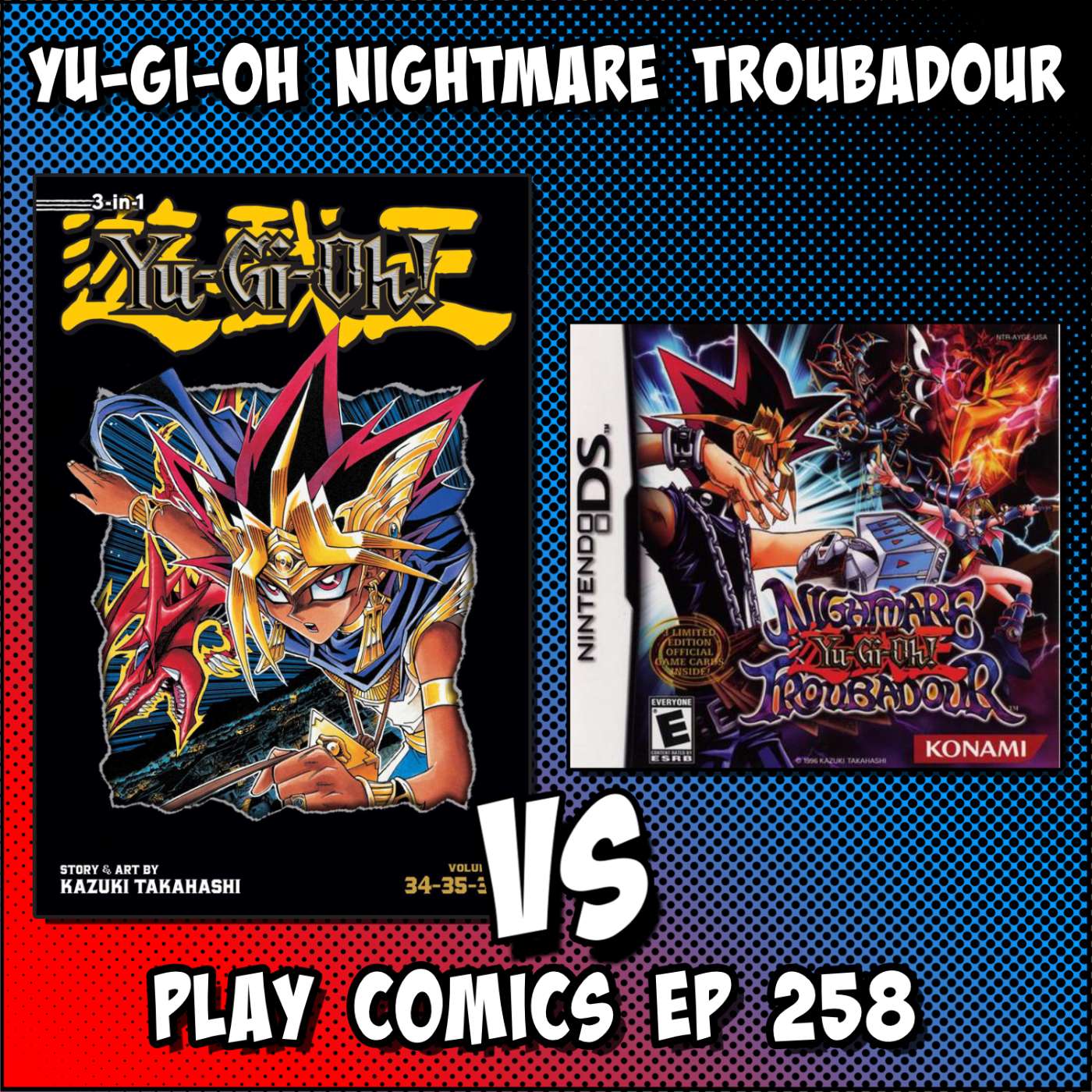
Read transcript Video game licensing runs on a very simple equation: if a popular franchise exists, and a handheld system exists, someone will eventually put a game together and slap on a release date. That’s probably the story behind Yu-Gi-Oh! Nightmare Troubadour, with Konami treating the whole affair with the enthusiasm of checking a box on an extremely profitable to-do list. It was the franchise’s first outing on the Nintendo DS, arriving with the confidence of a company that already knew the math worked. The pitch itself barely needed a pitch meeting: take the actual Duel Monsters card game, cram in over a thousand cards, and let the DS’s two screens do what a real card table always wished it could, which is render your monsters in flashy 3D up top while the actual decision-making, deck construction, knowing what a Trap Card does, happens down on the touchscreen below. The story loosely resets you into a remixed version of a Yu-Gi-Oh tournament arc, because apparently even a game that’s essentially “trading card simulator” still needed somebody to kidnap somebody, and wireless dueling and card trading rounded things out for anyone who wanted to bankrupt a friend without leaving the couch. Making the trip through Battle City with me is The Gaming Anthropologist, who’s been out in the field studying gaming culture the way some people study a subject that actually pays. So build your deck, set a face-down card of your own choosing, and let’s find out whether Nightmare Troubadour actually captured what made Duel Monsters worth dueling over, or whether “the license existed and so did the hardware” was doing all the heavy lifting. Learn such things as: Is Yu-Gi-Oo the Madden franchise of anime and manga based games? How hard is it to go play a game with a different set of rules than you’re used to? Are we setting a record for games where you don’t even play as any of the characters? And so much more! You can find The Gaming Anthropologist @the_gaming_anthropologist on Instagram and Threads, her Patron page, and of course her website The Gaming Anthropologist. If you want to be a guest on the show please check out the Be a A Guest on the Show page and let me know what you’re interested in. If you want to help support the show check out the Play Comics Patreon page or head over to the Support page if you want to go another route. You can also check out the Play Comics Merch Store. Play Comics is part of the Gonna Geek Network, which is a wonderful collection of geeky podcasts. Be sure to check out the other shows on Gonna Geek if you need more of a nerd fix. Play Comics is also part of Art Comedy Pop-Culture Network, which is a long-standing creative organization spawning from a love of Adult Swim. Be sure to check them out for all sorts of entertainment news, commentary, and just plain fun stuff. You can find Play Comics @playcomics.bsky.social on Bluesky, @playcomicspodcast on Threads, @playcomics on YouTube, or the Play Comics...
0:00I'm SP from Legends of SHIELD, a show about the general Marvel Comic Universe, part of the Guinea Geek Network, just like the show you're checking out now. Shows on the network are individually owned and opinions expressed may not reflect others. Find other hilarious and fun geeky shows at guineageeknetwork.com. Art, comedy, pop culture, and much more. You're listening to ACPN. And welcome to PlayComics, where once again we're looking at a video game based on a comic property and how well it represents that source material. And today, for like the 30th time over the last 2 weeks of games, it feels like— of real-world game releases anyway, because that is what Yu-Gi-Oh did to us. It's Yu-Gi-Oh! Because there's a lot of Yu-Gi-Oh! This time we're looking at Yu-Gi-Oh! Nightmare Troubadour, and naturally I can't do this by myself, so I have the Gaming Anthropologist here with me. How are you doing today?
1:39Hello! I'm very good, thank you.
1:42What was it that made you look at this list and say, ooh, ooh, ooh, I want to go talk about this Yu-Gi-Oh!
1:48game? Um, Nightmare Troubadour, for like, like specifically, um, It's not just my opinion, it's the opinion of other people as well, but it was basically the perfect DS game. It used the DS to its full potential, even though it was, you know, the first DS game made by Yu-Gi-Oh! for the system, and it had its charming little quirks, you know, but You could build your deck, um, the, the, the, uh, I— words are a thing. You could build your decks, collect cards, you could battle characters from the manga and the show. There was storylines, cinematics, like it was a huge, involved, very story-heavy game. And it really sucked you in. You felt like you were battling. It was really cool.
2:51That's one of the things that I found pretty interesting with this one is that it had a bunch of story in there that all makes sense in what I have been able to pick up from the Yu-Gi-Oh storyline. But it's also like, here's you, the player, who is not a character in the game presumably, but you get to go do all the things that a character in the game would be doing.
3:13That's— I personally, like myself, I love RPGs. I love games where I get to play the story and I'd be part of the story. So when that came out for the DS, like, no one had really seen something that complicated and invert— like, I want to say immersive, but that's not the word. Immersive. There you go. No one had ever seen anything so immersive. And just the graphics themselves, you know, you summon your cards and the battle takes place, and there's fire and sparks and music and stuff like that, and it was a lot more advanced than in the previous iterations of these games. So it was really exciting. I also want to add that this game came out after the anime had essentially finished, so it excited a lot of video game players to get into the card game because they either didn't realize there was a card game or they were seeking out more of, of that anime that they really loved. And they went and bought this game and it was so pleasing to them. It was such a good, um, experience that they, that they were just like, okay, where can I get more? And it essentially saved the card game. Part of, of that franchise because it, uh, encouraged players to seek out more.
4:44Were you playing the card game at the time?
4:45Um, I do want to say that I have very mild knowledge of the card game. Uh, I played the video games and I loved the anime, uh, a lot as a child, but my husband is the one who plays Yu-Gi-Oh! and, um, he's very competitive. So I'm, I'm essentially thrust into the world of Yu-Gi-Oh on a weekly basis.
5:09Cool. So me and you are on the same page with the card game then.
5:13Yeah.
5:13Mostly because I don't have anybody I know who plays it.
5:17Oh no. The, the, the addiction of the Yu-Gi-Oh game is something that I have been able to avoid.
5:23I grew up playing Magic and when my wife saw that there were other card games like it, she said, no, you've picked this one. You're sticking with it.
5:34Same.
5:35But it was more of a self-imposed ban on other card games.