
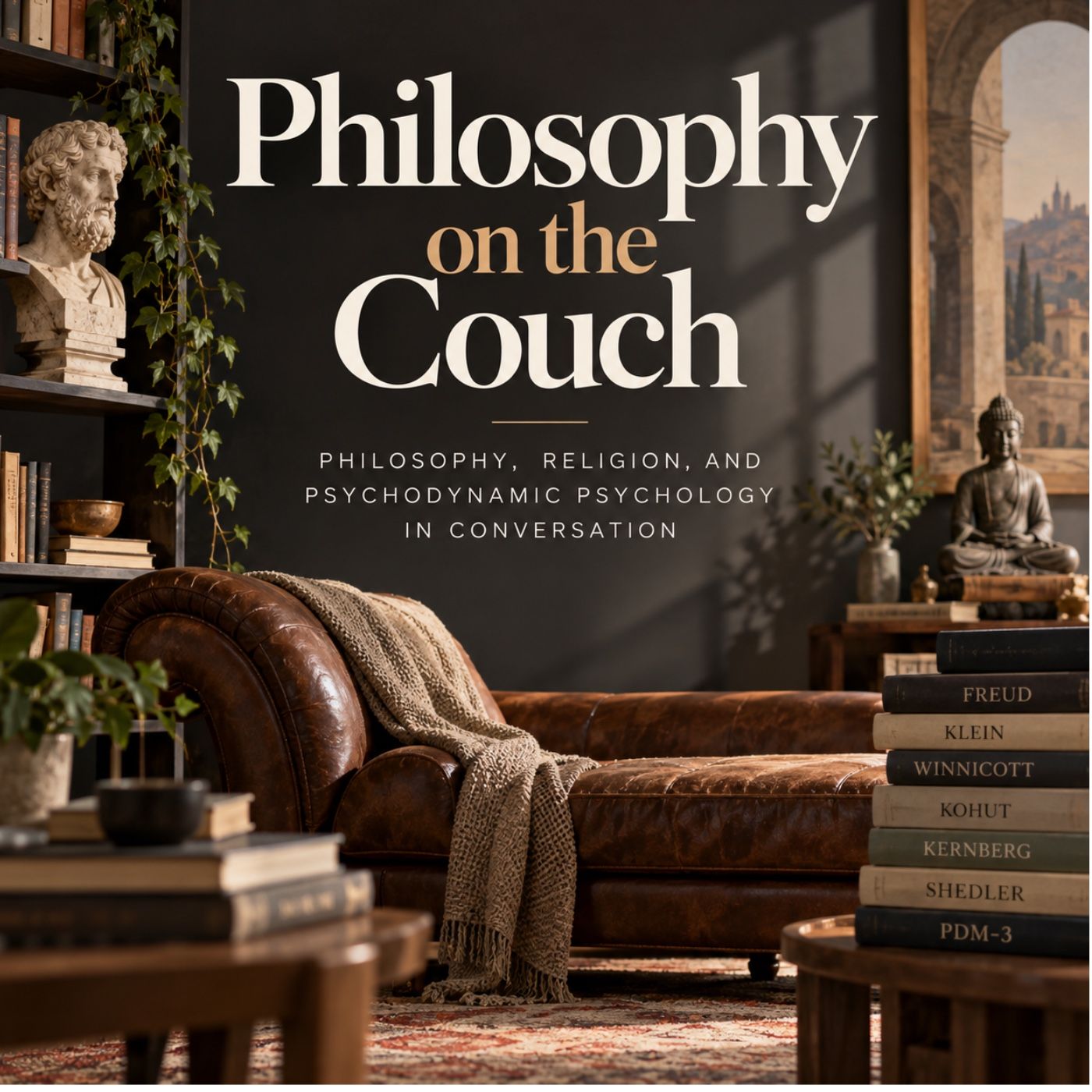
For thousands of years, philosophers and religious traditions have wrestled with the same questions that eventually entered the consulting room: Why do we suffer? Why do we repeat the same mistakes? What makes us jealous, resentful, anxious, ashamed, or afraid of abandonment? What is the self? What does it mean to love another person? And why is knowing how we ought to live rarely enough to make us live that way? Philosophy on the Couch brings philosophy, religion, and psychodynamic psychology into conversation. Each episode takes an idea from thinkers and traditions ranging from Stoicism,...
Thanksgiving is a holiday built around gratitude, but what happens when we feel obligated to appreciate people who have also disappointed or hurt us?...
Schopenhauer argued that a person can do what they want but cannot want what they want. That single line challenges the familiar belief that change is a...
Can a philosopher who died more than 2,300 years ago still teach us how to live well today? Classicist Edith Hall, author of Aristotle’s Way: How Ancient...
In 399 BCE, Socrates was sentenced to death by an Athenian jury after being convicted of impiety and corrupting the youth. Rather than escape imprisonment,...
What happens when personal conscience comes into conflict with political authority? The story of Thomas Becket, the Archbishop of Canterbury who challenged...
Why do people who pride themselves on being kind, fair, and decent sometimes treat others with shocking cruelty? Friedrich Nietzsche warned that high-minded...
What happens when we spend our adult lives longing for a parent who never truly existed? Søren Kierkegaard explored how despair emerges from the struggle to...
Søren Kierkegaard called anxiety the "dizziness of freedom," the vertigo that strikes when we realize we are responsible for authoring our own lives. Yet in...
Why can two people look at the same painting and discover entirely different meanings? Using Salvador Dalí’s surrealist art, this episode explores how...
Most of us imagine cruelty as something committed by people fundamentally different from ourselves. But Nietzsche and Freud both suspected that aggression,...
Why does desire sometimes become strongest precisely when something remains beyond our reach? Freud believed wanting was woven into the architecture of the...
Stoicism teaches that much of our suffering comes from trying to control what does not belong to us: other people’s opinions, behavior, judgments, and...
Examine the striking convergence between Jean-Paul Sartre’s concept of “bad faith” — the self-deception that denies personal freedom and responsibility — and...
In this episode of Philosophical Psychodynamics, we explore Marcus Aurelius’ concept of the Internal Citadel through a psychodynamic lens, examining how...
Explore the intersection of ancient Hellenistic philosophy and modern depth psychology. This episode deconstructs the pursuit of *ataraxia* using...
A high-level breakdown of Heraclitus’ philosophy applied to modern psychodynamic theory, exploring the fluid self, unconscious processes, and personality...
Showing the latest 20 of 65. Every episode is in the API: GET /v1/podcasts/pod_04tj0xsdhmaf3r1r4p3wcccjmh/episodes