
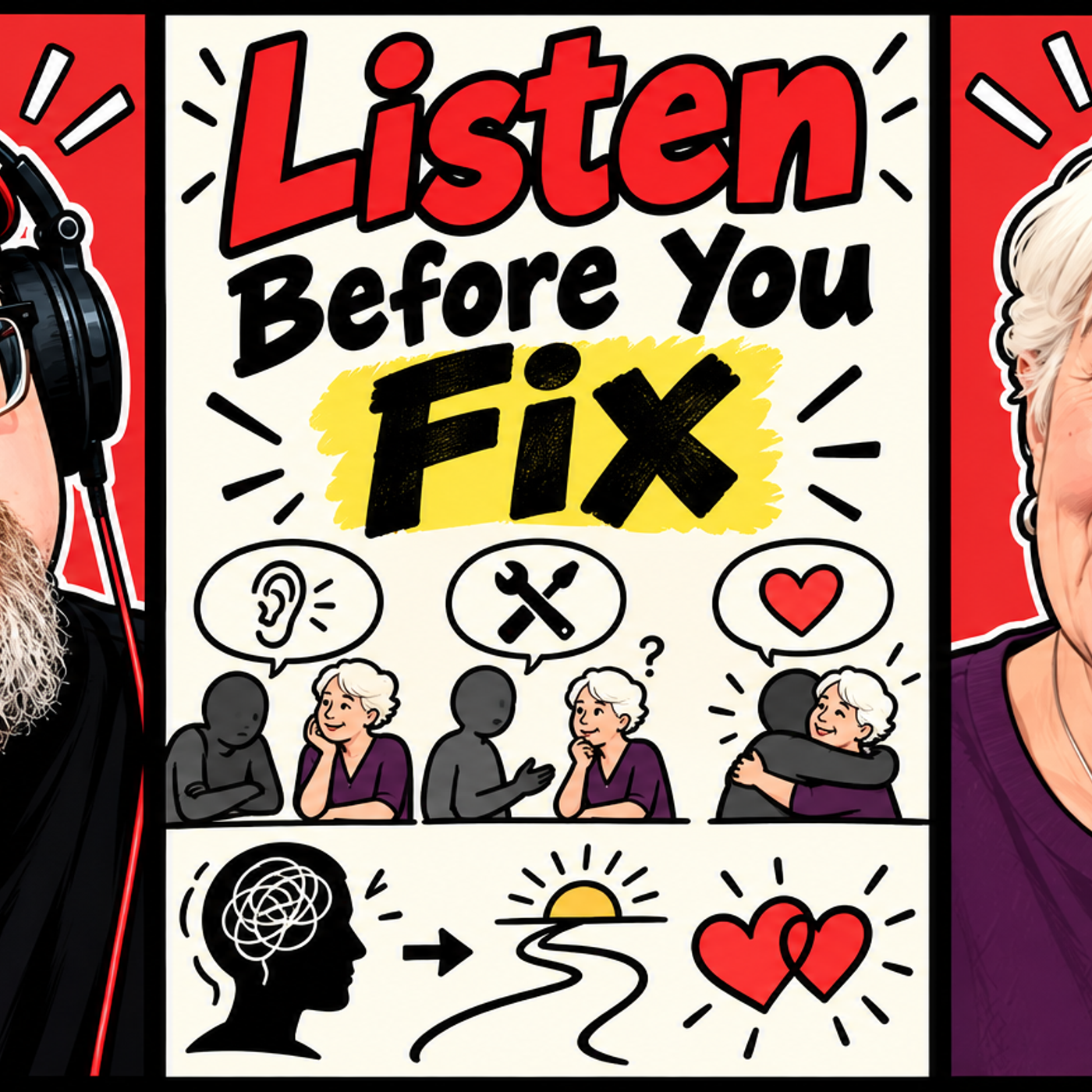
Pete Vs Anxiety!!!!! · Pete vs anxiety!!!!!
In this episode, Pete and Susan McKeown discuss the complexities of mental health, substance use, and the importance of communication in relationships. They explore self-care, the dynamics of marriage, and the need for understanding mental health issues within partnerships. In this conversation, Susan McKeown discusses her book 'Beyond the Tango' and explores the complexities of marriage, parenthood, and mental health. The dialogue emphasizes the importance of communication, understanding needs, and breaking the stigma surrounding mental health issues. Takeaways Self-care is essential Effective communication is key Marriage requires ongoing effort Communication is essential for relationships Chapters 00:00 Introduction to Mental Health and Substance Use 03:44 The Importance of Self-Care 09:07 Communication in Relationships 15:43 Navigating Marriage and Relationships 19:47 Addressing Mental Health in Relationships 22:10 Navigating the Roller Coaster of Marriage 24:26 The Journey of Parenthood 30:41 Communication: The Key to Relationships 36:14 Understanding Needs in Relationships 40:54 Breaking the Stigma of Mental Health "If you want to try it, go to or click the link, api.psychpal.ca/try?ref=pete susan website: beyondthefirstdance.com
Pete: Ever wish you had someone to talk to anytime, anywhere, matter what you're going through? Meet PsychPAL, your 24-7 AI companion, designed to help you process your thoughts, calm your mind, and keep you moving forward. Chat anytime during a panic attack on a restless night or just when you need to vent. Prefer talking instead of typing? Try voice journaling. PsychPAL listens, transcribes, and truly understands. You can even upload screenshots of tough conversations, and it'll help you unpack how they made you feel. PsychPAL keeps life organized, too. It can add appointments to your calendar, track your mood, and even summarize your sessions for your therapist so you'll never lose progress. Plus, built-in crisis resources are always just one click away. It's a privacy-first, constantly evolving, made to complement your professional care, not replace it. Ready to try it out? Head over to the link in this episode and use my code, Pete, at checkout to get 20 % off your first month subscription to PsychPAL. PsychPAL, because your mind deserves a companion too. There we go. I think that's the one I like. We got it. We got it. Boom. peter: but Pete: went to doing like pre-recordings. Well, Keith, we're at the part of the interview where I'm gonna ask you those two questions. All right, Amanda Landes: that I had been kind of like since head for a while about about writing the story because Mia Mason: you are not the only one that experiences thoughts, Pete "mental Health Champ": Well, Dr. Erica, before we start wrapping up, I'm going to ask you Pete: Hello, welcome to another exciting episode of Pete for Excited. Before we always get started, guys, you what to do. We got a shout out to our boys over there, PsychPal, guys. link will be in the description as always. You know, 20% off Pete Pete is the code for 20% off your first month at checkout, guys. With that being said, my guest today is has a bachelor's in nursing in North in Northeastern University's Pediatric Nurse Practitioner Program. She's certified and prevention specialist, educating and advocating issues of mental health and substance use. Please welcome the author of Beyond the first dance, a guide for couples to think beyond their wedding day, and beyond the tango, a guide to thrive thriving marriage while juggling careers, children and chaos. And one of the only Susan McNow is here. Susan, how are you doing today? Susan McKeown: I am doing great, Peter. Thank you. Yes. Pete: So S Susan, go ahead and let everybody know a little more about yourself and then we'll get into the conversation. Susan McKeown: Sure. I live up here in Manchester, New Hampshire with my husband of fifty-five years. We raised four children together and I'm blessed with two grandchildren. I spent my forty-one year career as a pediatric nurse practitioner. but then after I retired, I had the chance to go to grad school and get my MBA in creative writing, and that gave me the real chance to start focusing on writing and getting the books out. So it's been a joy. Pete: Yeah. Yeah. And I know you do a lot of workshops and stuff with your husband too. And I I've explored your website for a bit. It was really interesting. You have a lot to offer, which I really liked. And I was I was looking at even even have ones for substance abuse and things like which is interesting because that's a topic for a lot of people, you know, they don't know what to do in those situations. Susan McKeown: You are right, Peter. There's a tremendous amount of isolation that goes on with families that are suffering with a loved one with substance use. and we have experienced it in our own family. and so twenty-four years ago we started a a group here in Manchester for adults who have a loved one. And we met every Tuesday. and it's it's been been very rewarding. We've seen a lot of good things happen. but it it certainly is an epidemic that has plagued our country. And unfortunately we haven't really gotten rid of the stigma yet. And so families are sometimes still afraid to come out and talk about it. because unfortunately they think it's their fault. and it's it's not. It's not. It's a lot of genetics Pete: Yeah. Yeah, Susan McKeown: involved that they have no control over. Pete: you know, a lot of times too, mental health is the reason why they end up having these issues too, because they're trying to medicate something they're not sure about, you know, and it goes to the same thing being stigmatized as well. Like, you know, a lot of addicts, man, when they tell people they're an ex addict, people look at them weird. Me, I'm just curious, okay, cool. How long have you been sober? You know? Like I support Susan McKeown: Yeah. Pete: any way I can you know, and I Susan McKeown: Right. Pete: I know it's hard because it's like that elephant in the room. It's like you know they have a problem and then people treat them differently. And then it's it's just horrible. But at the same time, when people are experiencing it, they're like, well, they're trying to force them to go do something. It's like you can't force them to do something they don't want to do, unfortunately. I know this is the hardest thing to tell you is that you just got to watch them self destruct until they're ready for that. You know, and it's it's it's a hard thing to tell people, but you know, you can't help somebody that doesn't want help, you know, Susan. And you you would know, especially since you've had it happen in your own family too. Susan McKeown: Well, you just be there for them and support Pete: Mm-hmm. Susan McKeown: them. And and that's terribly important. And know the resources, okay? so that they're able to offer them when when willing to accept them. but taking care of yourself, and this is a lot of what I get into in my workshops, both with substances and with relationships and marriage, is taking care of yourself. we're a pretty self-care deprived society. Pete: Mm-hmm. Yep. Susan McKeown: We put ourselves, we don't mean to, but we put ourselves on the bottom of the list. And I would say Pete: Yeah, yeah. Susan McKeown: women particularly are very guilty of this. caregivers, you take care of everybody else. in even without substance issues, it just it seems to work out that way. That you're you're taking care of other people, your children to begin with, your spouse, your coworkers, your neighbors, your church friends, your community. And you'd take care of yourself if there were more hours in the day, but you just don't seem to get to it. And self care is tremendously important for every relationship that you have. Pete: Yeah, 100% correct. Yeah, for sure. You know, it's always the mom role or whoever's playing that role that always worries about everybody else, but not themselves. And you know, you have to remind them, you know, if you're not you're not okay, you're not good for anybody else. Like you want to help everybody, but if you're not in a great state of mind, it's not going to be helpful to anybody else around you. You know, I think sa self care is definitely something people need to advocate more for. Like take some time to do something they enjoy. You know, everybody's always worried about. you know, everybody else. Well then when it comes worrying about yourself, we are we're terrible at taking care of ourselves. Like you can be great to your partner, take care of them really well. But then when it comes to you, you're just like, Well just keep putting that off or whatever. But you know, it it needs to stop though because, you know, if if you're not good, though, you know, it's just you like I said, it doesn't work out well for anybody. Susan McKeown: The well runs dry if you don't Pete: Mm. Susan McKeown: if you don't don't feed it. And I have a a diagram in one of my books about burnout. And you know what happens is you Pete: very good topic. Susan McKeown: you give, give, give, and then what happens? You get exhausted. And then when we get tired, we get resentful, we get angry. And Pete: Mm-hmm. Susan McKeown: then if you're a good person, you start to feel guilty about feeling angry and resentful. So how do you assuage that guilt? You Give, give, give, give, give. And it's a cycle that that happens. And at some point you have to decide to break that cycle. And you start with just taking even an hour, hour a week. It should be an hour a day, but an hour a week to begin with, just for yourself. Okay, whether it's to go sit down and and read a book, go out for a walk, which is wonderful therapy in nature Pete: Mm-hmm. Susan McKeown: for a walk, but do something for yourself. And what that does is it just peps you up more and then to do something for your partner. and that will help you also. And what happens is you get a sense of self esteem and self satisfaction and it gives you more energy. And that energy can go right out and back into the universe again, into the people that Pete: Mm-hmm. Susan McKeown: you love. But you've got to get out of that burnout cycle and get into a renewal cycle. Pete: Yeah, definitely. Burnout is a very interesting topic. We've covered it a few times on this show. I myself experienced it at my last job I was at. I was burnt out completely. I was done. I was angry about it. Ever the slightest things would set you off, you know, and and things like that too. And it was because I was trying to do so much, you know, and it was hard because I kept juggling a lot of stuff, you know, and then I kept adding more to the plate. And then the well ran beyond Susan McKeown: Yeah. Pete: dry, man. We were we were desert dry. Because my own b the the funny part though is my own boss. Had said to somebody, well, I know, you know, he's he's burnt out. Okay, so if you knew that, then what actions are you taking? Hers, nothing. Susan McKeown: Yeah. Pete: Didn't do anything to solve the problem when you knew the issue was there because you know I'm trying to do so much. I I managed to accomplish a lot of things, you know, but it it just feels like they like to throw that word. well, we he's burnt out. Okay, cool. So what are you doing about that problem? I know Brandon from the Breakfast Express, I can't remember. I think that's what his podcast the morning, morning breakfast something, he was. He has a burnout podcaster. He was talking about that where he went and talked to some of these top 500 companies and he told them, he said, Listen, I'm gonna tell you right now that he listed like, what do you say? One, two, three, he said, he told three of them, he's like, I told three of them that if they don't change the way they're gonna be, they're not gonna exist here in 10 years because they're gonna burn out all their employees. You know, think about Amazon work, how fast they turn over people. It's it's crazy. You know, and then when people Susan McKeown: Mm-hmm. Mm-hmm. Pete: people don't realize that when you look at the turnover rate. It's like, okay, but why did they leave though? That's the question you have to ask these people. Okay, so why did you leave your last job? What happened? You know, Susan McKeown: Absolutely. Yep. Pete: and get ready for the answer to be that, you know, maybe they're just too much. They weren't they just weren't they weren't overwhelmed and you know, and then and stop judging people when they say that because they they could be. You don't know. You've never you've never worked there, if you've never been there, you don't know what's going on there. Susan McKeown: You never know what's going on in someone's life. And and life at home Pete: Exactly. Susan McKeown: has a big influence on how life is at work and everywhere else. And so that's a lot of what I address in my book, because I think my purpose is increase your harmony at home so you can have more harmony in all the other aspects of your life. And your relationships won't just survive, they'll thrive if you. Pete: Yep. Susan McKeown: work to get good harmony at home with your primary person in your life makes a huge difference. And I think we've all experienced this. When things aren't going well, we're we're irritated the minute we walk into work because of what we just left at home. And it's not going well. And so if we can Pete: Yeah. Very good point. Susan McKeown: if we can put our emphasis on that primary relationship, it's amazing how it can free up energy for all the other areas of your life. Pete: Definitely. So Susan, let's get into the book. Beyond the First Dance, A Guide for Couples to Think Beyond Their Wedding Day. So how did you come up with this book? Like what was that moment you decided that, you know what, I want to write a book? I know you got the the degree in writing, creative writing and everything like that. So was that what led to the book? Or was there a moment where you're like, you know what, I I might as well write a book about this and help other people? Susan McKeown: Well, it came from a lot of places. Actually, I had wanted to write a book about marriage forever. As a matter of fact, I told my husband that on our wedding night. He goes, please don't base it on tonight. It will be a short story. Pete: that's awesome. Susan McKeown: I said, okay. But anyway, it's a topic that always interested me. Relationships, human relationships always interested me. And as a nurse practitioner, I I dealt with families all the time for Pete: Yeah. Susan McKeown: fing years. So I really could see the impact of of how marriage affects families, individuals, and particularly children that I was working Pete: Mm-hmm. Susan McKeown: with. Then Patrick and I began speaking with engaged couples, and you'd have a room of you know, 30 to 40 couples sitting there, all optimistic, just excited and passionate and looking forward to their life, which is just what I want them to do. And then knowing in my head that the statistics Pete: Mm. Susan McKeown: were saying, yeah, between 41 and 50% of you are gonna get divorced, I thought this is that's awful. We can do better than that. Pete: That is that is really bad. Susan McKeown: In our own extended family, I witnessed personally six divorces. That affected 12 adults and 14 of my nieces and nephews. Wow, that's a lot to witness. These are people that were part of your life that you cared about, and all of a sudden it's dissolved and they're gone. It's just a a terrible thing to witness. So between those two experiences, Peter, the engaged couples groups and my own personal extended family, I thought, really, we we can do better. There's a lot of research out there, and so grad school allowed me the chance to just delve into it and I would read two to three books a month. I would listen to every podcast. I just have a library full of books on relationship. And so that's what I really have focused in on. And I love it. I love it. And there's an awful lot of evidence out there on what makes a good marriage and a strong marriage and one that thrives. So that's what I want to share with people. Who don't have the time to listen or read. Pete: Yeah, definitely. You know, I think communication's a big one for them too. A lot of them don't know how to communicate. You know, I'm sure you run into that one a lot with these guys. All we're all excited, but then okay, so how's your communication? And then it's like nobody has anything to say after that point because they already know that's one of the main issues. They all don't they don't know how to talk to each other. You know, in in in my last conversation, verbiage f applies to this too, the way the things that you're saying to each other, the words you're using, a lot of that stuff makes makes and breaks the conversation. Because you know, and your tone of voice as well, you know, you you don't want to disrespect your partner, but at the same time you wanna make sure they felt heard because if they're not being heard, then they're gonna they're not gonna stay. Because why stay if someone's not gonna listen to your concerns? Susan McKeown: Yeah. Communication is the overarching as well as the foundation of good Pete: Right. Susan McKeown: good relationships that really surrounds it. because you know your major issues in a relationship are money, sex, religion, in-laws, career, careers, working, raising children, and household chores. Those are the main areas of conflict in relationships. But above those and underneath them is communication. So how are you going to address these issues? They're going to arise in pretty much any relationship. These things are going to come up at some point or another. And so knowing how to talk about it and listen, Pete: Uh-huh. Susan McKeown: learning how to listen. Listening's hard because a lot of times we spend our energy thinking up our defense. You know, you're you're saying Pete: Yeah, exactly. Susan McKeown: this, but but I'm going to tell you about how I feel about this. And I'm not really listening. And that's what we need to do is is listen to our partners' feelings. Feelings. Pete: That key word, feelings, you're Susan McKeown: What's going on? Pete: right. The key word in that sentence. Feelings, Susan McKeown: Yeah. Pete: everyone. Susan McKeown: Yeah. And and how do I feel and can I express it? And that's I think one of the most basic things in any relationship. It starts like everything, it starts with us. Know who you are. Pete: Mm-hmm. Susan McKeown: Know what you need and know how to ask for it. Not demand it, nag it, ask for it. I was thinking, you know, that really I put a lot of thought in lately. I've been irritable. And I was trying to figure out why. And I just decided that sometimes I just get so tired because I feel like I I'm doing a lot of stuff around here. And I'm just hoping that maybe we could talk a little bit more about how we could spread some things out here. And then I wouldn't be so crabby and naggy with you either. Does that sound reasonable? Pete: Yeah, you know, but that's not how the conversation ends, usually, because usually one part will just start this. I'm not doing chores. You know, you see these posts on the internet where these guys are like, Well, I'm not doing my wife, they I want this. That's cool. Did you define these things when you got married that this is what roles you all were gonna play? I mean, that to me it's just like it's great, but then you send the wrong message to the younger generation that this is how things are supposed to go. No, you do it the way it works best for your situation, you know, and I and like I said, Susan McKeown: There you go. There you go. Pete: You know what I mean? Because like communication between me and my ex-wife, we we communicated up to the point where we we agreed that it just wasn't working out for the two of us, you know, and we agreed to that. Like we'd have open conversations about everything. We just didn't see eye to eye on certain things and that's all. And we just agree we couldn't come to a co come to a balance where it worked for both of us. So we're like, you know, instead of ruining each other's lives and making each other miserable, we're just gonna go our own separate ways and you know, just be done with it. Anybody? Susan McKeown: Mm-hmm. Mm-hmm. Pete: You and if somebody has it just it just didn't work out. I don't I don't have to sit there and bash him. Cause I watch my parents do that all the time. Like my mom used to just say hateful things about my dad, and my dad's just like, I Susan McKeown: Mm-hmm. Pete: don't want nothing to do that shit, you know. And it's like it was always interesting because when you get the two of them in the same room, it's like the tension is thick, and you're like, and it's not from him, it's usually her because my mom was very confrontational, you know, and things like that too. But at the same time, you know, like all those other conversations, sex comes up a lot of times, and it's like, Well, that's what I'm I'm lacking, so I'm gonna cheat. I'm like that, but that's not the foundation of this thing, man. You need to learn how to communicate your needs, you know? Like Susan McKeown: Mm-hmm. Pete: like be reasonable. Don't be don't be like don't go sociopathic level where you're like asking for un and unachievable things. That's crazy. Like, come on now, you know? You'll get those type of people too that set up those arguments. And their their need and their their want is so high for some reason, they just have unbelievable expectation. Either they were implanted these as a kid. Or they just decide that they're watching so they've seen something where they decide that's what they want too, and then it's just like that's where things start crumbling. Susan McKeown: Mm-hmm. And you're right. And what we observe in the marriage of our parents has a big influence on us. It can be positive and it it can be negative, but if you can take from the negativity and learn from it, it can be very Pete: Exactly. Susan McKeown: helpful. And as a prevention person, one of the things that I I really advocate is spend the time dating. Okay. Dating. Pete: Mm-hmm. Susan McKeown: And you know, I'm not a big fan of moving in together right away because Really, until there's like a real commitment and you know what it's all about, you should just have lots of experiences in many different settings with lots of different people and watch how your partner responds. You know, Pete: Yeah. Susan McKeown: are they are they sensitive to people who have less than they do? what's their political leanings, their religious leanings? What's their attitude towards children? Pete: And it's all good questions too. All really good questions. Susan McKeown: And these things are going to come up. So if you can Pete: Mm-hmm. Susan McKeown: learn them ahead of time, what you're doing is increasing your chances of of success. And you know what? It's okay if you get to a point where you think, you know what, this really isn't working out. We're not jiving. We're not on the same wavelength. Pete: Mm-hmm. Susan McKeown: Then you call it off before you've made the commitment to marry. And so it's Pete: Yeah. Susan McKeown: important to do a lot of homework, you know, with the car industry. They say, kick the tires. Yeah. Kick the tires. You do a lot more research into buying a car than some of us do in our marriage, preparing Pete: Yeah. Susan McKeown: for our marriage. What are we supposed to be thinking about? That's the stuff that I really try to address. Pete: You know, and let's let's take it to the next level. Say they have a mental health disorder, you know, like BPD. BPD is a really interesting one because they tend to switch emotions so fast. I I I dated a girl that had BPT, and I was a very eye-opening experience because I it was a lot of listening. You know, that keyword in the sentence, you know, in one episode we did one in this other other doctor talking about listen. We just tell them just listen. You have to listen to them because you also have to remember now. That they take your words serious and run with them. So you have to be careful what you're saying to them. So you have to really think this out. You can't just spout random things out to these individuals, you know. And same thing people did with bipolar and any anything else you put in there, it it increasesly goes back to the conversation piece, you know, learning learning how to communicate. Because with them, they don't communicate in the same way like you know, average people would. So now you have another elemental layer in there that you really need to do your research on, you know. And I did one before we even started dating, we were talking, I did a lot of research. I actually had the the world-renowned Dr. Jen Bellinger who actually specializes in BBD come on, you know, and things like that too. So I learned a lot that I got a lot of information from her. I told her, you know, I had I got in a relationship with a person in this situation. She was like, Well, have a great community that helps partners. That way you could be the better person. But you know, once again, the key word is you have to do your research, like you know, Susan and I were saying, you know, she's gotta kick the tires because you need to understand what you're getting into with these other individuals as you add that layer in too, because Now you're not only dealing with that, you're dealing with whatever possibilities of what could come up. And you know, you have to be very understanding that sometimes some of these guys, their emotions they can't control because they're overwhelming. You know, in like BPDs situations, theirs goes from zero to a thousand, and then you could be the worst person the next day. They don't like that one, but that's just how it goes, you know. But you have to, you know, you have to do, like I said, do the research. Again, we repeat the same thing. Just listen and do your research because they'll teach you more than you realize that you'll learn. Susan McKeown: Yep. And as big a proponent as I am of strengthening marriages, I also have in the introduction to Beyond the Tango that there are circumstances: Pete: Mm. Susan McKeown: physical, emotional, sexual abuse, domestic violence, and Pete: I love it. I love it. Susan McKeown: untreated, and that's I italicized that word, untreated, mental health issues and substance abuse issues, that when these things are present. They need to be addressed because if they're not, they are destructive to the adults and the children. And particularly I do emphasize children Pete: Mm-hmm. Susan McKeown: because they're vulnerable and there should be a safe exit strategy. So I don't think every marriage is just gonna go on no matter what. You have to be aware of these things. Now, ideally, you you're emphasizing, Peter, I think, is to Recognize these things before Pete: Mm-hmm. Susan McKeown: marriage and see that they are getting addressed in a very concrete, specific way with counseling, support, medication if necessary. and when that's happening, things can work. I think that marriage and parenthood are vocations. And Pete: Mm-hmm. Susan McKeown: I don't think we've treated them like that. I think we've treated them like social milestones. You go Pete: Yeah. Susan McKeown: to school, get your education, get your job, get married, have kids, live your life. I I think that's too unrealistic. I think you really need to look at them as a vocation, a real calling. Yes, I really do want to get married. Okay. So do your homework, okay? And Pete: Mm-hmm. Susan McKeown: yes, I I would like to have children. But this is what it's going to entail. Find out some of the things. Keep up with child development. So you start off with the sleepless nights and then you move into the tempered tantrums. And then you move into the, you know, few cute years in there and then talking back and then adolescence and all. We Pete: Yep. Susan McKeown: have to, we have to change with those. We have to grow with those. Okay. Pete: Yeah. Susan McKeown: And people just expect things to go just smoothly. This is not one shot to nirvana. This is a roller coaster ride and and you have to be willing to look at it as a a life's calling and something that you're willing to take on and learn about. Pete: Yeah. So let's get into the second book. You you mentioned it Beyond the Tango, A Guide to Thriving Marriage While Juggling Careers, Kids, and Chaos. Like, so what is the premise of the book? Like I obviously you touched a little bit about it just a second ago, but w how much more can they expect when reading this one? Susan McKeown: Well, I think they can kind of expect a lot. I I I just had a wonderful review from Jack Canfield who's written that series, Chicken Soup for the Soul. And he's had a lot Pete: that's awesome, really. That's really cool. Susan McKeown: of experience and yeah, I put that on my website because Jack's very thorough about when he reads a book and it he talks about that it this does hit. the different stages of marriage. So wherever you are in it, it's probably going to hit you. And I start off with the the dating part and then the early marriage where, and that's Pete: Mm-hmm. Susan McKeown: the tango, the tango, the lust, the passion. This is just great. And after two or three years, well, things settle down a little bit. Some of those things that you thought were so cute are kind of quirky now and they might be kind of irritating you. And so what do you do about that? And we go into the phase of wanting to change our spouse, you know. Maybe if I nag enough or do this enough, maybe they'll change. Basically, none of us are going to change very much. Hopefully, there's personal growth throughout our years together, but the basic change in disposition and personality is probably not. So it's good to know that ahead of time. and then you go on deciding whether you're gonna have children. And I mean. It's a fact. I have four children, wouldn't trade them for anything. However, you have to know that couples who do not have children are a bit happier than those who do have children. And that doesn't Pete: Okay. Susan McKeown: have anything to do with the children themselves. Parents want children, they love their children, but there is, there's work here. You're bringing in more possibilities for conflict. You're not going to be able to do everything you want to do when you want to do it. You have other little beings that you're responsible for now. And one of the things too is the underpinnings in society when we don't have a lot of support for family leave, for child care, for SNAP, the the thing that helps their parents feed their children, when there's not the social underpinnings of it, this adds more stress for families. So there's a lot of things that go on which in as to why parents Pete: That's more stress for parents. So there's a lot of things that align as to why parents Susan McKeown: don't or I should say couples who don't have children Pete: don't work issues and couples don't have Susan McKeown: tend to be a bit happier because they don't have a lot of the same stresses that parents do. And yet parents wouldn't change their children. They love them dearly. They just want to do the best they can. Pete: Yeah, no, I agree with that. I have three daughters of my own. and you know, one of them just graduated high school in May. It's it's scary. It's a crazy thing to say. Like she one graduated, I got two more go. They're both twins. And you know, it's so interesting because each one of them have their own personality. And it's Susan McKeown: Yes. Pete: like, especially with girls, being a dad. I was taking care of my own at one point. So I had to learn things that, you know, most dads don't. So I I learned all about it, all about, you know, periods and things like that. You know, stuff like you they did Susan McKeown: Mm-hmm. Pete: most people didn't have to, but you know, I also respected their boundaries, you know, like you're you're you're developing you're developing into a woman. You need your space. I need to knock on the door before I open the door and just walk in, you know, things like that too. And then, you know And now you know, she she came to me and said she openly was she was she was interested in girls. Okay, cool. So love you anyway. You know what I mean? It's like I thought she she wanted said it to me. I was like, okay, cool, you know. I'm like, did you want me to love you less? Cause it's really not gonna happen like that, unfortunately. You know, it is stressful though, because when you have them at a young age, you don't realize the responsibility you're taking on because now you're adding another person. Not only do you have to take care of yourself, you have to manage your relationship with your partner, then you have the kid that needs attention as well. So like you have to divide your time. You know, and it's it's hard Susan McKeown: Yes, yes. Pete: at times. So, you know, like I always try to do stuff when I included them, you know, and as they were getting older, we we'd always try and do something together. The three of us would all get together, you know, the three girls and I would get together, we'd play like board games and stuff, and we played like some really in-depth ones because they like remember now, they're really intelligent, so they can understand a lot of this stuff. So we play and I test how much complexity they can handle. And they were just thriving at it because they just loved it because it, you know, was keeping them going. So I try to do different things. you know, take them places and do stuff with them, go take out randomly and just, you know, b take shopping randomly, go buy stuff. You know, there's there's plenty of places you can go these days. Miss A's is a great saver for that. They can go in there and pick up the makeups, the bath bombs, all the stuff they want for really cheap. You know, Susan McKeown: You know it all. Pete: things like that. You know, and then I do different creative things with them. Like we we made our own hoodies one time, you know, things like that too. Halloween, we all dressed up in years the Purgers. Me and me and my other daughter did we were driving around and hear sound going off the whole time. You know it It's great. I wouldn't change it for the world. You know, I would I would change how I behaved with them now because they didn't deserve me struggling as bad as I did. And I didn't want to admit I had a problem, you know, and now you know we're re-rebuilding our relationship now, which has gotten stronger. because they can see the things have changed, like, you know, the I'm not the same person. Two years into this show, I've learned so many different things about myself, you know, meeting such great people as yourself. I discover different things as I go, you know, in different things, you know, and and I share it with other people too. You know, and they can tell that though. Like these kids know they they can tell. Like they hadn't seen me for God, how long? Like three we hadn't seen each other for three years. We talked a bit. Their mom moved them back here to the Illinois area where I'm at now. And the when I came back for the the she invited me to come to the graduation was a big turning point because I like, Yeah, I'm gonna be here. So I came and then they were saying, Well, you're not the same person. The minute they walked in and said, You don't seem like the same person at all. Says a lot though, because I worked hard on changing. Susan McKeown: Uh-huh. Yep. Pete: My perspective on things and the way I I do things and addressing my issues I've had with my own, you know, my abandonment was tenant, you know, things like that. I've dealt with a lot of issues that caused me to have a lot of rage that outspurred to them that that my their mom didn't deserve. Like she may not be the greatest person, but at the same time, she didn't deserve the treatment I did to her, you know. And then when I got to my marriage where, you know, we would communicate it more, it was different because, you know, she had different values than I did. Like, you know, she would make me plates and stuff because she was a southern girl. And it was really strange to me because it was just like Okay, this person's making my food, but I could tell that was her love language, you know? And she dealt with a lot of mental health issues too. So a lot of trauma and things like that. So like you had to learn on the go, like listen to them and really listen to her. Hey, listen, you're triggering me. I need you to stop. So then you need to listen to stop because you're triggering her because she she has PTSD. And we had a moment where she it triggered one time. And let me tell you, that was the scariest moment ever. Because now you're seeing your person that you love is turned into a complete zombie, doesn't know who you are, is attacking you because their f fight or flight mode is kicked in, you know, and it it got rough. Like we got physical. I was trying to control her, calm her down, you know, things like that. It was things that you didn't think you'd ever have to do to this person, you know, and and stuff like that. But it was a scary moment. But, you know, like I said though, at the end we decided the two adults that it just we were going two different paths, we had different views on things we couldn't agree to, you know, and we ended it the right way. We just decided, okay. We're gonna end it. It's not working. No hate towards each other. No, no need to like my parents reduced to bad mouthing. You know, we don't do none of that stuff. Susan McKeown: Well, you've done a very good job, Peter, of describing the ups and downs and challenges Pete: Yeah. Susan McKeown: that couples will face. And you know, values and friendship is is is terribly important. there's a book by David White, who he calls Three Marriages, and he talks about the marriage that we have with ourself, the marriage that we have with our our partner. And the marriage that we have with our work. Pete: Mm-hmm. Susan McKeown: And I would add two more to that. The marriage that we have with our children and the marriage that we Pete: Mm, I agree. Susan McKeown: have with our home. And people sometimes just view of it, you know, we our marriage. And a lot of times after marriage, you just say, Well, we're married. I don't need to think about that anymore. We're married, okay? Pete: Yeah, yeah. Susan McKeown: But there are these other marriages going on, and all five of these I think deserve attention. And and the first one that deserves attention is the relationship itself. And Pete: Yeah. Susan McKeown: I talk about the importance of carving out 20 minutes every day. Okay. Time's not going to be the same. Okay. Maybe five o'clock when you don't have kids. It's going to be 10 o'clock if you do have kids. Okay. Wait till they're in bed. This is 20 minutes of undistracted, uninterrupted time where you look each other in the eye and you say, How are you? How is Pete: Yeah. Susan McKeown: your day? What's going on? What's the good? What's the not so good? And talk about it. Those 20 minutes. And that's taking care of your marriage. talking about your work, being honest about your work situation. And yes, everybody has some stress at work, but basically, do you love it? Do you find meaning in your work? Is it is Pete: Yeah. Susan McKeown: it Providing some satisfaction beyond a paycheck for you. If not, think about that. Think about that. Maybe there needs to be some changes. so and the relationship you have with yourself, everything starts with you. Everything starts with you. I mentioned it earlier. Always know who you are and what you need and ask for it. And you know, that's going to be a pretty much a full-time job because through our life we're changing with all experiences and situations, we grow and change. So you can't expect your spouse to be a mind reader. Very dangerous, Pete: Exactly. Susan McKeown: very dangerous to do that. You should have known that would have made me happy. You should have known that that would have upset me. You should have known. Pete: God, I hate when people make those statements. Susan McKeown: Well, and why? Why would anybody know what's important to you unless you knew it first and communicated it? So Pete: Yeah. Susan McKeown: it's really important to take that responsibility. And then the other part of you know, your marriage, your marriage to your children, of course, because they as you well described there, lots of needs, changing developmental stages, absolutely. Pete: Mm-hmm. Susan McKeown: And then your home. People forget our home. That requires a lot of work. It's our biggest asset financially, and and keeping up with it is going to be really important. So how do you divide all these marriages up? How do you pay attention to them? It's not going to be equal this week, okay? You know, maybe the relationships get more this week and this weekend the house gets more and then the children get a little bit every day. but it's figuring out how to balance these and balance is a kind of a a misleading word. You're not gonna balance things well all the time. Some things are gonna need more attention at certain times, Pete: Yeah. Susan McKeown: but making sure that all those marriages get the attention that they need. Pete: Yeah, no. And communication plays big key in there again because, you know, goal this week, I won't have this much time to devote to this. I have s you know, giving giving them some kind of feedback on like, listen, hey, I have something important I gotta do you know, things like that. You know, just simple conversation, plan out, Susan McKeown: Yes, yes. Pete: you know, and and you know, they make calendars for reasons, guys. You can sit there and plan the whole thing out. Okay. You know, I know Susan McKeown: Yeah. Pete: people think that's weird. I did it was weird at first, but then I'm like, you know, actually that's a really great idea because then you'll know Set up blocks of time to have those conversations. Like Susan was saying, spend 20 minutes. That's it. 20 minutes. Hey, how's your day? That's what I would usually had when she came home, I give her like 15, 20 minutes to just kind of unwind and then ask her, hey, how's your day? Because I was curious. I wanted to know, you know, how your day was. Just let me know. You know, and sometimes she wanna talk about it, other days she wouldn't. And you know, sometimes she'd just come in and want to hug and that's all she wanted. And then she'd go sit down and I'll get started in this and this time or whatever. You don't gotta worry about it. You know, a lot of times, you know, take over some of the rules for them. Like we had as roles, like I would wash the clothes and and do stuff like the wash of beddings and things because she didn't like doing it. Okay, cool, I got you. But she loved to cook. So I'm like, you you could do it. Go ahead. Be my guest. I'll make some deals here and there. It won't be as great as yours, but you know, cause you know, but we all kind of like communicated and then that was the one the strong thing we did have was communication though. The back and forth conversation about things, you know, hey, you're you're you're crossing a boundary or something. Hey, you're triggering me, you know, things like that, like those simple things that made it last longer, you know. And then like I said, we just had an honest conversation near the end of it. And, you know, and that's what it was. You know, at the end of the day, it didn't have to be messy, like people like to make, or then it's not, you should already know. You know, I'm not a mine reader. Susan McKeown: Yeah. Pete: Like you said, I'm not a minor and she's not a minor, you like we've said that to you so you went on a mine reader. Susan McKeown: Right. Pete: Okay, I messed up. Let me reapproach this from a different direction, tell you exactly how I'm feeling, you know, and and you know, don't make it a surprise because when I talked to her about some things I had. She was like, why don't you tell me sooner? Because it's hard to tell you things because I'm, you know, I'm just, it's just hard for me to communicate that. It's always been a problem, but something I work on, you know, and and things like that. And she knew I had issues and she had things, you know. And hers I didn't really know much, but I got little by little, she'd open up and tell me, which is great, because you'd get a little more out of her. And then you'd find out some pretty wild things in that conversation. But at the same time, I didn't judge her. I didn't at any point make her feel bad about it, nothing like that. She'd get upset. I'd try to keep her. You know, tell her this son right here. I just sit there and hang out with her. She listened to music was her thing. So I just sit there and listen to her, listen to her music and things like that. And she's like, you're w she always like she always liked to make say, are you sleeping? No, I'm sitting there listening to your music with you. I'm vibing with you, you know, because this is what you want. So I'm hanging out with you to listen to things like that too, you know. But like I said, that was the one of the big things for us. Susan McKeown: You bring a couple of words in there that trigger things with me. When you're talking with your spouse and and listening to, you know, yeah, how was your day or what's going on with you? asking the three H's, do you need to be heard? Do Pete: Mm-hmm. Susan McKeown: you need to be helped, or do you need to be hugged? Pete: Yeah. Susan McKeown: And those are it's sometimes when you come home, you've had problems at work. You don't need your spouse to try to solve them for you. Just listen to me. Listen to me. Expound about my boss or my co-worker. So do Pete: Key keyword in that sentence, guys. Listen. We've covered this topic before now. Susan McKeown: and ask. Ask what they need. Do you yes, I just need you to listen. I don't need you to solve it. I've got to figure this myself out at work. Okay. So don't start giving advice. Just listen and then ask what they need. And do you need to be heard. You know, just so I'll listen to you. Do you need to be held? You need a hug from me. Pete: Mm-hmm. Susan McKeown: or do you need some help? Do you really want some opinion and some suggestions here? Those are three very different things, and they may all come into play at different times. But it really helps you. it helps your spouse knowing that you are listening and that Pete: Yeah. Susan McKeown: you can be there for them in the way they need you there. But you've got to ask for that. and Regarding that 20 minutes too, where you're asking about this, but it's also the time to, so how are things, how are things with us right now? How are things? How do you think things are going? That's also a time where a spouse can say, you know, I gotta tell you, I was upset yesterday, okay, because you were late getting home from work and you you didn't call me. And so aside from worry, I had dinner ready and you didn't get home. Was really angry. I felt really disrespected that you didn't think enough to just call me and tell me you're running late. I understand that you run late. There's meetings, there's bad Pete: Mm-hmm. Susan McKeown: traffic, there's reasons it happens. Next time, please note those two words. I think they're very powerful. Next time, could you please call me if you know you're running late? Then it's no problem. I just hold dinner and I'm not worried about something happening to you. So Pete: Yeah. Susan McKeown: those three things. Notice the I words. You just are always late and you don't call me and you forget that. And it okay, the U U U. When you start youing U and pointing fingers, it immediately triggers defensiveness and argument Pete: Mm-hmm. Susan McKeown: type environment. So talk about how you feel and what could be different next time so it doesn't continually happen over and over and over again. Pete: I agree. Susan, we're at that part of the interview now where I'm gonna ask you two questions. The first one's a bit of a fun one, okay? So this question Susan McKeown: Okay. Pete: to you is that if your mental health had a song, what would you say that song would be? Now we've had some very funny answers to this question. Susan McKeown: Yeah, it was a song. What would Pete: Grandma's got ran over by reindeer, by the way, was the top answer so far. That one had me rolling for a bit. Susan McKeown: You're talking about what song would it be? Okay, that Pete: Mm-hmm. Susan McKeown: ex that exists already. I'm so bad at pulling up titles of songs, but my husband's got a list of songs. Pete: bet that's awesome. I'll have to have him come on sometime and talk to music with me. I love music. Susan McKeown: He's got a playlist. It's wonderful. just today he played a song. I said, I've been thinking about that song, but I don't even know the title of it. But I just love that song. Pete: Right. Susan McKeown: Okay, Butterflies I Dolly Parton. I get Pete: Okay, okay. The late Dolly partner. Like it. Alright. Dolly's been made and it's made it's Susan McKeown: Yeah. Yeah. Pete: made its way into this conversation because she has not been messing yet, but that's awesome though. So Susan Susan McKeown: Well, I do I do blogs and I just wrote my blog last week about yesterday actually about about Dolly Parton. She's Pete: Yeah. Yeah, a lot of people didn't realize what Dolly really did for a lot of people. You know, they saw she did a lot. Susan McKeown: yeah. You didn't hear a negative you didn't hear a negative thing about her. She knew who she was, Pete: Exactly. Susan McKeown: she knew what she wanted. She asked for it and she got it and she made no apologies. And she was very Pete: Yeah, exactly. Susan McKeown: generous to humanity. So go Dolly. Okay, what's the next question? Pete: All right, Susan. The final question of the interview and the reason I started this podcast is if you could break the stigma about mental health. Now what I'm asking you is just something you want people to stop believing. Now you can apply this to relationships too, since that's your area you as well. You know, just just something you want people to stop saying or doing. Susan McKeown: To educate yourself about mental health and substance use. It is a disease. It is not something that people are willfully taking on in their life. And it is treatable. People, there's 23 million people in this country in long-term recovery. Recovery. Treatment works, recovery happens. Okay. Pete: Mm-hmm. Susan McKeown: And to remember that. And and Don't stigmatize it because it can happen to anyone. Pete: Very true. Susan, thank you so much for being here. It was great seeing you again. before we start closing the show out, do you want to let everybody know where they can find you? Where they can find the books, obviously. Susan McKeown: Sure. of course I'm on Amazon, but you can walk into any bookstore and ask for the book. This current one is Beyond the Tango, a guide for couples for a thriving marriage while juggling kids' careers in chaos. And my blog, my website is Beyond the First Dance. That's the title of the first book. Beyond the First Dance.com is the website. You can sign up for my blog there. It comes out every two weeks. And it's a one pager, it's a quick read, but it's supportive of healthy relationships and having more harmony in our homes so we can have more harmony in our lives. Pete: I love it, guys. I will have all the links to Susan's website and her blog and everything for you guys to check out. And again, Susan, thank you so much for being here. It was really great having you. It was great seeing you again. do do you have any books planned in the future? We you know, we always ask our authors because a lot of them already have that third book planned. Susan McKeown: Yeah, I think no, I don't think a a book plant, but I do a lot of speaking. I love speaking, you know, to groups, corporations, associations, Pete: Awesome. Susan McKeown: men's groups, women's groups, whatever. And doing that in the blog is really how I'm getting my message out there now. Pete: I love it, Susan. Well, thank you again for being here, guys. With that being said, we're gonna wrap up this episode of Pete for Sanxiety. You guys don't want to find on Pete for Sanxiety. I'm X all the way down to TikTok. I'm on Spotify all the way down Pandorio. And if you're in the Pennsylvania area, we are on the Pep Radio Network, guys. And with that being said, we you know I always say, guys, it costs nothing, absolutely not to be kind to somebody. One kind act you could do could save some life. Or hell, you can make their day. I'm Pete for Sanxiety signing off saying, Don't ask how your day is today. Say, hey, how's your mental health?