
People First! with Morag Barrett · Morag Barrett
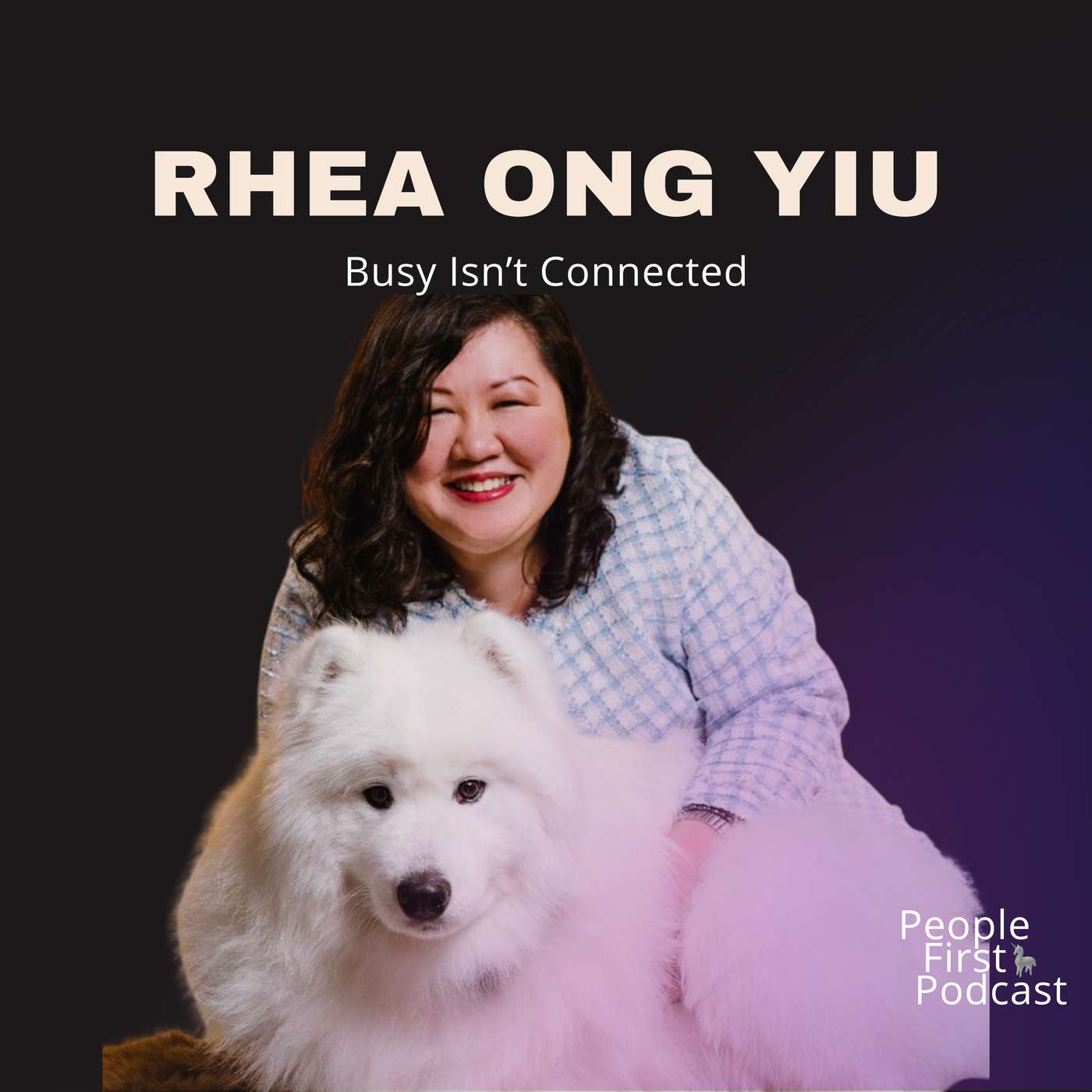
We’re more connected than ever. So why do so many leaders—and teams—feel disconnected? In this episode of People First!, Morag speaks with Rhea Ong-Yiu about the growing gap between doing work and actually connecting at work. They explore: Why transformation doesn’t happen as quickly as leaders expect The difference between “doing” and “being” in leadership Why structure doesn’t restrict people—it can liberate them How AI is amplifying the need for human connection The role of community in creating meaningful work Why showing up matters more than joining another platform This isn’t about adding more to your day. It’s about changing how you show up in it. (01:55) - From expectations to finding your own path (03:39) - The human side of transformation (04:38) - Why change doesn’t happen overnight (05:53) - Structure vs hierarchy—what actually works (06:30) - Creating space for co-elevation (09:08) - AI and the rising need for human connection (10:22) - “Doing” vs “Being” in leadership (14:10) - The shift toward community-led work (16:07) - Building meaningful connection in a digital world (18:41) - Why disconnection isn’t about location (20:15) - Generosity as a leadership practice (21:47) - The power of small, intentional actions (22:14) - Leadership lessons from Coco
Morag Barrett, SkyeTeam.com (00:00.972) Welcome to this week's episode of People First. And my guest this week is evidence that the world is a small space. I write in both my books, Cultivate the Power of Winning Relationships and You, Me, We, Why We All Need a Friend at Work, how forget six degrees of disconnection, it is more like two degrees of connection. And my relationship with Rhea just demonstrates that. So my guest this week is Rhea Ong Yew. I'll say that again and then I can cut it out. My guest this week is Rhea Ongyi and she is an executive, sorry, did I say that? Ong you. Take three. The good news about Riverside is I just have to remove those words and it's gone you. Rhea Ong Yiu (00:39.567) On you. Yeah, sorry. Morag Barrett, SkyeTeam.com (00:51.372) My guest this week is Rhea Ong-Yiu and she is an executive coach and has worked with Ernst & Young and others leading major transformations in organizations. However, the Small World Connection is through Keith Farazzi, who wrote the foreword for Cultivate. And I got the opportunity to meet Rhea as part of the Bhutan Transformation Coaching Program that Keith formed. and that she and I are both volunteer coaches within. She has such an interesting journey to share, including a fabulous new book, Adventures with Coco. So Rhea, welcome to People First. Rhea Ong Yiu (01:32.711) Thank you for having me, Morag Morag Barrett, SkyeTeam.com (01:35.666) My pleasure. I know I've just scratched at the surface of all the wonderfulnesses that you bring to the world and the work that you do, but I'm going to start with the origin story. So when you were a wee girl growing up, what was it that you wanted to be as an adult? And in what way does that show up in how you show up today? Rhea Ong Yiu (01:55.143) Yeah, it's very fascinating because I grew up in a half Chinese household and my mom is a nurse, my dad is an engineer. Our family is split between medical and engineering practices. At the time I was growing up, the only exposure I had was construction and hospitals. So I felt like Morag Barrett, SkyeTeam.com (02:21.634) Okay. Rhea Ong Yiu (02:25.199) I think I was influenced to think that I will become a nurse. But later on in my uni days, I realized that I couldn't stand blood and needles. So that is really something that is like, that's a real realization that maybe the projection of what your parents wish for you is not always what you're designed to do. And I found Morag Barrett, SkyeTeam.com (02:38.55) Yeah. Rhea Ong Yiu (02:55.527) I found a fascination at that time on computers. At that time it was the rise of the internet in the Philippines. We didn't have internet growing up. So I would say I was drawn to that. It's so fascinating. It's a new world. And I eventually convinced my parents to allow me to shift into a computer science degree. Morag Barrett, SkyeTeam.com (03:25.536) Okay, and so that shows up in the work that you're doing today. but it's people and computers. You're not just about the digital transformation, you're also looking at the human transformation as well. So tell us a little bit about that. Rhea Ong Yiu (03:32.807) absolute Rhea Ong Yiu (03:39.707) No, absolutely. I fell in love with the human side of transformation when I was doing agile and digital transformation at one of the companies that I worked for here in Switzerland. I realized I really found fulfillment and joy when I'm able to organize things. So I have a very architectural mindset. So creating an environment and ecosystem where people can thrive and people can... find kind of a solid ground for them to stand on and leverage that to become the best version of themselves. That's where I found the most joy doing. Morag Barrett, SkyeTeam.com (04:23.767) So I can see how that lights you up as you just talk about that concept. What's the biggest misunderstanding that you find with the leaders that you're talking about as to why they should care for or implement the work that you do? Rhea Ong Yiu (04:38.811) Yeah, I think one of the toughest things in transformation that I would say I've experienced is that we have a concept of change or transformation and it happens kind of overnight, but people need time. People need time to connect. People need time to build relationships. And people need time to feel at home in new structures as well. And that's one thing that I've realized. And also, I recognize that we often say, hey, we don't want hierarchy. But actually, hierarchy is not all that bad. would say, What we need is structure, a better structure of operating that actually liberates people by knowing what the boundaries are and what we're designed to do. So defining the roles, really understanding what we expect from each other, that liberates us to actually do more of what we can give to the organizations, right? And I often see that we try to stifle that. Morag Barrett, SkyeTeam.com (05:53.558) Yes, I mean those structures or bureaucracy and hierarchy end up creating friction and bottlenecks in the very processes that they're trying to streamline, which is where the work that you and I are doing is so similar and connected in that our goal is to help people to flourish and to bring the best version of themselves so that we can be better together. So I mentioned in the introduction that we're both Rhea Ong Yiu (06:11.303) Mm-hmm. Rhea Ong Yiu (06:16.305) Absolutely. Morag Barrett, SkyeTeam.com (06:21.101) part of the Bhutan Transformation Coaching team. What was it about that particular piece of work that attracted you to volunteer your time and expertise? Rhea Ong Yiu (06:24.496) and Rhea Ong Yiu (06:30.651) Yeah, so when Keith invited me to join the Bhutan Coaching Group, the whole ask was to really help kind of create the structure for co-elevation. As you know, he's very passionate about co-elevation. And designing that structure, I started listening into, what are the challenges you're experiencing? And I noticed some... Morag Barrett, SkyeTeam.com (06:44.407) Mm-hmm. Rhea Ong Yiu (06:58.695) telltale symptoms of, you know, these are things that actually with better structure, better, I would say, collaboration and a space for people to be heard, feel and seen, we can start shifting that needle. So that was basically what drew me into it, is to help create that space. Morag Barrett, SkyeTeam.com (07:26.933) And so what were some of those baseline ideas and areas that you saw? Rhea Ong Yiu (07:33.947) Yeah, I would say first, I would say is really creating the first few kickoff session and also the monthly meetup. We tried to really hear the voices of everyone, not like one person telling what's going on. It's not an update meeting, but a co-creation meeting. So we've shifted that a little bit to really hear everybody's voices. We fielded that into, okay, what are the needs of the leaders in Bhutan, right? How do we make sure that we feed that into the work that we are doing there? And we also noticed some un-clarities where we tried to clarify the roles, where we tried to clarify, okay, what is the expectation from each other? How do we define confidentiality? So we are... barely scratching the surface of what we're doing there, but there's a clear path forward. Morag Barrett, SkyeTeam.com (08:38.925) It's interesting in the work that we do where it's about human connection, that especially when we're working across geographies and cultures and expectations and there are so many nuances that come to it. What do you see as some of the opportunities for all of us at this point in time to increase human connection and decrease some of the disconnection and loneliness that I'm researching and certainly reading about every single day? Rhea Ong Yiu (09:08.825) Absolutely. I think more and more as AI becomes so much more prominent, I see AI leveraging all the technicalities, speeding up all the processes. More and more we need to start trusting on each other and having conversations with each other. I think that's what really, I would say, accelerates the change in the organizations where, you know, we create work with meaning and not just doing. Morag Barrett, SkyeTeam.com (09:49.203) Mm-hmm. Ooh, work with meaning, not just doing. Say more. Rhea Ong Yiu (09:56.251) Yeah, I think if you look at there's a three part component, right? Doing, being, and what's the other one? Knowing. I think we need to start operating in that being space, showing presence, building connections. These are stuff that AI cannot take away from us. Morag Barrett, SkyeTeam.com (10:09.101) Mm-hmm. Morag Barrett, SkyeTeam.com (10:21.644) Okay. Rhea Ong Yiu (10:22.407) This is where real innovation can happen. If you look at the rubber band theory, right, where you have tensions, the more you pull at the seams and the more you create impact when the conversations happen, noticing those tension points, noticing where you can create energy, that's a space where human can thrive. Morag Barrett, SkyeTeam.com (10:53.055) It's that I've been using the phrase human being or human doing. And to your point, we get sucked into the doing for the majority of our days and without attention and intention moving to the how does this fuel me or drain me? How does this help bring me closer to whatever it is that brings me meaning doesn't happen. And I know in the work that you do as executive coach, Rhea Ong Yiu (11:16.059) Mm-hmm. Yeah. Morag Barrett, SkyeTeam.com (11:21.025) Helping leaders to understand that meaning and being piece is key. So who are the leaders that are seeking you out and what is that that executive coaching work that you love to do? Rhea Ong Yiu (11:34.215) Yeah, so a lot of, I've been exposed to lot of leaders from the C-suite all the way down to new founders who are just at the cusp of, you know, creating a new business or a new product innovation with very, very senior experienced C-suite in large global pharmaceuticals. I've seen the challenge, the very complex challenge of the landscape that they're approaching and the challenge of also like how do you manage the workforce or at least not manage, but I would say how do they view the workforce in this new era where AI comes into the picture, right? And how do you maybe re-skill some of them? Morag Barrett, SkyeTeam.com (12:27.393) Mm-hmm. Rhea Ong Yiu (12:28.805) I've been part of large reskilling efforts in my previous roles where we start looking at, how do we make sure that we retain the talent, the knowledge of the people, but allowing them to experiment and allowing them to kind of stretch those skills in new ways in the digital field. So think about SAP into a digital role. So I've seen that work. I've helped create a way for people to transition. When you look at founders in general, they are entering a very fast-paced market. so the work I have done is really in terms of how do you ethical products? Morag Barrett, SkyeTeam.com (13:27.488) Mmm, okay. Rhea Ong Yiu (13:28.199) and making sure that they can operate at the highest level of ethics and not selling themselves to the first investor that comes in who will potentially overtake the vision that they have. helping founders to really explore that and find meaning in what they're bringing to the world. Morag Barrett, SkyeTeam.com (13:57.418) So these are not easy questions that you're helping founders and leaders to think through and explore. What are you learning about you and who you are and who you are becoming? Rhea Ong Yiu (14:10.597) Yeah, I think one of the things that I'm learning is there is a very strong pull on myself towards real community work, like community building. And it's not, know, community. We often associate that to not for profit. Actually, community is going to be the next place where people will create new products that are being loved by a supportive group of people, right? So really I'm very drawn to that where you have a community element of acceptance, the voice of the people and yeah, and just finding products that are very human centered and supportive of people to thrive. Morag Barrett, SkyeTeam.com (15:11.083) It's interesting to me that before the pandemic, I was a real skeptic of like virtual interactions. My mistaken belief was that if you want to be a better human, you have to do it in a room with other humans. And I think there's an element of truth in that, but like all things, there's an element truth in all perspectives. And so through the pandemic and since I've learned much like our relationship, it is only being conducted through the camera and the two dimensions of technology. Rhea Ong Yiu (15:17.787) the Morag Barrett, SkyeTeam.com (15:38.946) But when there is a choice to lean in, to reveal a little bit more of what's going on behind the mask or what's going on behind the backdrop, we can actually make deep and meaningful connections, create that community that you've just described. And I know you've had extensive experience in creating those global communities digitally. So tell us a little bit of that adventure and the work you've done there. Rhea Ong Yiu (16:07.003) Yeah, I think we live in very volatile times, right? We've gone through a pandemic where everyone had to shelter in place. We are now going through the rough patch of the war where also it's hard to move around the world at this stage. So... Morag Barrett, SkyeTeam.com (16:18.999) Mm-hmm. Rhea Ong Yiu (16:35.003) I noticed that there is a growing sense of that need or the yearning for connection in every human being, right? And especially in the pandemic, I saw that it was so strong that I've really experienced how people are so, I would say committed to build their relationships online because I guess no matter what they are experiencing in their own world in their own space, there is that need to kind of like find connection and meaning from what they are experiencing internally. And this format of virtual connection is such a place that you can do that, right? Like you can just call someone. Morag Barrett, SkyeTeam.com (17:13.911) Mm-hmm. Rhea Ong Yiu (17:28.687) regardless of where we are in the world and connect with each other and find something in common that keeps the conversation alive. Morag Barrett, SkyeTeam.com (17:41.806) So many of the organizations and leaders I'm working with are in this hybrid environment, a little bit of this, a little bit of that, and a whole lot of nothing because many of them are still applying old rules of engagement for when we used to go to the office and work side by side or send that inter-company memo, email or whatever. But now the reality is, it's Tuesday, I'm working from home, tomorrow I'm working from New York. Rhea Ong Yiu (17:48.551) Bye bye. Morag Barrett, SkyeTeam.com (18:09.367) Thursday I might be working from somewhere else. And yet at our fingertips, we have Skype and email and text messages and WhatsApp and Signal and all of these tools. So for leaders who are listening to this thinking, yeah, I'm getting hundreds of connection requests every day from my team and yet I'm feeling disconnected. What can you suggest for them that you've learned from growing Rhea Ong Yiu (18:12.103) Mm-hmm. Rhea Ong Yiu (18:33.306) Mm-hmm. Morag Barrett, SkyeTeam.com (18:37.471) the global communities that you've shaped. Rhea Ong Yiu (18:41.095) Yeah, I think disconnection doesn't come from the place. It's more the topics. It's more what's in your heart that is seen and appreciated or valued, right? So having meaningful connections is important, but belonging to a community where you have a sense of a rhythm of continuity of that relationship. That's actually very valuable. We underestimate the power of having a community rally behind us, but that need for being seen and appreciated and valued, that is a human longing that needs to be filled. Right? So being part of a community that you find shares your values and sees the value that you bring to the table, that is so important. And when I say belonging to community, I'm not saying, I am a member of this, but I don't show up to meetings. You don't build relationships by paying the membership fee. You actually build those relationships by showing up. And I think that's important. Morag Barrett, SkyeTeam.com (19:54.414) So again, leaders, what can they do then to, if they recognise that they're just going through the transaction of the relationship, they're paying the membership dues by responding to the slack in the evening, but they're not really leaning into creating that sense of belonging connection. How can they do that without it feeling soft, fluffy and awkward? Rhea Ong Yiu (20:15.249) Yeah. Yeah. Yeah, you know, Keith always talks about generosity. And I feel like generosity goes both ways, right? It's me giving of my heart, but also me receiving of that. So we need to, as leaders, need to be able to open up to be vulnerable enough to receive, but also give generously. Pour whatever strengths, whatever... capabilities we have or talents we have into that community. It's in giving. I love the terminology that they share. It's called packets of generosity. It is a way of building connection, right? So when you give even an article, hey, Mark, I thought of you when I read this, that helps people feel seen. And you might, when you receive it, she was thinking of me. That is such a significant Morag Barrett, SkyeTeam.com (21:16.097) Mm-hmm. Rhea Ong Yiu (21:17.637) we underestimate the power of just that small happy birthday message. And you know, that is, there's a lot that we can do to build that connection. And it can be a muscle that we maybe, it feels like running on a treadmill every day. Like who are we connecting with every day within that community, right? So it's not so much the big platforms, but really the one-on-one small details. Morag Barrett, SkyeTeam.com (21:22.518) Yep. Morag Barrett, SkyeTeam.com (21:47.872) It's the slowing down to be present instead of jumping onto the next Zoom call and getting straight down to business. It's the spending a moment saying, hey, tell me about Coco, tell me about the book, what's lighting you up. And that's how we start to build those threads that actually bring us closer together. So on that note, tell us about Coco and tell us about your new book. Rhea Ong Yiu (22:00.581) Exactly. Rhea Ong Yiu (22:08.615) I'm so- Rhea Ong Yiu (22:14.513) Yeah, so Coco is almost five year old Samoyed. He's turning five end of this month. I got him during COVID. I've been looking for a dog forever and my work didn't allow me because I was traveling a lot. But when COVID hit as I go, this is the right time and it will give me the opportunity to adapt my work and how I would want to show up for work. Morag Barrett, SkyeTeam.com (22:36.961) Mm-hmm. Rhea Ong Yiu (22:43.847) with a timeline that we had to work from home. So I did that. I started building on just getting to know each other. It was a leadership lesson in itself. I mean, I'm not a parent, but having a dog is very, very, very, close to it. I learned to listen well, listen to his needs, pay attention because he doesn't speak with words, right? So also just really listening to body language, looking at Morag Barrett, SkyeTeam.com (23:02.614) Yeah. Rhea Ong Yiu (23:14.161) how he's stressed or not in situations, and then when are the moments I can stretch him a little bit as a training ground. Those were really precious learnings that I had. And so I wrote this book, this book, it's called, Yeah, it's meant to be a four-part installment. So I released the autumn edition. Morag Barrett, SkyeTeam.com (23:32.906) Adventures with Coco. Rhea Ong Yiu (23:42.289) We're working on the winter edition that's coming up soon. It's an illustrated version. It has 12 leadership core values. And the whole idea behind the book is that one of the things that I reflected on is the attention span of people is getting shorter and shorter. So not a lot of people have time to read books. And often they are away. Morag Barrett, SkyeTeam.com (23:51.979) Mm-hmm. Rhea Ong Yiu (24:12.175) doing stuff while only one side of the parent is taking care of the kids. So I realized that this book will help leaders tap into that inner child. So the leadership is based on the leadership values are wrapped around a story that's about two to three pages long. So it's not very long at all and it's illustrated. And then you have a conversation with maybe a younger child to unpack that story. Now, by doing so, you also start experiencing that value come to life in their own eyes. And also, is a part of the book is an adventure. So what are things that you can do together to explore that core value showing up in real life and having the conversation around Morag Barrett, SkyeTeam.com (24:42.721) Mm-hmm. Morag Barrett, SkyeTeam.com (25:01.141) Mm-hmm. Rhea Ong Yiu (25:11.141) you know, how you nurture that. And last but not the least, there is a space for the adults for deeper reflection. for example, speaking about curiosity, I asked the question, what parts of your life have you ignored the value of curiosity or suppressed that? And what would have changed if you would ask more open questions? You would be more curious, right? Morag Barrett, SkyeTeam.com (25:17.549) Okay. Rhea Ong Yiu (25:39.621) And so there is a space for writing down and writing those reflections. And because it's so short, you're actually pulsed every week to do something about a specific value. Morag Barrett, SkyeTeam.com (25:52.204) So the first book set in autumn with 12 leadership values and messages, the new book is Winter. So will it be the same 12 or a different set of values? Rhea Ong Yiu (26:05.201) I would say 70 % the same values in a different facet because if you look at, for example, you mentioned earlier presence. So if you look at presence, it has very different facets. And so I try to wrap that around different stories because I also understand learning for children is so absolute almost. So you need to give them different perspectives of how that value shows up. Morag Barrett, SkyeTeam.com (26:11.639) Mm-hmm. Rhea Ong Yiu (26:35.023) and different conversations around. Morag Barrett, SkyeTeam.com (26:38.413) Well, I'm looking forward to sharing it and it will be my standard gift for new parents, but also for other leaders, because it's the quick win and the profound message and the cutest heck dog. Let's just face it, Coco is adorable. So as we come to the end of our time together, how can leaders who are listening and watching this episode learn more about you and the work that you do? Rhea Ong Yiu (26:43.558) Rhea Ong Yiu (26:51.719) ha ha. Rhea Ong Yiu (27:03.803) Yeah, I'm very active on LinkedIn. So if you're interested in connecting with me and exploring what we can do together, how I might be able to help you. I help teams. help leaders in terms of executive coaching. I have just recently completed my systemic team certification. So I'm working on that space as well, helping organizations drive for change. One thing that I'm very passionate about recently is how to create the organizations of the future with AI. so think about human-centric AI-powered organizations. How do you create a real win-win-win scenario in that space? Morag Barrett, SkyeTeam.com (27:52.757) So many great conversations and work to be done in that space. Rhea, thank you for joining me this week on People First. Rhea Ong Yiu (27:59.985) Thank you so much, Mark. Thanks for the invite.