
Our Future is Kind Podcast · Michael G Neece
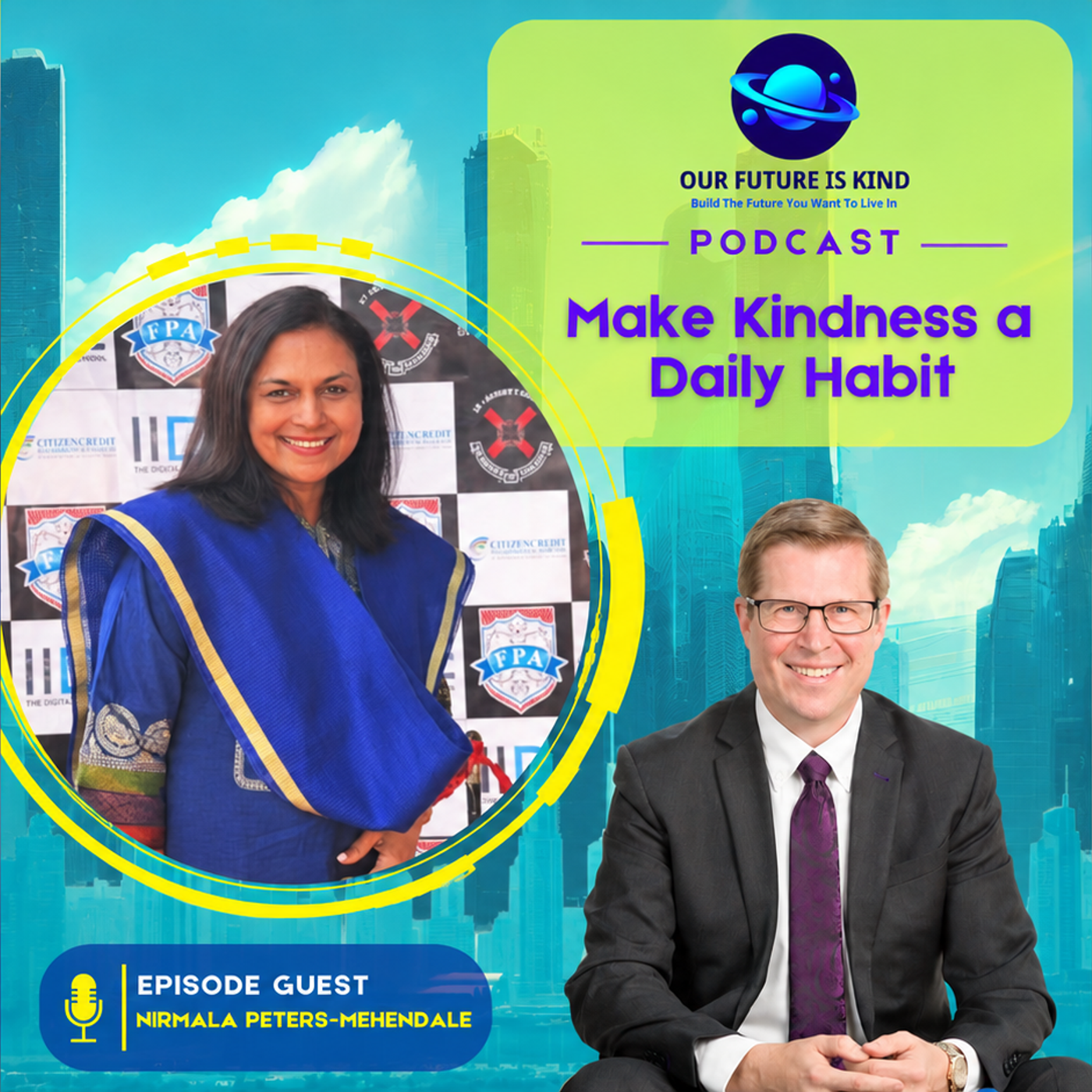
Our Future Is Kind Episode 88 In this episode of Our Future Is Kind, Michael Neece speaks with Nirmala Peters-Mehendale, founder of Kindness Unlimited, former President of the World Kindness Movement, and ⭐Our Future Is Kind CO-AUTHOR⭐, about making kindness a practical part of everyday life. Nirmala shares how balancing personal interests with the greater good can help create a more generous and connected world. The conversation explores the power of small acts of kindness, volunteering, gratitude, and sharing what we have. Nirmala also discusses supporting young people through kindness programs, finding joy in nature and music, and focusing on the positive changes we can make in our own lives and communities. Website : https://www.kindnessunlimited.in/utm_source=chatgpt.com Their new book "Our Future is Kind"! https://www.ourfutureiskind.com/ofikbook LinkedIn : https://www.linkedin.com/in/nirmalapetersmehendale/ Please visit our website to get more information: http://ourfutureiskind.com/ Michael G. Neece's Essential Information -Book a Call! https://ourfutureiskind.as.me -PressKit:https://onedrive.live.com/?redeem=aHR0cHM6Ly8xZHJ2Lm1zL2YvcyFBaVdyWHZsbEx3Ujl4WGJEZzRkcGE4ZDBWMUVGP2U9a3R6TTBP 🔔𝐃𝐨𝐧'𝐭 𝐟𝐨𝐫𝐠𝐞𝐭 𝐭𝐨 𝐬𝐮𝐛𝐬𝐜𝐫𝐢𝐛𝐞 𝐭𝐨 𝐦𝐲 𝐜𝐡𝐚𝐧𝐧𝐞𝐥 𝐟𝐨𝐫 𝐦𝐨𝐫𝐞 𝐮𝐩𝐝𝐚𝐭𝐞𝐬. https://www.youtube.com/@YourNextKeynoteSpeaker/?sub_confirmation=1 ⭐⭐⭐ Audio Podcast is currently on your favorite platforms: Spotify: https://open.spotify.com/show/7aQcfpaZkX9Wisd9c9BWXv ApplePodcast: https://podcasts.apple.com/us/podcast/our-future-is-kind-podcast/id1784037822 AmazonPodcast: https://music.amazon.com/podcasts/b3e101ff-9a05-4a17-9160-879012997d5c/our-future-is-kind-podcast Podcast guests and key partners: @ShariAlyse @ThirdWaveVolunteers @Nataliesiston @bravehealerproductions2444 @mari_trademarks @erikwalkerneill9708 @lisapowellgraham @TheMyImpossiblePodcast_MK @_bernadette_smith @nikki-groom @laraheacock4059 @bravehealerproductions2444 @ChefaloConsulting @MindfulManagementPodcast Michael is co-founder of The Human Summit, Learn about The Human Summit: www.thehumansummit.com/home https://www.linkedin.com/company/the-human-summit https://www.facebook.com/groups/thehumansummit 🔗 Check Out My Books Here! 🚀 "Tony Jenzano, Astronaut Trainer" https://www.amazon.com/Tony-Jenzano-Astronaut-Trainer-Stars/dp/1469659921 ⭐ "In Kind" https://www.amazon.com/Kind-Consciously-Craft-Meaningful-Career/dp/B0CT32X7LD 🏅 International #1 Best Seller "Joy Unleashed" https://www.amazon.com/Joy-Unleashed-Ultimate-Guide-Living-ebook/dp/B0G46K2MZC
speaker-0: Welcome to Our Future is Kind, a podcast exploring how we build the future we want to live in one kind act at a time. I'm your host, Michael Nies, president of our Future is Kind, and your companion in conversations about kindness, leadership, connection, and courage. Each week I sit down with thoughtful leaders, creators, and bridge builders to explore what a healthier, more humane future could look like and the choices it takes to build it. These are honest conversations about purpose, culture, curiosity, and what it really means to show up for one another at work, in our communities, and in everyday life. Along the way, we'll unearth practical ideas, small but meaningful acts, and questions worth sitting with, because building what's next is a choice. So let's dive in. You've heard the podcast, maybe read the books, but maybe you want a multi-day leadership retreat. Michael goes deep with high engagement. He gets you on your feet to have breakthrough moments, breaking one-inch wooden boards karate style. He drills into ego management, team dynamics, and a framework built on 35 years of cosmic kindness that changes how your people actually show up for each other. Michael's team will ask the right questions, then design the retreat around your group's real goals, not a template. Ready to talk through what a reset could look like? Our futuristkind.com slash bucket. Nirmala PetersMhendele graduated from the Tata Institute and began her efforts in philanthropy in 2005 when she started Kindness Unlimited, an initiative aimed at fostering volunteerism and collaboration among the youth in order to spread kindness. Nirmala is a past president of the World Kindness Movement, the organization that invented World Kindness Day. The publication date that is chosen for our book that we are writing together. and it I just have to say her generosity linked to her goals of building a kinder future is what attracted me to her work and to her very warm heart. So, Normala, welcome to the program. speaker-1: Michael, thank you for having me. It's always a pleasure talking about my most favorite subject in the whole wide world. And that's the importance of kindness. speaker-0: It's lovely. Yeah. Well I I gave a brief introduction of you. I would love for you to tell our audience what makes you you. You. speaker-1: that's a good question and a tough one too. so basically, you know, I come from a simple middle class Indian home. we just two sisters and life is good with parents who just wanted us to study and stand on our feet. And I got into doing my masters and it was an MSW in social work. And so it always talked about my training. I I I felt I feel very strongly as a person. So I'm not too sh as very highly sensitive as a kid. And so I could feel the energy in the room around me. And I was always concerned about what career to take. I knew I had to work and I had to earn and had to stand on my two feet. That was absolutely important. And as luck would have it, I met someone who told me about the course at institute just by chance, I and at the right time and I just applied and I was there. And so to just say that I was lucky to find my path. And so I started off working with people who I enjoy. I enjoy group dynamics, I enjoy human behavior, and then went into the corporate world which was also looking at the human side. And so I was with human resources, the corporate world was a world which has a mix of things, right? The good, bad, ugly. And so that gave me a good view into what life is, chasing quarter to quarter results. And yeah, and then one fine day again I met a friend and a colleague who said, let's start our own company. And from there I went back to starting my own firm, which was an HR b boutique firm. which was called Mind Movers. I led it for twenty five years, recently stepped down from that table so that I could focus all my work in the social sector again. And so you see, it's been a mix of doing many things and yeah, I just feel very blessed to be where I am at this point in time. speaker-0: Well, I felt very blessed to meet you at the Pay 20 Kindness Without Borders Summit back in May and immediately just loved what you were saying when you were on the big stage, talking to everybody in the room, and then we had a chance to split together, I think we were on a bus headed somewhere together and just getting to know you and the the the way that you see the world. I mean, how how do you see kindness in the world? What is its importance? How do you personally relate to make to it? speaker-1: So Michael, when I started researching kindness, which was around twenty odd years ago, I wanted a definition that made sense to anybody. And that means people who are non-believers too. Because we are we live in echo chambers. And we'd like to believe that everybody thinks like us. But because I have, you know, this background that puts me into diff with different people, I realize that not everybody sees it that way. People have people have had trauma, bad childhood, all kinds of things. And so I said, How do we have a definition that speaks to everybody? And that was a tough tough thing to do because I'm saying I don't want the dictionary definition of kindness. and I met Mr. Kalbakh. That's another long story. The number of strangers I met like you who became friends. And Mr. Kalbak was a 70 plus year old cancer survivor, absolute stranger. Somebody wrote about his obsession with kindness in tw 2002. And I I kind of, you know, after my dad passed away, I started asking myself, how do I grieve? How do I fast forward this whole thing? And I said, Dad was kind. And that word kind somehow stuck in my head and it played around and I read this article and I called up this person and I said, Mr. Kalbach, you've been doing research on kindness. And I'd like to meet you or talk to you. And God, he lived down my road. Among one point four billion Indian people, this man lived down my road. Now I said the divine or call it what you were has some plan for me and I cannot say no. So I knocked at his door and again We became friends for life and started discussing the research behind kindness. And he was very influenced by the Buddhist philosophy and the Dalai Lama and what they had to say about compassion as being the seed for kindness, which is a verb and an action. So you got to feel it, a lot of us feel, but we can't act. But if we don't feel there's no question about acting. speaker-0: Right. speaker-1: And we said, we're looking at a country like mine, which has you know, it's not a developed country. It has poverty staring at you every single day, right in your face. You can't avoid some of the things that people go through. And so what and we find that the those on the bottom of the pyramid are the kindest. It's very strange. It's like if I have an accident, I want water on a train, I'm feeling faint. It's those at the bottom who just come. It's the rich who have something to lose. And they would not want to possibly spend of their time. It's very, very I mean, that thing hit me. And so our definition is how do I balance my self interest with the greater good? And so we are saying you don't have to be selfless because that's not sustainable. And my own research has told me that a lot of people who are selfless burnout because self compassion, self care, self kindness is a huge part of being aware. And so we I said, while I am going, and you know, I have hundreds of ways of doing it in my part of the world. I'm just going down, I'm jumping into a rickshaw, is somebody standing at my apartment down and I say, Would you like to have a ride with me? So I'm going somewhere, I'm taking someone with me. I have you know, I have a couple of oranges I bought from the market, I just throw one to the security guard and say, hop one, let's share an orange or an ice cream. So the question is you start small and you start realizing that it just brings joy when you share. And I share only what I have. I can't share what I don't have. speaker-0: Yes. speaker-1: Yeah. And so when I work with you today it's to make them aware that all of us have a gift. if for you it might be the ability to be a poor podcaster, to be an astronomer, to write. For somebody else it might be photography, mathematics, science, whatever, right? So my point is if I even share that gift because I have it, I know I have it, I have a lot of it, what a better world we'd have. speaker-0: Love that you think so broadly, also think very granularly in the moment. How do you on a terrible day when you're not feeling great and things have gone badly? You've you've ripped, your your garments, you've spilled coffee on your side, something's bonus in. How how do you pick yourself back up, inspired and to recharge your batteries and to declined that? speaker-1: So as much as I believe in giving kindness, I believe in receiving kindness. And I find many of us have a block we're very very embarrassed to receive kindness. And so I might find that friend of mine who is non judgmental and just make a call and say I'm feeling, you know, terrible, horrible, I wanna I do not do what, but someone I know I listen or I know, today's a day to just listen to my favorite music or go for that brisk walk. So I've become very aware of days that are not too good. And I actively charge that battery, we're always charging our phone, but how about charging our cells? being aware today is a not such a good day. And so I believe those who give and those who receive, we always would need that. There are days we give and the days we need to take gracefully. And if we can understand that, it's a little makes life that much easier. I don't say that, every day I handle it as beautifully as I make it. I love to sleep so sometimes they just go to sleep. speaker-0: Nap, snap R treasure, treasure. speaker-1: Okay. speaker-0: So when I think about some of the conversations you and I've had, we've talked in particular about younger people, teens, people maybe who are in college, maybe in preschool, maybe middle school. I I know that's been a focus of yours. And I'm curious, why focus on that particular part of society society? speaker-1: So post COVID, I was trying to focus our work in kindness unlimited to be little more clear and in a particular direction because we were doing, a lot of kindness all over the place. And I thought the team thought it's better to focus and so we started looking at kindness and its connection to various aspects of life and we found a clear cut connection with mental well being. And so we decided to dig up the statistics of our own country and the world statistics and it's dismissed. And we found that, okay, young people, when I was a grow growing up, I just thought, we didn't have social media. I didn't have any comparison. I went down, played, had an ice cream and I was feeling okay. Right? I used to be bored and my parents would allow me to be bored. and everything was not structured play. It was go and find something to do. You don't have to go to a class. And today I find young people who are in school especially, it's all regimented play. And where they're missing out on l a lot of small joys. So I started looking at my own childhood. In fact, that was one thing that I did. And a lot of people I know back then and what young people are missing. And that's the time I realized post COVID things shifted drastically for this generation. They you know, they grew up socialized on a screen. Yes. Yes. And they missed two years of life, whatever that their age was at that time, seemed to be a huge setback. And that's when we did our own research and we hired again professors from the Tata Institute of Social Sciences, so it's a it's a body that has its own eminence, and we said let's put kids through a volunteering program where they are forced to get out of their houses. They are forced to leave the screen. They're forced to do something for somebody else and let's test out what they say about it. And so that was encouraging. And what really was an aha moment was when the research showed that those who were kinder to others tended to be kinder to themselves. And that's made it all the more, we got to work with this group. It's with with stretch resources, we can't be all over the place, so let's focus our resources and let's enter the college ecosystem. So that's not easy because you're non-academicians, but once we were able to show the research and said we have a program, we entered and now we are slowly moving from college to college. where we putting kids to a program, not very difficult volunteering, what I call micro volunteering. because there's small little steps that make you feel joyful, that make you feel I could do it, that make you build the connections within the group who's volunteering. So this is a group who's not concerned about anything, just coming out, wanting to do some good. And the vibe is very different in such groups. So make them understand that. And you know. I think we've t it's two years now and we've had a fair amount of success. in India there's a national education policy that's pushing experiential learning. So I'm trying to use the grades that are coming for our program to say anyway you're getting some grades, instead of just doing nothing or pretending to do something. Let's really do something. So that's all I and believe me, I'm having a great time doing all this. speaker-0: Whenever I speak with younger people, in their teens and twenties, I always get a sense with our world is gonna be there are there's such the less tolerance on their part or baloney, you know, when it comes to policies that make sense or workplaces that don't treat them well. There's there seems to be a lot less tolerance of that. Have you seen that this well? Have you seen that young people are a little bit more Truth hole, or the the challenge do you think? speaker-1: I think Gen Z and now Gen Alpha are a very different kind of generation. A generation that has never been here before. It's extremely unique. They are to some extent a privileged generation because the generations before worked very hard, right? You had the post-war generation, the post-recession, and there was actually the scarcity generation. and then you come to us and then so I I think they have, you know, decided to reject some of the things that we valued. And one of the things that we valued was status, title, money. And we put a high premium to that. And so now they're kind of wearing cool clothes, non branded clothes, you know, just saying I want things that are unstructured and I want to do my own thing. They've come out with their own language, their own emojis. They're kind of trying to break away. And I get them because I spend time with them so I understand them and they are not to be blamed because they were just born at a time like this. speaker-0: Well, I get the sense though that they also are going to take over the world and do great things. I mean, that's I have I I have three children, twenty three, twenty one, and seventeen, and I get the sense that they just don't see the world quite the way that you do. Love the way they see the world. speaker-1: Yeah. So there's hope. Yes. So there's a lot of hope. because if they're going to break the model and have a reset, then possibly that's what they want what'll happen. We if they want to consume less. If they're going to be more aware, if they're going to stand up for what's right, then that's you know, and we all need to be pushed over the edge for change to happen. And I think the tripping point is now. speaker-0: Yes, yes. Thank goodness. Goodness. So speaking of now, you and I are right when we're writing a big the book, of course, is called Our Future is Kind, the ultimate I die make friends. Friends. And you don't have to spoil what you're gonna write, but can you tell me what your hopes are for this book? I mean a book that has the word future and the word pind in it. What do you hope the readers come away with? speaker-1: I think it should it will be a very realistic way of showing the reader that this is a way of life that's practical, that's livable, that's beneficial to them and the world at large. And if the stories inspire people to say, because we've had role models that didn't speak the language that we know is the right language, right? And so we say that, these are stories of people that can inspire you to live and find joy and find purpose and meaning. You know, to me, purpose, connection, curiosity, all these are very important to keep me afloat. And so if this book can bring that in, I think it could get many more people to join, as I say, the wagon of kindness. speaker-0: Yeah, yeah. So I would love to take you on a thought experiment with me if you are game to do. Okay. You and I are getting into a teleport mean and I say, Normala, take the controls. Guide us to a hundred years in the future. And as you are dialing up twenty one, twenty six, I say, Nirmala, we did all the right things. And we did all the things and we did the might. So when we get to twenty one, twenty six, it will be the most brilliant, beautiful future you can imagine. So then you open the doors to the time machine and let us out. What are you looking for to confirm that it really is the best future? How do you know? How do you know? speaker-1: I I visualize people just having just enough and people sharing of what they have. Like if I have a produce that's growing corn and you have wheat, I'd like to come and give you my corn and take your wheat. And I'd like to get back to a system where we're not hoarding. Where we are so satisfied with what we have and we're just sharing and giving and the the bata system is again all alive and we're living in communities, small communities, where everybody takes care of everybody and you know, it takes a village to raise a child is a real situation. speaker-0: Makes sense to me. So if we are to get to that in the community focused future where people really care about each other and they and importing resources and leaving others star to star. I said we did all the white things to grow hair. Normal level. What are all those right things? speaker-1: It starts with a mindset. And my penny dropped when I asked myself, Do I have enough? It was a very deep question and a difficult answer. But when I answer that very honestly, looking at the people around, because you tend to look at people who are far better off than you, usually in life, right? But when you say, Do I have enough? I think that mindset about what is enough, right? I could have seven planes and helicopters and still not find it's enough, right? So do I can I say it's enough and then start sharing? So I'm not saying to be wealthy is a bad thing. To be wealthy is a very good thing if you can use that wealth which you are blessed with and you know how to make it for the good of everybody else, right? So, you know, there's just a percentage one percent of the world that holds we always give the statistics of over ninety percent of the world's resources and wealth. Right. So you have a gift of multiplying money. That's a great gift somebody has. But is it money just for money's sake or is it wealth for sharing and innovation and helping people have jobs and, doing things that makes this world a better place? Is that going to be tending towards greed? Because that's where we are heading. We are now looking at greed as A role model and the new world we say greed is not a value to be lived. greed is not something that excites me anymore. Sharing does. speaker-0: Makes sense to to me, the idea that that seeing others reveal what they mean can be deeply, deeply satisfying, especially if you know that they previously were without. speaker-1: Yeah, yeah, yeah, yeah. In fact even in sales, even Ziegler said this years ago that just helping other people what get what they want helps you get what you want. Right. We can see it in we can see it in daily life that it's a benefit to build a network of givers. It's a simple thing like my mother was in hospital, let's say I need four bottles of blood. If I'm a giver and I have given blood, it's extremely easy for me to tell the network and I have ten people wanting to donate blood for my mother. But I've never given blood, I'm not in the giving network. I may have to purchase it at a price. And that too, it I here it's people so happy to give. So these are very small examples, but givers if they are very conscious, they'll realise what a good world they live in. speaker-0: Well, we do live in a world of abundance where food is destroyed after it's been grown because it's too hard to ship. And then we have other people who are starving to death. And that always that's bothered me since I was a little you know, a little kid. I I sometimes feel like I'm an alien. He's arrived here on planet Earth and trying to understand humanity and like some humans are so delightful and then others just are waffling. speaker-1: Yes, yes, yes. So sometimes when I forgive them I say, there's something possibly, not there's a lot of research about our brains, right? And so I'm very hopeful with the research on neuroplasticity because if our brains can be wired this way, they can be wired the other way. Mm-hmm. And so if we have an education system or something that makes us rewire this, because we are doing a practice daily. Like for example, if gratitude is a practice. Right? And it's a very strong practice that kids follow every day before going to bed. And it will do something to the brain, but it has to be consistent and persistent. And I think if we start a l making people realize that, I think this medical science also has brought open that direction. speaker-0: Are there other practices that you engage in to keep your own kindness at the surface and and ready? Ready? speaker-1: So I for the last fifteen years don't have any news channel in my house. Okay. So I don't listen to the news. I read the paper. I have three newspapers that come home and I like that because I can choose what to read. And I can choose what to focus on because the news anchors in my world were shouting and screaming and I kept telling myself they get paid to do it. W I don't get paid to listen. And why am I sitting and listening to this opinion piece? It's not even factual, an opinion piece. So that made a huge difference to me. you know, and also you know, small things like I go through my Google Calendar and you are there in the calendar today, and I send out a good wipe to each of people who I'm gonna meet with today. speaker-0: Thank you. speaker-1: Little little things that make you forcefully look and get your brain to think the world is good, you got to make it better. You have a role to play and don't feel so hopeless. I'm also a person who focuses on the locus of control that I have. So I tend to say, you know, a lot of things about the big world sometimes are disappointing, irritating. But I say this is my world and what can I control today? speaker-0: Yeah, that's that's a powerful concept. if you stew on things that are too far away to use something with then you are wasting time, as could be spending your tith on something with in your locus of conductive controls. Yeah. Are there things that you reach for that inspire you in terms of folks, movies, t me shows, poetry, walks in nature? What what do you do that really gets you excited about light. speaker-1: well I live in one of the most populous cities in the world. It's called Maximum City, Mumbai. And I'm extremely aware that when I go out and in nature I feel terrifically energized. And so I get, you know, many people don't realize that Mumbai has the world's only jungle. It has hundreds square kilometers of biodiversity right here. Most people don't know about it. so I go there for a walk. I kind of, you know, force myself to take little short breaks because nature energizes me. I feel extremely spiritual in nature. I just, you know, looking at a sunrise, sunset, is magnificent. I feel so much of hope. of course there's poetry and there are books. And yesterday I watched Bucketless for the third time with Morgan Freeman and you know, I it j it just gets me to think about life and living and loving and you know, so I I choose what to consume. speaker-0: That's great. living an intentional life is one of the first steps forward being able to stay healed and to help others heal. Do you find that your interactions with the other people in particular that that's where you can pull that wisdom and and and be listening to? speaker-1: No, I I I love the energy, right? So we have dance as part of our program. So we dance and we have music and gosh, it's so freeing and it's so you know, something happens to the body, the brain and now there's so much of research on dance that I'm gonna make it part of our program extremely strongly. And get them to choose the music. We've also done blindfolded dance. So we're not looking at one another and just looking at movement. And so there's some there are little things that don't cost much money that can be done. speaker-0: Well, it's a privilege to be able to move. I have to say, I I I had a stroke three years ago. so the idea that I am fully back and I can run and walk and can juggle and I can dance, it is a privilege. I I have also seen a family member who's been fairly ill who wants to just kind of stay in a room and not meet not. And that feels so sad. The limiting. What what words of uplift can you provide to our listeners here about how how how to call you back in if they add a noun down? speaker-1: One I'm not very religious but there's just one quotation and that came from my involvement with Alcoholic Anonymous because I worked in factory and where I used to attend a lot of AA meetings with my workers. And then the twelve steps and so that particular prayer that A has adopted, which is, you know, either God or the divine grant me the serenity to accept the things I cannot change and the courage to change the things I can. But most important to pray for the wisdom to know the difference. And every day when I'm sorting this out, it is is this problem solvable, not solved? God give me the grace to take this because, you know, there's nothing I can do about it right now. and I can do something about this to to be able to see there are things I still can do something about, in spite of all the tragedy at this particular time. to me, I s there are three of these quotations around my house which tells me about the serenity prayer and it's in three different languages Indian languages. and so, you know, I think it's a daily reminder that if I at at one time I had two little boxes when I was much younger and I used to put the problems into those boxes. Solvable you know, just to get it very real, then accept it, right? This is something that's at this time you cannot change. for example, my my brother ha my cuc husband has a brother with Down syndrome. Right? So when I married it was an acceptance that I ha I'm gonna live with him. It's not gonna change. There is no miracle happening. I have to accept and love him as he is. So this is this box. The minutes in this box, then life is so much now. What can I do to bring joy to him? speaker-0: Yeah. speaker-1: and and so there are many examples of life being tough, but being clear that well, there are two boxes to sort out. speaker-0: I love that. I would be remiss if I didn't ask you a little bit about the role kindness movement and wood twenty. Can you tell everybody about those the few different initiatives initiatives? speaker-1: So when I started Kindness Unlimited in 2005 officially, we realized that there was the World Kindness Movement that was set up in ninety seven. And Dr. Maudi, who was a university professor in Tokyo, had this vision that people across the world should come together and promote kindness. And so he wrote to people. And the people who actually responded and agreed. were not surprisingly educators and school teachers. And they said that we totally get it, that kindness is a stepping stone to peace. And so the World Kindness Movement is a it's it's a movement. It's not a not-for-profit. It doesn't really have money, but it's a concept that can be rally more and more organizations around the world to shine the light on kindness. And the World Kindness Movement would help there. The K twenty for me was fantastic because now I have a new group of people who are living in my time because Dr. Mori was not in my time. And now I have a nuke team, who is speaking the language of our times and who says this kindness without borders. So I see such a, parallel between these two and it delights me to see, you know, how we are talking the same thing. And after twenty nine years of the World Kindness Movement, we still need more kindness. And we are not there yet. And so we need more people to come together and as I say, shout all of us in one voice. Actually I say to roar. To to say that we are the living examples. And and what I like about K twenty is the science, the research. that will come out from more and more people sharing and if we can share the research out to various people communities, businesses, organizations, schools, you know, because there is there is a part of the left brain and the right brain. And so we need to look at both while they're talking of a concept. I'm excited, very, very excited. speaker-0: Well, I'm glad that we met there. And I'm also glad that in addition to you joining the book project, Our Futurist Kind, we've had several others from the K H1T also join in the book project. And so it feels like this book really has some petty hitters when it to the champions of woodiness. some somebody has likened it to being the Avengers assembling in the kindness real's realm. speaker-1: You never know or somebody will take and make a movie out of those stories. You never know where it goes, right? speaker-0: Well, I I am thrilled that you are my co-author. I thrilled that we get to create this book that will have so much impact. before we wrap up our session here, I want you to tell people how can they get in touch with you? How they how can they get in their orbit? What are you working on next so that they can support you in that? speaker-1: Well, I think the the easiest sorry, the easiest is to get in touch with me through LinkedIn. and you know, Nirmala Peters Mahendele is my LinkedIn name and I definitely check every day and definitely respond to everyone who writes to me on a message and I will get back. I'm I love meeting new people. and you know, so I think I'd love to meet new people, I'd love to share, I'm happy to share our research. I'm happy to share about flourishing, a concept that I'm very excited about because I think it's different from happiness. And so I'm really deep diving into why some people seem to flourish and others don't. So anything that I know and somebody else is wanting some help and I would like to, you know, also learn because every conversation helps me learn. I specially want to thank you, Michael, for inviting me and pushing me actually, because I was, you know I'm not a natural writer, believe me. I can speak till the cows come home. But I am not and so it did require a nudge and I'm extremely grateful for that nudge. speaker-0: I can tell you right now, having not read what your chapter is yet, yours is going to be one that I cherish. I just know it. speaker-1: I'll need all the help, when it comes to writing, believe me, but I'll get there. speaker-0: It's going to be great. And in the meantime, Nirmala Peters Mahindle, thank you for joining our features kind Pict Jazz.cast. speaker-1: Thank you, Michael. Grateful. Namaste. speaker-0: Hey! If something in this episode hit home, we invite you to go a little deeper. Michael's books walk you through strategies that help people create more kindness at work, in their relationships, and within themselves. These shifts make your days feel lighter and your relationships feel truer. These tools are tried and tested. Whichever of Michael's books you, speaker-1: Pick up. speaker-0: we bet you'll feel confident knowing you have real strategies in your back pocket. Grab a copy at our futuristkind.com slash. speaker-1: Books. speaker-0: We'd love to hear what you think. speaker-1: This week's kindness challenge. Find one small way to share something you already have. Whether it's your time, food, speaker-0: Skills. speaker-1: or a simple act of generosity. Start small and notice how giving and receiving kindness can bring joy to both you and others. Wanna stay inspired so you can stay kind? Spend time in nature. Take walks. Listen to uplifting music. Dance, or watch an inspiring movie like The Bucket List, Nirmala also recommends practicing gratitude, choosing what you consume and focusing on what you can control instead of worrying about things beyond your reach. speaker-0: You've been listening to our Future is Kind podcast, where building what's next is a choice. Make your next choice a good one and help build the future we want to live in.