
Office 365 Distilled · Steve & Marijn
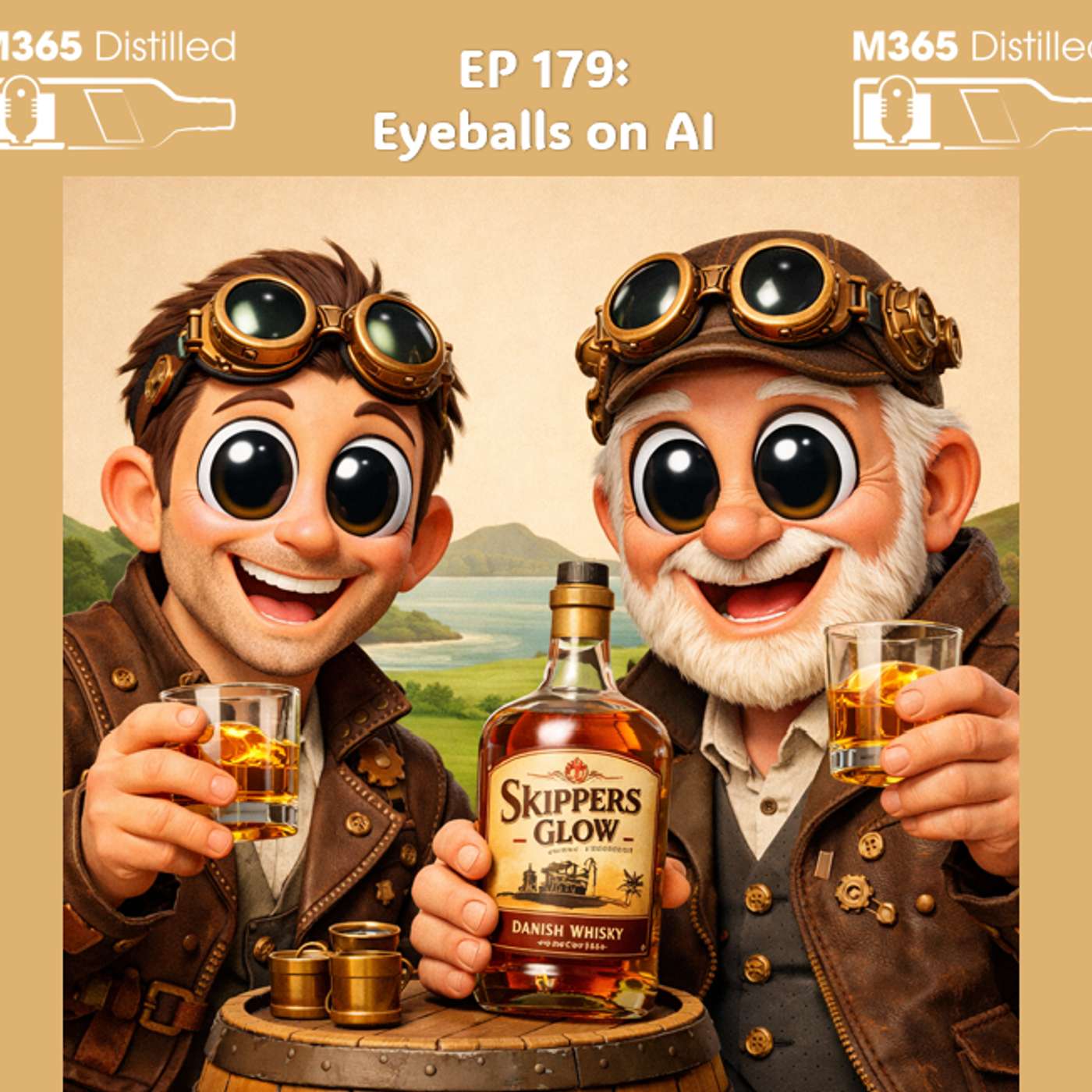
Happy new year everyone! The boys are back and making plans for fun events this year. Marijn hates the fact that Steve is now higher up the CommunityDays speaker board list than Marijn. They reminisce about past events and eventually get on topic: AI doesn't care if your sites are pretty. So how much work do you need to put in to make SharePoint "pretty" for AI (AKA readable)? So what is the ratio for human eyeballs vs AI? The boys finish off with a superb Danish whisky, Skippers Glow, kindly donated by friend-of-the-podcast Kasper Larsen. It all started with this post from Daniel Anderson: https://www.linkedin.com/posts/danielando_sharepoint-in-2026-activity-7410921384069017600-m52B/
Speaker 1: Hey. Hey. 2026, baby. Excellent. Oh, for fuck's sake. I'm all excited, and all I get out of you is Yeah. Speaker 2: But I I just have a half working mouth after the surgery this morning. Speaker 1: Okay. You had surgery on your tooth. Speaker 2: Yes. And I had a few whiskeys down already. Speaker 1: Actually, I am a bit the same way. Speaker 2: Yes. So... Speaker 1: Yes. We've we've already been tasting something called the Deanston Winter Festival. Mhmm. Which... Yes. Marijn bought me a a gift if you remember last time, this is my winter Christmas gift to him and we had a taste or two. So... Yeah. But Casper, we've gotta say thank you a little bit later on, which we will do with pleasure. You'll get more details of that at the end. Speaker 2: Yes. Casper and Fiona. Casper Speaker 1: and Fiona? Speaker 2: Yeah. Yeah. It's... Oh, Fiona. Sorry. Not Fiona. It's not Fiona. Okay. Speaker 1: Fiona. Fiona. Can live with that. Speaker 2: Let's not tell his wife. Okay. Speaker 1: Anyway, happy New Year, people. Welcome to Office 365Distilled or Microsoft 365Distilled. Who gives a shit anymore? Speaker 2: People can still find us, so that's good. That's true. Speaker 1: Casper, I'm looking forward to seeing you in Bremen. Marijn is still checking his agenda, but I will be there and we'll be able to reciprocate in kind. That'll be good. Yeah. Oh, well. So did you have a good Christmas and New Year? Speaker 2: It was okay. It was good. Yeah. Just... See, the thing is when you get as old as me, then they all just look alike. They all look the same. Speaker 1: They'll feel the same. Speaker 2: They feel this. Yeah. No. Feel... No. It it feels harder every year, but mainly getting up in the morning. But Speaker 1: I have no problem getting up in the morning. Speaker 2: No. But after after this big Christmas then, I didn't even wanna go there. Speaker 1: You didn't even wanna go Speaker 2: I didn't even wanna New Year's resolution? No. No. No. Speaker 1: That is true. That is true. The house is becoming Speaker 2: a house. House. A home. Yes. Speaker 1: Yeah. Well, this studio is becoming messy, but we'll work Speaker 2: that one out later. Speaker 1: Yeah. In the middle of rewiring again, but there you are. Speaker 2: Yeah. And at some point, we'll put the cameras up. Speaker 1: I've got the... Todd, the brackets brackets were there before. I am thinking about it. And I also started working on the networking for them the other day. Yeah. Yeah. But, yeah, it's weird having priorities like I need Exactly. A Speaker 2: Kitchen first, cameras later. Speaker 1: Yeah. But they're in place. The one above my head pointing at Marijn and the one above his head pointing at me. Speaker 2: Yeah. It's gonna be cool. Speaker 1: It's It's gonna make me a busy, busy man having both video to do and sound to do. Yep. But all good practice. All good practice. And actually, folks, if you're going to be in Hamburg in June, we are going to be recording six podcasts throughout Speaker 2: the Six podcasts. Speaker 1: Yes, saw, I was in Tunisia. Speaker 2: Wait, wait, wait, wait, wait, wait. Speaker 1: I was in Tunisia with Martin. Speaker 2: Martin, was Speaker 1: gonna say Martin and I double jammed myself. And we're gonna do three in the morning and three in the afternoon. So we're actually gonna take a room there, just to record podcasts with people. So whoever wants to come and join us, three visitors and three Speaker 2: Well, speakers Speaker 1: yeah, maybe. Whether we do whiskey every time or not. But they basically were chewing over that idea at the moment of Okay. Of actually doing that because we won't be at 200 by then, unfortunately. Speaker 2: So should we open up a guest list? Speaker 1: I'll let Martin work Speaker 2: it out. Oh, yeah. Because, yeah, I think the call for speakers is still open. Speaker 1: It is. Yes. Okay. Speaker 2: Yeah. So the way you sold this to me, hey. I'm in Tunisia. I'm with Martin, and he wants us to do, like, few years ago, like, the the second The podcast after Speaker 1: the keynote. Yeah. That's right. Yeah. Speaker 2: So I said, yes. And now you came back and you're like, oh, we're gonna do all day of podcasting six episodes. Speaker 1: We were playing around with Speaker 2: it. Okay. Speaker 1: Actually, we do... I thought... I think the way it worked out, we'll do three fusion talk and three m three six five, so you may not need to do m three six. Speaker 2: Yeah. That makes sense because... So then I can actually go and watch some sessions. Yes. Yes. Maybe give one as well. Yeah. Know. Yeah. Speaker 1: Something like that. Again, where it's early days playing around. Okay. Okay. Speaker 2: That's fun. Speaker 1: So yeah, so Tunis here was actually really good, just before Christmas. Yeah. Jamal organised the event, he's doing another one in Tunis. Tunis City is, don't know how to describe it, it is a amazingly vibrant... Speaker 2: Energetic. Yeah. Speaker 1: Yeah. City. It is really so cool. The market is just... Yeah, you got to go to the... Speaker 2: Oh, yeah. Yeah. Yeah. I can imagine. Yeah. Yeah. So every year, one of my goals of the year is to go to three places I've never been before. Speaker 1: Oh, I didn't know that. Speaker 2: And this year it was, well, 2025 was Manchester, Athens and to... Oh, Zagreb. Speaker 1: Yeah. Speaker 2: And there was a fourth one as well. I can't remember. But, I haven't been in Africa for years, so I kind of wanna do one of his shows, one of the things that he organizes maybe in, Saudi Arabia or Dubai or, maybe Tunisia. Speaker 1: It really interesting. So, I mean, I've done Africa before, but not for a long time like you, so that was quite enough. But it's like two and a half hours flight for less, more it was less two hours ten minutes from here. All of a sudden you're in this environment which is completely different to whatever you're used to Speaker 2: you know. Remember remember just Speaker 1: so laid back you know. Oh yeah, we're not gonna get started yet, we're still waiting for some people to turn up. So we started forty minutes late or something. Speaker 2: Oh I can remember that from Casablanca. Speaker 1: Yeah but nobody backslided. Speaker 2: No, just Speaker 1: so chilled out the audience just goes okay And and, yeah, there was no gaps between the presenters. Now I was thinking how wrong that is, but it was just taking it in your stride. And it and it really is magic. Jamal, I don't know how you work this out, but it works, you know? Yeah. It's... It really breaks the informalness of the day. You don't kind of finish an end and then everybody goes, oh yeah, yeah. It just, hey, the new one guys comes in, they have a chat while you change over from one to another and then he gets on and does a presentation. Awesome. It's Speaker 2: more like a comedy club. Speaker 1: A little bit that way, yes. Okay. Yeah, yeah, with a little, yeah, a compare. It was That's cool pretty neat. I mean, I spoke three times, I think. I did the keynote on the first day from the audience. And what was... I really loved was it was students. There was a lot of IT kind of students in there as well, so young people. And I wish we'd known about it and we'd mass suggest it to Jamal because we kind of was pitching this at 100 to 200. Yeah. But because you had people that had very rarely heard of SharePoint. You kind of needed to step back to Brigette, Niveskiew as well was over there. Know, man, if I'd have known we could have to re lowered the levels. Yeah. But to do these sessions for people that are just entering the industry, think is awesome. It really was good. Speaker 2: Oh absolutely, yeah. And it's a good gateway into this whole world and to the whole community of that one. Speaker 1: And it was all fully inclusive at the hotel, so the first thing I did was went to the bar and I said, Oh really, I'll take one of those sheavous regals. Sorry sir, that's not included. Okay, that's interesting. He said, but don't worry, we do have a local whisky. I mean do you? Lot of whisky. Quite exciting, you've got a local whisky, I'll taste that. So he poured this thing in the glass and I took one taste and went, can I have a look at the bottle please? So I looked at the bottle and it said, do know what the ingredients were? So if I take this whiskey and I look at the ingredients... Speaker 2: Barley, water... Yeah, so the ingredients. Speaker 1: Yeah. So the ingredients for this one was water, alcohol, Speaker 2: Okay. Speaker 1: Whiskey, and caramel. It wasn't a whiskey at all. And Vascu as well, God bless him, he fell for the same thing. So I said to the barber, this is not really whiskey. I couldn't even drink it. I just gave it to him back and I went, you know, why don't you just do that and I will Oh pay Speaker 2: my god. Speaker 1: Yeah, it was so funny. So funny. So I think we all cashed in our bands after a while and went for the non alcoholic versions because that's what it was. But it was a really well organised event terms of the once you got used to this laid back approach, it was a very chill day. Speaker 2: So how was the turnout? How many people Speaker 1: were there? Oh, there was probably 40 or 50 people there. I mean, of the workshops were eating 15 or 20 people. Nice. So there wasn't hundreds there, there wasn't? Speaker 2: No, no, Speaker 1: no. But everybody sat down. If you got the audience going, you got some really good questions from them. So it was fun considering it we're all English speaking. There's some French speakers and stuff were there. Yeah. There was an amazing French guy, I think from Tunisia, talked about AI and talked about how it was thinking. I'm not going do it now because I think we should go through the slides and I think it'll make a great podcast about how it works. Because I started feeding the slide into chat GPT and said, look, can you break this down? And it talks about how we think as humans and how AI thinks as artificial intelligence. Okay. It was really clever. So there's some pretty cool sessions there too. But again, it was Yeah. Yeah. Yeah. It was a bit over Speaker 2: Too too much. Speaker 1: Tunis, it was good. I enjoyed it immensely. Yeah. And if you wanna do some speaking, I think he's got another event running in February or something in Tunis. Speaker 2: Yeah. But that's a little too close by Speaker 1: Yeah. Speaker 2: So we organize all the travel. And I also think it was just... I'm gonna be going to Malta for a week, and that's probably just... I think that was just in that week. Holiday? Yes. Interesting holiday. Speaker 1: Malta's a Speaker 2: mom and my daughter, which we do every year. So we went to Malaga two years ago. We went to Speaker 1: Athens last year. Speaker 2: Yeah. So now I wanna go to Malta. Yeah. Never been there, so it's the first one on my list of three places I've never been before. So... Yep. Speaker 1: Neat. Neat. Neat. Yep. Alright. So that's travel. So, yes, we'll be in Bremen in a couple of weeks, and I Speaker 2: think You're gonna be in Bremen the week after I'm gonna be in Tallinn for the CTTT... TTTT event. Conference. Yes. Two days in beautiful Estonia. Speaker 1: Yeah. And I think there's something else been enabled as well, but I can't think what it is. I really need to get my head around where I'm going over the next few days. Last year was so busy, you know? Yeah. So, we shall see. Speaker 2: And I saw, so if you go to the Community Days website, they also have this, leaderboard or speaker board or something. Here we go. I used to be number one for years. Yes. But then, of course, Jamel was doing all these things nonstop. He's now number one. I now saw you were on number six. I'm not surprised. And I'm on number 19. Speaker 1: No. So I Speaker 2: was browsing through it. I was like, oh, there's Steve. Anuk is on eight or nine or something. And then where am I? And I'm scrolling, scrolling, scrolling. Oh, number 19. Speaker 1: But that's that's your strategy now just to do a few big events and not? Speaker 2: No, not really. Speaker 1: No. I actually think it's because it's only part organization depending... Speaker 2: It doesn't matter. Speaker 1: I mean, Speaker 2: when I was number one, was so it was it was weird because I felt like there's so many other people doing way more things than I'm doing. But for some reason, I think the algorithm didn't didn't refresh or something. I don't know. It it was a mistake from the computer. I'm sure. Anyway, it doesn't matter. But Speaker 1: That was funny. Speaker 2: I didn't even saw you, like, number six, and then I look at number nine, then me all the way down. I was like, oh. Oh, wish I could see Speaker 1: because I'd have certainly gone. Speaker 2: I know. I know. So I saw that. I I should I was thinking like, I take a screenshot? Speaker 1: No. They might not notice. So we got a bit of an interesting subject that we want to talk about today. Speaker 2: Yes. Exactly. So last week... So I'm on the email list from Daniel Anderson, who's a very Anderson. Brilliant guy from, I wanna say, New Zealand or Australia. I don't really know. I think Australia, but I'm not 100% Speaker 1: sure. Did you know that anybody from New Zealand that's called Australian and anybody Australian's called New Zealand, they will hate you forever? Speaker 2: I know. You I Speaker 1: just fucked yourself in the meantime. Speaker 2: Absolutely no. But he's from Down Under. He's from Down Under. Exactly. Yes. From far away. Far, far away. Yeah. And and he's got a really good two weekly something newsletter. Very well written, a little thought provoking, mainly around how metadata is so much better than folders. But this time, he made another case. And I read it, and I I just copied it. I sent it to you, and I said, this is gonna be our next topic. Speaker 1: Yep. So that's cool. Do So we agree with it? 100%. Speaker 2: I don't think it's an or or, but it's an and and. Speaker 1: What do you mean by that? Speaker 2: So, basically so, basically, what he said in very short form is that we have been developing SharePoint sites mainly for users, for human eyeballs, but we have... We should we should start thinking about optimizing it for AI. So my... Speaker 1: Not just optimizing. What he's saying is we should build them for AI Speaker 2: Yes. Exactly. Speaker 1: And humans second. Speaker 2: Yeah. So... That's what Speaker 1: you mean by and and. It's not an or. Or for humans, or for AI. Exactly. Speaker 2: It's it's for both. Speaker 1: Yeah. And and even compromise a little bit on both. Speaker 2: Yes. But then the question is, should it be eightytwenty humans or eightytwenty AI or seventythirty or... Because... Well, let's take Speaker 1: the common problem. The common problem when you build it for humans is you want to try and make adoption easy. And so we tend to cop out and we use folders instead of metadata. So that's the biggest kind of trend when it comes to humans because you say, well actually I don't have to train everybody on how to use metadata. Yeah. They can carry on using folders that Speaker 2: they As they've used always Speaker 1: done. Correct. Whereas if you're doing it for AI, then you need to be able to make sure everything is tagged as it is for search because it uses a lot of the same methodology to identify content in the initial stages is it needs metadata and tags and keywords, which is not so easy with folders. Sure. So for humans, would build with folders to ease adoption, but for AI, you really should make sure there is metadata and tags. Speaker 2: Yeah. Exactly. Yeah. Basically, that's basically what he said. Yeah. Speaker 1: Which brought me to another idea. I know we're going go through the details in a minute, but I'm kind of jumping to the end and maybe I shouldn't, but I'll forget it if Whiskey I can say at the end. Speaker 2: Not not that end. Speaker 1: Okay. Fiona will come to the table. You can, of course, build for folders, but still tag and still add metadata. Speaker 2: Oh, yeah. Absolutely. Speaker 1: So I think that's very much the and and, but let's see. Anyway, let's work out. But we started looking at this because I also said that Google also have been talking about and issuing how to make a website, a normal website, not SharePoint, and would maybe just spend five or ten minutes on this suitable for AI answers and questions. Speaker 2: Yeah, for AI consumption. Speaker 1: Yes, AI consumption. Good word. I think we might have a title in there somewhere. Consuming knowledge with AI. From Down Under. Yes, from Down Under. Speaker 2: Down Under. Yes, Speaker 1: Down Under this table. That was fine, Fiona. Right. Speaker 2: Casper, I'm Speaker 1: sure you're giggling already because you know what we're talking about and nobody else does yet, so that's fine. All righty, go. So yes, the AI stuff for Google where they said being prepared for being able to questions. They came up with a few things on this, didn't we? So they Speaker 2: said, know, Google's talking about a human centered AI experience. Yeah. So they're already doing and and and. Yeah, exactly. So basically, what they said was designed for humans, but don't forget AI. So that's mainly like 80% humans, 20% for AI. So they talk about offer a frictionless experience. Speaker 1: So it looks good and feels good when you're using it. You can navigate easily to it, that kind of stuff. Speaker 2: Exactly. But also, if you're using AI to write some of the stuff, maybe mark it as with an icon saying this is written by AI. Maybe. Yep. That was one of the things that they put on there. Speaker 1: Yeah. Simply to make sure that you're building it in as open and transparent way as possible. Speaker 2: Exactly. Transparency is definitely a very big part of this. Speaker 1: Yeah. Interestingly enough, other day, I was working on some images, when I was in New York just recently. There's a Spanish artist that does these really interesting sculptures of really thin faced. So, he does your face, but it's really thin and squashed and they're about four or five stories high. But when you look at them from the side, looks like a full face. And as you look all the way around it, see it. Have you seen Speaker 2: these things? I've seen something like this. Speaker 1: I was working on this this image because when I was in New York walking down the side of the river, take it, there's one on the other side of the river and I was taking pictures of it, so I wanted to be able to sort of show its different angles. Yeah. And I was playing with the background and I wanted it, well I need this city background, so I used Adobe. I was in Adobe Photoshop. It said you can generate a background. Speaker 2: Yeah, yeah, yeah. Speaker 1: So I tried to generate a background. Yeah. Didn't get what I wanted, so in the end I used some of my stuff. But when I saved it, it gave me a warning saying, hey, you've used AI generated stuff, so we're going to tag it accordingly, whether I liked it or not. And in fact, I deleted the AI generated stuff, but it had already tagged it to say it was delete. So yes, there's a Speaker 2: new trend these days as well with AI generated images. I I read this morning, is where you have a picture of a lady fully dressed, and you just say to AI, how does she look? Remove her clothes. Interesting. Speaker 1: Yeah, try that tomorrow. This is for real. You're just walking down the street and you say, hey, remove her clothes. Has AI progressed that much? I bet the Rayburn AI glasses. The Rayburn. Just make everyone Speaker 2: naked. Everyone naked. I Speaker 1: remember, it's not new. I remember the Sunday newspaper thirty years ago used to sell X-ray specs. Little advert in the corner, x-ray specs. Yeah. Oh well, anyway we digress, that's unusual for us. So anyway, yes, we're talking about making sure that you're transparent and that people know what is human created and what is AI created. Speaker 2: Yeah, absolutely. Yes. So build trust through transparency, let everyone know that this is AI generated. Prioritize the goals. User Speaker 1: goals. Speaker 2: Oh, user goals. Yes. Exactly. Speaker 1: You can see that. Surely you can see that's user goals. U S E R. I wrote the notes and my handwriting gets really because my thinking starts thinking of the next word while I'm still writing the... More than one. Yeah. Alright. Shitty and perfect. Speaker 2: I have that problem as well where I'm thinking faster than I can explain something, so I'm just skipping true sentences. Speaker 1: Yeah. Speaker 2: And... Yeah. Well, anyway. So, yeah, prioritize user goals. Why are they here? Why... What what do they want out of your website? Speaker 1: Just because you've got AI, it should all still be focused on the point of the page. Speaker 2: Exactly. And to be honest, I hate these web pages where you're looking for something easy and simple, like a conditional formatting rule or something, but they've got this 2,000 word page with a very lengthy intro because more words definitely means a better search ranking or something. I hate those things. Just... And and for those pages, for those websites, so blocks that have more than 20 ads and have more than 20,000 words where they should only be 200, AI is a lifesaver. Speaker 1: Yeah. Point it. Shoot it. Say, hey. Give me an update. Speaker 2: And I really hope those websites die. I've I've complained to a few people, said, look. I'm... I I have this this newsletter that I send out, and you make good blog posts about good topics. But every time I open up your website, there is a gazillion ads all screaming at me. I don't wanna point anyone to your website. It is horrible. Yeah. Interesting. But the content is good, so, well, it doesn't matter. Speaker 1: Maybe your, your newsletter needs to do AI summaries. I don't know. I don't know how much people would get pissed off with that. Speaker 2: I know because I want to drive people to the content of other people, because I'm reading all those things and they're all super clever people. And I want to give those people a little spotlight. But... Yeah. Okay. Speaker 1: If they wanna just earn the money from it. Speaker 2: Yeah. No. It kinda makes sense. Speaker 1: Yeah. Okay. Which is what you wanna do in your newsletter, isn't it? Speaker 2: No. It's it's not monetized yet because I can't find anyone to pay for it. But, yeah, maybe I need to talk to our friends at EF Point or something. Yep. Alright. Speaker 1: So if people start to see more AvePoint content on there, they will know why. Speaker 2: Yes. Alright. Speaker 1: So anyway, yes. We talked about goals, making sure people understand that. And then we talked about assure accountability. Mhmm. So making sure that you're accountable for what you're teaching people, that you're not just being misled and stuff. Exactly what you've been talking about. Speaker 2: That's also one Speaker 1: of the errors as well. Speaker 2: Yeah. The accountability is one of the problems with the evergreen SharePoint situation that all the things you're writing today might be obsolete next year. Speaker 1: True. Speaker 2: So, yeah, it's it's difficult. But then maybe we just need to, number five, plan for errors. Speaker 1: Yeah. Exactly. Make sure we have an appropriate get out of jail free clause or a way of contacting you if they have questions Speaker 2: or Speaker 1: some way of checking that site to make sure it's updated. Yeah. Or regular... Put a life cycle on it, a page life cycle on it that you can manage yourself. Speaker 2: Yeah. Exactly. Yeah. It's actually one of the things that I've been building for a few customers is an automatic revision date and an whole revision process for their documents, which I think is definitely something you need. Speaker 1: No. I agree, Take it off... Take it out of search results if the data expires and then send somebody a link to say, check. This is still valid. Speaker 2: Yeah. Exactly. Yep. Yep. So that's how we optimize our site. Speaker 1: Well that was the Google's view on where sites should be because they're basically moving away from your standard SEO stuff to more AI focused SEO, AI EO. Speaker 2: Yeah. And it's kind of weird because when AI came out, the first thing I thought was we're never going to use Google again. Google is going to go away. It's going to be, oh, I even didn't want to buy any shares from Google because I thought this company's going to be dead in six months. Speaker 1: So you sold short on Google. Speaker 2: I did not. I'm happy I didn't because this stock is going through the roof because their Gemini is really kicking ass. It's really, really, really good. So... Speaker 1: But then they always had market advantage. It's just that they were not very good at the time, but now, of course... Speaker 2: Exactly. Yeah. So every time you Google something, it's coming up with a Gemini answer. Yeah. So it's beautiful. They have all that. Yeah. Market advantage. Speaker 1: Yeah. I read something a few days ago that people are not going past it. They're just saying that's enough for me. Good enough for me. Speaker 2: Exactly, yeah. Most of the time that's good enough for me as well. Speaker 1: But of course Google gets clicks for going to other websites. Yes. So they'll probably have to downgrade the quality of their AI so that they can continue in business. Or do what ChatGPT is doing, find some way of integrating adverts into the... Speaker 2: That's definitely one of the things that they're gonna do is get adverts in the AI. And I wonder Speaker 1: whether you even know about it. You'll just be reading some information with a subtle in the 1950s... Speaker 2: Now suddenly I want to buy some diapers or something. Speaker 1: Yeah. Speaker 2: Okay. Speaker 1: Yeah. But exactly in the 1950s they banned it of course, but they used to Speaker 2: subliminal images of Speaker 1: drinks and crisps and stuff to go and buy in the cinema. Yeah. But they banned all of that stuff. Beautiful. It was late as the seventies, I think they were still doing it. Speaker 2: I think so. Yeah. I I read a lot of stories about it. I I still think that's... I think I think Netflix does that as well because every time I'm watching a movie on Netflix, I get the urge to get a whiskey and some M and M's. Is that right? Every freaking time, every night when I'm watching something, every night it's the same. Speaker 1: M and M's and whiskey. Speaker 2: M and M's and whiskey. Speaker 1: It's a quality mix. Speaker 2: It is. And the... And and they're they're just uplifting each other because I'm drinking a whiskey, and I think, oh, I want some M and M's. So I grab some M and M's and then I think, oh, my mouth goes a little dry, so I need some more whiskey. And then M and M sound like a good idea. Speaker 1: That's how Netflix can afford to buy buy recently HBO, whatever it was they bought? Speaker 2: Universal or... Speaker 1: Universal, whatever it was, I can't remember. Anyway, so anyway that's Google's view, but of course what Mr Anderson was talking about was really about building SharePoint pages, but a similar frame. So we're building a SharePoint Speaker 2: page Well, for site. We're building a site. Speaker 1: Yeah, the pages are for the human side of things. But we tend to move away from a full structure of content when really that should become a higher priority. That's what is basically And Speaker 2: basically, what he was pointing out was that for the last twenty years, let's say, the main question from customers was make it look like something else than SharePoint. Correct. Make it look like not SharePoint. Speaker 1: I did want it to look like SharePoint. Speaker 2: And, I mean, last few... Let's say last two years, Microsoft really made a big effort in making pages look beautiful and make sites look beautiful. So we got all the header things. We got all the colors with the brand center and all everything. But he just says, stop focusing all your attention and all the money into making it look pretty, but more focus on getting the content right and getting the structure right so that AI can read it better. And I definitely believe that. Today, I'm... Well, for the last year, I've been partnering with this organization that is building intranets. Intranet as a as a as an as a platform built on top of SharePoint. And, I mean, I I work with customers of them and they are sending me mock ups of how they want this intranet to look. And some of them are just beautiful. I'm... Today, I'm I'm I'm working on a beautiful, Internet that's gonna look absolutely gorgeous. And we can do that in SharePoint, but it's gonna cost so much money because you need to do all these HTML CSS changes. And, basically, is it gonna be worth it if in '27 or maybe even this year, if instead of going through the Internet looking at a news item or an event item or an incident or a procedure, if AI just tells me. Speaker 1: Yes. Good call. So are we getting back to the point of, you know, the nineties where internet should just have a search bar in front? Now it should just Speaker 2: have a Just Google, the Google homepage. Speaker 1: Yeah, that's what we used to say. Everybody says, yeah, we just need your internet to have a search bar. But you know, maybe a prompt page. I was playing with facilitator the other day as well. Speaker 2: Facilitators. But Speaker 1: have you seen the setting the templates up for the meetings? Speaker 2: I heard about it. Yep. It's a pretty new feature. Yep. But I haven't done it. Speaker 1: So basically you decide how you want to manage the meeting and you prompt facilitator to actually manage the meeting for you like that. Yeah. So at the moment I'm trying to set it up so that you can pre fill out agendas, but we can't quite do that through an agent. So you've got to combine agent and workflow to make sure people get actioned and prompt, but it's a very, very clever way of moving. But again, it's so prompt driven. Everything is so Yeah, prompt so driven these I mean, sites need to be able to respond to prompts and questions because that's what people will expect. Speaker 2: Yeah. And to be honest, like when all these things came out, when all this AI stuff came out, I thought Intranets are going to be safe because... Well, I'm now talking about Intranets, but I mean, I Daniel Anderson was talking about Speaker 1: will still have a job because Intranets. Speaker 2: I will still have a job because Intranets, I go there and it shows me or it can push information to me. And with the AI, I always need to ask questions and then I'll get an answer. Until they release the, actions, I think it was called, where you can just create a little workflow and say, every day at 09:00, send me an email with my most important, emails and the most important chats and the news of the day. Speaker 1: From the internet. Speaker 2: Yeah. So then I thought, damn, I'm gonna be out of a job. Speaker 1: And here you are. Speaker 2: And here I am. Yes. Speaker 1: One of the things I talked about at Tunisia was intranet and the way that it's changing stuff. And some of the interesting facts I came across is in 2025, how many people were made unemployed that were cited as AI redundancy? I don't need them anymore. Yeah. So just The US. They're the only figures I could get hold of. What do you think the number was? Speaker 2: I I saw I saw that somewhere, but it was quite a big number. Was it 300,000? Speaker 1: 414,000 was the number that Holly and I eventually worked out from all the various websites. But equally the same people are saying, 'ah, we made a mistake'. We're having to start to bring some of those people back in because even though we, you know, we did the session and that's what we're getting, we're losing so much knowledge and expertise. So we've got to try and... It's too early. In two years time, maybe, when the appropriate training's taken place. So, and that's where we are now. We're basically saying we've got a SharePoint page with knowledge in it, but we don't build it for people to search for it or find it or click on it. We've got to start building it for as AI ready or Copilot ready. Speaker 2: Yeah. It's it's one of the... So what what are you talking about? Like, the the knowledge, the the tacit knowledge in people's heads and that we need to bring that to AI. That is something that Rebecca Isaacson from the knowledge fee cap podcast I is talking about as think that's gonna be a very important thing because still 80% of all the knowledge is stuck in our head. Speaker 1: Still the biggest problem, though, is we've known this for thirty or forty years. Speaker 2: Absolutely. Speaker 1: But AI won't change this necessarily. No. No. Speaker 2: No. It's a it's a knowledge management librarian problem. Speaker 1: Yes. And it's that problem. I'm not sure AI will fix that. Still need to have the right processes in place and the willingness to sort of build the change and the drive forward and all that kind of stuff. That's... Speaker 2: But what I think will change, and this is a very different topic, of course, but I think what will change is that AI will be able to ask you the right kind of questions to drive... To collect the the right knowledge. Yep. Speaker 1: I don't disagree with that. But we still... It still needs to drive something forward. Mhmm. It still need... I'm gonna pass the water over to you. Speaker 2: Oh, yes. Thank Speaker 1: you. It still needs to know what's triggering it. Speaker 2: Yes. That's But it could maybe look at what is the knowledge that I'm lacking or something like that. Speaker 1: How does it know? Speaker 2: I don't know. Speaker 1: So let's not move on. Let's just move on to to what we can do with pages because potentially we could work that in. So what we're going to talk about, just to finish off this podcast in the last 20 or so, based upon Mr Anderson, Mhmm. First name, please. Daniel? Daniel Anderson. Thank you. I still much prefer mister Anderson. Speaker 2: You've seen too many Speaker 1: Matrix movies. I must put it on my list to to watch it again. Speaker 2: I was talking I was talking about it with my daughter that we should watch it because she's now 14, and I think that's the perfect age to introduce her to something like Speaker 1: this. Yeah. Speaker 2: Started watching the wolf of Wall Street. And after a few minutes, we decided to turn it off after he was snorting coke out of the asshole of a hooker. Was looking at me like, that really? So we decided to turn it off. And then we took... We put on Pulp Fiction Oh. Which we turned off after he She stabbed her in the heart. Stabbed her in the heart. She was like, okay. Speaker 1: Related movies. Yeah. So you should have just done the matrix. Speaker 2: Basically, we watched Zootopia two, the the cartoon animation movie, which was very fun. But at at some point, they also stabbed someone in the heart with an antidote. And I was like, do you know what movie that's from? That's why But we watched the I also said we should watch The Matrix because that's the, the origin of so many stories and stuff. Anyway. Yeah. Speaker 1: All right, cool. So we've got four things that talk about how you should think about building a site and not focusing, but to make them Co Pilot aware or AI aware. And so, Daniel Anderson come up with his list and we've kind of mooched around with it a little bit to to bring it down. And we'll post the the URL for his article. Speaker 2: Oh, absolutely. Yeah. Well, it's it's an email, but I need to get in touch to see if he has something Alright. That we can link it somewhere as Speaker 1: So his first comment really was about auditing for agent readability. So you need to make sure that basically you've got constant metadata, everything is fully complete, common naming, that kind of stuff. Yes. But just... But to be fair to Daniel and everything else, it is really what you should have done for search to make search work well too. Speaker 2: It's what you should have done when you moved from your file share into SharePoint. Yes. That would have been the perfect time to do it. Speaker 1: True. But if people are investing in Copilot and paying the extra, you need to make sure you're getting the value from it. So that I think is one of the bigger drivers. Yeah, exactly. So yes, so audit for agent readability. Speaker 2: Yes. And not only for your structure of your documents, but also the structure within the document, Like, use h one titles, h two titles on your pages, in your documents, in your whatever. I mean, markdown is also perfect for that because it's super readable by machines because you plug in the the bold and the checkpoints and the bullet points and the titles and the whatever's Speaker 1: This is like everybody does for that stuff. Speaker 2: Yeah. Yep. Speaker 1: Yeah. I don't even know what markdown looks like. Okay. But I'm not a dev. I don't do any coding or scripting. It's Tends to be a bit of a nerdy thing. Speaker 2: Markdown is still a nerdy thing just like loop is not loved by end users. Markdown is notepad on steroids. Yep. I get it. So basically. Speaker 1: Anyway, so, yes, so audit readability. We'll talk about that a little bit later when we talk about testing. Yeah. But think about the facts that you've got good headings in place, good structure of your data. Good headings. Just the same as if you're writing a report or a structured email. Yeah. Know, make sure that that is in place. Does it mean that that's the only thing that a human will read? It just means that it needs to be in there for the agent to pick it up. Yes. You can still do a synopsis or you can still put something on the page using little icons and pictures and images that delivers a similar information, but with a link that takes you to the full in-depth article, which has been written for, you know, AI and Copilot to be able to understand and read. So audit for agent readability and we'll get to testing on that a little bit later. Speaker 2: The Speaker 1: next interesting one, I'm just gonna let you read those. Because they're my handwriting. Can you really not read it? Isn't it amazing? I encrypted it, see. Speaker 2: Yeah, exactly. Speaker 1: I encrypted it with my left handed stroke standing on my head, writing it down so that only me can do it. You need the key. Alright. Treat content as infrastructure. Speaker 2: Yes. So I love that. Yeah. Yeah. It's brilliant. Just like we have our cables for our network infrastructure, this is the basic, yeah, the basic stuff. Speaker 1: Yeah. Now treat content as infrastructure. It is your key message. It is the reason for creating the site. Mhmm. It is the reason for storing in that library or two libraries or three libraries or whatever it takes. The other thing is that some of that structured stuff for AI is don't put a million documents into one library now because it needs to be able to scan it and know the changes and stuff. So think about more libraries and more smaller libraries than so many large libraries or even sites. So, the site basically does not need to have an admin overhead. So, basically you don't need to be led into that content. It should still be a nice way of accessing that content. Speaker 2: Yeah, but I also think that what he meant was more of, don't look at filling out metadata as overhead, as extra things that you need to do, but as something that is really important. It's actually building your infrastructure, filling out the metadata. It's like laying all those cables. It's the same thing, writing down the metadata on these documents. That's not over it. It's building your infrastructure. Speaker 1: So it's just because you have to fill out some metadata. Mhmm. It's not wasting time. You're adding value by doing that. Exactly. That's the message you Speaker 2: need today. Yes. Speaker 1: And that basically in the SharePoint world means content types, metadata tags, manage metadata, which is obviously a high priority. Absolutely. And Yeah, basically making sure that AI using text is able to be able to decipher that relevant content from that area. Speaker 2: Cool. Speaker 1: Yeah. Alright. Next one. Can you not read that one either? Speaker 2: Designed for both AI and humans. There you go. You're your screenwriting. Exactly. I think that's important because we... It's it's the adoption curve. I mean, have people using AI, but we also have people not using AI. Speaker 1: Correct. Speaker 2: I don't know how long, but we'll see about that. It's like we still have people that are not using Google. Speaker 1: True. Speaker 2: So we'll see. Speaker 1: And we still get people that don't trust AI and won't just, that's not the only way they work. They need to be able to see, feel, touch, click. Speaker 2: Yeah, exactly. Yeah. And that's fine. It's like electric cars and gas cars. I mean... Speaker 1: This is what you mean by and and. Speaker 2: Yeah, exactly. Speaker 1: I should be able to go to a page and be enticed into that page to be deep dive and click a few more things and then read the content. Yeah. But equally, I should set up the structure for my data behind that page or in that library as a view, whatever, what behind that view to be able to have Copilot or AI read that page. I'm here to get Speaker 2: everything from it. Have metadata, but also create good views. Yes. Use conditional formatting. Use some colors. Say, oh, this document is active or not active or review date or this choice or whatever. Make it just appealing. Have good naming conventions for documents maybe. Yep. Things like that so that a human can see it, but also that an AI can parse it. Yeah. Agreed. I think that's important. Speaker 1: And I think it's it's... For me, there's a bit of a process here that you need to work through. So one of the next items to do is test with Copilot. Mhmm. But actually, whereas we tend to start a site by deciding what we're gonna put on the homepage. We know that the real way of starting a site is by understanding what the content is going to be placed there, what its title, subject, manage is going to be, how it's going to, who owns it, that kind of stuff. Yeah. Get that in first and then test it with Copilot to make sure that you can question it, you get the right answers back, it's picking up those things. But also you can start to use it to build the content of your page. Hey, give me a synopsis on how I enroll a new employee in the organization without having to point them to, you know, specific links or specific titles or anything else that goes with me. So you can test it with Copilot, start asking it questions, and once you know that structure is correct, then use that Copilot to say, okay, give me a synopsis. What will people want to look at on the main page? What text would I need? What headings would I need? Speaker 2: Yeah. And that brings us back to what Google also says, like frictionless experience and prioritize the user goals. If you're building a site on, the trainings that people can do, ask the AI about the trainings that they can find on the site. Test it out. Yeah. Awesome. Yeah. Speaker 1: It's good. So test with Copilot, point at it, ask questions of it and make sure that actually the page is going to be, you know, audited for agent readability. What is interesting is that I was thinking about this as we were chewing this over earlier as well, You could create an agent and point it at a site and get some kind of measurement from it. And then you can use the same agent on different sites so that you can compare and say, hey, how many subjects are being discussed on this site? If you've got 17 subjects, hey, maybe it's Speaker 2: It's too too much. Split it up. Speaker 1: You can sit there and go, hey, you know, standard questions. So tell me what the site is about in two words. Speaker 2: That would be a really great prompt to share with other people. Speaker 1: Got to build it first. It's just an idea at the moment. Speaker 2: Yeah. I love that idea. I think that's really cool. My build a prompt or create a prompt. What do you do? Build a prompt, create a prompt? You prompt the prompt. Speaker 1: An agent. Because the agent is the delivery mechanism. So you define a prompt. Speaker 2: You define a prompt. Okay. You don't prompt a prompt. Okay. Yeah. That does a quality check on your SharePoint sites. Library. Well, maybe but maybe on the library, maybe on the site and just say a number of things. Yeah. Okay. Yeah. Like that. Yep. I think that's a cool idea. Maybe our friends at the Copilot Connection could, the Coco, PP, Logs. Yes. Speaker 1: The award winning people from ESPN. This is their space. They should come up with that. Speaker 2: Exactly. Speaker 1: We need a prompt that we can point at any SharePoint site that will give us a quality rating and a comparable... A comparability... Sorry, something that you can compare to. And actually you'll be able to say, hey, I've just created a new site, run the prompt at it and it will tell you whether it's as good as the other pages on the site. Speaker 2: Yeah, something like that. Speaker 1: Yeah, there you go. So now Kevin's just stopped in the supermarket and went, 'Those boys, what a great idea, I better write that down before I forget it.' write it on the back of the cornflakes. Go to the paper where you get some big marker pens and just tell them that you had to use it and then write it on the back of the cornflakes. Your kids will tell you all about it when they get their breakfast in the morning. That's fine, let's go back to that a little bit later on then and talk about what 2026 means for AI Co Pilot pages. And let's talk about another listener of our podcast. Speaker 2: Gasper. Yes. Gasper Larson. Fiona, apparently. Yes. Speaker 1: It is. Yes. Speaker 2: Gasper Larson. Speaker 1: Got the risk information. I've got So Speaker 2: we've I've I've met him mainly online a number of times. He's also an MVP. He's a dual MVP, actually. And and the fun thing... Well, we can't talk... We can't discuss anything about anything that happens on on our MVP meetings. But what I can say is if we're there with a number of people, Casper is... Most of the time, he's one of the only people with his camera on. So I feel like I know him because I'm always seeing him in meetings, and I'm always seeing him being in the meeting. But he's also one of the people that asks the really good questions. When he asks a question, I'm always like, why didn't I think of that? That's such a good question. So he treated us. He treated us. One thing I still wanna say, he's one of the people behind the, PMP Modern Search. Oh, okay. Thanks. Speaker 1: Then I know him better than I thought. Speaker 2: Yeah. I've... I'm using his stuff all day long. Yep. And he's also one of the people that organizes the monthly, PMP community. Forgot what the right name was, but they do... Every month, they've got an hour, and you can just come up and ask questions about the PMP search thing. Oh, I wanna do this, but I can't figure it And Yeah. They'll just happily do an hour of Speaker 1: I love all of that. Speaker 2: Free stuff. Speaker 1: But he likes our podcast. Speaker 2: He listens to our podcast. He likes our podcast. Yes. He admits. I don't know if he wants us to say that to the whole world, Speaker 1: Too late. Speaker 2: He did. Speaker 1: And so then he decided that Speaker 2: At some point, he said, what's your address? So I happily gave him his address, my address, because I'm always good for stuff. And he said, I'm gonna send you a whisky that I really like. And this is a Danish whiskey. Speaker 1: Yes. So it's called Skipper's Glow. Speaker 2: Yes. From the Isle Of Feonia. Speaker 1: So Yeah. And it's from the... It's got a great name for the distillery. It's the Nijnburgh Distillery Speaker 2: Yes. Speaker 1: Matrix again. Speaker 2: Yes. Speaker 1: So this is a limited edition, even more thank yous. It's number 72 from nearly 200 bottles. And it's 52%, which according to Holly is no nonsense, no babysitting. It's 52%. I love that. No nonsense, no babysitting. It's non chilled filtered natural color, I. E. Whiskey with no cosmetics. Nice. And they said it's organic because it's Scandinavia. I have no Speaker 2: idea Speaker 1: about She's just too deep for me. There's a story to this whole cask, okay? Speaker 2: Yes, there is. Speaker 1: It's a marriage of two casks and it's the first filled bourbon and the first American Virgin and then, because it's Denmark, she says one cask spent six months at sea during a sailing season. Yes. So I guess they stick it on a boat and sail it around the sea. Speaker 2: Yep, exactly. And then when they come back, they married it with a peated bourbon cask and, this is what it is. Speaker 1: Excellent. Nice. Alright. So what we're supposed to see is is get, Maritime Breeze on the nose. Mhmm. Salty air and wet rope vibes. Alright. Just let me... Vanilla, honey. Okay. A gentle peated smoke, not eyly shouting, more a polite murmuring Speaker 2: Yes. Speaker 1: With fresh apple and orange peel. So I'm really looking forward Speaker 2: to that. Absolutely. Speaker 1: Yes. Is that what you... Or you've tasted this before, Speaker 2: of course. It tastes of robe. No. It doesn't. Speaker 1: No. But that oakiness, I think, is probably what she's Speaker 2: Oakiness is definitely there. I mean, the the orange peel is there. It is a little smoky. It's not too smoky. It's it's... As she says, it's not ala smoke, but the peatiness is definitely there. Speaker 1: Not on the nose, though. I don't get it on the nose. Speaker 2: But you'll you'll definitely get it on the aftertaste. Speaker 1: And I get Speaker 2: what she Speaker 1: means by this sort of salty sea breeze. Speaker 2: Yeah. But I think that's this... The the peatiness that comes out a little bit. Speaker 1: Maybe. Speaker 2: Because you see that It... I love the color. It's beautiful. It's dark and No. Speaker 1: It's not. It's orange. Orange. We compare it... Look to the Deanstons? You know? Deanstons is mellow brown, and this is orange. Speaker 2: It's bright orange as well. Speaker 1: Yes, it is a bit. It is. It's just radioactive somewhere. Maybe. So it's very, very nice on the nose. Yeah. Alright. Taste it, and let's see whether you're right to what Ollie thinks the, the palate is like. So Speaker 2: definitely that peatiness comes out when you drink it. On the finish, but also just on the sip of the tongue, it's definitely there. You got that. For it... I I don't really get that bourbon vibe out of this. It's... I I... The vanilla is very dark vanilla. Speaker 1: It isn't there at all, I don't think. Speaker 2: No. It's it's it's more stewed. It's more... Yeah. It's got it's got a bunch of things happening. Speaker 1: Alright. Look. It's definitely got dried fruit in there, and it's quite quite heavy. Speaker 2: Mhmm. Nice and oily But as Speaker 1: there is something on the palate that bit me. You saw my face, I'm sure, That maybe it's just the first taste. Maybe it's the... Maybe it's that dark chocolate, but there was something on the palate. I didn't swallow it because I was thinking, what is that? It's kind of a bit medicinal. It's not creamy for me at all, but I think that's because it's plus 50%. Speaker 2: Creamy? Speaker 1: Well, it says here that, a nice gentle spice with vanilla cream on the palate. I don't get that at Speaker 2: all. No. Speaker 1: This is a knock your block soft kind of, drink. Not badly. Speaker 2: No. Definitely not in a bad way. It's it's not sharp. It's it's got a little bite, but it's it's an elegant bite, I think. Speaker 1: I like it very much. There's a lot of complexity there in the in the finish. Yeah. A lot of complexity. And the orange just come later. I'm starting to get it now. What's thirty seconds after I put the glass down? Mhmm. Oh, and there's chocolate as well. Long last. Yeah. Let's keep sprouting chocolate, but... But not dark chocolate. Speaker 2: More milky chocolate. Speaker 1: Yeah. I agree with that. A a kind of a nutty, almondy kind of... Speaker 2: Yeah. Speaker 1: Mhmm. Well, this is really, really very good. Speaker 2: Yeah. I haven't tried it with a drop of water, to be honest. Speaker 1: But My Angel is upstairs. You might just get a drop out of it rather than me to pour too much. There's not a lot in there, so it will just dribble in. There we go. Think I'll do the same. Alright. I should have brought the Angel. I saw it earlier when we was upstairs. I had fun this weekend while you're just tasting that one. Go on. I'll let you finish that one first. Speaker 2: Of course, it mellows it out. It... But it rounds it out. It makes it much more elegant. Speaker 1: It doesn't take away of the palate at all. Speaker 2: No. No. No. It's not like it's suddenly a different drink. Speaker 1: Removes with the saltiness and sharpness on the palate on the nose. Speaker 2: Mhmm. Well, definitely on the palate. Speaker 1: And it brings out whatever that thing was that I could... You know what I get once you do this more? I noticed it before, but it was faint, but cough sweets. That's kind of, you know, those cough lozenges. Speaker 2: I don't get that. Yeah, know. That's what I could Speaker 1: get earlier. That medicinal stuff, that's exactly what it Speaker 2: is. Okay. Speaker 1: Toffee comes out, though. Speaker 2: Yeah. True. Yeah. Big toffee. More. Yeah. And Speaker 1: the smoke, I'm finally starting to get the smoke. Really? Okay. Oh, and the Speaker 2: the doctor chocolate Speaker 1: now is back. Not this not this... That is definitely a two for one. Speaker 2: Mhmm. It makes it much more elegant. This is more like a villain 16 level of elegance, but not in the beatiness, but in the elegance Oh, right. Speaker 1: The depth. Yeah. I love this. I don't know whether you know what I mean when I say bonfire toffee. I don't. So in November 5, Guy Fawkes set fire to the Houses of Parliament. We all have, in The UK, there's bonfire. And there are a couple of things that come from that. One is the red toffee apple dipped, you know, and it's sweet toffee. But the other thing is bonfire toffee, which is very, very deep, treacle toffee. And it's so you it's dark. It's nearly black. Mhmm. And it's quite... It's not bitter. It's not to the point where it's got to the point, but that is what I get out of this. Okay. That really deep taken to just over the edge crispy toffee, dried toffee. Speaker 2: Okay. Speaker 1: Nice. Mr Anderson. No. Mr Casper. I know I was going with both Speaker 2: of Okay. Speaker 1: Mr Anderson, Mr Casper, you have made this an incredibly interesting podcast. Yes. But Casper, you have brought a very special whisky. I agree with your taste. If this is one of your favorite ones, that is bloody good. Speaker 2: It is. Speaker 1: Very bloody good. Speaker 2: So what I need to do is I need to check up with him to see if he's driving to Hamburg, to Bremen, or if he's flying because he's coming from Denmark. Oh, yeah. So it's not that far. Speaker 1: No. You may well be driving. Speaker 2: So maybe we can give him something in return. Speaker 1: Maybe we can. Alright. And I would also pay for another bottle of this. Maybe. Yeah. Yeah. Well, you're in touch with him, I guess, so you can negotiate accordingly. But excellent. Thank you very, very much. Yeah. I'm just gonna finish off this. Oh, Speaker 2: yeah. It's it's very nice. Oh, yeah. There's also a fun fact that Casper, before he was doing SharePoint, he was actually a skipper on a on a... One of the big boats. Oh, really? Yeah. Yeah. Yeah. Speaker 1: So is e the skipper that's mentioned? Speaker 2: Oh, that's a good question. Speaker 1: Skippers glow. Oh. Oh, yeah. It says on the label Casper used to be a skipper. Wow, that was incredibly. We've always said that we would do whiskeys or we try to do whiskeys that are difficult to get old of that you wouldn't normally taste. And I think this I've never heard of Isle Of Fiona. I mean, I looked at it and thought, oh, it must be somewhere off Scotland. Yeah. But obviously that's not the case. No. So nice touch. Very nice touch indeed. So Isle Speaker 2: Of Feonia, Skipper's Glow, I would say definitely worth of buying a bottle. Speaker 1: Absolutely. Absolutely. Speaker 2: I did not look at the price. I have no idea. I don't care. It was a gift, but I would definitely buy another bottle. Speaker 1: Well, this is a limited edition. So this... If, yeah, if you can get Speaker 2: this Yeah. Speaker 1: Yeah. I'm definitely gonna take some samples before you disappear off home today. Definitely. Yeah. Speaker 2: It was a present to the podcast, we should share it. Speaker 1: Yeah. Yeah. Absolutely. That's beautiful. Alright. Well, what an interesting podcast. We're at an hour now. Speaker 2: Oh, did we do it again? Speaker 1: We're just two minutes over, but that's fine. But great subject, my friend. Thank you very, very much indeed. I think that, if we talk about Mr Anderson specifically, he came up with really quite nice sort of closure for his newsletter. So he basically said in 2026 your SharePoint sites are not... Does it look good? Will people go to the site? It's really about can Asians read it? Yeah. That's the key. And I'd like you. Our view, I think is the and to and. For now? Well, but I honestly think if you're either never going to go to the site, and I don't know we'll ever get to that. That is another conversation on its own. Speaker 2: And the other thing that I was thinking about a few times already when we were having this conversation is like, this is what AI can do today. I mean, what can it do in six months? What can it do in twelve months? Because we were talking about, or or the Google thing was talking about, when you add images, for example, put an alt tag in. Yes. Because AI can't read images. Well, now it can. Speaker 1: To a extent. Yes. Speaker 2: Yeah. So what else can you do in some time? I mean, now we're creating, I mean, we're creating documents. So many people are writing blog posts like Fescu, for example, always writes these very long, beautifully written, well thought out blog posts. I stopped doing blog posts a few years ago because it just takes too much time. Now switch to YouTube videos. But at some time, AI will probably start to be able to recognize bits and bobs from my videos. Speaker 1: I mean, if you go to the Google platform, I was at Google World in Amsterdam. Oh, week. One of the guys there did a demo and he played a three minute video of Formula One... Formula Electric. Mhmm. And then he said, okay. They threw it into the page and they said Speaker 2: Oh, good. And at least somebody looked at formula electric. Yes. Speaker 1: That's true. But then they said, hey. Tell me how many products did you find in there? And so it basically went through the whole video and gave them a list of all the products they could find. But not only that, whether it was on the side of the car, on the side of track, somebody's helmet or whatever. And at what point in the video it was at. So brilliant, you know, that kind of stuff has sort of already been around. I mean, we scan these labels and yes, it does a text search and it already knows about what the bottle is, but I don't need to worry about it anymore. I take the picture and it says, hey, did you know you've got bottle one ninety... No. I didn't realize I had it. Now I can read it. So it's telling you both the obvious stuff and the stuff behind it. Yeah. But what I I really find interesting about what you've just said, and I'm hoping it will come back in mind because I can't remember what it was. Shit. Hate it when that happens. I'll just say diamonds are forever. Now you said something and it dawned on me about the content. Oh, yeah. AI and and pictures. Smarter. The problem is that AI is not just thinking about tagging a picture anymore. So you've got to go through those many stages of AI. Hey, what's this picture about? Give me some tags for that picture and then do it. And that's where agents come in again. So you can ask it to explain a picture because I took pictures of the labels and it told me about the whiskey. It's almost as if it says, hey. I'm super intelligent. I can tell you this much about the whiskey. Whereas really, just wanted to add some search tags onto it so people can find it easier. And so you've got to be very specific about what you need it to do again. Speaker 2: Yeah. Mhmm. Speaker 1: And that's really where part of the knowledge comes into its play. Yeah. Speaker 2: Anyway, I think it's good. Basically, 2026, make it a priority to not only make your SharePoint sites look good, but also to make them look good to AI. Correct. Speaker 1: Yeah. And we'll see what actually happens. 27, eight. Speaker 2: Oh boy. Speaker 1: Yes. What can AI do? That's another podcast in the same, right? Maybe next time. Yeah. Yeah. We still got to do a last minute, a last inch party, you know, and get really drunk and Speaker 2: Oh, we should. Speaker 1: Yes. I got lots of bottles there to finish. So, anyway Yeah. Thank you to our guests even if they were not here. Speaker 2: Yep. And they are? Casper and Daniel. Yes. Speaker 1: Casper and Daniel. Yeah. Fiona. So that's cool. And Fiona. Fiona. Speaker 2: Fiona. Yes. Speaker 1: That's good. Alright. Steve Dalby is signing out and saying goodbye. And as always, I remember a time in our podcast where Marijn used to do a really long finish. Nowadays, he just freaking says goodbye. Speaker 2: But thanks for listening. Speaker 1: Yeah. If you're still here one hour and ten minutes later, we hope you enjoyed the whiskey and our musings. And I'm gonna say goodbye and hand over to Marijn. Speaker 2: Well, let's definitely not make it a habit in 2026 to make an hour and ten minutes long podcasts. I think nobody's waiting for that. Speaker 1: So nobody's listening anymore. Speaker 2: I don't know. We'll see. We'll have to look at the analytics because basically what the analytics set was that in '24 and '25, we basically got the same amount of listeners. Speaker 1: Yeah. That is true. Speaker 2: So I kinda wanna see if we can move it around. And I don't really know how to do that yet. I don't wanna buy anything or whatever, but I just wanna, I don't know, see how we can improve. Speaker 1: So are you back into 2026 focused again on increasing the numbers? It's one of the Speaker 2: it's one of the things on my list. Yeah. Exactly. Speaker 1: Alright. Good. Good. Good. So maybe just getting it as a video might be the next step. So something we do Might be. Physically. Speaker 2: With my looks Oh, no. So I will Speaker 1: talk, but we'll only put you on the video. I can live with that. And on that note, thanks very much, and thanks for listening. Ciao. Bye bye.