
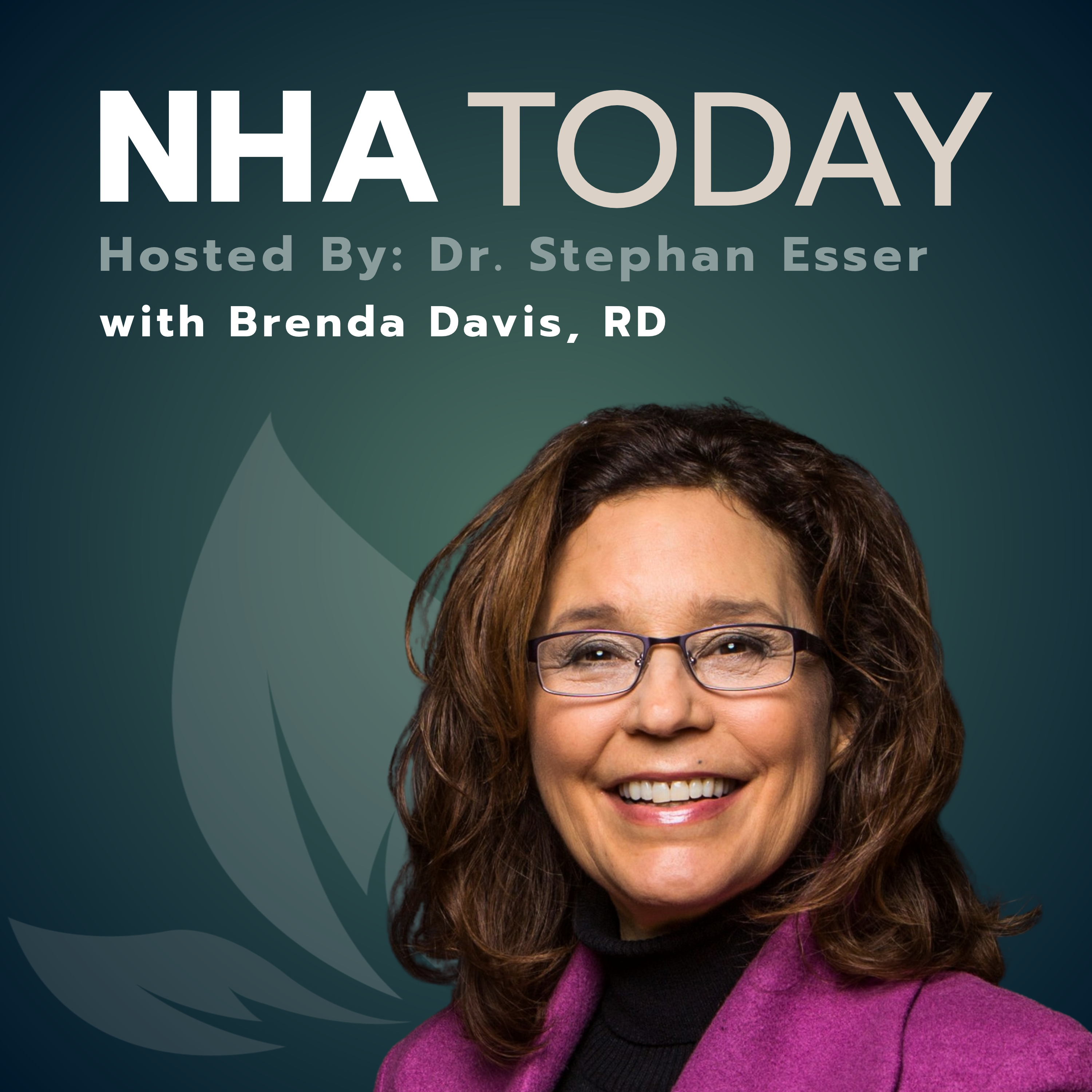
NHA Today Podcast · National Health Association
The Essential Nutrition Habits for Protecting Your Muscles, Bones and Brain as You Age As we get older, our bodies need fewer calories, but that doesn’t mean we need fewer nutrients. In fact, some nutritional needs actually increase with age. So how can we make sure we’re eating the right foods to maintain our strength, independence and vitality? In this episode of the NHA Today Podcast, Dr. Stephan Esser welcomes plant-based nutrition expert and bestselling author Brenda Davis, RD, for a practical conversation about nutrition and healthy aging. Drawing from decades of experience and her book Plant-Powered Seniors, Brenda explains why protein, calcium, vitamin B12 and other essential nutrients deserve special attention as we age. She shares simple ways to make everyday meals more nutritious, protect muscle and bone health and support cognitive function through a whole-food, plant-based diet. They also explore Brenda’s personal journey to plant-based eating, how nutrition science has evolved over the past 40 years and why healthy eating doesn’t have to mean giving up the foods and traditions you love. In This Episode Why our nutritional needs change as we age How much protein older adults really need and the best plant-based sources Simple ways to make everyday meals more nutrient-dense The essential nutrients for maintaining strong bones and muscles How plant-based nutrition may support memory and cognitive health The role of food variety and fiber in supporting gut health When protein powders or supplements might be helpful How to navigate family meals and traditions while eating plant-based Practical food swaps that can make healthy eating easier Brenda reminds us that healthy aging isn’t just about living longer. It’s about maintaining the strength, mobility and mental clarity to keep doing the things we love. About Brenda Davis, RD Brenda Davis is an internationally recognized registered dietitian, nutrition educator and author who has spent decades advancing the science of plant-based nutrition. She has served as a public health nutritionist, clinical nutrition specialist, nutrition consultant and academic instructor. She has presented at medical and nutrition conferences in more than 20 countries across five continents and co-authored 14 award-winning, bestselling books. Her book, Plant-Powered Seniors, provides practical guidance for meeting nutritional needs, preserving strength and supporting healthy aging through plant-based eating. Plant-Powered Seniors: https://plant-poweredseniors.com/ Website: https://brendadavisrd.com Instagram: https://www.instagram.com/brendadavisrd/ Facebook: https://www.facebook.com/brendadavisrd LinkedIn: https://www.linkedin.com/in/brenda-davis-72571618 About Dr. Stephan Esser Dr. Stephan Esser is a board-certified physician specializing in sports medicine and lifestyle medicine and the host of the NHA Today Podcast. Instagram: https://www.instagram.com/esserhealth/ Connect with the National Health...
Stephan Esser MD: Hello, and welcome to another NHA Today podcast. I'm your host, Dr. Stefan Esser. And today I'm joined by the one and only Brenda Davis. Brenda is a leader in her field and internationally acclaimed speaker. She's worked as a public health nutritionist, clinical nutrition specialist, nutrition consultant, academic nutrition instructor. She's been a featured speaker in medical, nutritional, and dietetic conferences in over 20 countries on five continents. She's co-author of 14 award-winning best-selling books, and the list goes on and on. And I actually just I'm gonna go off the notes for a second here because I wanna say something. In the last 20 plus years of being involved kind of in the health community and speaking around the country, et cetera, Brenda Davis is one of my personal health heroes. And here's why. So Brenda has not only, you know, walks the walk and talks the talk, but she also presents and speaks and shares with people with a true level of empathy, with a true level of just kind of compassion for people. The work she's done in places like the Marshall Islands. But then to the next other level, to the work she's done at the international level, writing dietetic journal articles that have changed the way that dietitians think about plant-based nutrition, et cetera. So I'm gonna just start this very special moment for me, Brenda, just saying what an absolute gift you are to all of us and all of the work that you've done and continue to do in the books you're writing that we're gonna hear about today. And thank you for inspiring me and being always so compassionate to me and so kind to me all the times that I've met you over the years. Ew and I was first just starting to speak and cutting my teeth, you were always so warm and so willing to be supportive. And just I just want to say thank you for that. So Brenda Davis: Well Stefan, I am just overwhelmed with that introduction. Thank you. You are a health hero to me as well. And I I am just so grateful to be here. And that was one of the kindest introductions I've ever had. So thank you so much. Stephan Esser MD: Well, it's from my heart and every word of it. So let's get right in now that we're past the mushy part. Let's get right into that. So here is my let's start with some questions for you. I want the audience to get to know you more and and I want to get to know you more. And so I'm gonna ask you this question, you know, have you always eaten a plant-based diet? Brenda Davis: No, I and I that's one of the things that I admire so much about you and your upbringing and your your just lifelong experience with this. I was raised in you know, my dad was French Canadian, my I very traditional diet, plenty of meat and dairy. My mom did a lot of home cooking, but we also had a lot of junk food and always lots of ice cream and Cakes and all sorts of things like that. And so plant-based eating really was not part of how I was raised at all. Stephan Esser MD: So but what attracted you to it then? If you were raised with more of a traditional approach, was there an aha moment or was it a slow progression? Brenda Davis: there were there were I I would say almost both, because I've I've always had this sensitivity to animals. I can remember as a little kid, Stephan Esser MD: Mm. Brenda Davis: you know, just picking the worms off the sidewalk for fear that they would get run over by a bicycle or stepped on or something. Like a lot of us, I think, have that compassion when we're really young, and then we slowly get desensitized to all of that. But when I was in high school, I I developed a fascination with nutrition and with health and all of those things. And and and you know, vegetarian diets to me seemed so appealing, but they almost seemed like a practical impossibility. I'd I'd only ever met one vegetarian in my whole life. And my dad thought he was an absolute wacko and that it was like, criminal for him to be feeding his children this way, So I didn't have that exposure at all. And I just couldn't imagine being able to do that. But you know, after I graduated with a degree in human nutrition and became a public health nutritionist, I just started seeing more and more articles and and books Stephan Esser MD: Mm. Brenda Davis: that, you know, even things like Diet for a you know, a small planet and and I remember this one book, More with Less, and it was all about eating in a way that was more responsible and and would create fewer carbon emissions. I think this was in the 70s, you know? Stephan Esser MD: Right, right. Yeah. Brenda Davis: And and so it the more I learned, the more it just made sense to me, not only for human health, but for the health of the planet. But you know, to be honest, ultimately what really changed everything for me was. I was prodded to learn more about the industrial animal agriculture industry. And and and it happened because of a friend who was deer hunting and he stopped by on his way hunting, and I tried to make him feel really guilty about killing an innocent animal. And it was what he said to me that really changed the course of my life. He said, you know, he said, just because you don't have the guts to pull the trigger. Does not mean you are not responsible for the trigger being pulled. Every time you buy a piece of meat camouflaged in cellophane in the grocery store, he said, at least the animals I eat have had a life. He said, you can't say the same for the ones sitting on your plate. And I Stephan Esser MD: Wow. Brenda Davis: was silenced. I was absolutely silenced. And when he left, I made a vow to myself that I would begin to take responsibility for the food that I was eating. And I started to research. I ordered animal agriculture magazines and I realized that the goal was to produce the greatest amount of meat for the fewest dollars. Stephan Esser MD: Yeah. Brenda Davis: And and it, you know, I you know, once I started to understand the suffering that animals endure, I I knew there was nothing that could justify it. It was simply unjustifiable as a human race. We should not be doing this. And so to me, it was, you know, the we couldn't justify it saying that, well, it tastes good or it's convenient or it's tradition or it's our culture. Stephan Esser MD: Yeah. Brenda Davis: History has taught us that even deeply entrenched traditions can perpetrate terrible injustices. And that is how I began to view the modern animal agriculture industry. And and my mom was raised on a farm. She they had a name for their cow. And they had, it was it was a very different world. And and today, you know, the the pain, suffering, and slaughter of animals is just beyond our wildest imagination, and that's why it's very much behind closed doors. So you know, in a nutshell, plant-based eating for me began as an interest in nutrition. Stephan Esser MD: Mm-hmm. Brenda Davis: But it quickly evolved into something so much deeper. it was a commitment to protecting human health, but also preserving our planet. And and you know, expanding my circle of compassion to all sentient beings, which I think is a responsibility of the human race. And we're Stephan Esser MD: Well. Brenda Davis: so far from it. But that's what did it for me. Stephan Esser MD: it's a beautiful thesis statement there. I feel like you hit the trifecta, right? This can this, Brenda Davis: He's Stephan Esser MD: importance of human nutrition, right, and health and the vitality that comes from that nutrition, planetary health, and then the compassion to animals. I mean, I just it sounds to me like I mean, there's so many things wrapped up in that that it's, you know, I mean, how can you say no? Right. I mean, if you if you're presented with all of that information, unless you are just a a selfish hedonist, right? I mean, it kind of like the reality, right? It's just wow. Brenda Davis: It's it exactly, it's a moral imperative that we move towards a world that is more compassionate, more sustainable. we want to leave something for the future generations. And we, you know, there it we have to do it now. I mean, if we don't do it, it's we're gonna be forced to do it eventually because of what's happening globally. So I just think we need to really take responsibility and and start eating in a way that's consistent with all of the things that we value so strongly. Stephan Esser MD: you've been on the forefront of kind of advancing a plant centered diet for decades. And and as you've kind of been on that forefront, I'd ask you the question what kind of changes toward a plant centered diet have you seen in our society over the last number of decades? Have you seen changes? Brenda Davis: my goodness, have I seen changes? Well, you know, when I was in university, like this is over 40 years ago, we learned two things about plant-based diets. We learned vegetarian diets were risky and vegan diets were downright dangerous. And you know, that was it. That was it. and and you know, vegetarian diets were not appropriate for children or or pregnant and lactating women, vegan diets for no one. That and and you can imagine. my decision a few years later to become completely pretty much vegan was scary because in those days it was not viewed as something that was a reasonable choice. But the changes have been truly extraordinary. You know, most people in those days didn't even know what a vegan was, to be honest. Stephan Esser MD: Right, right. Brenda Davis: There were very few vegetarian and vegan health professionals, mostly within the Seventh-day Adventist community or you know, religious communities, Buddhists, that, you know, those the people that were making those sort of ethical choices for religious reasons. and the scientific literature was really limited. Even in the 80s, there were, well, there were 70s and 80s, there were a handful of studies on vegan diets in. Children. There were two in the 80s that were considered the classic studies, but earlier studies on some very rigid communities that showed gross malnutrition in children were viewed as proof positive these diets weren't adequate. and and so you know, and and most of the research we did have focused on this, on Could can these diets meet our nutritional requirements rather than exploring any potential health advantages or anything like that? Stephan Esser MD: Mm-hmm. Brenda Davis: And and practically speaking, being vegan wasn't that easy. You know, there were very few plant-based options like non-dairy milks or yogurts or anything like that. Eating at restaurants, people would look at you very strangely if you asked if they had any vegan option. They didn't even know what where you are talking about. some different planet or so it was it was a lot harder. But you know, and I think 40 years ago we asked a question, can people actually thrive with eating without eating animal products? Is it even possible? But today the conversation has really shifted away from simply asking whether these diets are nutritionally adequate to exploring how they can promote health and How they Stephan Esser MD: Right. Brenda Davis: can, in some cases, help to manage or reverse disease. And the other thing that I think is super exciting is we have more and more physicians, dietitians, and other health professionals who are embracing plant-based diets. And we have, you know, the American College of Lifestyle Medicine and the Plantrician Project and all of these organizations that support health professionals that are. Are making these kinds of choices. And the food landscape I think has changed beyond recognition since, you know, in 40 years. We have Stephan Esser MD: Right. Brenda Davis: everything. You can get anything plant-based, milks tofu, temphi, and meat alternatives, and you know, just a ton of products and restaurants. We have lots of vegetarian and vegan restaurants, but almost all restaurants offer some plant-based options in their menu. I can remember going to a really fancy, fancy restaurant in Tofino. It was c what was the the Wikinanishin or something like that? But anyway, it was a very fancy restaurant. And my friend said, I've been here before, but I don't think they'll have anything for you. And I went up to the desk to check before going. And I said, Do you offer any vegan options? And she said, my goodness, she said, We have a whole vegan menu. And that's Stephan Esser MD: Love it. Brenda Davis: we're seeing that more and more. And of course, you know, I I think what excites me most is that plant-based eating isn't viewed as simply an alternative lifestyle anymore. It's recognized a l as a a legitimate evidence-based approach to to promoting health and planetary health as well. And I mean we still have work. There's no we can't kid ourselves. There's Plenty of misinformation. There's a growing trend towards carnivore style diets. And so there's still lots of work to do. But I honestly, if somebody had told me 40 years ago that we would be where we're at today, I I wouldn't have believed them. And I think it's been one of the greatest, really privileges of my career to witness and contribute to this. transformation in the way that I have been able to. Stephan Esser MD: That's so true. right? You walk into any gas station almost many times these days, they have green smooth like a Dwellas, right? Or bold house farms or some of these things. You're like, what, what's going on? So that's a beautiful thing Brenda Davis: Yes. Stephan Esser MD: to see. And I I like what you hit there too at the academic level, right? Some of these transitions that we're seeing where people are more willing and comfortable at the academic level to talk about it as though it's a legitimate option rather than as like some weird, you know, bizarre thing done, you know, that we should never allow people to do. And so it's beautiful. Brenda Davis: And you know, I have to add to that, you know, I have had opportunities to speak at at national dietetic conferences all over the world, but when I spoke at the Academy of Nutrition and Dietetics, and this is probably 20, 25 years ago, probably 25 years ago, I I I had a room that would hold 900 people. And we had probably 300 people on the floor and 200 people out the door to listen. and it was the second biggest selling tape, that lecture of the entire conference. The first was the keynote address. But there was so much interest. And then a a couple of years later, I had the you know privilege of speaking for dietitians of Canada. And I can remember, you know, being so scared that I would be ousted from the profession when I started on this journey. And I can remember the president of the of of our organization coming up to me after I spoke and saying, I just want you to know that you make me so proud to be a dietitian, Stephan Esser MD: wow. Brenda Davis: and saying, thank you for the work that you've done. It's been so important. And so just having that, Stephan Esser MD: Awesome. Yep. Brenda Davis: stamp of approval or whatever you would call it from, you know, the these organizations has been so So wonderful i and and so really and truly we are seeing that kind of acceptance among mainstream health professionals. Stephan Esser MD: Very exciting to see. It's funny you bring that up. I saw sometime back a pediatric preventive cardiologist. And when I shared with them kind of what my children were eating, they turned and said, this is wonderful. I'm so excited they're eating this way, you know? And I was like, Wow, you know, what a cool kind of, you know, because I'm Brenda Davis: Aww isn't that great? Stephan Esser MD: certainly 40 years ago, that probably would not have been the response. so to see that Brenda Davis: No. Stephan Esser MD: that that evidence, right, is kind of trans transforming, kind of you know. Brenda Davis: Yeah, forty years ago we would have they would have reported us to their children's aid. Stephan Esser MD: That's right. Bad things happening here. You know, you've been in this space for decades, teaching at every level, like you said, the academic level, right? The organization level, the personal, inter interpersonal level. You know, what when you see people transition, you talked about your own transition. When you see people transition to a plant-based diet, what are some of the common reasons that you've seen that people change their behavior? Brenda Davis: Well, I I think if you were asking me why people become vegan or pant plant exclusive, my answer would be a little different because ethical and environmental concerns play pretty major roles in in that decision for many people. But when it c when it comes to adopting healthier diets, I think there are really four, or at least I see four key motivators. And and the first is really a health wake-up call. So, someone gets diagnosed with pre diabetes, diabetes, hypertension, heart disease, cancer, whatever the case may be, they recognize that without health, you lose your freedom. And health becomes their number one priority. And a lot of times there's enough information out there to give them a sense that diet could actually make a meaningful difference. And if they're lucky, they'll have a health professional. That guides them in that direction and not just diet, but other lifestyle changes as well. And I think the second, and this is a really powerful one for a lot of people, is inspiration from others. So you witness Stephan Esser MD: Mm. Brenda Davis: someone else's transformation, and then you start to believe that it's possible. So it could be a family member who improves their blood glucose or cholesterol or both, or a coworker who drives their diabetes into remission. Seeing someone else make really profound changes and experience the rewards for that just makes change feel possible for others. And then I think another is just a lot of people, including young people, have a desire to optimize health. And the the this is a group of people that are already super health conscious, but they want to keep raising the bar. And so they're they're researching, they're digging, they're They're trying Stephan Esser MD: Mm-hmm. Brenda Davis: to find what really is optimal and they're interested in prevention, performance, you know, all of those things and doing everything they can to stay healthy. And so often they end up, you know, where doors are open that would would guide them in a plant-based direction, which is quite wonderful. And then I think the other is sort of on a s in a similar vein, it's it's the desire to age well. And and as people Stephan Esser MD: Mm-hmm. Brenda Davis: get older, they become you know increasingly aware of how precious their health and independence are. And though they they just want to be strong and active and mentally sharp. They want to be able to travel and hike and garden and play with their grandchildren and continue doing all the things they love. I can remember my granddaughter saying to me, you know, she said, Grandma, she said, You're not like other grandmas. She said, most grandmas they don't do cartwheels, they don't do handstands, they don't, slide down the slides and go on the monkey bars with their grandchildren. She said, I am so lucky. And I just thought, Stephan Esser MD: The best compliment ever. Brenda Davis: you know, I just thought that's why we're doing this. We have Stephan Esser MD: Right. Brenda Davis: so I have so much fun with my grandchildren. It's just you know, it's Stephan Esser MD: Awesome. Brenda Davis: It it just makes life so much more fun and enjoyable in every way. yeah. Stephan Esser MD: Right. I think that's a perfect segue to, you've written 14 books, many of bestsellers with great awards to them. Most recently you wrote a book titled Plant Powered Seniors with some of your colleagues. And I just wanted to hear about that. What's the what was the inspiration for this book? Brenda Davis: Well, I would say the inspiration just came from recognizing that older adults are an often overlooked, nutritionally vulnerable population, and that there was a real need for a practical, comprehensive guide to healthy aging on a plant-based diet. And and for us, you know, the I mean, there were we had three authors on this book. It was very personal. So Vesanto, who is one of the authors. And I have been writing plant-based nutrition books together for decades. And now, you know, we're both seniors. Sh I'm 67, she's 84. And our co-author Charlene Black, who is a physician and a university professor, is in her 70s. So we're, you know, we've got the younger seniors, middle seniors, older seniors, and and you know, I think one of the greatest challenging you know, or challenges I should say of aging. Is that we need fewer calories as we get older, but we don't need fewer nutrients. And in fact, Stephan Esser MD: Mm. Brenda Davis: some of our nutrient requirements actually increase. And you know, preserving muscle mass and strength becomes you know so important. And so what ends up happening is we need to pack more nutrition into less food. And that is a a a big challenge for a lot of people. And so for us writing this book, we needed to take all of that into consideration, but we also wanted to be go, go beyond preventing nutritional deficiencies and chronic disease. We we really wanted to help people preserve their strength, their mobility, their cognitive function, independence, vitality, all of that well into their later years. And you know, I think of people like Ann Esselston, you know. And Caldwell Esselston who are in their 90s, and Anne who broke a world record for the, Stephan Esser MD: Right. Brenda Davis: the dead hang. And she's just so amazing. And that is what is possible when you make these healthy choices throughout your life. And so mean, that's why we wrote this book. We just wanted to really support those who had a desire to either eat a plant forward or a plant exclusive diet. to do really well as they you know as they grow old. Stephan Esser MD: Awesome. When I think about that, that's such a good point. I see so many patients, right, as they age who are eating less, but now they're just teetotalers, if you will, right? Eating this, Brenda Davis: Yes. Stephan Esser MD: a little bit of ice cream, a little bread, et cetera. And their nutrient needs are not being met. So I here's a question for you. What is your take on the use of fresh squeezed juices andor fresh smoothies with all the fruits and veggies, et cetera, that to help people get a little bit more concentrated burst of nutrients? Do you are you for that? Against that? What's your take? Brenda Davis: I'm totally for that. and because I I've I feel like we need to be flexible in our guidelines. And and so for someone who you know is having a hard time getting enough calories in, putting those calories into liquid form in a smoothie that you can add soft tofu, hemp seeds, frozen peas, all kinds of greens and Making those foods easier to get down in it's just you can get a lot of calories in a smoothie without filling yourself up the same way you would with the same solid foods. And so what a wonderful way of providing excellent nutrition, even if you have dental challenges or Stephan Esser MD: I was gonna say, right? Brenda Davis: whatever the case may be, I think it's a wonderful thing. And then in terms of juicing. when you're juicing, you can add things like dark leafy greens and Stephan Esser MD: Mm-hmm. Brenda Davis: different wide variety of vegetables and ginger and fresh turmeric and all Stephan Esser MD: Right. Right. Brenda Davis: of these amazing you know anti-inflammatory, antioxidant loaded foods, and there's no fiber to inhibit the absorption of those nutrients. So you're just they're very, very available for absorption. And so I think that they can have absolutely a wonderful role in the diet. It's just they can be a lot of work, but you can, I think there are some companies that will provide those things for you. So I definitely think they're a wonderful option and and need to be, you know, considered at least. Stephan Esser MD: Give me an example. Let's say I'm gonna give you a common breakfast somebody may eat. And then if you can give me an example of, you know, some things somebody might do to maximize the nutrients in it, right? So this this this senior who's trying to maximize their vitality, reduce inflammation, slow cognitive decline. Let's say. So I make a bowl of oatmeal with some raisins, bananas, and water and cinnamon in it. Now, have at it. What can we do to take that to the next level? Brenda Davis: so much. So much. So, first thing is, you know, rolled oats are fine, but but the closer you go to the intact grain, the better. So you could step it up to steel-cut oats, you could step it up further to oat groats. And then one of the things I love to do if you're doing oat groats, it takes about the same amount of time to cook lentils. So you could add a few lentils to those oat groats and add. protein, iron, zinc, getting all of those nutrients in. You can add hemp seeds, you can add so some of these omega-3 rich seeds, flax seeds, chia seeds, etc. So getting some omega-3s in there, you want to get protein up as well. So you want, that the hemp seeds, and I like cooking in in soy milk or at least adding a lot of soy milk to that cereal as opposed to water, because then you're adding a whole lot of other nutrients, including a lot of protein, which you you know, you're aiming for most seniors, probably at least 20 grams per meal. So you doing that can help you get there. And then where are all those antioxidant-rich you know, choices in this mix? So you want berries and all kind like I like to have a variety of fruits in my breakfast bowl. So this morning for example, I had blueberries, raspberries, I had some chopped-up peaches and bananas. So all of those Stephan Esser MD: Yum. Brenda Davis: in there, and and then I always have because I love it, some sort of a stewed fruit on top. And my favorite is Italian prune plums, and you just stew them with the tiniest bit of water until you know they cook at a slow heat and then they're completely covered. in liquid by the time and then you just put them in jars and I do about fifty sixty pounds of these in the summer to or in the fall so we have some in the wintertime. And I'll never forget one morning Joel Furman was at our place and I was serving breakfast and he said, Well what is this? And I told him what it was and he did not think it sounded very good. And then he tasted them and I think he might have eaten two entire jars. He said this Stephan Esser MD: Love it. Brenda Davis: could be one of the best things I've ever eaten in my life. Stephan Esser MD: that's awesome. Brenda Davis: They are so good. And that goes on top. And then I I always add the you know seeds and other things to the top as well. But I think there are so many ways of fortifying that breakfast to make it you know have such a good nutrition pun. Stephan Esser MD: You know what it strikes me, right? Because if you told me eat a bowl of lentils for breakfast, I'd be like, come on. I don't really want that savory necessarily. But then Brenda Davis: Yeah. No. Stephan Esser MD: if you're just adding a little handful in there, they mix in with the oats and you probably don't even notice them, you know? Right. And they're right. Brenda Davis: You you don't notice them. I don't notice them at all. And I have to tell you, I sometimes like this morning our breakfast included the the the the the grains that I cooked, sorghum, barley, camut, and oak roats and the lentils. So I often mix up variety of grains. Sometimes there's quinoa in there, sometimes there's, you know, Stephan Esser MD: Nice. Brenda Davis: whatever. You can do all kinds of grains, and I make a big enough batch. That it goes into my fridge, and then I you can add, whatever you want to it. But sometimes I make it very plain so that I can put it on salads and stuff like that as well. Stephan Esser MD: Right, right, right. Brenda Davis: And then if I do it plain and not creamy, I make a chia pudding with, and my chia pudding is just soy milk, prunes. So that's my sweetener, is prunes because I use dates quite a bit as sweeteners. So I like to use prunes in the chia pudding. And a touch of vanilla and that's that's and some hemp seeds. I put soy milk, hemp seeds, prunes, and a touch of vanilla or vanilla powder. Stephan Esser MD: Sounds tasty. Well, and there's the good data, right, on prunes being so good for the bones, right? So one or two a day with regards to osteoporosis, Brenda Davis: Yes, exactly. Yep. Stephan Esser MD: et cetera. I love what I'm hearing from you there, right? Is you're complementing this basic foundational caloric intake with all these different micronutrients that influence the cells at different levels in different ways. And that diversity we know is so good for the gut, right? Having 30 plus different foods a week or whatever it is, right? That helps with gut flora, right? It's just, you're hitting everything. Brenda Davis: Yep. Well, and and the 30 plus a week. One day I just decided for fun, just my eating my usual thing to see how many I was getting in a day in one day. And I was at 58 without Stephan Esser MD: Ha ha. Brenda Davis: including most of the spices. So Stephan Esser MD: That's awesome. Brenda Davis: it was just like I'm getting 20 at each meal, it seems. Stephan Esser MD: Right. Well, and this is why all the people need this, right? Especially we know in North America, in America, especially and and in in the US, right? We know that fewer than eight percent of Americans consume the recommended amount of fruits and vegetables, right? So we know Brenda Davis: Yes, exactly. Stephan Esser MD: they desperately need to learn more about this. And when you when you think about this senior population, what are a couple things that senior plant-based eaters need to be more conscientious of than let's say their, 30 year old peers? Brenda Davis: Yeah, so so I would say, you know, if I think about nutrition specifically, I think the first is getting a reasonable balance of macronutrients. So protein, carbohydrate, and fat, and not just balance but quality from the of of nutrients. So, you know, protein of course becomes important as we age because we become less efficient at building and maintaining muscles. So we need to make sure we're getting enough of that and spreading it reasonably. through the meals of the day. And then we want high quality protein as well. So we want it to be coming from foods that, you know, when we say high quality, we're really talking about, you know, macronutrients that are intrinsic to whole plant foods that provide a lot of other value other than just those macronutrients. So the fiber, the phytochemicals, the antioxidants. And then you know high quality carbohydrates. So that means from whole plant foods. And And then, we also want to be getting high-quality fats and enough healthy fats. And we might want to consider our essential fatty acid sources as well. So all of that is important. And then we need to start thinking about micronutrient adequacy. And so for seniors, you know, we we have higher recommendations for vitamin D and vitamin B6 and calcium and So we want to think about micronutrients and how we're going to meet those requirements. So vitamin B12, of course, is essential for anyone eating a plant-based diet, but it becomes especially important as we age because our ability to absorb it can decline as well. And then calcium and vitamin D and iodine, I think all deserve attention. Depending on dietary choices, you know, we might have to consider iron, zinc, selenium, choline. But for many people, if you're eating a really varied diet, those can be pretty much taken care of. But certainly calcium and vitamin D often fall short. So we really need to think about those. And then another thing that a lot of people don't really think about is getting enough food. And so it may sound surprising because most people overeat and we think about overconsumption. But for older adults eating whole food plant-based diets, Sometimes they have very small appetite and and they get full easily. And so we need to think about that. And here is where the smoothies can fill Stephan Esser MD: Right. Yep. Brenda Davis: that gap beautifully. And and so we need to just be intentional about getting enough food, maintaining a healthy weight, maintaining our muscle mass and strength and so forth. And then I would say a fourth thing is we need to think about nourishing our gut microbiome. And we talked about that already with the variety of choosing getting at least, a thirty, I would say thirty a day, but thirty a week, whatever. We need to have a big variety, a wide range of legumes and whole grains and vegetables and fruits and nuts and seeds and all of the different fibers they you know offer to support a diverse, resilient gut microbiome. And then Stephan Esser MD: Right. Well, and I think many of us are guilty of not having enough of those in the home, right? We have our specific things Brenda Davis: Yes. Stephan Esser MD: that we're accustomed to consuming and then we don't have that diversity. Yeah. Brenda Davis: Yeah, exactly. And then the other thing I think we really need to be aware of is as we get older, we have less room for what we call discretionary calories. And that means we we want to maximize the benefits of whole plant foods while minimizing potentially harmful dietary exposures. And this can be, you know, low nutrient ultra-processed foods. I think there are some processed foods that can play a very valuable role. Diet, fortified non-dairy soy milk or you know, or non-dairy milks, which can provide extra calcium and vitamin D and B12 and so forth. But plant foods provide, you know, such an array of phytochemicals and antioxidants, you know, that support long-term health. So, but we need to think about dietary exposures like you know, excessive use of high temperatures, especially dry heat. all of the potentially damaging environmental contaminants that that can come in various foods. They tend to move up the food chain, especially persistent organic pollutants. But those kinds of things we need to think about microplastics. And we're not eating fish, but maybe we're eating a lot of salt and salt can be a source. Or maybe we're using, you know, water in plastic bottles and these kinds of Of things. Stephan Esser MD: Right. Brenda Davis: So I think we need to factor that in as well as we get older because we want to minimize our exposure to these harmful compounds. Stephan Esser MD: Makes a lot of sense, right? As we age, that our immune systems are becoming a little bit more senescent as well. And so Brenda Davis: Yes. Stephan Esser MD: we know the second leading cause of death, of course, is cancer right after the heart disease. So making sure that we're addressing those other areas, that's a really good one. Good tips as well. Now, all of that was a lot of great stuff. Is all of that stuff covered in your book for? So there we go. So Brenda Davis: yes, absolutely. Stephan Esser MD: and again, a reminder to those of you who may have missed it, the name of the book is Plant Powered Seniors. And you can get it on Amazon and everywhere else. I just looked it up the other day and saw it. So definitely want to get out there and get it. if you have a senior in your life, Brenda Davis: Thank you. Stephan Esser MD: or if you are a senior, or if your, you know, hopes is to have a healthy senior life, it's a good time to read it. So lots of reasons to get the book. I'm gonna put you on the Brenda Davis: Thank you. Stephan Esser MD: spot here. Protein intake. You talked a little about it, it's a hot button topic. and so here I am as a clinician. I have a 67-year-old female. I'll put together a little story here for you. She's an avid walker. She has some elevated blood pressure and is otherwise healthy. She's five, six, weighs about 130 pounds. When you think about protein intake for her, how much does she need per day? And let's say you you can give it to us in grams per kilogram and all that as well. and what types of foods should be focused in on, right? Brenda Davis: Well, before I answer your question, and I can relate, because I'm 67 as well, so you picked a good age there, but before I get into it, I want to tell you something. I have had, I c can't tell you how many, but number of women who are seniors, often 70s, 80s, who come to me saying that, you know, I'm having issues. Like my my skin is thin, it breaks and bleeds and bruises so easily. My nails and my hair, my, are not doing so well. My hair is always falling out. my stomach is is distended, like it's like I'm bloated. I having all of these issues, and everybody tells me that my diet is perfect, like I'm eating a whole food, plant-based diet. What could possibly be wrong? And so I do an analysis, and almost every time they come in between 35 and 40 grams of protein. So they're eating their half a cup of beans. They might be, you know, having oatmeal and almond milk with their blueberries and some seeds for breakfast, but it's it's so often on the on the low end. And it it as soon as I bump them to you know 60, 70 grams of protein, it's like these issues resolve in fairly Stephan Esser MD: Mm. Brenda Davis: short order. And they're shocked. They said, well, why didn't Anybody tell me protein's the last thing I thought of. Everybody said if you eat a you know healthy plant-based diet, you get enough protein. And I said the the that that's generally true for most adults, but for older people who are eating less and need more protein for various reasons, you know, it may not be enough. And so so I would I generally recommend one to one point two grams of protein per kilogram body weight per day for seniors who are healthy. Stephan Esser MD: Okay. Brenda Davis: for seniors who are struggling with a chronic disease or sarcopenia or something like that, the the common recommendations are 1.2 to 1.5, which is not easy to get as a senior on a plant-based Stephan Esser MD: Right. Brenda Davis: diet. They may need to have some more concentrated protein sources like hemp, you know, hemp hearts added to things, or they may even want to add a clean protein powder or something like that. Stephan Esser MD: Yeah, I was gonna ask you about that. What your take is on the use of protein supplementation. Yeah, let's say that Brenda Davis: Yeah. Stephan Esser MD: somebody has an already very healthy program nutritionally. what is your take? And and do you do you recommend cycling different types of plant based proteins? Do you recommend one over the other, right? Because we've got so many options now, rice and hemp and soy and you know, the list goes on. So what's your take? Brenda Davis: I I like to get my nutrients from foods. And so I I I like if I'm doing a smoothie, it's gonna have hemp seeds and soft tofu and maybe some frozen peas, those kinds of things added, and I don't add any concentrated protein. But I would never say that it's not an appropriate option for some people. And it may be an an an appropriate option for some athletes who need 1.6 grams of protein per kilogram. It may be an option for seniors who are having a really hard time eating enough. And and you know, so for most of my ladies, I you know, I I just tell them to switch their almond milk for soy milk, add a few tofu cubes to their salad, you know, just tiny little things, three or four changes, and they're they're up from 35 or 40 to sev 60, 70 grams, just Stephan Esser MD: Nice. Brenda Davis: like that. It it's not Hard to do. But for people that really are challenged, and this is another thing, Stefan, you can't, you when you when you calculate your requirements, it's based on your healthy body weight, not your actual body weight. So Stephan Esser MD: okay. Brenda Davis: this is really important. So if you weigh 200 pounds and your healthy weight is 150, you're basing your protein requirements on 150 pounds. And you'll divide your weight by 2.2 because there's 2.2 pounds per kilogram. And so for this woman you're talking about who's 130 pounds, she'll she'll you know need 60 to 70 grams of protein a day. But getting back to the the question about the protein powders, I you know it's interesting if you look at the amino acid profile of different plant proteins because potatoes come out shockingly good. we're looking for for enough leucine, because that drives muscle protein synth synthesis in elderly people. And some people are are worried about getting, you know, driving mTOR and and and increasing cancer risk from eating protein. But in fact, you know, you need to be building muscle after you eat, after your resistance train. And it's not that building muscle after you train or you eat that's the issue. It's chronic mTOR activation where you're overeating constantly, you're eating a Western-style diet, and you're dry, you've got this chronic overactivation of mTOR. The healthy, normal, cycling of mTOR. Stephan Esser MD: Right. Brenda Davis: You need to build and maintain muscle as you get older. So, and we need enough leucine to do that, which means enough of the legume family. Yeah, you may have a little Setan thrown in there. That's really important. And so, you know, when it comes to choosing a protein powder, if you decide to go in that direction, you want something that is third party tested, free of contaminants, you know, or low in contaminants. Stephan Esser MD: Right. Brenda Davis: I don't know if there's anything that's free of contaminants. But certainly that's been third party tested. And I think it's not a bad idea to have a mix of different types of protein. And so I mean, hemp protein's great, but proteins that we don't necessarily think of as being, you know, great when they're extracted and concentrated like potato protein is quite impressive. Soy is fine, you know, all of these different types. So I Stephan Esser MD: Yeah. Brenda Davis: think that actually matters a little less than that it's a Clean third party tested protein source. Stephan Esser MD: Makes sense. we talked a little about yeah. Brenda Davis: Now, getting back, let's get back to yeah, I was just gonna say getting back to to the challenge of meeting protein requirements. the stand the standard adult RDA in North America is 0.8 grams per kilogram body weight. So, and we still don't have a separate RDA for seniors, but they do in a lot of countries. Australia, all the Nordic countries, Austria, Germany, I mean there are a lot of countries. with separate higher protein recommendations for older adults. And there's a really good reason for that. As we age, we're losing muscle mass. Our muscles become less responsive to the muscle building effects of protein. And this is known as anabolic resistance. And so we need a little more protein to stimulate the same muscle building response that we would have had as a younger adult. So, and the other thing, you know, getting enough protein isn't enough. We have to combine it with resistance training. It helps us to preserve muscle mass strength and independence. And we need to do that at least two or three times a week. And the other thing I would say is don't get all your protein at dinner. You need to get a reasonable amount in each meal to maximize muscle protein synthesis. And so that I think is also important. And then the other thing I'd want to say is that we can easily meet our protein needs with whole plant foods. and so you're wanting to have the soy milk and hemp seeds and some nuts at breakfast and some higher protein grains. you get, 10 to 13 grams of protein in a cup of chemic berries or a lot of these intact grains. And but then things like tofu, tempeh, edamami, so lentils, beans, chickpeas, all can make really valuable contributions. And soy foods are really useful because they provide super high quality protein. Tofu, the protein, is pretty much as digestible as it is from animal products. But you know, I think there's variety is important, but there's no, you know, no reason not to eat soy, even though there's some negative press about so we just want it to be organic and you know you want it to be relatively unprocessed. I mean like tofu is minimally processed I I would say tempeh I make at home when it's very easy to do. and and then you know edamami and those kinds of things are really wonderful. And and you know I think getting back to your patient Because she has slightly elevated blood pressure, she needs to watch her sodium and ensure enough potassium and fiber-rich whole plant foods to keep the sodium in in check, enough magnesium and so on. And yeah, I think I think that pretty much covers it. But she would be aiming for 60 to 70 grams of protein, 20 grams per meal if she has a snack, maybe five or 10 in the snack. Instead of just having an apple, maybe she's having an apple with some. mixed nut butter or peanut butter, something like that. Stephan Esser MD: Mm. Yeah. If you do you have a favored way for people to track their caloric intake? and all the proteins and fats and all the rest. Brenda Davis: Yeah, I don't think people need to do this consistently on a day-to-day basis, but there are a lot of apps that will track this chronometer and all of these other things. Stephan Esser MD: Right. Right. Brenda Davis: And I've never used any of those. I mean, when I'm doing an analysis, I use Ashra, but but I think doing it for a week or two can be really educational for people. And and I'm not an expert on which apps are best or anything like that. But just it I think a lot of times people learn a lot by by putting in what they're eating. They realize where there Stephan Esser MD: Yeah. Right. Brenda Davis: are some important gaps and maybe how they can fill those gaps in a reasonable way. So I think it's a good exercise. Stephan Esser MD: It seems Yeah, I was gonna say just even that awareness of what's going into your mouth. So so many people are right, eating in an unaware fashion. So we talked Brenda Davis: That's exactly right. Stephan Esser MD: some of there about the science, about the needs for protein. We talked a little about this example of an individual. I I'm curious to bring it back to you again. You know, what was the hardest part of adopting a plant-based diet for you? What was the hardest part? Brenda Davis: you know, and this is a long time ago. So this is like four almost 40 years ago that that Stephan Esser MD: Yeah. Yep. Brenda Davis: my family made this tri change. And there's no question, for me, the hardest part wasn't giving up the meat, dairy, and eggs. It was navigating the impact that of our new way of eating on our families, on our extended families. Stephan Esser MD: Mm. Mm-hmm. Brenda Davis: because food in in my family, food was You know, such an expression of love. And my dad was quite an amazing cook too, not just my mom, and and and for him it was a powerful expression of love. And my favorite food as a kid was Wienersnitzel. We grew up in Germany, and if you don't know what Wienersnitzel is, it's a veal cutlet that's breaded, fried in and it fried in butter, and then with mushroom gravy on top. That was my favorite. favorite thing in the world. And so, for him, well, my birthday would always be Wienersnitzel. He would buy these two inch steaks. I loved filet mignon and lobster tails. I loved scallops and you know all of that thing. And so those were treats. And now you know he couldn't do that anymore. It it was really hard. And you know I our and our both families on both sides, my husband's and my family were so worried our children were just small, my, four and one when we became completely plant-based and they were terrified that we're gonna stunt the kids' growth and, so Stephan Esser MD: Yeah. Brenda Davis: so navigating, I n for me the most important thing in the world is family. And I I I didn't want this way of eating to interfere with the connection I had with my with my parents, with my aunts, with my uncles, with my cousins, with those people were so important to me with my husband's family. And and so that was the thing that was most difficult for me. And and difficult for them as well. They, you know, they want to make us happy and make you know do g you know carry on tradition and and custom and and all of a sudden we couldn't eat the turkey at Thanksgiving or Christmas. Stephan Esser MD: Right. Brenda Davis: And And so it was, I think, no question, that was by far the most difficult thing for me. So we had to find these new ways to honor our traditions and stay true to our values and be able to share meals with our family that was still very omnivorous. And so very quickly I learned to make a a kind of a tofu roast that is, you know, mash four or five pounds of tofu and season it and then you put it in a a sieve with cheesecloth on each side and you it molds to that shape and then it gets stuffed with whatever stuffing is your favorite traditional stuffing and and and then you've got this beautiful centerpiece that you can put alongside the whatever turkey or whatever they're preparing Stephan Esser MD: Right, right. Brenda Davis: and then figure out ways. now my sister-in-law she'll do, you know, if she's doing the potatoes she'll do two separate pots. Stephan Esser MD: Right. Brenda Davis: And then we'll do use, she'll use a little bit of whatever instead of butter in the vegetables, maybe olive oil. And I don't worry about that stuff at the special occasions. If people are trying to make it, Stephan Esser MD: Well that's right. Brenda Davis: plant friendly, then that's I'm really grateful for that. And so that's just how I've I've navigated it. But the easiest part, surprisingly, was the food itself. I I've always loved cooking. I've loved experimenting. I love cooking healthy food. And for me, creating amazing, delicious, plant-based meal was a meals was a was a fun challenge and it was an absolute joy. And so rather than feeling like I had to give things up, I felt like I was discovering a whole new world of foods and flavors. And you know, I remember making that little, those little broccoli trees on a casserole or whatever for the kids and doing fun things and and yeah i the the kids they learn to love what they grew up with. I'll yeah and Stephan Esser MD: That's right. Yep. Brenda Davis: I'll tell you a story like this is people be shocked but my kids l loved vegetables and I can remember my daughter at nine years of age coming up the stairs and saying Mom what could I have for a bedtime snack and I said honey just look in the fridge and see what you can see and She found a batch of spinach. She said, mom, we have spinach. Could I cook it for a snack? And I said, sure, honey. And she got out the frying pan and she put fresh garlic in it and a little bit of tamari Stephan Esser MD: No. Brenda Davis: and she cooked it all up and she's sitting at the table with her plate of spinach and she's squeezing fresh lemon juice on top. Stephan Esser MD: my goodness. Brenda Davis: And and and my son, who was six at the time, walks upstairs and he sees her and he goes, Is that spinach? And she says, Yes. And he said, Well, is there any more? And she said, No, I'm sorry I ate the last batch. And he just burst into tears. Stephan Esser MD: Ha ha ha. I love it. I love it. Brenda Davis: And so it's what you expose your kids to and Stephan Esser MD: That's right. Brenda Davis: the and the excitement you have around the foods that will really impact what they'll learn to love. So Stephan Esser MD: Well, and I think I can resonate with that so well, right? Growing up as a plant-based eater is that, the things that r set off the neurologic memory in my brain of love and connection and being cared for from the birthday parties, et cetera, may have been those, you know, those dates that were stuffed with peanut butter at my birthday party, right? That we'd have every year or whatever. Or the the fresh banana ice cream that my mother would make from frozen bananas through the champion juicer, right? Those, when I Brenda Davis: Okay. Stephan Esser MD: now make that for my children, right, it lights up a part of my brain. That just feels that connection, that love, et cetera. Just like the kid maybe who grew up with Chuck E. Cheese or grew up having Domino's pizza at their birthday parties and has that neurologic connection, So that's that's Brenda Davis: Exactly. And it's so interesting because my mom was actually adopted and we were reunited with her birth family about 20 years ago. Stephan Esser MD: Wow. Brenda Davis: And I discovered that my grandmother was a Seventh-day Adventist vegan, Stephan Esser MD: Yeah. Brenda Davis: basically, who created, they said her food was out of this world. Like she made her own almond milk and gluten roasts and all of these things. She would even make gum for the kids from the stuff from the trees. And it was Stephan Esser MD: I love it. Right, right. Brenda Davis: just, I and I never had the privilege of meeting her because she unfortunately passed away before we were connected. But I was just, I couldn't believe that. It was, I feel like it was there genetically somehow. Yeah. Stephan Esser MD: Somewhere deep in the roots. I love it. we were talking a little about the nervous system and the brain and our memories of things. as we age, so many people struggle with cognitive decline. And if you had to, if you had to, counsel people in general, and I know there's part in the book on this, just about top four or five things to people be thinking about eating as they enter into those senior years that can help help with brain health. What would what what would those couple things be that you just say, make sure that blank. Brenda Davis: Yeah, for sure. And and I think of all of the things that we face as we get older, cognitive decline is the one that's most feared. because we lose ourselves over and over and over again, Stephan Esser MD: Mm-hmm. Brenda Davis: and our families lose us. And it's like they mourn over and over and over again as we develop dementia and we start to not remember, you know, things that are so important. but you know, the good news is that That most of the foods associated with better brain health are plant foods. And you know, one of the sort of best-studied dietary patterns is the mind diet, which combines elements of the Mediterranean diet and DASH diets that are associated with better health. But when I think of, you know, three or four things we should really be doing, first adding leafy greens and colorful vegetables, which you know provide an abundance of The protectors of phytochemicals, antioxidants, essential nutrients. And then second, berries, especially blueberries and Stephan Esser MD: Mm, mm. Brenda Davis: blackberries, which are rich in polyphenols, which we know may help protect brain cells. And then third, legumes, soy foods like tofu, tempeh, edamami, Stephan Esser MD: Mm. Brenda Davis: all the foods and whole grains. They all provide protein and fiber and nutrients that support healthy blood vessels and blood glucose regulation. And the fiber, of course, also n nourishes the gut microbiome, which may influence brain health, of course, through the that gut-brain connection. And and I mean think that's just super, super important. We have to remember that all of the ways of eating that protect our heart also protect our brain. So that's super important. And then the fourth thing are nuts and seeds, especially walnuts and omega-3 rich seeds like flax and chia and hemp seeds. providing the omega-3s. And then for people who are exclusively plant-based or vegan, I think we need to consider B12 vitamin D and the long-chain omega-3 fatty acids. And B12, we need a most of us need a supplement because few of us eat enough fortified foods to get the B12 we need. And and this I think is important to mention. The the NIH recommends that everyone over 50 relies on supplements or fortified foods and not animal products for B12. And the reason is simple. B12 in animal products is bound to protein. And we need enough stomach acid and enzymes to cleave the the B12 off Stephan Esser MD: can Brenda Davis: the protein it's bound to. And when we're over 50, our ability to do that diminishes. And it's estimated up to about 30% of seniors do not do that. So So the recommendation is for all people over 50 to rely on supplements or fortified foods, not just vegans or plant-based eaters. So that's important to recognize. And then vitamin D, everybody tends to be low in vitamin D, it seems. Even people who are fair-skinned and exposed to sunshine, we still, so many of us are low in vitamin D, but as we get older, our ability to make vitamin D from sunshine diminishes. one of the things that I think is fun to know is that the the f there are very few plant foods that are significant sources of vitamin D, but mushrooms are one of them. And mushrooms, you can if you buy mushrooms, button mushrooms, or portobello or oyster or whatever in the grocery store, you usually don't know if they've been exposed to sun and if they're sources of vitamin D. But there's a trick you can do when you bring them home. So you can put them on a cookie sheet. gills up, put them in warm sun for 15, 30 minutes or an hour if you want. And you will increase the vitamin D to the extent that one serving will supply your day's needs. And that vitamin D will last there for, a week in the refrigerator. So it's Stephan Esser MD: Wow. Brenda Davis: a really simple trick to to to use to boost the vitamin D in your mushrooms. But vitamin D is important. And then the long chain omega-3s are are really important. And and and we, you know, we still are trying to figure the long chain omega threes out in terms of their impact on brain health and you know, our ability to make long chain omega-threes, all of that. But generally our ability to convert omega-three, you know, the alpha lenic acid into DHA, DPA and EPA is is limited. And so it's kind of like a precautionary thing to consider taking a supplement of DHA and EPA because we know that people with dementia tend to have lower levels in their brain. We know that probably half the fat in the brain is DHA. Stephan Esser MD: Right. Brenda Davis: And it's really important. Now, there was a study that just came out that showed giving 2,000 milligrams of DHA per day for two years. increased DHA levels in the blood and tissues, but it didn't reduce cognitive decline. And so that, got on the radar of a lot of people and they started saying, well, I guess it doesn't matter if we take EPA and DHA. But the reality is all they used was DHA. And some of the critics are saying EPA it it has a synergistic effect with DHA and they we need both. And so it might have been a very different result if we would have used both. And also it may have been a different result if we would have done it for five years rather than two years. And there are a Stephan Esser MD: Right, right. Brenda Davis: lot, so there's so many un unanswered questions, but I personally have had my omega-3 index tested and and and I I supplement. it was 5.7%. I strive for six to eight percent, and so I started taking a little bit more. And for some people that means. 500 milligrams per day. For some, it might be 750 or even a thousand, depending on where your levels start. But what we know is vegans' average levels are probably around three to four percent. average levels in the omnivorous or general population tend to be around four to five, depending on how much, you know, fatty fish is being consumed. Stephan Esser MD: Right. Brenda Davis: And and and and people in Japan, it's closer to 10 or 11 percent. Stephan Esser MD: Wow. Right. Brenda Davis: Because they eat a lot of fish. And so it seems as though this is one of the one of the low-hanging fruits that we can kind of take care And then I think it's important to mention that no single food or supplement will guarantee protection against dementia because there's also a genetic you know, factor as well. And so, but even if you carry the genes, you know, you've got you've got the Apo4 or you know some of these genes that will increase your risk. it doesn't mean you'll necessarily develop the disease. And so there are there are a lot of things we can do to reduce our risk, even if we have something like that. So there was a a 2024 study from the Lancet that estimated That about 45% of dementia cases could be prevented or delayed by addressing 14 modifiable risk factors. And they included things like high blood pressure, elevated LDL, diabetes, physical inactivity, smoking, hearing loss, social isolation, like those kinds of things. But what's particularly important is most of the risk factors are strongly influenced by our everyday choices. a healthy diet and preferably tons of plants, regular physical activity, not smoking, maintaining social connections, all of those things play a very important role. And one of the things that I would say is do not underestimate the impact of hearing loss as well. Because you know, so many people when they can't hear, I I recognize this because my mom was having problems with hearing. And and she had surgery and it's been corrected to a significant degree. Her personality when she had the sig severe hearing loss, and now that she can hear Stephan Esser MD: Mm. Brenda Davis: well, it is night and day. So when you can't hear well, you pretend you can. And and so you're misunderstanding things, you're saying things that sound silly, you don't want to say things because you might say something that sounds silly. Stephan Esser MD: Right. Right. Brenda Davis: You don't want to be in social situations where you can't hear people because you won't be able to respond. So you isolate yourself and you're scared to talk for fear that there'll be a response that you can't respond to. And it is extremely socially isolating. And so that's something that I think as we get older we really need to be conscious of. so yeah, and of course we need to have appropriate medical care, we need to manage blood pressure, cholesterol, all of that stuff. Manage our vision and hearing problems. And all of those things will could you know significantly contribute to to having a healthier cognitive function as we age. Stephan Esser MD: Well, you're setting it me up there, right? For the kind of a the addressing it is a very comprehensive approach, right? It's not just a single nutrient or a Brenda Davis: Yeah. Mm mm. Stephan Esser MD: single bullet. and that's what we heard from somebody I just recently interviewed as well on the cognitive aspect of things. And so kind of good reinforcement there for all of us to do what we can in each of those areas. You know, maybe Brenda Davis: Absolutely. Stephan Esser MD: an area that might be a little simpler. What about with the aging seniors, in particular women who tend to have more variability in their iron levels? what are what are some of the key n Key foods that should be on the plate, on a daily basis. Brenda Davis: Yeah, and I think that's one of the key misconceptions in nutrition is we you need to eat meat to get enough iron, and even recommendations for infants, you know, serve meat as one of the first foods for their iron. but plant-based diets actually do provide plenty of iron, and studies often find that vegans consume as much or more iron as meat eaters. And usually it goes like this: vegans, vegetarians, meat eaters, which Is just strange to people. But many of the, you know, vegans will be over 20 milligrams, vegetarians around 19 or 20, v omnivores around 18, 19, something like that. Because a lot of the food that they're eating doesn't contain iron, even though they're consuming meat. But the thing that we do need to recognize is plant foods contain non-heme iron. Animal foods contain non-heme iron too, but they also contain heme iron, which is super highly bioavailable. And so iron status may be different even though we're eating more iron. And so we tend to have lower serum ferritin levels than omnivores. And this could be a a good thing if they're within you know the reference range, Stephan Esser MD: Mm-hmm. Brenda Davis: just at the lower end, because high ferritin is associated with higher blood iron levels and more, you know, iron can act as a prooxidant, so can accelerate Stephan Esser MD: Right. Brenda Davis: oxidative stress. And so so how do we, how do we improve well and the other thing I should say is that is that senior women it at that they're no longer menstruating and so their iron requirements are for an a menstruating woman are about eighteen milligrams per day, and then they drop to the same as men, which is eight milligrams per day after they stop menstruating. Stephan Esser MD: Yeah. Yep. Brenda Davis: So So often iron, you know, is less of an issue than it would have been in their earlier years. But there are still people that do, you know, end up having low iron levels. And so, how do we deal with that? Well, number one, get to know which plant foods are super high in iron because there are a number of them. One of the best is lentils. So lentils are even Stephan Esser MD: Mm. Brenda Davis: better than other beans and chickpeas and so, but tofu, tempeh, and then certain seeds like Pumpkin seeds are a really good source. Some whole grains are great sources. Some leafy greens, and even iron fortified foods can contribute. Like often veggie meats, if people are eating them, can be fortified with iron, as can, of course, a lot of whole grains or grain products. and then and then once you've and then other, you know, iron-rich foods, things that we might not think of, like black strap molasses and and and Stephan Esser MD: Yeah. Brenda Davis: Dry some dried fruits and these things can contribute as well. But of course, legumes and nuts and seeds are the superstars here. And then the next thing we want to do is we want to pair iron-rich foods with iron absorption enhancers. So the one that most people are familiar with is vitamin C. So when you eat an iron-rich meal like a lentil dish with red peppers or broccoli, for example. You're going to increase the absorption of iron from that iron-rich food by probably two to six times. So this is really impressive. But there are even other things that can enhance iron absorption. So things like garlic and onions and carotenoid-rich foods and ginger and turmeric, and there are other foods that can actually boost iron absorption as well. And then the third is just to be mindful of the compounds that inhibit iron absorption. And the two Stephan Esser MD: Mm. Brenda Davis: biggies are phytates from wheat bran and other whole grains and legumes and polyphenols, especially like tannins from teas. And if you, for example, have a breakfast bowl and you sprinkle it with wheat bran. You may reduce the absorption of the iron from that meal Stephan Esser MD: okay. Brenda Davis: by 50 to 90 percent. So you want to eat whole plant foods, but you don't necessarily have to to extract the fiber and sprinkle it all over everything because you're already getting a load of fiber with your whole plant foods. And so also there are ways of reducing phytates by soaking, sprouting, yeasting, fermenting, you know, all of these things can help. To reduce phytates in foods naturally. And then the polyphenols tea. If you drink tea with a meal, again it can reduce iron absorption probably 50 to 90% from the meal. So, I mean, especially we're talking black tea, green tea, even some herbal teas can reduce if they're high in polyphenols. So we just want to make sure that we separate our tea drinking if we're challenged with iron. w from our main meals by an hour or two. drink your tea between meals instead of with your meals. and then, you know, just just recognize that, you know, it's not a bad idea to have your iron status tested. And and you know, it like like I said, lower stores is are not necessarily bad if they're within the reference range, but we still want to have decent iron status. And so know and if you're suffering from unexplained unexplained fatigue or or whatever that you think you you may be iron or b twelve deficient you know just make sure you're tested and and you know Stephan Esser MD: Right. Brenda Davis: so you can identify what what is causing you know and and the thing is is is particularly in older adults iron deficiency may mean that you're losing blood somewhere so there may be in some sort of GI bleed or something like that that can can be the cause, and that definitely needs to be ruled out. Stephan Esser MD: lot of good stuff for people to unpackage there. So everybody I go back and review that part so you can take notes and write out a game plan for yourselves. I love how specific there is a lot of good detail in there. And well, you know, I wanted to address one more area if we could, and that was on, you know, bone health, which we know unfortunately, Brenda Davis: Okay. Stephan Esser MD: right? An epidemic of kind of osteoporotic, you know, changes that occur for women. and, you know, when you think about nutrients and nutrition to help protect the bones, what would be the and I know Everybody buy the book. All of these details are in the book. So this is a these are some of the highlights that she's giving us. But what are some key essential nutrients or foods that you think about on a daily basis that that everybody should be eating for healthy bones? Brenda Davis: Well, this is a really important question, especially for people eating you know, plant-based. And and of course, for senior women, particularly, because our estrogen levels are declining, which of Stephan Esser MD: Mm-hmm. Brenda Davis: course can accelerate bone loss. But it's you know, it's it's really relevant for people eating plant-based because a number of studies have found that that vegans have lower bone mineral density and higher fracture rates than meat eaters or Lacto-ovovegetarians. And some of the biggest studies have combined the vegans and lacto-ovovegetarians, and lacto-ovovegetarians often also have slightly higher risk. But it does it doesn't mean we can't have strong bones on a vegan diet, but it does mean we need to be intentional. And so one of the the biggest reasons probably that we do have a little bit higher risk is because we're we do we tend to be slimmer. So there's you know, there's less stress on the bones when you're slimmer. and and and less bone because we're smaller. And and so that's a big a big factor. But we need to think about calcium. And I think a lot of people say, you know, you don't really have to worry about it. We're you know, we don't pee out as much calcium, whatever, on a plant-based diet. But women over fifty and men over seventy, the RDA is twelve hundred milligrams a day. And I think it's n a reasonable idea to try to aim In that vicinity. And so the best plant sources are things like calcium set tofu, fortified plant-based milks, and low oxalate greens like kale, bokchae, broccoli, Chinese greens. But it's important to recognize that high oxalate greens like spinach, Swiss chard, and beet greens, although they're very high in calcium, that calcium is largely unavailable. We might absorb 5% of the calcium from those foods. Stephan Esser MD: Uh-huh. Brenda Davis: because it's it because of the high oxalate content. And Stephan Esser MD: Mm-hmm. Brenda Davis: so the the low oxalate greens, you're getting about 40 to 70 percent of the calcium from Stephan Esser MD: Wow. Brenda Davis: those greens. Now that compares to cow's milk at about 32 percent. Soy milk is very similar to cow's milk. calcium set tofu is in that vicinity of 20 to 30 percent as well, probably 25 to 30 percent as well, but the that we absorb the most from low oxalate greens. So close to double what we might absorb from cow's milk. But people, you know, are not necessarily eating the volume of greens they would need Stephan Esser MD: Right. Brenda Davis: to meet those calcium requirements. So getting greens in I love the way the Esselstons do it where they have these, you know, these these greens between meals, with meals, you know. So that's a a wonderful way to to boost your green intake. And then the other thing is even if you, you know, you manage to get to that 1200 milligrams of of of calcium, you need vitamin D to be able to absorb it. And so, you know, and as I mentioned, our ability to make it declines with age. So we need to ensure an adequate intake. And I live in Canada. It means we have this long, what we call vitamin D winter. It means the no vitamin D winter, really, where we can't make vitamin D because we don't get warm sunshine. You need warm sunshine to make vitamin D. And so we need to act, we need to take a supplement, there's no question. And then the other thing that a lot of people don't realize is protein is essential for both muscles and bones. And Stephan Esser MD: Yeah. Brenda Davis: protein makes up an important part of the bone matrix. And strong muscles help to protect us from falls. So, Stephan Esser MD: Right. Brenda Davis: and to help to keep the bone strong as well. So, you know, we need to make sure we're getting a decent amount of protein. And then fourth, we need to recognize the many other bone-building nutrients. So vitamin K and magnesium and potassium and you know, even you know, even what do we find in flax seeds? You know, we we find high levels of a number of nutrients that that are are really important for bones. So boron being one of them. So that's that's you know that's important to recognize and vitamin K, some people will take vitamin K2 because it it is you know thought to be most important for bones. Many of us make enough vitamin K2 from K1. But if you've been on a course of antibiotics, you don't have that same microbial army that will produce the K2, so you might need Stephan Esser MD: Right. Brenda Davis: to supplement at that point. And then the other thing I would say is eat enough food, again, inadequate calorie intake, Stephan Esser MD: Yeah, yeah. Brenda Davis: and unintended weight loss accelerates bone and muscle loss. And so, what we see in terms of the greatest risk are people with the lowest BMIs. Like in Epic Oxford, they found the risk only increased with people with a BMI under 22.5. and that's probably you and me. So we need to be aware of that. And you know, I have to say myself, I my mom had osteoporosis at 50 years of age. And so when I was 50, I thought, well, I'll get my bone density tested. And My bone density was so high they couldn't even plot it on the graph. There was an arrow at the top. My doctor was absolutely stunned because I had already been vegan for 20 years. And he said, I he said, I don't know what you're doing, but just keep doing it. He said, your bone density is over is is two, I think it was 2.2 times above expected. You know, it was just Stephan Esser MD: We'll take it. Brenda Davis: crazy. But then I decided at about 65 to have my bone mineral density done again because I had been postmenopausal for a dozen Stephan Esser MD: Right. Brenda Davis: years. And it was not the same story. I was not, Stephan Esser MD: Yeah. Brenda Davis: I didn't have osteopenia or osteoporosis, but my bone density was definitely inching towards osteopenia, which shocked me. I thought my bones, because I do a lot of physical activity, Stephan Esser MD: Right? Brenda Davis: I do weights, I do push-ups, I do all of that stuff. My diet is is pretty much as good as it gets. And still my bone density is declining. I don't take any hormones. But you know, Stephan Esser MD: Yeah. Those hormones. Right. Right. Brenda Davis: obviously they have a big impact. And we need to recognize that and do what we can do to, you know, really preserve our bone mineral density. Stephan Esser MD: Right. Well, a lot of good nutritional tips there for people. And I know even more in the book for people to kind of review and and learn from. You know, I I really enjoyed having you on today. And I always love leaving our our Brenda Davis: Thank you. Stephan Esser MD: our viewers and our listeners with a couple very tangible things. And obviously you shared so much valuable and scientifically based information throughout the talk. But if you were sitting down with someone who just turned to you and said, Brenda, what what are three or four things that I can do? Starting today to improve my health, what would you what would you counsel them? Brenda Davis: I would say number one, set your focus on whole plant foods. Make them the foundation of every meal. You know, just think of ways that you can sneak vegetables, fruits, legumes, whole grains, nuts, and seeds into each meal or not sneak, but make them the foundation. You know, and and make you know, each food group brings something different to the table. So try to have you know something that will will represent each group in your meal if you can. The more variety we include, the more nutritionally complete and satisfying our diets become. And so get, you know, just buy things that you might never have even tasted before. Try to get that variety. I love going to Asian supermarkets. And you know, I I I remember the first time I bought a pomelo and I just thought I'd died and gone to heaven. It was just so good. Stephan Esser MD: Ha ha. Brenda Davis: And so some of these things, my husband just brought back some grapes from one of these ethnic stores that they were long and skinny, and I think they were the Stephan Esser MD: Right. Brenda Davis: best grapes we've ever eaten in our lives. They were so good. And so it's just fun to try. You know, try passion fruit, try some of these different foods, but make whole plant foods with a foundation. And then, you know, there are some. Things that I would consider nutritional superstars and make them regular guests at your table. I'm thinking of things that just provide an extraordinary nutritional return. So again, the dark leafy greens, the cruciferous vegetables, the mushrooms and berries and beans and lentils, and the omega-3-rich nuts and seeds. Like these are nutritional powerhouses that are packed. With all of the good things we we need, like fiber and phytochemicals and micronutrients and so on. And then the third, I would say, make some simple swaps. And maybe this should be the first to improve the quality of your diet. So, you know, begin if you're just starting out on this journey, begin by replacing a refined grain with a whole grain. Like maybe going from white rice to brown or black or red rice. you know, replacing a sugary cereal with oatmeal and then maybe steel cut oats and gradually, you know, go to a more whole grain. processed snacks with fruits and nuts. I love Stephan Esser MD: Mm-hmm. Brenda Davis: having a bowl of unshelled nuts on my counter. And if I'm hungry, I might crack open a walnut. My grandchildren love that bowl of nuts because it's so much fun to crack them open. And Stephan Esser MD: All right. Brenda Davis: you know, it's just it's a really it just think about swaps like that. So swapping your dairy milk for a non-dairy milk, swapping, you know, just easy, easy swaps that you can do. and and then it you know, think about. Don't focus so much on what you're giving up. Focus on all the wonderful foods you're adding. And then I think fourth and maybe the most important of all is make cooking your superpower. It's just it's one of the most transformative things that you can do for your health. So, you know, we need to learn to prepare healthy foods. And many of us, unlike Stefan, who grew up With this wonderful array of foods that were just part of your daily repertoire. Most of us didn't grow up eating these foods. And so it's like a whole new world. And sometimes we feel like a fish out of water. Like, how do we navigate? What do we do with an intact whole green? What do we do with beans and lentils or tofu when we've never eaten those foods in our lives? And so taking a a a plant-based cooking class, going to potlucks, just starting out with recipes and now we have the internet and the recipes on YouTube and the different people that are providing whole food plant-based recipes that are totally amazing. and and so I I just I I I think it's important for us to learn to love being in the kitchen and to experiment. And and one of my favorite things is to take a family favorite recipe and veganize it or make it a plant-based make a plant-based version. And and one of the things I love is to hear somebody saying, This is the best whatever it is that I've ever tasted. You know, like I make a a lasagna that Where I make the the tofu feta with cashews and and tofu and then, a a cheesy sauce and with cashews and red peppers or whatever. And Stephan Esser MD: Yeah. Brenda Davis: and just making it beautiful and delicious. One of the things that I I, you know, blew away my family at Christmas once was I made about five different fermented cultured cheeses and using nuts and seeds, and they just couldn't believe they were real cheese. They were just shocked. And and I make something else that's a treat at, you know, for special occasions is that the you know, people love to get these Bach Cadbury turtles, you know, I think it's Cadbury that makes those turtles with the caramel inside. And so I've figured out a way to do a whole food sort of plant based troll. The only whole the part that isn't whole food is I use real chocolate, dark chocolate, though like eighty or eighty five percent. And you make the the Caramel using dates and pine nuts. And if Stephan Esser MD: Huh. Brenda Davis: you can't afford pine nuts, which many people can't because they're so darn expensive, you can use cashew butter. You can even use peanut butter to make a caramel Stephan Esser MD: Fun. Brenda Davis: and or a mixed nut butter. And you just whiz it up in the blender with a little bit of vanilla or vanilla powder. And and it's like caramel, it tastes like Caramel, it's unbelievable. You put your pecans on your cookie sheet with a dollop of the caramel, freeze it solid, and they get a really good high-quality dark chocolate. And just, it just goes on, you just spoon it on top and then it solidifies instantly, and they're so good. And my my granddaughter said, Grandma, I like your I like your turtles better than the turtles you buy in the store, you know. Stephan Esser MD: No. Hi compliment. that's great. Brenda Davis: yeah, it's just and then the other thing I think is important to note is that you don't have to change everything overnight. You know, start where you are, make changes you can sustain, one at the time if you have to, celebrate your progress and recognize that every little step you take in the right direction is a gift to yourself and and to the planet as well and future generations and So just do do what you can and and and keep moving in the right direction. Stephan Esser MD: Awesome. well, as expected, Brenda did not disappoint in sharing her passion, her stories, and her empathy with us today. Yet once again proving why you are one of my health heroes. So what a delight to have you on and what a blessing you are to so many. And I want to say again, thank you for everything you have done and are continuing to do to change the landscape of health, kind of. in your locale and internationally and throughout the world. And now most recently with this up and coming book, Plant Powered Seniors, which wanna encourage all my viewers to go out and get a copy of and read more, learn more, apply to your lives and continue to grow and thrive. So Brenda Davis, thank you so much for joining today. Brenda Davis: Well, thank you so much, Stefan. And I am so excited I'm so excited that you're doing this podcast and that you're doing so many things to just move this message forward. And thank you for having me as your guest. It was such an honor and a privilege. Stephan Esser MD: My pleasure. Thank you everybody for joining us today. We look forward to seeing you at the next edition of the NHA Today podcast.