
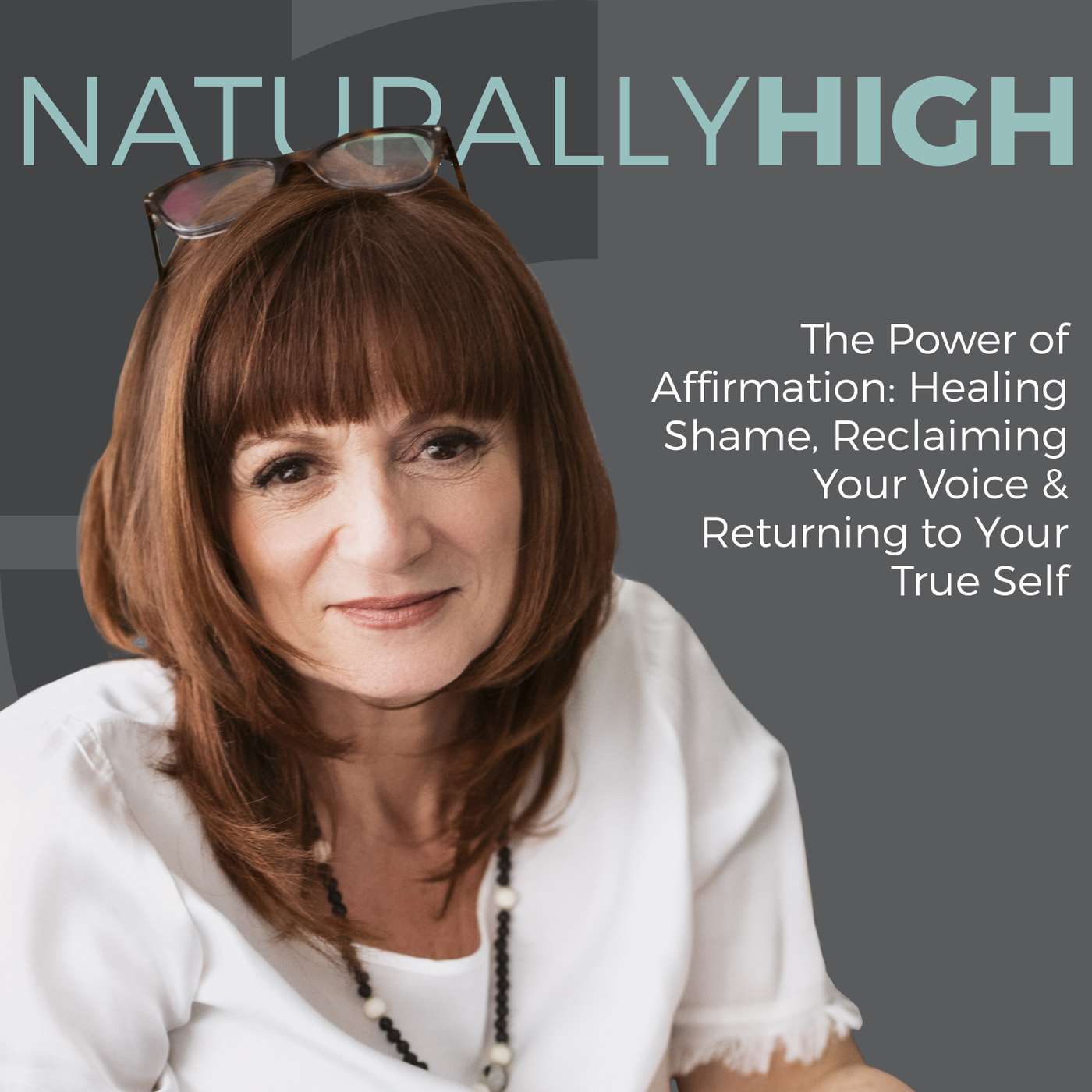
Naturally High · Jeanne Foot
In this episode of Naturally High, Jeanne continues the AWAKEN Series by exploring the second A in her proprietary methodology: Affirming. More than positive thinking or repeating affirmations, true affirmation is about emotionally validating your lived experience, so your nervous system can finally stop bracing for the next impact and begin to heal. Many of us grew up emotionally unseen, dismissed, minimized, or shamed. Over time, this lack of validation can quietly shape our lives, contributing to perfectionism, people-pleasing, addiction, emotional numbness, and the belief that there is something inherently wrong with us. Jeanne explains why one of the most powerful shifts we can make is moving from asking, "What's wrong with me?" to "What happened to me?" Drawing from trauma-informed, attachment-based, and somatic perspectives, Jeanne explores why healing requires more than understanding our past intellectually. Lasting transformation happens when we create enough safety to reconnect with the parts of ourselves that developed to protect us. As our nervous system begins to trust that healing is possible, shame loosens, self-compassion grows, and our authentic self has room to emerge. This conversation is an invitation to stop abandoning yourself, honour your lived experience, and begin affirming your own healing from the inside out. Resources discussed in this episode: Nonviolent Communication – Marshall B. Rosenberg Internal Family Systems (IFS) – Dr. Richard Schwartz Naturally High Exercises — Contact Jeanne Foot | The Recovery Concierge: TheRecoveryConcierge.com LinkedIn: Jeanne Foot LinkedIn: The Recovery Concierge Instagram: The Recovery Concierge Facebook: The Recovery Concierge Twitter: @recvryconcierge
Jeanne: [00:00:06] Welcome back to Naturally High. My name is Jeanne Foot and as always, I'm excited to be here with you today. So lately we've been unpacking the AWAKEN series. It's an acronym, which is what I use for my proprietary methodology. And it is not the only, but it's a kitchen sink approach to many different things but I've distilled it down to a methodology and it really helps us become the fullest expression of our most authentic and truest self with a capital S. So I want you to know that each show stands alone by itself or can complement one another. But today we're going to introduce the second A in AWAKEN, which stands for affirming. And if you haven't had a chance to listen, I encourage you to go back and look for the AWAKEN episodes, especially if you listen to them, you can listen to them in any order, but if you do listen to them in chronological, you'll find they're probably helpful, but a quick refresh. Jeanne: [00:00:58] So if you're joining us for the first time, the first A in AWAKEN is for awareness. To awaken to consciousness, which is really the portal to transformation. We literally cannot change anything in our lives if we're not aware of it. Now, W is for worthiness, and how we see ourselves is how we see the world. It really depends on the lenses of the glasses that I'm wearing is how I'm going to view things, whether it's a positive or, you know, a brighter or darker lens. It's also how I, you, me, all of us decide our worthiness. No one else does that. But we determine our worthiness through the lens of how we see ourselves, which is essential because our market value, if you want to use an analogy, is often the result of our inner narratives reaffirming either what we believe about ourselves and others, or what we don't believe about ourselves and others, and our self-esteem is vibrational frequency. So our self-esteem is the vibrational frequency of that reflection coming back to us. So what do I mean by that? If we see ourselves as less than in any way, that is the energy and frequency, the vibration that is going to be mirrored back to us. And as I said to you a million times, if you're joining us for the first time, this is not the last time you're going to hear me say this. Whether you think you can or you think you can't, you're right. Henry Ford, my favorite quote. It's all going to be self-fulfilling. So you might as well set yourself up for success in how you want that to be. Jeanne: [00:02:36] So today we're going to unpack the second A, which is for affirming. And to affirm is really to be validated for what you've experienced in life. And it's also an essential component for us to heal and move beyond whatever it is that you've experienced. Now it can come in the form of validation. It can come in the form of someone showing support for you, or acceptance of something or someone. But I don't want you to think affirmation is about slapping a positive quote over a lifetime of pain, because it's not thinking your way through a painful situation because that would be a bypass. If you're going to tell yourself it's going to be better and, you know, just get on with it, kind of pull yourself together and get on with it and it's all going to be better. It doesn't work that way. It's about really emotionally validating what you've experienced, what you've survived, what you've been through. It's about honoring your lived experience, your knowledge, your embodied healing so that your nervous system can finally stop bracing for the next impact and allow the true self to emerge. So when you've been distressed or had trauma or adversity, you're kind of waiting for that next shoe to drop. We've all heard that term or what's going to happen next. So we never fully relax into whatever the present moment allows us because we're hyper vigilant, waiting for the next thing to go wrong. But what's important is when we acknowledge our own experience as real, just acknowledge our own experience as real. Our shame loosens and the body begins to trust that healing is available to us. And it becomes our new baseline in that who you are becoming. Jeanne: [00:04:16] So that's a beautiful thing. Our internal narratives change for what's wrong with me to what happened to me. And that's also a beautiful change because we are putting so much shame and blame onto ourselves all the time, thinking we screwed up. This isn't right. We can't get it right. We're not enough in so many different ways. And when we recognize that we were really doing the best we could do with the circumstances we were given, that shame can loosen, that grace and compassion can come in. And that allows us to them move beyond it. So if you're a coach, counselor or therapist, affirm it is where your work and your client's work will meet you, where you can hold space for their truth while also trusting your own embodied wisdom, your training and lived experience, and the framework that guides you. So both are acts of emotional sobriety. Both are declarations of bringing light to the dark by raising your standards, resetting your non-negotiables about what is okay and what is not okay, and determine what is no longer normal. And telling yourself, I matter. My healing matters and I count. My healing counts, I count. Say it with me. My healing matters and I count. I promise you. Well, I was going to say I hope, but I do promise I would be shocked if you didn't learn one thing if you listened to this episode. Jeanne: [00:05:50] But my promise is that you'll find something that is of value to understanding yourself better. And if you don't, I invite you to be in dialogue with me. And maybe we can even expand that a little further. I invite both clients and practitioners to listen through a dual lens of how does this impact you personally and how does this impact you professionally? Because so many of us grew up emotionally invisible. Our feelings were dismissed, minimized, ignored, completely shamed. And that left us wondering, as young children, that there's got to be something wrong with us. It's got to be something wrong with me. Because to conceive that there is something wrong with your parents or your family is really too painful a reality, especially because children are so dependent on their families for survival. So what I think happens is we turn that war on ourselves. And this is where life starts to become even more painful. In fact, the very lack of validation in childhood contributes to addiction, perfectionism and emotional numbness. I think I'm being guilty of all three over my lifetime. Which are all gateways to finding coping strategies to help us make things feel more manageable. But they just exacerbate the whole problem into so much worse. So you're really retraumatized and traumatized children or traumatized people. So we're already kicking the dog when the dogs down. That's horrible. So let's look at this a different way. Jeanne: [00:07:21] Given what most of us have lived through, it makes sense that you should feel this way. Emotional validation is a gateway to emotional healing, and it allows us to make sense of what we are feeling. And in the context of your own story. And something as simple as I see you, this must be so hard for you can go a long way. It helps orientate us to our own inner world, allowing us to feel more steady and reduce the emotional intensity, which actually calms our nervous system and opens up the door for real learning and change. And that is typically the opposite of what we experience in these really dire moments is when something horrible has happened to us. It may seem benign for a parent, or it may be they're just not aware, but we're not validated and said, I see you. This is so hard for you. We're usually told the complete opposite pull yourself together. Get on with it. Don't be silly. What are you crying for? And so when that happens, we start to take our pain into white knuckling it. And it's not metabolized in it. And the way to metabolize it and transcend it is actually to feel it. It's the only way out is through. So it is one of the fundamental requirements to move through trauma and trauma beyond is to be validated for what we experience, that we're not going crazy, that our experience was real contrary to what we've been told. Jeanne: [00:08:55] And without validation, we learn not to trust ourselves. We start to second guess everything, our own intuition. We start wondering what's wrong with you rather than just the outer world has denied your experience. So I think this is a really important part that we be conditioned not to have the truth validated for us not to have our experience validated for us. And so of course, we feel like we're going crazy even though we're not. So one of the things this does is it stilts our true self because our true self cannot feel safe enough to be seen. And it, if it spent a lifetime trying to manage the chaos of our of our everyday volatility, it's going to start to hide behind fragmented parts of a younger self to keep us protected and safe. Many of us learned at a very young age to trade our authenticity for attachment. So you've heard me say this a hundred million times, and I think that's worth saying 100 million times means it's important. So pay attention. What happens is when we trade our authenticity for attachment is we basically say, I will do what I need to do to conform so that my world is predictable and safe. So whether that's staying small, staying quiet, people pleasing, fawning so we don't lose our connection with those around us, or our predictability. And affirming in this context means turning towards those parts with curiosity and reparenting them with warmth, and letting your adult self lead with integrity instead of old survival patterns. Jeanne: [00:10:40] So when we spent a lifetime of people pleasing, we really want to start to feel safe enough to allow those fragmented parts to come forward. And one of the things that I learned most recently is that our parts are not the complete I. I feel that I'm not enough versus a part of me feels that I'm not enough. And that's a huge distinction. So if we can slow this down and we can just gain some traction between stimulus and response, we can start to unpack some of this in a way that's very healing, heartwarming, and giving us the grace and compassion that we need to move forward. Now, although we need to be witnessed by another person, we must also be able to affirm our own healing. And that comes feel after we feel safe, when we feel safe enough to speak out, to offer a different opinion or try something new. It is the true self who is affirming us. We start to drop the personas and ask, who am I and why am I here? We start to question who we are being in these moments, because we've been conditioned to behave a certain way for most of our life. Doesn't mean that that's who we really are. It's who we've been accustomed to shown. Jeanne: [00:12:07] And that's a persona. And this is something I continue to ask myself on a regular basis as I'm constantly changing all the time. Who am I and why am I here? And when we feel steadier, we can stop the running. That's a big one. Big, big one for me. We can be with ourself and allow the bodily and heart intelligence to speak to us. So for me, I worked from the neck up. I think a lot of us do. I think people have heard the terms somatic experience in nervous system regulation. You know, grace and self-compassion, embodiment. And they probably think, yeah, these are buzzwords. They are so vital, so vital to us being able to understand ourselves and be able to move beyond those stuck parts of ourselves. So this is why I speak about it. This is why you hear about it. And we can't talk our way out of trauma. I've said this to you over and over again. All it does is exasperate us because trauma is an embodied sense. It's not just what events happen to us, which we can talk and regurgitate without meaning. It's really an embodied sense as well of what's wrong or what happened, rather. So our self-compassion and grace can find its way back to us when we stop abandoning ourselves, and we allow ourselves to get messy and triggered and, you know, not yet who we want to be. We are all of the things. Jeanne: [00:13:33] We are our parts. We are our personas. We are our triggers. We are messy. We are great. And it's only when you can start to welcome all of those parts of you and recognize that each part is a protector, trying to get your attention and asking you what would be helpful right now? What do I need? And when we do, grace shows up and it's allowing room for those parts that are still trying to catch up to our intentions. When we pair this with our heart coherence, where our mind and our body and I think spirit as well align, we gain access to a deeper intuition, much steadier self-regulation, and a really felt sense of intuitive guidance. This is where we stop fighting our story and start listening to what is asking us to become. And this can usually happen in the second half of life. And the second half of life doesn't necessarily need to be chronologically, you know, 40, 50 plus. It can be an event driven like, you know, you've had trauma, you've had a serious illness, you've had an awakening or whatever it may be, or it could just be that you've outgrown who you were because it's become too painful to suppress your true, authentic self. So when our internal world changes, so must our outer world. At the same time, this is where having clear, healthy boundaries is absolutely essential, because people who are trading their authenticity for attachment are not clear on what is important to them. Jeanne: [00:15:11] Their I don't know, they're very indecisive. They're waiting for social cues to see if, whatever their opinion or what the majority want before they offer up theirs. And so it is essential that we stop using conforming as a way of being accepted. And I want to take you back before we go forward. The importance of having a reparative experience in a healing relationship is the absolute essential component to repair early childhood wounding, and the reason being is the lack of attunement from primary caregivers, which created the original attachment wound can only be repaired when it's correctly attuned, and now it can be by someone who's safe in our life. It could be a coach, it could be a therapist, it could be a partner. It can be anybody who can absolutely provide attunement and safety. And really, attunement means that I'm with you. I'm tracking you. My undivided attention is with you and no one else in this moment. And you're the only person that matters. And when you feel that and when you are able to receive that, more importantly, you can then move beyond it. Do you hear me say about different tools and different people at different times? So we all want to build what I call our own emotional toolbox. And that can come in so many different ways. And it's something that we will do lifelong. Jeanne: [00:16:44] Whether it's we want to build anchors, like when we have these beautiful moments in our life as well, we want to anchor that in not just the negativity. We want to anchor in that. I remember feeling amazing when I went to that first yoga class. As you know, that's where naturally I came from that I went to this Kundalini yoga class and I came out of there as high as a kite naturally. And I thought, yeah, I want more of that. That would be a beautiful thing to anchor in, whether it's breathwork, somatic cues, rituals, people, practices. We want to give the body something to return to when it feels overwhelmed. So we can stay present enough to choose our authentic self over old attachment strategies. And when we do, we start to build different tools for different times, as I mentioned. And then it's not like, what do I do in these moments? For example, I have like so many types of breathwork, I do alternate nostril breathing, I do breath of fire. I have box breathing like we could go on and on forever. But what I'm trying to say is they all have their purpose. So one of the ones I use for anxiety all the time is alternate nostril breathing. It allows space between stimulus and response and it works incredibly quickly. Super accessible. You could do it in your car. Jeanne: [00:18:09] You could do it in the bathroom, even if you were in a work environment or in a, you know, a social environment. You can go to the washroom and, you know, calm yourself within a matter of 30 to 60s or a few minutes for that matter. And over time, these anchors and these tools help us embody our own healing. And we don't really have to outsource that to anybody. We just need to know that we can access it. So given what anybody has gone through, we want you to honor and validate whatever your experience is because that is your truth. That is your experience. And nobody should ever try to take that away for you or trump it with their experience. If you're human, you're on this planet, you've had some form of suffering, and that's what it's supposed to be. It's not supposed to be easy all the time. We can have suffering and we can have beauty in the same moments, but we have to make space for it. And we have to stop outrunning it because when we outrun it, we just can't. We just can't. And so therefore, all that happens is we make our pain so much worse. Jeanne: [00:19:19] So I want to talk about emotional validation, healing, because so many of us grew up emotionally invisible or feeling dismissed, minimize their shame that we've learned not to trust ourselves. And this is such a violation of self integrity, and we really need to rebuild that muscle back in that our experience was real. And the only person who can validate that for us now is we have to have, even though we do this in partnership with the right mentor or fellow journeymen, we also need to do it with ourselves. And this opens the door for real learning and change. And we have to be able to honor our history so that we can bring the self compassion to ourselves. Where formerly we would have just got triggered and bolted. And now we're asking you to hang on to yourself in these not always painful moments, but messy moments, especially when we feel we want to bolt and we have to start to honor our heart intelligence. And the research often describes a career coherency between mind, body and emotions, giving us a really deep access to intuition, steady regulation, and a felt sense of inner guidance. And basically, what I'm saying is this looks like you're learning to trust yourself. You can learn to say, I can sit with those quiet moments. I can feel a steady presence inside of me, rather than that ego bellowing from your ear and trying to drown you out. There's a different type of wisdom that comes through with all of this. And so I think this is important. I think grace shows up, allowing room for parts of us that are still trying to catch up to our intentions. Jeanne: [00:21:17] So many of us really have learned not to trust ourselves. And that makes absolute sense when we're being completely dismissed most of our life and told otherwise by, you know, wise, mature adult, quote unquote. So, you know, we learn to discount what we really want, what we feel. And we must think that, you know, there's something wrong with us, which is one of the reasons how we turn the war on ourselves. Because when the absence of, you know, appropriate validation and emotional healing and emotional capacity being mirrored back to us, we're going to think it's us. And so we need to have healthy boundaries, especially as we grow and evolve and change, right? And how we protect our healing without recreating harm, because people are going to find it inconvenient when we start to say no to things we normally would have said yes to, but maybe saying whatever answer we need to say, whether it's no or yes to something, it may be yes to me before I say no to you. And so I think it's really important that we understand that the context of our relationships can change. Where we used to say yes, which felt much more comfortable to people. Please, to be the person who's overextended themselves to say yes, whether it's, you know, doing that extra thing on a volunteer board or whether it's, you know, being the first one to sign up for a volunteer position or overstaying or babysitting or whatever it may be. Jeanne: [00:22:52] We, we get value out of that. We get protection out of that. We feel safe when we're doing that. But it quietly runs our whole life. So unless we're aware of it, we can't change it. And so it's really important for us to really know what our non-negotiables are. Like, what are we going to be okay with and not okay with? Especially as we start to say more to ourselves and we may have to turn the radio down, so to speak. So we hear less external noise so we can hear our own internal voice. And so this is the crux of the work, because where we were comfortable is in giving of ourselves at a cost to ourselves. I'm going to say that again, where we were comfortable was giving of ourselves to a cost to ourselves. So we would do things because there was a security, there was certainty in doing something for someone else, but it betrayed the very person that we who is the most important one, which is our self, our self integrity, our relationship with ourself because we abandoned ourself in these moments. And this is why choosing authenticity without abandoning attachment is the new skill that we haven't yet learned. That as the adult self strengthens, we start to reverse that. We choose the authenticity without abandoned attachment, where before we would choose attachment over authenticity. Jeanne: [00:24:30] So this is how we change in the second half of our life. So affirming your worth naturally leads you to different boundaries. You're going to stop making yourself available in every crisis, every demand, every old dynamic that harms your nervous system. Nonviolent communication is a way to speak from clarity and respect for yourself without collapsing. And I think we're going to do a session on nonviolent communication, because it really is something that opens up for people in relationship dynamics. Like a lot of people argue over content, not context. So what did I say? What did you say? And get stuck in that dynamic where they've lost the plot completely? It's really about how are you making me feel in this moment with this, this dynamic? How is it playing out? Because you've misunderstood me completely or I misunderstood you. And we're talking about content, and it has nothing to do with content. And I'm feeling really badly in this moment. So we really got to stop re-injuring in our relationships by bringing in some communication fundamentals. So I think we address that another time. But I think it's just really important because every time we are in dialogue with someone, there is a need on each side. I need to express myself and I need to be understood and you get to do the same. It's not just like one side is only. And then from there, it's not. What we did or didn't do is what do we need to do to solve this problem? And from there we can start to move forward. Jeanne: [00:26:11] So when I talk about nonviolent communication, we're talking about being an observer. So what is actually going down here? So as if a camera was playing, what am I feeling? So what is the feeling that's coming up for me in this moment? What am I needing? I need him to stop yelling. I need a moment to be able to express myself too. And what am I requesting without blame? So it. Then it becomes I need you for. I need you to listen to me. That this kind of altercation is very jarring for me. And so I just like to be able to open up conversation with you without anything else. So that's my requesting without blame. So these are skills that are essential in relational healing. And most of us don't do that very well at all. We get so caught up in the blame shame game and we just as I said before, we lost the plot completely. So I just want to really leave you guys with the fact that At. If you're a practitioner or you're doing your own self healing, it starts with tiny acts of self recognition, micro boundaries, and self validation. And I say it starts with tiny, tiny, tiny because Rome wasn't built in a day. And if the boundaries or the steps are too big. Jeanne: [00:27:44] In the beginning, you're take yourself out of the change mechanism. And so we need it to be very small, as I say before, floors. What is your floor? What can you what is one tiny step that you can do for yourself? Is it an affirmation? Is it self journaling? Is it one hard no that you're not prepared to do anymore? Is it having a difficult conversation with someone that you know is overdue? And for practitioners, How you do you embody your dysregulation in your own nervous system. When you're with clients, you want to be acutely aware of what is going on for you in those moments as well. And where do I still doubt my own healing? And what safety anchors are available to me right now? So each and every one of us, I want you to affirm your own healing because it counts. You count. You matter. I want you to share one way you'll be healing your affirm your own healing this week. I would love for you guys to stop one micro behavior that still keeps you stuck in your rear view mirror. In a story that says you're broken, you're not enough. You're too much. And affirming is where we start to challenge the story, the narrative, and let our nervous system catch up. And that's when healing starts to actually happen. Jeanne: [00:29:16] So if you know anyone who can benefit from the AWAKEN series Naturally High, please, please share it widely. That is my greatest wish. That people can understand their own complexity as a human, and it's broken down into a user's manual, and they feel that it's just a little bit easier. And, you know, we are complex and that is the reality. And so if you know someone who needs us, please share widely, it would be my absolute gift for you to be able to hold space for yourself, allow your truest soul expression for your greatest healing and expansion. That's what we're supposed to do. And that you can close the gap between your pathology, your history, and your survive into your thriving to actually flourishing. So until next time, I want you to stay naturally high. Jeanne: [00:30:15] Thank you for joining me for this episode of Naturally High. If this conversation resonated with you, I'd love to hear your thoughts. Please leave a rating and review on Apple Podcasts or Spotify, or reach out to me through the links in the show notes. Together, we're changing the way the world approaches mental health, addiction, and trauma. Remember to like, subscribe and leave a rating for Naturally High on Spotify, Apple Podcasts, or wherever you listen so you never miss an episode. For more inspiration and resources, follow me on Instagram @therecovery_concierge or visit therecoveryconcierge.com. Stay empowered, keep rising, and I'll see you in the next episode.