
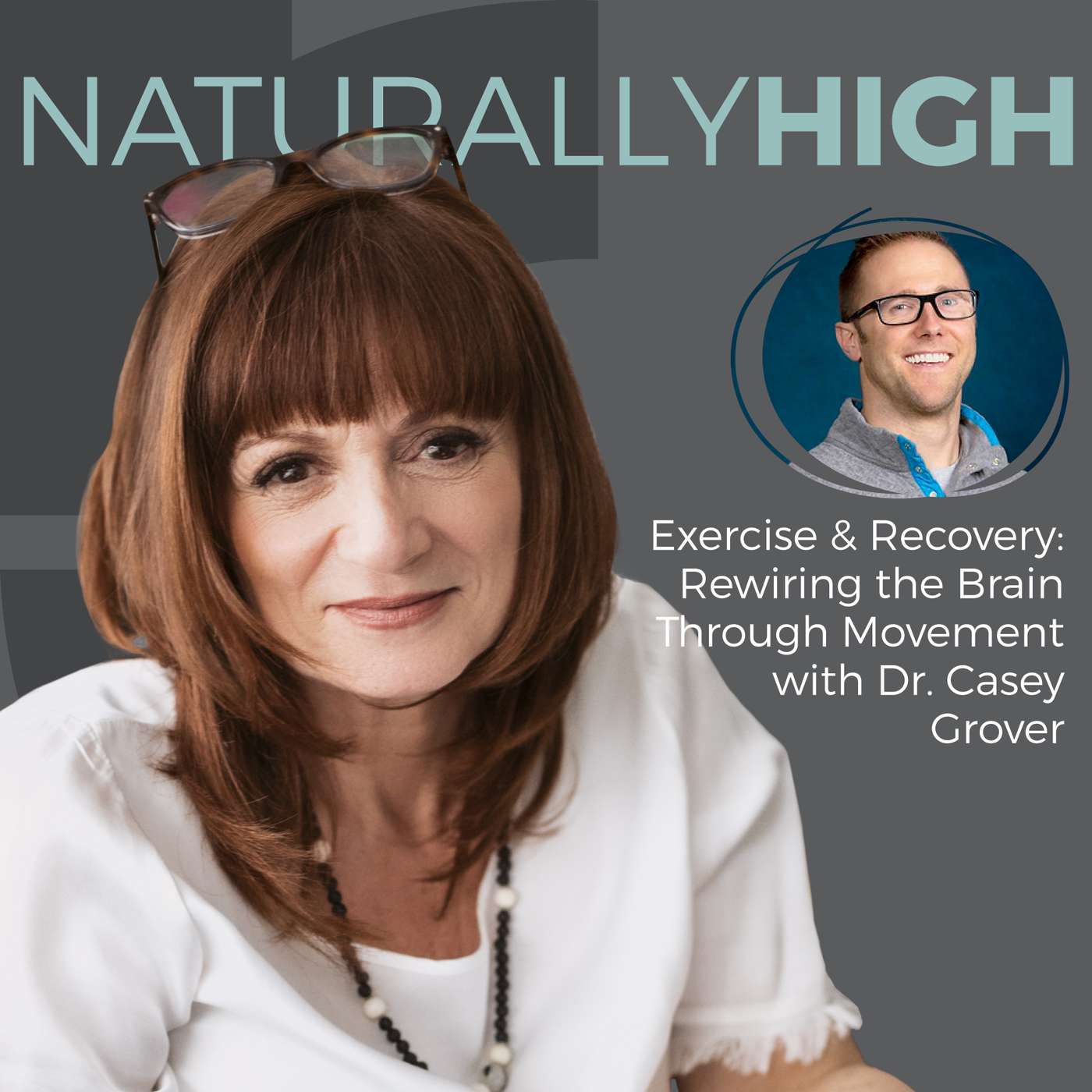
Naturally High · Jeanne Foot
In this energizing episode of Naturally High, Jeanne welcomes addiction medicine specialist Dr. Casey Grover for an inspiring conversation about one of addiction recovery's most underutilized tools: exercise. Drawing on his years of experience in emergency medicine and addiction treatment, Dr. Grover explains why movement is about far more than physical fitness—it is powerful medicine for the recovering brain. Together, Jeanne and Dr. Grover explore how dopamine, movement, and meaningful social connection help restore the brain's natural reward system during addiction recovery, supporting long-term sobriety, resilience, and healing. From CrossFit communities to walking the dog, they remind us that recovery isn't about finding the "perfect" workout—it's about discovering movement that brings joy, fosters connection, and supports sustainable healing. Jeanne and Dr. Grover also discuss identity, belonging, post-acute withdrawal syndrome (PAWS), and why community-based fitness can become a powerful catalyst for long-term recovery. Whether it's joining a recovery-focused fitness group or simply taking a daily walk, every step can help strengthen both physical and emotional well-being. Whether you're newly sober, supporting a loved one, or looking for evidence-based strategies to improve your mental well-being, this episode offers practical insights into how exercise, community, and movement can strengthen addiction recovery, promote brain healing, and help you feel naturally high. In this episode, you'll learn: 02:10 – Why exercise naturally restores dopamine and helps heal the brain during addiction recovery. 02:10 – How addiction disrupts the brain's reward system—and how movement helps repair it. 04:50 – Why positive social connection amplifies the benefits of exercise and boosts the brain's natural dopamine response. 06:56 – The role of belonging, community, and "finding your tribe" in building sustainable recovery. 09:48 – Why CrossFit is one example of recovery-friendly fitness—and why the best exercise is the one that works for you. 11:52 – How to choose movement you genuinely enjoy instead of forcing yourself into exercise. 11:52 – Why even 15 minutes of movement can improve your mood, build confidence, and support lasting recovery. 13:10 – The relationship between movement, stress reduction, nervous system regulation, and getting out of your head. 14:46 – How movement and positive social connection can support healing during post-acute withdrawal syndrome (PAWS). 27:20 – Why recovery is about creating a life filled with purpose, accountability, achievement, and natural rewards instead of substances. About Dr. Casey Grover Dr. Casey Grover is an emergency physician, addiction medicine specialist, and host of the Addiction Medicine Made Easy podcast. Working daily on the front lines of overdose, withdrawal, and addiction treatment, he is committed to modernizing addiction medicine through education, compassionate care, and reducing...
Jeanne: [00:00:06] Hello, everybody, and welcome back to another episode of Naturally High. Today's guest is Doctor Casey Grover, who is the host of the podcast Addiction Medicine Made Easy. Doctor Casey Grover has spent his career on the front lines, first in the emergency department and now in the fight against the addiction crisis. A UCLA medical school graduate who finished in the top three of his class, Doctor Grover trained in emergency medicine at Stanford and spent 14 years in the emergency department, eventually serving as both medical director and chief of staff at a community hospital of the Monterey Peninsula. But is what he kept seeing in the emergency department the same patients, the same crises, the same unmet need that led him to addiction medicine. Today, Doctor Grover runs an outpatient addiction medicine clinic in Monterey, serves as the medical director of residential treatment program, co-founded the nonprofit Central Coast Overdose prevention. And as I mentioned, host the podcast addiction Medicine Made easy his message simple addiction is treatable, recovery is possible, and no one should ever have to navigate it alone. So let's listen up because I think you'll find that we push the edges on this episode like we do on both our episodes for Naturally High and for the addiction medicine made easy. Today I have an incredible guest. I say that always, but they keep getting better. Doctor Casey Grover. We did a podcast together. We've actually I've been on his he's been on ours. And we have some synergy about how we think about some of the pressing issues in addiction medicine. And one of them was shame and stigma, and we've done that. So now we're moving into a lighter subject and that is exercise and recovery. So welcome Doctor Casey. I just wanted I'm so glad you're here. Why exercise. Tell me a bit more. Why would you think exercise. We know we're supposed to pull certain levers like eat properly, go to, you know, right. Nutrition. But why exercise? Tell me a little bit. Casey: [00:02:10] So, John, first of all, it's so great to see you again. And thank you for including me. If this turns out to be a video podcast, you'll see I'm in my car. I am sitting in the parking lot outside juvenile hall in my county, and I am really honored to get to do CrossFit with the young men in juvenile hall this morning. I am a deep, deep, deep believer in the healing power of exercise when it comes to mental health and addiction. So the simplest answer is we are meant to move as human beings, and when we do exercise, it releases the pleasure chemical, dopamine. And with addiction, a lot of what happens is the reward system in the brain gets broken by the substance. So I'll give you an example. So let's say a person drinks alcohol. Their dopamine level goes maybe 2 to 4 times the normal maximum amount. And so what happens is over time, by repeated use of alcohol, they push the brain to release more and more and more dopamine. And eventually the brain runs out and the person feels pretty lousy. Low mood, no energy, even sometimes depressed when they don't have their substance. And when people are trying to get sober, a lot of times their dopamine levels are just so low they don't feel good. And that early period of recovery, there can be a lot of moodiness, a lot of emotion. And what we know is one of the best ways to repair the dopamine reward system in the brain is exercise, because it releases dopamine, and it can retrain the brain to actually feel high naturally, which is obviously the focus of your podcast. And even better, when you do it with people like in CrossFit, that positive human connection amplifies the dopamine release from exercise. So that's what I'm going to do today. Jeanne: [00:03:57] Well, you said a lot of good things here because, you know, not only do we have some brilliant medicine for the soul and for the dopamine system, we also have another social connection that typically is very limited for people in recovery. So talk a little bit more about the social aspect because we're not criticizing one method over another. We're just sort of how can we amp up and how can we take our present levers and amplify them so that people can have more experiences? And social connection is absolutely vital. So tell me about how you integrate both that as well as like this young man is getting like 1 to 1 time with you. Casey: [00:04:39] It's me and like ten guys. Okay, sorry, sorry. Jeanne: [00:04:42] But still, a group is still very powerful because they're all going to experience something as they go through that one hour together, let's just say, right. Casey: [00:04:50] So let's briefly just talk about the brain chemistry behind why exercise feels good and positive social connection feels good. So our brain basically has two priorities. The first is don't die right now. And that is our fight or flight system. So that's anxiety. That's adrenaline. We look around. Is there danger. And if there is, we're ready to fight or we're ready to run. Mhm. When the brain looks around and says we're not going to die this minute. Now it says, how can I live as long as possible? And that's where dopamine comes in. So we are still wired as though we are living in prehistoric times several thousand years ago. It takes thousands of years for our brain to evolve, so we don't know what to do with social media. We don't know what to do with artificial intelligence. We don't know what to do with pornography. It's all so unnatural and our brains have not had time to adapt. So three things naturally release dopamine. And these are things that are associated with human survival in prehistoric times. We needed to eat. That's why food tastes good. We needed to make more humans. That's why sex feels good. And we needed to be in a tightly knit community so we could protect each other. And that's positive social connection. And that's the third release of dopamine. So we are truly wired to live in small villages of maybe 50 or so people and connect with those people because a group protected itself. So we are not wired to interact on Zoom. We are not wired to talk on the phone. We are wired to have positive human connections face to face. And so in CrossFit, it's a branded type of fitness. People come in, there's a prescribed workout, there's usually good music, and people love their tribe. At my CrossFit gym, I absolutely love them. Shout out to Frank, who runs First City Fitness in Monterey. He's been so generous in allowing me to bring my patients to workout at his gym. Jeanne: [00:06:55] Beautiful. Casey: [00:06:56] It's like the 430 class is the 430 class. That's their tribe. The 530 class is the 530 class. That's their tribe. And it's this really cool thing that the fitness, the tiredness, it all feels so much better when you've got people doing it with you and you can fist bump them when you do something well. So again, that tribe mentality is a big part of what I try to do in incorporating fitness into recovery. And again, this morning when I go work out with a young man in juvenile hall, these guys have been incarcerated for a while. And again, that's their tribe. I'm grateful that they welcomed me in to be a part of that so I can teach them some CrossFit. Jeanne: [00:07:33] Beautiful. So what are you noticing? I'm just curious, like you've obviously been doing this for a little bit of time and there must be some feedback or observations. Casey: [00:07:43] Yeah. So I think it comes back to, again, our very primitive brain wiring. Interesting of in versus out. So we are wired again to be in these small villages and to be suspicious of those in the outgroup. That could be another tribe. They could come hurt us again. We're wired to feel like we're in an in-group. And it's really interesting. They've actually done studies. I believe it was a British study. Don't quote me on that, that they put a person on the ground who clearly needed help. It was an actor, and they put that person in a soccer jersey. Obviously in Europe they call it football. So they're a footie jersey. And they found that people were more likely to stop when that team was their team, and people of a rival team were more likely to just kind of walk away. I guess in versus out. It's really core wiring in our brain. So what happens at the gym last night at 530, I showed up my lovely, beautiful, fantastic bride, Doctor Reb Close, one of my colleagues at work. She was there. I was there 3 or 4 people in recovery were there. We see them every week. It's like, hey, great to see you. Can't wait to work out with you. Their smiles. There's that feeling of in that belonging group. Exactly. And that's what I really try to create. And again, we talked about some gyms that have done this. There's reps for Recovery in Reno. It's a community. It's you're in the in group, you're accepted. And that's dopamine. And it encourages people to keep working out, which releases more dopamine and again, helps that healing process from addiction. Jeanne: [00:09:26] I understand exactly why connection and belonging is so important. Do you find that obviously you you're talking about people who have been oppressed, right? Literally, if they've been incarcerated. So are you finding that you can build that trust instantly? Is it an instant thing or something that's slowly requires time? I'm just curious. Casey: [00:09:48] Yeah. So the first is, is let's talk about not the incarcerated setting because that's a little bit different. So going to a CrossFit gym. When you walk in, you kind of get a vibe, like when you walk into a. Jeanne: [00:10:00] Restaurant, I. Casey: [00:10:00] Agree. What's the vibe? And again, kudos to Frank, who runs First City Fitness here in Monterey. It is the most welcoming gym you can walk in and be the fittest person in Monterey County. You can walk in and need to lose 60 pounds. You feel welcome either way. Excellent. And part of what CrossFit is is it's a prescribed workout, but they offer options for those who aren't able to do it so you don't feel like you're a failure, you don't feel like you don't fit in. So again, we did a workout last night. It was kettlebell swings and lunges, and there was a weight suggested for the men. I was able to do that, and the guy next to me just scaled back and dropped the weight. And so the workout was leveled out. And he felt great because he was able to complete the workout at his level. So he again felt in part of the group. And then we all laugh together. We pick the music. Usually the coach is laughing. It's a really collegial, happy, inclusive vibe. And then at the end, you know, you fist bump everybody. You may not know them that well, but you say, great workout. And then there's actually an app where you can track your workouts and you can virtually fist bump somebody if they did a great job from like a biological perspective. We are tapping into that primitive. We need to be in a village with positive human connection vibe. And it's so fun. It just it people feel welcome. And I just am so grateful to be able to create that setting. Jeanne: [00:11:29] So there's a couple of things I wanted to address before we go backwards. I want to move forward. Tell me a little bit about how people see themselves in terms of their identity changing when they step into a gym, as opposed to never, because for some it may be a very new thing to actually start to work towards their own best level of self. What do you notice? Casey: [00:11:52] My approach to fitness and exercise is you have to do what works for you. I agree. My patients are probably laughing because I'm going to give my favorite addiction joke is if a patient came to me and said, Doctor Grover, I put mayonnaise on my left ear, I'm sober. I would say, great, let me go buy you some mayonnaise because it works. So some people come into CrossFit and they're just like, this is not for me. And that's totally okay. They might just like to walk. They might like to paddleboard, they might like to do whatever. But again, it's about that group. One of my patients, she's killing it. She's two and a half years sober. Her AA friends and her like to paddleboard together again. There's that inclusivity. And if people don't like CrossFit, it's okay. But again, what you'll find is that once people start getting into fitness, they can start setting goals, they can see positive changes, and that welcoming environment allows them to come in at whatever level they're at and feel like they can. They can be a part of the team. So for me. I tell people, let's try just 15 minutes of what you like. Is it yoga? Is it boxing? Is it tennis? Is it honestly just walking your dog for 15 minutes? Exercise. I try to have people decide what they like, and I let them do what they feel is right for them. Jeanne: [00:13:10] Do you want an entry point? And it doesn't have to be like, you know, I was thinking about what our discussion today, exercise, exercise can feel like a bit of a stretch for people where we're talking essentially, we're talking about movement like get up and move, because movement also shakes out your physiology and your nervous system. You can down regulate if you're feeling stressed or there's tension built up or you've had just a hard day, which we all are vulnerable to, right? So sometimes just being able to breathe it out, walk it out, just get up from one end and get out of your head by. I always say when someone's in their head is to just get up and move. It doesn't matter where you go. Like you can walk to one end of the house to the other. You'd be better than just sitting and frozen, because people get frozen and locked into that moment, and they can't release themselves from it. And that's where the mind gets a grip on it. So we know this is really good for us and there's so many positives. So we've got obviously positive brain activity. And you know, it's interesting because before and we also have the social component too. But I want to talk about Paws, which, you know, post-acute withdrawal symptom. Right. Because they say that could be 6 to 24 months typically, I don't know, as a medical, I don't know if that's changed as a physician, if you know any more. But what do you typically see? And how does that impact what people are doing? Because people are coming at different levels of sobriety or, you know, some people are maybe very early in their journey and everything feels like, you know, it's a grind where others feel like they're, you know, they're, they're flowing. It's much easier for them. Casey: [00:14:46] So I'm going to make one comment and then I'll answer your question about post-acute withdrawal syndrome. So again, my belief is you have to find exercise that you like. Otherwise it feels like a chore. So again, if it's walking the dog, I'll share. Personally, I am the parent of a 16 year old. She is a fantastic human being, but she just tells me, dad, I do not run so we don't make her run. She does dance, she does gymnastics. We find ways for her to move in a way she likes. I do the same with my patients. Just what do you like? And truly, it. Sometimes for people, it's just walking the dog. And that's great. Now, coming back to post-acute withdrawal syndrome, poorly studied, I had the honor of publishing a paper on it a few years ago, kind of summarizing what we know about it. And the answer is it's poorly studied. We don't have trials on it, and it's largely anecdotal. Jeanne: [00:15:39] They actually teach that in addiction treatment. So there you go. Poorly studied. Casey: [00:15:43] They really don't. On the addiction medicine side. So here's how I describe it to my patients. So a drug has a particular path through your brain. Let's look at opioids. So let's say somebody is using fentanyl. Fentanyl specifically acts at the opioid receptor. But the way I describe it to my patients, it's like throwing a rock into a pond. So the rock pierces the surface of the water. That's the opioid hitting the opiate receptor. But there's ripples. And those ripples affect our dopamine or serotonin or norepinephrine, all those other brain chemicals. The ripple effect from the drug changes them. And so people may get sober, like, let's say a person gets on Suboxone. That opiate receptor is now taken care of, but all those other systems are out of balance. Correct. They don't feel pleasure because of the dopamine. They feel depressed because their serotonin is off. They feel distracted because their norepinephrine is off. People just feel weird. And the way I describe it is your brain needs to figure out which way is up again, and all those other systems need to heal. My experience has been is that the vast majority of symptoms are in the first months of sobriety. And we do kind of a yeah, with my patients when they hit six months, because I tell them a lot of the moodiness, insomnia, anxiety that you've been like, why do I feel so weird? You're past that now. I'm gonna sound like a broken record here, but one of the best ways to heal paws post-acute withdrawal syndrome is exercise, and another one is positive human connection. That's why AA and Na meetings often feel so helpful. Or a group. And again, looking at a group fitness setting, that's a double whammy on trying to heal those brain chemistry systems. Jeanne: [00:17:37] So let's talk about groups settings for a moment. So where are there other opportunities, do you think, in the recovery movement that we could actually, you know, create communities outside of drinking spaces. So we've got fitness, we've got the rooms. What else would you see as a as a really healthy lifestyle alternative for sober people? Casey: [00:18:00] It really depends on the person. What do they like. And some people absolutely love A and n a. And as a physician, you know, a 12 step program works for a couple of reasons. They have a sponsor, so they have someone to reach out to when they're stressed. There's a specific program. People feel lost. What do I do next? You do step one and step two, right? And then the third is, is that there's a community. It's welcoming. You get your chips right when you make an accomplishment that releases dopamine. So when you get your 30 day chip, your brain's firing dopamine. Now, other settings would be if people are spiritual churches can be wonderful, wonderful communities. One of my patients. He's so funny. He's been an atheist his whole life. He's 11 months sober and he just found God, and he is going to church and studying the Bible, and he feels so fulfilled to be able to volunteer at his church. And again, coming back to that in group, he feels accepted. Uh, sports teams can be fun. There's, you know, rec softball leagues and soccer leagues. Uh, some people like book clubs. I have one patient who loves books, so he's in a book club and he sits down with his book club once a week. Sometimes sobriety groups will host events. One of my patients just went to a barbecue hosted by his local AA chapter, and it was wonderful to be able to go out and barbecue and enjoy the sunshine and not have to worry about seeing people drinking. Jeanne: [00:19:29] Perfect. Sounds great. So we know there's a lot of benefits about exercise, right? There's understandable, but we're talking about people who struggle with addiction. And there is always that flip side. And it's not for everybody. But there could be a small minority who fall into that compulsive exercise. Kind of addictive state. Okay, we all call ourselves out, right? It's part of the game. We teach what we know. So talk to me a little bit about that. Like, what are you looking for? Like, and how do you deal with that with people when you, when you see it so overtly in your face? Casey: [00:20:04] So I'll just share a personal story and I'll talk about how exercise, I truly believe, saved my life. Um, so I grew up here in Monterey County. I went off to UCLA. I'm very proud of my alma mater, go Bruins. And unfortunately, I graduated from high school on a Saturday. And by Monday, my dad was diagnosed with terminal cancer. I'm sorry. And so as I went off to college, I was so lost. Uh, I got straight A's, but on the inside, it was awful. I developed an eating disorder, anorexia and bulimia. I was diagnosed with major depression, I started self-harming, I still have some scars, and I had to find something I could do to channel my negative energy and just to try to feel better. And so I picked up running. And through college, I used to run more miles in a week than hours. I would sleep in a week. And it just, it was a Zen like state. I could clear my head. I could listen to music. I could think through my thoughts. I would not have graduated college without exercise. Now, the problem is, is that's been my predominant coping strategy for most of my adult life. And when we talk about an alcohol use disorder, there are 11 criteria. If you take out the word alcohol and put an exercise, you could call me an exercise use disorder. I'm frequently injured because of how much I exercise. I prioritize exercise. I can't cut down otherwise my mental health falls apart. Yeah, but is it better than me self-harming? Jeanne: [00:21:35] Yeah, absolutely. Casey: [00:21:36] It's almost like if a person goes from an alcohol use disorder to overusing exercise. Think of it as harm reduction. Ultimately, we need to get them more tools. I'm in therapy. I see a therapist once a week. I'm working on emotional self-regulation. I'm working on dealing with the stress of being a doctor. And I find that instead of having to pound out weights, I can just take my dog for a walk and feel okay. So I'm learning to, to, to be more responsible, if you will, with exercise. But absolutely, people with the so-called addictive personality will throw themselves 100% into whatever they're doing. But if it's fentanyl exercise, I pick exercise. Jeanne: [00:22:15] Absolutely. Yeah. I understand the theory of good, better, best, right? Like that makes sense to us. Like is what is the one you can live in? And ultimately, people are just trying to feel more comfortable, right? And there's rather than allowing whatever is going on for you, like, you know, the grief you, you couldn't process at that time. You probably couldn't have got through school if that came forward. Right. So that was a very practical solution for you. But I guess what I'm saying is how can someone Find a more balanced perspective towards some sort of exercise regime when they have those tendencies. What are some of the criteria or what would you say would how it would look like, or what would you suggest or recommend for someone? Casey: [00:22:59] So let's, let's go back to a little bit of fundamentals here. At its core, addiction is people don't like how they feel. Jeanne: [00:23:08] Mhm. Casey: [00:23:08] They want to feel better and they want control over how they feel. And the substance gives them that control. So for me, with exercise, I'll have a stressful day at work. I feel all those negative feelings from a tough day. And I want to feel better and I want control over it. And like you said, Jean, people want to feel better quickly, so exercise works. So I think if people have that addictive personality, it's probably worth following some sort of program to give them specifics. And I'll give you an example. Coming back to CrossFit every day is a prescribed workout. Crossfit involves functional movement, meaning try to move as naturally as possible, high intensity and variable movements. So one day might be legs, the next day might be back, the next day might be chest and core. It varies and it's Monday to Friday or Monday to Saturday, so it incorporates some rest days. So why does AA work for some people? They love the structure. So CrossFit in particular has a very structured workout schedule. A person might decide that they want to join a gym and they want to do Zumba. Cool. Sign up for the Zumba classes and on the days they're in class, pick something you can do that's easier on your body. Again, walking the dog is a great example. So again, I think really what people need is structure. And finding a structured exercise program can be really helpful. Jeanne: [00:24:34] And I think you bring up an important component. Like for me, I work out, I work out with a trainer and I work out in a gym. But the people I know who have a social component to it, like going to CrossFit and being part of like the Monday, Wednesday, Friday class or whatever the classes are, right? Some sort of regime or regular schedule there. I don't want to say the word addicted, but they're almost addicted. They really, truly love it. So it's almost what I'm seeing is the social component is kind of the it's a built in accountability. Because if you're not there, somebody's going to say, hey, where were you Friday? I didn't see you Friday morning. Like, what's going on? Are you okay? Right. So I think that's an important component apart from it actually feels good because we're all working collectively together to do something that's really good for us. And we're going from our attic identities to I'm a person who looks after my body and takes care of myself, so that you're just shedding your identity altogether by indulging in something that's so good for you. Can you just talk a little bit about that? What you see emerge as you see people who are really committed and some of the transformations you've probably witnessed, right? Casey: [00:25:45] Yeah. Let's come back to the accountability part. So a lot of helping people recover from addiction is to try to get back to understanding how to live like an adult. So a lot of my patients have been homeless. They've been in and out of rehab. They've been in and out of jail. They don't know how to use Microsoft Excel. They don't know what compound interest and investing is. They don't know a lot of these things. And setting goals and trying to achieve them is very helpful. Accountability and learning to be accountable is a part of that transition. Makes sense. So in jail, they tell you what to do when you're homeless, there are no rules. Once you try to get sober and try to build and grow and be able to get a job and live independently again, that accountability has to happen. I have an appointment at 10 a.m.. I'm going to be there at 10 a.m.. So why does AA work? There's accountability. There's a local group here in Monterey County called rats. One of my staff in my office goes, and you actually sign an agreement to be accountable to join the group. And they will call you out if you. Wow. Now, CrossFit is the same way. We literally text each other like, hey, you didn't come last night. What's up? Or at the workout be like, hey, it was a great workout last night. Where were you? If that feels like an obligation and is a stressor, that might not be a good fit for someone, but for someone who can take that as, hey, I miss you, come work out with me. It's going to be fun. You're part of the group. Casey: [00:27:20] That positive accountability can be really helpful. Now, to come back to your question with identity. People want to be able to see incremental positive change. When we set goals and achieve them again, I sound like a broken record, but that's the dopamine. I also do with my family Tae Kwon Do, and I actually believe martial arts are uniquely suited to help people with addiction, learn accountability, keep accountability, improve their accountability, and set goals. Why I do taekwondo the way it works is you start as a white belt. You know absolutely nothing. We line up in the class, you're dead last and after three months, if you learn your forms and your self-defense and the white belt kick and you break a board when you test, the dopamine goes off as you're given your yellow belt. When you get the yellow belt, you have to learn a form. You get one stripe on your belt. After a month, you learn the next form. You get a little stripe on your belt. You outrank the yellow belt that's brand new. You're moving up in the class, and then you set that goal. I'm going to get my orange belt. You learn the forms, you learn the kicks, you have the test, you break the board, dopamine goes off and you earn your orange belt. And so it continues. And so I actually feel like that goal setting and accountability of I've got class, I have to learn this, I have to practice. And guess what? Now I'm a green belt. And that learning and growing is really uniquely suited to help people with addiction, set those goals, achieve them. And then the dopamine kind of fuels it all. Jeanne: [00:28:57] Amazing. It's just amazing how many ways there are to get better. And they're so obvious and we don't even think about it, but they can have tremendous impact. So talking about impact, what is the person who hired you or allowed these gentlemen to go with you to this program? What are they noticing? What is the correction saying to you about the difference in these men or some of the feedback from management around that? I'm just curious. Casey: [00:29:26] So this is I have to be very honest, I'm still very green. Last week was my first week with the men in juvenile hall. This will be my second week. I have a very unique position being a physician who loves fitness and is certified as a CrossFit coach. So last week when I worked out with the young men, they had just done a half marathon, so I was told to take it easy on them. And I literally just helped them stretch. And it was really funny because I show in I've got my nonprofit t shirt on, they have no idea who I am. And I started helping them stretch and they're like, what do you know about stretching? And I literally said, it's okay, I'm a doctor. And they were like, what are you doing here? So it was fun. We stretched together and then they wanted to do some upper body stuff because their lower bodies were resting. And I showed them some of the CrossFit moves, and they really thought it was cool that I could teach them, and I could also do it myself. The other gentleman that goes with me to the juvenile hall, his name is Mike. He's a former power lifter and he's in recovery. And his lived experience allows him to connect with those young men differently. He's been to jail. I have not he's in recovery. I've never dealt with that. Casey: [00:30:36] And so as kind of a one two punch. They see his physique and want to learn from him. They know I'm a physician and I love fitness, and they can see the moves that I'm teaching them, and they really connected with that. So they asked me, Doctor Grover, can you help us get more stuff? So I bought some sandbags and some yoga mats. Can we have music? So I bought a little stereo and we're gonna see what they want to do today. They're just little sponges. They come up to me like, what should I be eating? And is the workout I'm doing okay? They're very lost young men. Many of them have been incarcerated for five or more years, and I'm really hoping to inspire them to incorporate fitness into their lives after they complete their sentence. And I'll tell you a brief story about one of my other patients. I'm not going to give his name because for anonymity, privacy reasons. But I have been taking care of him as drug of choice as methamphetamine. And I kept telling him like, hey, come work out with me. It's going to be fun. And he had identified as being someone who wanted to be fed. So I brought him to the first workout at the gym. He was one day off of meth. He was out of breath. He couldn't keep up. Casey: [00:31:46] He cramped up and he said, doc, I got to go to residential. So he went to residential treatment. He finally was able to get off methamphetamine, and we hosted a five K here in Monterey County to support recovery. And he won. He took first place and he was so proud. And once that clicked that yes, I can achieve, I can get stronger. I can get better. That started to allow him to goal set. And so he started to come to CrossFit more regularly. And I just saw him yesterday, and we crowdfunded for him to be able to take a course to become a CrossFit coach. He's 11 months sober. He is so competitive at the gym, he's like, I'm gonna do better than you. And not in a mean way, but he's goal setting. He he wants to set that goal and achieve. And I'm really hoping that he's going to be able to be a CrossFit coach. And the only reason I say I'm hoping is because he just got a job offer, and he's going to have to make his schedule work. Between working his day job and coaching CrossFit. And for him, he told me yesterday, fitness is the core of my recovery. I want my body to be able to do certain things because it helps me stay sober, and being sober helps my body and it just. Jeanne: [00:32:59] And your mind, right? I think a lot of them feel that impact. Like, firstly, I want to thank you for your vulnerability, your relentless passion to serve a very marginalized group of people. And that takes tremendous courage. And it's like walking against the tide or swimming against the tide, I should say. So I want to just acknowledge that. But I think more importantly, what you do is you hold a vision for this gentleman like you have for other young men in the group of what what is possible. Nobody's ever had a vision for them beyond their derogatory self, which has landed them in the place that they've landed in. And it's usually through no fault of their own sometimes, but usually it's just they've had horrendous childhoods and adversity at a very young age, and everybody was doing the best they can. And that's really defined the trajectory of the path they're on. And then along comes you. Who says, I'm going to hold a mirror up of who you really are, not who you think you are, but who you really are. And then you show them what it takes, which is a little bit of determination, consistency, and grit. Jeanne: [00:34:10] Okay. That this is what you can be if you just stay with the, you know, the daily regime. And so you're transforming lives. And that is just truly amazing. And I just really want to acknowledge you because all it does is take one person to believe in somebody to really change that. And probably for these gentlemen, they haven't had much connection of that in the past. Jeanne: [00:34:37] Thank you for joining me for this episode of Naturally High. If this conversation resonated with you, I'd love to hear your thoughts. Please leave a rating and review on Apple Podcasts or Spotify, or reach out to me through the links in the show notes. Together, we're changing the way the world approaches mental health, addiction, and trauma. Remember to like, subscribe and leave a rating for Naturally High on Spotify, Apple Podcasts, or wherever you listen so you never miss an episode. For more inspiration and resources, follow me on Instagram @therecovery_concierge or visit therecoveryconcierge.com. Stay empowered, keep rising, and I'll see you in the next episode.