
Montessoripodden · Montessoripodden
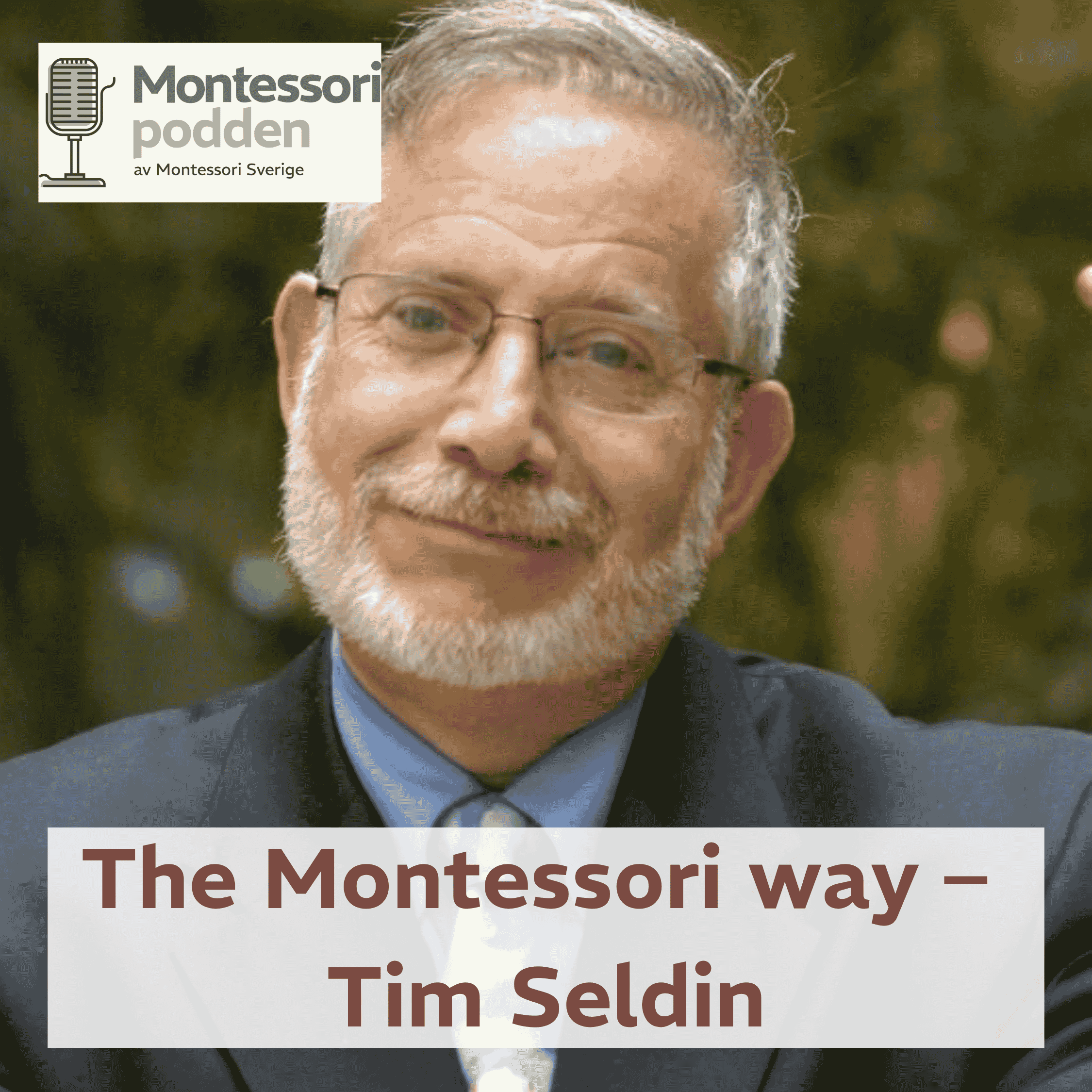
Tim Seldin har arbetat med Montessori i mer än 50 år, som lärare, skolledare, lärarutbildare och författare. Han är också en välkänd profil inom den internationella Montessorirörelsen. I det här avsnittet pratar vi med utgångspunkt i den nya, reviderade upplagan av hans bok The Montessori Way. Men samtalet kommer att handla om mycket mer än boken. Tim berättar om sin egen väg in i Montessori och om hur Montessorirörelsen har förändrats under de år han varit verksam. Vi pratar bland annat om klassstorlek och varför färre barn och fler vuxna inte alltid är en fördel i en Montessorimiljö. Vi pratar också om vad som egentligen krävs för att en verksamhet ska kunna kalla sig Montessori, om gamla motsättningar inom rörelsen, om forskning och om vad Tim ser som de stora utmaningarna framåt. Och vad ger honom hopp efter mer än 50 år inom Montessori? Montessoripodden görs av Montessori förskolor och skolor i Sverige AB.
Maria: Welcome to Montessori-podden. today's episode, I Tim Seldin, has more than 50 years of experience of Montessori as a teacher, school leader, author and international profile. starting point for our conversation is the newly revised edition of The Montessori Way. But we also about Tim's own path into Montessori, about class play, about the role about what is really the famous Montessori activity. and how movement has changed in last five decades. And so we by looking forward. What worries Tim with Montessori today? And what gives him hope? My name is Maria Chakri and the Montessori podcast is made by Montessori preschools and schools in Sweden and the Enjoy! Okay, for many families around the world, How to Raise an Amazing Child the Montessori Way became the first introduction to Montessori. It was practical, accessible and clearly directed to parents. And now, more than two decades later, we have a new edition called The Montessori Way. And this title is broader, more philosophical and perhaps more ambitious. and it suggests not only a way of raising children, but a way of understanding education and human development. So... I'm speaking today with Tim Seldin. You have more than 50 years of Montessori education as a teacher, school leader, author and international spokesperson. And today I would like to explore what has changed, what has remained and who this new book is really for. Welcome, Tim. USB: Thank you. Well, first off, the the book that you mentioned that you saw first, that many parents have seen, is How to Raise an Amazing Child. And I remember when DK Press approached me back in gosh, 2002, I think about that one. Esther Ripley, who I knew as a monastery teacher trainer with the St. Nicholas Society, was my editor. We had a great time writing that book and thinking about monastery in the home and getting the right pictures. It was quite quite a project. That is now in its third edition. There's a brand new edition that just Maria: Yeah. USB: came out. And it has been translated into many languages. The other book that you mentioned, The Monastery Way, was actually published by the Monastery Foundation back in 2003. and that edition eventually was replaced by this new edition. So it's really the second edition of an older book. And it is intended for a very different audience. I think of the monastery way as a tabletop book for someone who is serious about wanting to understand monastery education as a way of life and a way of education. At first off, the big picture, you know, how it all began and what are the core beliefs behind it, and what are the principles that define a what I would call a fully implemented monastery program. And then I look at each of the age levels, beginning with early childhood, age three to six, the children's house or Casa de Bambini, which most people that's usually their first experience. the Nido or the infant toddler Montessori is actually newer. it evolved in Italy. And I think it's been very, very important. I actually went to a a sort of a prototype of that when I was a little baby. and I went to Montessori from age one through the 12th grade or through graduation to university. But the the book go, yeah, I guess so. Maria: So you're a Montessori through and through. USB: You know, I must say my parents, when I was a kid ran the Barrie school that I attended, they never talked about Montessori. when I was a child in the 40s and 50s, 60s, Montessori was almost unknown in the United States. So very few people ever spoke about it. certainly my mother, who later turned out to have taken a course in monastery education, she didn't think of herself as a monastery educator. even though our school went from infants through the twelfth grade. And it absolutely followed most of the core principles. The big thing that I remember is when I was a child, we had the multi-year classes, we had the hands full on learning, we we raised the chickens and the horses and you know, cooked and did all kinds of practical skills. We hiked, we we learned to row boats and canoe and and hike and camp, all those things. But they didn't call it Montessori and I didn't have all the Montessori materials. So we had we had some, but I would say more of what we worked with was things that could be made by us quite often or by our teachers. rather than materials coming from Europe. Because I remember when I became headmaster of the Barrie School in 1971, I ordered the first order of monitoring materials from Amsterdam. And it took four or five months to arrive. It was a big deal to go to Baltimore and and unpack the crates and so forth. But we we just didn't have them. We we made do with other things. Maria: Going back to those early days, this is one of my first questions. You have worked in Montessori education for over 50 years. How did your journey begin? Well, apart from being a Montessori child, obviously, but how did you then come into Montessori? USB: Well, again, I would have never called myself a Montessori child. So as the years went by, I heard Montessori, it was not normally talked about. books about Montessori were not readily available. They were not in my mother's library that I could see. And I I was a kid. I I didn't care. when I went to university, in my last year, I was in a graduate seminar with someone who turned out to be a Montessori school principal. Man by the name of Gilbert Giuliani. And we were in this seminar in international relations. And I don't know why, but he kept bringing up the name Montessori, which perked my interest. I I said to him after class, you know, hi, I'm Tim Selden. Can you tell me you keep mentioning the word Montessori? What is that? I've heard that before. And he told me and he asked me who I was, and I said who I was. And he said, you're Francis Selden's son. And I said, You know my mother? He said, Yeah, I run another school in the area. I run the Potomac Monastery School. He took me to his school one day that week. We drove out, and it looked just like my mother's school, you know, the horses and the animals and all this. It was very much like my mother's school, except all the beautiful monastery materials. And the long and short of it, Mr. Giuliani became my friend. He became my mentor. He was the one that helped me bring it in. And when my mother passed away, and I became the head of school. I decided to make it officially Montessori, which is quite the journey. Anyway, that's part of how it began. I never intended to be an educator. I intended to be a lawyer or a psychologist. By this time in my education, I was more interested in psychology. I was teaching part-time in my mother's school, as many children who have parents that have a school. You know, as you're if you're good, you work in the summer camp and you maybe you you do. some things when you're not in college classes, because I was in the same city. And you know, I was teaching classes in the high school and I was doing the same kinds of things with these students that I had when I was a student there, which is taking them out into Washington, DC to see things really happening in the real world, you know, going to to the Congress and going to the White House and going to the museums, not just sitting there talking at them, but rather asking questions rather than giving them answers. and so when when actually what happened was when Martin Luther King was shot in 68, I was in graduate school and my mother called me and said, Can you please drive to the Washington DC campus? Because in those days we had two camps, one out in Maryland where she lived. And can you make sure it's okay? Cause I understand that there's rioting. And there was burning and really bad things were happening. Many, many buildings were burnt. And I I drove up, I was a little sports car with a great big Saint Bernard dog in the top town. And I was wearing a suit, which was sort of my my typical in those days. And this these it was the school was three city blocks. It was surrounded by African American men for the most part. And they're all pointed outwards. They had baseball bats and axes. And this gentleman comes up to me and says, Are you Francis Selden's son? I said, Yes, sir. And he said, Get up the hill, get that stupid car out of here before it gets burned. Get out of those clothes, get that big dog down here and help us. And for the next three days, I basically I stayed with these people and with the dog, and we chased off kids who would have burned down the school. And in those three days, I heard from these people who were. fathers or uncles of students in the school, because my mother was completely integrated right from the beginning. And in those days, Washington, DC was strictly segregated. our school was was very integrated compared to most schools of the day. And these were people who were protecting the school because they lived in the neighborhood and they They valued it because of the way they had been treated and and supported and educated. And at the end of those three days, I called my mother up and I said, Okay, you you always wanted me to work with you. tell me what you want me to do on yours. And that's that's how it happened. Maria: And about 20 years ago or so, as I understand it, you wrote both books, How to Raise an Amazing Child, but also the first edition of The Montessori Way. You wrote the more or less contemporary, right? USB: Yes, well, I mean, by the time I I was running the Barrie School from 1971 to 1993. it was a very big school. It was a school I went to, my mother's school. and I had become a leader in the monastery community in the United States. I was running teacher training at the Institute for Advanced Montessori Studies. I Had written other books, but they were aimed at teachers. and we were doing a lot of work on parent education and and again, teacher education. So in 1993, I felt that the best thing I could do with the rest of my life was not to run one school, but to sell the school to the parents and to create something that we call the Monastery Foundation, which is essentially an international. school consulting group that helps monastery schools around the world, mostly in North America and South America and Asia, rarely in in Europe because you have other people who do that work there. But we, you know, I I've written books, I continue to be involved with teacher education. I've spoken at international conferences all over the world, although rarely in Europe, usually UK, but never never any European country other than recently I was asked to go to Georgia, the the Republic of Georgia. But usually my friends, Dr. Paul Epstein, who was one of my co-authors of the Montessori Way, he's had many more invitations to Europe. And my my stepson, Dr. Robin Howe, has also spoken to Montessori Europe, I I believe, in Sweden, just a a summer ago. But Basically, yes, I've been involved in articulating Montessori, running international conferences, working in Australia, New Zealand, United States, Canada, South Africa, Iraq of all places. We've done a lot of work in Iraq. and yes, we wrote the book basically to try to make Montessori accessible to people who didn't understand it. And one of the reasons I wrote the Montessori Way. Is it's a typical book explaining Montessori. The ones I had read were written by people either by Maria Montessori or Claude Claremont or, you know, people like you know, you know, the the many, many other people who had attempted to articulate Montessori, but they had no pictures. So, you know, Paulopoeck Lillard was writing prolifically when I was starting. And there would usually be, you know, several pages of black and white photographs. I thought nobody is really explaining Montessori in a way that not only a parent might get a glimpse. I mean, the closest thing to was Aileen Wolfe's Parent's Guide to the Montessori Classroom, which was Maria: All USB: a very good, very good book. But it didn't really go into depth. It was meant to just help a parent to have some idea of what Montessori materials their child was working with. and I felt there needed to be something that would go from infants through high school. And talk about the big picture of how monastery began and how it worked and monastery at every age level. And that that's how Maria: So who is the primary reader you had in mind when you wrote The Montessori Way? USB: A parent who is really dedicated, somebody who really wanted to understand monastery like a college professor, a student of education, or it's used in many, many training programs around the world as the very first book to begin the monastery journey when you're preparing a monastery teacher. Maria: Should Montessori teachers read it? USB: absolutely. It's a great gift for it's a great gift because the typical monastery educator is trained at one age level. And this is intended to give them a better glimpse of how monastery evolves at different age levels. Maria: And so the primary reader is basically a parent and a teacher with no prior knowledge basically to Montessori, but also maybe those who wants to have a little bit more accessible information. USB: Yes, a a a educator in Holland or the United Kingdom or Sweden who has heard of Montessori, would like to get a better understanding of it, doesn't intend to become a Montessori educator necessarily. They just want to understand it. It's a great book for that. Maria: What's the biggest difference you think from this book and the other one, How to Raise an Amazing Child, the Montessori Way, because the titles are similar. What's the biggest difference? USB: Yes, well, the how to raise how to raise an amazing child is the real title, the first one you mentioned. the monastery way is a subtitle. and they and they did that because I have written the monastery way earlier. but the answer is that the monastery way is written to talk about monastery mostly in a school setting. We do talk about the home, but that's just one chapter out of many. Whereas how to raise an amazing child is really about how do you raise a child from infancy through age five. and it's all about the home environment and going out into the city. There's another book you haven't mentioned, Maria, called Monastery for Every Family, which is which is a companion to How to Raise an Amazing Child. And that talks about family life. That's about the relationship between the parents and how to to make traditions and travel with children, so forth. And it's not as heavily illustrated. Maria: And they are primarily for homeschoolers, but basically just for home environment and family. USB: Yes, that's correct. I've never written anything for the homeschooler. First off, because it changes so much. Secondly, because I've never done it myself. Maria: Right. USB: And so I I don't like to write about something I don't really know well. Thirdly, because there are many people who make a living trying to help parents who want to homeschool their child to to figure out how to do it. And usually it does not involve monitoring materials. It's it's basically a very small subset. Of real Messory education. The other thing is, frankly, for me as a Messie educator, I have deep respect for parents who want to educate their child at home, but I don't know what they're doing that really is Montessori. It's just they're just doing homeschooling with a Messieuri taste. And the reason for that is the very definition of Montessori is the liberation of the child. And to do that. Among other things, you not only have to set up autodidactic learning materials and teach children to be independent, you also need to have a large group of children who pretty much run the community themselves. If basically what you've got is a group of brothers and sisters, you know, typically two to five children at the most, I that's very, very different from what happens in a good Montessori environment. Maria: Let's just stay on that topic for a second, because homeschooling obviously is part of that. But also another angle on this subject is the class sizes and the student teacher ratio, because quite often when you have parents visiting a school, prospective parents visiting a school, they will ask a few questions, they have some sort of checklist and they ask questions. And one is usually... concerning class sizes and teacher-student ratio. And I sometimes just ask, may I ask why? Where does this question come from? Because in their mind, the smaller group, the better, the more teachers, the better. And I try to explain to them, not necessarily. What's your take on that discussion? Because that is sort of from a parent point of view, a concern they have. What's your take on this? USB: Absolutely. The the normal parent is looking for ideally a one-on-one tutoring situation. They think that would be best. as you know, in monastery practice, if we can, we would much rather have a class of between 25 and 35 children on the average, divided between, you know, evenly the three ages that are normally in the class. Or in elementary, you could have. more than three. So the original elementary class might have been larger still and might have had six to twelve year olds in the class. I mean it's not like that there's a science to it. You can do a lot of things. But basically what we're trying to do is slow down the number of children that are leaving and and the number of children that are entering the class so we have a class identity and a class culture and deep friendships among the children. So the three-year age range, among other things, seems to be a good model for that because you've got, you know, it doesn't change 50% of the class in one year. It's usually just a third. So the reason why parents do this is they think that the teacher is the source of knowledge. And the larger the number of children, the more likely the class is to be unruly or the lar the more likely. it is that the child won't get any attention. And in a good monastery classroom, the child really doesn't need a lot of teacher time. And it's done very, very strategically in terms of of telling them great stories or asking them questions or asking them what project they're working on next or or observing, documenting what the children are doing so that we have a record of how the children are learning. what the children are learning, how do how do they know what we think they know? I mean many people think if we teach a lesson, the child has learned it, as opposed to we teach a lesson, we try to figure out how does the child really think about this? Do they really understand it? And that requires a a trained observer, someone who understands the principles of I guess we call it constructive diseducation, Piaget's idea of genetic epistemology, you know, asking deep questions about, tell me what you what do you think is going on here and why do you think this is true, as opposed to, can you teach me how to use this Montessori material? Maria: What happens if you think in a Montessori classroom that has Well, not enough children in your opinion. When the class is too small. USB: Well, I mean, think lear learning goes on. I mean, it's not the end of the world. I think a few things happen. You have fewer children to stimulate other children. So you've got a smaller social group. I think if one child chooses to leave or is unhappy or is bored, there's a greater chance that the whole class will start to fray apart. I think also if you've got a child who is for any reason having difficulties emotionally is acting out or being a bully because he's unhappy or maybe he's not feeling well or his parents are arguing, whatever's going on in his life, there's a greater chance that the class will not be able to provide the kind of support that it would if it was larger and it was really run by children. the other thing that we always say is the smaller the number of adults to children, the more likely the adults are gonna interrupt the children's concentration and basically take over. And what we're trying to do is we're trying to help children to learn to do it for themselves as much as they can. Maria: Yeah, the teacher shouldn't be everywhere. USB: Yep. The other thing is, you know, unless the government is paying the bills and is very able to be very generous, what generally happens is monastery teachers, first off, they they require an addition to their university degree, which most people, at least in North America, have before they become a monastery teacher. They also need to take another year or longer of monastery training, and then they often go beyond that. To complete their first their second degree, the master's, and then more and more getting doctorates. these people are well trained. If they if they get injured or ill or retire, it's hard to replace them. And so the cost of having these teachers, of paying them appropriately, is challenging. And if you have a one to ten ratio, it's that much more challenging than if you have. one teacher with 30 children with a good assistant who's paid well, but probably not as well as the as the main teacher. so the economics are yet another issue. Maria: Okay, so getting back to the book at hand right now, The Montessori Way, that it says on the cover, revised and expanded. What has changed in the new edition? USB: Well, some chapters on things like research but basically each chapter was we went through it, we updated it, we expanded it, we I know we added the the chapter on research. There was originally a chapter on special education that was completely rewritten and expanded by Dr. Ann Epstein with with my collaboration. we did a a r a fresh look at Montessori at the secondary level, because again, in the 20 years since we started, many, many more adolescent programs have evolved around the world. so those are some of the ways that we we improved it. Maria: Well, what is, according to you, the most common misunderstanding modern parents have about Montessori? USB: would suppose the most common misunderstanding is first off, in many countries of the world, a monastery school is not a a government school. There are government schools, of course, in various countries. And in other countries, there may be Government subsidies. But the typical parent for most of the history of Montessori, and I think in most places in the world, the parent is choosing to invest, to pay privately to send their child to a monastery school. And that's a big barrier because they're making a serious investment. Number two, unless the parent grew up as a Messie child or has somewhere along the line become very familiar with what it is. their frame of reference is some sort of traditional education. Now, while that can vary from place to place, in general people assume that education is teacher directed. And their fear is that monastery children will not be academically well enough educated to be able to get accepted into either good secondary schools or really good universities. No. On the other hand, usually the monastery children have developed a love of learning and are very trusting of adults and are much more usually much more successful as students than many really hard disciplined students are, because the hard disciplined student is doing it because of guilt or because of a belief that that's the only way they're gonna have a successful career. Whereas the monastery child is usually more likely to actually enjoy creating and doing things and thinking. They they tend to have a, I call them joyful scholars. So I I think that's one of the issues. The other is the parents think that somehow the monastery school is going to be like a traditional school, and they're going to know what lesson the child is going to do this week. And it's going to be, you know, how does my child compare to the other students in the class? Or why do you have You know, these other age groups in the room, why isn't there just one age group? So it depends on what their previous experience is and whether they're familiar with it. If they come from, for example, Poland, where going off to the country for a week at a time for as a school group is is fairly common. At least that part of the idea of going out into the world may not seem so unusual. On the other hand, not learning from textbooks. or teachers standing at the front of the room lecturing may seem weird to them. So again, it you know, we just every parent has their own ideas of what they expect education to be. Maria: But then within the Montessori community, what would be the most common misunderstanding within the community of Montessoriens? USB: That all monastery schools are the same, that all monastery teachers are the same. And they they walk in and they discover that no two monastery schools necessarily are the same. They may, they may have very different policies, procedures. I mean, I see monastery schools where children have to sit in desks all day and where there are no monastery materials and they're just using textbooks and workbooks, but they're calling it Montessori. Maria: You've been in the Montessori field, if you can use that word, for over five decades. How has your own understanding of Montessori evolved over the decades? USB: well, when I first began, the gentleman who was my mentor, Gil Giuliani, was trained by the Association Monasterie International. And he was a bit of a rebel, because in those days AMI was becoming somewhat closed minded and dogmatic and very hostile to the the American Monastery Society, which at that time was give or take around 15 years old or so. So it used to be that if you were an AMI trained teacher and you ever taught at an AMS school, you were blackballed. I I remember at the Barrie School, my shells were natural wood, you know, sh varnished. And I had a an AMI teacher come to visit us and The only thing that she she could say to me was, you know, you're not a real Montessorian because your shelves aren't white. I'm thinking, I'm sorry. Come on, gotta be something better than that. I have a friend in Seattle who's probably becoming known on the internet because she makes these very funny videos. She's called Tiny Cabinet Montessori. her name is Brianna Reddick, and Brianna just recently created a video. In which she basically pretends to, she says, I thought I was a Montessorian, but I guess I'm wrong. And you know, she sort of cries and says, You know, I guess it's all over. And appears on the screen as a a comment from somebody who had seen her video saying, A real Montessorian only has cursive, movable alphabets. And in Brianna's school uses print. She said, I thought I was a real Montessorian, I guess I'm not. And she goes outside and she throws her her diploma in the trash can says, I guess it's all over for me. Maria: It reminds me, that whole scene reminds me so much of Monty Python's Life of Brian, where they discuss the different variations and what something means. it's, Thankfully, I think we've come a little bit further today. We've come closer to some sort of unification and to see that we do it differently, but we have the same goal. But at times, that scene from Life of Brian has been scaringly accurate. USB: Well, again, there are different stories of how it happened, but the reality is that the name Montessori is not copyrighted in most countries. I think it is in Switzerland, but in most countries, anyone theoretically could open a school and run it however they want and call it Montessori. Maria: Yeah, sure. USB: And in the United States, in Canada, in India, in Australia, I mean, we see some pretty weird understandings of Montessori and and so many, many parents will say clearly the monastery educators do not have their act together because they say that this is what they're about, but here's this school doing this, that, the other. So between that and the tendency among monastery educators historically to criticize people who were not from their particular tribe of Montessori. My mother, as I said, was a student of John Dewey's. And John Dewey's movement was called progressive education. And so I remember in 1968, I learned about the Progressive Massary Society out in Seattle. And I thought, boy, these guys must be more modern. turned out they they weren't very organized or a small group. but the idea appealed to me. And then I learned about the American Montessori Society. And, you know, I reached out to them and they they seemed very much part of of the way I saw the world, much more liberal. I found that the American Monastery Society welcomed me in. It was very, very easy to not only find support, but to because we knew a lot, the Barrie School was much bigger than most schools and had a lot to teach and share. And You know, the next thing I knew, I was on the speaker circuit addressing much older people about my understanding of Montessori, which is really just the way I had been taught as a child. So even though it wasn't called Montessori, I just this is what I believe to be true. And it had nothing to do with Montessori. And of course later, as I became trained as a Montessori educator, I blended those two things together. Maria: After more than 50 years then in the movement, what concerns you most about Montessori today? USB: Well, I think it it's the same. I think that we are the victims of our popularity. I think in many parts of the world, monastery is spreading rapidly. I think the understanding of it varies widely from place to place. I think we do need to work together. So if someone thinks they're a monastery educator or running a monastery school, it doesn't do any good to criticize them. But I think that it's increasingly important to try to. To find common ground, to try to encourage schools to do high fidelity monitoring, those to do it right, as opposed to just sort of throw things together and hope it works. I think the other thing is that in many countries of the world, the birth rate is falling. The number of children available to go to these schools is dropping. I mean, we're seeing that. in in many parts of the United States where it's harder and harder to recruit enough children to keep the existing classes full. Maria: We have the same problem since we were this world with the population, the birth rates. USB: Yep. So again, because most schools in the United States are privately funded, they operate like businesses, and only those that are the strongest will survive. So I think that, you know, among other things, there's plenty of children to go around. But again, we've historically only gotten a really small percentage. So what we try to what I try to do at the Monastery Foundation is to help schools to find a way. To find those parents who are really drawn to what they're doing. And they may not understand Montessori, but they know what they like about childhood and what they want for their children. They may just never thought about it. So a lot of my work is not so much to promote Montessori as a brand, but to get parents thinking about how do they really want to raise their children? And that Montessori may be the answer. That they would find very appealing. I think right now we're seeing a lot of movements that are, I would say, child honoring and yet different. For example, Ratio Emilio, or there's a return in the United States to an interest in play-based education, which is just sort of a free form. You know, it'll be okay. They could do real school when they're five. which I think is is a really silly mistake. Or or or or of course there's always an interest in Waldorf, but Reju in particular, it's easy, it's cheap. You know, in a few weeks you can get someone trained to do it. We're also seeing a lot of forest schools now where children are just basically playing outdoors, but they're just usually preschools only. So I think for Montessori, I want to know where the Monaster high schools are. I mean, starting the children off when they're young is great, but it really flourishes as the children get older. So it's very, very critical to me to see as many families as possible choose Montessori, appreciate what their children are doing, and choose to stay with Montessori when most families would normally go elsewhere. Maria: If we look at it from the other angle than about Mottosori today, we talked about what concerns you, but what gives you hope? USB: Monasterians first off are increasingly talking with each other. It's not perfect. I can tell you as one of the leaders for many, many years of a first the American Monastery Society. And then in 1995 or 96, I think it was, I resigned from the American Monastery Society because I really felt it was behaving about as badly as the AMI was originally behaving. And I became much more friendly with AMI, appreciating them for what they were doing really well. I also became friendly with Montessori in the UK, with now I'm not sure I know the politics of Montessori Europe, but Montessori Europe and and the Montessori Association in the UK and so forth. And just realizing there are all these different groups like the Opera Montessori, where you are in Italy, that are you know just all trying to do the best that they can. So I be for me, I became much more mellow, much more willing to talk with people who had different backgrounds in Montessori and were willing to and different understandings. the Pakistani Montessori movement would be an example. and and just try to find again common ground. And at the very least, let's not let's not throw stones at each other. I think the other thing that I have hope for is that. You know, brain research in neuropsychology, neurobiology is absolutely catching up. So we have all these researchers, Steve Hughes being one of the most popular today, but many, many other people around the world, who are doing research that is confirming that Montessori really was onto something, that she was seeing something without the advantage of MRIs and other brain research techniques. And that there really is efficacy in what we do in terms of of maximizing the chance that children will learn well and and be happy. Maria: Here in Europe we have Solange de Venrode, Montessori teacher that became a neuroscience researcher. That is amazing. USB: She is indeed. Solange and I had had done work together through a number of projects. And she is indeed amazing, amazing researcher and very, very important in the work she's doing. United States, we have a whole research network. We have a journal of research in Montory, a lot of interest in what they're calling neuroatypical or neurodivergent children Maria: Hmm. USB: and how to support them. And of course, since the pandemic, many countries are reporting that children's learning and children's ability to attend are compromised because of their experience during those years. I'm wondering how long that's gonna go on. But in other words, I'm not sure today whether it's TikTok or or you know you know, mass media that's causing them to become distracted or whether it's what happened. Maria: I'm not sure. So to wrap this up, if people read your book, the revised version of the Montessori Way, and take away only one central idea, what do you hope that would be? USB: Montessori is much bigger as a movement than they thought. That there's a reason why Montessori schools may look different one from the other, that there is something we call the Messie Way, which is both a a set of unified principles that you could see in any program that calls itself Montessori, whether it's in an orphanage or done with infants or done with Alzheimer's or done with children with special needs. You know, there is that, that it can be done in in human relationships. that there's a monastery. We're seeing a lot of countries drifting to authoritarianism. And we're dealing with crises like what's happening with climate change and the environment and you know the science deniers. That's really scary. And you know, again, we're just trying to say, you know, we've got to have the willing, the people who are willing, need to have a way of resisting this tendency to stop thinking and to sort of shut down and stop reading the news. And understand there's another better way than just getting mad or getting depressed, that there's a way to build a better world. Maria: Well, that's an excellent conclusion, Tim. Thank you for talking to me today. USB: It was my pleasure.